States brace for ‘nearly certain’ Medicaid budget shortfalls amid COVID-19

https://www.healthcaredive.com/news/states-brace-for-nearly-certain-medicaid-budget-shortfalls-amid-covid-19/578120/

Coronavirus updates: Virus reaches all 50 states, stock futures fall

Dive Brief:

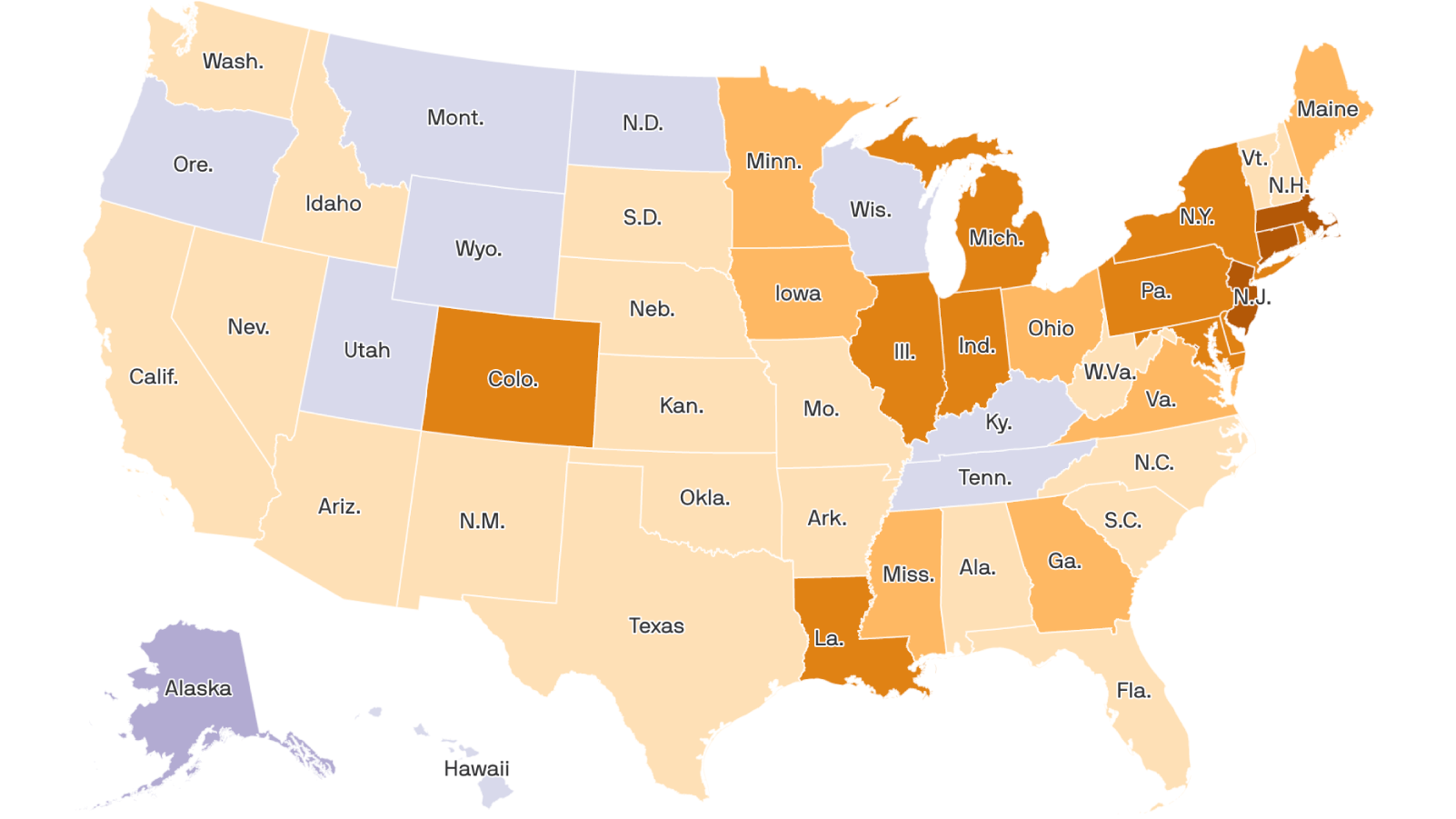
  • Most states with budget projections expect Medicaid shortfalls due to rising spending as more people lose jobs and enroll into the safety net insurance for low-income Americans due to the COVID-19 pandemic, according to a new Kaiser Family Foundation survey.
  • Almost all states with enrollment projections and more than half with spending projections expect program growth to surpass pre-pandemic estimates. Nearly all states anticipate growth will accelerate even more in the 2021 fiscal year, KFF found. As a result of that growth, 17 of 19 states with budget projections report a shortfall is “nearly certain” or “likely” for the upcoming fiscal year.
  • The survey comes as Congress once again considers raising the federal match rate for Medicaid in the $3 trillion Health and Economic Recovery Omnibus Emergency Solutions Act, passed by the House of Representatives on Friday.​

Dive Insight:

Medicaid is often the top line spending item in state budgets, sending states scrambling for ways to reduce spend in the safety net health insurance program, including controversial block grants for funding.

At the start of the 2020 fiscal year, states anticipated modest Medicaid spending growth, and flat enrollment growth due to the strong economy. That forecast quickly shifted as the coronavirus spread in the U.S., which lost some 21 million jobs in April as businesses shutter their doors in compliance with stay-at-home orders, sending the unemployment rate to 15%.  

Because the U.S. generally couples coverage to employment, skyrocketing job loss could make an estimated 17 million people newly eligible for Medicaid and 6 million eligible for subsidies in the Affordable Care Act marketplaces by January 2021.

Medicaid officials from 38 states shared their budget projections with KFF for the survey. States that did not respond were still gathering data about the coronavirus or didn’t have updated enrollment or spending projections for the 2020 or 2021 fiscal years, KFF researchers Robin Rudowitz and Elizabeth Hinton said.

Thirty-two of 34 states with enrollment projections think enrollment will exceed initial projections in 2020, and 30 of 31 states anticipate that growth in 2021 will outpace the current fiscal year.

States are more mixed on spending projections. Over half of states with projections, 18 of 32, expect 2020 Medicaid spending to exceed pre-pandemic estimates. Eight states anticipate no change, and the remaining six project slightly lowered spending due to lower healthcare utilization as non-essential services have largely ground to a halt.

State Medicaid officials are more in lockstep when it comes to 2021 spending projections. Nearly all states with projections — 29 of 30 — think Medicaid spending rates in 2021 will increase over 2020.

Without greater support from the federal government, the survey hints states will face significant spending cuts for Medicaid for the upcoming fiscal year, which begins July 1 for most states. Multiple groups, including the National Governors Association and the National Association of State Medicaid Directors, have called for a higher federal match rate.

One of the first legislative packages designed to mitigate the fallout of COVID-19, the Families First Coronavirus Response Act passed March 18, authorized a 6.2 percentage point increase in the rate for Medicaid if states meet certain requirements. States can’t increase premiums or restrict eligibility standards and must cover COVID-19 testing and treatment without cost-sharing.

The HEROES Act passed by Democrats in the House on Friday would increase the match rate by 14 percentage points from July 1, 2020, through June 30, 2021, along with benchmarking an additional $100 billion for providers.

However, Senate Majority Leader Mitch McConnell, R-Ky., and President Donald Trump have said they’re in no rush to pass another round of legislation adding to the more than $3 trillion Congress has approved so far.



Jay Powell warns US recovery could take until end of 2021

https://www.ft.com/content/2ed602f1-ed11-4221-8d0b-ef85018c96ea

Fed Makes Second Emergency Rate Cut to Zero Due To Coronavirus ...

Fed chair says economy may not fully bounce back until virus vaccine is available.

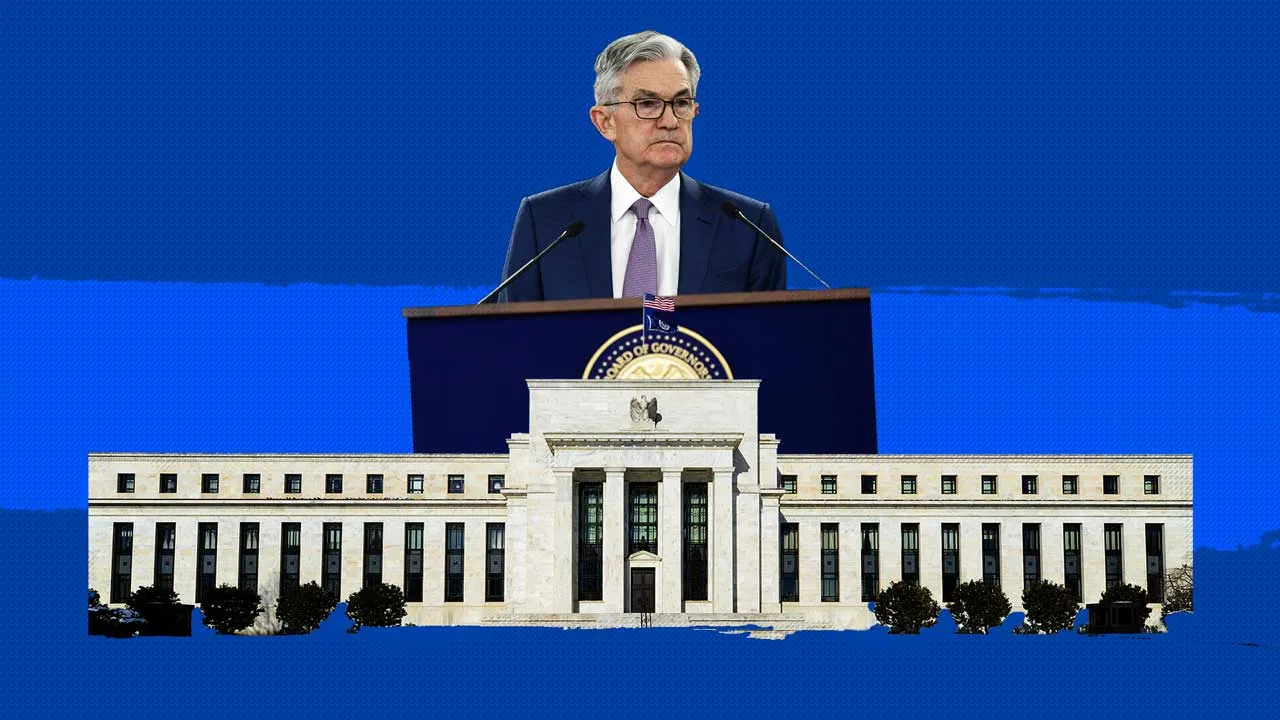
Federal Reserve chair Jay Powell has warned that a full US economic recovery may take until the end of next year and require the development of a Covid-19 vaccine.

“For the economy to fully recover, people will have to be fully confident. And that may have to await the arrival of a vaccine,” Mr Powell told CBS News on Sunday. A full revival would happen, he said, but “it may take a while . . . it could stretch through the end of next year, we really don’t know”.

He added: “Assuming there is not a second wave of the coronavirus, I think you will see the economy recover steadily through the second half of this year.”

Mr Powell told CBS it was likely there would be a “couple more months” of net job losses, with the unemployment rate climbing to as high as 20-25 per cent. But he said it was “good news” that the “overwhelming” majority of those claiming unemployment benefits report themselves as having been laid off temporarily, meaning they are expecting to go back to their old jobs.

Oil prices and stocks in Asia rose on Monday despite the gloomy outlook. West Texas Intermediate, the US crude benchmark, climbed 4.4 per cent to take it above $30 a barrel for the first time in two months. Brent crude, the international benchmark, rose 3.6 per cent to $33.67 a barrel. Japan’s Topix was up 0.4 per cent and China’s CSI 300 index of Shanghai- and Shenzhen-listed stocks added 0.6 per cent.

Donald Trump, US president, said last week that he hoped to have a vaccine ready by the end of 2020. But public health experts, including Anthony Fauci, the head of the US National Institute of Allergy and Infectious Diseases, and Rick Bright, the recently ousted head of the US Biomedical Advanced Research and Development Authority, have warned that the process is likely to take longer.

Dr Fauci, a high-profile member of Mr Trump’s coronavirus task force, has said he expects the search for a vaccine to take at least a year to 18 months. But Dr Bright has said that was too optimistic.

Some world leaders have also raised doubts about the immediate prospects for a vaccine. Giuseppe Conte, prime minister of Italy, said at the weekend that his country could “not afford” to wait for a vaccine, while Boris Johnson, UK prime minister, warned that a vaccine “might not come to fruition” at all.

Mr Powell said that while lawmakers had “done a great deal and done it very quickly”, Congress and the Fed may need to do more “to avoid longer-run damage to the economy”.

The Fed chair said fiscal policies that “help businesses avoid avoidable insolvencies and that do the same for individuals” would position the US economy for a strong recovery post-crisis.

Mr Powell also reiterated his position against using negative interest rates, something Mr Trump has called for. The Fed chair told CBS that the Federal Open Market Committee had eschewed negative interest rates after the last financial crisis in favour of “other tools” such as forward guidance and quantitative easing.

The US Congress has already approved nearly $3tn of economic relief measures intended to support struggling businesses and individuals, but there is growing consensus in Washington that more fiscal stimulus will be needed — even if Democrats and Republicans are divided over how to dole out federal funds.

Late on Friday, the Democrat-controlled House of Representatives passed Nancy Pelosi’s plan for $3tn in new stimulus spending.

Mr Trump has repeatedly called for the next stimulus to include a cut to payroll taxes — deductions for entitlements such as social security and Medicare. Last week, Larry Kudlow, the top White House economic adviser, suggested that lower corporate taxes and looser business regulation should be part of any future relief package.

The Trump administration has taken a more bullish stance on the US economic recovery than Mr Powell, with White House officials repeatedly insisting that the economy will bounce back before the end of the year.

Mr Powell told CBS it was a “reasonable expectation that there will be growth in the second half of the year” but “we won’t get back to where we were by the end of the year”.


AFL-CIO sues feds over coronavirus workplace safety

https://www.axios.com/afl-cio-sues-feds-over-coronavirus-workplace-safety-6de76122-2c75-4f84-92e5-21048c08b44b.html

AFL-CIO sues feds over coronavirus workplace safety - Axios

With states reopening for business and millions of people heading back to work, the nation’s largest labor organization is demanding the federal government do more to protect workers from contracting the coronavirus on the job.

What’s happening: The AFL-CIO, a collection of 55 unions representing 12.5 million workers, says it is suing the federal agency in charge of workplace safety to compel them to create a set of emergency temporary standards for infectious diseases.

Driving the news: The lawsuit against the U.S. Labor Department’s Occupational Safety and Health Administration (OSHA) is expected to be filed on Monday in the U.S. Court of Appeals in Washington, D.C.

  • Citing an urgent threat to “essential” workers and those being called back to work as government-imposed lockdowns are lifted, the AFL-CIO is asking the court to force OSHA to act within 30 days.
  • It wants a rule that would require each employer to evaluate its workplace for the risk of airborne disease transmission and to develop a comprehensive infection control plan that could include social distancing measures, masks and other personal protective equipment and employee training.

The agency has issued guidance, in collaboration with the Centers for Disease Control and Prevention, to protect workers in multiple industries — including dentist offices, nursing homes, manufacturing, meat processing, airlines and retail.

  • But the unions complain these are only recommendations, not requirements, and that mandatory rules should be imposed.
  • OSHA has been considering an infectious disease standard for more than a decade, they note, and has drafted a proposed standard.

U.S. Labor Secretary Eugene Scalia, in a letter to AFL-CIO President Richard Trumka, said employers are already taking steps to protect workers, and that OSHA’s industry-tailored guidelines provide more flexibility than a formal rule for all employers.

Yes, but: OSHA has received more than 3,800 safety complaints related to COVID-19 as of May 4, but it had already close to about 2,200 of them without issuing a single citation, according to the AFL-CIO.

What they’re saying: “It’s truly a sad day in America when working people must sue the organization tasked with protecting our health and safety,” Trumka said.

  • “But we’ve been left no choice. Millions are infected and nearly 90,000 have died, so it’s beyond urgent that action is taken to protect workers who risk our lives daily to respond to this public health emergency.
  • “If the Trump administration refuses to act, we must compel them to.”
  • OSHA could not immediately be reached for comment on the lawsuit.


Most states still aren’t doing enough coronavirus testing

https://www.axios.com/coronavirus-testing-states-still-behind-629973cb-d8ad-4f36-a6fa-d59959fe84a3.html


Most states still aren't doing enough coronavirus testing - Axios


Most states still aren’t doing enough coronavirus testing, especially those that have suffered from larger outbreaks, according to recent testing targets calculated by the Harvard Global Health Institute.

Between the lines: It’s much harder to contain the virus once a lot of people have it — which is why we needed strong social distancing in the first place. But knowing who is infected is the foundation of containment going forward, and most states are still behind.

The big picture: Nationally, the U.S. needs to be doing about 900,000 tests a day, according to the Harvard estimate, which was released earlier this month.

  • But not all states need to be doing the same amount of tests. The goal Harvard suggested for each state — the number of tests they should have done on May 15  was calculated based on the size of its outbreak as of early May.
  • That means that New York needs to be doing a much larger number of tests each day than Wyoming, even after accounting for the states’ huge population discrepancy.

Why it matters: Most states have already begun reopening to some extent, even without key public health tools — like testing and contact tracing — fully built up.

  • That increases the chance that the virus will spread undetected as people begin interacting with one another again.
  • And these premature measures may just increase the number of tests a state needs, especially because the estimates were based on the assumption states would remain closed until May 15.
  • “The moment you relax, the number of cases will start climbing. And therefore, the number of tests you need to keep your society, your state from having large outbreaks will also start climbing,” Harvard’s Ashish Jha warned.


Cartoon – 100% Tax Cut Today

Recruiting. Talent Management | HENRY KOTULA

If the White House is struggling, how will ordinary businesses fare? 

https://mailchi.mp/f4f55b3dcfb3/the-weekly-gist-may-15-2020?e=d1e747d2d8

The RAOI Advisory Opinion: A Transformative Moment or a Bump in ...

In a week that saw reopening activity pick up across the country, drawing even more attention to the need for sufficient testing to give employers and workers confidence in returning to work, a new study from researchers at New York University (NYU) suggested that a widely-hailed rapid testing machine from Abbott Labs may be unreliable.

The Abbott ID NOW COVID-19 test produced false negatives a third of the time using nasopharyngeal swabs, and 48 percent of the time with less-invasive “dry nasal swabs”, according to the study, which has not yet undergone peer review. The five-minute, point-of-care test received emergency use authorization from the Food and Drug Administration (FDA) in late March and has been touted as a “great test” by President Trump, whose White House relies on it to test the President and those around him.

On Thursday, the FDA issued a warning about the potential for false negative results using the Abbott test. The company disputes the findings and sent a list of questions to the NYU researchers for clarification. Meanwhile, two White House staffers—an aide to the President and the Vice President’s press secretary—tested positive for coronavirus, causing the White House to mandate masks for all employees starting this week.

The uncertainty around test results, and the ensuing concern about safety at the White House, provides a foretaste of the difficult road ahead for thousands of employers nationwide as stay-at-home orders are lifted, and companies consider when and how to reopen workplaces.

If the White House is struggling, how will ordinary businesses fare?

US coronavirus update: 1.46M cases, 87K+ confirmed deaths, 10.2M total tests conducted.


Facing a reckoning on physician compensation?

https://mailchi.mp/f4f55b3dcfb3/the-weekly-gist-may-15-2020?e=d1e747d2d8

Doctor salaries have shot up 30% in past decade over fears of ...

As health systems take tentative steps to resume non-emergent procedures and office visits, it’s increasingly clear that volume will not quickly return to pre-COVID levels. According to a health system chief physician executive we spoke with this week, this has forced medical group leadership to reevaluate physician compensation, at least for the rest of 2020.

“We’ve kept our doctors pretty much whole for the past three months,” she said, “but given the losses we’re facing for the rest of the year, we can’t keep it up much longer.” We’ve had a flurry of calls in the past two weeks with systems in the same position. Most of their doctors are primarily paid based on their productivity. “We all loved the upside opportunity,” mused one physician leader, “but we never thought something could happen that would completely wipe us out.”

This point got us wondering whether we might be seeing the beginning of the end of RVU-based physician compensation, as physicians seek greater stability and safety. But moving to a salary-driven model is far from easy. How much upside are doctors willing to trade off for security? The survey data used to benchmark compensation, based on last year’s business model, is essentially irrelevant—and likely will be for next year as well. According to one consultant, “Given that there’s no consistency in volume or compensation strategy, the 2020 data will be garbage, too.” Not to mention, dramatically shifting the way doctors are paid has huge cultural and operational ramifications.

There are no easy answers, but we think this conversation about the future of compensation, and the larger issues it raises about doctors’ relationship to, and role in, the health system, is long overdue. One executive shared his system’s plan to pay their doctors 85 percent of their 2019 compensation through the summer. He’s not sure yet what the other side of August looks like. “Maybe we’ll have physicians who want to continue to be paid on productivity like a car salesman. But if you want that kind of upside now, the safety net likely won’t be there the next time.” However, he hopes this experience “provides a reset point that gets us to a more sustainable—and professional—way of working together for the future.”  


Quantifying the massive blow to hospital volumes

https://mailchi.mp/f4f55b3dcfb3/the-weekly-gist-may-15-2020?e=d1e747d2d8

Even after hearing dozens of reports from health systems about how steep their COVID-related volume losses have been, we were still floored by this analysis from healthcare analytics firm Strata Decision Technology, documenting a 55 percent drop in patients seeking hospital care across the country.

The report, which analyzed data from 228 hospitals in 51 health systems across 40 states, found that no clinical service line was immune from steep volume losses. The graphic below shows volume loss by service line in March-April 2020 compared to the same period in 2019.

Unsurprisingly, ophthalmology, gynecology, ortho/spine and ENT—all specialties with a high portion of elective cases, and heavily dependent on procedures—saw volume declines of greater than 70 percent. But even obstetrics and neonatology (which we expected to be “pandemic proof”) and infectious disease (which we thought might be busier in the throes of COVID-19) saw losses of 20-30 percent.

Looking at specific procedures, complex elective surgeries like spinal fusion and hip and knee replacements were almost completely obliterated. Precipitous declines in encounters for chronic diseases like coronary heart disease and diabetes (down 75 and 67 percent, respectively) and cancer screenings (a 55 percent decline in breast health and a 37 percent decline in cancer care overall) point to the likelihood of worrisome disease exacerbations, and a future full of more complex patients.

The volume losses, plus a 114 percent rise in uninsured patients, led to average two-week losses of $26.5M per health system across the study’s cohort. Strata will continue to track and publish volume changes, but this early snapshot paints a bleak picture of staggering financial hits, and “lost” patient care that will carry lasting ramifications for the health of communities nationwide.


Putting a pillar of the community in jeopardy

https://mailchi.mp/f4f55b3dcfb3/the-weekly-gist-may-15-2020?e=d1e747d2d8

Pillars of the Community - New York Improv Teams

It’s easy to become numb to the numbers we’re bombarded with on a daily basis—case counts, deaths, financial losses, unemployment claims, bailout funding. An article from the Washington Post this week put a very human face on how the coronavirus crisis is playing out on the ground, profiling the experience of 115-bed Griffin Hospital in Derby, CT.

We first got to know Griffin, and its CEO Patrick Charmel, years ago in the course of work for our former employer. It’s a remarkable, fiercely independent organization—recognized as the flagship hospital of the “Planetree” patient-centered care model, and a decade-long fixture on Fortune’s list of Top 100 Best Companies to Work For. But the COVID-19 wave hit Griffin hard, as it did much of Connecticut.

With the high cost of caring for COVID patients, and lost revenue from cancelled procedures, Griffin has had to make hard decisions about furloughing and redeploying staff—incredibly difficult for a small facility that has been a pillar of the community for a century. Charmel has been able to secure some relief in the form of advance payment from Medicare, but his efforts to lobby for a share of the state’s allocation of CARES Act grant funding for hospitals proved unsuccessful, and so the future of the hospital—or at least its continued viability as an independent organization—is in jeopardy.

In the words of Griffin’s chief financial officer, “This could be devastating for us.” As the recovery begins, and questions begin to be asked about the billions of dollars of “bailouts” paid to “greedy hospitals”—an easy narrative for the media to latch onto—it’s worth remembering what’s happening to Griffin Hospital, and to hundreds of other similar organizations across the country.

Countless communities rely on these hospitals, and their survival is worth safeguarding.