GOP Rep. Gohmert—Who Shunned Masks—Reportedly Tests Positive For Coronavirus

https://www.forbes.com/sites/carlieporterfield/2020/07/29/gop-rep-gohmert-who-shunned-masks-reportedly-tests-positive-for-coronavirus/#2a9eaa2e393f

GOP Rep. Gohmert—Who Shunned Masks—Reportedly Tests Positive For ...

TOPLINE

A Republican congressman from Texas who said last month that he doesn’t wear a mask on the House floor because he doesn’t have Covid-19 tested positive for the virus Wednesday, according to a Politico report citing anonymous sources.


KEY FACTS

Rep. Louie Gohmert was reportedly diagnosed Wednesday morning during routine White House testing, required because he was slated to travel to Texas with President Donald Trump later in the day, Politico reported. 

Gohmert has been seen not wearing his mask on the floor, and told CNN in June it’s because he is tested often enough to be aware of his status.

“I keep being tested and I don’t have it,” he told CNN last month. “So I’m not afraid of you, but if I get it I’ll wear a mask.”

Gohmert was present at the House for Tuesday’s Attorney General Bill Barr hearings without a mask.


KEY BACKGROUND

According to media reports, Gohmert is at least the eighth member of Congress to have been infected with the virus that has also been detected in more than 4.3 million Americans. Gohmert’s state, Texas, has been one of the worst-hit in the union.


What it’s like to be a nurse after 6 months of COVID-19 response

https://www.healthcaredive.com/news/what-its-like-to-be-a-nurse-6-months-coronavirus/581709/

Those on the front lines of the fight against the novel coronavirus worry about keeping themselves, their families and their patients safe.

That’s especially true for nurses seeking the reprieve of their hospitals returning to normal operations sometime this year. Many in the South and West are now treating ICUs full of COVID-19 patients they hoped would never arrive in their states, largely spared from spring’s first wave.

And like many other essential workers, those in healthcare are falling ill and dying from COVID-19. The total number of nurses stricken by the virus is still unclear, though the Centers for Disease Control and Prevention has reported 106,180 cases and 552 deaths among healthcare workers. That’s almost certainly an undercount.

National Nurses United, the country’s largest nurses union, told Healthcare Dive it has counted 165 nurse deaths from COVID-19 and an additional 1,060 healthcare worker deaths.

Safety concerns have ignited union activity among healthcare workers during the pandemic, and also given them an opportunity to punctuate labor issues that aren’t new, like nurse-patient ratios, adequate pay and racial equality.

At the same time, the hospitals they work for are facing some of their worst years yet financially, after months of delayed elective procedures and depleted volumes that analysts predict will continue through the year. Many have instituted furloughs and layoffs or other workforce reduction measures.

Healthcare Dive had in-depth conversations with three nurses to get a clearer picture of how they’re faring amid the once-in-a-century pandemic. Here’s what they said.

Elizabeth Lalasz, registered nurse, John H. Stroger Hospital in Chicago

Elizabeth Lalasz has worked at John H. Stroger Hospital in Chicago for the past 10 years. Her hospital is a safety net facility, catering to those who are “Black, Latinx, the homeless, inmates,” Lalasz told Healthcare Dive. “People who don’t actually receive the kind of healthcare they should in this country.”

Data from the CDC show racial and ethnic minority groups are at increased risk of getting COVID-19 or experiencing severe illness, regardless of age, due to long-standing systemic health and social inequities.

CDC data reveal that Black people are five times more likely to contract the virus than white people.

This spring Lalasz treated inmates from the Cook County Jail, an epicenter in the city and also the country. “That population gradually decreased, and then we just had COVID patients, many of them Latinx families,” she said.

Once Chicago’s curve began to flatten and the hospital could take non-COVID patients, those coming in for treatment were desperately sick. They’d been delaying care for non-COVID conditions, worried a trip to the hospital could risk infection.

A Kaiser Family Foundation poll conducted in May found that 48% of Americans said they or a family member had skipped or delayed medical care because of the pandemic. And 11% said the person’s condition worsened as a result of the delayed care.

When patients do come into Lalasz’s hospital, many have “chest pain, then they also have diabetes, asthma, hypertension and obesity, it just adds up,” she said.

“So now we’re also treating people who’ve been delaying care. But after the recent southern state surges, the hospital census started going down again,” she said.

Amy Arlund, registered nurse, Kaiser Permanente Medical Center in Fresno, California:

Amy Arlund works the night shift at Kaiser Fresno as an ICU nurse, which she’s done for the past two decades.

She’s also on the hospital’s infection control committee, where for years she’s fought to control the spread of clostridium difficile colitis, or C. diff., in her facility. The highly infectious disease can live on surfaces outside the body for months or sometimes years.

The measures Arlund developed to control C. diff served as her litmus test, as “the top, most stringent protocols we could adhere to,” when coronavirus patients arrived at her hospital, she told Healthcare Dive.

But when COVID-19 cases surged in northern states this spring, “it’s like all those really strict isolation protocols that prior to COVID showing up would be disciplinable offenses were gone,” Arlund said.

Widespread personal protective equipment shortages at the start of the pandemic led the CDC and the Occupational Safety and Health Administration to change their longstanding guidance on when to use N95 respirator masks, which have long been the industry standard when dealing with novel infectious diseases.

The CDC also issued guidance for N95 respirator reuse, an entirely new concept to nurses like Arlund who say those changes go against everything they learned in school.

“I think the biggest change is we always relied on science, and we have always relied heavily on infection control protocols to guide our practice,” Arlund said. “Now infection control is out of control, we can no longer rely on the information and resources we always have.”

The CDC says experts are still learning how the coronavirus spreads, though person-to-person transmission is most common, while the World Health Organization recently acknowledged that it wouldn’t rule out airborne transmission of the virus.

In Arlund’s ICU, she’s taken care of dozens of COVID positive patients and patients ruled out for coronavirus, she said. After a first wave in the beginning of April, cases dropped, but are now rising again.

Other changing guidance weighing heavily on nurses is how to effectively treat coronavirus patients.

“Are we doing remdesivir this week or are we going back to the hydroxychloroquine, or giving them convalescent plasma?”Arlund said. “Next week I’m going to be giving them some kind of lavender enema, who knows.”

Erik Andrews, registered nurse, Riverside Community Hospital in Riverside, California:

Erik Andrews, a rapid response nurse at Riverside Community Hospital in California, has treated coronavirus patients since the pandemic started earlier this year. He likens ventilating them to diffusing a bomb.

“These types of procedures generate a lot of aerosols, you have to do everything in perfectly stepwise fashion, otherwise you’re going to endanger yourself and endanger your colleagues,” Andrews, who’s been at Riverside for the past 13 years, told Healthcare Dive.

He and about 600 other nurses at the hospital went on strike for 10 days this summer after a staffing agreement between the hospital and its owner, HCA Healthcare, and SEIU Local 121RN, the union representing RCH nurses, ended without a renewal.

The nurses said it would lead to too few nurses treating too many patients during a pandemic. Insufficient PPE and recycling of single-use PPE were also putting nurses and patients at risk, the union said, and another reason for the strike.

But rapidly changing guidance around PPE use and generally inconsistent information from public officials are now making the nurses at his hospital feel apathetic.

“Unfortunately I feel like in the past few weeks it’s gotten to the point where you have to remind people about putting on their respirator instead of face mask, so people haven’t gotten lax, but definitely kind of become desensitized compared to when we first started,” Andrews said.

With two children at home, Andrews slept in a trailer in his driveway for 12 weeks when he first started treating coronavirus patients. The trailer is still there, just in case, but after testing negative twice he felt he couldn’t spend any more time away from his family.

He still worries though, especially about his coworkers’ families. Some coworkers he’s known for over a decade, including one staff member who died from COVID-19 related complications.

“It’s people you know and you know that their families worry about them every day,” he said. “So to know that they’ve had to deal with that loss is pretty horrifying, and to know that could happen to my family too.”


KHN’s ‘What The Health?’: Trump Twists on Virus Response

https://khn.org/news/khn-podcast-what-the-health-trump-twists-on-virus-response/

KHN's 'What The Health?': Trump Twists on Virus Response | Kaiser ...

President Donald Trump — who has spent the past six months trying to play down the coronavirus pandemic — seems to have pivoted. In back-to-back briefings on July 21 and 22, Trump cautioned that the U.S. is in a dangerous place vis-a-vis the pandemic. He urged the public to wear masks — although he has rarely worn one in public.

Meanwhile, Republicans in the Senate are scrambling to put together a package for the next COVID-19 relief bill, facing a July 31 deadline, when some of the benefits passed in the spring expire. House Democrats passed their bill in May.

This week’s panelists are Julie Rovner of Kaiser Health News, Joanne Kenen of Politico, Margot Sanger-Katz of The New York Times and Tami Luhby of CNN.

Among the takeaways from this week’s podcast:

  • Although Trump’s renewed emphasis on COVID-19 has surprised some of his critics, it may persuade his supporters to take actions promoted by public health officials. Trump’s emphasis on the importance of face coverings, perhaps coupled with the rising number of cases in parts of the country, could convince people who were otherwise dismissive of masks. People who do not necessarily trust public health officials may listen to Trump.
  • Republicans on Capitol Hill are in disarray on how to approach the next coronavirus relief bill. They are not in lockstep with the White House and are not supporting Trump’s call for a payroll tax cut.
  • One reason members of Congress are not eager to cut the payroll taxes is that the economic downturn has spurred concerns the Medicare and Social Security trust funds are being depleted faster than expected. However, analysts point out that when employment rises again, some of those concerns could dissipate.
  • A key sticking point in the economic relief package is whether to extend the bump in unemployment benefits that Congress approved in the spring. Lawmakers are facing a hard deadline on the issue because that money runs out next week, and the prohibition on evictions that was also part of an earlier COVID-19 relief bill ends even sooner. With rent, mortgages and other bills coming due Aug. 1, unemployed consumers could face a tough beginning of the month.
  • The Food and Drug Administration has approved limited use of pool testing for COVID-19. That allows approved labs to put together a small number of tests to run at once, thus conserving some of the materials needed for the process. If the pool tests positive, then those people whose results were pooled have to be tested again individually. The efforts have limited usefulness when rates of transmission are high in a community, but they may be helpful in specific settings, such as schools or workplaces.
  • New data shows that opioid addiction ticked back up in 2019, after a slight decline. Part of the problem is the growing use of the powerful — and dangerous — drug fentanyl. Economic woes also play a role. Addiction is often referred to as an epidemic of despair.
  • Although it’s unlikely the judicial system will overrule the administration’s efforts to bolster short-term insurance plans — which are generally less expensive but don’t offer as much protection for consumers as policies sold on the Affordable Care Act’s marketplaces — they could be circumvented if Democrats take over the White House. Even still, Democrats would likely have to find a way to make ACA plans more affordable.


US coronavirus data will now go straight to the White House. Here’s what this means for the world

https://theconversation.com/us-coronavirus-data-will-now-go-straight-to-the-white-house-heres-what-this-means-for-the-world-142814?utm_medium=email&utm_campaign=Latest%20from%20The%20Conversation%20for%20July%2028%202020%20-%201689316298&utm_content=Latest%20from%20The%20Conversation%20for%20July%2028%202020%20-%201689316298+Version+A+CID_abf5f3d50179e225ba3e81ad0fbb430c&utm_source=campaign_monitor_us&utm_term=US%20coronavirus%20data%20will%20now%20go%20straight%20to%20the%20White%20House%20Heres%20what%20this%20means%20for%20the%20world

US coronavirus data will now go straight to the White House ...

Led by physicians, scientists and epidemiologists, the US Centers for Disease Control and Prevention (CDC) is one of the most reliable sources of knowledge during disease outbreaks. But now, with the world in desperate need of authoritative information, one of the foremost agencies for fighting infectious disease has gone conspicuously silent.

For the first time since 1946, when the CDC came to life in a cramped Atlanta office to fight malaria, the agency is not at the front line of a public health emergency.

On April 22, CDC director Robert Redfield stood at the White House briefing room lectern and conceded that the coronavirus pandemic had “overwhelmed” the United States. Following Redfield at the podium, President Donald Trump said the CDC director had been “totally misquoted” in his warning that COVID-19 would continue to pose serious difficulties as the US moved into its winter ‘flu season in late 2020.

Invited to clarify, Redfield confirmed he had been quoted correctly in giving his opinion that there were potentially “difficult and complicated” times ahead.

Trump tried a different tack. “You may not even have corona coming back,” the president said, once again contradicting the career virologist. “Just so you understand.”

The exchange was interpreted by some pundits as confirmation that the CDC’s venerated expertise had been sidelined as the coronavirus continued to ravage the US.

In the latest development, the New York Times reported this week the CDC has even been bypassed in its data collection, with the Trump administration ordering hospitals to send COVID-19 data directly to the White House.

Diminished role

When facing previous public health emergencies the CDC was a hive of activity, holding regular press briefings and developing guidance that was followed by governments around the world. But during the greatest public health emergency in a century, it appears the CDC has been almost entirely erased by the White House as the public face of the COVID-19 pandemic response.

This diminished role is obvious to former leaders of the CDC, who say their scientific advice has never before been politicised to this extent.

As the COVID-19 crisis was unfolding, several CDC officials issued warnings, only to promptly disappear from public view. Nancy Messonnier, director of the CDC’s National Center for Immunization and Respiratory Diseases, predicted on February 25 that the virus was not contained and would grow into a pandemic.

The stock market plunged and Messonnier was removed from future White House press briefings. Between March 9 and June 12 there was no CDC presence at White House press briefings on COVID-19.

The CDC has erred during the pandemic, most significantly in its initial efforts to develop a test for COVID-19. The testing kits proved to be faulty – a problem compounded by sluggish efforts to rectify the situation – and then by severe delays in distributing enough tests to the public.

But many public health specialists are nevertheless baffled by the CDC’s low profile as the pandemic continues to sweep the globe.

“They have been sidelined,” said Howard Koh, former US assistant secretary for health. “We need their scientific leadership right now.”

What does it mean for the world?

The CDC being bypassed in the collection of COVID-19 data is another body blow to the agency’s standing.

Hospitals have instead been ordered to send all COVID-19 patient information to a central database in Washington DC.

This will have a range of likely knock-on effects. For starters, the new database will not be available to the public, prompting inevitable questions over the accuracy and transparency of data which will now be interpreted and shared by the White House.

The Department of Health and Human Services, which issued the new order, says the change will help the White House’s coronavirus task force allocate resources. But epidemiologists and public health experts around the world fear the new system will make it harder for people outside the White House to track the pandemic or access information.

This affects all nations, because one of the CDC’s roles is to provide sound, independent public health guidance on issues such as infectious diseases, healthy living, travel health, emergency and disaster preparedness, and drug efficacy. Other jurisdictions can then adapt this information to their local context — expertise that has become even more essential during a pandemic, when uncertainty is the norm.

It is difficult to recall a previous public health emergency when political pressure led to a change in the interpretation of scientific evidence.

What happens next?

Despite the inevitable challenges that come with tackling a pandemic in real time, the CDC remains the best-positioned agency – not just in the US but the entire world – to help us manage this crisis as safely as possible.

In the absence of US leadership, nations should start thinking about developing their own national centres for disease control. In Australia’s case, these discussions have been ongoing since the 1990s, stymied by cost and lack of political will.

COVID-19, and the current sidelining of the CDC, may be the impetus needed to finally dust off those plans and make them a reality.


Maps Of The USA That Made Us Say “Whoa”: States Resized According To Population Density

https://www.ranker.com/list/maps-mash-v1/mel-judson?format=slideshow&slide=25

States Resized According To Population Density

One question still dogs Administration: Why not try harder to solve the coronavirus crisis?

https://www.washingtonpost.com/politics/trump-not-solve-coronavirus-crisis/2020/07/26/7fca9a92-cdb0-11ea-91f1-28aca4d833a0_story.html?utm_source=ActiveCampaign&utm_medium=email&utm_content=Republicans+Roll+Out+%241+Trillion+Coronavirus+Relief+Plan&utm_campaign=TFT+Newsletter+07272020

Questions to ask students in class to help them deal with the ...

Both President Trump’s advisers and operatives laboring to defeat him increasingly agree on one thing: The best way for him to regain his political footing is to wrest control of the novel coronavirus.

In the six months since the deadly contagion was first reported in the United States, Trump has demanded the economy reopen and children return to school, all while scrambling to salvage his reelection campaign.

But allies and opponents agree he has failed at the one task that could help him achieve all his goals — confronting the pandemic with a clear strategy and consistent leadership.

Trump’s shortcomings have perplexed even some of his most loyal allies, who increasingly have wondered why the president has not at least pantomimed a sense of command over the crisis or conveyed compassion for the millions of Americans hurt by it.

People close to Trump, many speaking on the condition of anonymity to share candid discussions and impressions, say the president’s inability to wholly address the crisis is due to his almost pathological unwillingness to admit error; a positive feedback loop of overly rosy assessments and data from advisers and Fox News; and a penchant for magical thinking that prevented him from fully engaging with the pandemic.

In recent weeks, with more than 145,000 Americans now dead from the virus, the White House has attempted to overhaul — or at least rejigger — its approach. The administration has revived news briefings led by Trump and presented the president with projections showing how the virus is now decimating Republican states full of his voters. Officials have also set up a separate, smaller coronavirus working group led by Deborah Birx, the White House coronavirus response coordinator, along with Trump son-in-law and senior adviser Jared Kushner.

For many, however, the question is why Trump did not adjust sooner, realizing that the path to nearly all his goals — from an economic recovery to an electoral victory in November — runs directly through a healthy nation in control of the virus.

“The irony is that if he’d just performed with minimal competence and just mouthed words about national unity, he actually could be in a pretty strong position right now, where the economy is reopening, where jobs are coming back,” said Ben Rhodes, a deputy national security adviser to former president Barack Obama. “And he just could not do it.”

Many public health experts agree.

“The best thing that we can do to set our economy up for success and rebounding from the last few months is making sure our outbreak is in a good place,” said Caitlin Rivers, an epidemiologist at the Johns Hopkins Center for Health Security. “People are not going to feel comfortable returning to activities in the community — even if it’s allowed from a policy perspective — if they don’t feel the outbreak is under control.”

Some aides and outside advisers have tried to stress to Trump and others in his orbit that before he could move on to reopening the economy and getting the country back to work — and life — he needed to grapple with the reality of the virus.

But until recently, the president was largely unreceptive to that message, they said, not fully grasping the magnitude of the pandemic — and overly preoccupied with his own sense of grievance, beginning many conversations casting himself as the blameless victim of the crisis.

In the past couple of weeks, senior advisers began presenting Trump with maps and data showing spikes in coronavirus cases among “our people” in Republican states, a senior administration official said. They also shared projections predicting that virus surges could soon hit politically important states in the Midwest — including Michigan, Minnesota and Wisconsin, the official said.

This new approach seemed to resonate, as he hewed closely to pre-scripted remarks in a trio of coronavirus briefings last week.

“This could have been stopped. It could have been stopped quickly and easily. But for some reason, it wasn’t, and we’ll figure out what that reason was,” Trump said Thursday, seeming to simultaneously acknowledge his predicament while trying to assign blame elsewhere.

In addition to Birx and Kushner, the new coronavirus group guiding Trump includes Kushner advisers Adam Boehler and Brad Smith, according to two administration officials. Marc Short, chief of staff to Vice President Pence, also attends, along with Alyssa Farah, the White House director of strategic communications, and Stephen Miller, Trump’s senior policy adviser.

The working group’s goal is to meet every day, for no more than 30 minutes. It views its mission as half focused on the government’s response to the pandemic and half focused on the White House’s public message, the officials said.

White House spokeswoman Sarah Matthews defended the president’s handling of the crisis, saying he acted “early and decisively.”

“The president has also led an historic, whole-of-America coronavirus response — resulting in 100,000 ventilators procured, sourcing critical PPE for our front-line heroes, and a robust testing regime resulting in more than double the number of tests than any other country in the world,” Matthews said in an email statement. “His message has been consistent and his strong leadership will continue as we safely reopen the economy, expedite vaccine and therapeutics developments, and continue to see an encouraging decline in the U.S. mortality rate.”

For some, however, the additional effort is too little and far too late.

“This is a situation where if Trump did his job and put in the work to combat the health crisis, it would solve the economic crisis, and it’s an instance where the correct governing move is also the correct political move, and Trump is doing the opposite,” said Josh Schwerin, a senior strategist for Priorities USA, a super PAC supporting former vice president Joe Biden, the presumptive Democratic nominee.

Other anti-Trump operatives agree, saying he could make up lost ground and make his race with Biden far more competitive with a simple course correction.

“He’s staring in the mirror at night: That’s who can fix his political problem,” said John Weaver, one of the Republican strategists leading the Lincoln Project, a group known for its anti-Trump ads.

One of Trump’s biggest obstacles is his refusal to take responsibility and admit error.

In mid-March, as many of the nation’s businesses were shuttering early in the pandemic, Trump proclaimed in the Rose Garden, “I don’t take responsibility at all.” Those six words have neatly summed up Trump’s approach not only to the pandemic, but also to many of the other crises he has faced during his presidency.

“His operating style is to double- and triple-down on positions and to never, ever admit he’s wrong about anything,” said Anthony Scaramucci, a longtime Trump associate who briefly served as White House communications director and is now a critic of the president. “His 50-year track record is to bulldog through whatever he’s doing, whether it’s Atlantic City, which was a failure, or the Plaza Hotel, which was a failure, or Eastern Airlines, which was a failure. He can never just say, ‘I got it wrong and let’s try over again.’ ”

Another self-imposed hurdle for Trump has been his reliance on a positive feedback loop. Rather than sit for briefings by infectious-disease director Anthony S. Fauci and other medical experts, the president consumes much of his information about the virus from Fox News and other conservative media sources, where his on-air boosters put a positive spin on developments.

Consider one example from last week. About 6:15 a.m. that Tuesday on “Fox & Friends,” co-host Steve Doocy told viewers, “There is a lot of good news out there regarding the development of vaccines and therapeutics.” The president appears to have been watching because, 16 minutes later, he tweeted from his iPhone, “Tremendous progress being made on Vaccines and Therapeutics!!!”

It is not just pro-Trump media figures feeding Trump positive information. White House staffers have long made upbeat assessments and projections in an effort to satisfy the president. This, in turn, makes Trump further distrustful of the presentations of scientists and reports in the mainstream news media, according to his advisers and other people familiar with the president’s approach.

This dynamic was on display during an in-depth interview with “Fox News Sunday” anchor Chris Wallace that aired July 19. After the president claimed the United States had one of the lowest coronavirus mortality rates in the world, Wallace interjected to fact-check him: “It’s not true, sir.”

Agitated by Wallace’s persistence, Trump turned off-camera to call for White House press secretary Kayleigh McEnany. “Can you please get me the mortality rates?” he asked. Turning to Wallace, he said, “Kayleigh’s right here. I heard we have one of the lowest, maybe the lowest mortality rate anywhere in the world.”

Trump, relying on cherry-picked White House data, insisted that the United States was “number one low mortality fatality rates.”

Fox then interrupted the taped interview to air a voice-over from Wallace explaining that the White House chart showed Italy and Spain doing worse than the United States but countries like Brazil and South Korea doing better — and other countries that are doing better, including Russia, were not included on the White House chart. By contrast, worldwide data compiled by Johns Hopkins University shows the U.S. mortality rate is far from the lowest.

Trump is also predisposed to magical thinking — an unerring belief, at an almost elemental level, that he can will his goals into existence, through sheer force of personality, according to outside advisers and former White House officials.

The trait is one he shares with his late father and family patriarch, Fred Trump. In her best-selling memoir, “Too Much and Never Enough,” the president’s niece, Mary L. Trump, writes that Fred Trump was instantly taken by the “shallow message of self-sufficiency” he encountered in Norman Vincent Peale’s 1952 bestseller, “The Power of Positive Thinking.”

Some close to the president say that when Trump claims, as he did twice last week, that the virus will simply “disappear,” there is a part of him that actually believes the assessment, making him more reluctant to take the practical steps required to combat the pandemic.

Until recently, Trump also refused to fully engage with the magnitude of the crisis. After appointing Pence head of the coronavirus task force, the president gradually stopped attending task force briefings and was lulled into a false sense of assurance that the group had the virus under control, according to one person familiar with the dynamic.

Trump also maintained such a sense of grievance — about how the virus was personally hurting him, his presidency and his reelection prospects — that aides recount spending valuable time listening to his gripes, rather than focusing on crafting a national strategy to fight the pandemic.

Nonetheless, some White House aides insist the president has always been focused on aggressively responding to the virus. And some advisers are still optimistic that if Trump — who trails Biden in national polls — can sustain at least a modicum of self-discipline and demonstrate real focus on the pandemic, he can still prevail on Election Day.

Others are less certain, including critics who say Trump squandered an obvious solution — good governance and leadership — as the simplest means of achieving his other goals.

“There is quite a high likelihood where people look back and think between February and April was when Trump burned down his own presidency, and he can’t recover from it,” Rhodes said. “The decisions he made then ensured he’d be in his endless cycle of covid spikes and economic disruption because he couldn’t exhibit any medium- or long-term thinking.”


‘That’s Ridiculous.’ How America’s Coronavirus Response Looks Abroad.

WATCH THE VIDEO

Video -'That's Ridiculous.' How America's Coronavirus Response ...

From lockdowns to testing, we showed people around the world the facts and figures on how the U.S. has handled the pandemic.

The United States leads the world in Covid-19 deaths, nearing 150,000 lost lives. The unemployment figures brought on by the pandemic are mind-boggling. The Trump administration’s slow and haphazard response has been widely criticized. But what does it look like to young people around the world, whose governments moved quickly and aggressively to contain the coronavirus?

We wanted to know, so we reached out to quite a few and showed them charts, facts, photos and videos illustrating the U.S. response. Spoiler: They were not impressed.

Many advanced economies, from Germany to Singapore, directly supplemented salaries to save jobs. Other nations with fewer resources started mass testing at the first sign of an outbreak. Many countries mandated universal lockdowns — and successfully flattened the curve. In some parts of Europe, you could be fined for straying too far from your home. And Vietnam, a nation of 95 million people, has not seen a single Covid-19 death.

This Opinion video is a follow-up to a popular video we produced last year, which asked young Europeans to respond to American policies such as health care and parental leave. Many comments suggested we produce a sequel. Well, here it is — the Covid-19 edition.


New CDC Report Says Nearly Half of U.S. Population Is at Risk of Contracting Severe COVID-19

https://www.cidrap.umn.edu/news-perspective/2020/07/chronic-conditions-put-nearly-half-us-adults-risk-severe-covid-19

Coronavirus Disease 2019 Case Surveillance — United States ...

Chronic conditions put nearly half of US adults at risk for severe COVID-19

About 47% of US adults have an underlying condition strongly tied to severe COVID-19 illness, researchers at the Centers for Disease Control and Prevention (CDC) have found.

The model-based study, published today in the CDC’s Morbidity and Mortality Weekly Report, used self-reported data from the 2018 Behavioral Risk Factor Surveillance System and the US Census.

Researchers analyzed the data for the prevalence of chronic obstructive pulmonary disease (COPD), heart disease, diabetes, chronic kidney disease (CKD), and obesity in residents of 3,142 counties in all 50 states and the District of Columbia. They defined obesity as having a body mass index (BMI) of 30 kg/m2 or higher.

They found that prevalence patterns generally followed population distributions, with high numbers in large cities, but that these conditions were more prevalent in rural than in urban areas. Counties with the highest prevalence of these conditions were generally clustered in the Southeast and Appalachia.

Severe COVID-19 disease, requiring hospitalization, intensive care, and mechanical ventilation or leading to death, is most common in people of advanced age and in those who have at least one of the previously mentioned underlying conditions.

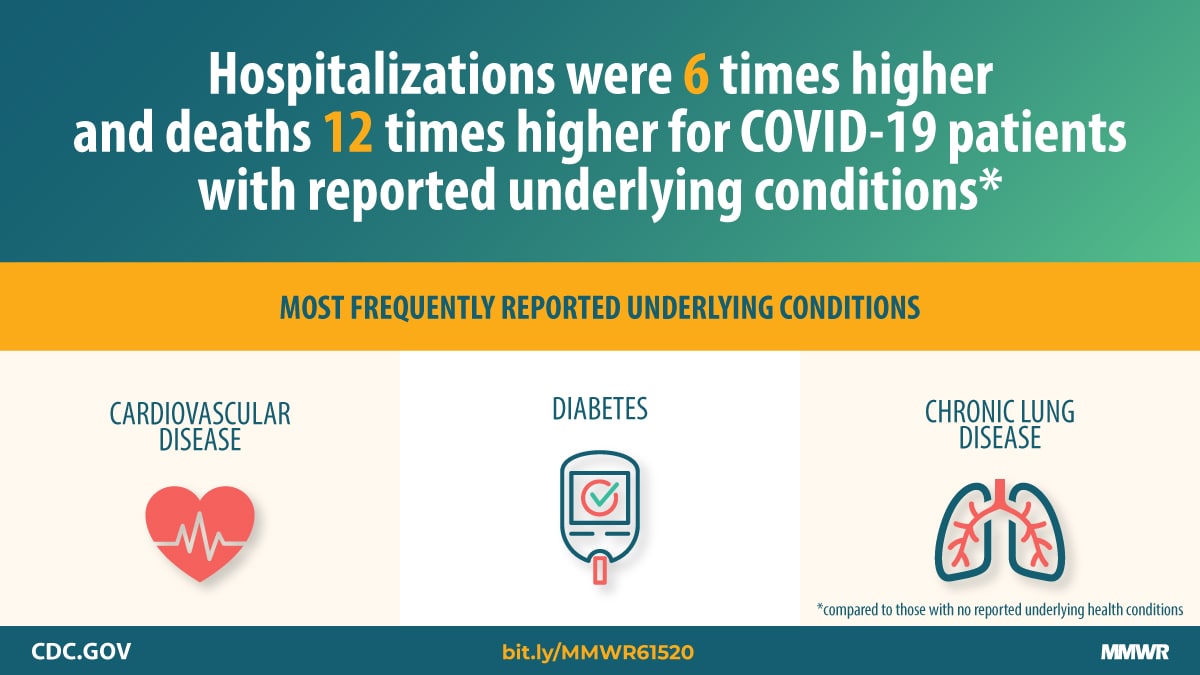
A CDC analysis last month of US COVID-19 patient surveillance data from Jan 22 to May 30 showed that those with underlying conditions were hospitalized six times more often, needed intensive care five times more often, and had a death rate 12 times higher than those without these conditions. But the authors of today’s reported noted that the earlier study defined obesity as a BMI of 40 kg/m2 or higher and included some conditions with mixed or limited evidence of a tie to poor coronavirus outcomes.

Prevalence of underlying conditions in rural, urban counties

Median estimated county prevalence of any underlying illness was 47.2% (range, 22.0% to 66.2%). Numbers of people with any underlying condition ranged from 4,300 in rural counties to 301,744 in large cities.

Prevalence of obesity was 35.4% (range, 15.2% to 49.9%), while it was 12.8% for diabetes (range, 6.1% to 25.6%), 8.9% for COPD (range, 3.5% to 19.9%), 8.6% for heart disease (range, 3.5% to 15.1%), and 3.4% for CKD, 3.4% (range, 1.8% to 6.2%).

Nationwide, the overall weighted prevalence of adults with chronic underlying conditions was 30.9% for obesity, 11.4% for diabetes, 6.9% for COPD, 6.8% for heart disease, and 3.1% for CKD.

The estimated median prevalence of any underlying condition generally increased with increasing county remoteness, ranging from 39.4% in large metropolitan counties to 48.8% in rural ones.

Resource allocation, preventive health measures

The authors noted that access to healthcare resources in some rural counties may be poor, adding to the risk of severe COVID-19 outcomes.

“The findings can help local decision-makers identify areas at higher risk for severe COVID-19 illness in their jurisdictions and guide resource allocation and implementation of community mitigation strategies,” they wrote. “These findings also emphasize the importance of prevention efforts to reduce the prevalence of these underlying medical conditions and their risk factors such as smoking, unhealthy diet, and lack of physical activity.”

The researchers called for future studies to include the weighting of the contribution of each underlying illness according to the risk of serious COVID-19 outcomes and identifying and integrating other factors leading to susceptibility to both infection and serious outcomes to better estimate the number of people at increased risk for COVID-19 infection. 


I’m a doctor in Miami. Here’s how I know Florida’s covid-19 outbreak won’t improve anytime soon.

https://www.washingtonpost.com/opinions/2020/07/21/im-doctor-miami-heres-how-i-know-floridas-covid-19-outbreak-wont-improve-anytime-soon/?utm_campaign=wp_main&utm_medium=social&utm_source=facebook&fbclid=IwAR3cbnYiDkNswMcWc3AzmM2BfSOF5bskUtLUf83b66MI3ojH49xTygQVrUI

July 26: Tracking Florida COVID-19 Cases, Hospitalizations, and ...

I knew something was amiss when I had my car repaired in early June, shortly after Miami began relaxing its coronavirus restrictions. At first glance, the dealership looked as if it was following the recommended precautions: Every other seat was blocked off with tape, and customers and workers were wearing face coverings.

On closer inspection, many of the customers’ nostrils protruded above their masks. Staff members wore masks with one-way valves, allowing their breath to escape as they told customers the cost of fixing their clunkers. And no one was enforcing limits on the number of customers who could enter the reception area while waiting for their repairs.

It wasn’t just the repair shop. As I walked around my neighborhood in the early evenings, I’d pass houses with cars packed into their driveways. The sounds of Pitbull and J Balvin blared through the tropical shrubbery — a sure sign of a Miami house party.

A month later, Miami has become the pandemic’s epicenter. Miami-Dade County’s intensive-care units and emergency departments are jammed. Specialists unaccustomed to managing critically ill patients are being called into action. The state has sent 100 additional health workers, mostly nurses, to the county’s large public hospital to help its exhausted staff.

I see patients in one of the hospital’s primary-care clinics. Recently, a colleague started her week as ward attending by being called to a code, one of several occurring simultaneously in different parts of the hospital; a middle-aged woman recovering from the coronavirus had suddenly gone into cardiac arrest. Other colleagues have been intubating physically fit young people who precipitously went into respiratory failure.

This is what happens when your state becomes a national embarrassment. And the reason is clear: We have suffered from failures of political leadership at every level.

Florida’s challenges are similar to those that New York and other northern states faced months ago. But while leaders in those states took aggressive action and modeled good behavior, our state has been significantly more laissez-faire and chaotic. Bars and restaurants closed for indoor service in March but reopened in June; now, Miami-Dade County’s mayor has shut them down again. Opening business might have worked if our state and local officials had enforced the correct wearing of appropriate masks, or modeled good mask-wearing behavior themselves, or provided businesses with instructions on maintaining proper ventilation. But they didn’t.

Covid-19 testing is woefully inadequate, and the lucky folks who can actually score an appointment at one of the state’s free testing sites, such as Marlins Park, are waiting more than a week to receive their results. The perpetually underfunded and politically influenced Florida Department of Health lacks enough staff to adequately trace all the people who test positive. Our leaders should have developed a robust public-health infrastructure capable of supporting contact tracing and quarantine enforcement long ago. They didn’t, and scrambling to assemble these systems in the midst of a pandemic is too little, too late.

Ironically, I feel safer at work, where everyone wears masks correctly and takes proper precautions, than I do out in public. We still have adequate personal protective equipment — for now — and are not yet forced to wear garbage bags and rain ponchos like our colleagues in New York. But many staff are already calling in sick, and we worry we won’t have enough nurses, respiratory therapists and doctors to manage the continuing deluge. And still young medical trainees tell me they see crowds of people, many without masks, congregating in the trendy areas of Miami Beach and in Miami’s Brickell neighborhood.

Meanwhile, Florida Gov. Ron DeSantis (R), who only recently began reliably sporting a mask, has thrown up his hands and proclaimed that younger adults are “going to do what they’re going to do,” arguing that he’s powerless to stop them. At the same time, he’s been bullying local school districts to offer in-person classes next month. Unfortunately, many public schools are housed in environmentally unhealthy buildings with lousy ventilation. Several classrooms in my daughter’s public high school lack windows; in other rooms, the windows that do exist don’t open. For years, the building’s outdated air-conditioning system has emitted a musty smell.

In a rational world, the federal government would help us test more people, faster; state and federal leaders would set an example by wearing masks correctly and consistently; local officials would strictly enforce quarantine rules; someone would slap warning labels on those awful ubiquitous online ads for valved masks; and our public health departments would be guided by health experts, not politicians. But this is Florida, a state with a well-established history of being anything but rational.

So for now, the state’s citizens continue to muddle through. My fellow physicians and I are trying to stay on top of a fast-changing situation, while also keeping an eye on hurricane season. In the absence of responsible leadership, we doubt Florida will stop setting records — of the wrong kind — anytime soon.


Houston, Miami, other cities face mounting health care worker shortages as infections climb

https://www.washingtonpost.com/national/houston-miami-and-other-cities-face-mounting-health-care-worker-shortages-as-infections-climb/2020/07/25/45fd720c-ccf8-11ea-b0e3-d55bda07d66a_story.html?utm_campaign=wp_main&utm_medium=social&utm_source=facebook&fbclid=IwAR14P9OGxTOPU8pMgjsVof7YlOAPv-vfxq2MBm9RlpYFVVa3qvpmvyIjFyA

Shortages of health care workers are worsening in Houston, Miami, Baton Rouge and other cities battling sustained covid-19 outbreaks, exhausting staffers and straining hospitals’ ability to cope with spiking cases.

That need is especially dire for front-line nurses, respiratory therapists and others who play hands-on, bedside roles where one nurse is often required for each critically ill patient.

While many hospitals have devised ways to stretch material resources — converting surgery wards into specialized covid units and recycling masks and gowns — it is far more difficult to stretch the human workers needed to make the system function.

“At the end of the day, the capacity for critical care is a balance between the space, staff and stuff. And if you have a bottleneck in one, you can’t take additional patients,” said Mahshid Abir, a senior physician policy researcher at the RAND Corporation and director of the Acute Care Research Unit (ACRU) at the University of Michigan. “You have to have all three … You can’t have a ventilator, but not a respiratory therapist.”

“What this is going to do is it’s going to cost lives, not just for covid patients, but for everyone else in the hospital,” she warned.

The increasingly fraught situation reflects packed hospitals across large swaths of the country: More than 8,800 covid patients are hospitalized in Texas; Florida has more than 9,400; and at least 13 other states also have thousands of hospitalizations, according to data compiled by The Washington Post.

Facilities in several states, including Texas, South Carolina and Indiana, have in recent weeks reported shortages of such workers, according to federal planning documents viewed by The Post, pitting states and hospitals against one another to recruit staff.

On Thursday, Louisiana Gov. John Bel Edwards (D) said he asked the federal government to send in 700 health-care workers to assist besieged hospitals.

“Even if for some strange reason … you don’t care about covid-19, you should care about that hospital capacity when you have an automobile accident or when you have your heart attack or your stroke, or your mother or grandmother has that stroke,” Edwards said at a news conference.

In Florida, 39 hospitals have requested help from the state for respiratory therapists, nurses and nursing assistants. In South Carolina, the National Guard is sending 40 medical professionals to five hospitals in response to rising cases.

Many medical facilities anticipate their staffing problems will deteriorate, according to the planning documents: Texas is hardest hit, with South Carolina close behind. Needs range from pharmacists to physicians.

Hot spots stretch across the country, from Miami and Atlanta to Southern California and the Rio Grande Valley, and the demands for help are as diffuse as the suffering.

“What we have right now are essentially three New Yorks with these three major states,” White House coronavirus task force coordinator Deborah Birx said Friday during an appearance on NBC’s “Today” show.

But today’s diffuse transmission requires innovative thinking and a different response from months ago in New York, say experts. While some doctors have been able to share expertise online and nurses have teamed up to relieve pressures, the overall strains are growing.

“We missed the boat,” said Serena Bumpus, a leader of multiple Texas nursing organizations and regional director of nursing for the Austin Round Rock Region of Baylor Scott and White Health.

Bumpus blames a lack of coordination at national and state officials. “It feels like this free-for-all,” she said, “and each organization is just kind of left up to their own devices to try to figure this out.”

In a disaster, a hospital or local health system typically brings in help from neighboring communities. But that standard emergency protocol, which comes into play following a hurricane or tornado, “is predicated on the notion that you’ll have a concentrated area of impact,” said Christopher Nelson, a senior political scientist at the RAND Corporation and a professor at the Pardee RAND Graduate School.

That is how Texas has functioned in the past, said Jennifer Banda, vice president of advocacy and public policy at the Texas Hospital Association, recalling the influx of temporary help after Hurricane Harvey deluged Houston three years ago.

It is how the response took shape early in the outbreak, when health-care workers headed to hard-hit New York.

But the sustained and far-flung nature of the pandemic has made that approach unworkable. “The challenge right now,” Banda said, “is we are taxing the system all across the country.”

Theresa Q. Tran, an emergency medicine physician and assistant professor of emergency medicine at Houston’s Baylor College of Medicine, began to feel the crunch in June. Only a few weeks before, she had texted a friend to say how disheartening it was to see crowds of people reveling outdoors without masks on Memorial Day weekend.

Her fears were borne out when she found herself making call after call after call from her ER, unable to admit a critically ill patient because her hospital had run out of ICU space, but unable to find a hospital able to take them.

Under normal circumstances, the transfer of such patients — “where you’re afraid to look away, or to blink, because they may just crash on you,” as Tran describes them — happens quickly to ensure the close monitoring the ICU affords.

Those critical patients begin to stall in the ER, stretching the abilities of the nurses and doctors attending to them. “A lot of people, they come in, and they need attention immediately,” Tran said, noting that emergency physicians are constantly racing against time. “Time is brain, or time is heart.”

By mid-July, an influx of “surge” staff brought relief, Tran said. But that was short-lived as the crisis jumped from one locality to the next, with the emergency procedures to bring in more staff never quite keeping up with the rising infections.

An ER physician in the Rio Grande Valley said all three of the major trauma hospitals in the area have long since run out of the ability to absorb new ICU patients.

“We’ve been full for weeks,” said the physician, who spoke on the condition of anonymity because he feared retaliation for speaking out about the conditions.

“The truth is, the majority of our work now in the emergency department is ICU work,” he said. “Some of our patients down here, we’re now holding them for days.” And each one of those critically ill patients needs a nurse to stay with them.

When ICU space has opened up — maybe two, three, four beds — it never feels like relief, he said, because in the time it takes to move those patients out, 20 new ones arrive.

Even with help his hospital has received — masks and gowns were procured, and the staff more than doubled in the past few weeks with relief nurses and other health-care workers from outside — it still is not enough.

The local nurses are exhausted. Some quit. Even the relief nurses who helped out in New York in the spring seem horrified by the scale of the disaster in South Texas, he said.

“If no one comes and helps us out and gives us the ammo we need to fight this thing, we are not going to win,” the doctor said.

One of the root causes of the problem in the United States is that emergency departments and ICUs are often operating at or near capacity, Abir and Nelson said, putting them dangerously close to shortages before a crisis even hits.

Texas, along with 32 other states, has joined a licensure compact, allowing nurses to practice across state borders, but it is becoming increasingly difficult to recruit from other parts of the country.

Texas medical facilities can apply to the Department of State Health Services for staffers to fill a critical shortage, typically for a two-week period. But two weeks, which would allow time to respond to most disasters, hardly registers in a pandemic, so facilities have to ask for extensions or make new applications.

South Carolina last week issued an order that allows nursing graduates who have not yet completed their licensing exams to begin working under supervision. Prisma Health, the state’s biggest hospital system, said this week that the number of patients admitted to its hospitals has more than tripled in the past three weeks and is approaching 300 new patients a day.

“As the capacity increases, so does the need for additional staff,” Scott Sasser, the incident commander for Prisma Health’s covid-19 response said in a statement. Prisma has so far shifted nurses from one area to another, brought back furloughed nurses, hired more physicians and brought in temporary nurse hires, among other measures, Sasser said.

Bumpus has fielded calls from nurses all over the country — some as far afield as the United Kingdom — wanting to know how they can help. But Bumpus says she does not have an easy answer.

“I’ve had to kind of just do my own digging and use my connections,” she said. At first, she said, interested nurses were asked to register through the Texas Disaster Volunteer Registry; but then the system never seemed to be put to use.

Later she learned — “by happenstance … literally by social media” — that the state had contracted with private agencies to find nurses. So now she directs callers to those agencies.

Even rural parts of Texas that were spared initially are being ravaged by the virus, according to John Henderson, CEO of the Texas Organization of Rural and Community Hospitals.

“Unless things start getting better in short order, we don’t have enough staff,” he acknowledged. As for filling critical staffing gaps by moving people around, “even the state admits that they can’t continue to do that,” Henderson said.

The situation has become so dire in some rural parts of the state that Judge Eloy Vera implored people to stay home on the Starr County Facebook page, warning, “Unfortunately, Starr County Memorial Hospital has limited resources and our doctors are going to have to decide who receives treatment, and who is sent home to die.”

Steven Gularte, CEO of Chambers Health in Anahuac, Tex., 45 miles from Houston, said he had to bring in 10 nurses to help staff his 14-bed hospital after Houston facilities started appealing for help to care for patients who no longer needed intensive care but were not ready to go home.

“Normally, we are referring to them,” Gularte said. “Now, they are referring to us.”

Donald M. Yealy, chair of emergency medicine at the University of Pittsburgh Medical Center, said rather than sending staff to other states, his hospital has helped others virtually, particularly to support pulmonary and intensive care physicians.

“Covid has been catalytic in how we think about health care,” Yealy said, providing lessons that will outlast the pandemic.

But telehealth can do little to relieve the fatigue and fear that goes with front-line work in a prolonged pandemic. Donning and doffing masks, gowns and gloves is time consuming. Nurses worry about taking the virus home to their families.

“It is high energy work with a constant grind that is hard on people,” said Michael Sweat, director of the Center for Global Health at the Medical University of South Carolina.

Coronavirus has turned the regular staffing challenge at Harris Health in Houston into a daily life-or-death juggle for Pamela Russell, associate administrator of nursing operations, who helps provide supplemental workers for the system’s two public hospitals and 46 outpatient clinics.

Now, 162 staff members — including more than 50 nurses — are quarantined, either because they tested positive or are awaiting results. Many others need flexible schedules to accommodate child care, she said. Some cannot work in coronavirus units because of their own medical conditions. A few contract nurses left abruptly after learning their units would soon be taking covid-positive patients.

Russell has turned to the state and the international nonprofit Project Hope for resources, even as she acts as a morale booster, encouraging restaurants to send meals and supporting the hospital CEO in his cheerleading rounds.

“It’s hard to say how long we can do this. I just don’t know” said Russell, who praised the commitment of the nurses. “Like I said, it’s a calling. But I don’t see it being sustainable.”