Cartoon – We’re way beyond Rational Thinking

Management Cartoon # 7684: We're way beyond rational thinking. You ...

Cartoon – Crisis Leadership Today

Cartoon – Before Rational Thinking Sets In | HENRY KOTULA

GOP senators in close races mislead on preexisting conditions

https://www.washingtonpost.com/politics/2020/07/15/gop-senators-close-races-mislead-preexisting-conditions/?utm_campaign=wp_main&utm_medium=social&utm_source=facebook&fbclid=IwAR3XOi91b1jsLf-grP_iIXALJiIvlZNItPE1ZDO0_ql4Wlw8m3GicyoHIH8

2018 midterms: Republicans mislead voters about preexisting ...

“Steve Daines will protect Montanans with preexisting conditions.”

“Of course I will always protect those with preexisting conditions. Always.”

“What I look forward to working on is a plan that protects people with preexisting conditions.”

— Sen. Cory Gardner (R-Colo.), in an interview with Colorado Public Radio, July 1, 2020


Sound familiar? Just like President Trump, these Republican senators say they support coverage guarantees for patients with preexisting health conditions. And just like Trump, their records show the opposite.

The president’s doublespeak — voicing support for these protections while asking the Supreme Court to strike them down — is spreading into some battleground Senate races this year.


It’s a classic case of buyer beware: Look under the hood of what Daines, Gardner and McSally are selling, and you’ll find a car without an engine.

THE FACTS

Republicans for a decade have tried to repeal the Affordable Care Act, President Barack Obama’s signature health-care legislation. The Supreme Court has upheld the law twice in the face of challenges from conservative groups. As coronavirus cases reached a new high in the United States, the Trump administration filed a legal brief on June 25 asking the Supreme Court to strike down the entire law, joining with a group of GOP state attorneys general who argue that the ACA is unconstitutional.

Before the ACA, insurance companies could factor in a person’s health status while setting premiums, a practice that sometimes made coverage unaffordable or unavailable for those in need of expensive treatment or facing a serious illness such as cancer.


The ACA PROHIBITED THIS PRACTICE through two provisions: “guaranteed issue,” which means insurance companies must sell insurance to anyone who wants it, and “community rating,” which means people in the same age group and geographic area who buy similar insurance pay similar prices. The changes made insurance affordable for people with serious diseases or even those with minor health problems, who also could have been denied coverage before the law’s passage.

Now, about 20 million people covered through the ACA could lose their health insurance if the Supreme Court strikes down the law, among many other consequences bearing directly on the U.S. response to the coronavirus pandemic.

In addition to the coverage guarantee, the ACA established online health insurance marketplaces and subsidies for participating buyers. The law also directs billions of dollars a year in federal funding to states that have chosen to expand their Medicaid programs under the Obamacare law. Millions of Americans have gained coverage through those provisions.

We asked the Daines, Gardner and McSally campaigns whether the senators support or oppose the GOP lawsuit at the Supreme Court and how they would address affordability issues for patients with preexisting conditions if the ACA falls. None of their campaigns responded to our questions.


“Steve Daines will protect Montanans with preexisting conditions.”

Daines voted to repeal the ACA in 2013 and has supported efforts to repeal and replace the law more recently during the Trump administration.

Regarding the GOP lawsuit, a Daines spokesperson was quoted in the Billings Gazette saying the senator “supports whatever mechanism will protect Montanans from this failed law, lower health care costs, protect those with preexisting conditions and expand access to health care for Montanans.”


“What I look forward to working on is a plan that protects people with preexisting conditions.” (Gardner)

Gardner has been voting to repeal, defund or replace the ACA since 2011, the year after its passage. This year, his campaign website says nothing about the law, but his official Senate website says, “Fixing our healthcare system will require repealing the Affordable Care Act and replacing it with patient-centered solutions, which empower Americans and their doctors.”

Asked by the Hill whether he supported the GOP lawsuit, Gardner said: “That’s the court’s decision. If the Democrats want to stand for an unconstitutional law, I guess that’s their choice.” In an interview with Colorado Public Radio, Gardner evaded the question six times in a row.

“Of course I will always protect those with preexisting conditions. Always.” (McSally)

In 2015, McSally voted to repeal the ACA when she served in the House. In 2017, she voted to replace the ACA with the American Health Care Act, which would have allowed insurers to charge higher premiums to patients with complicated medical histories.

McSally, now in the Senate, has declined to comment on the GOP lawsuit pending before the Supreme Court. When asked by PolitiFact, “the campaign didn’t specifically answer, but pointed to her general disapproval of the ACA.”

WHAT HAPPENS IF  THE GOP LAWSUIT SUCCEEDS?

Trump told The Washington Post days before his inauguration in 2017 that he was nearly done with his plan to replace the ACA. Three and a half years later, no replacement plan has emerged from the administration and Republicans in Congress hardly agree on what it would look like — or how to preserve the protections for preexisting health conditions.

Sen. Thom Tillis (R-N.C.), who is also running for reelection this year, has introduced a 24-page bill called the Protect Act that includes language guaranteeing coverage for preexisting conditions. Daines signed on as a co-sponsor on June 24, the day before the Justice Department filed its brief in the Supreme Court. McSally signed on in April 2019. Gardner is not listed as a co-sponsor.

Experts say the Tillis proposal does not offer the same level of protection for preexisting conditions as the ACA, and they warn that millions of Americans could lose their health coverage if the ACA falls and the Protect Act is the only replacement.

“Insurers before the Affordable Care Act had multiple and redundant ways that they could avoid people who had preexisting conditions,” said Karen Pollitz, a senior fellow at the Kaiser Family Foundation. The Protect Act prevents some of those practices, but it “leaves enough other loopholes that it would make it very possible and likely for insurers to be able to avoid paying benefits for the conditions they most worry about,” she said.


Before the ACA, an insurance company could reject an application outright, say, after reviewing a patient’s medical history. The Protect Act has language barring that practice.

“The second thing they could do is, they could sell you coverage, but they could exclude your preexisting condition. ‘Oh, you have diabetes? I’m not going to pay for any of those benefits,’” Pollitz said. “The Tillis bill says you can’t do that, so that’s good.”

In the days before the ACA, insurers were allowed to charge higher premiums based on a patient’s health status. To prevent this, the Protect Act takes language from the Health Insurance Portability and Accountability Act (HIPAA), rather than the newer ACA.

“The Protect Act inserts old HIPAA nondiscrimination language that prevents employers from varying worker premium contributions based on health status,” Pollitz said. “But the Protect Act also includes the old rule of construction that says nothing limits what the insurance company can charge the employer or individual.”

Pollitz said the “community rating” language in the ACA provides clearer protections in this area. The Protect Act says “nothing … shall be construed to restrict the amount that an employer or individual may be charged for coverage under a group health plan.”

“The bill would reinstate three protections at risk in the Texas case — prohibiting insurers from denying applicants based on pre-existing conditions, charging higher premiums due to a person’s health status, and excluding pre-existing conditions from coverage,” Sarah Lueck, a senior policy analyst at the left-leaning Center on Budget and Policy Priorities, wrote in an analysis.

“But it would leave many others on the cutting room floor,” she wrote, because insurers would be able to exclude coverage of benefits such as maternity care, mental health and substance-use treatment; set annual and lifetime limits on insurance payouts; and charge older patients more than younger patients at greater levels than the ACA allows, among other changes.

It’s important to keep in mind that the Protect Act would not replace other parts of Obamacare, such as the online marketplaces and subsidies. Neither would it continue the ACA’s Medicaid expansion, which 37 states and D.C. have now adopted. That includes Arizona, Colorado and Montana.


The Pinocchio Test

Voters deserve straight answers when their health care is on the line, especially in the middle of a deadly pandemic.

Daines, Gardner and McSally have voted to end the Affordable Care Act. People with preexisting conditions would have been left exposed because of those votes; insurers could have denied coverage or jacked up prices for sick patients.

The three senators’ comments about the GOP lawsuit are woefully vague, but they can all be interpreted as tacit support. Asked about the case, a Daines spokesperson said “whatever mechanism” to get rid of the ACA would do. McSally’s campaign “didn’t specifically answer, but pointed to her general disapproval of the ACA.” Gardner avoided the question six times in one interview, but in another, he said: “That’s the court’s decision. If the Democrats want to stand for an unconstitutional law, I guess that’s their choice.”

Four Pinocchios all around.


White House tells hospitals to bypass CDC on COVID-19 data reporting

https://thehill.com/policy/healthcare/507321-white-house-tells-hospitals-to-bypass-cdc-on-covid-data-reporting?fbclid=IwAR2Q0n6LNYQa1p6rPQeRGUPi-54i8uTAyRxcmTcZXC6Q9mbVRZx3e1GH518

White House tells hospitals to bypass CDC on COVID-19 data ...

Hospitals will begin sending coronavirus-related information directly to the Department of Health and Human Services (HHS), not the Centers for Disease Control and Prevention (CDC), under new instructions from the Trump administration.

The move will take effect on Wednesday, according to a new guidance and FAQ document for hospitals and clinical labs quietly posted on the HHS website.

Previously, hospitals reported to the CDC’s National Healthcare Safety Network, which the agency describes as the nation’s most widely used health care-associated infection tracking system.

The CDC tracked information including how many beds are available, the number of ventilators available and how many COVID-19 patients the hospitals have.

Beginning Wednesday, hospitals will report the same data but will bypass the CDC and send it to HHS directly. 

According to HHS, the goal is to streamline data collection, which will be used to inform decisions at the federal level such as allocation of supplies, treatments and other resources.

But the move comes amid concerns that the White House has been sidelining the CDC and after Trump administration officials attacked Anthony Fauci, the nation’s top infectious disease expert and a member of the White House coronavirus task force.


UnitedHealth Group posts $6.6B in Q2 profit amid COVID-19 care deferrals

https://www.fiercehealthcare.com/payer/unitedhealth-group-posts-6-6b-q2-profit-amid-covid-19-care-deferrals?utm_medium=nl&utm_source=internal&mrkid=959610&mkt_tok=eyJpIjoiTldOaVpEUTJOMk0yTWpNNSIsInQiOiJJcFROOCtmWDU4TEhnT0FkTFFCTHZmRHpVWHBJV015M0QzQSswV3llT2liQzFsXC9wM1VYXC8yT2xsREdQVVh1WnhvNHk3TEdHNEtrTlZcL2s5WXlWZXZVMjR1TUdPZEgrNnVPOTVuYUNJSVo5VmFhT05XQlZYYmlJTHE2ekhwZENDdCJ9

The outside of UnitedHealth Group's headquarters

UnitedHealth Group reported $6.6 billion in profit for the second quarter, beating Wall Street projections.

That’s also a significant increase in profit compared to the second quarter of 2019, where the healthcare giant brought in $3.3 billion, according to its earnings report (PDF) issued Wednesday.

UnitedHealth’s mid-year profits sit at $10 billion, compared to $6.8 billion in the first half of 2019.

The insurer also reported $62.1 billion in revenue for the quarter, an increase year-over-year but a number that fell short of analysts’ expectations. UnitedHealth brought in $60.6 billion in revenue in the second quarter of 2019.

Through the first half of 2020, UnitedHealth has earned $126.6 billion in revenue, up from $120.9 billion in the first six months of 2019.

The insurer attributes the unexpectedly high profit to large amounts of care deferral due to the coronavirus pandemic and said it’s likely to see that offset in future quarters as elective procedures and other services resume.

In the earnings release, CEO David Wichmann touted the company’s efforts to combat the pandemic in the second quarter.

“Our 325,000 dedicated team members, including the 120,000 clinicians serving on the front lines of care, have tirelessly responded to COVID-19 with agility, innovation and compassion,” Wichmann said in a statement.

“We moved swiftly to assist the people we serve and their care providers, including the provision of $3.5 billion in proactive voluntary customer assistance and accelerated care provider funding. We remain committed to taking further actions to address any future imbalances as a result of the pandemic,” he said.

Though COVID-19’s full impact on finances remains unclear, UnitedHealth maintained its full-year earnings guidance of between $15.45 and $15.75 per share.


Coronavirus cases soar by more than 1 million over 5 days

https://www.cnn.com/2020/07/14/world/million-coronavirus-cases-five-days-intl/index.html

Coronavirus cases soar by more than 1 million over 5 days - WRCBtv ...

Coronavirus cases soared by more than a million globally in just five days as the numbers continue to accelerate from week to week, according to figures from Johns Hopkins University.

Reported cases increased by 1,046,200 from July 6 through July 10, up from a 994,400 increase over the five days from July 5 through July 9.
The total global case number surpassed 13 million on Monday, growing by 1,061,600 between July 8 and July 13.
While some countries that were hit early in the outbreak have managed to contain the virus, the number of cases globally has been accelerating fairly steadily.
There have now been more than half a million deaths from the virus worldwide, according to JHU data.
The World Health Organization’s director-general on Monday warned there would be “no return to the old normal for the foreseeable future.”
Tedros Adhanom Ghebreyesus told a media briefing in Geneva that there were no shortcuts out of this pandemic, and that while we may hope for an effective vaccine, there must be a focus on using the tools that are available now to suppress transmission and save lives.
“We need to reach a sustainable situation where we do have adequate control of this virus without shutting down our lives entirely, or lurching from lockdown to lockdown,” Tedros said.
He told reporters there was a “roadmap to a situation where we can control the disease and get on with our lives” that would require three things: a focus on reducing mortality and suppressing transmission; an “empowered, engaged community” that takes individual measures to protect the whole community; and strong government leadership and communication.
Two countries accounted for half of all new cases added worldwide on Sunday, he told the briefing.
“Yesterday, 230,000 cases of Covid-19 were reported to WHO. Almost 80% of those cases were reported from just 10 countries, and 50% come from just two countries,” he said.
Tedros did not name the countries, but WHO data indicated that he was referring to the United States and Brazil. According to the JHU tally of cases, the US, India and Brazil accounted for more than 112,000 new cases on Sunday.
The US has the world’s highest confirmed numbers, with at least 3.4 million recorded cases and at least 135,615 deaths. Brazil has almost 2 million confirmed cases and India is closing in on one million.
“Let me be blunt: Too many countries are headed in the wrong direction,” Tedros said.
“If governments do not clearly communicate with their citizens and roll out a comprehensive strategy focused on suppressing transmission and saving lives; if populations do not follow the basic principles of physical distancing, hand washing, wearing masks, there is only one way this is going to go. It’s going to get worse and worse and worse.”
“But it does not have to be this way,” he added. “It’s never too late to bring the virus under control, even if there has been explosive transmission.”


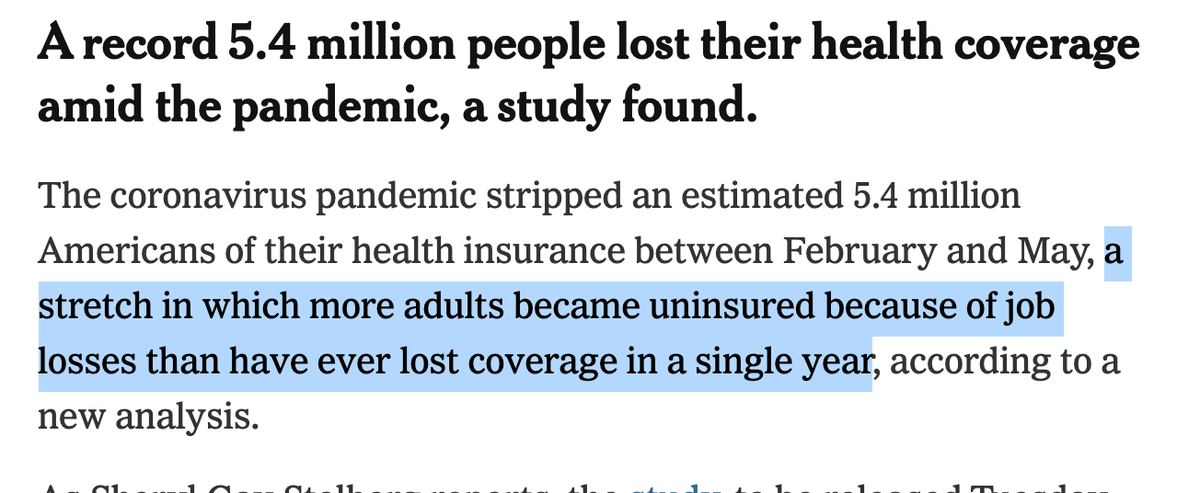
5.4 million Americans lost health insurance

https://www.axios.com/newsletters/axios-vitals-285240f4-9110-4c86-ad7e-e0c37085a957.html?utm_source=newsletter&utm_medium=email&utm_campaign=newsletter_axiosvitals&stream=top

Medicare for All (@AllOnMedicare) | Twitter

Roughly 5.4 million adults in the U.S. lost their health insurance from February to May after losing their jobs, according to a new estimate from Families USA, a group that favors the Affordable Care Act.

Why it matters: There are more adults under 65 without insurance in Southern states, which are the same states setting new records for single-day coronavirus infections along with rising hospitalizations, Axios’ Orion Rummler writes.

What they found: 3.9 million adults lost health insurance over one year during the Great Recession, per Families USA’s analysis. It only took four months in this current crisis for an estimated 5.4 million Americans to lose health insurance.

  • More than 20% of adults in Georgia, Florida, South Carolina, North Carolina, Mississippi, Oklahoma and Texas were without insurance as of May.
  • All of these states have set new records in the past two weeks for their highest number of coronavirus infections in a single day, per data from the COVID Tracking Project.
  • 46% of adults who lost coverage due to the pandemic came from five states: Florida, New York, Texas, California and North Carolina.

The backdrop: 21 million Americans were unemployed in May, according to the Bureau of Labor Statistics’ nonfarm payrolls report.


Trump admin seeks relaxed grandfathered ACA health plan rules that up out-of-pocket costs

https://www.healthcaredive.com/news/trump-admin-seeks-relaxed-grandfathered-aca-health-plan-rules-that-up-out-o/581463/

Paying for Health Insurance Out of Pocket Maximum, OOP Health ...

Dive Brief:

  • The Trump administration proposed a rule Friday to allow some group health plans grandfathered under the Affordable Care Act to raise out-of-pocket costs for enrollees but still allow them to have health savings accounts. Such plans must not discriminate against enrollees with pre-existing conditions, but are exempt from many other ACA regulations. If they violate any rules regarding costs or structure they lose their grandfathered status and are required to follow all the mandates of the landmark 2010 law.
  • The proposed rule, issued by the U.S. Department of Labor, would relax some of the complex inflation and pricing calculations grandfathered plans must follow. The department admitted that the change could lead to higher deductibles and other out-of-pocket costs for the estimated 23.1 million enrollees in such grandfathered plans.
  • The rule stems from a 2017 executive order issued by President Donald Trump that allows regulatory changes to be made in response to perceived economic burdens imposed by the ACA. However, the Labor Department conceded in its Federal Register publication of the proposed rule that the current rules for grandfathered health plans probably weren’t that burdensome.

Dive Insight:

The administration has made no secret of its ire for the ACA and is actively trying to overturn it at the U.S. Supreme Court. A release explaining the changes notes fixed cost-sharing for high-deductible health plans would be raised, and “an alternative method of measuring permitted increases in fixed-amount cost sharing” has been introduced that “would allow plans and issuers to better account for changes in the costs of health coverage over time.”

The formal 76-page proposal, published in the Federal Register on Sunday, said premiums might go down as a result of the changes, but there were no estimates provided or circumstances where that might occur.

Moreover, the proposed rule also noted that the change could lead to more people foregoing healthcare because their out-of-pocket costs might become unaffordable.

The Labor Department also noted that there have been so few fluctuations in the state of grandfathered health plans in recent years that it was likely the current regulations were not overly burdensome in the first place.

Public comments will be solicited until mid-August before a final rule is issued.

Sen. Patty Murray, D-Wash., and ranking member of the Senate Health, Education, Labor, and Pensions Committee, wasted little time late last week blasting the proposal.

“Regardless of what the president wants to believe, we’re in the middle of a pandemic that is devastating families’ health and finances,” Murray said in a statement.


White House goes public with attacks on Fauci

White House goes public with attacks on Fauci

Dr. Anthony Fauci describes his 'very different' relationships ...

Tensions between the White House and Anthony Fauci, the government’s top infectious diseases expert, are spilling into the open as officials openly attack the doctor for his public health advice during the coronavirus pandemic. 

Fauci’s advice has often run contrary to President Trump’s views, and the attacks on Fauci have begun to look like a traditional negative political campaign against an opponent. Yet this time, the opponent is a public health expert and career civil servant working within the administration. 

Dan Scavino, deputy chief of staff for communications, shared a cartoon on his Facebook page late Sunday that depicted Fauci as a faucet flushing the U.S. economy down the drain with overzealous health guidance to slow the spread of the pandemic.

The cartoon, which shows Fauci declaring schools should remain closed and calling for “indefinite lockdowns,” did not accurately portray what Fauci has advised in public.

Adm. Brett Giroir, the administration’s testing czar, downplayed any riff within the White House coronavirus task force before offering some criticism of Fauci.

“I respect Dr. Fauci a lot, but Dr. Fauci is not 100 percent right and he also doesn’t necessarily, and he admits that, have the whole national interest in mind,” Giroir told “Meet the Press” on Sunday. “He looks at it from a very narrow public health point of view.”

There have been tensions between Trump and Fauci throughout the pandemic. The president has repeatedly downplayed the severity of the virus, broken with the advice of his own public health experts and painted rosy but at times misleading pictures of the U.S. response. Fauci, who has served four decades in his current post, has offered blunt talk on the dangers of the pandemic that has directly contradicted the president from time to time.

But the latest criticisms mark a shift as the White House has begun publicly undermining one of the leading public health voices in the administration at a time when multiple states are struggling to get new outbreaks under control.

White House trade adviser Peter Navarro, whom the president tapped to manage the use of the Defense Production Act, said he personally proceeds with caution before heeding Fauci’s advice.

Trump said last week that Fauci is a nice man but that he’s “made a lot of mistakes.”

A White House official this weekend sent media outlets a lengthy list of “mistakes” Fauci has made since the pandemic began, like his comment in March that there is no need for people to wear masks.

That comment came before scientists knew people could spread the virus without showing symptoms, and Fauci, the Centers for Disease Control and Prevention (CDC) and other experts now urge people to use face coverings in public.

Public health experts have leaped to Fauci’s defense on Twitter, noting that Fauci is one of the most respected health experts in the world, having worked for six presidents and researched HIV/AIDS, Ebola, Zika and a variety of other infectious diseases.

“When studies show that, opposite from SARS & MERS, COVID19 is most infectious soon after infection & less infectious later, we recognize asymptomatic transmission and importance of masks,” tweeted Tom Frieden, the former director of the CDC.

“That’s called science, not a mistake. The real, deadly mistake is not listening to science.” 

Ashish Jha, director of the Harvard Global Health Institute, tweeted, “His track record isn’t perfect. It’s just better than anyone else I know. Sidelining Dr. Fauci makes the federal response worse. And it’s the American people who suffer.”

Polls still show the public trusts Fauci more than Trump for accurate information on the virus, with Democrats more likely than Republicans to believe the infectious diseases expert.

White House press secretary Kayleigh McEnany during a “Fox & Friends” interview Monday insisted Fauci’s recommendations were reaching Trump, while saying he represented only “one viewpoint” among many considered by the president.

“The point of the task force is to be a whole of government look at what is best for this country,” McEnany said when asked about the status of the relationship between Trump and Fauci. “Dr. Fauci is one member of a team, but rest assured, his viewpoint is represented and the information gets to the president through the task force.”

Still, Fauci’s public appearances became few and far between as his dire warnings about the state of the pandemic in the U.S. increasingly clashed from more hopeful messages coming from the White House. 

Fauci also told the Financial Times last week that he hadn’t briefed Trump in two months, in which time a growing number of states have experienced significant surges in cases.

Fauci was not present at the White House coronavirus task force media briefing last week, events that have become rarer even as the COVID crisis grows worse.

And while he was a regular on cable news in the early days of the pandemic, his appearances have dwindled, a fact he said last week could be because of his “honesty.” 

While Fauci has warned that the U.S. could hit 100,000 new COVID-19 cases per day if steps aren’t taken to alter the trajectory of the outbreaks, Trump has tied the rise in cases to increased testing. 

While Fauci attributed outbreaks in some states to reopening too quickly after the spring lockdowns, Trump and his top allies have mostly stood by their decision to push governors to jump over checkpoints set by the White House.

Fauci has refuted the president’s claims that the rise in cases is solely tied to increased testing and that 99 percent of cases are “totally harmless.” 

And as Trump touted a falling COVID-19 death rate, which is actually now increasing, Fauci has said the U.S. shouldn’t take comfort in the “false narrative,” noting the disease can cause other severe health outcomes. 

Fauci’s warnings grew more urgent last week when he warned that the U.S. is “facing a serious problem” and the pandemic has become politicized. 

“And you know from experience historically that when you don’t have unanimity in an approach to something, you’re not as effective in how you handle it,” Fauci said in an interview with FiveThirtyEight. “So I think you’d have to make the assumption that if there wasn’t such divisiveness, that we would have a more coordinated approach.”


Democrats align around a health policy platform

https://mailchi.mp/86e2f0f0290d/the-weekly-gist-july-10-2020?e=d1e747d2d8

Abstract Word Cloud For Health Policy With Related Tags And Terms ...


Promising that “we are going to at last build the health care system the American people have always deserved”, a joint task force of health policy advisors from the Biden and Sanders campaigns this week released a unified set of proposals that will serve as part of the former Vice President’s campaign platform for the November election.

While the document does not include Sanders’ signature “Medicare for All” proposal, it does support a government-run public insurance option that would be available to all Americans, at income-adjusted, subsidized rates—including free coverage for those with low incomes. It also promises to expand Medicare benefits to include dental, vision, and hearing coverage, and to extend Medicare eligibility to those age 60 and above.

For those who lose their health coverage due to the COVID pandemic, the unity document endorses having the government pick up the tab for COBRA benefits and shifting enrollees into premium-free coverage on the Obamacare exchanges when their COBRA eligibility expires.

It also promises greater investment in public health resources, including increased funding for the CDC, and funding to recruit 100,000 contact tracers nationwide.

Other key components of the proposal include eliminating “surprise billing”, reducing drug costs, addressing racial and gender-based health inequities, and bolstering investment in scientific research.

This week’s document represents an important step in unifying the progressive and moderate wings of the Democratic party around key health policy principles. Should Biden win in November, and if Democrats gain control of the Senate, we’d expect quick action on many of these proposals.

Clearly the most difficult would be the public option and Medicare expansion, which would require lengthy negotiation with various industry groups to garner sufficient political support. Similar to the 2009 process that led to the Affordable Care Act, we would likely see a year’s worth of political horse-trading, leading to passage of some compromise legislation before the midterm elections in 2022.

All of that in the midst of an ongoing pandemic and likely prolonged economic downturn—both of which will probably allow for the passage of more far-reaching legislation than might otherwise be possible.