How much nurse pay is rising—and why

Travel Nurse Guaranteed Pay: The Truth - The Gypsy Nurse

Amid a nationwide staffing shortage, rising demand for nurses has led hospitals to increase salaries and other benefits to attract and retain workers, Melanie Evans reports for the Wall Street Journal.

Hospitals increase salaries, benefits to keep up with nursing demand

Hospitals across the country have been struggling amid staffing shortages, particularly of nurses, Evans reports. According to health care consultancy Premier, nurse turnover rates have increased to around 22% this year, up from the annual rate of about 18% in 2019.

“We are employing more nurses now than we ever have, and we also have more vacancies than we ever had,” said Greg Till, chief people officer at Providence Health & Services.

To retain their current nurses and attract new staff, many hospitals have increased their nurses’ salaries to remain competitive in the job market, Evans reports.

For example, HCA Healthcare, one of the largest hospital chains in the country, said it increased nurse pay this year to keep up with Covid-19 surges and compete with rivals also trying to fill vacant positions.

Similarly, Jefferson Health in May raised salaries for its nearly 10,000 nurses by 10% after the system discovered that rivals had increased their compensation. “The circumstances required it,” said Kate Fitzpatrick, Jefferson’s chief nurse executive.

In addition, Citizens Memorial Hospital in Bolivar, Mo., this month raised its nurses’ salaries by up to 5% after rivals in other nearby cities increased their workers’ wages. Sarah Hanak, Citizen Memorial’s CNO, said the hospital also increased the hourly wages of nurses working overnight shifts by around 15% to ensure sufficient staffing for those shifts.

“We were forced to,” Hanak said. “We absolutely have to stay competitive.”

Overall, the average annual salary for RNs, not including bonus pay, grew to $81,376, according to Premier—a 4% increase across the first nine months of the year. This is larger than the 3.3% increase in the average annual nurse salary for 2020 and the 2.6% increase in 2019, Evans writes.

In addition to salary increases, some organizations, such as Providence, are also offering other benefits to attract and retain nurses, such as more time off, greater schedule flexibility, and new career development opportunities. Many hospitals are also hiring new graduates to work in specialized roles in ORs and other areas, allowing them to advance their careers more quickly than they would have before.

Overall, this rising demand for nurses has allowed those entering the workforce to negotiate higher salaries, more flexible working hours, and other benefits, Evans writes.

“I think you get to write your ticket,” said Tessa Johnson, president of the North Dakota Nurses Association.

Nurse compensation increases were inevitable—here’s why

It was inevitable that we would get to this point: baseline nurse compensation on a clear upward trajectory. Inevitable because this boils down to laws of supply and demand. Amid a clear nursing shortage, organizations are being forced to raise baseline compensation to compete for increasingly scarce qualified nurses. This is true in nearly every market, even for those considered to be ‘destination employers.’

If anything, what’s most surprising in the data from Premier is the moderated increase of around 4%. From a worker’s perspective, that’s not even covering cost of living increases due to inflation. However, amid this new data, it’s important to keep two things in mind:

Two considerations for health care leaders

  1. New data only captures baseline compensation.Differentials—which organizations must standardize and expand across shifts, specialties, and even settings—plus overtime put baseline compensation much higher. Not to mention lucrative sign-on bonuses, that members tell us are increasingly table stakes in their markets. In general, we don’t recommend this type of incentive that does nothing for retention. You’re better off investing those resources in baseline compensation as well as beefing up your RN bonus plan to incentivize retention.
  2. There is a new floor for wages (and it’s only going up from here).

Open questions (and important indicators) we are assessing

  • What happens to wages for entry-level clinical roles? As the shortage of RNs persists, organizations will need to make a shift to team-based models of care, and those are only possible with a stable workforce of entry-level personnel. Right now, that part of the health care workforce is anything but stable. When you consider their work and their wages in comparison to out-of-industry players that pay the same or better, that’s a clear area where investment is required. 
  • Will the share of nurses working permanently with travel agencies return to pre-pandemic levels? That’s to say, what will those RNs who experienced the traveler lifestyle and pay value more moving forward: the flexibility and premium pay or stability of permanent employment? Even if this number stabilizes a couple percentage points above pre-pandemic levels, that will aggravate provider’s sense of shortage.

New campaign to thank health care workers

The American Hospital Association, the American Medical Association and the American Nurses Association teamed up to release a new “Forever Grateful” TV and digital ad campaign on Monday to thank health care workers.

Why it matters: The campaign comes in the face of record levels of reported health care worker burnout tied, in part, to the prolonged emergency response to COVID-19.

  • The AHA also released a new video thanking health care professionals working in America’s hospitals and health systems for their work.

CVS wants to employ doctors. Should health systems be worried?

https://mailchi.mp/96b1755ea466/the-weekly-gist-november-19-2021?e=d1e747d2d8

HealthHUB | CVS Health

We recently caught up with a health system chief clinical officer, who brought up some recent news about CVS. “I was really disappointed to hear that they’re going to start employing doctors,” he shared, referring to the company’s announcement earlier this month that it would begin to hire physicians to staff primary care practices in some stores. He said that as his system considered partnerships with payers and retailers, CVS stood out as less threatening compared to UnitedHealth Group and Humana, who both directly employ thousands of doctors: “Since they didn’t employ doctors, we saw CVS HealthHUBs as complementary access points, rather than directly competing for our patients.” 

As CVS has integrated with Aetna, the company is aiming to expand its use of retail care sites to manage cost of care for beneficiaries. CEO Karen Lynch recently described plans to build a more expansive “super-clinic” platform targeted toward seniors, that will offer expanded diagnostics, chronic disease management, mental health and wellness, and a smaller retail footprint. The company hopes that these community-based care sites will boost Aetna’s Medicare Advantage (MA) enrollment, and it sees primary care physicians as central to that strategy.

It’s not surprising that CVS has decided to get into the physician business, as its primary retail pharmacy competitors have already moved in that direction. Last month, Walgreens announced a $5.2B investment to take a majority stake in VillageMD, with an eye to opening of 1,000 “Village Medical at Walgreens” primary care practices over the next five years. And while Walmart’s rollout of its Walmart Health clinics has been slower than initially announced, its expanded clinics, led by primary care doctors and featuring an expanded service profile including mental health, vision and dental care, have been well received by consumers. In many ways employing doctors makes more sense for CVS, given that the company has looked to expand into more complex care management, including home dialysis, drug infusion and post-operative care. And unlike Walmart or Walgreens, CVS already bears risk for nearly 3M Aetna MA members—and can immediately capture the cost savings from care management and directing patients to lower-cost servicesin its stores.

But does this latest move make CVS a greater competitive threat to health systems and physician groups? In the war for talent, yes. Retailer and insurer expansion into primary care will surely amp up competition for primary care physicians, as it already has for nurse practitioners. Having its own primary care doctors may make CVS more effective in managing care costs, but the company’s ultimate strategy remains unchanged: use its retail primary care sites to keep MA beneficiaries out of the hospital and other high-cost care settings.

Partnerships with CVS and other retailers and insurers present an opportunity for health systems to increase access points and expand their risk portfolios. But it’s likely that these types of partnerships are time-limited. In a consumer-driven healthcare market, answering the question of “Whose patient is it?” will be increasingly difficult, as both parties look to build long-term loyalty with consumers. 

30% of hospital healthcare workers remained unvaccinated as of September

Dive Brief:

  • Some 30% of U.S. healthcare workers employed at hospitals remained unvaccinated as of Sept. 15, according to an analysis of Centers for Disease Control and Prevention data published Thursday by the Association for Professionals in Infection Control and Epidemiology.
  • The findings include data from 3.3 million healthcare workers at more than 2,000 hospitals, collected between Jan. 20 and Sept. 15.
  • Healthcare personnel working in children’s hospitals had the highest vaccination rates, along with those working in metropolitan counties.

Dive Insight:

The vaccination rate for healthcare workers is roughly in line with that of the general population, though the risk of exposure and transmission can be higher in settings where infected COVID-19 patients are treated, Hannah Reses, CDC epidemiologist and lead author of the analysis, said.

When the shots were initially rolled out, vaccination rates climbed among healthcare workers, rising from 36% to 60% between January and April of 2021, the analysis found. But a major slowdown occurred shortly after.

From April to August, vaccination rates rose just 5%. They then rose 5% again in just one month — from August to September — likely due to the delta variant and more systems implementing their own mandates, the report said.

Researchers also found discrepancies in vaccination rates based on the type of hospitals and their geographic locations.

By September, workers at children’s hospitals had the highest vaccination rates (77%), followed by those at short-term acute care hospitals (70%), long-term care facilities (68.8%), and critical access hospitals (64%).

Among healthcare workers at facilities in metropolitan areas, about 71% were vaccinated by September, compared to 65% of workers at rural facilities.

The findings come as health systems work to comply with new vaccination mandates from the Biden administration.

Healthcare facilities must follow the CMS rule, which stipulates employees must be fully vaccinated by Jan. 4 or risk losing Medicare and Medicaid funding. Unlike the Occupational Safety and Health Administration’s rule that applies to businesses with 100 employees or more but excludes healthcare providers, the CMS rule does not allow for a testing exception.

Both agencies’ rules were met with pushback. The attorneys general of 10 mostly rural states — Missouri, Nebraska, Arkansas, Kansas, Iowa, Wyoming, Alaska, South Dakota, North Dakota and New Hampshire — filed a lawsuit on Oct. 10 against CMS for its rule and said the mandates would exacerbate existing staffing shortages.

“Requiring healthcare workers to get a vaccination or face termination is unconstitutional and unlawful, and could exacerbate healthcare staffing shortages to the point of collapse, especially in Missouri’s rural areas,” the state’s attorney general, Eric Schmitt, said in a statement.

But some regional systems that implemented their own mandates have seen positive results.

After UNC Health and Novant Health in North Carolina required the shots, staff vaccination rates rose to 97% and 99%, respectively, according to a White House report.

Among Novant Health’s 35,000 employees, about 375 were suspended for not complying, and about 200 of those suspended employees did end up getting vaccinated so they could return to work, according to the report.

And some major hospital chains across the country are joining suit with the looming deadline, including HCA with its 183 hospitals and more than 275,000 employees.

The chain is requiring employees be fully vaccinated by the CMS deadline on Jan. 4, a spokesperson said in an email statement.

At the same time, this year’s flu season is difficult to predict, though, “the number of influenza virus detection reported by public health labs has increased in recent weeks,” Reses said.

“The CDC is preparing for flu and COVID to circulate along with other respiratory viruses, and so flu vaccination therefore will be really important to reduce the risk of flu and potentially serious complications, particularly in combination with COVID-19 circulating,” Reses said.

The ‘threat multiplier’ healthcare leaders can’t afford to ignore

Greenhouse Gas Emissions From U.S. Healthcare On the Rise | MedPage Today

From excessive waste to greenhouse gas emissions, healthcare organizations play a key role in contributing to climate change.

Research suggests the United States is the highest contributor to the global healthcare climate footprint. The healthcare industry accounts for 8.5 percent of all greenhouse gas emissions in the U.S.. Worldwide, the healthcare industry is responsible for 4.4 percent of net emissions, which is the equivalent of 514 coal-fired power plants, according to a 2019 report from Arup and Health Care Without Harm, a group dedicated to achieving more sustainable healthcare practices. 

The medical supply chain accounts for 71 percent of healthcare’s carbon footprint. Excess waste is created from plastic gloves, surgical supplies, medicine containers and gowns, among other materials. If the American healthcare sector were its own country, it would be the 13th largest source of greenhouse gas emissions in the world, according to a column by Baltimore-based Johns Hopkins physicians.

A 2010 study estimated that each occupied U.S. hospital bed created 33.8 pounds of waste per day. Hospitals also dispose of 2 million pounds of supplies that have never been used, which costs them $15 million each year.

Other key contributors to healthcare’s carbon footprint are emissions from facilities, which account for 17 percent of its footprint, and indirect emissions from electricity, heating and cooling, which account for 12 percent, according to the Arup and Health Care Without Harm report.

A study by the National Health Service in England found that 2 to 3 percent of its carbon footprint is created by inhaled anesthetic gases. The drugs are vented through hospital rooftops and can be destructive to the ozone layer. Despite the potential consequences of releasing the gases into the atmosphere, the U.S. has no regulations on how to dispose them.

New spending from Build Back Better would outweigh cuts in DSH payments, finds Urban Institute

https://www.healthcarefinancenews.com/news/new-spending-build-back-better-would-outweigh-cuts-dsh-payments-finds-urban-institute

Earlier this year, President Joe Biden proposed a framework called Build Back Better that would, among other things, expand Medicaid. If the BBB plan is implemented, a new Urban Institute analysis predicts that federal health subsidies would outweigh a projected increase in hospital spending by about 3-to-1.

The current draft of the Build Back Better Act (BBBA) includes provisions that would extend enhanced ACA subsidies to people below 100% of the federal poverty limit in the 12 states that have not expanded Medicaid. These provisions are intended to extend health insurance coverage to millions of people and to lower the cost of healthcare for many families.

Hospitals in non-expansion states would see more than $6.8 billion in new spending as a result of the BBBA’s closing of the Medicaid gap, which is about 15 times larger than the expected disproportionate share hospital allotment cuts of $444 million, the findings showed.

Overall, new federal health subsidies disbursed to non-expansion states for people in the coverage gap would be $19.6 billion. Florida, Texas, Georgia and North Carolina hospitals are among those that would have the most substantial increases in spending because of added coverage, the analysis found.

The Urban Institute also determined that the benefits of the changes would not necessarily go to the same hospitals that would sustain reductions in DSH allotments. If true, that means some hospitals may be worse off with the proposed changes.

Still, though only a portion of the total increased federal spending under the BBBA provisions would flow to hospitals, the researcher concludes that in the years during which additional subsidies would be provided, hospitals would be substantially better off overall than they are under current law, even after proposed Medicaid DSH cuts are taken into account.

WHAT’S THE IMPACT?

The effects of the new federal health subsidies would vary across states, largely because of differences in state populations, the Urban Institute showed. 

Florida hospitals, for instance, are projected to gain $1.7 billion in new spending because of added coverage, and to lose $33 million in DSH allotments, resulting in a net gain of $1.6 billion. Texas hospitals could gain $1.6 billion in new spending and lose $157 million in DSH allotments, gaining almost $1.5 billion. Georgia and North Carolina hospitals would also have substantial increases in spending because of added coverage that would exceed their reduced Medicaid DSH allotments by more than $750 million and almost $900 million, respectively. 

Meanwhile, because Wisconsin already covers adults up to the FPL under Medicaid, it would have a small net loss in payments to hospitals for the Medicaid gap population, but a net gain overall.

Hospitals serving a disproportionately high share of undocumented people would see less benefit from reform than other hospitals, and could see substantial DSH cuts. At the same time, the overall decline in the number of uninsured people could save spending on uncompensated care for the uninsured, data showed. If states and localities save on uncompensated care, the savings could be distributed to hospitals most in need after DSH cuts.

THE LARGER TREND

The BBBA’s increased subsidies are set to end after 2025, whereas the bill’s Medicaid DSH cuts would be permanent. More broadly, nationwide Medicaid DSH cuts specified under the Affordable Care Act have been repeatedly delayed, but they are now due to be implemented in fiscal year 2024. At $8 billion in that year, those cuts are much larger than the DSH cuts specified in the BBBA. 

Unless Congress intervenes, UI said, these ACA-related DSH reductions would be in addition to the DSH cuts in the BBBA for the 12 non-expansion states. 

The BBBA was slated to go to a vote the week of November 15, but that timetable may shift. According to CNN, the Congressional Budget office has yet to give a final cost estimate score for the bill; a group of moderate Democrats is waiting to see the CBO score before deciding whether to vote for the bill.

Tenet inks another $1B deal with SurgCenter Development for ambulatory surgery centers, long-term partnership

Tenet strikes $1.2B surgery center deal - NewsBreak

Dive Brief:

  • Tenet and its subsidiary USPI have entered into a $1.2 billion deal to acquire ambulatory surgery center operator SurgCenter Development, expanding on a previous $1.1 billion cash deal inked with SCD last year.
  • Under the new deal announced Monday, Tenet will acquire SCD’s ownership interests in 92 ambulatory surgery centers and other support services in 21 states.
  • In addition to the acquisition, USPI and SCD plan to enter into a five-year partnership and development agreement in which SCD will help facilitate “continuity and support for SCD’s facilities and physician partners.” USPI will also have exclusivity on developing new projects with SCD during the five-year agreement.

Dive Insight:

Despite being a legacy hospital operator, Tenet’s outpatient surgery business is key to its long-term strategy.

After the latest deal closes, USPI will operate 440 surgery centers in 35 states, Tenet said Tuesday. The acquisition will boost USPI’s footprint in existing markets, such as Florida where it already operates 47 centers and will gain an additional 15. USPI will also enter new markets, such as Michigan, with a sizable footprint at the outset, executives said Tuesday.

The deal includes 65 mature centers and 27 that have opened in the past year or will soon open and start performing their first cases. Tenet may also spend an additional $250 million to acquire equity interests from physician owners.

Tenet leaders touted SCD’s service line mix, pointing out that a significant portion of the cases performed by these centers are for musculoskeletal care, which includes total joint and spine procedures.

The deal is expected to generate $175 million in EBITDA during the first year, executives said. 

SVB Leerink analysts characterized the deal as savvy and said it will reshape the company’s earnings towards a “faster growing, higher margin, and improved capital return profile.”

Heading into 2021, Tenet had expected a greater share of its earnings power to come from its outpatient surgery business. This deal accelerates that aim over the long-term.

In 2014, Tenet’s ambulatory surgery business accounted for just 5% of the company’s overall earnings. Prior to this latest deal, Tenet expected the unit to account for 42% of its overall earnings in 2021.

This latest announcement follows Tenet’s deal in October with Compass Surgical Partners to acquire its ownership and management interests in nine ambulatory surgery centers located in Florida, North Carolina and Texas for an undisclosed sum.

Kaiser Permanente averts strike in tentative deal with health care workers

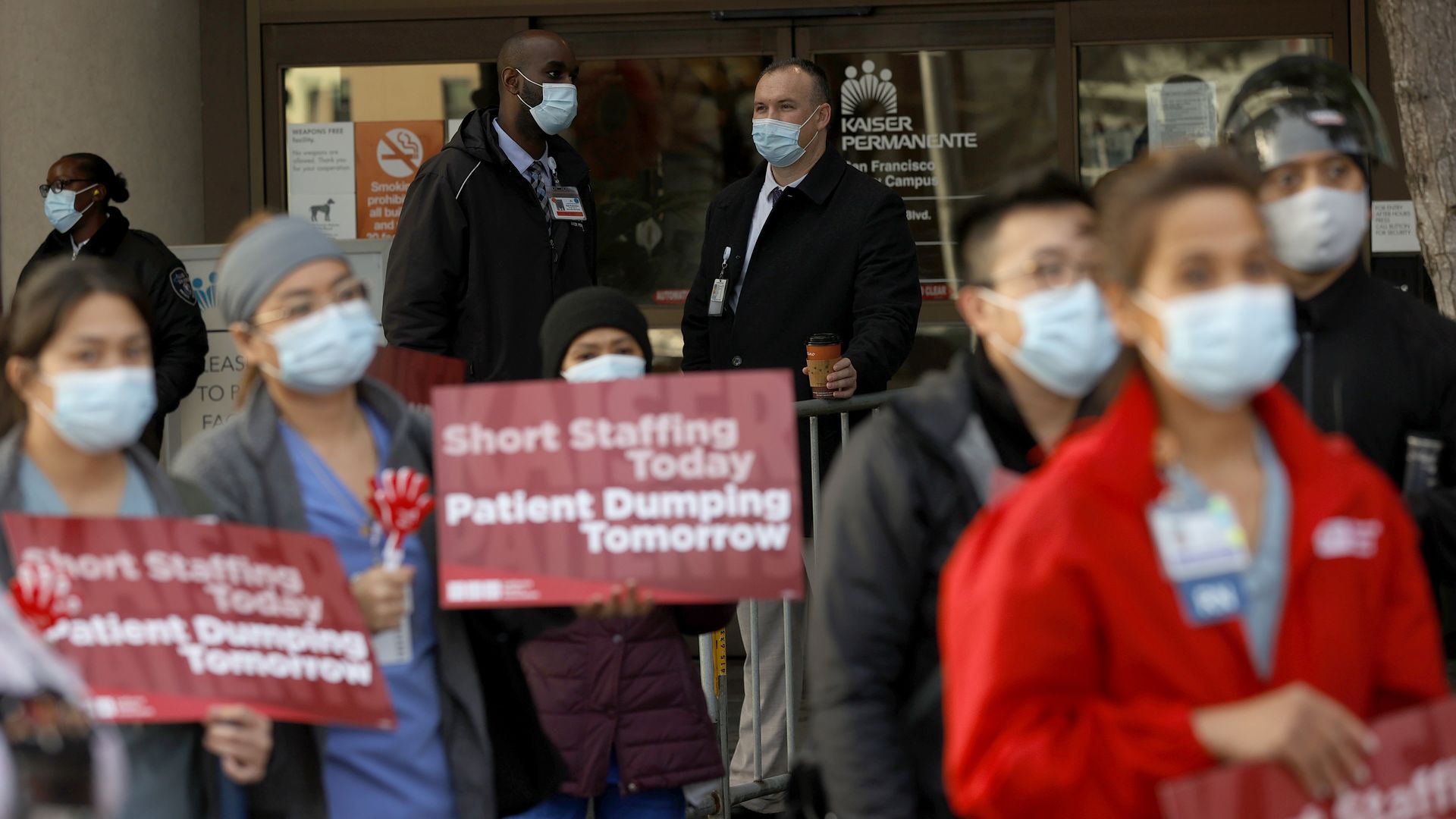
Kaiser Permanente security guards monitor an informational picket outside of the Kaiser Permanente San Francisco Medical Center on November 10, 2021 in San Francisco, California.

Union leaders representing nearly 50,000 health care workers and medical staff reached a tentative agreement in a labor dispute Saturday, avoiding a strike set to begin Monday.

Why it matters: The breakthrough in talks comes as nurses, front-line technicians and other hospital employees face worker shortages and burnout due to the ongoing COVID-19 pandemic.

The big picture: More than 30,000 Kaiser Permanente employees in Oregon, Washington, California and other states threatened to walk out on Monday over lower pay for new hires, Reuters reports.

  • Kaiser and the Alliance of Health Care Unions ended up reaching a tentative four-year deal that includes wage increases, health and retirement benefits and bonus opportunities, per CBS News.

What they’re saying: “This agreement will mean patients will continue to receive the best care, and Alliance members will have the best jobs,” Hal Ruddick, executive director of Alliance, said in the statement.

  • “This landmark agreement positions Kaiser Permanente for a successful future focused on providing high-quality health care that is affordable and accessible for our more than 12 million members and the communities we serve,” said Christian Meisner, senior vice president and chief human resources officer at Kaiser.

What’s next: The agreement heads to union members for ratification, and, if ratified, it will become retroactive to Oct. 1.

Senate bill would make telehealth reimbursement permanent for certain services

https://www.healthcarefinancenews.com/news/senate-bill-would-make-telehealth-reimbursement-permanent-certain-services

A bipartisan group of senators have introduced a bill to make telehealth reimbursement permanent for certain services such as those provided by physical therapists, audiologists, occupational therapists and speech language pathologists.

Sens. Steve Daines (R-Mont.), Tina Smith (D-Minn.), Jerry Moran (R-Kan.) and Jacky Rosen (D-Nev.) introduced the “Expanded Telehealth Access Act” on Thursday, according to The Hill.

If passed, the legislation would extend telehealth reimbursement policies that were temporarily added during the COVID-19 public health emergency.

WHY THIS MATTERS

The Centers for Medicare and Medicaid Services has long said that Congressional action is needed to make emergency telehealth measures permanent.

But on Tuesday, CMS released new actions that will allow Medicare to pay for mental health virtual visits furnished by Rural Health Clinics and Federally-Qualified Health Centers. This is through telecommunications technology such as audio-only telehealth calls.

Telehealth is particularly important for rural areas where patients may have to travel long distances for care.

The Senate bill has the support of the American Telehealth Association, the American Physical Therapy Association, the American Speech-Language-Hearing Association and the American Occupational Therapy Association, among others, according to the report.

The biggest issue in telehealth reimbursement remains. This is whether providers will be continued to be paid at in-person parity for a telehealth visit. 

THE LARGER TREND

The Senate Bill is a companion to a House bill introduced in March by Rep. Mikie Sherrill (D-NJ) called the Expanded Telehealth Access Act.

In May, Senator Daines, one of the sponsors of Thursday’s legislation, with Senator Catherine Cortez Masto (D-Nev.), proposed the “Telehealth Expansion Act of 2021” to permanently allow first-dollar coverage of virtual care under high-deductible health plans.

Tenet strikes $1.2B surgery center deal

Tenet Healthcare Corp. signs deal for ambulatory surgery center at Good  Samaritan Hospital with Hospital for Special Surgery - South Florida  Business Journal

Dallas-based Tenet Healthcare and one of its subsidiaries have entered into a definitive agreement to acquire Towson, Md.-based SurgCenter Development. 

Under the agreement, Tenet and its subsidiary United Surgical Partners International will acquire ownership interests in 92 ambulatory surgery centers and related ambulatory support services for approximately $1.2 billion. Of the 92 ASCs, 16 of them are under development and have not yet opened. 

Under the deal, expected to close in the fourth quarter of this year, SurgCenter and USPI will also enter into an agreement to develop at least 50 centers over a five-year period. 

“We are extremely pleased to announce this transformative transaction and partnership, which builds upon USPI’s position as a premier growth partner and SCD’s track record of developing high-quality centers with leading physicians,” Saum Sutaria, MD, CEO of Tenet Healthcare, said in a Nov. 8 news release. “By welcoming these centers into our company, USPI will maintain its reach as the largest ambulatory platform for musculoskeletal services, a high-growth service line.”

Tenet said it expects the deal to generate strong financial returns.