Most consumers nervous about returning to care settings

https://mailchi.mp/aa7806a422dd/the-weekly-gist-may-8-2020?e=d1e747d2d8

As non-essential businesses begin to reopen, there’s no guarantee that merely opening the doors will make customers return. A recent Morning Consult poll provides an assessment of the impact of COVID-19 on consumer confidence: fewer than one in five US adults are currently comfortable doing (formerly) everyday activities like eating at a restaurant or going to a shopping mall.

The graphic below provides similar data for healthcare. Consumers’ willingness to visit healthcare providers in person for non-COVID care is only slightly better, at 21 percent. Which providers might see patients return most quickly?

Consumers say they are about twice as likely to visit their primary care doctor’s office than other healthcare facilities, including hospitals, specialists, and walk-in clinics. And when it comes to scheduling a routine in-office visit, nearly half say they will wait two to six months, with almost one in ten not comfortable going to a doctor’s office in person for a year or more.

Healthcare facilities face an uphill battle in bringing back patients—many of whom have ongoing chronic diseases that necessitate care now. Reaching patients through telemedicine and providing concrete messages about how they can safely see their doctor will be critical to staving off a tide of disease exacerbations that will mount as fear delays much-needed care.


I’m a nurse in a Covid-19 unit. My hospital’s leaders frighten me more than the virus.

I’m a nurse in a Covid-19 unit. My hospital’s leaders frighten me more than the virus

As a nurse, my hospital's leaders frighten me more than Covid-19 ...

I’ve been a nurse for almost 10 years, working mainly on a hospital’s cardiac floor.

One day I was assigned to a makeshift intensive care unit that had previously been an observation unit for highly stable patients waiting for test results. Many of the patients in this new Covid-19 unit were intubated, with ventilators breathing for them.

When I started the shift, a trained intensive care unit nurse was crying in the supply closet. She was overwhelmed and anxious, hadn’t worked on her familiar unit in weeks, and had been told that her next shift would be an overnight one — and she had no choice in the matter.

Many of us don’t have a choice. We are assigned to work in unfamiliar units, with patients who are outside our expertise, without any training. We’re lost.

Most shifts start with nurses crying. Most shifts end that way too.

“It’s out of our hands,” we hear from hospital administrators.

Nurses who typically work in outpatient clinics are being sent to inpatient floors and assigned to care for patients who are acutely ill. Many haven’t worked at the bedside in decades. The number of patients who have fallen in this unit has risen exponentially in the past two weeks due to lack of training of outpatient nurses.

I wonder if the patients know their nurses are overwhelmed, and that many of them are scared they’ll make a deadly mistake.

“Everyone is out of their comfort zone, just hang in there,” we’re told.

Doctors have been instructed not to enter patients’ rooms unless they must as a way to minimize their exposure to the virus that causes Covid-19 while nurses go from one room to the next, medicating, bathing, turning, and comforting their patients without changing their uncomfortable personal protective equipment, since supplies are limited. This work can take hours. It is not uncommon for nurses to go all day without drinking water or eating because that would mean removing our protective gear.

During one of my shifts, a doctor at my hospital posted several TikToks he made while sitting at the nurses’ station of a busy Covid-19 unit as nurses whispered words of encouragement to patients clinging to life supported by ventilators. Over our words and the hum of the ventilators, I wondered if our patients heard music coming from this doctor’s TikToks.

“We hear your concerns, but there’s nothing we can do,” doesn’t reassure or encourage us.

One day as I worked in the makeshift ICU, one of the hospital’s leaders went floor to floor making an important delivery. She approached our nursing station in her crisp professional attire and fresh disposition, and proudly delivered a supply of makeup-removing wipes. She told us to use the wipes to clean our faces before putting on our N95 masks so we could reuse the masks later, then moved on to the next nurses’ station without asking how our staff was doing or if we needed anything. I wonder if she had noticed the nurse crying in the supply closet.

“That’s above us, we don’t make those decisions,” is passing the buck at its worst.

Excuses from hospital administrators seem to have punctuated every shift for the past six weeks. The praise and applause from hospital leadership only go so far.

I can read in my co-workers’ faces and hear from the stories they tell that the biggest danger we face is not Covid-19. It’s the hospital’s administration.

Leadership is failing us, even as we stand firm in not failing our patients. We care for your loved ones, Covid-19 or not, monitor their vital signs, give them medications, rub lotion on their backs, help them to the bathroom, and brush their hair. We FaceTime their families from our personal phones so they can see their loved ones fighting to live. This is important care that nurses are proud to provide.

The narrative is simple. Nursing, and nurses, are not valued. It’s a shame, and maybe even a deadly shame, that hospital leaders don’t care about nurses like we care for our patients.


14 health systems receiving biggest CARES Act payments

https://www.beckershospitalreview.com/finance/14-health-systems-receiving-biggest-cares-act-payments.html?utm_medium=email

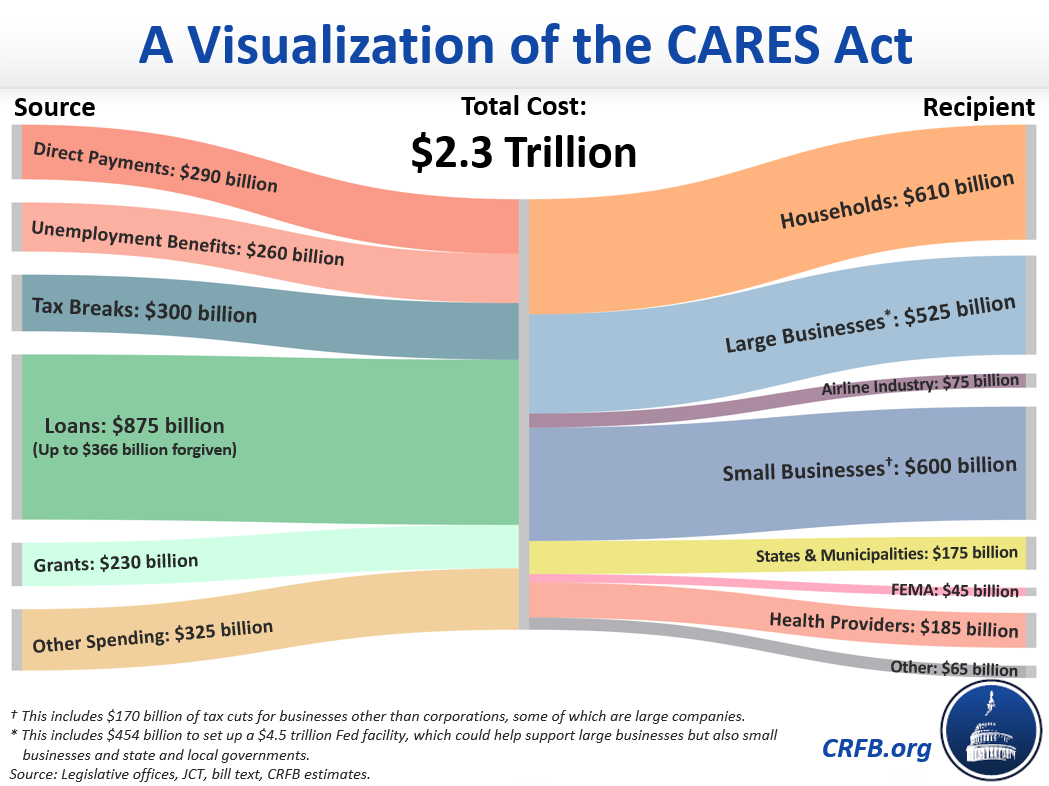
A Visualization of the CARES Act | Committee for a Responsible ...

Hospitals across the U.S. received their first payments in April from the $175 billion in relief aid Congress allocated to cover expenses or lost revenues tied to the COVID-19 pandemic. 

The first $50 billion in funding from the Coronavirus Aid, Relief and Economic Security Act was delivered to hospitals last month. HHS distributed $30 billion based on Medicare fee-for-service reimbursements and another $20 billion based on hospitals’ share of net patient revenue.

HHS released new data May 7, sharing where the $50 billion in funding went. The department provided a list of hospitals that received payments and agreed to the terms and conditions for receiving the relief aid as of May 4. As part of those terms, hospitals agreed not to balance bill COVID-19 patients and to submit documents showing the funds were used for expenses or lost revenue attributable to COVID-19.

Here are the 10 health systems that received the most funding: 

1. Dignity Health (San Francisco): $180.3 million

2. Cleveland Clinic: $103.3 million

3. Stanford Health Care (Palo Alto, Calif.): $102.4 million

4. Memorial Hermann Health System (Houston): $92.4 million

5. NYU Langone Hospitals (New York City): $92.1 million

6. The County of Los Angeles: $80.9 million (Los Angeles County operates four hospitals)

7. Hackensack (N.J.) Meridian Health: $76.8 million

8. Florida Cancer Specialists & Research Institute (Fort Myers): $67.3 million

9. Memorial Hospital for Cancer and Allied Diseases (New York City): $64 million

10. Massachusetts General Hospital (Boston): $58.1 million


Separately, major publicly traded hospital operators disclosed how much funding they received from the CARES Act. Each company received at least $195 million. 

1. HCA Healthcare (Nashville, Tenn.): $700 million

2. Tenet Healthcare (Dallas): $345 million

3. Community Health Systems (Brentwood, Tenn.): $245 million

4. Universal Health Services (King of Prussia, Pa.): $195 million


States face economic death spiral from Coronavirus

https://www.axios.com/coronavirus-states-economy-295ac091-9dc2-4852-be67-d070ec268d8c.html

YEAR-OVER-YEAR CHANGE IN STATE TAX REVENUES

April 2020 vs. April 2019, select states

States face economic death spiral from coronavirus - Business Insider


Early numbers show how significantly the coronavirus is devastating states’ revenue streams — and could force choices between raising taxes or gutting services and laying off public employees.

Why it matters: Even as some states move toward reopening, the economic ramifications of having shut down will haunt them far into the future.

  • When states can reopen, and how quickly industries are able to bounce back, could either worsen or improve projections.

What to watch: Sens. Bob Menendez (D-N.J.) and Bill Cassidy (R-La.) plan to introduce bipartisan legislation as soon as next week that would create a $500 billion fund designed to help struggling state and municipality budgets in the wake of COVID-19.

  • “If there was another way to do this, I’d rather do it the other way,” Cassidy tells Axios. “But what I don’t want to happen is all this money spent for families and for employers to go to waste because cities cannot provide essential services.”
  • Menendez tells Axios: “This is the time to step up to the plate.”

By the numbers: The Urban Institute has been compiling lost revenue data as states make it publicly available. So far, there are figures for about one in four states that compare this April’s state income and sales tax revenue collections against those from April 2019.

  • The data shows collections dropping between 20% and more than 50%, depending on the state, senior researcher Lucy Dadayan tells Axios — and those figures could get worse as new data comes in.
  • South Dakota is an outlier in the states the Urban Institute has tracked so far, in that revenues actually appear up for April. That may be largely because it is one of very few states that did not issue a stay at home order. But experts expect to see revenue declines next month.
  • Although it has not yet released April sales tax numbers to enable a year-over-year comparison, California’s staggering tax revenue loss due to COVID-19 has led to an expected $54.3 billion budget shortfall through FY 2021 — including a $13.4 billion shortfall this fiscal year, the governor announced Thursday. That’s with a $21 billion surplus last year.
  • New York also has yet to release April tax revenue data, but its latest budget projection has the state short as much as $13.3 billion in FY 2021, according to Dadayan’s analysis of most recent state budget projections. Illinois is looking at a more than $4.6 billion shortfall for next fiscal year.
  • Arizona is projecting to be short more than half a billion dollars for this fiscal year.
  • The projected shortfalls for FY 2020, which ends at the end of June for most states, is arguably a bigger problem because there isn’t much time left to make changes, per Axios’ Dan Primack.

The big picture: Democratic-leaning cities have seen the highest case and death rates. But red and blue states alike are facing serious budget shortfalls.

  • That’s why some Republican senators are getting behind efforts to provide federal dollars to help states balance budgets.
  • Even after accounting for state emergency savings accounts — which in many states were at an all-time high — 33 states will likely need to fill budget gaps of 5% or more, according to a recent analysis by Moody’s Analytics.
  • 21 states would need to fill gaps of 10% or more.
  • “Anybody is going to be overwhelmed by this — even states who were well prepared,” Dan White, director of government consulting and fiscal policy research at Moody’s Analytics, tells Axios.

Between the lines: Much of the burden will likely be pushed on struggling local governments’ plates, White said.

  • Cities have also lost smaller revenue sources such as hotel occupancy fees, inspection fees and construction fees.
  • Some could be forced to lay off public workers needed to combat the virus and keep the public safe — such as firefighters, paramedics, public hospital workers.
  • It’s either that or raise taxes in the midst of high unemployment and financial insecurity. “That’s the death spiral,” said Menendez, who has been talking with mayors across his state.
  • New York City Mayor Bill de Blasio has already said he may have to start furloughing municipal employees if the city doesn’t receive federal funds to help fill budget gaps.

Some state and local governments will wait to make tough budget decisions in the hopes that they get needed funds from Congress, which is in heated negotiations around the fourth stimulus package.

Republican lawmakers have been hesitant to provide this much federal help to states, but they’ve been warming to the idea.

  • Menendez says he expects several Republican senators besides Cassidy to sign on to their proposal.


Bankrupt hospitals sue feds

https://www.axios.com/newsletters/axios-vitals-e6483366-26b3-4f34-99c1-f2b356e47b4a.html?utm_source=newsletter&utm_medium=email&utm_campaign=newsletter_axiosvitals&stream=top

Stifel CEO: Hospitals Will Go Bankrupt in Overlooked Threat

Small hospitals going through bankruptcy are suing the Small Business Administration, arguing it is unlawful for the federal government to deny them loans under the Paycheck Protection Program, Axios’ Bob Herman reports.

Why it matters: Allowing bankrupt hospitals access to PPP loans could keep their doors open, and could force the federal government to reverse its stance and allow other bankrupt firms to get PPP loans.

Driving the news: Faith Community Health System, a small rural hospital in Texas that filed for bankruptcy in February, sued the SBA Thursday.

  • The hospital wants to apply for a $2.4 million PPP loan to pay staff and remain open while it goes through bankruptcy and handles the coronavirus pandemic.
  • However, the SBA says bankrupt companies will not be approved for the bailout money because of their “high risk.”
  • Faith Community argues the government agency doesn’t have the authority to exclude bankrupt firms from PPP funding because the law doesn’t spell out those eligibility requirements.

The big picture: Courts are starting to take hospitals’ side.

  • A bankruptcy judge in Maine said the funding was a “grant of aid necessitated by a public health crisis,” and that two hospitals that sued the federal government are entitled to PPP loans.
  • A separate bankrupt hospital in Vermont also should be eligible for PPP funds, a judge ruled this week.

The bottom line: Rural hospitals have been in dire straits for years, and for those that are on the precipice of or are going through bankruptcy, they may be eligible for this bailout funding despite SBA exclusions.


9 health systems with strong finances

https://www.beckershospitalreview.com/finance/9-health-systems-with-strong-finances-050620.html?utm_medium=email

Here are nine health systems with strong operational metrics and solid financial positions, according to reports from Fitch Ratings, Moody’s Investors Service and S&P Global Ratings.

1. Advocate Aurora Health, which has dual headquarters in Milwaukee and Downers Grove, Ill., has an “Aa3” rating and positive outlook with Moody’s and an “AA” rating and stable outlook with S&P. Moody’s said it expects Advocate Aurora to maintain low leverage, a favorable liquidity position and healthy long-term margins, despite the near-term impact from COVID-19.

2. Phoenix-based Banner Health has an “AA-” rating and stable outlook with Fitch and an “AA-” rating and stable outlook with S&P. The health system has a strong financial profile and growing financial stability in its insurance division, Fitch said. Notwithstanding the impact from the COVID-19 pandemic, Fitch expects Banner’s improvement to operating margins will resume and continue to support spending levels and liquidity growth.

3. Clearwater, Fla.-based BayCare Health System has an “Aa2” rating and stable outlook with Moody’s. The health system has strong operating performance and favorable balance sheet metrics, Moody’s said. The credit rating agency expects the health system to maintain strong liquidity and to move quickly with capital expansion.

4. Cincinnati-based Bon Secours Mercy Health has an “AA-” rating and stable outlook with Fitch. The health system has a broad geographic footprint, a good payer mix and a strong financial profile, Fitch said. The credit rating agency anticipates that Bon Secours Mercy Health will increase capital spending over the next three years due to strategic investments in its expanded markets.

5. Omaha, Neb.-based Children’s Hospital and Medical Center has an “AA-” rating and stable outlook with Fitch. The hospital has a dominant market position as the only comprehensive pediatric provider in Nebraska, and its operating cash flow levels are robust enough to absorb any short-term pressure related to the COVID-19 pandemic, Fitch said.

6. Naples, Fla.-based NCH Healthcare System has an “AA-” rating and stable outlook with Fitch. The health system has a strong financial profile, robust operating performance and a leading market position in a favorable service area, Fitch said.

7. Stanford (Calif.) Health Care has an “Aa3” rating and stable outlook with Moody’s. The health system has unique clinical offerings and a strong reputation for patient care and research, Moody’s said. The credit rating agency expects Stanford Health Care to maintain strong patient demand and grow absolute cash flow over the next several years.

8. West Des Moines, Iowa-based UnityPoint Health has an “AA-” rating and stable outlook with Fitch. The health system has strong leverage metrics and regional diversification, Fitch said. The credit rating agency expects the system’s cash flow margins to return to levels of at least 7 percent beyond early 2021 after declining in 2020 due to the COVID-19 pandemic.

9. Arlington-based Virginia Hospital Center has an “AA-” rating and stable outlook with Fitch. The credit rating agency expects Virginia Hospital Center’s strong operating performance to continue after the market recovers from the COVID-19 pandemic.


Trump will urge Supreme Court to strike down Obamacare

https://www.politico.com/news/2020/05/06/trump-supreme-court-obamacare-240366?utm_source=The+Fiscal+Times&utm_campaign=f343554e9c-EMAIL_CAMPAIGN_2020_05_06_09_42&utm_medium=email&utm_term=0_714147a9cf-f343554e9c-390702969

Trump will urge Supreme Court to strike down Obamacare - YouTube

Attorney General Bill Barr had urged the White House to soften its attack on the law during the pandemic.

President Donald Trump on Wednesday said his administration will urge the Supreme Court to overturn Obamacare, maintaining its all-out legal assault on the health care law amid a pandemic that will drive millions of more Americans to depend on its coverage.

The administration appears to be doubling down on its legal strategy, even after Attorney General William Barr this week warned top Trump officials about the political ramifications of undermining the health care safety net during the coronavirus emergency.

Democrats two years ago took back the House of Representatives and statehouses across the country by promising to defend Obamacare, in particular its insurance protections that prevent sick people from being denied coverage or charged more because of a health condition. The issue may prove to be even more salient in November amid the Covid-19 outbreak that health experts believe will persist through the fall.

The Justice Department had a Wednesday deadline to change its position in a case brought by Republican-led states, but Trump told reporters Wednesday afternoon his administration would stand firm. DOJ declined to comment.

“Obamacare is a disaster, but we’ve made it barely acceptable,” Trump said.

The Supreme Court later this fall will hear a lawsuit from the GOP-led states that argue the Affordable Care Act was rendered invalid after Congress eliminated its tax penalty for not having health insurance. A coalition of Democratic state attorneys general and the Democratic-led House of Representatives are defending the law in court.

The Trump administration had previously shifted its legal position in this case, but appears to have decided against doing so again. DOJ originally argued the courts should throw out just Obamacare’s preexisting condition protections, before last year urging that the entire law be struck down.

The Supreme Court is expected to hear the case during its next term starting in October, but it hasn’t scheduled arguments yet. A decision is unlikely before the Nov. 3 election. The court has previously upheld Obamacare in two major challenges that threatened the law’s survival.

About 20 million people have been covered by Obamacare, and the law is expected to provide a major safety net during the economic freefall brought on by the coronavirus. Millions more are expected to join the Medicaid rolls, especially in states that joined Obamacare’s expansion to poor adults. Others who lost workplace health insurance can sign up on the law’s health insurance marketplaces, though the Trump administration isn’t doing much to advertise coverage options.

House Democrats in a filing to the Supreme Court on Wednesday said the pandemic showcased why justices should preserve the law.

“Although Congress may not have enacted the ACA with the specific purpose of combatting a pandemic, the nation’s current public-health emergency has made it impossible to deny that broad access to affordable health care is not just a life-or death matter for millions of Americans, but an indispensable precondition to the social intercourse on which our security, welfare, and liberty ultimately depend,” their brief read.

Obamacare has grown more popular since the GOP’s failed repeal bid during Trump’s first year in office, though the law is still broadly disliked by Republicans. Many Democrats are eager to again run on their defense of Obamacare this fall. That includes presumptive presidential nominee Joe Biden, who has advocated for building on the health care law rather than pursuing a comprehensive progressive overhaul like “Medicare for All.”

Top Trump officials have long been split on the legal strategy in the Obamacare lawsuit. Barr and Alex Azar, the Health and Human Services secretary, both opposed a broader attack on the law, but White House officials have been more supportive, seeing it as a chance to fulfill Trump’s pledge to repeal Obamacare. Barr, in a Monday meeting with Vice President Mike Pence and other White House officials, made an eleventh-hour plea for the administration to soften its legal stance ahead of the Supreme Court’s briefing deadline.


States cut Medicaid as millions of jobless workers look to safety net

https://www.politico.com/amp/news/2020/05/05/states-cut-medicaid-programs-239208?utm_source=The+Fiscal+Times&utm_campaign=f343554e9c-EMAIL_CAMPAIGN_2020_05_06_09_42&utm_medium=email&utm_term=0_714147a9cf-f343554e9c-390702969

Medicaid Cuts Could Hurt Seniors Most | Muskegon Tribune

Three states have cut back state spending on the program since the pandemic hit, and more are warning of painful cuts to benefits and services.

States facing sudden drops in tax revenue amid the pandemic are announcing deep cuts to their Medicaid programs just as millions of newly jobless Americans are surging onto the rolls.

And state officials are worried that they’ll have to slash benefits for patients and payments to health providers in the safety net insurance program for the poor unless they get more federal aid.

State Medicaid programs in the previous economic crisis cut everything from dental services to podiatry care — and reduced payments to hospitals and doctors in order to balance out spending on other needs like roads, schools and prisons. Medicaid officials warn the gutting could be far worse this time, because program enrollment has swelled in recent years largely because of Obamacare’s expansion.

The looming crisis facing Medicaid programs “is going to be the ’09 recession on steroids,” said Matt Salo, head of the National Association of Medicaid Directors. “It’s going to hit hard, and it’s going to hit fast.”

Medicaid programs, among the largest budget items in most states, provide health insurance to roughly 70 million poor adults, children, the disabled and pregnant women. The federal government on average pays roughly 60 percent of program costs, with poorer states receiving a higher share. States have the latitude to adjust benefits, payments to health care providers and eligibility requirements with oversight by the federal government.

Now, governors are turning to Congress for help as it weighs a new package to rescue state budgets battered by the pandemic. They’re asking lawmakers to provide a bigger boost to Medicaid payments and provide hundreds of billions of dollars in aid to shore up state budgets.

Medicaid naturally faces heightened demand as economic conditions worsen. But that leaves states facing more need at the same time that they have less money.

“The cruel nature of the economic downturn is that at a time when you need a social safety net is also the time when government revenues shrink,” Ohio Gov. Mike DeWine, a Republican, said Tuesday as he announced $210 million in cuts to his state’s Medicaid program in the next two months.

The vast majority of a $229 million spending cut made by Colorado Democratic Gov. Jared Polis last week came from Medicaid, though new federal funds will forestall an immediate reduction in benefits or payments to health providers. State legislative committee staff have warned Medicaid enrollment there could spike by 500,000 by the end of the year.

In Georgia, where Medicaid enrollment is projected to rise by as much as 567,000, Republican Gov. Brian Kemp and legislative leaders have instructed every state agency to prepare for 14 percent reductions across the board.

House Democrats are pushing to deliver a $1 trillion-plus package in aid to state and local governments and to support safety net programs, which could alleviate pressure on states to make deep cuts to health care during a pandemic. Some Republican lawmakers have questioned the need for more aid, after Congress has shoveled out trillions of dollars in rescue funding.

Congress already gave states a temporary 6 percent increase in the federal portion of Medicaid spending in an earlier coronavirus package. That prompted Alaska Gov. Mike Dunleavy, a Republican, to cut state Medicaid spending $31 million last month, saying the temporary federal boost would make up the difference.

State officials largely agreed the increase was helpful but said it likely will be washed out by an expected enrollment surge. The nation’s governors say Congress — in addition to providing at least $500 billion in direct support to states — must double the Medicaid funding boost to 12 percent as it did in the previous recession. At least one Republican senator facing a tough reelection fight, Cory Gardner of Colorado, said his state sorely needs extra Medicaid funding to avoid “harmful budget cuts.”

Anywhere from 11 million to 23 million more people could sign up for Medicaid over the next several months. The demand will be even greater in roughly three-quarters of states that expanded Medicaid enrollment to poor adults under the Affordable Care Act.

The portion of state budgets devoted to Medicaid spending has grown quickly since the previous recession, making it a riper target for cuts. Medicaid spending on average accounted for 15.7 percent of state budgets in fiscal 2009, a number that jumped to 19.7 percent in fiscal 2019.

Medicaid enrollment data in some states often lags, making it difficult to determine how much national sign-ups have climbed since jobless claims began surging two months ago. Some states have begun to report notable surges, however, and larger increases are expected in the coming months.

Arizona in the past two months saw 78,000 people enroll in Medicaid and the Children’s Health Insurance Program, which receives more generous funding from the federal government. Virginia has seen a 20 percent increase in enrollment applications since mid-March.

In New Mexico, where 42 percent of the population was already enrolled in Medicaid, sign-ups in the first two weeks of April surged by about 10,000 more people than were expected before the pandemic.

New Mexico’s top Medicaid official said the budget is a significant concern for a state heavily reliant on oil and natural gas. She worries a prolonged economic downturn could force the state to roll back pay increases to Medicaid providers enacted last year, and another planned pay raise for next year is almost certainly off the table.

States that accepted the temporary Medicaid payment increase from Congress are barred from cutting back enrollment while they’re receiving the enhanced funds. That leaves states with the option of cutting benefits or provider payments to find Medicaid savings, which could ignite fierce brawls in state capitals.

Michigan state Rep. Mary Whiteford, the Republican chairwoman of a health care appropriations panel, said the state’s Medicaid enrollment could increase from 2.4 million to 2.8 million by the end of the year.

“We are just planning for major cuts moving forward,” Whiteford said.

Before the pandemic, states had socked away $72 billion in rainy day funds — an all-time high, said Brian Sigritz of the National Association of State Budget Officers. But that figure was easily dwarfed by the $150 billion Congress provided to state and local governments in an earlier package, and it’s far short of what states are demanding.

“Now, we’re looking at greater declines than what we saw during the Great Recession and increased spending,” Sigritz said. “If there aren’t more federal funds, states will have to look at cutting funding for key services: public safety, education, health care. That’s where the money is.”


9 states seek $36B in federal advances for unemployment claims

https://www.politico.com/states/california/story/2020/05/05/9-states-seek-36b-in-federal-advances-for-unemployment-claims-1282530?utm_source=The+Fiscal+Times&utm_campaign=f343554e9c-EMAIL_CAMPAIGN_2020_05_06_09_42&utm_medium=email&utm_term=0_714147a9cf-f343554e9c-390702969

9 states seek $36B in federal advances for unemployment claims

Nine states have told the Department of Labor they plan to ask for $36 billion in federal advances to cover the astronomical cost of unemployment payouts amid the coronavirus pandemic, according to new information provided to POLITICO Tuesday night by federal officials.

Illinois, which had fiscal problems before the coronavirus, tops the list with an $11 billion request in May and June.

California, the first state to borrow, plans to seek the next-highest amount over the same two months: $8 billion.

Texas will ask for advances totaling $6.4 billion in May, June and July and New York will ask for $4.4 billion in the same three months.

Connecticut, Hawaii, Massachusetts, Ohio and West Virginia have also signaled an intent to borrow between May and July to fund their unemployment systems. Some of the states, like Illinois and California, only requested advances for May and June.

There is no approval process for the advances, a department spokesperson said. States notify the Departments of Labor and Treasury of their needs, the spokesperson said, and the Department of Labor certifies those amounts to the Treasury Department.

States are able to draw down advances as they need them, but won’t necessarily end up using the full amounts.

California took out its first $348 million unemployment insurance loan last week, slipping into the red just two years after repaying the $65 billion it borrowed from the federal government during and after the Great Recession. It was one of about three dozen states that took out federal loans to weather the last downturn, a scenario likely to repeat itself in the coming weeks and months as unemployment numbers soar nationwide.

The latest national figures last week showed that more than 30 million had filed jobless claims since mid-March.

California’s unemployment insurance system, funded by payroll taxes, was barely solvent before the pandemic blindsided the economy, with less of a cushion than any other state or territory except for the U.S. Virgin Islands, according to the Department of Labor’s Trust Fund Solvency Report.

Besides Hawaii, all of the states requesting advances also fell well below the department’s recommended solvency level.

Since mid-March, California Gov. Gavin Newsom said Monday, the state has issued $7.8 billion in unemployment relief, and more than 4.1 million people have filed claims — about 21 percent of the state’s pre-pandemic workforce.

Newsom stressed that the state was “good for our word,” but called for direct federal aid. “This pandemic is bigger than even the state of California,” he said. “The economic consequences of this pandemic are such that we can balance our budgets without substantial cuts, unless we get additional federal support.”

States won’t accrue interest on these federal loans through Dec. 31, under the federal Families First Coronavirus Response Act. But the last round of unemployment fund borrowing cost California $1.4 billion in interest payments, according to the state’s Department of Finance.


Hoag sues to end Providence affiliation

https://www.beckershospitalreview.com/hospital-transactions-and-valuation/hoag-sues-to-end-providence-affiliation.html?utm_medium=email

Hoag Memorial Hospital Presbyterian | Visit Newport Beach

Hoag Memorial Hospital Presbyterian, a two-hospital network based in Newport Beach, Calif., is trying to sever its ties to Renton, Wash.-based Providence. 

Hoag announced May 4 that it has filed a lawsuit in an attempt to dissolve its affiliation with Providence. Hoag said it filed the lawsuit after a year of attempted negotiations.

“Hoag must be able to keep local resources and decision making in Orange County to address all the health needs of community members for years to come,” Robert T. Braithwaite, president and CEO of Hoag, said. “The current structure of our relationship with Providence, we believe, is not in the best interest of our patients, the community, our physicians and team members.”

The link up dates back to 2012 when Hoag entered into an affiliation agreement with Irvine, Calif.-based St. Joseph Health, which has since been acquired by Providence, a 51-hospital system.

“Under the existing affiliation, Hoag’s mission and legacy are at risk of being diluted within a large national hospital system,” Mr. Braithwaite said. “We must be able to maintain Hoag’s unique character and role as Orange County’s most trusted health care network, as well as keep local control of community assets.”

Regarding Hoag’s lawsuit, officials from Providence released the following statement to The Orange County Register:

“Now, at a time when all hospitals and health systems are battling the COVID-19 pandemic, the Hoag leaders took legal action to sever its relationship with Providence for reasons that remain unclear,” said the statement from Providence. “Our relationship has been strong since 2012. The Hoag leaders’ so-called ‘realignment’ plan would negatively impact patient care, diminish resources and medical expertise available to Orange County.”