5 trillion-dollar questions hanging over hospitals

Big questions tend to have no easy answers. Fortunately, few people would say they went into healthcare for its ease.

The following questions about hospitals’ culture, leadership, survival and opportunity come with a trillion-dollar price tag given the importance of hospitals and health systems in the $4.3 trillion U.S. healthcare industry. 

1. How will leaders insist on quality first in a world where it’s increasingly harder to keep trains on time? 

Hospitals and health systems have had no shortage of operational challenges since the COVID-19 pandemic began. These organizations at any given time have been or still are short professionals, personal protective equipment, beds, cribs, blood, helium, contrast dye, infant formula, IV tubing, amoxicillin and more than 100 other drugs. After years of working in these conditions, it is understandable why healthcare professionals may think with a scarcity mindset

This is something strong leaders recognize and will work to shake in 2023, given the known-knowns about the psychology of scarcity. When people feel they lack something, they lose cognitive abilities elsewhere and tend to overvalue immediate benefits at the expense of future ones. Should supply problems persist for two to three more years, hospitals and health systems may near a dangerous intersection where scarcity mindset becomes scarcity culture, hurting patient safety and experience, care quality and outcomes, and employee morale and well-being as a result. 

The year ahead will be a great test and an opportunity for leaders to unapologetically prioritize quality within every meeting, rounding session, budgetary decision, huddle and town hall, and then follow through with actions aligned with quality-first thinking and commentary. Working toward a long-term vision and upholding excellence in the quality of healthcare delivery can be difficult when short-term solutions are available. But leaders who prioritize quality throughout 2023 will shape and improve culture.

2. Who or what will bring medicine past the scope-of-practice fights and turf wars that have persisted for decades? 

It is naive to think these tensions will dissolve completely, but it would be encouraging if in 2023 the industry could begin moving past the all-too-familiar stalemates and fears of “scope creep,” in which physicians oppose expanded scope of practice for non-physician medical professionals. 

Many professions have political squabbles and sticking points that are less palpable to outsiders. Scope-of-practice discord may fall in that category — unless you are in medicine or close to people in the field, it can easily go undetected. But just as it is naive to think physicians and advanced practice providers will reach immediate harmony, so too is it naive to think that aware Americans who watch nightly news segments about healthcare’s labor crisis and face an average wait of 26 days for a medical appointment will have much sympathy for physicians’ staunch resistance to change. 

The U.S. could see an estimated shortage of between 37,800 and 124,000 physicians by 2034, according to the Association of American Medical Colleges. Ideally, 2023 is the year in which stakeholders begin to move past the usual tactics, arguments and protectionist thinking and move toward pragmaticism about physician-led care teams that empower advanced practice providers to care for patients to the extent of the education and training they have. The leaders or organizations who move the needle on this stand to make a name for themselves and earn a chapter or two in the story of American healthcare. 

3. Which employers will win and which will lose in lowering the cost of healthcare? 

Employers have long been incentivized to do two things: keep their workers healthy and spend less money doing it. News of companies’ healthcare ventures can be seen as cutting edge, making it easy to forget the origins of integrated health systems like Oakland, Calif.-based Kaiser Permanente, which dates back to one young surgeon establishing a 12-bed hospital in the height of the Great Depression to treat sick and injured workers building the Colorado River Aqueduct. 

Many large companies have tried and failed, quite publicly, to improve healthcare outcomes while lowering costs. Will 2023 be the year in which at least one Fortune 500 company does not only announce intent to transform workforce healthcare, but instead point to proven results that could make for a scalable strategy? 

Walmart is doing interesting things. JPMorgan seems to have learned a good deal from the demise of Haven, with Morgan Health now making some important moves. And just as important are the large companies paying attention on the sidelines to learn from others’ mistakes. Health systems with high-performing care teams and little variation in care stand to gain a competitive advantage if they draw employers’ attention for the right reasons. 

4. Who or what will stabilize at-risk hospitals? 

More than 600 rural hospitals — nearly 30 percent of all rural hospitals in the country — are at risk of closing in the near future. Just as concerning is the growing number of inner-city hospitals at increased risk of closure. Both can leave millions in less-affluent communities with reduced access to nearby emergency and critical care facilities. Although hospital closures are not a new problem, 2022 further crystalized a problem no one is eager to confront. 

One way for at-risk hospitals to survive is via mergers and acquisitions, but the Federal Trade Commission is making buying a tougher hurdle to clear for health systems. The COVID-19 public health emergency began to seem like a makeshift hospital subsidy when it was extended after President Joe Biden declared the pandemic over, inviting questions about the need for permanent aid, reimbursement models and flexibilities from the government to hospitals. Recently, a group of lawmakers turned to an agency not usually seen as a watchdog for hospital solvency — HHS — to ask if anything was being done in response to hospital closures or to thwart them. 

Maintaining hospital access in rural and urban settings is a top priority, and the lack of interest and creativity to maintain it is strikingly stark. As a realistic expectation for 2023, it would be encouraging to at least have an injection of energy, innovation and mission-first thinking toward a problem that grows like a snowball, seemingly bigger, faster and more insurmountable year after year.

Look at what Mark Cuban was able to accomplish within one year to democratize prescription drug pricing. Remember how humble and small the origins of that effort were. Recall how he — albeit being a billionaire — has put profit secondary to social mission. There’s no one savior that will curb hospital closures in the U.S., but it would be a good thing if 2023 brought more leadership in problem-solving and matching a big problem with big energy and ideas. 

5. Which hospital and health system CEOs will successfully redefine the role? 

Many of the largest and most prominent health systems in the country saw CEO turnover over the past two years. With that, health systems lost decades of collective industry and institutional knowledge. Their tenure spanned across numerous milestones and headwinds, including input and compliance with the Affordable Care Act, the move from paper to digital records, and major mergers and labor strikes. The retiring CEOs had been top decision-makers as their organizations met the demands of COVID-19 and its consequences. They set the tone and had final say in how forcefully their institutions condemned racism and what actions they took to address health inequities. 

To assume the role of health system CEO now comes with a different job description than it did when outgoing leaders assumed their posts. Many Americans may carry on daily life with little awareness as to who is at the top of their local hospital or health system. The pandemic challenged that status quo, throwing hospital leaders into the limelight as many Americans sought leadership, expertise and local voices to make sense of what could easily feel unsensible. The public saw hospital CEOs’ faces, heard their voices and read their words more within the past two years than ever. 

In 2023, newly named CEOs and incoming leaders will assume greater responsibility in addition to a fragile workforce that may be more susceptible to any slight change in communication, transparency or security. They will need to avoid white-collar ivory towers, and earn reputations as leaders who show up for their people in real, meaningful ways. Healthcare leaders who distance themselves from their workforce will only let the realistic, genuine servant leaders outshine them. In 2023, watch for the latter, emulate them and help up-and-comers get as much exposure to them as possible. 

Health systems’ minimum wage skyrockets

The percentage of healthcare organizations with an internal minimum wage of $15 or higher increased significantly over the last year, according to the “2022 Health Care Staff Compensation Survey” from SullivanCotter.

In 2021, less than 30 percent of healthcare organizations had an internal minimum wage of $15 per hour or more; this year, nearly 70 percent do. Some health systems are increasing the internal minimum wage to stay competitive amid staffing shortages and rising inflation. Others are increasing hourly rates as a result of union negotiations.

Health systems reported large increases in overall staff salaries, wages and benefits this year, and many expect to see increases in 2023 as well.

Here is how the internal minimum wage rates changed over the last year:

1. Less than $10 per hour
2021: 2.9 percent
2022: 2.2 percent

2. $10 per hour
2021: 14.7 percent
2022: 5 percent

3. $11 per hour
2021: 13.7 percent
2022: 3.9 percent

4. $12 per hour
2021: 12.7 percent
2022: 7.8 percent

5. $13 per hour
2021: 12.7 percent
2022: 6.1 percent

6. $14 per hour
2021: 14.7 percent
2022: 5.6 percent

7. $15 per hour
2021: 26.5 percent
2022: 53.9 percent

8. More than $15 per hour
2021: 2 percent
2022: 15.6 percent

Hospital margins see eleventh-hour improvement

Hospitals experienced a slight boost to operating margins in November, but not enough to restore the median negative margins that persisted for 2022 to date.

Kaufman Hall’s December “National Flash Hospital Report — based on data from more than 900 hospitals — found hospitals’ median operating margin was -0.2 percent through November, a slight improvement from the median of -0.3 percent recorded a month prior. 

A 1 percent decline in expenses from October to November drove the eleventh-hour improvement to margins and tipped the scales on hospitals’ relatively flat revenue. Additionally, hospitals saw labor expenses decrease 2 percent in November, potentially driven by less reliance on contract labor. 

The median -0.2 percent margin recorded in November 2022 marks a 44 percent decline for margins in 22 year-to-date compared to 2021 year-to-date. Kaufman Hall’s index shows hospitals’ median monthly margins have been in the red throughout 2022, starting with the -3.4 percent recorded in January, driven by the omicron surge. November is tied with September as hospitals’ best month of the year, with both sharing a median margin of -0.2 percent. 

Outpatient care marks one of the brighter spots for hospitals’ finances, with outpatient revenue up 10 percent year-over-year while inpatient revenue was flat over the same time period. 

“The November data, while mildly improved compared to October, solidifies what has been a difficult year for hospitals amidst labor shortages, supply chain issues and rising interest rates,” Erik Swanson, senior vice president of data and analytics with Kaufman Hall, said. “Hospital leaders should continue to develop their outpatient care capabilities amid ongoing industry uncertainty and transformation.”

Tracking the rise of high-intensity billing in emergency care

https://mailchi.mp/ad2d38fe8ab3/the-weekly-gist-january-6-2023?e=d1e747d2d8

 The December issue of Health Affairs included an intriguing study that sought to explain the recent trend toward more high-intensity billing in emergency departments (EDs). Using ED visit data for “treat-and-release” visits (i.e. ED patients who were not admitted to the hospital), the study found that visits deemed high-intensity, as defined by certain high-complexity or critical care billing codes, rose from around 5 percent of visits in 2006 to 19 percent in 2019.

The authors conclude that while about half of this increase can be explained by changes in patient case mix and available care services that were visible in claims data, the other half is due to the adoption of sophisticated revenue cycle management programs, and industry-wide changes to billing practices that include upcoding. 

The Gist: At first blush, an increase in high-intensity ED billing may not be a bad thing, if it means that greater numbers of people with low-acuity needs are going to urgent care centers, and avoiding EDs for needs that can be managed elsewhere. But the study finds that treat-and-release rates are going up for high-intensity patients. 

Though the authors list many potential reasons for this—including the changed role of the ED as a diagnostic referral center used by primary care physicians for quick workups of complex patients, the growing number of multimorbid seniors, and value-based care’s pressure to reduce hospital admission rates in favor of more resource-intensive ED visits—we have a strong suspicion that good old-fashioned upcoding also plays a role, especially as the percentage of emergency medicine practices managed by private equity companies increased from four percent to over eleven percent across the same time period as the study. 

Why are fewer hospital admissions coming from the emergency department?

https://mailchi.mp/ad2d38fe8ab3/the-weekly-gist-january-6-2023?e=d1e747d2d8

At a recent health system retreat, the CFO shared data describing a trend we’ve observed at a number of systems: for the past few months, emergency department (ED) volumes have been up, but the percentage of patients admitted through the ED is precipitously down.

The CFO walked to through a run of data to diagnose possible causes of this “uncoupling” of ED visits and inpatient admissions. Overall, the severity of patients coming to the ED was higher compared to 2019, so it didn’t appear that the ED was being flooded with low-level cases that didn’t merit admission. Apart from the recent spike in respiratory illness brought on by the “tripledemic” of flu, COVID and RSV, there wasn’t a noteworthy change in case mix, or the types of patients and conditions being evaluated in the emergency room. (Fewer COVID patients were admitted compared to 2021, but that wasn’t enough to account for the decline.) The physicians staffing the ED hadn’t changed, so a shift in practice patterns was also unlikely. 
 
A physician leader attending the retreat spoke up from the audience: “I can diagnose this for you. I work in the ED, and the problem is we can’t move them. Patients are sitting in the ED, in hallways, in observation, sometimes for days, because we can’t get a bed on the floor. The whole time we are treating them, and many of them get better, and we’re able to discharge them before a bed frees up.”

With nursing shortages and other staffing challenges, many hospitals have been unable to run at full capacity even if the demand for beds is there. So total admissions may be down, even if the hospital feels like it’s bursting at the seams.

The current staffing crisis not only presents a business challenge, but also adversely impacts patient experience, and makes it more difficult to deliver the highest quality care. A good reminder of the complexity of hospital operations, where strain in one part of the system will quickly impact the performance of other parts of the care delivery continuum.

How the Omnibus spending package impacts healthcare

https://mailchi.mp/ad2d38fe8ab3/the-weekly-gist-january-6-2023?e=d1e747d2d8

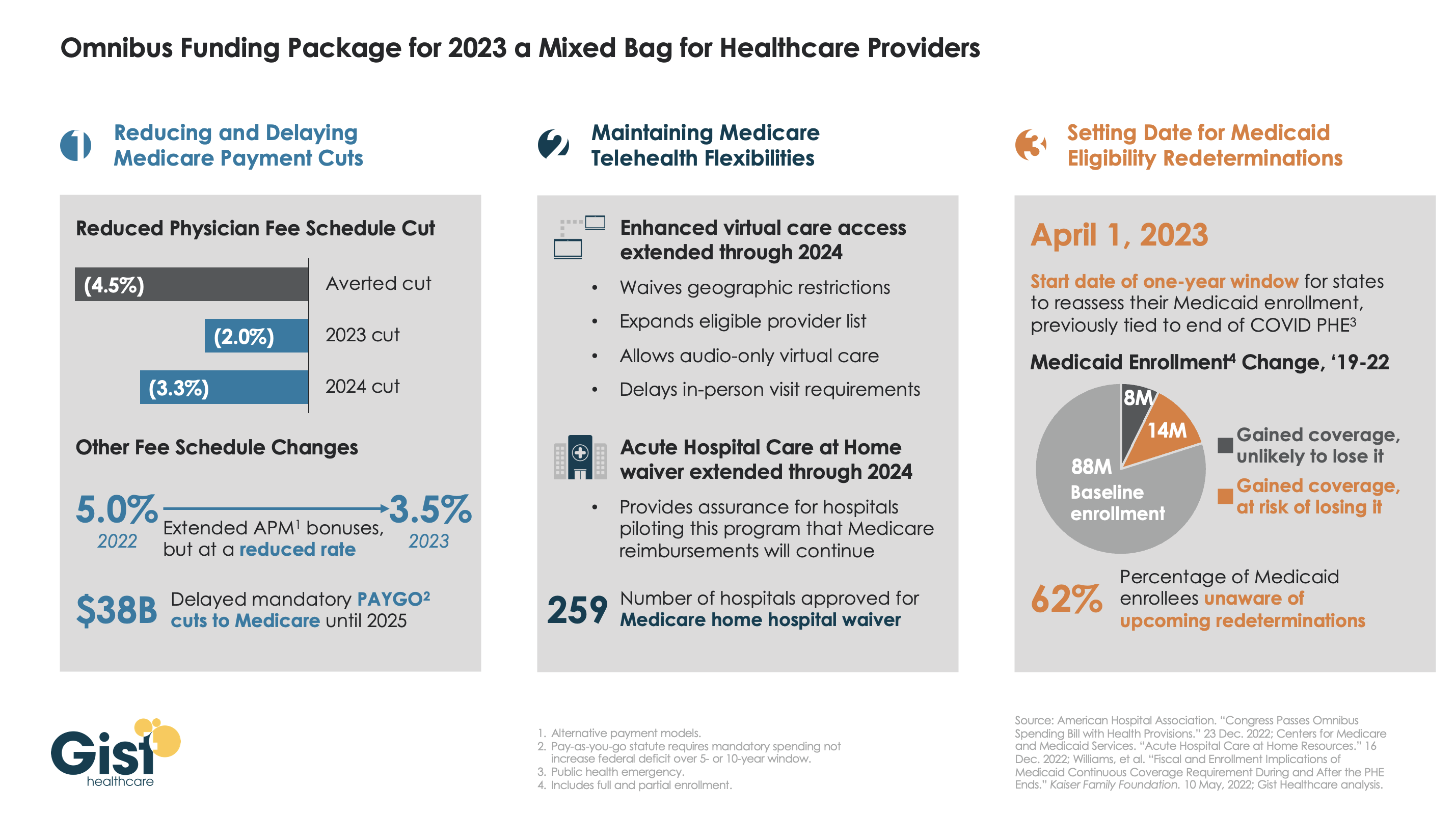
While healthcare wasn’t a top priority for lawmakers hammering out the Omnibus bill aimed at keeping the government open through next September, the graphic above outlines the bill’s three greatest areas of impact for providers.

The package reduces the planned 4.5 percent 2023 physician fee schedule cut to two percent, while also extending value-based care bonuses in alternative payment models (albeit at 3.5 percent, instead of five percent). It also delays the $38B Medicare spending cut required by the PAYGO sequester, pushing that cut out two years.

On the telehealth front, the bill extends Medicare’s pandemic-era virtual care flexibilities through 2024, including the “hospital at home” waiver. It also sets April 1, 2023 as the start date of a one-year window for states to reassess Medicaid enrollment, decoupling the start of eligibility redeterminations from the end of the federal COVID public health emergency. Medicaid enrollment grew by 25 percent over the course of the pandemic, but around two-thirds of new enrollees may lose eligibility after redeterminations. 

Overall, the legislation is a mixed bag for providers. The uninsured population is expected to grow, at least in the short term. Physician groups had hopes for a complete reprieve from Medicare pay cuts, and the fact that they didn’t get it may signal growing Congressional hesitancy to intervene with the Medicare physician fee schedule in the future. But the telehealth extensions may encourage other wider adoption of reimbursement by private insurers, bolstering providers’ long-term virtual care investments.

Biden signs omnibus bill into law, reducing physician pay cut

https://mailchi.mp/ad2d38fe8ab3/the-weekly-gist-january-6-2023?e=d1e747d2d8

Late last week, President Biden signed a $1.7T spending package to fund the federal government through next September. While around half the funds are dedicated to defense, some important healthcare items made it into the bill, including a reduction in planned Medicare physician pay cuts and a two-year postponement of the $38B Medicare spending cut required by the PAYGO sequester.

The law also decoupled several measures from the end of the federal COVID public health emergency (PHE), setting April 1st as the start date for states to begin Medicaid eligibility redeterminations, and extending Medicare’s telehealth flexibilities and the Acute Hospital Care at Home waiver program through the end of 2024. For more details on these changes, see our graphic below.

The Gist: Medical groups were hoping for more of a reprieve from the Medicare physician fee schedule cuts, but Congress proved unwilling to address concerns over rising practice costs. We’re relieved that Medicare’s new telehealth and hospital at home policies will continue beyond the PHE, given the early interest we’ve seen from the provider community in embracing these new, more consumer-friendly care models.

Once the new Congress finally gets underway, we’re expecting this to be an uneventful two years for federal healthcare legislation, with the emphasis of health policy likely to shift toward states, federal agency rulemaking, and judicial activity.

2022 Was Hospitals’ Worst Financial Year in Decades, But 2023 Won’t Be Much Better

https://medcitynews.com/2023/01/2022

Financial analysts have said that 2022 may have been the worst year for hospital finances in decades. This year looks like it will be yet another year of financial underperformance, with rural providers in especially dire circumstances. 

What’s driving this bleak financial reality? It’s “primarily an expense story,” said Erik Swanson, a senior vice president at Kaufman Hall‘s data analytics practice.

“Growth in expenses has vastly outpaced growth in revenues — since pre-pandemic levels since last year, and even the year prior — such that margins are ultimately being pushed downward. And hospitals’ median operating margin is still below zero on a cumulative basis,” he declared, referring to 2021 and 2020. 

Here’s some context about how dismal this situation is: Even in 2020, a year in which hospitals saw extraordinary losses during the first few months of the pandemic, they still reported operating margins of 2%.

What’s even more disconcerting is that hospitals are underperforming financially pretty much across the board, Swanson said.

For example, the financial reports for the country’s three largest nonprofit health systems — AscensionCommonSpirit Health and Trinity Health — revealed they are all struggling. Ascension reported a $118.6 million loss in the third quarter of 2022, CommonSpirit posted a $227 million loss, and Trinity posted a $550.9 million loss.

Even Kaiser Permanente, one of the country’s largest health systems with an integrated delivery model, reported a $1.5 billion loss for the third quarter of 2022.

Rural hospitals are in even worse shape, but more on that below.

Other hospitals have been forced to shutter service lines to offset these financial losses. Some are also turning to integration and consolidation.

For example, Hermann Area District Hospital in Missouri said last month that it is seeking a “deeper affiliation” with Mercy Health or another provider. This announcement came after the hospital eliminated its home health agency as a cost-cutting measure. In December, the hospital projected a loss of $2 million for 2022.

We can also look at the mega-merger between Atrium Health and Advocate Aurora Health, which was completed last month. The deal, which is designed for cost synergy, creates the fifth-largest nonprofit integrated health system in the U.S. 

The merger was finalized one day after North Carolina Attorney General Josh Stein expressed concern about how the deal could impact rural communities. He said that while he didn’t have a legal basis within his office’s limited statutory authority to block the deal, he was worried that it could further restrict access to healthcare in rural and underserved communities.

Stein brings up an extremely valid concern. Rural hospitals’ dismal financial circumstances are becoming more and more worrisome — in fact, about 30% of all rural hospitals are at risk of closing in the near future, according to a recent report from the Center for Healthcare Quality and Payment Reform (CHQPR).

A crucial reason for this is that it is more expensive to deliver healthcare in rural areas — usually because of smaller patient volumes and higher costs for attracting staff. Another factor is that payments rural hospitals receive from commercial health plans isn’t enough to cover the cost of delivering care to patients in rural areas, said Harold Miller, CEO of CHQPR. 

“Many people assume that private commercial insurance plans pay more than Medicare and Medicaid. But for small rural hospitals, the exact opposite is true,” he said. “In many cases, Medicare is their best payer. And private health plans actually pay them well below their costs — well below what they pay their larger hospitals. One of the biggest drivers of rural hospital losses is the payments they receive from private health plans.”

In Miller’s view, rural hospitals perform two main functions: taking care of sick people in the hospital and being there for people in case they need to go to the hospital. 

To fulfill the latter job, rural hospitals must operate 24/7 emergency rooms. These hospitals get paid when there’s an emergency, but not when there isn’t — even though the hospital is incurring costs by operating and staffing these units.

“Rural hospitals have a physician on duty 24/7 to be available for emergencies. But they don’t get paid for that by most payers. Medicare does pay them for that, but other payers don’t. If the hospital is doing two different things, we should be paying them for both of those things. Hospitals should be paid for what I refer to as ‘standby capacity,’” Miller said.

He bolstered his argument by pointing to these analogies: Do we only pay firefighters when there’s a fire? Do we only pay police officers when there’s a crime?

It’s also important to remember that rural hospitals are in the midst of transitioning to a post-pandemic environment, now without the pandemic-era financial assistance they received from the government, said Brock Slabach, chief operations officer at the National Rural Health Association

“Rural providers are looking to move into the future without the benefit of those extra payments. And they’re in an environment of really high inflation. It’s over 8%, and for some goods and services in the healthcare sector, that’s going to be over 20% in terms of increased prices. Wages and salaries have also gone up significantly. But patient volumes have maintained below average or average. That all presents a huge challenge,” Slabach said.

Rural providers across the country are dealing with the stressors Slabach described and clamoring for more government help. For example, the Michigan Health & Hospital Association sought more money from the state last month after having to take 1,700 beds offline.

Many rural hospitals can’t escape their fate. From 2010 to 2021, there were 136 rural hospital closures. There were only two closures in 2021, and Slabach said 2022 produced a similarly low number. But these low totals are due to government relief, he explained. Slabach said he’s expecting an increase in rural hospital closures in 2023.

When a rural hospital closes, it means community members have to travel far distances for emergency or inpatient care. Miller pointed out another problem: in many rural communities, the hospital is the only place people can go to get laboratory or imaging work done. The hospital might also be the only source of primary care for the community. Shuttering these hospitals would be a massive blow to rural Americans’ healthcare access.

In the face of these potentially devastating blows to patient access, financial analysts’ outlook is bleak. 

Higher inflation and costly labor expenses will continue to have negative effects on hospitals — both rural and urban — in 2023, according to an analysis from Moody’s. Expenses will also continue to increase due to supply chain bottlenecks, the need for more robust cybersecurity investments and longer hospital stays due to higher levels of patient acuity.

All of this doom and gloom begs the question — are any hospitals doing well financially?

The answer is yes, a select few. Let’s look at the three largest for-profit health systems in the nation — Community Health SystemsHCA Healthcare and Tenet Healthcare. As of 2020, these three public health systems accounted for about 8% of hospital beds in the U.S. 

These three systems all had positive operating margins for the majority of the pandemic, including most recently in the third quarter of 2022.

Large public health systems have shareholders to report to and stock prices to worry about. Does this mean they’re more likely to deny care to patients who can’t afford it while other hospitals pick up the slack?

Slabach said it’s tough to say.

“Obviously, hospitals try to mitigate their exposure to risk when it comes to taking care of patients. Most hospitals do a really good job of providing services and care to people who don’t have insurance or don’t have the means to pay. But that gets stressed in this current financial environment. So indeed, there may be instances where what you suggested might happen, but it’s not because they want to deny services or deny care. It’s because they have a bigger picture they have to maintain,” Slabach said.

And the big picture involving dollar signs for hospitals looks pretty bleak in 2023.

6 health systems hit with credit downgrades

A number of health systems experienced downgrades to their financial ratings in recent weeks amid ongoing operating losses, declines in investment values and challenging work environments.

Here is a summary of recent ratings since Becker’s last roundup Nov. 15:

The following systems experienced downgrades:

Adventist Health (Roseville, Calif.): Saw a downgraded long-term credit rating on bonds it holds, declining from “A” (negative) to “A-” (stable) by S&P Global Ratings.

The December downgrade follows a 2021 downgrade from Fitch Ratings from “A+” to “A.” That downgrade reflected “a series of one-time events and the lingering deleterious impact from the novel coronavirus” which “resulted in lower than anticipated operating EBITDA margins,” Fitch said. In November, Fitch added to this assessment by downgrading Adventist’s outlook from stable to negative, reflecting “continued negative operational pressure.” 

The group, which operates 23 hospitals in California, Hawaii and Oregon, was also assigned an “A” rating by Fitch to 2022 bonds and other outstanding debt.

Catholic Health (Buffalo, N.Y.): The group was downgraded on debt from “B1” to “Caa2” by Moody’s and is in danger of defaulting on its covenants.

The nonprofit health system, which serves residents in Western New York with four acute care hospitals and several other facilities, saw its rating drop in November on approximately $364 million of debt.

Duke University Health System (Durham, N.C.): Downgraded to an “AA-” credit rating by Fitch Ratings.

The December downgrade comes amid concern over Duke’s planned integration of the Private Diagnostic Clinic, a for-profit medical group with more than 1,800 physicians.

The rating, reduced from “AA,” applies both to specific bonds the group holds and to its overall issuer default rating. In addition to the integration of the Private Diagnostic Clinic, Fitch also cited concern over macro issues such as labor and inflationary pressures, which have helped to drag down operating results for the health group.

Main Line Health (Radnor Township, Pa.): – Had its bond rating downgraded to “A1” from “Aa3” by Moody’s.

The December downgrade reflects a multiyear trend of weak operating performance and expectations of tepid progress into 2023, Moody’s said.

In addition to Main Line’s revenue bond rating declining, its outlook has been revised to stable from negative at the lower rating. The hospital group has approximately $651 million in outstanding debt, Moody’s said.

Prime Healthcare (Ontario, Calif.): The group was downgraded on probability of default rating to “B2-PD” from “B1-PD” as well as its ratings of the system’s senior secured notes to “B3” from “B2” by Moody’s.

Moody’s also revised the outlook in November to negative from stable because it projects operating expenses will continue to pressure the 45-hospital system’s profitability in the near term, presenting challenges for “the company’s pace of deleveraging,” according to a Nov. 18 news release.

Westchester County Health Care Corp. and Charity Health System (Valhalla, N.Y): The group was downgraded from “Baa2” to “Baa3” by Moody’s.

The December downgrade for CHS is based on WCHCC’s legal guarantee to pay debt service on CHS’ Series 2015 bonds, if CHS is unable. The outlook for both systems remains negative with WCHCC and CHS having $773 million and $127 million of debt, respectively, at the end of fiscal year 2021, Moody’s said.

New Jersey hospital shifts to freestanding ER after Trinity, Capital Health transaction closes

St. Francis Medical Center in Trenton, N.J., on Dec. 21 transitioned to a freestanding emergency room that offers various outpatient services after Capital Health acquired the hospital from Trinity Health, according to PBS affiliate WHYY.

The campus, renamed Capital Health – East Trenton, must feature a primary family health clinic and a women’s OB/GYN clinic, according to terms of the transaction. 

Other services, such as cardiac surgery, are moving to Capital Health Regional Medical Center in Trenton, where “extensive capital projects” are being planned, the health system said in a Dec. 8 news release. 

A St. Francis spokesperson told the news outlet that the hospital had been financially struggling for years. 

“St. Francis has done many great things for the Trenton community, but the current healthcare landscape has made it unsustainable,” Capital Health President and CEO Al Maghazehe said. “Without these key approvals, Trenton would have lost desperately needed healthcare services, including emergency services, behavioral health and cardiac surgery.” 

Capital Health said it has taken “a significant risk” to try and prevent a healthcare crisis for Trenton’s 90,000 residents, according to the report.