America’s inflation turnaround

It may be time to update your inflation narrative.

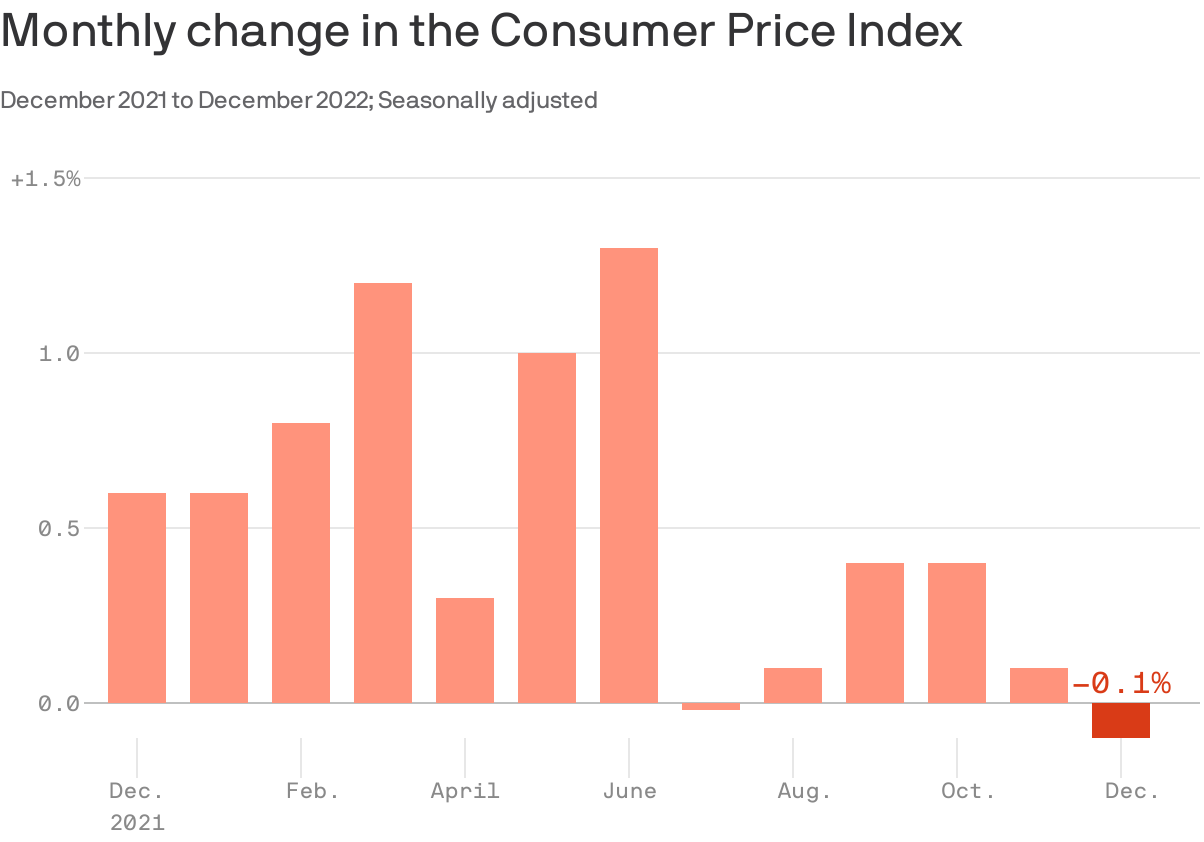
The ultra-hot readings that defined the first half of 2022 appear to be firmly in the rearview mirror, improving the odds that price pressures can dissipate further without excessive economic pain.

  • That’s the key takeaway from the December Consumer Price Index released this morning, which confirmed notably cooler inflation as the year came to a close.

Why it matters: 

The nation’s inflation problem isn’t over, but so far inflation is slowing while the job market is still healthy, an enviable combination.

  • As Princeton economist Alan Blinder put it in an op-ed last week, inflation was “vastly lower” in the second half of 2022 than the first; yet, “hardly anyone seems to have noticed.”

By the numbers: 

In the final three months of 2022, core inflation (which excludes food and fuel costs) came in at an annualized 3.1% — higher than the Fed aims for, but hardly crisis levels. In the second quarter of the year, that number was 7.9%.

  • It’s a stunning decline, occurring alongside a labor market that by nearly all measures is still flourishing. Just this morning, the Labor Department announced that jobless claims fell to an ultra-low 205,000 last week.

State of play: 

Grocery prices rose 1.1% in the final three months of the year, an uncomfortably high rate, but not as extreme as the rates seen earlier in 2022.

  • Gasoline prices, pushed up by Russia’s invasion of Ukraine, were once the crucial reason why inflation was rising. In recent months, the opposite has been true: December pump prices slid 9.4%, helping drag the overall index into negative territory.
  • Disinflation was at work for many other goods, including used cars (-2.5%) and new vehicles (-0.1%) where prices have reversed, helped by easing supply chain bottlenecks.
  • Shelter costs pushed inflation upward, surging 0.8% in December. But private-sector data points to rents on new leases falling in recent months, which would only filter into the CPI data over time. That makes for a more benign inflation outlook in 2023.

What to watch: 

That’s not to say there aren’t risks ahead. The war in Ukraine is ongoing, and another energy price shock could occur.

  • The Fed has also focused in on the services sector, where price increases have slowed from last summer but remain frothy. The risk is that business costs associated with the still-tight labor market (like higher wages) will pass through to prices for consumers.

The bottom line: 

Inflation will still be a worry in 2023, but much less so than it seemed a few months ago.
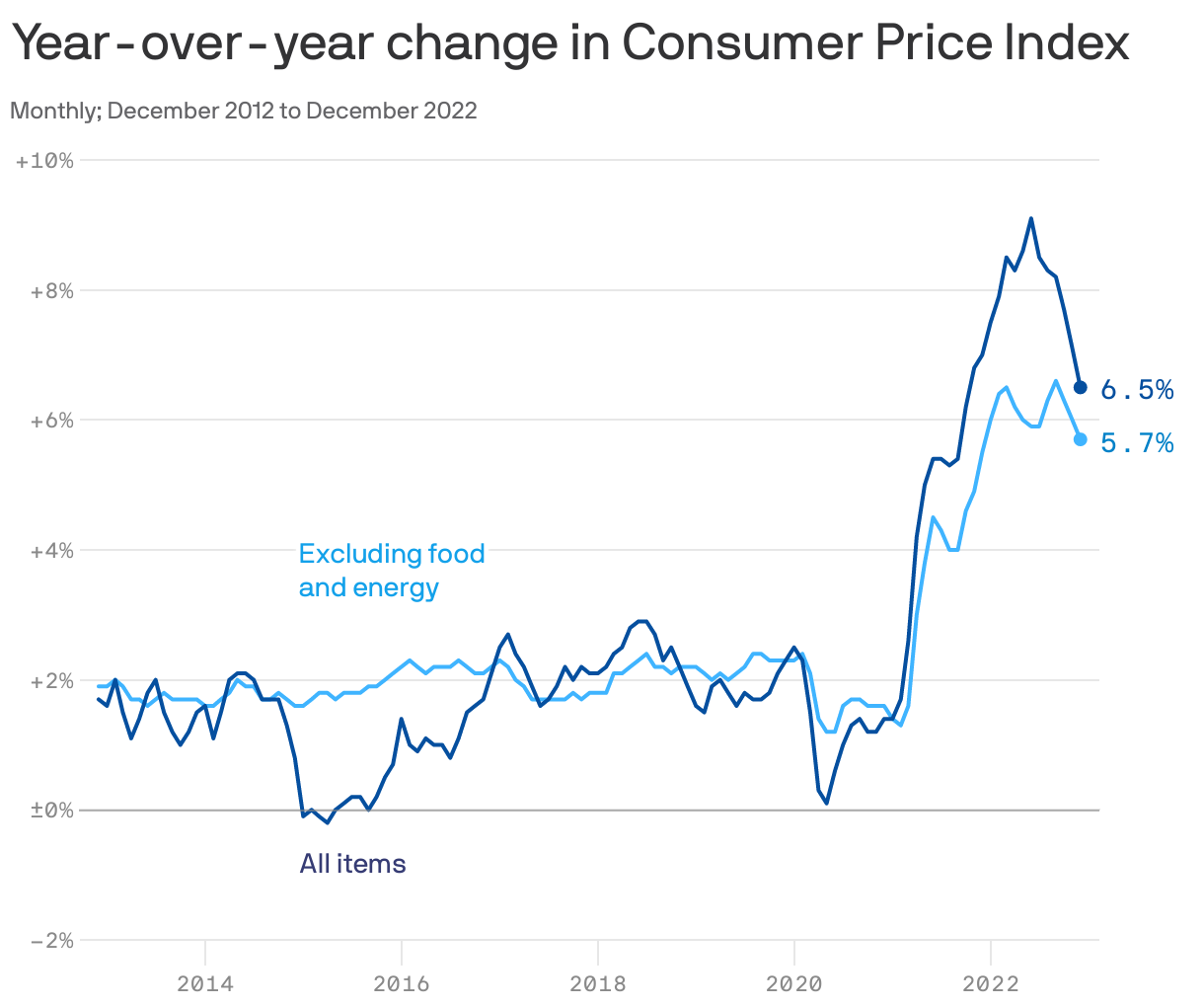
Consumer prices fell in December as inflation continues to cool

U.S. consumers got a reprieve from soaring costs in December: the Consumer Price Index declined on a monthly basis, the first drop since last summer as falling prices for items including gasoline and used cars dragged the overall index down.

By the numbers:

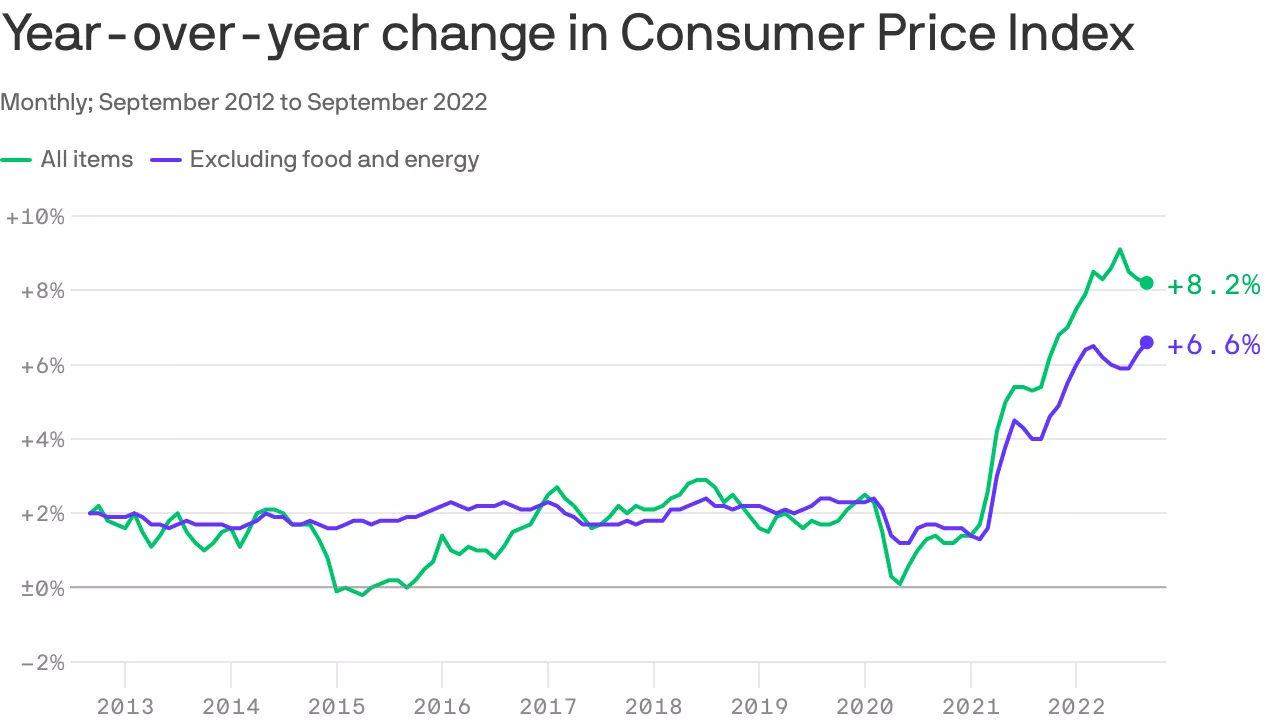
The index, which captures price changes across a basket of consumer goods and services, fell 0.1%, following an increase by the same amount in November. Over the past 12 months ending in December, the index is up 6.5%, falling from 7.1% through November.

  • Core CPI, which excludes food and fuel costs, rose by 0.3% last month. Over the last 12 months through December, the index rose 5.7%. In November, those figures were 0.2% and 6%, respectively.

Why it matters:

The hot inflation that persisted through much of last year continues to show signs of receding — offering at least some relief for shoppers, the White House and the Federal Reserve, though some underlying inflation pressure remains.

Where it stands:

The data caps a year in which consumer prices rose rapidly, though the pace of cost increases began to slow in the final months of the year.

  • As consumers shifted spending and supply chains began to heal, price increases for a range of goods have cooled or, in some cases, costs have fallen outright.

Between the lines:

The Federal Reserve, which has been raising interest rates aggressively to tame inflation, is watching the services sector closely, where inflation can be more challenging to stamp out.

  • A sub-index measuring price moves within the services category (excluding housing) accelerated by 0.4%, after two straight months of cooler readings
  • Still, in the 12 months through December, this sub-index is up 7.4% (compared to 7.3% in November).

Wage growth looks healthy but not inflationary

The Goldilocks nature of these jobs numbers is particularly apparent in the wage data.

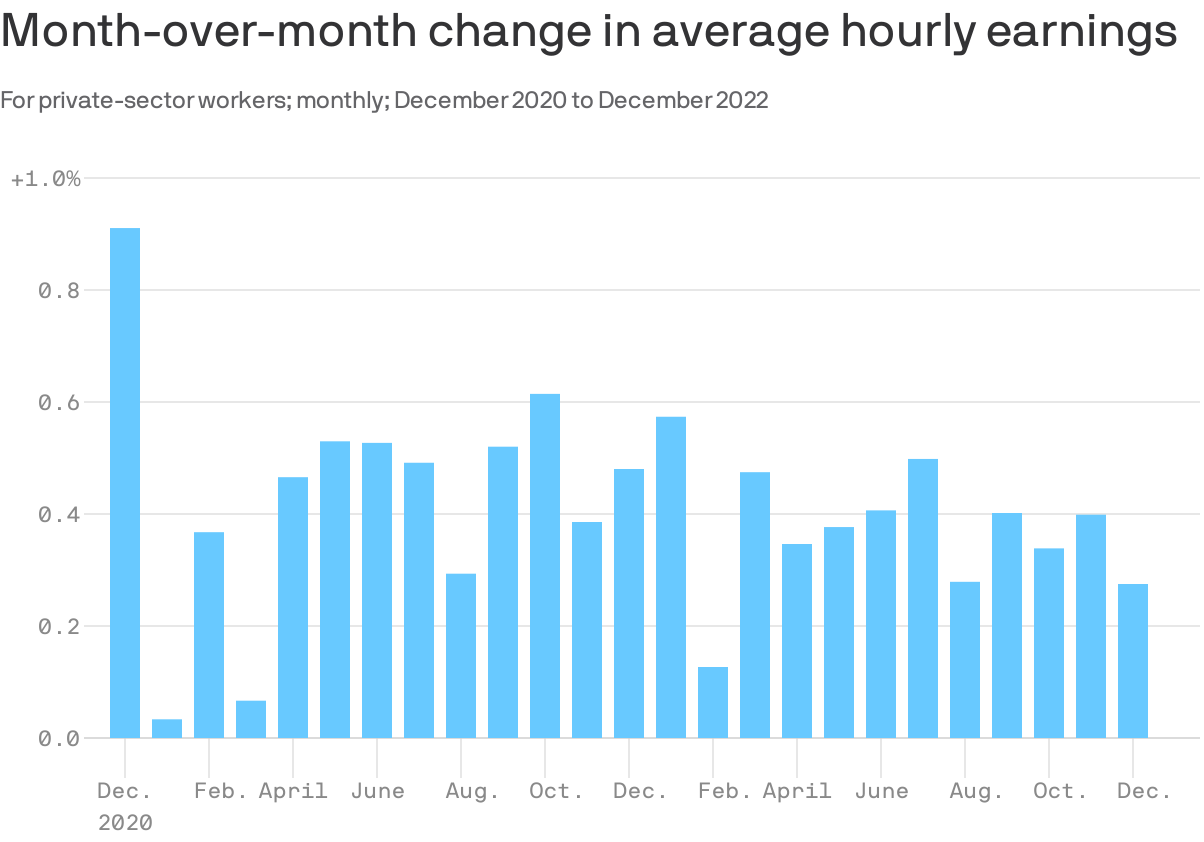
By the numbers: Average hourly earnings rose by 0.3% in December, and are up 4.6% over the last year. Over the last three months, worker pay rose at a 4.1% annual rate.

  • Wages are rising, but unlike a year ago, the pace is consistent with the economy settling into the 2% inflation that the Fed seeks.
  • For example, there were stretches in 2018 and 2019 that featured wage growth similar to that in Q4 paired with low inflation levels — which meant rising real wages for workers.
  • In other words, current pay growth, if sustained, would help diminish the Fed’s fears of an upward spiral of wages and prices. Also, it sets workers up to see gains in their real compensation, if and when inflation comes down.

The intrigue: It appears that a surge in earnings initially reported in November was a head fake. The Labor Department revised those numbers to show a 0.4% rise in hourly earnings, not the 0.6% first reported.

  • The original figures had been a source of alarm among Fed watchers, suggesting the central bank might need to step up its monetary tightening campaign.

It is a good reminder  for both policymakers and those of us in the media — to not overreact to single-month shifts in any volatile data series.

A superb jobs report

We really liked what we saw in the December jobs report, which made us more optimistic about the possibility the 2023 economy will hold up reasonably well. More details below.

  • Situational awareness: In less optimistic news, the Institute for Supply Management’s survey of service industry activity plunged in December, to 49.6% — down from 56.5% in November. This is the first time the index has been in negative territory since May 2020.

The U.S. labor market is extraordinarily strong, despite gloom-and-doom economic forecasts and high-profile layoffs.

  • That is the takeaway from December numbers, out this morning, that were outstanding in subtle and not-so-subtle ways.

Why it matters: If America’s economy is going to come in for a soft-landing — inflation dissipating without mass unemployment — you would expect to see numbers that look a lot like last month’s.

  • The economy continues to add a healthy number of new jobs, though the pace is moderating. Wages are rising, but not so quickly as to alarm economic policymakers. And more workers are entering the labor force, which — if sustained — could heal labor shortages.
  • The data has positive developments both for American workers — who continue to have abundant job opportunities — and for Fed officials seeking evidence that their inflation-fighting efforts are starting to cool job creation and wage growth to more sustainable rates.

The headline unemployment rate, at 3.5%, matched its lowest levels in decades. If you extend the calculation out a couple more decimal places, University of Michigan economist Justin Wolfers points out, it was 3.468%, the lowest since 1969!

  • It fell even as the labor force expanded by 439,000 workers, a welcome development on the supply front after months of little progress. More Americans working means fewer of the labor shortages that have contributed to inflation.
  • An additional 717,000 Americans reported being employed, helping resolve what had been a puzzling disconnect between different sources of labor market data — and in a positive direction.
  • A stunningly low jobless rate might raise some alarm bells at the Fed over the possibility the job market is too tight, and that this could fuel inflation. But the labor force growth and benign wage data (more on that below) may take the edge off those fears.

By the numbers: Employers are still hiring at a rapid pace — 223,000 in December — but slowing from early last year’s unsustainable numbers.

  • The economy has added roughly 247,000 jobs per month on average in the last three months, slower than the 366,000 in the prior three-month stretch, and less than half of the 539,000 jobs added each month in Q1 2022.
  • Evidence of tech layoffs did show up somewhat in the report, with the information sector shedding 5,000 jobs. Temporary help services employment fell by 35,000, the clearest sign employers are paring back demand for workers.
  • But most other sectors, including leisure and hospitality, construction and health care, continued to add jobs.

The bottom line: If we keep getting numbers like these, 2023 may not be such a rough year for workers after all.

The dire state of hospital finances (Part 1: Hospital of the Future series)

About this Episode

The majority of hospitals are predicted to have negative margins in 2022, marking the worst year financially for hospitals since the beginning of the Covid-19 pandemic.

In Part 1 of Radio Advisory’s Hospital of the Future series, host Rachel (Rae) Woods invites Advisory Board experts Monica WestheadColin Gelbaugh, and Aaron Mauck to discuss why factors like workforce shortages, post-acute financial instability, and growing competition are contributing to this troubling financial landscape and how hospitals are tackling these problems.

Links:

As we emerge from the global pandemic, health care is restructuring. What decisions should you be making, and what do you need to know to make them? Explore the state of the health care industry and its outlook for next year by visiting advisory.com/HealthCare2023.

Inflation cools in November for the second-straight month

Following a cooler-than-expected inflation reading in October, consumer price gains slowed even further last month: the Consumer Price Index rose 7.1% in the year ending in November, down from 7.7% the prior month, the Labor Department said on Tuesday.

Why it matters: Inflation is still way too high, but the data offers some hope that it can ease alongside a still-healthy economy.

By the numbers: On a monthly basis, CPI rose 0.1%, slower than the 0.4% in October.

  • Core CPI, which strips out volatile food and energy costs, also continued to ease. On a monthly basis, it rose 0.2% — up 6% over the 12 months ending in November.
  • In October, those figures were 0.3% and 6.3%, respectively.

Where it stands: The Federal Reserve has raced to try to get inflation under control, raising interest rates at a historic clip — moves that risk throwing the economy into a recession.

  • Officials will likely raise rates by a smaller (but still historically huge) amount following a two-day policy meeting that concludes on Wednesday.
  • That will come after surprisingly cooler inflation readings, though officials have warned that its war on inflation is far from over.

High labor costs, inflation make healthcare outlook negative, Moody’s says

Sustained high labor expenses and inflationary pressures will continue to affect the healthcare industry in 2023, keeping the outlook for nonprofit hospital systems negative, Moody’s said in a Dec. 7 report.

In addition to such pressures, persistent COVID-19 surges, supply chain disruptions and the need for continued cybersecurity investments will also increase expenses, the report said. And while operating revenue is expected to modestly improve next year, the ending of federal Coronavirus Aid, Relief and Economic Security Act funding, net Medicare cuts and the end of the public health emergency will negatively affect hospital revenues, Moody’s said.

“This level of operating cash flow production will likely prove insufficient over the long term to enable adequate reinvestment in facilities, maintain investment in programs, or support organizational growth — key considerations that drive our negative outlook,” said Brad Spielman, vice president, senior credit officer for Moody’s.

Some of the less well-funded healthcare systems could even face breaches of covenant amid such a challenging backdrop, Moody’s warned. Such covenants typically refer to issues like days of cash on hand or minimum coverage of debt.

Management in such challenged systems have taken measures to mitigate the danger of such breaches, the report said. These include liquidating investments and drawing on lines of credit as well as refinancing debt, an unfavorable option in the current economic situation.

The present interest-rate environment, however, currently makes such a move relatively costly,” the report noted.

The Moody’s report follows quickly on the heels of a similar one from Fitch Ratings Dec. 1 that highlighted the “formidable challenge” of high labor expenses and inflationary pressures facing the industry.

Inflation slowing as Wall Street looks bullish on healthcare sector

Wall Street’s roil has stabilized somewhat in recent days, with the S&P 500 brushing up against its 200-day moving average and rising more than 10 percent since its October lows, as of publication time.

The index’s 50-day moving average is trending up, according to financial data firm Refinitiv. But it still must climb another 7.4 percent to form a “golden cross,” which is when a stock or index’s short-term moving average rises above one of its longer-term moving averages. The S&P 500’s 20-day and 100-day moving averages are closer to the milestone, only needing increases of 5 percent and 1.2 percent, respectively.

The Dow Jones Industrial Average has already formed a small golden cross: its 20-day moving average is 1.2 percent higher than its 200-day moving average.

Investors Optimistic about Healthcare Sector

 Investors are most optimistic about the Healthcare sector, which is trading close to its 3-year average “price to earnings-per-share” ratio of 48.1x, according to Simply Wall Street.

 Analysts are expecting an annual earnings growth of 13.4 percent, higher than the sector’s past year earnings growth of 5 percent.

 Merck and Johnson & Johnson were among last week’s top gainers driving the market.

Inflation Appears to be Slowing

 The recent lower-than-expected inflation figures could indicate it is slowing.

 The Fed may continue raising rates, considering the strength in recent labor market and retail sales data.

Inflation cools more than expected in October

The Consumer Price Index cooled more than expected in October: it rose 7.7% from a year earlier, down from 8.2% the prior month, the Labor Department said on Thursday.

Why it matters: Inflation still remains painfully high, but a bigger-than-expected easing in price pressures for items like used cars and apparel helped pull the overall index down.

By the numbers: On a monthly basis, CPI rose 0.4%, the same pace as September.

  • Core CPI, a closely watched gauge that strips out volatile food and energy costs, eased in October. On a monthly basis, it rose 0.3% — up 6.3% from a year ago.
  • In September, those figures were 0.6% and 6.6%, respectively.

Catch up quick: Soaring costs have eroded many Americans’ wage gains, souring their view on the economy that has otherwise held up.

  • Supply chain problems have led to shortages of vehicles and other consumer goods, which pushed up prices. Russia’s invasion of Ukraine has created a volatile backdrop for energy costs.
  • Those supply chain pressures have eased and consumers have dialed back demand for goods, pushing prices down. But costs for services have raced ahead.

Where it stands: The Fed has raced to try to get inflation under control, raising interest rates at a historic clip.

  • In recent months, inflation data has surprised to the upside. That’s kept officials on an aggressive path to slow the economy down, with the hope inflation will follow suit. Those moves have risked throwing the economy into a recession.

U.S. economy adds 261,000 jobs in October as labor market stays solid

https://www.axios.com/2022/11/04/october-job-report-2022-release

The labor market remained solid in October: the U.S. economy added 261,000 jobs, while the unemployment rate rose to 3.7% from 3.5%, the government said on Friday.

Why it matters: The last major economic report before the midterm elections shows that while jobs growth has slowed, employers continue to add workers at a robust pace as the labor market defies fears of a recession.

Driving the news: October’s jobs gains were above the 205,000 payrolls economists expected. It’s a slightly slower pace than the 315,000 jobs added in September, which was revised higher by 52,000.

  • Average hourly earnings, a proxy for wage growth, rose by 0.4% in October — a bit faster than the prior month, when wages grew 0.3%.
  • The share of people working or looking for work, known as the labor force participation rate, was 62.2%, a tick below the 62.3% in September.

The backdrop: The Federal Reserve this year has raised interest rates at historically rapid pace in an effort to slow the economy and, in turn, beat back soaring inflation. Many economists warn that the U.S. will soon enter a recession. Still, the labor market has chugged along.

  • Layoffs are being reported in a handful of sectors, including technology. But a range of job market indicators have suggested that, generally, employers are hungry for workers and trying to hold on to staff.

That is worrisome for the Fed, which fears the too-hot labor market will stoke inflation. But, on the flip side, it’s been great for American workers — though the booming job market has been coupled with decades-high inflation that’s eaten away at wage gains.

  • The economy is a top issue for voters in next week’s midterm elections.