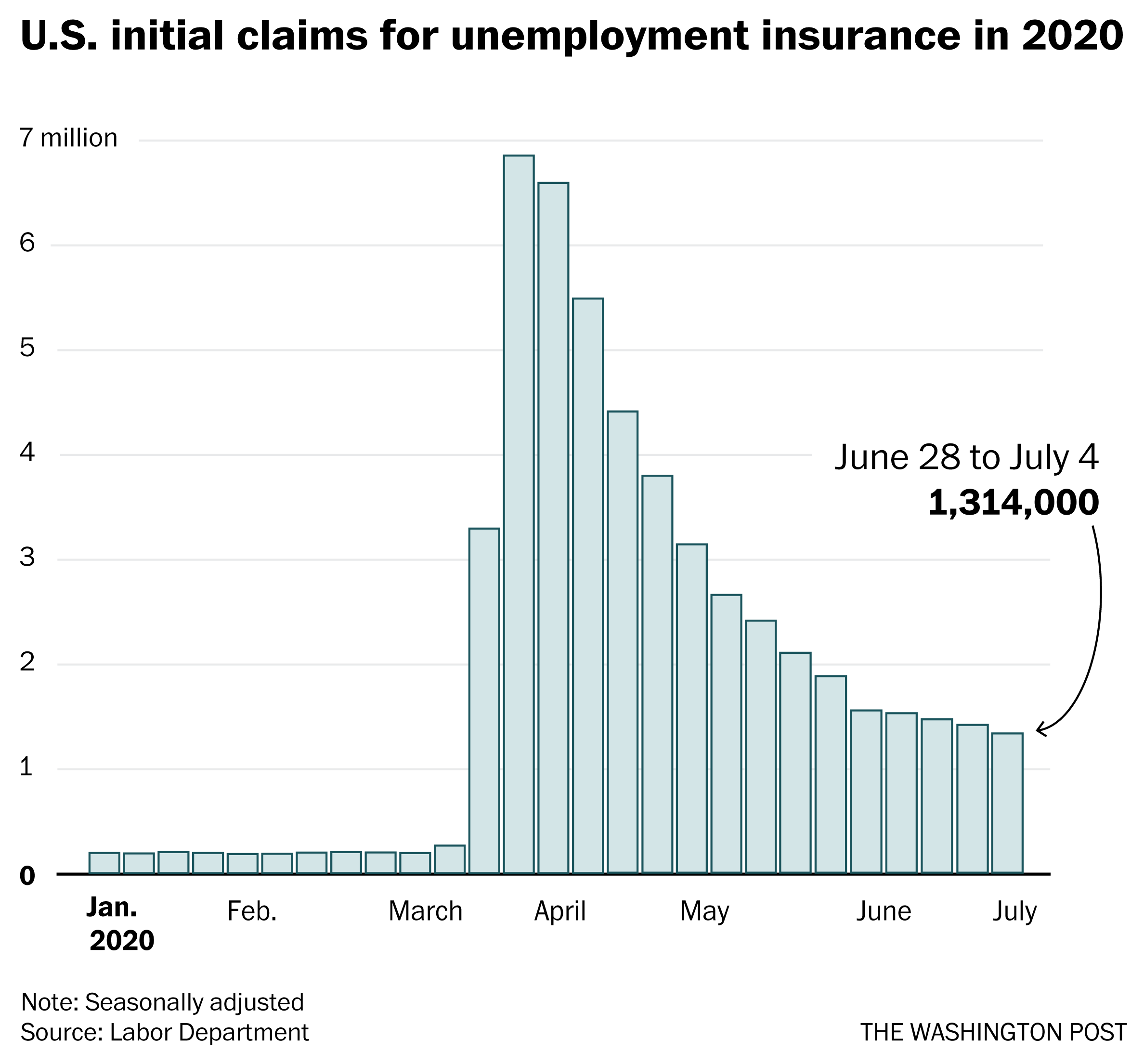
Cartoon – Unemployment Rate vs. Unemployed

Editorial cartoon: The shadow of unemployment

US weekly jobless claims hit 1.4 million, post second straight weekly increase

https://www.businessinsider.com/us-jobless-claims-unemployment-insurance-labor-market-filings-recession-coronavirus-2020-7

  • US jobless claims for the week that ended Saturday totaled 1.43 million, the Labor Department said Thursday. That came in slightly below the consensus economist estimate of 1.45 million.
  • It marked a second consecutive weekly increase after the prior week’s report ended a 15-week streak of declines. This week’s report brought total filings over a 19-week period to more than 54 million.
  • Continuing claims, the aggregate total of people receiving unemployment benefits, totaled 17 million for the week that ended July 18.

More than a million Americans filed for unemployment benefits last week, reflecting the continued high level of pandemic-induced layoffs as the US rolls back its economic-reopening efforts.

New US weekly jobless claims totaled 1.43 million in the week that ended Saturday, the Labor Department reported Thursday. That was slightly below the consensus economist estimate of 1.45 million compiled by Bloomberg. It also was a minor increase over the prior week’s 1.3 million filings, a reading that marked the first gain in 15 weeks.

In just a few months, the more than 54 million unemployment claims filed during the coronavirus pandemic have far surpassed the 37 million during the 18-month Great Recession. The latest figure is more than double the 665,000 filed during the Great Recession’s worst week.

“A combination of uncertainty from rising virus cases to the withdrawal of financial support is concerning for an already fragile recovery,” said Daniel Zhao, senior economist at Glassdoor. “The economy is still in deep risk of falling sideways – where conditions improve so sluggishly that the effects of the crisis become increasingly permanent.”

Continuing claims, which represent the aggregate total of people receiving unemployment benefits, came in at 17 million for the week that ended July 18, a decline from the prior period’s revised number.

Stubbornly high weekly claims for unemployment insurance add to growing concerns that the economic recovery from the pandemic-induced recession is stagnating as coronavirus cases increase. A number of states have had to pause or roll back their reopening plans to deal with COVID-19 spikes, harming the economic recovery.

Going forward, industry watchers will be waiting to see what the July jobs report shows. The report, due August 7, reflects a reference period that includes last week, when initial jobless claims ticked up for the first time in 15 weeks. That could foreshadow a negative headline jobs number in July, although the nonfarm payroll report has become increasingly difficult to predict.

Last week, the additional $600 unemployment benefit from the CARES Act expired, meaning that soon millions of Americans will see a significant decrease in weekly income. The GOP this week introduced its proposal, the HEALS Act, that would cut the weekly benefit to $200 until states could implement a program that’d replace 70% of wages for most filers.

In the week ending July 25, there were 829,697 initial claims from 50 states reporting for Pandemic Unemployment Assistance, the program that extended benefits to gig workers and independent contracts. The total applications for all state programs for the week ending July 11 was 30.2 million. 


Envisioning the future of health system strategy

https://mailchi.mp/0fa09872586c/the-weekly-gist-july-31-2020?e=d1e747d2d8

We’ve spent the past five months working with our health system members to develop a perspective on the impact of the coronavirus pandemic on strategy, discussing what’s changed and what hasn’t, and where leaders should focus moving forward. The above graphic provides an overview of that perspective.

We think about the future across three time periods:

The “near future”, which will largely be dominated by concerns about reopening and recovering clinical operations and financial stability;

The “next future”, which we view as a period of strategic realignment during which we’ll see a “land grab” for advantage among payers, providers, and disruptors;

And the “far future”, in which the fundamental structure of the industry—how healthcare is organized, delivered, and paid for—will see more dramatic changes based on the evolution of economic and policy drivers.

Over time, “market uncertainty” caused by the uncertain course of the disease itself, along with societal and political shifts, will give way to “industry uncertainty”, under which a new competitive landscape will begin to develop.

Across those time horizons, health system strategy should focus on agile and decisive actions to respond to the environment—ensuring a safe and reliable return to normal clinical operations, taking best advantage of the opportunity to play new roles in the delivery of care (e.g., virtual and home-based services), and over time, building a full-scale, consumer-centric care ecosystem.

That’s a lot of rhetoric, but the hard work lies beneath—requiring systems to execute on several key fronts, from ensuring efficient, “systematized” operations, to building sustainable payment and pricing approaches, to adopting a relentless focus on services that earn and maintain consumer loyalty over time. We’ll have more to share on all of these ideas across the coming months, as our work with members continues. What’s clear now is that we’re not going back to the old way of doing things—we’re heading toward a “brave new world” of healthcare delivery.


Fitch: Nonprofit hospital margins unlikely to recover until COVID-19 vaccine

https://www.beckershospitalreview.com/finance/fitch-nonprofit-hospital-margins-unlikely-to-recover-until-covid-19-vaccine.html?utm_medium=email

What Happens When A Nonprofit Hospital Goes 'For-Profit' : Shots ...

Median financial ratios for nonprofit hospitals and health systems improved before the COVID-19 pandemic, which will provide some financial cushion to withstand financial pressures, according to a report from Fitch Ratings. 

The medians for 2019, based on 2018 data, showed the nonprofit hospital and health system sector stabilized after a period of operational softness. The medians for 2020, based on 2019 audited data, are expected to show improvement in operating margins driven by higher revenues, cost reductions and increased cash flow, Fitch said.

“We expect the 2020 medians will represent peak performance levels until the sector is able to recover from the effects of the pandemic on operations,” Fitch said. 

The credit rating agency said the nonprofit healthcare sector is unlikely to stabilize until a COVID-19 vaccine is widely available.

“The sector has shown considerable resiliency over the years, weathering significant events such as the Great Recession and legislative changes to funding,” Fitch said. “However, the coronavirus presents entirely new and fundamental challenges for the sector in the short term in the form of volume and revenue disruption, and over the medium to longer term with expected deterioration of individual provider payor mixes and possible changes in the behavior of healthcare consumers.”


1.3 million Americans filed first-time unemployment claims last week

https://www.cnn.com/2020/07/16/economy/unemployment-benefits-coronavirus/index.html

1.3 million people filed for first-time unemployment last week

It’s still not easy to remain employed in the US, nearly four months after the coronavirus pandemic began upending the economy.

Another 1.3 million people filed first-time jobless claims on a seasonally adjusted basis for the week ending July 11, according to the Department of Labor. That’s down 10,000 from the prior week’s revised level.
On an unadjusted basis, more than 1.5 million people filed first-time claims, up almost 109,000 from the week before. The seasonal adjustments are traditionally used to smooth out the data, but that has tended to have the opposite effect during the pandemic.
Weekly first-time unemployment applications have been on the decline for more than three months since their peak in the last week of March. But last week’s drop was less than expected.
“Overall, filings remain high and are declining at a stubbornly slow pace,” said Rubeela Farooqi, chief US economist for High Frequency Economics, noting that the risk of mounting permanent job losses is high. “The pace could slow even further or reverse in coming weeks in response to a surge in virus cases and related closures of businesses.”
Continued claims, which count workers who have filed claims for at least two weeks in a row, stood at more than 17.3 million for the week ending July 4, down 422,000 from the prior week. These claims peaked in May at nearly 25 million.
In addition, about 928,500 million people in 47 states filed for first-time pandemic unemployment assistance last week, down almost 118,000 from the week before. And almost 14.3 million people claimed continued pandemic benefits across 48 states for the week ending June 27. That’s up nearly 406,000 from the prior week.
The pandemic program was created by Congress in March to respond to the coronavirus outbreak. It provides temporary benefits to workers who typically aren’t eligible for payments, including freelancers, independent contractors, the self-employed and certain people affected by the coronavirus. It expires at the end of the year.
Looking at all workers participating in an array of unemployment programs, just over 32 million Americans claimed jobless benefits the week ending June 27, down about 433,000 from the prior week.
That total includes those in the traditional and pandemic unemployment programs, as well as the pandemic emergency unemployment compensation program, which has nearly 936,500 filers. Lawmakers created it in March to provide those who have exhausted their benefits with an additional 13 weeks of payments. It also expires at the end of 2020.


8 health systems with strong finances

https://www.beckershospitalreview.com/finance/8-health-systems-with-strong-finances-0713.html?utm_medium=email

Here are eight health systems with strong operational metrics and solid financial positions, according to reports from Fitch Ratings, Moody’s Investors Service and S&P Global Ratings.

1. Baylor Scott & White Health has an “AA-” rating and stable outlook with S&P. The health system has an expansive and growing market position in Texas, healthy operating performance and robust cash flow, S&P said. The health system’s financial cushion positions it well for its COVID-19 response, according to the credit rating agency.

2. South Bend, Ind.-based Beacon Health System has an “AA-” rating and stable outlook with Fitch. Beacon is the acute care leader in its northern Indiana service area and has a track record of strong operating margins, Fitch said. The credit rating agency expects Beacon to return to strong operating margins and sustain strong liquidity, despite pressure from the COVID-19 pandemic.

3. Boston Children’s Hospital has an “Aa2” rating and stable outlook with Moody’s. The hospital has a preeminent reputation as the top children’s hospital in the U.S., robust cash reserves and strong fundraising capabilities, Moody’s said. The credit rating agency expects the hospital’s exceptional market position and robust liquidity to help it return to pre-COVID-19 levels to support proposed increases in leverage and capital investments.

4. Carle Foundation, a three-hospital system based in Urbana, Ill., has an “AA-” rating and stable outlook with Fitch. The health system has a very strong financial profile, and Fitch expects it to sustain profitable operating margins after managing through the pandemic.

5. Salt Lake City-based Intermountain Healthcare has an “AA+” rating and stable outlook with Fitch and an “Aa1” rating and stable outlook with Moody’s. The health system has a leading market position, low debt levels and strong absolute and relative cash levels, Moody’s said. The credit rating agency expects Intermountain will be able to substantially return to and sustain pre-COVID-19 volume levels and margins.

6. Oakland, Calif.-based Kaiser Permanente has an “AA-” rating and stable outlook with Fitch. The rating agency said Kaiser has a leading market share in California and other key markets, and its operational profile is arguably the most emulated model of healthcare delivery in the nation.

7. New York City-based Memorial Sloan Kettering Cancer Center has an “AA-” rating and stable outlook with S&P. The hospital has robust fundraising capabilities, an advantageous payer mix and has expanded its ambulatory footprint, providing additional revenue diversity, S&P said.

8. Tacoma, Wash.-based MultiCare Health System has an “Aa3” rating and stable outlook with Moody’s and an “AA-” rating and stable outlook with Fitch.. The 10-hospital system has an extensive footprint, a track record of successfully executing on multiple projects and strategic ventures concurrently and good financial management, Moody’s said. The credit rating agency expects MultiCare to return to stronger operating results after recovering from disruptions related to the COVID-19 pandemic.


Another 1.3 million people applied for new jobless benefits last week as the pandemic’s toll on the economy continued

https://www.washingtonpost.com/business/2020/07/09/another-13-million-people-applied-new-jobless-benefits-last-week-pandemics-toll-economy-continued/?fbclid=IwAR0cDN8SNbJF-SoMktqUOPJyJQ5ZTwvqENXxZzkbXhcygOOrgVxVDotPlHI

Another 1.3 million people applied for new jobless benefits last ...

Another 1.3 million people filed for unemployment for the first time last week, a slight decrease from the week before, as novel coronavirus cases and closures surged around the country, according to data released Thursday by the Department of Labor.

The numbers of new unemployment filings have remained above a million each week since the pandemic began mid-March. That number has averaged about 1.4 million the past four weeks.

In addition, states reported that another 1 million claims were made under the Pandemic Unemployment Assistance program, which grants jobless benefits for gig workers, self-employed workers and contractors, the agency reported.

When combined, the two numbers for initial unemployment claims have ticked up the past three weeks, from 2.24 million in mid-June to 2.44 million last week.

The numbers for the first few days of July come as rising cases of coronavirus infections have hit states and counties nationwide, touching off a new round of closures and restrictions and sending some workers back to the unemployment insurance queue for the second time in just a few short months.

“The bad news is that initial claims are still historically very high and they suggest that damage is continuing to accumulate in the economy,” Adam Ozimek, chief economist at Upwork, said in an interview.

The unemployment rate, which is tabulated separately from the weekly jobless claims, has trended downward the past two months, to 11.1 percent last month, as many laid off or furloughed workers in industries like food service and retail were called back to work. Yet a rising number of workers have reported permanent layoffs.

And the jobless statistics don’t capture the damage from the new round of cases yet.

“All these factors look more like an economy that is riding into a recession than out of one,” Ozimek said. “At this stage in the game, when we’re this far from initial shock, it becomes less likely that new layoffs are the types of jobs that snap back.”

The numbers of people continuously receiving benefits at the end of June has also trended gradually downward. The last week of June saw 18.1 million people on unemployment insurance, down from 19.3 million people the week before that, as re-hirings have slightly outpaced new layoffs week by week.

But as hopes fade for a quick rebound from the pandemic — the United States reported more than 60,000 new cases on Wednesday, a new high — signs of longer term economic damage are emerging.

Levi Strauss & Co. said this week that it planned to cut about 15 percent of its nonretail and nonmanufacturing positions, or about 700 jobs this year. United Airlines warned it may need to furlough nearly 40 percent of its workforce this year, about 36,000 employees. Industrial and aerospace manufacturer the Barnes Group said it would layoff 400 workers; BAE Systems, a defense and aerospace company, said it planned to layoff 300 employees.

There are many workers like Samantha Hartman, 29, whose temporary layoff — she was furloughed in March from Rosen Hotels & Resorts, the hospitality company she works for in Orlando — became permanent this week.

Hartman said her supervisor called her this week to tell her that the company had tried to come up with a way to keep employees but found their hands tied with almost no business coming in.

“Everything is up in the air,” Hartman said. “I fully expect not to find another job in this industry.”

The company, which received a Paycheck Protection Program small business loan of more than $6 million according to the Orlando Sentinel, announced Wednesday that it would layoff a “substantial” amount of its workforce by July 31.

Hartman, who has a heart condition, said the company is letting her keep her health care through August. She moved to Orlando two years ago for the job. Now, she says she’ll probably move back with her family in California when her lease is up next year.

She said Florida’s challenges — including large delays in unemployment insurance processing, mishandling of the coronavirus response, a governor she doesn’t trust — make her less likely to stay in Florida. “If I’m going to struggle financially, I’d rather do that back home where I have a support system,” Hartman said.

Plunging consumer demand amid the virus’s surge and ensuing shutdowns have shuttered businesses across the country. Bed Bath & Beyond announced it would close 200 stores; Brooks Brotherswhich filed for bankruptcy protection this week, said it would close 51 stores.

And there’s a grim waiting game for what are expected to be widespread layoffs in state and municipal governments, as budgets are drastically pared to meet declining tax revenue.

Initial weekly jobless claims remain well above the record before the pandemic, of 695,000 in 1982. They have dropped every week since the peak of 6.9 million, from a week in late March, but have plateaued for more than a month.


June’s cautious economic recovery is based in part-time work and vulnerable industries

https://www.washingtonpost.com/business/2020/07/02/junes-cautious-economic-recovery-is-based-part-time-work-vulnerable-industries/?fbclid=IwAR290sM5RZgwuxNMBDi1chv_i1ulzy4zY2KF4f1cDUMCsiTTpME2wkGVM6s&utm_campaign=wp_main&utm_medium=social&utm_source=facebook


The June unemployment rate of 11.1 percent, down from a peak of 14.7 percent in April, reflects a continuing, cautious economic recovery. What those numbers don’t show is an increase in employment driven disproportionately by part-time work and industries that are vulnerable to another shutdown.

The unemployment rate is a blunt tool. It takes into account anyone who works, even if they work for only one hour a week. And part-time employment has recovered much more quickly from April’s catastrophic losses than full-time employment. While full-time employment is still 12 percent lower than it was in February, part-time employment is back to pre-pandemic levels.

According to the Labor Department’s survey of American households, many of those workers would work full-time if they could and are working part-time only because of poor economic conditions. The number of people pushed into part-time work has more than doubled since February. Meanwhile, the number of people who work part-time by choice is still down by 23 percent.


The unemployment rate isn’t wrong: Part-time work is still work. However, those jobs have already proved to be vulnerable to a slowing economy. Anyone pushed into part-time work by the coronavirus’s initial shock to the economy may be even more vulnerable in the case of future shutdowns. And part-time workers may not have access to benefits such as health insurance that are available to full-time workers.

The industries that bounced back in May and June are also at the mercy of future shutdowns as coronavirus cases surge across the Sun Belt. For instance, unemployment in leisure and hospitality is still very high but dropped by 10 percentage points from April’s staggering 40 percent. Retail and wholesale unemployment dropped by a third. In contrast, finance, government and professional services have had a slow start to recovery. Unemployment in the information industry actually increased from May to June.


If the greatest gains in employment are in industries that suffered most in the early stages of the pandemic, those gains are vulnerable to future waves of shutdowns. Meanwhile, less-volatile industries may continue to be slow to bounce back. A Congressional Budget Office report predicted that the unemployment rate is expected to stay above its pre-pandemic levels through the end of 2030.


Trinity Health expects $2B revenue plunge as it cuts, furloughs more staff

https://www.healthcaredive.com/news/trinity-health-cutting-cost-cutting-2-billion-revenue-shortfall/580738/

The Dumbest Things You Can Do With Your Money | Work + Money

Dive Brief:

  • Trinity Health, one of the nation’s largest nonprofit health systems, said Monday it will take more measures to cut costs due to the downturn spurred by the novel coronavirus. The restructuring plan includes eliminating positions, extending furloughs, severances and reductions in schedules. The decisions are being “customized” across the system based on factors that include volume projections and the cost and revenue challenges in each market.
  • The Livonia, Michigan-based hospital operator said it continues to treat COVID-19 patients, however, it has “for now seen declining numbers of very sick patients with COVID-19.”
  • The system said it expects revenue to be depressed or “below historical levels” for the remainder of this fiscal year and much of the next. It projects revenue to drop by $2 billion to $17.3 billion for fiscal year 2021, which starts after its June 30 year end.

Dive Insight:

In May, Trinity said it planned to furlough nearly 12% of its workforce — or 15,000 employees out of the 125,000 nationally.  

Trinity, one of the nation’s largest hospital operators with 92 facilities and operations across 22 states, is now broadening that restructuring, extending and adding new furloughs.

In a Monday bond filing, Trinity said its operations were “significantly” impacted by the effects of the pandemic as many operators saw depressed volumes due to shelter-in-place orders, which started in most of Trinity’s markets during the last two weeks of March.

“The effect of COVID-19 on the operating margins and financial results of Trinity Health is adverse and significant and, at this point, the duration of the pandemic and the length of time until Trinity Health returns to normal operations is unknown,” according to Monday’s bond filing.

The system said relief funds provided by the federal government have not been enough to cover its operating losses. Trinity has received $600 million in relief funds that do not have to be repaid and more in loans through the advanced Medicare payment program, according to a previous analysis by Healthcare Dive.

Still, the system said it has drawn on credit facilities totaling $1 billion to provide adequate liquidity during the pandemic. Trinity reported having 178 days cash on hand as of March 30.

Some nonprofits are faring better than Trinity and pulling back on earlier staffing cuts.

Mayo Clinic said last week it will call back its furloughed workers by the end of August and restore pay that had been cut due to the pandemic.

Mayo has some of the most cash on hand in terms of days when comparing other major nonprofit systems. Mayo had 252 days of cash on hand as of March 30, more than the other 20 largest nonprofits except Cleveland Clinic and New York-Presbyterian.


Coronavirus live updates: New York activates quarantine for travelers from hotspots as Florida shatters daily record

https://www.cnbc.com/2020/06/24/coronavirus-live-updates.html?utm_source=&utm_medium=email&utm_campaign=30961

Chart of daily new coronavirus cases in the United States through June 23, 2020.

The coronavirus continues to surge in states around the country, mostly in the South and West. Testifying before members of Congress on Tuesday, White House health adviser Dr. Anthony Fauci said parts of the U.S. are beginning to see a “disturbing surge” and described the overall situation as a “mixed bag” across different regions and states.

  • Global cases: More than 9.29 million
  • Global deaths: At least 478,289
  • U.S. cases: More than 2.34 million
  • U.S. deaths: At least 121,279

The data above was compiled by Johns Hopkins University.

California reports more than 7,000 cases, biggest daily jump so far

3:30 p.m. ET — California reported an additional 7,149 Covid-19 cases since Tuesday, a 69% increase in two days, bringing the state’s total to 190,222 cases, according to the state’s health department.

While the daily case numbers are growing, Gov. Gavin Newsom said that the state performed a record number of tests in the last 24 hours. However, the percent of tests coming back positive has slightly increased in the last two weeks, sitting at 5.1% on a 14-day average, he said.

Hospitalizations from Covid-19 in California have also increased 29% in the last 14 days, totaling 4,095 as of Tuesday, Newsom said.

“We cannot continue to do what we have done over the last number of weeks. Many of us understandably developed a little cabin fever, some I would argue developed a little amnesia, others have frankly taken down their guard,” Newsom said at press briefing. —Noah Higgins-Dunn

The pandemic still hasn’t peaked in the Americas, WHO says

2:30 p.m. ET — Coronavirus outbreaks in the Americas, which include North, South and Central America, haven’t reached their peaks yet, the World Health Organization warned.

Over a third of the new cases reported Tuesday were from five countries in the Americas, according to WHO data. The U.S. reported the most cases and is the worst-hit country in the world with more than 2.3 million cases and at least 121,279 deaths as of Wednesday.

The comment by the WHO came a day after Dr. Anthony Fauci, the United States’ leading infectious disease expert, expressed concern a “disturbing surge” in coronavirus infections as states continue to reopen.

One WHO official said that parts of the Americas had not “reached a low enough level of transmission “with which we can achieve a successful exit of successful and social distancing measures.” —Berkeley Lovelace Jr.

The entrance to the Magic Kingdom at Disney World is seen on the first day of closure as theme parks in the Orlando area suspend operations for two weeks in an effort to curb the spread of the coronavirus (COVID-19). Paul Hennessy/SOPA Images/LightRocket via Getty Images)

1:04 p.m. ET — More than 7,000 people have signed an online petition urging Disney and local government officials to reconsider the reopening of Disney World next month.

The petition comes as coronavirus cases in the state are rapidly rising.

It is difficult to determine how many of the signees of the online petition are actually Walt Disney employees or if the petition is union-backed. There is no mention in the petition itself of any affiliation with an employee union.

“The safety and well being of our cast members and guests are at the forefront of our planning, and we are in active dialogue with our unions on the extensive health and safety protocols, following guidance from public health experts, which we plan to implement as we move toward our proposed, phased reopening,” Disney said in a statement to CNBC. —Sarah Whitten

Florida shatters record for new cases in a day

People wait for a health assessment check-in before entering Jackson Memorial Hospital, as Miami-Dade County eases some of the lockdown measures put in place during the coronavirus disease (COVID-19) outbreak, in Miami, Florida, U.S., June 18, 2020.

12:15 p.m. ET — The Florida Department of Health reported 5,508 new coronavirus cases, surpassing the previous record single-day increase of 4,049 new cases reported on Saturday.

Florida is among a handful of states that includes Arizona and Texas that are experiencing expanding outbreaks of the virus.

As cases continue to rise by the thousands every day in Florida, the percent of total tests coming back positive has also risen. On Wednesday, the state reported that 15.91% of all tests came back positive, up from 10.82%. That increase indicates that the surge in new cases is not due solely to ramped up testing. —Will Feuer

NY, NJ and CT impose quarantine on travelers from hotspot states

11:51 a.m. ET — The governors of New York, New Jersey and Connecticut jointly announced a 14-day quarantine for travelers entering the states from coronavirus hotspots.

The Northeastern bloc of states has successfully combated their own outbreaks, having brought peak infection rates down considerably, and are now worried about visitors reintroducing high transmission rates.

“We worked very hard to get the viral transmission rate down. We don’t want to see it go up because a lot of people come into this region and they can literally bring the infection with them,” New York Gov. Andrew Cuomo said at a press conference with New Jersey Gov. Phil Murphy and Connecticut Gov. Ned Lamont.

The hotspot states included in the advisory so far are: Alabama, Arizona, Arkansas, Florida, North Carolina, South Carolina, Texas, Utah and Washington. —Sara Salinas

New York City Marathon canceled

Lelisa Desisa of Ethiopia crosses the finish line to win the Men's Division during the 2018 TCS New York City Marathon in New York on November 4, 2018.

10:29 a.m. ET — The 2020 TCS New York City Marathon has been canceled amid the ongoing coronavirus pandemic, according to an announcement from the race’s organizers. Scheduled for Nov. 1, the event was supposed to commemorate the 50th running of the marathon.

New York Road Runners, which organizes the race, said the decision was made from a health perspective in partnership with the New York City Mayor’s Office.

“While the marathon is an iconic and beloved event in our city, I applaud New York Road Runners for putting the health and safety of both spectators and runners first,” said Mayor Bill de Blasio in a statement.

NYRR said runners will receive a full refund of their entry fee or complimentary entry for 2021, 2022 or 2023. They will also be invited to participate in a virtual marathon event taking place from Oct. 17 to Nov. 1.

The New York City race is the world’s largest marathon and counted 53,640 finishers in 2019, according to NYRR. —Hannah Miller

More states are reporting increases in new Covid-19 cases as U.S. 7-day average continues to grow

A patient is wheeled into Houston Methodist Hospital as storm clouds gather over the Texas Medical Center, amid the global outbreak of the coronavirus disease (COVID-19), in Houston, Texas, U.S., June 22, 2020.

0:11 a.m. ET — As of Tuesday, the seven-day average of daily new Covid-19 cases in the U.S. increased by more than 32% compared to one week ago, according to a CNBC analysis of data compiled by Johns Hopkins University.

Cases are growing by 5% or more in 30 states across the country, including Arizona, Texas, Montana and Idaho. Since Monday, four more states have seen growth in their 7-day average of daily new cases.

Texas health officials reported an all-time high of 5,489 new cases on Tuesday, surpassing 5,000 cases in a single day. The state has also been seeing record spikes in hospitalizations in recent weeks. As of Tuesday, there are 3,335 people currently hospitalized in Texas based on a 7-day moving average, which is a 49% increase compared with a week ago, according to Covid Tracking Project data.

California also broke its record for daily number of positive cases on Tuesday, adding 6,712 new cases, according to Johns Hopkins data. The state surpassed 6,000 new cases for the first time on Monday. —Jasmine Kim

IMF slashes forecasts for U.S. economy, GDP

9:47 a.m. ET — The International Monetary Fund slashed its economic estimates for global GDP and the U.S. economy amid the ongoing coronavirus pandemic, and warned that governments’ debt levels will continue to soar as they combat the crisis.

The IMF forecast a contraction of 4.9% in global GDP and estimated that the U.S. economy will contract by 8% in 2020, CNBC’s Silvia Amaro reports. The new estimates were downward revisions from what the IMF forecast in April.

The Washington-based institution said the new figures were due to expectations that social-distancing measures will likely remain in place during the second half of 2020, hurting productivity and supply chains.

The Fund also downgraded its 2020 estimates for the euro zone and its GDP forecast for 2021. —Hannah Miller

The U.S. will eclipse its first peak, Dr. Scott Gottlieb says

8:20 a.m. ET — Daily new cases of coronavirus will surpass the country’s first peak in April, former Food and Drug Administration Commissioner Dr. Scott Gottlieb told CNBC.

“We’re going to eclipse the totals in April, so we’ll eclipse 37,000 diagnosed infections a day,” he said on CNBC’s “Squawk Box.” “But in April we were only diagnosing 1 in 10 to 1 in 20 infections, so those 37,000 infections represented probably half a million infections at the peak.“

Since April, the U.S. has significantly ramped up the country’s capacity to test broadly for the virus, including among asymptomatic and pre-symptomatic patients. That means even though confirmed cases will likely peak again, the underlying outbreak probably isn’t as large as it was in April, Gottlieb said.

“The total number of deaths is falling because the total infection burden in the country is a lot lower now than it was in April,” he said. —Will Feuer

Most recent 1 million cases were reported in just a week, WHO says

Chart of global daily new coronavirus cases by region

8:08 am ET — The pandemic is still accelerating, with the most recent 1 million cases being reported in one week, World Health Organization Director-General Tedros Adhanom Ghebreyesus said, according to Reuters.

During a virtual conference on vaccine development and access across the continent, Tedros added that every country in Africa has now developed laboratory capacity to conduct diagnostic testing for the virus.

The virus has sickened more than 9.27 million people around the world and killed at least 477,807 people. There is still no U.S.-approved treatment or vaccine for the disease. —Will Feuer

India reports record single-day spike in cases
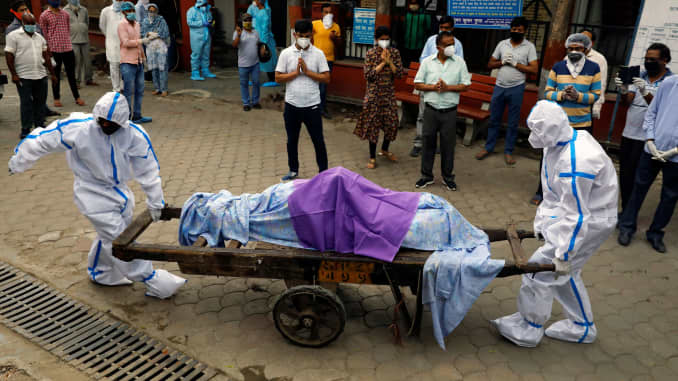
Health workers wearing Personal Protective Equipment (PPE) carry the body of a person who who died due to the coronavirus disease (COVID-19), at a crematorium in New Delhi, India, June 24, 2020.

7:12 a.m. ET — India has reported its highest spike of new cases of infections since the virus took hold in the country of more than 1.3 billion people, according to The Associated Press. 

In 24 hours, the country reported 15,968 new cases and 465 deaths, the AP reported. That means the virus has now infected more than 456,183 people in India, killing at least 14,476, according to data compiled by Johns Hopkins University.

Maharashtra, New Delhi and Tamil Nadu are the hardest-hit states, making up almost 60% of all confirmed cases in the country. New Delhi, in particular, is emerging as a cause for concern in the federal government, the AP reported, due to poor contact tracing infrastructure and limited hospital capacity.

India has the fourth worst coronavirus outbreak in the world, based on total number of confirmed cases, behind only the U.S., Brazil and Russia. —Will Feuer

The EU is discussing reopening its borders, but US citizens could remain barred

A general view of almost desert Pantheon square during Italy's lockdown due to Covid-19 pandemic.

6:51 a.m. ET — The European Union is discussing how to reopen its external borders as the region looks to revive its economies, but visitors from the U.S., and elsewhere, could be barred from entering the bloc for now.

Thirty European countries decided to close their external borders back in March to contain the spread of Covid-19, but that measure is due to be lifted on Tuesday. Representatives of the EU governments are discussing the criteria to lift the travel restrictions from abroad, and at the moment, the main requirement is the coronavirus infection rate in the country of origin.

This means that countries with high rates, such as the United States and Brazil, could remain barred from entering European nations, at least for some time. —Silvia Amaro