$1.7 trillion U.S. spending bill would not stoke inflation: Moody’s

Dive Brief:

  • The $1.7 trillion “social infrastructure” legislation passed by the House and now before the Senate would spur growth, expand employment and boost productivity with limited inflationary impact, according to Moody’s Investors Service.
  • The spending “would occur over 10 years, include significant revenue-raising offsets and would likely only start to flow into the economy later in 2022 at a time when inflationary pressures from disruptions to global supply chains and U.S. labor supply will likely have diminished,” Moody’s Vice President-Senior Analyst Rebecca Karnovitz said
  • “Investments in childcare, education and workforce development have the potential to boost labor force participation and increase productivity over the medium and longer term,” she said. While the Senate will likely insist on amendments, the Build Back Better (BBB) bill currently would invest $555 billion in clean energy and “climate resilience” and $585 billion in childcare, universal prekindergarten and paid family leave.

Dive Insight:

CFOs concerned about rising prices and the risk of a wage-price spiral have found sympathy from some lawmakers who warn that the $5.7 trillion in spending Congress has already approved during the pandemic will further stoke inflation.

“Inflation is hammering working families across America,” Senate Minority Leader Mitch McConnell told the chamber last week. The Kentucky Republican called BBB a “socialist wish list” and an inflationary “taxing and spending spree.”

Some Democrats — including Sens. Kyrsten Sinema of Arizona and Joe Manchin of West Virginia — have cautioned that excessive spending could push up prices and worsen the fiscal outlook.

Sinema and Manchin have said that they want less costly legislation. With Democrats holding the smallest possible Senate majority, support from the two senators is essential for final passage of the bill.

“I have been concerned about high levels of spending that are not targeted or are not efficient and effective,” Sinema told the Washington Post on Nov. 18 while noting rising inflation.

“The threat posed by record inflation to the American people is not ‘transitory’ and is instead getting worse,” Manchin said on Twitter this month after the Labor Department reported that consumer prices rose 6.2% in October on an annual basis.

CFOs face even higher price gains for wholesale goods. The producer price index for final demand, a measure of what suppliers charge, soared 8.6% in October from the prior year, according to the Labor Department. That was a record jump in a series of data first published in 2010.

The Moody’s analysis suggests that concerns about the impact of BBB on inflation and the U.S. fiscal outlook may be overblown.

“We expect the spending package to have a limited impact on inflation,” Moody’s said.

Referring to the U.S. credit outlook, Moody’s said, “we expect the legislation to have only a small effect on the sovereign’s fiscal position, given that the spending would be spread over a decade and the revenue-raising measures would help offset the impact on federal budget deficits.”

The Congressional Budget Office estimates that the House version of BBB would push up fiscal deficits by $367 billion over a 10-year period.

Yet the estimate excludes about $200 billion in revenue that would come from a provision in the bill funding tougher tax enforcement and collection, Moody’s said.

“Estimates of the bill’s impact on the deficit are likely to shift in accordance with provisions that may be stripped from the Senate’s final version of the legislation,” according to Moody’s.
Jobless claims plunge to 199K, lowest level since 1969

Jobless claims plunge to 199K, lowest level since 1969

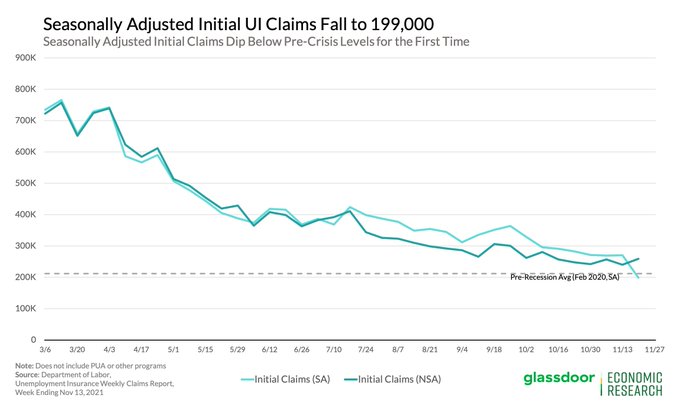
For the 1st time during the pandemic, initial UI claims have dipped below pre-crisis levels, falling to 199,000 (vs the Feb 2020 avg: 211,700). Layoffs are hitting new lows amid ongoing labor shortages as employers look to hold onto hard-to-find workers.

New weekly claims for jobless aid plunged to the lowest level in more than 50 years last week, according to data released Wednesday by the Labor Department.

In the week ending Nov. 20, there were 199,000 initial applications for unemployment insurance, according to the seasonally adjusted figures, a decline of 71,000 from the previous week. Claims fell to the lowest level since November 1969 and are now well below the pre-pandemic trough of 225,000 applications received the week of March 14, 2020.

The steep drop in unemployment applications comes after several strong months of job growth and rising consumer spending heading into the holiday shopping season. While high inflation has stressed many household budgets, U.S. job growth, economic production, stock values and corporate profits have all steamed ahead.

“Getting new claims below the 200,000 level for the first time since the pandemic began is truly significant, portraying further improvement,” said Mark Hamrick, chief economic analyst at Bankrate.com.

“The strains associated with higher prices, shortages of supplies and available job candidates are weighed against low levels of layoffs, wage gains and a falling unemployment rate,” he continued. “Growth will likely be above par for the foreseeable future, but within the context of historically high inflation which should relax its grip on the economy to some degree in the year ahead.”

The U.S. added 531,000 jobs in October and job growth in the previous months was revised substantially higher after a string of what first appeared to be meager gains. While businesses have struggled to hire enough workers to meet surging consumer demand, the decline in jobless claims appears to be a sign of an improving labor market.

“Layoffs are hitting new lows amid ongoing labor shortages as employers look to hold onto hard-to-find workers,” said Daniel Zhao, senior economist at Glassdoor, in a Wednesday thread on Twitter.

Even so, Zhao said the sharp decline below pre-pandemic levels may have been due to a lower than expected seasonal impact on hiring.

“As you can see from the above chart, this is in part due to the seasonal adjustment expecting a much larger jump in non-seasonally adjusted claims, so this dip below pre-crisis levels may be short-lived,” he explained.

U.S. economy adds 531,000 jobs in huge hiring rebound

U.S. economy adds 531,000 jobs in huge hiring rebound

The job market added a stunning 531,000 jobs last month. The unemployment rate ticked down to 4.6% — a new pandemic-era low.

Why it matters: America’s job market recovery has been on track all along.

Between the lines: Revisions to prior months are often overlooked. Not this month: Upgrades to both August and September were so enormous — fully 366,000 jobs higher than originally reported — that they have definitively reversed the narrative that there was a Delta-induced hiring slump in late summer.

By the numbers: America has now recovered 80% of the jobs lost at the depth of the recession in 2020.

The big picture: Leisure and hospitality added 164,000 jobs last month — but jobs growth was widespread. The disappointment — again — came in public sector education. State and local education shed a combined 65,000 jobs.

  • Wages are still rising: Average hourly earnings rose another 11 cents an hour in October, to $30.96. That’s enough to keep up with inflation.

What to watch: Millions of workers remain on the sidelines — and there wasn’t much improvement in pulling them back into the workforce.

The bottom line: “The Fall hiccup is now at best a Fall deep breath,” tweeted University of Michigan economist Justin Wolfers.

Lower volumes, higher wages, supply chain disruption all dragged down hospital

Hospitals’ performances declined “by almost every metric” during September as volumes dropped, average patient stays rose and expenses increased “dramatically” due to labor and supply chain issues, Kaufman Hall wrote in its latest monthly report.

Although revenue increased compared to this time last year, the industry analyst said that these pressures have led median change in hospital operating margin to decline 18.2% from August to September, not including CARES act funding.

These declines were greatest across regions heavily affected by the recent delta surge, with the west part of the country seeing the largest year-over-year drop in its median change in operating EBITDA margin (38%), Kaufman Hall wrote.

Hospital size also played a role in margin performance, they wrote, with hospitals containing more than 500 beds seeing year-over-year declines of 36% while those with 25 or fewer beds actually seeing their margins increase year over year.

Adjusted discharges dropped 5.1% month over month but remained up 11.4% year over year. Patient days similarly dropped 1.4% month over month, “reflecting a decrease in COVID-19-related hospitalizations,” but are still up 11.4% year over year, according to the report. Notably, the average length of stay saw increases across the board—0.7% month over month and 4.8% year over year.

Expenses and revenues continued their hand-in-hand climb during September.

For the former, total expenses grew 2.2% month over month and 11.2% year over year. Labor expenses increased 1.4% month over month at the same time as workers per patient bed declined, the group wrote. Other non-labor expenses, including drugs and medical supplies, also saw a 1.3% month-over-month increase.

“Multiple factors are contributing to alarming and sustained increases in hospital expenses,” Erik Swanson, a senior vice president of data and analytics with Kaufman Hall. “Growth in labor expenses are outpacing increases in hours worked, suggesting hospitals are paying more due to nationwide labor shortages. Rising supply and drug expenses also point to worldwide supply chain issues.”

Hospital revenues saw their seventh consecutive month of year-to-date increases when compared to 2020 and 2019 alike, “due in part to yearly rate changes and the continued rise in higher acuity cases,” Kaufman Hall wrote. Specifically, gross operating revenues minus CARES grew 12.3% year over year from 2020 and 12.3% year over year from 2019, with inpatient revenue rising faster than outpatient revenue.

Month over month was a different story, however, with gross operating revenue without CARES dropping 1.4%. While inpatient revenue was up 1.5% from August, a 3.3% decline in outpatient revenue “suggests that consumer worries about accessing care during the recent delta surge have led to another downswing,” Kaufman Hall wrote.  

Kaufman Hall’s reports incorporate data from more than 900 U.S. hospitals. The September numbers follow early warnings of delta-fueled recovery roadblocks from the group’s preceding monthly reports as well as recent hospital chain earnings calls highlighting high revenues, costs and COVID-19 patient counts.

Business forecasters see inflation heating up to 5.1%

Dive Brief:

  • Inflation as measured by the consumer price index will surge 5.1% year-over-year during the fourth quarter, forecasters for the National Association for Business Economics (NABE) said, raising their estimate in May for a 2.8% year-over-year increase in prices. The forecasters anticipate inflation will ease to 2.4% year-over-year during the fourth quarter of 2022, according to a survey.
  • “Inflation expectations have moved up significantly from those in the May 2021 survey,” according to Holly Wade, survey chair and executive director for the research center at the National Federation of Independent Business. “But panelists anticipate inflation will ease in 2022.”
  • The NABE panel reduced its estimate for growth in gross domestic product (GDP) this year to 5.6% from 6.7% in May, citing the coronavirus delta variant as the biggest risk to the expansion.

Dive Insight:

NABE expectations that inflation will cool next year align with the view of Federal Reserve Chair Jerome Powell and Treasury Secretary Janet Yellen. Both policy-makers have staked record stimulus in part on the premise that the fastest price gains in decades will slow as pandemic-induced kinks in supply chains even out.

The Fed’s preferred inflation measure — the core personal consumption expenditures price index — rose 3.6% in July compared with a year earlier, well above the central bank’s 2% target.

In an estimate released after a two-day meeting on Wednesday, Fed officials forecast that so-called core inflation will rise 2.3% next year, slightly above the 2.2% estimate by the NABE panel.

Confident that inflation will ease, Fed policy-makers indicated after their meeting that they may begin to cut $120 billion in monthly purchases of Treasury and mortgage bonds as early as their next scheduled gathering in November. Powell said that the Fed will gradually taper and may conclude bond buying “around the middle of next year.”

Half of the 18 participants in the Fed’s policy-making committee expect to raise the benchmark interest rate from a record low by the end of 2022.

“I expect inflation to decelerate,” Fed Governor Lael Brainard said Monday in a speech to NABE. “But with delta disrupting the rotation from goods to services and prolonging supply bottlenecks, it is uncertain just how fast and how much inflation will decelerate over the remainder of the year and into next year.”

With the delta variant disrupting demand and supply, the employment report for September due out on Oct. 8 “may be weaker and less informative of underlying economic momentum than I had hoped,” she said.

More than half (58%) of the NABE forecasters see downside risks to economic growth for the remainder of 2021, while 16% “expect the balance to be to the upside — a complete reversal from the May survey results,” Wade said.

Sixty-three percent of panelists identify the delta variant as the leading risk to growth, while 5% of respondents said fiscal policy inaction or gridlock as their greatest growth concern, NABE said. Two-thirds (67%) of survey respondents predict that nonfarm payrolls will return to pre-pandemic levels by the end of 2022.

Powell and Yellen will have an opportunity to update their views on inflation and the economy, and the outlook for record monetary and fiscal stimulus, in testimony scheduled for Tuesday before the Senate Banking Committee.

The NABE panel of 47 forecasters spans a range of organizations, including economists from Ford, Grant Thornton, Moody’s Analytics, the Conference of State Bank Supervisors, Nationwide Insurance, Morgan Stanley, the National Association of Homebuilders, Visa and Wells Fargo.

Hospitals projected to lose $54 billion in net income this year

https://www.healthcarefinancenews.com/news/hospitals-projected-lose-54-billion-net-income-year

Hospitals and Health Systems Projected to Lose About $54B in Net Income in  2021 | HealthLeaders Media

Higher expenses for labor, drugs and supplies as well as a continuation of delayed care during the ongoing COVID-19 pandemic is projected to cost hospitals an estimated $54 billion in net income over the course of this year, according to a new Kaufman Hall analysis released by the American Hospital Association.

Hospitals and health systems are seeing sicker patients, the report said. This includes COVID-19 patients and patients who put off care during the pandemic. They are requiring longer lengths of stay and more services than prior to the pandemic in 2019, the report said.

The seven-day average of new hospital admissions of patients with COVID-19 has increased 488%, from 1,900 on June 19 to 11,168 on September 14, the report said, citing recent data from the Centers for Disease Control and Prevention.

Many hospitals are also reportedly spending a lot more on staffing, paying for contract or travel nurses due to shortages.

WHY THIS MATTERS

The report projects hospitals nationwide will lose an estimated $54 billion in net income over the course of the year, even after taking into account federal Coronavirus Aid, Relief, and Economic Security (CARES) Act funding from last year

If there were no relief funds from the federal government, losses in net income would be as high as $92 billion. 

However, the AHA said, the uncertain trajectory of the Delta and Mu variants in the U.S. this fall could result in even greater financial uncertainty for hospitals.

Despite the recent announcement of additional provider relief funds, none have yet to be allocated or distributed, the AHA said. 

THE LARGER TREND

This latest analysis incorporates actual hospital performance data in the first and second quarters of this year, from before the latest surge. Projections were then made for the remainder of 2021 based on this data.

Based on the analysis, median hospital margins are projected to be 11% below pre-pandemic levels by year’s end. More than a third of hospitals are expected to end 2021 with negative margins.

Many hospitals were financially challenged and already operating in the red heading into the COVID-19 pandemic, the AHA said last year.

CARES Act funding helped hospitals and health systems, but covered only a portion of the more than $323 billion in losses hospitals were expected to have in 2020. 

The government allocated a total of $175 billion in relief funds to providers.

ON THE RECORD 

“America’s hospitals and health systems continue to face significant, ongoing instability and strain as the COVID-19 pandemic endures and spreads,” said AHA President and CEO Rick Pollack. “With cases and hospitalizations at elevated levels again due to the rapid spread of the Delta variant, physicians, nurses and other hospital caregivers and personnel are working tirelessly to care for COVID-19 patients and all others who need care. At the same time, hospitals are experiencing profound headwinds that will continue throughout the rest of 2021.”

Today’s Coronavirus Outlook

https://view.newsletters.time.com/?qs=5d3d457b67316844231fb3a418df549f286d7bc0e36c82fa4549eb4e171aee9219ecdde5a06ac8a6afa2f47c9bdd793ee8aff390a8f6971c0cdb0a83a542f2bac72c3583aaf33ed18d36b9ee33bd0e95

Nearly 396 million doses of the COVID-19 vaccine have been shipped to various U.S. states as of this afternoon, of which some 343.4 million doses had been administered, according to TIME’s vaccine tracker. About 49.3% of Americans had been completely vaccinated.

More than 195.3 million people around the world had been diagnosed with COVID-19 as of 1 a.m. E.T. today, and nearly 4.2 million people have died. On July 27, there were 614,584 new cases and 9,937 new deaths confirmed globally.

Here’s how the world as a whole is currently trending:

And here’s every country that has reported over 3 million cases:

The U.S. had recorded more than 34.6 million coronavirus cases as of 1 a.m. E.T. today. More than 611,000 people have died. On July 27, there were 70,740 new cases and 462 new deaths confirmed in the U.S.

Here’s how the country as a whole is currently trending:

Here’s where daily cases have risen or fallen over the last 14 days, shown in confirmed cases per 100,000 residents:

All numbers unless otherwise specified are from the Johns Hopkins University Center for Systems Science and Engineering, and are accurate as of July 28, 1 a.m. E.T. To see larger, interactive versions of these maps and charts, click here.

Unemployment claims jumped to 419,000 last week, a sudden increase reflecting an unsettled labor market

Unemployment claims jumped last week, as the delta variant of the coronavirus sparked rising caseloads around the country and renewed fears about the potential for more restrictions and business closures.

The number of new claims grew to 419,000 from 368,000, the third time in six weeks that they had ticked up, according to data from the Department of Labor.

Economists said the uptick was concerning but cautioned that it was too early to tell whether it was a one week aberration or telegraphed a more concerning turn for the labor market.

“The unexpected bump in claims could be noise in the system, but it’s also not hard to see how the rise of the covid-19 delta variant could add thousands of layoffs to numbers that already are double what they were pre-Covid,” said Robert Frick, corporate economist at Navy Federal Credit Union.

Overall, unemployment numbers have been falling gradually from the peaks at other stages of the pandemic, but they are still well above pre-pandemic averages.

The jobless numbers have provided a jarring catalogue about the economic devastation wrought by the pandemic — spiking to records as the pandemic unfolded in March 2020, and remaining at historic high levels throughout most of 2020.

The coronavirus surge last fall helped precipitate a rise in claims that saw the labor market, as seen in the monthly jobs report, slide backward too.

But until recently, the last few months been marked by strong jobs growth and a sense of optimism as vaccinations picked up, giving economists hope that the country was back on track to recovering the nearly 7 million jobs it is still down from before the pandemic.

Now, the delta variant is driving an alarming increase in covid-19 cases around the country, according to public health officials: the number of new cases increased more than 40 percent in the last week, sending jitters through the stock market, and is raising questions about whether state and local health authorities will reinstitute restrictions to slow the virus’ spread.

A new mandate in Los Angeles county to wear masks indoors has sparked protests and anger from local officials, as other counties where cases are increasing mull similar actions.

Frick said that the report showed the potential for unemployment claims to start trending upward after months of steady declines.

“There’s definitely a correlation, however loose, that the rise in covid does cause a rise in claims,” he said. “My fear is that the rise in the delta variant could cause claims to go back up…Certainly one week doesn’t show that. But I wouldn’t be surprised if we start to see claims rise.”

Texas for example, where cases have grown 54 percent in the last week, lead the way with an increase of 10,000 new claims.

However, there are also lots of signs that the economy continues to rebound despite rising caseloads.

The more than 2.2 million people that the Transportation Security Administration said it screened at airports on Sunday was the most since late February 2020 — and nearly three times the amount it was on the same day last year.

Restaurant dining has largely rebounded in recent months, at times surpassing the levels from before the pandemic — on Saturday the number of diners was 1 percent higher than the same day in 2019, according to data from Open Table.

Last week, some 12.5 million claims were filed for unemployment insurance overall, according to the most recent numbers — down from 32.9 million filed at the same point last year.

Nevada, Rhode Island and California topped the list of states with the highest number of people on unemployment, the Labor Department said.

Economic concerns in recent months have been more focused on the ways that workers are still held back from filling some of the more than 9 million job openings in the country, than unemployment, with high hopes that school re-openings in the fall will help many parents get back into the labor force.

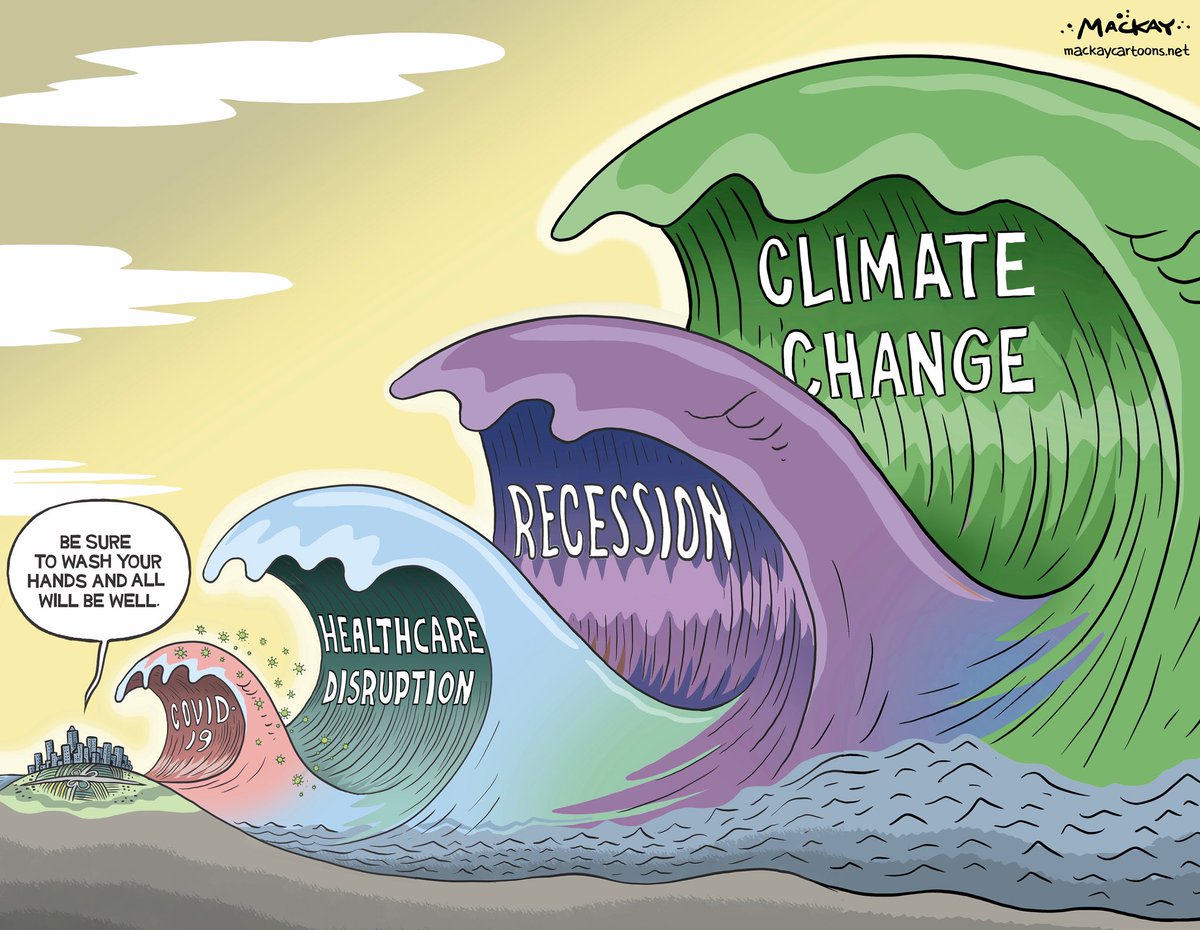
Cartoon – Catch a Wave

Dre Joanne Liu on Twitter: "Acid cartoon humor on the next Waves to come  2020-0311-NATrevised-healthcare.jpg 7 740 × 6 000 pixels… "

CFOs working around cost pressures, labor availability

Labor Shortage, Rising Costs, Supply-Chain Hiccups Hit Manufacturers -  Bloomberg

Dive Brief:

  • While CFOs, on the whole, remain optimistic about an economic rebound this year, they’re concerned about labor availability and accompanying cost pressures, according to a quarterly survey by Duke University’s Fuqua School of Business and the Federal Reserve Banks of Richmond and Atlanta.
  • Over 75% of CFOs included in the survey said their companies faced challenges in finding workers. More than half of that group also said worker shortage reduced their revenue—especially for small businesses. The survey panel includes 969 CFOs across the U.S.
  • CFOs expect revenue and employment to rise notably through the rest of 2021,” Sonya Ravindranath Waddell, VP and economist at the Federal Reserve Bank of Richmond said. “[But] over a third of firms anticipated worker shortages to reduce revenue potential in the year.”

Dive Insight:

As many companies struggle to find employees and meet renewed product demand, it’s unsurprising CFOs anticipate both cost and price increases, Waddell said.

About four out of five CFO respondents reported larger-than-normal cost increases at their firms, which they expect will last for several more months. They anticipate the bulk of these cost increases will be passed along to the consumer, translating into higher-priced services.

Despite labor concerns, CFOs are reporting higher optimism than last quarter, ranking their optimism at 74.9 on a scale of zero to 100, a 1.7 jump. They rated their optimism towards the overall U.S. economy at an average of 69 out of 100, a 1.3 increase over last quarter. 

For many CFOs, revenue has dipped below 2019 levels due to worker shortage, and in some cases, material shortages, Waddell told Fortune last week. Even so, spending is on the rise, which respondents chalked up to a reopening economy.

“Our calculations indicate that, if we extrapolate from the CFO survey results, the labor shortage has reduced revenues across the country by 2.1%,” Waddell added. “In 2019, we didn’t face [the] conundrum of nine million vacancies combined with nine million unemployed workers.”

Consumer prices have jumped 5.4% over the past year, a U.S. Department of Labor report from last week found; a Fortune report found that to be the largest 12-month inflation spike since the Great Recession in 2008. 

To reduce the need for labor amid the shortage, many companies will be “surviving with just some compressed margins for a while, or turning to automation,” Waddell said.