M&A boom will surge into 2022: KPMG

Dive Brief:

  • The boom in global mergers and acquisitions in 2021 will surge into 2022, fueled by abundant investment capital, historically low interest rates and a rebound in global economic growth, according to a survey of 345 corporate dealmakers in the U.S. by KPMG.
  • “Based on the volume of new pitches in November and December — transactions that would come to market in Q1 and Q2 of 2022 — there are no signs of a slowing deal market,” according to Philip Isom, global head of M&A at KPMG. While facing high valuations, “most investors have limited time horizons to invest in, so they may be willing to reach further on price than they have historically.”
  • More than 80% of the survey respondents across several industries expect total M&A valuations to rise further next year, with about one out of every three predicting at least a 10% increase, KPMG said. Dealmakers said transaction levels will remain robust because companies “need to remain on the offense with the competition” and “feel pressure from investors to raise their own valuations.”

Dive Insight:

Worldwide deal value from January until mid-November this year hit $5.1 trillion, the highest level since 2015 and a 34% gain compared with all of 2020, KPMG said. U.S. transactions rose to $2.9 trillion, or 55% more than during all of last year.

M&A has soared in 2021 as the economy recovered from a pandemic shock, record monetary and fiscal stimulus pumped up liquidity and many companies sought through acquisitions to regain their footing after months of lockdowns and persistent supply chain disruptions.

A widespread labor shortage will probably push up dealmaking next year. One-third of survey respondents said they want to use M&A to acquire talent, KPMG said.

Also, companies increasingly use acquisitions to change their business or operating models, KPMG said, noting that industrial and financial services companies buy companies that help speed their digital transformation.

“The aim is to increase efficiencies and contribute to having more agile workforces,” according to Carole Streicher, KPMG’s deal advisory and strategy service group leader in the U.S.

Private equity firms will continue to push up the volume and value of M&A next year, after increasing their involvement in transaction value by more than 55% so far in 2021, KPMG said. PE firms have pursued deals this year in part because of the prospect of an increase in corporate capital gains taxes.

Growing support for sustainability among investors, regulators and other stakeholders may prompt M&A, “as businesses look at their ecological footprint and consider purchasing, rationalizing or divesting assets,” KPMG said. Investors are likely to consider sustainable businesses more adaptable to market shifts.

Finally, concerns about the potential for rising borrowing costs may prompt dealmakers who rely on debt financing to speed up acquisition plans. Federal Reserve Chair Jerome Powell late last month said policymakers at their two-day meeting beginning Tuesday will likely consider speeding up the withdrawal of accommodation.

Dealmakers face some headwinds. Democrats in the Senate have yet to muster enough support for a roughly $2 trillion social policy bill that would help sustain economic growth. Meanwhile, the outbreak of the omicron variant of COVID-19 has highlighted the fragility of financial markets and the economy to any setbacks in curbing the pandemic.

Survey respondents identified several factors that will influence dealmaking next year, with 61% underscoring high valuations, 56% pointing to liquidity and other economic considerations, and 55% noting intense competition for a limited number of highly valued acquisition targets, KPMG said.

Still, only 7% of the survey respondents said they expect deal volumes to decline in their industries next year.

Survey respondents work at companies in industries ranging from media and financial services to energy and technology, with 194 of them CFOs, CEOs or other C-suite executives.

CFOs rank ‘retention, retention, retention’ as top priority for 2022: Deloitte

Gartner's 2022 Top Strategic Technology Trends. Old Problems. Old Trends.  New Names.

Dive Brief:

  • CFOs rank the challenge of attracting and retaining employees far above other internal risks for 2022, citing labor shortages and the difficulty of crafting a balance between remote and in-office work, Deloitte found in a quarterly survey.  
  • “The number of times CFOs cited talent/labor and related issues heavily outweighed other priorities for 2022,” Deloitte said Thursday in a report on the survey of Fortune 500 CFOs. “‘Retention, retention, retention’ was a resounding refrain, including through wages and incentives.”
  • Eighty-eight percent of the 130 respondents said they will use a hybrid work model next year, 92% will increase automation and 41% expect to shrink their companies’ real estate footprint, Deloitte said.

Dive Insight:

The slow return of workers from coronavirus lockdowns has led to labor shortages, competition for hires and an increase in wages.

Employees are switching jobs for higher pay at a near-record pace. The quits rate, or the number of workers who left their jobs as a percent of total employment, rose from 2.3% in January to 2.8% in October, the second-highest level in data going back to 2000, the U.S. Labor Department said. The quits rate hit a high of 3% in September.

Attracting and retaining employees vaulted to the No. 2 ranking of business risks for 2022 and the next decade, from No. 8 a year ago, according to a global survey of 1,453 C-suite executives and board members by Protiviti and NC State University. (Leading the list of risks for 2022 is the impact on business from pandemic-related government policy).

Companies are trying to hold on to workers, and attract hires, by raising pay. Private sector hourly wages rose 4.8% in November compared with 12 months before, according to the Labor Department.

Tight labor markets and the highest inflation in three decades have prompted companies to budget 3.9% wage increases for 2022 — the biggest jump since 2008, according to a survey by The Conference Board.

The proportion of small businesses that raised pay in October hit a 48-year high, with a net 44% increasing compensation and a net 32% planning to do so in the next three months, the National Federation of Independent Business said last month.

CFO respondents to the Deloitte survey said they plan to push up wages/salaries by 5.2%, a nine percentage point increase from their 4.3% forecast during the prior quarter.

“Talent/labor — and several related issues, including attrition, burnout and wage inflation — has become an even greater concern of CFOs this quarter, and the challenges to attract and retain talent could impinge on their organizations’ ability to execute their strategy on schedule,” Deloitte said.

The proportion of CFOs who feel optimistic about their companies’ financial prospects dropped to just under half from 66% over the same time frame.

“CFOs over the last several quarters have become a little more bearish,” Steve Gallucci, managing partner for Deloitte’s CFO program, said in an interview, citing the coronavirus, competition for talent, inflation and disruptions in supply chains.

CFOs have concluded that the pandemic will persist for some time and that they need to “build that organizational muscle to be more nimble, more agile,” he said.

At the same time, CFOs expect their companies’ year-over-year growth will outpace the increase in wages and salaries, estimating revenue and earnings next year will rise 7.8% and 9.6%, respectively, Deloitte said.

“We are seeing in many cases record earnings, record revenue numbers,” Gallucci said.

Describing their plans for capital in 2022, half of CFOs said that they will repurchase shares, 37% say they will take on new debt and 22% plan to “reduce or pay down a significant proportion of their bonds/debt,” Deloitte said.

CFOs view inflation as the most worrisome external risk, followed by supply chain bottlenecks and changes in government regulation, Deloitte said. The Nov. 8-22 survey was concluded before news of the outbreak of the omicron variant of COVID-19.

New jobless claims totaled 184,000 last week, reaching lowest since 1969

https://finance.yahoo.com/news/weekly-unemployment-claims-week-ended-dec-4-2021-192034644.html

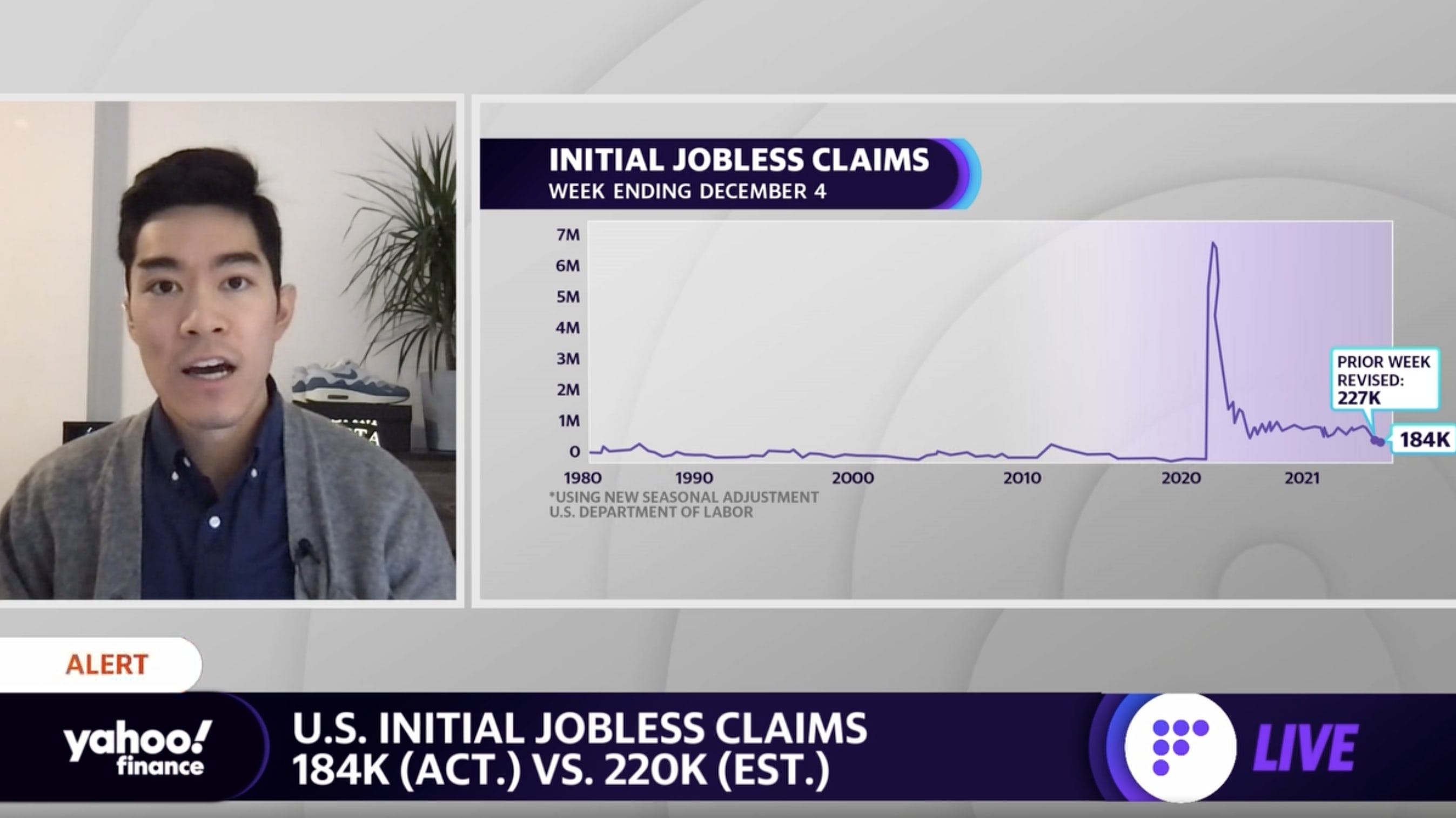
Weekly U.S. jobless claims fell to 184,000, lowest level since 1969

New initial jobless claims improved much more than expected last week to reach the lowest level in more than five decades, further pointing to the tightness of the present labor market as many employers seek to retain workers. 

The Labor Department released its weekly jobless claims report on Thursday. Here were the main metrics from the print, compared to consensus estimates compiled by Bloomberg:

  • Initial unemployment claims, week ended Dec. 4: 184,000 vs. 220,000 expected and an upwardly revised 227,000 during prior week 
  • Continuing claims, week ended Nov. 27: 1.992 million vs. 1.910 million expected and a downwardly revised 1.954 million during prior week

Jobless claims decreased once more after a brief tick higher in late November. At 184,000, initial jobless claims were at their lowest level since Sept. 1969. 

“The consensus always looked a bit timid, in light of the behavior of unadjusted claims in the week after Thanksgiving in previous years when the holiday fell on the 25th, but the drop this time was much bigger than in those years, and bigger than implied by the recent trend,” Ian Shepherdson, chief economist for Pantheon Macroeconomics, wrote in an email Thursday morning. “A correction next week seems likely, but the trend in claims clearly is falling rapidly, reflecting the extreme tightness of the labor market and the rebound in GDP growth now underway.”

After more than a year-and-a-half of the COVID-19 pandemic in the U.S., jobless claims have begun to hover below even their pre-pandemic levels. New claims were averaging about 220,000 per week throughout 2019. At the height of the pandemic and stay-in-place restrictions, new claims had come in at more than 6.1 million during the week ended April 3, 2020. 

Continuing claims, which track the number of those still receiving unemployment benefits via regular state programs, have also come down sharply from pandemic-era highs, and held below 2 million last week. 

“Beyond weekly moves, the overall trend in filings remains downward and confirms that businesses facing labor shortages are holding onto workers,” wrote Rubeela Farooqi, chief U.S. economist for High Frequency Economics, in a note on Wednesday. 

Farooqi added, however, that “the decline in layoffs is not translating into faster job growth on a consistent basis, which was evident in a modest gain in non-farm payrolls in November.” 

“For now, labor supply remains constrained and will likely continue to see pandemic effects as the health backdrop and a lack of safe and affordable child care keeps people out of the workforce,” she added. 

Other recent data on the labor market have also affirmed these lingering pressures. The November jobs report released from the Labor Department last Friday reflected a smaller number of jobs returned than expected last month, with payrolls growing by the least since December 2020 at just 210,000. And the labor force participation rate came in at 61.8%, still coming in markedly below its pre-pandemic February 2020 level of 63.3%. 

And meanwhile, the Labor Department on Wednesday reported that job openings rose more than expected in October to top 11 million, coming in just marginally below July’s all-time high of nearly 11.1 million. The quits rate eased slightly to 2.8% from September’s record 3.0% rate. 

“There is a massive shortage of labor out there in the country that couldn’t come at a worst time now that employers need workers like they have never needed them before. This is a permanent upward demand shift in the economy that won’t be alleviated by companies offering greater incentives to their new hires,” Chris Rupkey, FWDBONDS chief economist, wrote in a note Wednesday. “Wage inflation will continue to keep inflation running hot as businesses fall all over themselves in a bidding war for talent.”

Jobless claims plunge to 199K, lowest level since 1969

Jobless claims plunge to 199K, lowest level since 1969

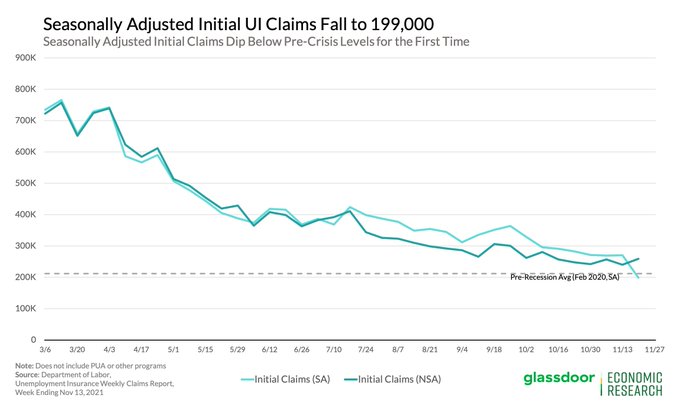
For the 1st time during the pandemic, initial UI claims have dipped below pre-crisis levels, falling to 199,000 (vs the Feb 2020 avg: 211,700). Layoffs are hitting new lows amid ongoing labor shortages as employers look to hold onto hard-to-find workers.

New weekly claims for jobless aid plunged to the lowest level in more than 50 years last week, according to data released Wednesday by the Labor Department.

In the week ending Nov. 20, there were 199,000 initial applications for unemployment insurance, according to the seasonally adjusted figures, a decline of 71,000 from the previous week. Claims fell to the lowest level since November 1969 and are now well below the pre-pandemic trough of 225,000 applications received the week of March 14, 2020.

The steep drop in unemployment applications comes after several strong months of job growth and rising consumer spending heading into the holiday shopping season. While high inflation has stressed many household budgets, U.S. job growth, economic production, stock values and corporate profits have all steamed ahead.

“Getting new claims below the 200,000 level for the first time since the pandemic began is truly significant, portraying further improvement,” said Mark Hamrick, chief economic analyst at Bankrate.com.

“The strains associated with higher prices, shortages of supplies and available job candidates are weighed against low levels of layoffs, wage gains and a falling unemployment rate,” he continued. “Growth will likely be above par for the foreseeable future, but within the context of historically high inflation which should relax its grip on the economy to some degree in the year ahead.”

The U.S. added 531,000 jobs in October and job growth in the previous months was revised substantially higher after a string of what first appeared to be meager gains. While businesses have struggled to hire enough workers to meet surging consumer demand, the decline in jobless claims appears to be a sign of an improving labor market.

“Layoffs are hitting new lows amid ongoing labor shortages as employers look to hold onto hard-to-find workers,” said Daniel Zhao, senior economist at Glassdoor, in a Wednesday thread on Twitter.

Even so, Zhao said the sharp decline below pre-pandemic levels may have been due to a lower than expected seasonal impact on hiring.

“As you can see from the above chart, this is in part due to the seasonal adjustment expecting a much larger jump in non-seasonally adjusted claims, so this dip below pre-crisis levels may be short-lived,” he explained.

CVS wants to employ doctors. Should health systems be worried?

https://mailchi.mp/96b1755ea466/the-weekly-gist-november-19-2021?e=d1e747d2d8

HealthHUB | CVS Health

We recently caught up with a health system chief clinical officer, who brought up some recent news about CVS. “I was really disappointed to hear that they’re going to start employing doctors,” he shared, referring to the company’s announcement earlier this month that it would begin to hire physicians to staff primary care practices in some stores. He said that as his system considered partnerships with payers and retailers, CVS stood out as less threatening compared to UnitedHealth Group and Humana, who both directly employ thousands of doctors: “Since they didn’t employ doctors, we saw CVS HealthHUBs as complementary access points, rather than directly competing for our patients.” 

As CVS has integrated with Aetna, the company is aiming to expand its use of retail care sites to manage cost of care for beneficiaries. CEO Karen Lynch recently described plans to build a more expansive “super-clinic” platform targeted toward seniors, that will offer expanded diagnostics, chronic disease management, mental health and wellness, and a smaller retail footprint. The company hopes that these community-based care sites will boost Aetna’s Medicare Advantage (MA) enrollment, and it sees primary care physicians as central to that strategy.

It’s not surprising that CVS has decided to get into the physician business, as its primary retail pharmacy competitors have already moved in that direction. Last month, Walgreens announced a $5.2B investment to take a majority stake in VillageMD, with an eye to opening of 1,000 “Village Medical at Walgreens” primary care practices over the next five years. And while Walmart’s rollout of its Walmart Health clinics has been slower than initially announced, its expanded clinics, led by primary care doctors and featuring an expanded service profile including mental health, vision and dental care, have been well received by consumers. In many ways employing doctors makes more sense for CVS, given that the company has looked to expand into more complex care management, including home dialysis, drug infusion and post-operative care. And unlike Walmart or Walgreens, CVS already bears risk for nearly 3M Aetna MA members—and can immediately capture the cost savings from care management and directing patients to lower-cost servicesin its stores.

But does this latest move make CVS a greater competitive threat to health systems and physician groups? In the war for talent, yes. Retailer and insurer expansion into primary care will surely amp up competition for primary care physicians, as it already has for nurse practitioners. Having its own primary care doctors may make CVS more effective in managing care costs, but the company’s ultimate strategy remains unchanged: use its retail primary care sites to keep MA beneficiaries out of the hospital and other high-cost care settings.

Partnerships with CVS and other retailers and insurers present an opportunity for health systems to increase access points and expand their risk portfolios. But it’s likely that these types of partnerships are time-limited. In a consumer-driven healthcare market, answering the question of “Whose patient is it?” will be increasingly difficult, as both parties look to build long-term loyalty with consumers. 

Tenet strikes $1.2B surgery center deal

Tenet Healthcare Corp. signs deal for ambulatory surgery center at Good  Samaritan Hospital with Hospital for Special Surgery - South Florida  Business Journal

Dallas-based Tenet Healthcare and one of its subsidiaries have entered into a definitive agreement to acquire Towson, Md.-based SurgCenter Development. 

Under the agreement, Tenet and its subsidiary United Surgical Partners International will acquire ownership interests in 92 ambulatory surgery centers and related ambulatory support services for approximately $1.2 billion. Of the 92 ASCs, 16 of them are under development and have not yet opened. 

Under the deal, expected to close in the fourth quarter of this year, SurgCenter and USPI will also enter into an agreement to develop at least 50 centers over a five-year period. 

“We are extremely pleased to announce this transformative transaction and partnership, which builds upon USPI’s position as a premier growth partner and SCD’s track record of developing high-quality centers with leading physicians,” Saum Sutaria, MD, CEO of Tenet Healthcare, said in a Nov. 8 news release. “By welcoming these centers into our company, USPI will maintain its reach as the largest ambulatory platform for musculoskeletal services, a high-growth service line.”

Tenet said it expects the deal to generate strong financial returns. 

U.S. economy adds 531,000 jobs in huge hiring rebound

U.S. economy adds 531,000 jobs in huge hiring rebound

The job market added a stunning 531,000 jobs last month. The unemployment rate ticked down to 4.6% — a new pandemic-era low.

Why it matters: America’s job market recovery has been on track all along.

Between the lines: Revisions to prior months are often overlooked. Not this month: Upgrades to both August and September were so enormous — fully 366,000 jobs higher than originally reported — that they have definitively reversed the narrative that there was a Delta-induced hiring slump in late summer.

By the numbers: America has now recovered 80% of the jobs lost at the depth of the recession in 2020.

The big picture: Leisure and hospitality added 164,000 jobs last month — but jobs growth was widespread. The disappointment — again — came in public sector education. State and local education shed a combined 65,000 jobs.

  • Wages are still rising: Average hourly earnings rose another 11 cents an hour in October, to $30.96. That’s enough to keep up with inflation.

What to watch: Millions of workers remain on the sidelines — and there wasn’t much improvement in pulling them back into the workforce.

The bottom line: “The Fall hiccup is now at best a Fall deep breath,” tweeted University of Michigan economist Justin Wolfers.

Lower volumes, higher wages, supply chain disruption all dragged down hospital

Hospitals’ performances declined “by almost every metric” during September as volumes dropped, average patient stays rose and expenses increased “dramatically” due to labor and supply chain issues, Kaufman Hall wrote in its latest monthly report.

Although revenue increased compared to this time last year, the industry analyst said that these pressures have led median change in hospital operating margin to decline 18.2% from August to September, not including CARES act funding.

These declines were greatest across regions heavily affected by the recent delta surge, with the west part of the country seeing the largest year-over-year drop in its median change in operating EBITDA margin (38%), Kaufman Hall wrote.

Hospital size also played a role in margin performance, they wrote, with hospitals containing more than 500 beds seeing year-over-year declines of 36% while those with 25 or fewer beds actually seeing their margins increase year over year.

Adjusted discharges dropped 5.1% month over month but remained up 11.4% year over year. Patient days similarly dropped 1.4% month over month, “reflecting a decrease in COVID-19-related hospitalizations,” but are still up 11.4% year over year, according to the report. Notably, the average length of stay saw increases across the board—0.7% month over month and 4.8% year over year.

Expenses and revenues continued their hand-in-hand climb during September.

For the former, total expenses grew 2.2% month over month and 11.2% year over year. Labor expenses increased 1.4% month over month at the same time as workers per patient bed declined, the group wrote. Other non-labor expenses, including drugs and medical supplies, also saw a 1.3% month-over-month increase.

“Multiple factors are contributing to alarming and sustained increases in hospital expenses,” Erik Swanson, a senior vice president of data and analytics with Kaufman Hall. “Growth in labor expenses are outpacing increases in hours worked, suggesting hospitals are paying more due to nationwide labor shortages. Rising supply and drug expenses also point to worldwide supply chain issues.”

Hospital revenues saw their seventh consecutive month of year-to-date increases when compared to 2020 and 2019 alike, “due in part to yearly rate changes and the continued rise in higher acuity cases,” Kaufman Hall wrote. Specifically, gross operating revenues minus CARES grew 12.3% year over year from 2020 and 12.3% year over year from 2019, with inpatient revenue rising faster than outpatient revenue.

Month over month was a different story, however, with gross operating revenue without CARES dropping 1.4%. While inpatient revenue was up 1.5% from August, a 3.3% decline in outpatient revenue “suggests that consumer worries about accessing care during the recent delta surge have led to another downswing,” Kaufman Hall wrote.  

Kaufman Hall’s reports incorporate data from more than 900 U.S. hospitals. The September numbers follow early warnings of delta-fueled recovery roadblocks from the group’s preceding monthly reports as well as recent hospital chain earnings calls highlighting high revenues, costs and COVID-19 patient counts.

Medicare, Medicare Advantage enrollees have comparable healthcare experiences

https://www.healthcarefinancenews.com/news/medicare-medicare-advantage-enrollees-have-comparable-healthcare-experiences

Enrollment in Medicare Advantage plans is increasing rapidly, and many insurers are expanding their MA offerings in a bid to grab larger portions of the market share. Medicare Advantage touts itself as having certain advantages over traditional Medicare, such as fitness benefits, coverage for hearing aids and eyeglasses, and limits on out-of-pocket spending.

This begs the question: Are enrollees in the two versions of Medicare fundamentally different, and what are their experiences like in terms of satisfaction?

New analysis from the Commonwealth Fund found that Medicare Advantage enrollees do not differ significantly from beneficiaries in traditional Medicare in terms of their age, race, income, chronic conditions, satisfaction with care, or access to care, after excluding Special Needs Plan (SNP) enrollees. 

Both groups reported waiting more than a month for physician office visits, while similar shares of Medicare Advantage and traditional Medicare enrollees report that their out-of-pocket costs make it difficult to obtain care.

Ultimately, MA and traditional Medicare are serving similar populations, with beneficiaries having comparable healthcare experiences. The care management services provided by Medicare Advantage plans appear to neither impede access to care nor reduce concerns about costs.

WHAT’S THE IMPACT?

Beneficiaries weigh a number of trade-offs when deciding whether to enroll in Medicare Advantage plans or traditional Medicare. Unlike the latter, MA plans are required to place limits on enrollees’ out-of-pocket spending and to maintain provider networks. The plans also can provide benefits not covered by traditional Medicare, such as eyeglasses, fitness benefits and hearing aids. 

Medicare Advantage plans are intended to manage and coordinate beneficiaries’ care. Some MA plans specialize in care for people with diabetes and other common chronic conditions, including Special Needs Plans. SNPs also focus on people who are eligible for both Medicare and Medicaid and on those who require an institutional level of care.

Traditional Medicare and MA enrollees have historically had different characteristics, with MA enrollees somewhat healthier. Black and Hispanic beneficiaries and those with lower incomes have tended to enroll in MA plans at higher rates than others, while traditional Medicare has historically performed better on beneficiary-reported metrics, such as provider access, ease of getting needed care, and overall care experience.

The Commonwealth Fund found that, after excluding beneficiaries in SNPs, beneficiaries enrolled in traditional Medicare do not differ significantly from MA enrollees on age, income, or receipt of a Part D low-income subsidy (LIS), which helps low-income individuals pay for prescription drugs. But beneficiaries in traditional Medicare are significantly more likely than MA enrollees to reside in a metropolitan area and more likely to live in a long-term-care or residential facility.

Beneficiaries in SNPs are different. Given the eligibility criteria for these plans, it’s not surprising that enrollees tend to have significantly lower incomes and a greater likelihood of receiving Medicaid benefits or LIS than other Medicare beneficiaries. 

Enrollment in SNPs for people who require an institutional level of care has been growing rapidly, leading to a similar share of SNP enrollees and beneficiaries in traditional Medicare living in a long-term-care facility.

There are some areas in which Medicare Advantage plans appear to perform better than traditional Medicare. In particular, MA enrollees are more likely than those in traditional Medicare to have a treatment plan, to have someone who reviews their prescriptions, to have someone they can contact for help, and to receive a response to a health query relatively quickly. 

By providing this additional help, Medicare Advantage plans are making it easier for enrollees to get the help they need to manage their healthcare conditions, the report found. Medicare experts have suggested providing a similar service to beneficiaries in traditional Medicare through care coordinators.

The results also raise questions about whether Medicare Advantage plans are receiving appropriate payments. MedPAC estimates that plans are paid 4% more than it would cost to cover similar people in traditional Medicare. 

On the one hand, Medicare Advantage plans seem to be providing services that help their enrollees manage their care, and this added care management could be of significant value to both plan enrollees and the Medicare program. On the other hand, rates of hospitalizations and emergency room visits are similar for beneficiaries in Medicare Advantage plans and traditional Medicare. This calls into question the impact of the added services on healthcare use, spending and outcomes.

THE LARGER TREND

Insurers are expanding their Medicare Advantage offerings at a decent clip, with Humana announcing last week it would debut a new Medicare Advantage PPO plan in 37 rural counties in North Carolina in response to market demand in the eastern part of the state.

Just last week, UnitedHealthcare, which already has significant market control with its MA plans, said it will strengthen its foothold in the space by expanding its MA plans in 2022, adding a potential 3.1 million members and reaching 94% of Medicare-eligible consumers in the U.S.

And for the third straight year, health insurer Cigna is expanding its Medicare Advantage plans, growing into 108 new counties and three new states – Connecticut, Oregon and Washington – which will increase its geographic presence by nearly 30%.

Centene is also getting in on the act, expanding MA into 327 new counties and three new states: Massachusetts, Nebraska and Oklahoma. In all, this represents a 26% expansion of Centene’s MA footprint, with the offering available to a potential 48 million beneficiaries across 36 states.

The Centers for Medicare and Medicaid Services said in late September that the average premium for Medicare Advantage plans will be lower in 2022 at $19 per month, compared with $21.22 in 2021. However, Part D coverage is rising to $33 per month, compared with $31.47 in 2021.

Enrollment in MA continues to increase, CMS said. In 2022, it’s projected to reach 29.5 million people, compared with 26.9 million enrolled in a Medicare Advantage plan in 2021.

AMA report: U.S. has “highly concentrated” payer markets that stifle competition  

https://medcitynews.com/2021/10/ama-report-u-s-has-highly-concentrated-payer-markets-that-stifle-competition/?utm_campaign=MCN%20Daily%20Top%20Stories&utm_medium=email&hsmi=166812730&_hsenc=p2ANqtz–Z_7y9-ZOPkhC7HI4RXSwuM5xDzd2B0uZi9sApeW1J89hQBktG-rqujxpBFiXmxEEnaK77vlq-7vHhr-qK8mxRgBmwA&utm_content=166812730&utm_source=hs_email

About 73% of health insurance markets are highly concentrated, and in 46% of markets, one insurer had a share of 50% or more, a new report from the American Medical Association shows. The report comes a few months after President Joe Biden directed federal agencies to ramp up oversight of healthcare consolidation.

The majority of health insurance markets in the U.S. are highly concentrated, curbing competition, according to a report released by the American Medical Association.

For the report, researchers reviewed market share and market concentration data for the 50 states and District of Columbia, and each of the 384 metropolitan statistical areas in the country.

They found that 73% of the metropolitan statistical area-level payer markets were highly concentrated in 2020. In 91% of markets, at least one insurer had a market share of 30%, and in 46% of markets, one insurer had a share of 50% or more.

Further, the share of markets that are highly concentrated rose from 71% in 2014 to 73% last year. Of those markets that were not highly concentrated in 2014, 26% experienced an increase large enough to enter the category by 2020.

In terms of national-level market shares of the 10 largest U.S. health insurers, UnitedHealth Group comes out on top with the largest market share in both 2014 and 2020, reporting 16% and 15% market share, respectively. Anthem comes in second with shares of 13% in 2014 and 12% in 2020.

But the picture looks different when it comes to the market share of health insurers participating in the Affordable Care Act individual exchanges. In 2014, Anthem held the largest market share among the top 10 insurers on the exchanges, with a share of 14%. By 2020, Centene had taken the top spot, with a share of 18%, while Anthem had slipped to fifth place, with a share of just 4%.

Another key entrant into the top 10 list in 2020 was insurance technology company Oscar Health, with 3% of the market share in the exchanges at the national level.

“These [concentrated] markets are ripe for the exercise of health insurer market power, which harms consumers and providers of care,” the report authors wrote. “Our findings should prompt federal and state antitrust authorities to vigorously examine the competitive effects of proposed mergers involving health insurers.”

The payer industry hit back. In a statement provided to MedCity News, America’s Health Insurance Plans, a national payer association, said that Americans have many affordable choices for their coverage, pointing to the fact that CMS announced average premiums for Medicare Advantage plans will drop to $19 per month in 2022 from $21.22 this year.

“Health insurance providers are an advocate for Americans, fighting for lower prices and more choices for them,” said Kristine Grow, senior vice president of communications at America’s Health Insurance Plans, in an email. “We negotiate lower prices with doctors, hospitals and drug companies, and consumers benefit from lower premiums as a result.”

Further, the report does not mention the provider consolidation that also contributes to higher healthcare prices. Mergers and acquisitions among hospitals and health systems have continued steadily over the past decade, remaining relatively impervious to even the Covid-19 pandemic.

Scrutiny around consolidation in the healthcare industry may grow. In July, President Joe Biden issued an executive order urging federal agencies to review and revise their merger guidelines through the lens of preventing patient harm.

The Federal Trade Commission has already said that healthcare businesses will be one of its priority targets for antitrust enforcement actions.