Expect More Hunger in America with Big New Rips to the Safety Net

https://healthcareuncovered.substack.com/p/expect-more-hunger-in-america-with

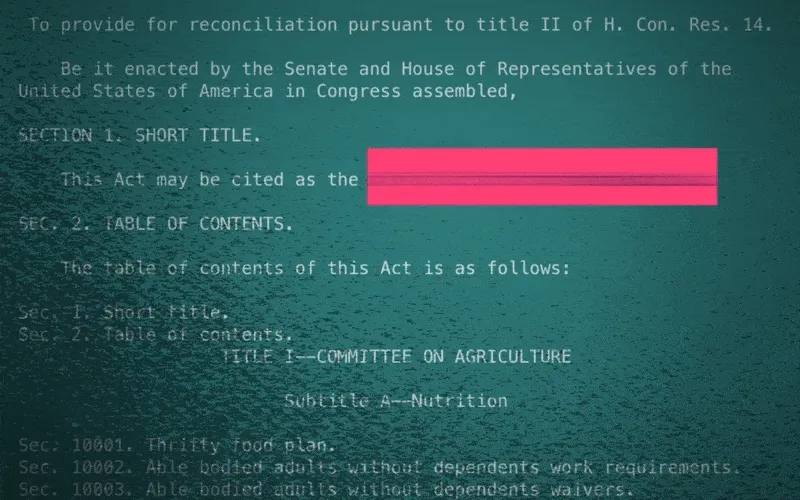
The recently passed One Big Beautiful Bill Act, which makes deep cuts to the Medicaid program, also puts the food assistance that 41 million low-income Americans rely on in jeopardy. Many of the families currently getting food provided by  the Supplemental Nutrition Assistance Program (SNAP) stand to lose that support.  

SNAP may well disappear for some families as the federal government moves to trim it. “The cuts are massive and extremely cruel when families need more support, not less,” says Signe Anderson, senior director of nutrition advocacy, at the Tennessee Justice Center in Nashville. 

Government food assistance was established during the Great Depression, but it wasn’t until 1977 that the program became more accessible when the requirement that recipients had to pay for a portion of their food stamps was ended. Throughout its history, foes of the program have tried to dismantle it and may have succeeded as a result of provisions in the bill President Trump signed on July 4. 

The new legislation calls for cutting spending for food stamps by $186 billion through 2034. “Everyone on food stamps will be affected in some way, and many will lose benefits,” Anderson says. “I don’t think the Congress understands the level of necessity in the community for food, health care and mental health treatment, some for the rest of their lives.” 

One major change is being made to work requirements that have historically been part of the Medicaid program, which is administered and partially funded by the states. Anderson points out that under the new arrangements, participants may find the task of enrolling and staying enrolled more onerous. “We see a lot of people cut off already because too many life circumstances make it difficult for them to meet work requirements.”  

Indeed when you look at the changes to SNAP, the first word that might come to mind is ‘draconian.’

To receive benefits those new to the program, and those already on it who are between 55 and 64 and do not have dependent children or who have children 14 and older, will have to prove they work. Or they will have to volunteer at least 20 hours a week or enroll in training programs. Parents of school-aged children will now be required to work.

Some five million people, including about 800,000 children and about a half million adults who are 65 and older, could lose their food benefits.  

The programs the new law targets have been a lifeline for some. Nikole Ralls, a 43-year-old woman in Nashville, who was once a drug addict but now counsels others who need help, says, “I got my life turned around because of Medicaid and SNAP.”  

In a recent memo to state agencies administering the SNAP program, Agriculture Secretary Brooke Rollins said she was concerned about what was described as abuse of the waiver system by states, noting that the new approach for the SNAP program would prioritize work, education and volunteering over what the department characterized as “idleness and excessive spending.” 

Anderson said, “The public doesn’t understand what hunger looks like and are misinformed about how well-run and streamlined the SNAP program is.”   

“Most of the people who can, do work.  We have parents working two and three jobs,” Anderson said. For families in this predicament food banks, which have become default grocery stores, may be of little help.  They, too, are stretched thin. The Wall Street Journal reported food banks across the country are already straining under rising demand, and some worry there won’t be enough food to meet demand.

20 Years Since 9/11: Why the U.S. Should Vaccinate the World

When will a coronavirus vaccine be ready? | Coronavirus | The Guardian

Earlier this week, David States and Bill Gardner argued that the U.S. should lead the developed nations in a program to immunize the entire human population. The Washington Post reported that President Biden is expected to call for a global vaccine summit conference.

David and Bill wrote that we should do this because it would save many lives. Perhaps this is all that needs to be said. We also argued that the U.S. stood to benefit if we could substantially reduce the number of global covid cases. This would reduce U.S. coronavirus exposure and slow the rate of evolution of new coronavirus variants. The economic cost to the U.S. of a more severe pandemic could easily be greater than the cost of making and distributing the vaccine. If so, the global vaccination effort would pay for itself.

There is, however, another moral argument for global vaccination, this one tied to 9/11 and the ensuing global war on terror. Since 9/11, the U.S. has engaged in 20 years of warfare in countries across the world.

The consequences of that war have been catastrophic. According to the Watson Institute at Brown University,

At least 801,000 people have been killed by direct war violence in Iraq, Afghanistan, Syria, Yemen, and Pakistan… The U.S. post-9/11 wars have forcibly displaced at least 38 million people in and from Afghanistan, Iraq, Pakistan, Yemen, Somalia, the Philippines, Libya, and Syria. This number exceeds the total displaced by every war since 1900, except World War II.

Of course, much of that violence was committed by al-Qaeda, ISIS, or the Syrian government. Some of the civil wars that have followed 9/11 might have happened anyway. Nevertheless, Americans failed to limit their 9/11 response to the specific individuals who carried out the attacks. This was a principal cause of the ensuing death and displacements.

So now, the U.S. is known not only for baseball and democracy but also for drone strikes and torture. If we led an effort to vaccinate the world, it would be one of the largest humanitarian actions in history. We should do this to set an example and balance the effects of the global war on terror.

The Fed’s independence helped it save the US economy in 2008 – the CDC needs the same authority today

https://theconversation.com/the-feds-independence-helped-it-save-the-us-economy-in-2008-the-cdc-needs-the-same-authority-today-142593

Centers for Disease Control and Prevention

The image of scientists standing beside governors, mayors or the president has become common during the pandemic. Even the most cynical politician knows this public health emergency cannot be properly addressed without relying on the scientific knowledge possessed by these experts.

Yet, ultimately, U.S. government health experts have limited power. They work at the discretion of the White House, leaving their guidance subject to the whims of politicians and them less able to take urgent action to contain the pandemic.

The Centers for Disease Control and Prevention has issued guidelines only to later revise them after the White House intervened. The administration has also undermined its top infectious disease expert, Dr. Anthony Fauci, over his blunt warnings that the pandemic is getting worse – a view that contradicts White House talking points.

And most recently, the White House stripped the CDC of control of coronavirus data, alarming health experts who fear it will be politicized or withheld.

In the realm of monetary policy, however, there is an agency with experts trusted to make decisions on their own in the best interests of the U.S. economy: the Federal Reserve. As I describe in my recent book, “Stewards of the Market,” the Fed’s independence allowed it to take politically risky actions that helped rescue the economy during the financial crisis of 2008.

That’s why I believe we should give the CDC the same type of authority as the Fed so that it can effectively guide the public through health emergencies without fear of running afoul of politicians.


The paradox of expertise

There is a paradox inherent in the relationship between political leaders and technical experts in government.

Experts have the training and skill to apply scientific knowledge in complex biological and economic systems, yet democratically elected political leaders may overrule or ignore their advice for ill or good.

This happened in May when the CDC, the federal agency charged with controlling the spread of disease, removed advice regarding the dangers of singing in church choirs from its website. It did not do so because of new evidence. Rather, it was because of political pressure from the White House to water down the guidance for religious groups.

Similarly, the White House undermined the CDC’s guidance on school reopenings and has pressured it to revise them. So far, it seems the CDC has rebuffed the request.

The ability of elected leaders to ignore scientists – or the scientists’ acquiescence to policies they believe are detrimental to public welfare – is facilitated by many politicians’ penchant for confident assertion of knowledge and the scientist’s trained reluctance to do so.

Compare Fauci’s repeated comment that “there is much we don’t know about the virus” with President Donald Trump’s confident assertion that “we have it totally under control.”


Experts with independence

Given these constraints on technical expertise, the performance of the Fed in the financial crisis of 2008 offers an informative example that may be usefully applied to the CDC today.

The Federal Reserve is not an executive agency under the president, though it is chartered and overseen by Congress. It was created in 1913 to provide economic stability, and its powers have expanded to guard against both depression and crippling inflation.

At its founding, the structure of the Fed was a political compromise designed make it independent within the government in order to de-politicize its economic policy decisions. Today its decisions are made by a seven-member board of governors and a 12-member Federal Open Market Committee. The members, almost all Ph.D. economists, have had careers in academia, business and government. They come together to analyze economic data, develop a common understanding of what they believe is happening and create policy that matches their shared analysisThis group policymaking is optimal when circumstances are highly uncertain, such as in 2008 when the global financial system was melting down.

The Fed was the lead actor in preventing the system’s collapse and spent several trillion dollars buying risky financial assets and lending to foreign central banks – decisions that were pivotal in calming financial markets but would have been much harder or may not have happened at all without its independent authority.

The Fed’s independence is sufficiently ingrained in our political culture that its chair can have a running disagreement with the president yet keep his job and authority.


Putting experts at the wheel

A health crisis needs trusted experts to guide decision-making no less than an economic one does. This suggests the CDC or some re-imagined version of it should be made into an independent agency.

Like the Fed, the CDC is run by technical experts who are often among the best minds in their fields. Like the Fed, the CDC is responsible for both analysis and crisis response. Like the Fed, the domain of the CDC is prone to politicization that may interfere with rational response. And like the Fed, the CDC is responsible for decisions that affect fundamental aspects of the quality of life in the United States.

Were the CDC independent right now, we would likely see a centralized crisis management effort that relies on the best science, as opposed to the current patchwork approach that has failed to contain the outbreak nationally. We would also likely see stronger and consistent recommendations on masks, social distancing and the safest way to reopen the economy and schools.

Independence will not eliminate the paradox of technical expertise in government. The Fed itself has at times succumbed to political pressure. And Trump would likely try to undermine an independent CDC’s legitimacy if its policies conflicted with his political agenda – as he has tried to do with the central bank.

But independence provides a strong shield that would make it much more likely that when political calculations are at odds with science, science wins.


Wave of evictions expected as moratoriums end in many states

https://apnews.com/833d91877e2f0fa913c5258978a9e83c
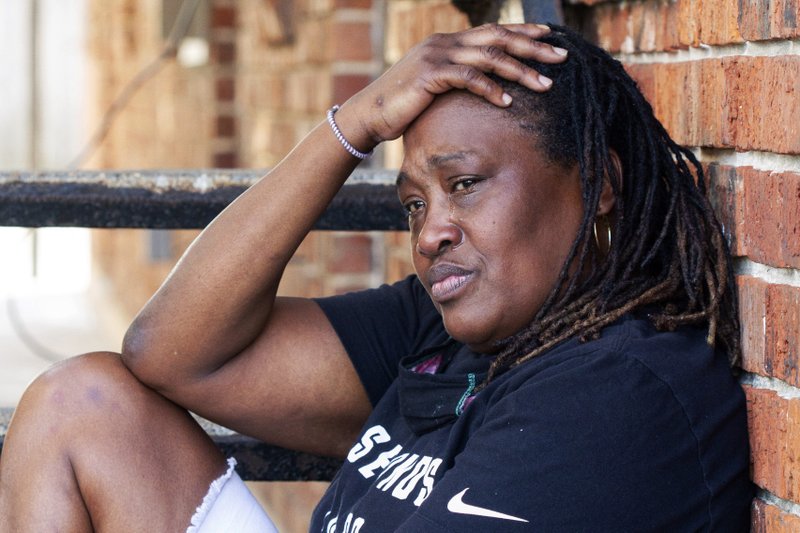
Wave of evictions expected as moratoriums end in many states

Kelyn Yanez used to clean homes during the day and wait tables at night in the Houston area before the coronavirus. But the mother of three lost both jobs in March because of the pandemic and now is facing eviction.

The Honduran immigrant got help from a local church to pay part of July’s rent but was still hundreds of dollars short and is now awaiting a three-day notice to vacate the apartment where she lives with her children. She has no idea how she will meet her August rent.

“Right now, I have nothing,” said Yanez, who briefly got her bar job back when the establishment reopened, but lost it again when she and her 4-year-old daughter contracted the virus in June and had to quarantine. The apartment owners “don’t care if you’re sick, if you’re not well. Nobody cares here. They told me that I had to have the money.”

Yanez, who lives in the U.S. illegally, is among some 23 million people nationwide at risk of being evicted, according to The Aspen Institute, as moratoriums enacted because of the coronavirus expire and courts reopen. Around 30 state moratoriums have expired since May, according to The Eviction Lab at Princeton University. On top of that, some tenants were already encountering illegal evictions even with the moratoriums.

Now, tenants are crowding courtrooms — or appearing virtually — to detail how the pandemic has upended their lives. Some are low-income families who have endured evictions before, but there are also plenty of wealthier families facing homelessness for the first time — and now being forced to navigate overcrowded and sometimes dangerous shelter systems amid the pandemic.

Experts predict the problem will only get worse in the coming weeks, with 30 million unemployed and uncertainty whether Congress will extend the extra $600 in weekly unemployment benefits that expired Friday. The federal eviction moratorium that protects more than 12 million renters living in federally subsidized apartments or units with federally backed mortgages expired July 25. If it’s not extended, landlords can initiate eviction proceedings in 30 days.

“It’s going to be a mess,” said Bill Faith, executive director of Coalition on Homelessness and Housing in Ohio, referring to the Census Bureau Household Pulse Survey, which found last week that more than 23% of Ohioans questioned said they weren’t able to make last month’s rent or mortgage payment or had little or no confidence they could pay next month’s.

Nationally, the figure was 26.5% among adults 18 years or older, with numbers in Louisiana, Oklahoma, Nevada, Alabama, Florida, Mississippi, New York, Tennessee and Texas reaching 30% or higher. The margins of error in the survey vary by state.

“I’ve never seen this many people poised to lose their housing in a such a short period of time,” Faith said. “This is a huge disaster that is beginning to unfold.”

Housing advocates fear parts of the country could soon look like Milwaukee, which saw a 21% spike in eviction filings in June, to nearly 1,500 after the moratorium was lifted in May. It’s more than 24% across the state.

“We are sort of a harbinger of what is to come in other places,” said Colleen Foley, the executive director of the Legal Aid Society of Milwaukee.

“We are getting calls to us from zip codes that we don’t typically serve, the part of the community that aren’t used to coming to us,” she added. “It’s a reflection of the massive job loss and a lot of people facing eviction who aren’t used to not paying their rent.”

In New Orleans, a legal aid organization saw its eviction-related caseload almost triple in the month since Louisiana’s moratorium ended in mid-June. Among those seeking help is Natasha Blunt, who could be evicted from her two-bedroom apartment where she lives with her two grandchildren.

Blunt, a 50-year-old African American, owes thousands of dollars in back rent after she lost her banquet porter job. She has yet to receive her stimulus check and has not been approved for unemployment benefits. Her family is getting by with food stamps and the charity of neighbors.

“I can’t believe this happened to me because I work hard,” said Blunt, whose eviction is at the mercy of the federal moratorium. “I don’t have any money coming in. I don’t have nothing. I don’t know what to do. … My heart is so heavy.”

Along with exacerbating a housing crisis in many cities that have long been plagued by a shortage of affordable options, widespread discrimination and a lack of resources for families in need, the spike in filings is raising concerns that housing courts could spread the coronavirus.

Many cities are still running hearings virtually. But others, like New Orleans, have opened their housing courts. Masks and temperature checks are required, but maintaining social distance has been a challenge.

“The first couple of weeks, we were in at least two courts where we felt really quite unsafe,” said Hannah Adams, a staff attorney with Southeast Louisiana Legal Services.

In Columbus, Ohio, Amanda Wood was among some 60 people on the docket Friday for eviction hearings at a convention center converted into a courtroom.

Wood, 23, lost her job at a claims management company in early April. The following day, the mother of a 6-month-old found out she was pregnant again. Now, she is two months behind rent and can’t figure out a way to make ends meet.

Wood managed to find a part-time job at FedEx, loading vans at night. But her pregnancy and inability to find stable childcare has left her with inconsistent paychecks.

“The whole process has been really difficult and scary,” said Wood, who is hoping to set up a payment scheduled after meeting with a lawyer Friday. “Not knowing if you’re going to have somewhere to live, when you’re pregnant and have a baby, is hard.”

Though the numbers of eviction filings in Ohio and elsewhere are rising and, in some places reaching several hundred a week, they are still below those in past years for July. Higher numbers are expected in August and September.

Experts credit the slower pace to the federal eviction moratorium as well as states and municipalities that used tens of millions of dollars in federal stimulus funding for rental assistance. It also helped that several states, including Massachusetts and Arizona, have extended their eviction moratorium into the fall.

Still, experts argue more needs to be done at the state and federal level for tenants and landlords.

Negotiations between Congress and the White House over further assistance are ongoing. A $3 trillion coronavirus relief bill passed in May by Democrats in the House would provide about $175 billion to pay rents and mortgages, but the $1 trillion counter from Senate Republicans only has several billion in rental assistance. Advocacy groups are looking for over $100 billion.

“An eviction moratorium without rental assistance is still a recipe for disaster,” said Graham Bowman, staff attorney with the Ohio Poverty Law Center. “We need the basic economics of the housing market to continue to work. The way you do that is you need broad-based rental assistance available to families who have lost employment during this crisis.”

“The scale of this problem is enormous so it needs a federal response.”


July ends on an uncertain note in the pandemic battle

https://mailchi.mp/0fa09872586c/the-weekly-gist-july-31-2020?e=d1e747d2d8

Fighting a losing battle - post - Imgur

After a week that brought the most disastrous economic data in modern history, the death of a former Presidential candidate from COVID, and signs of an alarming surge in virus cases in the Midwest, Congress left Washington for the weekend without reaching a deal on a new recovery bill. That left millions of unemployed Americans without supplemental benefit payments, business owners wondering whether more financial assistance would be forthcoming, and hospitals facing the requirement to begin repaying billions of dollars of advance payments from Medicare.

Also remaining on the table was funding to bolster coronavirus testing, with the top health official in charge of the testing effort testifying on Friday that the system is not currently able to deliver COVID test results to patients in a timely manner. While the surge in cases appears to be shifting to the Midwest, there were early indications of positive news across the Sun Belt, as the daily new case count in Florida, Louisiana, Texas, Arizona and California continued to decline, while daily death counts (a lagging indicator) continued to hit new records.

Nationally, the daily case count appears to have reached a new plateau of around 65,000, with daily deaths rising to a 7-day average above 1,150, matching a level last seen in May.

Meanwhile, new clinical findings continued to refine our understanding of how the virus attacks its victims. Reporting in JAMA Cardiology, researchers used cardiac MRI to examine heart function among 100 coronavirus patients, 67 of whom recovered at home without hospitalization, finding that 78 percent demonstrated cardiac involvement and 60 percent had evidence of active heart muscle inflammation—concerning signs pointing to possible long-term complications, even in patients with relatively mild courses of COVID infection.

And yesterday in JAMA, investigators reported that while young children are typically less affected by COVID-19 than adults, children under 5 may harbor 100 times as much active virus in their nose and throat as infected adults. While the study does not confirm that kids spread the virus to adults, it is sure to raise concerns about reopening schools, which has generally been considered relatively safer for younger children.

US coronavirus update: 4.8M cases; 151K deaths; 52.9M tests conducted.


30 million unemployed lose extra jobless benefits, as talks between Congress and the White House are at an impasse

https://www.washingtonpost.com/us-policy/2020/07/31/congress-bailout-unemployment-insurance/?utm_campaign=wp_main&utm_medium=social&utm_source=facebook&fbclid=IwAR209BwfddkZBp9kx4ot4BY41ncIlgSEDRHn7Ykg4RwGrys6O1dIUeCBjQY

30 million unemployed to lose extra jobless benefits, as talks ...

White House Chief of Staff Mark Meadows says Democrats rejected reasonable offers to extend unemployment insurance; Pelosi disputes pointing out House passed a bill to extend benefits back in May.

Nearly 30 million workers have lost $600 in enhanced weekly unemployment benefits that have kept much of the economy afloat these past four months during the coronavirus pandemic, as top lawmakers in Congress and the White House remain at an impasse over how and whether to extend the benefits.

Most of the last checks went out this week, but the program officially ended Friday, a day that Democrats and Republicans spent trading barbs over who was to blame for the failed negotiations.

White House Chief of Staff Mark Meadows said Democrats had rejected reasonable offers, while House Speaker Nancy Pelosi (D-Calif.) derided Republicans for trying to advance a short-term fix that would have extended the benefits for just a week.

“The president has been very clear for us to be aggressive and forward-leaning to make sure that they get protected, and yet what we’re seeing is politics as usual from Democrats on Capitol Hill,” Meadows said, addressing reporters in the White House briefing room.

As he was speaking, Pelosi held a news conference on Capitol Hill, where she criticized Republicans for proposing the short-term extension with their backs against the wall.

“What are we going to do in a week?” Pelosi asked as she explained why Democrats rejected the proposal to continue enhanced unemployment benefits at the current $600 weekly level for an additional week.

As many as 30 million workers, including gig workers and the self-employed, are currently receiving some form of unemployment insurance, which has been supplemented by $600 in extra benefits each week — on top of whatever state unemployment benefits a worker gets — since the crisis deepened in March.

Many economists and workers credit the additional money with helping them keep up with basic bills during the crisis: rent, mortgage, car and credit card payments, as well as everyday expenses like food. Most states cap weekly unemployment benefits well below $600; some pay as little as $275 a week as their maximum.

Candida Kevorkian, 53, her son and her daughter-in-law have all been laid off and live together with her two grandchildren in a two-bedroom apartment in South San Francisco, Calif. She worked at the Westin St. Francis hotel; her son worked at the Moscone Center, a convention center downtown; and her daughter-in-law worked at a Marriott.

The extra $600 Kevorkian gets brings her overall jobless benefits to about $1,050 a week before taxes. But she has about $1,700 in other fixed expenses on top of rent, which is $2,350 — after she negotiated with her landlord to lower it from $2,850. The family has already cut back on clothing, shoes and food, including cooking with meat once a week. She says she has little hope that her job will return given how poorly the public health side of the crisis is going, and she said she feels powerless.

“People are taking decisions for you and your life,” she said. “In the middle of this pandemic they’re playing with us.”

Back in March, when the economy was beginning to fail, because of the forced shutdowns to stop the spread of the virus, lawmakers rallied around the idea that they were rushing to shore up the economy through a short-lived public health crisis, agreeing to pass more than $2 trillion in stimulus that they thought would see the nation through the summer, when they hoped the pandemic would ease.

But surging coronavirus cases have spurred many states to reverse course and close down restaurants and bars again, weighing on the economic recovery. The novel coronavirus has killed more than 150,000 people in the United States, according to data gathered by The Washington Post.

Indeed, the pandemic outlasted the original relief efforts Congress passed.

Jim Quebman, 61, an engineer in Thousand Oaks, Calif., was initially told he’d be back at work in two weeks when he was furloughed in March from his job at a machine shop. But the date for his return keeps getting pushed back.

He’s been relying on the $600 he gets from the federal government, in addition to $450 in state benefits, to keep up to date with his monthly payments: $2,200 in property taxes, $1,200 to keep his health insurance once his employer stops paying in August, a $300 car payment and other expenses like food and repairs.

Without the $600, he said he might have to have to raid his 401(k) retirement savings.

“I’ll be in trouble within two months, basically,” he said. “How can you retire if you don’t have a pension and health care, that’s paid by, let’s say, a government.”

Raven Holmes, 38, a single mother of two who lost her job as an secretary in New Haven, Conn., back in February, said she already instituted a series of cuts in anticipation of the benefits’ expiration. She started carpooling to the grocery store, split a BJ’s Wholesale Club card with family to buy food in bulk, and has stopped getting takeout or restaurant food.

She also said she’s begun visiting food banks to help feed her and her two sons.

“Once you have absolutely nothing, it’s not hard at all,” she said, about accepting charity.

The longer Congress stalls, the more likely it is that she will have to plead with her landlord, utility companies, and other bill-holders to let accounts go into arrears until she lands on her feet again.

“Money is not a resource that can be depleted. It’s a man made thing: if you need more make more,” she said. “There are other countries — their citizens are fine, nobody is suffering and everybody is healthy. All our government wants is money in their pockets, while the people are poor and starving and scrounging.”

The wrangling over whether and how to extend jobless benefits has occupied Washington for months.

Eager to avoid blame for Friday’s expiration of the enhanced unemployment aid, Republicans have increasingly coalesced around the idea of a short-term fix. But Democrats have repeatedly rejected that approach and continue pushing for a wide-ranging $3 trillion bill the House passed in May. That bill would extend unemployment benefits through January.

Senate Majority Leader Mitch McConnell (R-Ky.) unveiled a $1 trillion counterproposal Monday, but it was quickly rejected by many members of his own conference and has increasingly seemed irrelevant as Republicans look to a short-term fix.

Senate Republicans have proposed cutting the $600 weekly federal benefit to $200 per week for two months while giving states time to transition to a more complicated system that would aim to replace 70 percent of a worker’s prior wages. A second proposal emerged this week that would give states the choice to implement the $200 bonus or move to a system that would replace up to 66 percent of wages.

Pelosi and Meadows have held meetings for four days straight, along with Treasury Secretary Steven Mnuchin and Senate Minority Leader Charles E. Schumer (D-N.Y.).

Pelosi said such a short-term extension might make sense if a deal were in sight on a larger bill and more time was needed to complete it. But, she said, that is not the state of play as the parties remain far apart.

“We anticipate that we will have a bill, but we’re not there yet,” Pelosi said.

Those who are relying the benefits have been watching the debate unfold wearily.

“Just a few men have to make this decision for how many million people? Ten guys to make a decision over these millions of people’s lives?” said Willie Woods, 60, who has been furloughed from his job as a hotel banquet server in New Orleans since April and is also losing the extra $600 a week in jobless benefits. “This country not taking care of American citizens like they’re supposed to. We didn’t bring this pandemic home. We were at work, and you hit us with a pandemic.”


The Constitution doesn’t have a problem with mask mandates

https://theconversation.com/the-constitution-doesnt-have-a-problem-with-mask-mandates-142335?utm_medium=email&utm_campaign=Latest%20from%20The%20Conversation%20for%20July%2022%202020%20-%201684316250&utm_content=Latest%20from%20The%20Conversation%20for%20July%2022%202020%20-%201684316250+Version+A+CID_3a4842bdc1542ab5ad1725fad090f099&utm_source=campaign_monitor_us&utm_term=The%20Constitution%20doesnt%20have%20a%20problem%20with%20mask%20mandates

The Constitution doesn't have a problem with mask mandates

Many public health professionals and politicians are urging or requiring citizens to wear face masks to help slow the spread of the COVID-19 virus.

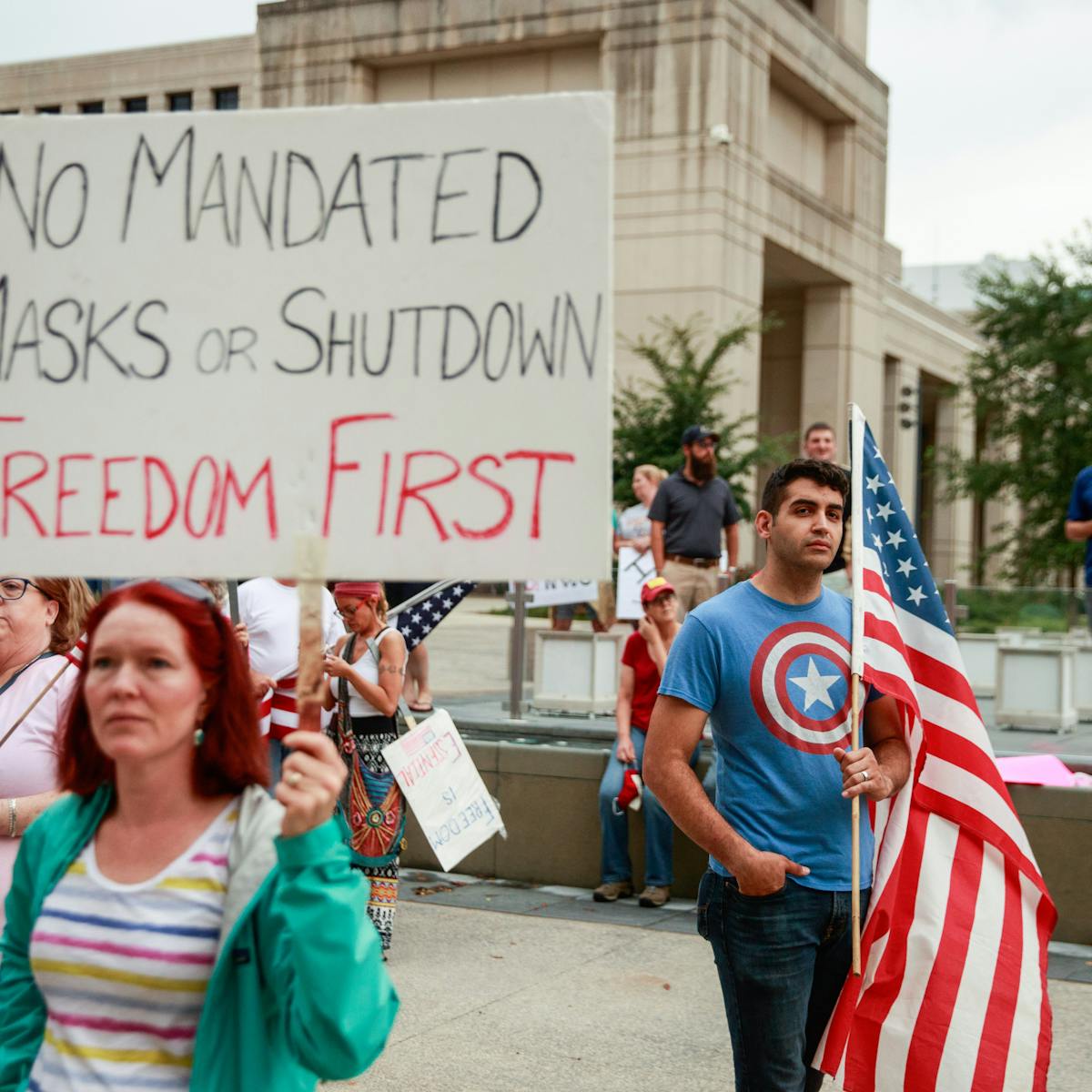
Some Americans have refused, wrongly claiming mask decrees violate the Constitution. An internet search turns up dozens of examples.

“Costco Karen,” for instance, staged a sit-in in a Costco entrance in Hillsboro, Oregon after she refused to wear a mask, yelling “I am an American … I have rights.”

A group called Health Freedom Idaho organized a protest against a Boise, Idaho, mask mandate. One protester said, “I’m afraid where this country is headed if we just all roll over and abide by control that goes against our constitutional rights.”

As one protester said, “The coronavirus doesn’t override the Constitution.”

Speaking as a constitutional law scholar, these objections are nonsense.

The objections

It is not always clear why anti-maskers think government orders requiring face coverings in public spaces or those put in place by private businesses violate their constitutional rights, much less what they think those rights are. But most of the mistaken objections fall into two categories:

Mandatory masks violate the First Amendment right to speech, assembly, and especially association and mandatory masks violate a person’s constitutional right to liberty and to make decisions about how to their own health and bodily integrity.

They’re not mutually exclusive claims:lawsuit filed by four Florida residents against Palm Beach County, for example, argues that mask mandates “interfere with … personal liberty and constitutional rights,” such as freedom of speech, right to privacy, due process, and the “constitutionally protected right to enjoy and defend life and liberty.” The lawsuit asks the court to issue a permanent injunction against the county’s mask mandate.

Responding to a reporter who asked why President Donald Trump appeared unconcerned about the absence of masks and social distancing at a campaign rally in Tulsa, Vice President Mike Pence said: “I want to remind you again freedom of speech and the right to peaceably assemble is in the Constitution of the U.S. Even in a health crisis, the American people don’t forfeit our constitutional rights.”

What the First Amendment does – and doesn’t – do

The First Amendment protects freedom of speech, press, petition, assembly and religion.

There are two reasons why mask mandates don’t violate the First Amendment.

First, a mask doesn’t keep you from expressing yourself. At most, it limits where and how you can speak. Constitutional law scholars and judges call these “time, place, and manner” restrictions. If they do not discriminate on the basis of the content of the speech, such restrictions do not violate the First Amendment. An example of a valid time, place and manner restriction would be a law that limits political campaigning within a certain distance of a voting booth.

Additionally, the First Amendment, like all liberties ensured by the Constitution, is not absolute.

All constitutional rights are subject to the goverment’s authority to protect the health, safety and welfare of the community. This authority is called the “police power.” The Supreme Court has long held that protecting public health is sufficient reason to institute measures that might otherwise violate the First Amendment or other provisions in the Bill of Rights. In 1944, in the case of Prince v. Massachusetts, for example, the Supreme Court upheld a law that prohibited parents from using their children to distribute religious pamphlets on public streets.

The right to liberty

Some anti-maskers object that masks violate the right to liberty.

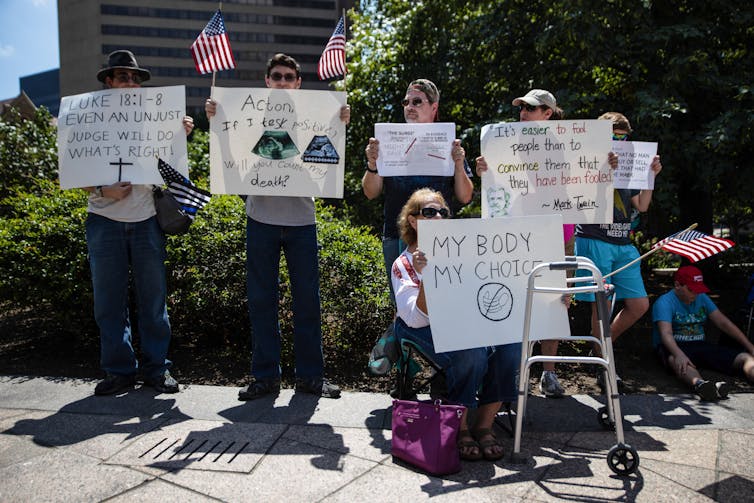
The right to liberty, including the right to make choices about one’s health and body, is essentially a constitutional principle of individual autonomy, neatly summarized as “My body, my choice.”

The 1905 case of Jacobsen v. Massachusetts shows why mask mandates don’t violate any constitutional right to privacy or health or bodily integrity. In that case, the Supreme Court upheld a smallpox vaccination requirement in Cambridge, Massachusetts.

The court said that the vaccination requirement did not violate Jacobsen’s right to liberty or “the inherent right of every freeman to care for his own body and health in such way as to him seems best.”

As the court wrote, “There are manifold restraints to which every person is necessarily subject for the common good. On any other basis, organized society could not exist with safety to its members.” In a 1995 New York case, a state court held that an individual with active tuberculosis could be forcibly detained in a hospital for appropriate medical treatment.

Even if you assume that mask mandates infringe upon what the Supreme Court calls “fundamental rights,” or rights that the court has called the “very essence of a scheme of ordered liberty,” it has consistently ruled states can act if the restrictions advance a compelling state interest and do so in the least restrictive manner.

Rights are conditional

As the Jacobsen ruling and the doctrine of time, place and manner make clear, the protection of all constitutional liberties rides upon certain necessary – but rarely examined – assumptions about communal and public life.

One is that is constitutional rights – whether to liberty, speech, assembly, freedom of movement or autonomy – are held on several conditions. The most basic and important of these conditions is that our exercise of rights must not endanger others (and in so doing violate their rights) or the public welfare. This is simply another version of the police power doctrine.

Unfortunately, a global pandemic in which a serious and deadly communicable disease can be transmitted by asymptomatic carriers upsets that background and justifies a wide range of reasonable restrictions on our liberties. Believing otherwise makes the Constitution a suicide pact – and not just metaphorically.