Surprise medical bills in the coronavirus era

https://www.axios.com/surprise-medical-bills-coronavirus-c61a5529-3272-4edd-b660-35dc61f751b4.html

Surprise medical bills in the coronavirus era - Axios

Rep. Katie Porter recently received an explanation of benefits from her insurer saying that, in addition to the $20 co-pay she paid when she got her coronavirus test, she may be on the hook for an additional $56.60.

The catch: The law requires insurers to cover coronavirus testing without cost-sharing. Porter knows that because she voted for it.

Why it matters: Containing the coronavirus depends on knowing who has it, and it’s going to be much harder to get people to get tested if they think they’ll have to pay for it. But it’s becoming increasingly clear that patients may be vulnerable to surprise coronavirus bills.

Between the lines: Porter, who received a coronavirus test on March 23, has insurance through UnitedHealthcare and shared her explanation of benefits with Axios. Congress has required both the test itself and the associated care to be covered without cost-sharing.

  • In a statement, UnitedHealth Group said it has waived member cost-sharing for coronavirus testing and treatment.
  • “Some members received bills early on when there were not yet specific COVID-19 billing codes and during a period in which code adoption was first taking place,” the company said, adding that it’s waiving those charges and evaluating claims from earlier this year to make sure they were handled correctly.
  • “We are not authorized to talk about [Porter’s] specific situation without permission, however, what likely occurred is that her provider used the wrong billing code for the visit. To confirm if that’s the case and have it corrected, we encourage Rep. Porter to contact us so we can clarify with her directly.”

Yes, but: There’s a huge question of who should have to pay for coronavirus testing as it becomes more prolific, and many insurers — United included — have said that they’ll only cover tests that are “medically necessary,” at least without cost-sharing. It’s unclear who will pay for tests that aren’t deemed medically necessary.

  • The federal government hasn’t said who should pay for testing when, whether it be insurers, employers or the government itself. Insurers are questioning whether they should be on the hook for the hundreds of thousands of tests of asymptomatic people that public health experts say will need to be conducted every day.
  • Even though Congress has tried to resolve payment disputes between insurers and out-of-network labs, there’s a loophole that would allow patients to receive balance bills from out-of-network labs in some circumstances.
  • If a patient sees an out-of-network doctor for a coronavirus test, they’re vulnerable to receiving a surprise medical bill from this provider — just as they are under normal, non-coronavirus conditions, said Loren Adler, associate director of the USC-Brookings Schaeffer Initiative for Health Policy.

What they’re saying: “We will not be able to truly reopen and rebuild if Americans rightly fear costly medical bills for visiting their health care providers for coronavirus tests,” Porter writes in a letter to top Health and Human Services officials being sent today, asking the administration to implement the law more forcefully.

  • She also asked for “formal, explicit guidance for insurers, providers, employers like nursing homes and assisted living facilities, and testing companies, as well as all 50 states…to ensure patients and workers are not asked to pay any costs.”




A 70-year-old man was hospitalized with COVID-19 for 62 days. Then he received a $1.1 million hospital bill, including over $80,000 for using a ventilator.

https://www.yahoo.com/news/70-old-man-hospitalized-covid-170112895.html

Man, 70, hospitalized with COVID-19 for 62 days gets $1.1 million ...

  • A man in Washington state who spent more than two months in the hospital and more than a month in the Intensive Care Unit with COVID-19 received a 181-page itemized bill that totals more than $1.1 million, The Seattle Times reported.
  • Michael Flor, 70, will likely foot little of the bill due to his being insured through Medicare, according to the report.
  • “I feel guilty about surviving,” Flor told The Seattle Times. “There’s a sense of ‘why me?’ Why did I deserve all this? Looking at the incredible cost of it all definitely adds to that survivor’s guilt.”

A 70-year-old man in Seattle, Washington, was hit with a $1.1 million 181-page long hospital bill following his more than two-month stay in a local hospital while he was treated for — and nearly died from — COVID-19. 

“I opened it and said ‘holy (expletive)!’ ” the patient, Michael Flor, who received the $1,122,501.04 bill told The Seattle Times.

He added: “I feel guilty about surviving. There’s a sense of ‘why me?’ Why did I deserve all this? Looking at the incredible cost of it all definitely adds to that survivor’s guilt.”

According to the report, Flor will not have to pay for the majority of the charges because he has Medicare, which will foot the cost of most if not all of his COVID-19 treatment. The 70-year-old spent 62 days in the Swedish Medical Center in Issaquah, Washington, 42 days of which he spent isolated in the Intensive Care Unit (ICU). 

Of the more than one month he spent in a sealed-off room in the ICU, Flor spent 29 days on a ventilator. According to the Seattle Times, a nurse on one occasion even helped him call his loved ones to say his final goodbyes, as he believed he was close to death from the virus.

While in the ICU, Flor was billed $9,736 each day; more than $80,000 of the bill is made up of charges incurred from his use of a ventilator, which cost $2,835 per day, according to the report. A two-day span of his stay in the hospital when his organs, including his kidneys, lungs, and heart began to fail, cost $100,000, according to the report.  

In total, there are approximately 3,000 itemized charges on Flor’s bill — about 50 charges for each day of his hospital stay, according to The Seattle Times. Flor will have to pay for little of the charges — including his Medicare Advantage policy’s $6,000 out-of-pocket charges — due to $100 billion set aside by Congress to help hospitals and insurance companies offset the costs of COVID-19.

Flor is recovering in his home in West Seattle, according to the report.


R1 RCM buys Cerner’s revenue cycle outsourcing business for $30M

https://www.fiercehealthcare.com/tech/r1-rcm-buys-cerner-s-revenue-cycle-business-30m-deal?mkt_tok=eyJpIjoiTXpReVptRTBOemxoWW1OaCIsInQiOiJcL0FZVXVvVmhwQWpxdFBoV1VKRjhON29CaWhLY3g2bXFhT0doXC9tWVFpWTd0blh3TEY3MTN0M3lsZEs3K002d0hLS25BNld4dlk0b3NhWDBYaUhWYkNTUGc5SVRlRjBEMERoS01kWlZER1hVMmhFTkczdTAzMDhxWWpIaWxORk1mIn0%3D&mrkid=959610

Cerner's headquarters are in Kansas City, Missouri

R1 RCM plans to pay $30 million for health IT giant Cerner’s revenue cycle business.

Chicago-based R1, a leading revenue cycle management technology vendor, is acquiring Cerner RevWorks’ services business and commercial, nonfederal client relationships. The deal, which was announced Wednesday, does not include RevWorks’ federal clients.

R1 said it plans to hire Cerner RevWorks employees once the deal closes in the third quarter of 2020.

Both companies have committed to a seamless integration between the company’s technology-enabled services platform and Cerner’s software, R1 said in a press release.

As part of the transaction, Cerner said it will extend R1’s revenue cycle capabilities and expertise to Cerner clients and new prospects, helping drive sustainable financial improvements for providers while enhancing their patients’ overall experience.

The closing of the acquisition is expected to take place in the third quarter of 2020, subject to customary closing conditions.

According to R1’s filing with the U.S. Securities and Exchange Commission (SEC), the deal is valued at $30 million inclusive of working capital, financed with cash on the balance sheet.

The acquisition price will be paid in three installments, according to the SEC filing.

R1’s stock rose 12% Wednesday following the news.

The deal further establishes R1’s footprint across the acute and ambulatory markets, the company said in the SEC filing. The RevWorks business brings in approximately $80 million in annual revenue across more than 150 customers.

“We look forward to working collaboratively with Cerner to deliver superior results for healthcare providers and the communities they serve,” said Gary Long, executive vice president and chief commercial officer of R1. “With our interoperable technology and end-to-end platform, we are well-positioned to serve Cerner’s customers, as well as other healthcare organizations across the country.”

“Cerner’s overall goal is to deliver client success and accelerate our ability to deliver scalable innovations,” said Brenna Quinn, senior vice president of revenue cycle management at Cerner, in a statement.

In a statement provided by the company, Cerner executives said the deal with R1 will bring its commercial, nonfederal clients a total solution that pairs “Cerner’s advanced technology with R1’s world-class revenue services, ultimately optimizing financial performance for health systems.”

“Cerner remains committed to and heavily invested in its revenue cycle solutions to help our clients combine clinical, financial, and operational health information when and where it’s needed,” the company said.

Centerview Partners LLC acted as financial adviser, and Kirkland & Ellis LLP acted as legal adviser to R1. Greenhill & Co. acted as an adviser to Cerner.

Earlier this year, R1 acquired SCI Solutions, a provider of SaaS-based scheduling and patient access solutions, for approximately $190 million in cash.

The RCM vendor’s revenue grew 16.2% in the first quarter of 2020, up $44.6 million to reach $320.5 million.

However, during its first-quarter earnings call in May, R1 executives said the company is expecting to see revenue decline by $10 million to $20 million in the second quarter, driven by lower patient volumes for its smaller physician customers.

Cerner’s revenue cycle business took a hit last year when Adventist Health terminated its revenue cycle outsourcing contract with the company, resulting in a $60 million impairment charge for Cerner in the third quarter of 2019, the company reported during its third-quarter earnings call.

Adventist transitioned all its revenue cycle operations to Huron Consulting Group. At the time, about 1,700 Cerner employees transitioned over to Adventist and Huron.

During the company’s fourth-quarter and year-end 2019 earnings call in February, Cerner Chief Financial Officer Marc Naughton hinted at a potential sell-off of the RevWorks business.

“Those areas that we don’t think are the growth areas for the company we want to focus on, we’re going to consider divesting as one of the options,” Naughton said during a Q&A with analysts. “It will be an existing business that we will basically go out to market and look for opportunities to say here is this asset, it’s something we’re willing to let go and some of these assets have significant value.”


Cartoon – Let’s begin your exam with a simple coordination test

Difference Between Islamic Takaful and Conventional Insurance - ED ...

Ascension reports $2.7B net loss in Q3

https://www.beckershospitalreview.com/finance/ascension-reports-2-7b-net-loss-in-q3.html?utm_medium=email

Ascension, Google working on 'secret' patient data project, says ...

St. Louis.-based Ascension saw revenue decline in the three months ended March 31, and it ended the period with a net loss, according to unaudited financial documents

The 150-hospital system reported operating revenue of $6.1 billion in the third quarter of fiscal year 2020, down 2.5 percent from the same period a year earlier. Net patient service revenue dramatically declined in March due to a drop in patient volume attributed to the COVID-19 pandemic.

“COVID-19 has been encountered across all Ascension markets, to varying degrees, and has had an adverse effect on the system’s revenues and operating margin,” management wrote in comments on the financial results.

Looking at the nine months ended March 31, net patient service revenue was up 1.9 percent year over year due to several factors, including an increase in physician office visits and expansion of service lines and sites of care. 

The health system’s expenses climbed more than 3 percent year over year to $6.4 billion in the third quarter, and expenses were up nearly 4 percent in the nine months ended March 31. Higher expenses related to expanded service lines and the transition toward standardized revenue cycle services pushed the system’s expenses higher before the COVID-19 pandemic, Ascension said. 

Ascension ended the most recent quarter with an operating loss of $429.4 million, compared to operating income of $80.1 million a year earlier. During the nine months ended March 31, the health system’s operating loss totaled $344.9 million.

After factoring in nonoperating items, including losses from investments of nearly $2.5 billion, Ascension reported a net loss of $2.7 billion in the third quarter of fiscal year 2020. In the same period a year earlier, the system recorded investment income of $1.1 billion and net income of $1.2 billion.

To help offset financial damage caused by the COVID-19 pandemic, Ascension received funds from the $175 billion in relief aid Congress has allocated to hospitals and other healthcare providers to cover expenses and lost revenue tied to the pandemic. The health system received $211 million in federal grants, according to The New York Times.

Ascension also applied for and received about $2 billion of Medicare advance payments in April, which must be repaid. 


Now Is the Time to Address Surprise Billing

https://www.medpagetoday.com/blogs/marty-makary/86455?xid=fb_o&trw=no&fbclid=IwAR1boFFgBZuSqJ9-1728UdSFeIK790TTXNeoJJ9mky9jCKbGyQ_G4jqwrfk

Tips to avoid surprise medical bills

The doctor-patient relationship is being undermined.

Private equity companies have spent millions in dark money to stall and effectively kill all versions of surprise billing reform. But this week, the issue will come before Congress again. Legislation was introduced Tuesday in the House that, among other things, would further assist hospitals with more relief funds. With this potential third disbursement of federal dollars comes an opportunity to finally address the embarrassing problem of surprise billing that has eroded the public trust in our great medical profession.

Physicians across the country are now signing a letter urging leaders of Congress to address surprise billing once and for all. I have already signed this letter and encourage you to consider doing so as well.

One reason the medical profession is the greatest profession in the world is that patients put their faith and trust in us. But 64% of Americans now say they have avoided or delayed medical care for fear of the bill. As more and more patients lose faith in the system, the doctor-patient relationship is being undermined by surprise billing and the modern-day business practices of price gouging and predatory billing. In fact, these egregious practices have become part of the business model of some private equity groups, which seek to replace physician autonomy with corporate medicine.

Our system today is unnecessarily complicated and works against patients’ interests by putting them in the middle of a finger-pointing blame game, which leaves them holding the bag. It doesn’t make sense for us to accept people with open arms, treat their ailment, and then ruin their lives financially. Medical science is a bastion of scientific and intellectual genius. We can fix this problem. Already, some efforts are advancing price transparency by creating a transparent marketplace for patients.

I’ve spent many years looking at the systematic cost issues that face our health system and patients. Simply put, the lack of fairness and transparency in pricing and billing practices has created financial toxicity and increased the general mistrust of the medical system for millions of Americans. No one designed it to be this bad. In fact, we have good people working in a bad system. When I explain details of pricing, billing, and collections with doctors and hospital leaders, they are invariably shocked and furious to learn how out of control their billing offices have gotten in overcharging patients and shaking people down for more than a reasonable amount for a service.

The current COVID-19 crisis is a stark reminder of the gaps in our health system that exacerbate the pressures facing providers and patients. Many Americans are getting crushed right now. Despite many years of debate in Washington and bipartisan agreement that something must be done, there is still no federal protection in place to safeguard consumers from an egregious surprise medical bill if they need emergency care or have limited options. The reality is that special interests — including the very private equity firms that stand to benefit financially from these exploitative business practices — continue to spend millions to maintain the status quo.

It’s time for a bipartisan compromise to end the non-transparent game of surprise medical billing. It’s time that Congress takes meaningful action to protect patients during this COVID-19 crisis and finally address this issue. Congress has solutions on the table that would bring much greater fairness and transparency to the healthcare system, protect patients from these predatory charges, and ensure that physicians are paid fairly for our services, as we deserve. It’s time we put an end to the cycle of financial toxicity and rebuild the great public trust in the medical profession.


Five components of an intelligent middle revenue cycle

https://www.beckershospitalreview.com/healthcare-information-technology/five-components-of-an-intelligent-middle-revenue-cycle.html

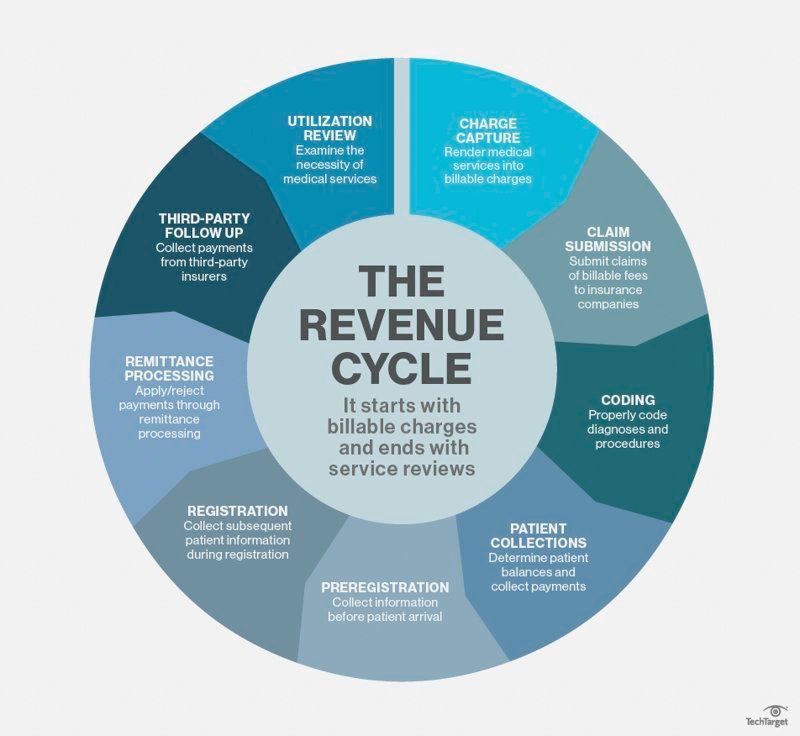
What is revenue cycle management (RCM)? - Definition from WhatIs.com

Keys to achieving revenue integrity and compliance across your organization

It’s old news: Revenue cycle complexity continues to increase, exacerbating existing challenges. And as we tackle those, new ones arise to take their place.

Ever-changing regulations are a given, but adopting value-based reimbursement (VBR) models currently poses a major challenge. New payment models complicating revenue cycle activity become more difficult with additional quality reporting and other requirements. Add in the operational realities of siloed workflows, data proliferation, and disparate systems, and it’s clear why efficient collaboration can seem nearly impossible.  Intelligent middle revenue cycle operations that manage to these challenges are vital to achieving revenue integrity and financial stability.


Use the right solutions at the right time

Today’s environment requires sharpening the way you ensure revenue integrity. Providers need an easy, seamless way to manage middle revenue cycle operations, and there are several effective strategies to accomplish that. Of course, it’s important to recognize and make use of your EMR system’s capabilities. It’s also essential to leverage complementary technologies with specific core competencies that will improve revenue cycle performance. For example, a solution that continuously monitors records in real time enables timely auditing, coding adjustments and case completion to reduce billing turnaround and reimbursement delays.


Take a smart approach to enabling technology

Augmenting your core systems with complementary technologies or capabilities on a single, integrated platform makes it much easier to support internal collaboration between different departments or teams. An integrated platform also enables you to seamlessly deploy additional capabilities onto that platform, ensuring speed to value. Instead of using multiple disparate tools, a shared platform enables interdepartmental communication and helps minimize inefficiency.  A smart technology platform that crosses departmental siloes and brings transparency across teams is critical. Platforms that leverage clinically aware artificial intelligence and other automation enable staff to proactively focus on the areas where their expertise has the most impact. In addition, when leveraging an integrated platform, one expert team’s work will not get cancelled out by another team’s contributions.

Regardless of which core system you use, integrating technology with targeted competencies and connectivity adds value to the EMR. It can provide a depth of specialized expertise that drives better documentation, coding and real time audit interaction — keys to a high-performing revenue cycle.


Prioritize comprehensive, correct documentation and coding

Unfortunately, it seems the battle against claim denials is here to stay. You can’t overlook the importance of front-end data validation to eliminate rework and inefficiency. However, the ability to ensure complete and accurate clinical documentation for every case will significantly impact revenue capture and reduce the inefficiency of denials and rework.

Broaden the scope of your CDI program with technology that uses clinical intelligence to drive concurrent documentation review for all payers. Getting it right up front contributes to better coding, accurate reimbursement, and appropriate quality measures, all of which are vital to success under VBR.


Increase collaboration with payers

As long as payers and providers continue working at odds, the costly onslaught of denials will persist. In a perfect world, both sides would join forces to find mutually beneficial solutions for claim errors, denials and payment delays. Imagine the savings in administrative inefficiency alone. However, we’re not in that world yet. Therefore, it’s important to make a proactive effort to understand the specifics of each payer’s contract and adjust your internal processes and technology rules accordingly. As operating margins get smaller, organizations have no choice but to increase efficiency and accuracy, and working together with payers can contribute significantly to that goal.


Consolidate, collaborate, communicate

Industry pressures to improve performance are unrelenting, especially around smart solutions, innovation, and increasing both efficiency and the bottom line. Organizations are expected to improve these areas while, at the same time, enabling patient-centric operations. One way to achieve this is to leverage innovative, integrated tools to augment core systems and promote partnership, communication and efficiency across multiple related disciplines.

Consider clinical documentation, coding and auditing. Numerous departments need pieces of that information for different reasons, including utilization review, medical necessity determinations, chart audits and quality monitoring, in addition to bill preparation. A single repository containing up-to-date data in a real-time view driven by supporting workflow, rules and alerts provides consistent and reliable information when and where it’s needed.

As patient care becomes more complex, so does the middle revenue cycle. Seek solutions that will simplify and manage the complexity in an administratively efficient way. Consider your prospective vendor’s core competencies when evaluating solutions and look for integration and intelligent automation that will add the most value to your organization.


State-by-state breakdown of 354 rural hospitals at high risk of closing

https://www.beckershospitalreview.com/finance/state-by-state-breakdown-of-354-rural-hospitals-at-high-risk-of-closing.html?utm_medium=email

What Rural Hospital Closures Mean for EMS Professionals

Twenty-five percent of the 1,430 rural hospitals in the U.S. are at high risk of closing unless their finances improve, according to an annual analysis from Guidehouse, a consulting firm. 

The 354 rural hospitals at high risk of closing are spread across 40 states and represent more than 222,000 annual discharges. According to the analysis, 287 of these hospitals — 81 percent — are considered highly essential to the health and economic wellbeing of their communities.

Several factors are putting rural hospitals at risk of closing, according to the analysis, which looked at operating margin, days cash on hand, debt-to-capitalization ratio, current ratio and inpatient census to determine the financial viability of rural hospitals. Declining inpatient volume, clinician shortages, payer mix degradation and revenue cycle management challenges are among the factors driving the rural hospital crisis.

The Guidehouse study analyzed the financial viability of rural hospitals prior to the COVID-19 pandemic, and the authors noted that the rural hospital crisis could significantly worsen due to the pandemic or any downturn in the economy. 

Here are the number and percentage of rural hospitals at high risk of closing in each state based on the analysis:

Tennessee
Rural hospitals at high risk of closing: 19 (68 percent)

Alabama
Rural hospitals at high risk of closing: 18 (60 percent)

Oklahoma
Rural hospitals at high risk of closing: 28 (60 percent)

Arkansas
Rural hospitals at high risk of closing: 18 (53 percent)

Mississippi
Rural hospitals at high risk of closing: 25 (50 percent)

West Virginia
Rural hospitals at high risk of closing: 9 (50 percent)

South Carolina
Rural hospitals at high risk of closing: 4 (44 percent)

Georgia
Rural hospitals at high risk of closing: 14 (41 percent)

Kentucky
Rural hospitals at high risk of closing: 18 (40 percent)

Louisiana
Rural hospitals at high risk of closing: 11 (37 percent)

Maine
Rural hospitals at high risk of closing: 7 (33 percent)

Indiana
Rural hospitals at high risk of closing: 8 (31 percent)

Kansas
Rural hospitals at high risk of closing: 26 (31 percent)

New Mexico
Rural hospitals at high risk of closing: 3 (30 percent)

Michigan
Rural hospitals at high risk of closing: 13 (29 percent)

Missouri
Rural hospitals at high risk of closing: 10 (26 percent)

Virginia
Rural hospitals at high risk of closing: 5 (25 percent)

Oregon
Rural hospitals at high risk of closing: 4 (24 percent)

California
Rural hospitals at high risk of closing: 6 (23 percent)

North Carolina
Rural hospitals at high risk of closing: 6 (23 percent)

Florida
Rural hospitals at high risk of closing: 2 (22 percent)

North Dakota
Rural hospitals at high risk of closing: 7 (21 percent)

Ohio
Rural hospitals at high risk of closing: 6 (20 percent)

Vermont
Rural hospitals at high risk of closing: 2 (20 percent)

Idaho
Rural hospitals at high risk of closing: 4 (19 percent)

Pennsylvania
Rural hospitals at high risk of closing: 4 (19 percent)

Washington
Rural hospitals at high risk of closing: 5 (18 percent)

Wyoming
Rural hospitals at high risk of closing: 3 (18 percent)

Texas
Rural hospitals at high risk of closing: 14 (16 percent)

Colorado
Rural hospitals at high risk of closing: 4 (14 percent)

Illinois
Rural hospitals at high risk of closing: 7 (14 percent)

Montana
Rural hospitals at high risk of closing: 7 (14 percent)

Nebraska
Rural hospitals at high risk of closing: 8 (13 percent)

New York
Rural hospitals at high risk of closing: 4 (13 percent)

Iowa
Rural hospitals at high risk of closing: 9 (12 percent)

Minnesota
Rural hospitals at high risk of closing: 8 (11 percent)

Alaska
Rural hospitals at high risk of closing: 1 (10 percent)

Arizona
Rural hospitals at high risk of closing: 1 (10 percent)

New Hampshire
Rural hospitals at high risk of closing: 1 (9 percent)

Wisconsin
Rural hospitals at high risk of closing: 5 (9 percent)


How insurers are covering COVID-19

https://www.healthcaredive.com/news/how-insurers-are-covering-covid-19/575372/

Private Health Coverage of COVID-19: Key Facts and Issues | The ...

Insurers are weighing how best to respond to the outbreak of the novel coronavirus as cases swell in the U.S. Here is a tracker to follow the latest policy and coverage decisions from the nation’s largest insurers.

The nation’s health insurers are responding to the coronavirus pandemic with changes to coverage associated with COVID-19 as the number of cases continues to swell across the U.S.

The biggest payers have said they will waive patient cost-sharing — copays, coinsurance and deductibles — for testing. Although some, such as Cigna and Humana, have gone farther by eliminating cost-sharing for all COVID-19 treatment.

In addition to coverage decisions, insurers are weighing the ways they can reduce administrative barriers to promote quicker access to care for those infected with the novel coronavirus. All are cutting back on prior authorization in various ways to ease access to care.

Hospitals say that’s not enough, and are calling on the biggest payers to follow actions taken by Congress and CMS to help resolve cash flow issues, by accelerating payments or opting into releasing interim periodic payments. The American Hospital Association also is urging payers to eliminate administrative burdens such as prior authorizations.

“This crisis is challenging for all of us, and everyone has a role to play,” AHA said in its letter to the nation’s largest insurers. “You could make a significant difference in whether a hospital or health system keeps their doors open during this critical time.”

Despite the policy changes by payers, employers with self-funded plans can opt out of these policies. A majority of workers are covered by self-insured plans, which essentially allow employers to decide coverage decisions given they’re paying for the claims and having insurers simply perform administrative services.

Below is a tracker with the latest coverage decisions for the nation’s largest insurers.

Blue Cross Blue Shield Association

The BCBSA is eliminating cost-sharing for COVID-19 diagnostic testing. It will also waive cost-sharing for treatment at in-network or Medciare rates through May 31, including inpatient stays.

BCBSA will remove prior authorization requirements for testing and for services that are medically necessary to treat an infected patient. BCBSA also is waiving limits on early refills to make it easier to access medications and expanding access to telehealth services.

Molina

Molina is halting cost-sharing for testing and treatment. That policy applies to Medicare, Medicaid and marketplace members nationwide.

Aetna (CVS)

Aetna will waive cost-sharing for certain members admitted to an in-network hospital with COVID-19 or complications from the disease. The policy applies to all of Aetna’s commercial plans, though self-insured members can opt out. The policy will apply to admissions through June 1. Aetna also is waiving cost-sharing for testing and associated visits, including telehealth.

Aetna also is attempting to make access to hospitalization faster for those with COVID-19 by easing prior authorization requirements, particularly in areas hard hit by the outbreak like New York and Washington.

Anthem

The nation’s second largest commercial insurer will waive cost-sharing for COVID-19 treatment and will reimburse providers at either in-network or Medicare rates through May 31. The policy applies to Anthem’s fully insured, individual, Medicaid and Medicare Advantage members. Self-insured plans can opt out. Anthem also is waiving cost-sharing for COVID-19 testing and in-network visits associated with testing whether it’s conducted at a physician’s office, urgent care or ER.

Anthem also is easing its limits on early refills for 30-day prescriptions. Anthem said it would waive cost sharing for telehealth visits, including those for mental health for a period of 90 days starting March 17. Self-insured plans have the option to opt in the new virtual care policy.

Centene

Centene will waive cost-sharing for COVID-19 related screening, testing and treatment for its Medicaid, Medicare and Marketplace members through June 30.

Centene also will eliminate prior authorization requirements for care for all its Medicare, Medicaid and Marketplace members. The company is also working to supply federally qualified health centers with personal protective equipment and assistance in providing small business loans to behavioral health providers and long-term service support organizations.

Cigna

Cigna will waive cost-sharing for all COVID-19 treatment, including testing and telehealth screenings through May 31. The policy applies to Cigna’s fully-insured group plans, individual coverage and Medicare Advantage plans. Self-insured plans can opt out.

Cigna will reimburse providers either at in-network or Medicare rates depending on the member. Cigna also is easing access to maintenance medication by offering free shipping for a 90-day supply. Cigna is easing prior authorization requirements for patients being discharged from the hospital to post-acure stays.

Humana

Humana is waiving cost-sharing for testing and treatment, including hospital admissions for COVID-19 cases. The policy applies to its Medicare Advantage plans, fully-insured commercial plans, Medicare supplement and its Medicaid plans. The policy is indefinite with no current end date. Cost-sharing will be waived for all telehealth visits and members can opt to refill prescriptions early.

Humana also is easing administrative barriers to allow infected patients to easily move from a hospital to post-acute care settings. It’s suspending prior authorization and referral requirements and requesting notification within 24 hours. It’s also implementing an expedited claims process to reimburse providers faster, Humana said.

UnitedHealthcare

The nation’s largest commercial insurer, will waive cost-sharing for COVID-19 treatment through May 31. The policy applies to its fully-insured commercial, Medicare Advantage and Medicaid plans. United also is waiving cost-sharing for COVID-19 testing at approved locations in accordance with Centers for Disease Control guidelines. There will be no cost-sharing for visits related to testing including at physician offices, urgent care, ERs and telehealth visits. The policy applies to United’s commercial, Medicare Advantage and Medicaid members.

UnitedHealthcare is opening a special enrollment period for some of its commercial members who opted out of coverage during the traditional enrollment period with their employers. This enrollment period will end April 6. The insurer also is easing prior authorization requirements through May 31, suspending prior approval for post-acute care and switching to a new provider.


Jobless claims spike to another weekly record amid coronavirus crisis

https://www.axios.com/jobless-claims-unemployment-coronavirus-e54561c2-ed25-4f1e-8e32-7fbec81a9a24.html?stream=top&utm_source=alert&utm_medium=email&utm_campaign=alerts_all

Jobless claims spike to 6.6 million, another weekly record amid ...

6.6 million people filed for unemployment last week, a staggering number that eclipses the record set just days ago amid the coronavirus pandemic, according to government data released Thursday.

Why it matters: Efforts to contain the outbreak are continuing to create a jobs crisis, causing the sharpest spikes in unemployment filings in American history.

  • The colossal number of unemployment filings is worse than most Wall Street banks were expecting.

The big picture: Nearly 10 million Americans have filed for unemployment claims in recent weeks, as businesses around the country shut down in response to the pandemic.

  • But the data lags by a week, so it’s almost certain labor departments around the country are still processing claims and people are still applying.