


Cartoon – Everything is Negotiable
Shapes of Recovery: When Will the Global Economy Bounce Back?

Is the glass half full, or half empty?
Whenever the economy is put through the ringer, levels of optimism and pessimism about its potential recovery can vary greatly. The current state mid-pandemic is no exception.
This graphic first details the various shapes that economic recovery can take, and what they mean. We then dive into which of the four scenarios are perceived the most likely to occur, based on predictions made by CEOs from around the world.
Economic recovery comes in four distinct shapes—L, U, W, and V. Here’s what each of these are characterized by, and how long they typically last.
Another scenario not covered here is the Z-shape, defined by a boom after pent-up demand. However, it doesn’t quite make the cut for the present pandemic situation, as it’s considered even more optimistic than a V-shaped recovery.
Depending on who you ask, the sentiments about a post-pandemic recovery differ greatly. So which of these potential scenarios are we really dealing with?
The think tank The Conference Board surveyed over 600 CEOs worldwide, to uncover how they feel about the likelihood of each recovery shape playing out in the near future.
The average CEO felt that economic recovery will follow a U-shaped trajectory (42%), eventually exhibiting a slow recovery coming out of Q3 of 2020—a moderately optimistic view.
However, geography seems to play a part in these CEO estimates of how rapidly things might revert back to “normal”. Over half of European CEOs (55%) project a U-shaped recovery, which is significantly higher than the global average. This could be because recent COVID-19 hotspots have mostly shifted to other areas outside of the continent, such as the U.S., India, and Brazil.
Here’s how responses vary by region:
| Region | L-shape | U-shape | W-shape | V-shape |
|---|---|---|---|---|
| Global (N=606) | 32% | 42% | 16% | 11% |
| U.S. (N=103) | 26% | 42% | 23% | 9% |
| Europe (N=110) | 29% | 55% | 12% | 4% |
| China (N=122) | 25% | 43% | 11% | 21% |
| Japan (N=95) | 49% | 26% | 23% | 1% |
| Gulf Region (N=16) | 57% | 26% | 17% | –
|
In the U.S. and Japan, 23% of CEOs expect a second contraction to occur, meaning that economic activity could undergo a W-shape recovery. Both countries have experienced quite the hit, but there are stark differences in their resultant unemployment rates—15% at its peak in the U.S., but a mere 2.6% in Japan.
In China, 21% of CEOs—or one in five—anticipate a quick, V-shaped recovery. This is the most optimistic outlook of any region, and with good reason. Although economic growth contracted by 6.8% in the first quarter, China has bounced back to a 3.2% growth rate in the second quarter.
Finally, Gulf Region CEOs feel the most pessimistic about potential economic recovery. In the face of an oil shock, 57% predict the economy will see an L-shaped recovery that could result in depression-style stagnation in years to come.
At the end of the day, CEO opinions are all over the map on the potential shape of the economic recovery—and this variance likely stems from geography, cultural biases, and of course the status of their own individual countries and industries.
Despite this, portions of all cohorts saw some possibility of an extended and drawn-out recovery. Earlier in the year, risk analysts surveyed by the World Economic Forum had similar thoughts, projecting a prolonged recession as the top risk of the post-COVID fallout.
It remains to be seen whether this will ultimately indeed be the trajectory we’re in store for.

https://www.visualcapitalist.com/wp-content/uploads/2020/09/state-of-democracy.html
View the full-sized interactive version of this infographic by clicking here
From Norway to North Korea, governing systems differ around the world. But has the world become more or less free in the past decade?
This visualization from Preethi Lodha demonstrates how democracy levels of 167 countries have changed since 2006. The original data comes from the Democracy Index, which is compiled annually by the Economist Intelligence Unit.
First, it’s important to understand the classifications made by the Democracy Index.
Based on answers to 60 questions across a nation’s electoral process, civil liberties, government functions, political participation and political culture, countries are assigned a range of scores in the Democracy Index.
Based on these scores, a nation automatically falls into one of the following four types of governance. Here’s which category fits the bill, depending on the range of scores:

One thing that stands out is that many hybrid regimes and flawed democracies are also considered high potential emerging markets, but are held back by their political instability.
In recent times, public demonstrations have been a major cause behind increases in Democracy Index scores and changes in governance classifications.
Algeria moved from authoritarian to hybrid regime in 2019, the only country in the Arab region to do so in the index. This came after sustained protests against the previous president, Abdelaziz Bouteflika—who had served for 20 years.
Chile experienced similar turmoil, for the better. After a spike in the scale of middle class unrest over inequality and unfair policies in late 2019, the political participation moved it up from a flawed to full democracy.
The U.S. has one of the oldest democracies in the world. However, it was downgraded from a full to a flawed democracy as of the 2016 index, a status that had been “teetering” since before then, according to the report that year.
Venezuela dropped into an authoritarian regime in 2017, and it doesn’t seem to be improving anytime soon. The state was found to use the COVID-19 pandemic as an excuse to crack down on any dissent against the government.
All in all, the average global democracy score worldwide emerged at 5.48 in 2019, although it’s clear that certain countries pull this value towards the opposite extremes.
North Korea, an authoritarian regime with a 1.08 score, has remained consistently one of the lowest ranked countries in the index. Meanwhile, its alphabetical successor Norway steadily keeps up its high score streak, with 9.87 being the best example of a full democracy in 2019.
Here’s how many countries made up each system of governance over the years, and the global Democracy Index score for that year.

Authoritarian regimes peaked in 2010 with 57 countries, whereas the full democracy category peaked in 2008 with 28 countries.
Since 2006, the average global score has slid from 5.52 to 5.48, and the total of countries categorized under full democracy decreased from 26 to 22.
Does this signal an increasingly divided world? And will the global pandemic—which is already delaying elections—have a further pronounced effect on backsliding these democracy scores?

In less than two months, the Supreme Court is set to hear the case that could overturn the Affordable Care Act — without Ruth Bader Ginsburg on the bench, fanning anxieties the landmark law is in greater jeopardy due to her passing.
“People should worry,” Nicholas Bagley, a health law expert and professor at the University of Michigan, said.
The death of the liberal justice on Friday at the age of 87 means that of the nine justices, there are now only three appointed by Democratic presidents instead of four.
Assuming the liberal wing was set to uphold the ACA, with Bader Ginsburg they would have only needed to pick up one more conservative justice to vote in favor of preserving the law. Chief Justice John Roberts has been a swing vote in several cases involving the law. Roberts’ 2012 vote saved the law from a fatal blow in a 5-4 decision when he deemed the individual mandate could be considered a tax.
Without Bader Ginsburg, they’ll now need to sway two — raising concerns about whether that’s possible.
“This opens it wide up and I really do think the law could be at risk,” Katie Keith, another legal expert who has followed the case closely, agreed.
The landmark but politically polarizing legislation ushered in health coverage gains and basic protections for millions under President Barack Obama (who appointed two of the three remaining liberal justices). The law’s latest time at the Supreme Court comes after a group of red states argued the law was moot after Republicans zeroed out a key part of it — a tax penalty for those that did not get insured as was required in the law.
However, a split decision may be welcome by ACA proponents.
If the the liberal wing is only able to sway one conservative justice, resulting in a 4-4 split case, it will buy more time for the law and its defenders, a set of blue states lead by California’s Attorney General Xavier Becerra.
In that instance, the case would be punted all the way back down to Judge Reed O’Connor. The Fifth Circuit, which oversaw the appeal following a decision by O’Connor, ruled the individual mandate was unconstitutional but did not weigh in on whether the rest of the ACA could stand without the mandate. It sent that question back to O’Connor, and that’s where the case would land again, before O’Connor, in the event the Supreme Court punts.
That outcome buys more time, plus another opportunity to appeal and for the case to again work its way back before the Supreme Court.
But one legal expert said based on cases from this past term there is reason to be hopeful that two conservative justices could be swayed to leave the remainder of the ACA intact even if the mandate is ruled unconstitutional.
Legal experts point to cases from the most recent term in which Brett Kavanaugh and Roberts — both appointed by Republicans — weighed in on severability in a way viewed as favorable for the outcome of the ACA case.
“I’m pretty hopeful,” Tim Jost, emeritus professor at Washington and Lee University School of Law, said.
Severability is an important question in the challenge to the ACA. The crux of the lawsuit centers on the argument that the individual mandate is so essential and intertwined into the fabric of the ACA that if the mandate is deemed unconstitutional than the entirety of the ACA must fall.
In their legal challenge, the red states and two individual plaintiffs argued that the individual mandate cannot be severed from the rest of the law, so the entire law should be overturned. That’s why ACA case watchers have tried to read the tea leaves by reviewing how justices have weighed in on severability in earlier cases.
Kavanaugh seemed emphatic about his belief that unconstitutional pieces of a larger law should not spell the demise for the entire law.
In a case decided this summer, political organizations were seeking to make robocalls to cell phones. However, a law, barred robocalls to Americans’ cellphones but was later amended by Congress to include an exception for the collection of debt. The plaintiffs argued this was a violation of the First Amendment, favoring debt-collection speech over political speech. The plaintiffs wanted the entirety of the robocall law overturned, not just the exception allowing robocalls for debt collection.
Kavanaugh wrote the 6-3 opinion, finding the exception for debt-collection unconstitutional, but ruling that the remainder of the law can stand.
In his opinion, Kavanaugh wrote that the court’s preference has been to “salvage rather than destroy” the rest of the law in the event a part is deemed unconstitutional.
“The Court’s precedents reflect a decisive preference for surgical severance rather than wholesale destruction, even in the absence of a severability clause,” Kavanaugh wrote in his opinion in the case, Barr v. Association of Political Consultants.
And Roberts showed similar favor for surgically precise decisions when it comes to severability. “We think it clear that Congress would prefer that we use a scalpel rather than a bulldozer,” he wrote in a separate 5-4 decision from this latest term regarding a challenge to the Consumer Financial Protection Bureau.

Nurse staffing levels have been an issue since long before the COVID-19 pandemic, but the crisis has accelerated those concerns, along with labor activity, as clinicians on the front lines have faced grueling conditions.
Before the strike began, UIH said staff-patient ratios are too rigid and remove flexibility, instead favoring acuity-based models focused on “obtaining the right nurse at the right time for each patient.”
But it amended that proposal last week, now agreeing to hire 200 nurses “to improve the staffing ratio, addressing the most important issue the nurses insisted on as a primary reason to strike,” according to INA.
Illinois has a Safe Patient Limits bill before its legislature that would spell out the maximum number of patients who may be assigned to a registered nurse in specified situations. HB 2604 was introduced in February 2019 and is currently before the House rules committee, though it has not received a full vote.
On Sept. 11, the day before the UIH strike began, a judge granted a temporary restraining order forbidding nurses in certain critical care units from going on strike.
The lawsuit, filed by the University of Illinois Board of Trustees, claimed a work stoppage among those nurses would endanger public safety due to the unique nature of the services provided in the units, specialized needs of patients they serve and lack of qualified substitutes to perform nurses’ duties.
About 525 nurses out of 1,400 represented by INA were barred from striking at UIH, according to the union.
Two days after UIH nurses walked off the job, service workers at the university main campus, hospital and various other facilities also went on strike.
Some 4,000 clerical, professional, technical, service and maintenance workers represented by Service Employees International Union 73 went on strike Sept. 14 over similar issues as the nurses, mainly staffing and pay.
The planned duration of the SEIU strike is unclear, though it’s been a week since it began.
“As UIC nurses return to work, we will continue our strike,” the union said in a statement. “We won’t quit until UIC respects us, protects us and pays us. Working through a pandemic and seeing our co-workers die has stiffened our resolve to fight for however long it takes to ensure the safety of all workers and those we serve.”
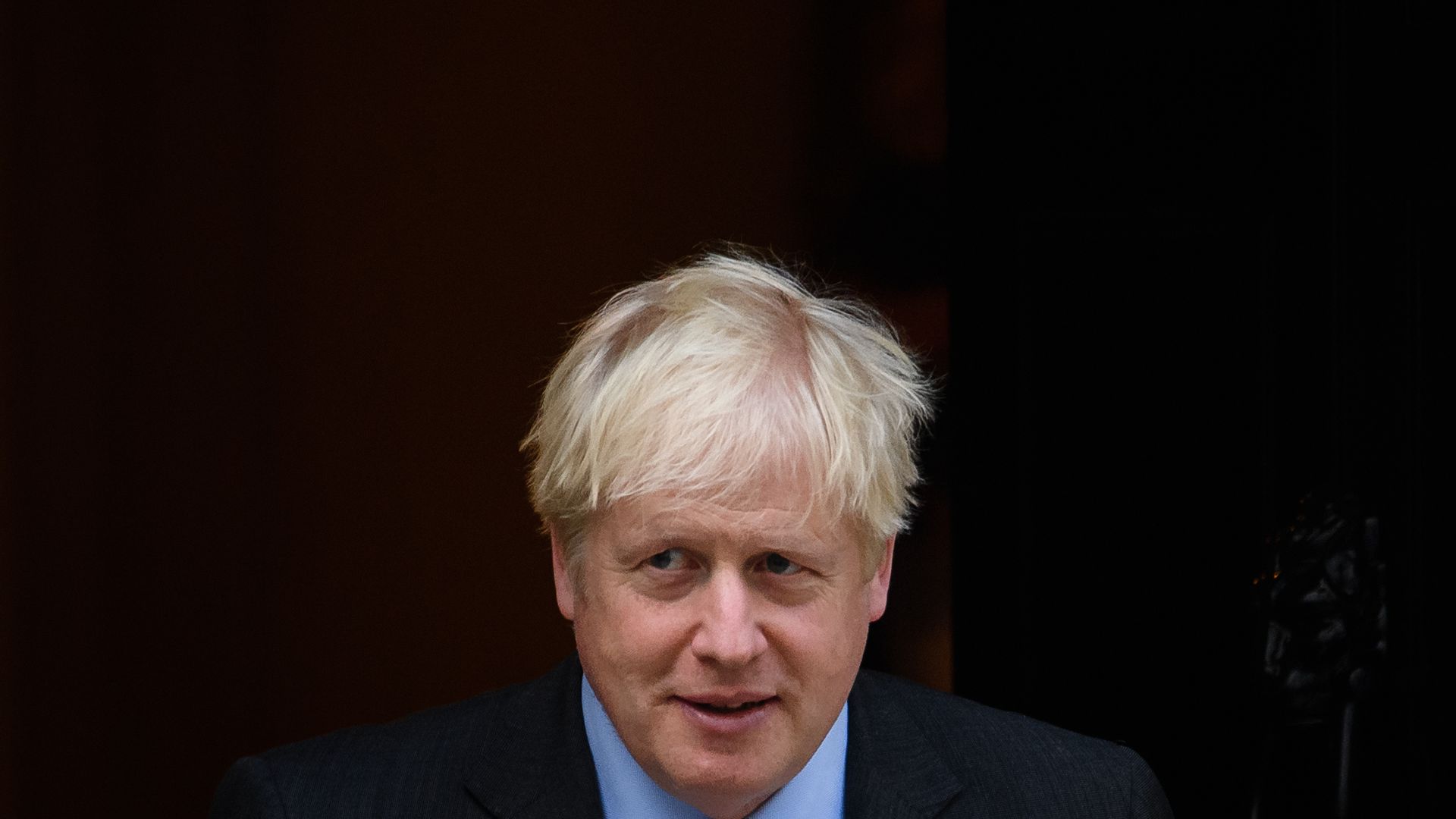
The U.K. could see up to 50,000 coronavirus cases per day by mid-October if current growth continues, top scientific advisers warned in a televised address from Downing Street on Monday.
The big picture: The U.K. has upgraded its coronavirus alert level from three to four as infections appear to be “high or rising exponentially.” Meanwhile, recent European Center for Disease Prevention and Control (ECDC) data shows that over half of all European Union countries are seeing an increase in COVID-19 cases.
What they’re saying: “At the moment, we think that the epidemic is doubling roughly every seven days” in the U.K., chief scientific adviser Patrick Vallance said.
Where it stands: ECDC data shows that Spain, France, the Czech Republic, Croatia and Romania have recorded more than 120 confirmed COVID-19 cases per 100,000 inhabitants in the last 14 days, according to AP.
What to watch: Analysts expect the British government to announce short-term restrictions after Prime Minister Boris Johnson met with ministers over the weekend, AP reports.
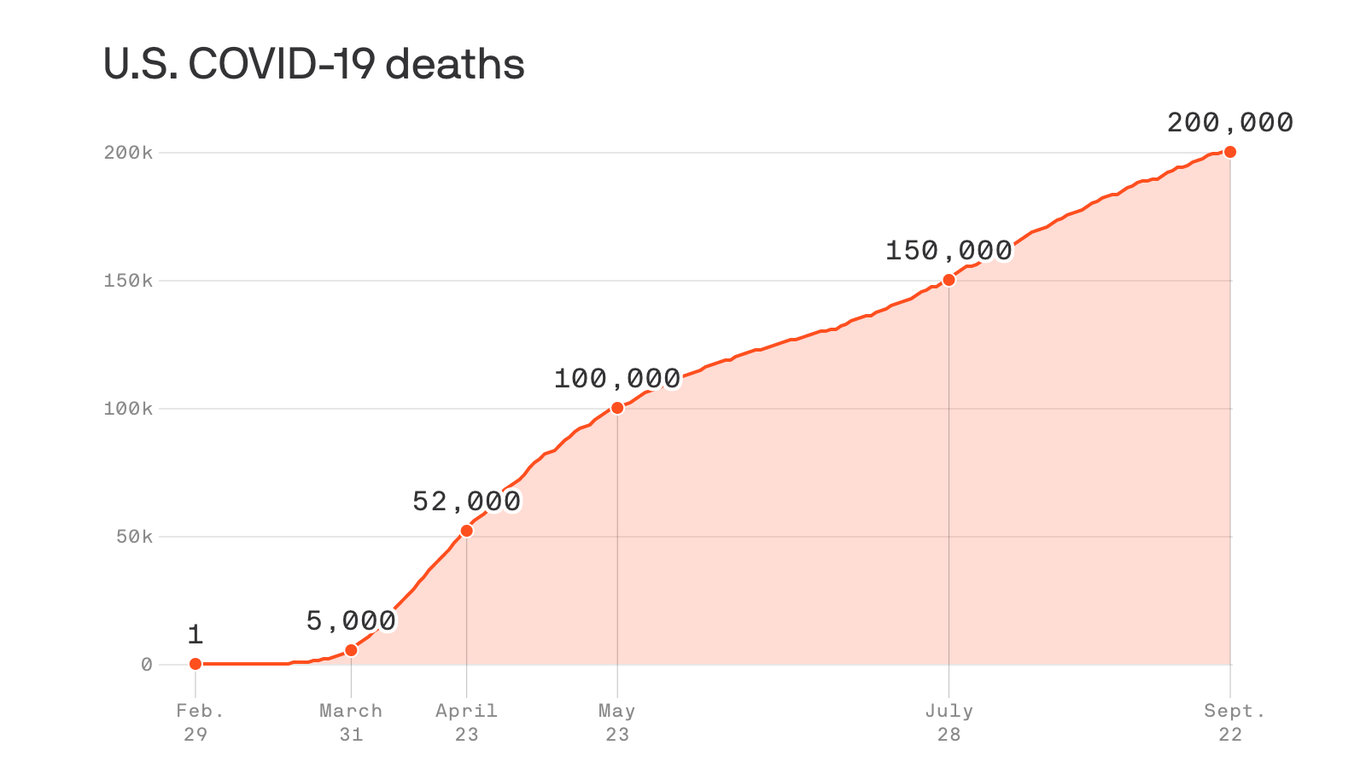
The coronavirus has now killed 200,000 Americans, according to Johns Hopkins data.
The big picture: Whatever context you try to put this in, it is a catastrophe of historic proportions — and is yet another reminder of America’s horrific failure to contain the virus.
This crisis has hit people of color especially hard.
And deaths keep coming — we’re averaging roughly 830 per day — even as the country increasingly sees the pandemic as background noise, as live sports resume and schools reopen and interest in news about the pandemic wanes.
Between the lines: The percentage of infected people who ultimately die from the coronavirus is lower now than it was in the outbreak’s earliest months, partly because doctors have gotten better at treating the virus and partly because outbreaks are now occurring within younger and lower-risk groups.

More than three million American workers lost health insurance coverage this spring and summer from their employers as the pandemic and spread of Covid-19 triggered massive job losses, a new study shows.
In all, there were 3.3 million adults under the age of 65 who lost employer-sponsored health insurance and almost two-thirds of them, or 1.9 million, “became newly uninsured from late April through mid-July,” according to a new analysis by The Urban Institute and funded by the Robert Wood Johnson Foundation. The loss of employer coverage has hit Hispanic adults particularly hard with 1.6 million losing health benefits, Urban Institute researchers said.
And it could get worse.
“With continued weakness in the labor market, researchers conclude federal and state policymakers will need to act to prevent job losses from leading to further increases in uninsurance,” the authors of the report wrote about their analysis, which was derived from 2020 U.S. Census data.
In particular, the analysis underscores the need to expand health benefits, particularly Medicaid under the Affordable Care Act, analysts say. The ACA dangled billions of dollars in front of states to expand Medicaid coverage for poor Americans but 12 states generally led by Republican Governors or legislatures have refused while President Donald Trump and his appointees at the U.S. Justice Department fight led by Republican Governors
“The danger of an inadequate safety net can be seen in the non-expansion states, where the number of uninsured adults has already increased more than 1 million,” Robert Wood Johnson Foundation senior policy advisor Katherine Hempstead said in a statement accompanying the report.

 HENRY KOTULA