Cartoon – Jobless Economic Recovery

Unemployment Figure Cartoons and Comics - funny pictures from ...

Cartoon – Long-Term Unemployed (Please Give)

Sack cartoon: Unemployment benefits | Star Tribune

Cartoon – Unemployment Rate vs. Unemployed

Editorial cartoon: The shadow of unemployment

US weekly jobless claims hit 1.4 million, post second straight weekly increase

https://www.businessinsider.com/us-jobless-claims-unemployment-insurance-labor-market-filings-recession-coronavirus-2020-7

  • US jobless claims for the week that ended Saturday totaled 1.43 million, the Labor Department said Thursday. That came in slightly below the consensus economist estimate of 1.45 million.
  • It marked a second consecutive weekly increase after the prior week’s report ended a 15-week streak of declines. This week’s report brought total filings over a 19-week period to more than 54 million.
  • Continuing claims, the aggregate total of people receiving unemployment benefits, totaled 17 million for the week that ended July 18.

More than a million Americans filed for unemployment benefits last week, reflecting the continued high level of pandemic-induced layoffs as the US rolls back its economic-reopening efforts.

New US weekly jobless claims totaled 1.43 million in the week that ended Saturday, the Labor Department reported Thursday. That was slightly below the consensus economist estimate of 1.45 million compiled by Bloomberg. It also was a minor increase over the prior week’s 1.3 million filings, a reading that marked the first gain in 15 weeks.

In just a few months, the more than 54 million unemployment claims filed during the coronavirus pandemic have far surpassed the 37 million during the 18-month Great Recession. The latest figure is more than double the 665,000 filed during the Great Recession’s worst week.

“A combination of uncertainty from rising virus cases to the withdrawal of financial support is concerning for an already fragile recovery,” said Daniel Zhao, senior economist at Glassdoor. “The economy is still in deep risk of falling sideways – where conditions improve so sluggishly that the effects of the crisis become increasingly permanent.”

Continuing claims, which represent the aggregate total of people receiving unemployment benefits, came in at 17 million for the week that ended July 18, a decline from the prior period’s revised number.

Stubbornly high weekly claims for unemployment insurance add to growing concerns that the economic recovery from the pandemic-induced recession is stagnating as coronavirus cases increase. A number of states have had to pause or roll back their reopening plans to deal with COVID-19 spikes, harming the economic recovery.

Going forward, industry watchers will be waiting to see what the July jobs report shows. The report, due August 7, reflects a reference period that includes last week, when initial jobless claims ticked up for the first time in 15 weeks. That could foreshadow a negative headline jobs number in July, although the nonfarm payroll report has become increasingly difficult to predict.

Last week, the additional $600 unemployment benefit from the CARES Act expired, meaning that soon millions of Americans will see a significant decrease in weekly income. The GOP this week introduced its proposal, the HEALS Act, that would cut the weekly benefit to $200 until states could implement a program that’d replace 70% of wages for most filers.

In the week ending July 25, there were 829,697 initial claims from 50 states reporting for Pandemic Unemployment Assistance, the program that extended benefits to gig workers and independent contracts. The total applications for all state programs for the week ending July 11 was 30.2 million. 


Envisioning the future of health system strategy

https://mailchi.mp/0fa09872586c/the-weekly-gist-july-31-2020?e=d1e747d2d8

We’ve spent the past five months working with our health system members to develop a perspective on the impact of the coronavirus pandemic on strategy, discussing what’s changed and what hasn’t, and where leaders should focus moving forward. The above graphic provides an overview of that perspective.

We think about the future across three time periods:

The “near future”, which will largely be dominated by concerns about reopening and recovering clinical operations and financial stability;

The “next future”, which we view as a period of strategic realignment during which we’ll see a “land grab” for advantage among payers, providers, and disruptors;

And the “far future”, in which the fundamental structure of the industry—how healthcare is organized, delivered, and paid for—will see more dramatic changes based on the evolution of economic and policy drivers.

Over time, “market uncertainty” caused by the uncertain course of the disease itself, along with societal and political shifts, will give way to “industry uncertainty”, under which a new competitive landscape will begin to develop.

Across those time horizons, health system strategy should focus on agile and decisive actions to respond to the environment—ensuring a safe and reliable return to normal clinical operations, taking best advantage of the opportunity to play new roles in the delivery of care (e.g., virtual and home-based services), and over time, building a full-scale, consumer-centric care ecosystem.

That’s a lot of rhetoric, but the hard work lies beneath—requiring systems to execute on several key fronts, from ensuring efficient, “systematized” operations, to building sustainable payment and pricing approaches, to adopting a relentless focus on services that earn and maintain consumer loyalty over time. We’ll have more to share on all of these ideas across the coming months, as our work with members continues. What’s clear now is that we’re not going back to the old way of doing things—we’re heading toward a “brave new world” of healthcare delivery.


‘I’m fighting a war against COVID-19 and a war against stupidity,’ says CMO of Houston hospital

https://www.beckershospitalreview.com/hospital-physician-relationships/i-m-fighting-a-war-against-covid-19-and-a-war-against-stupidity-says-cmo-of-houston-hospital.html?utm_medium=email


After two hours of sleep a night for four months and seeing a member of his team contract the virus, Joseph Varon, MD, is growing exasperated.

“I’m pretty much fighting two wars: A war against COVID and a war against stupidity,” Dr. Varon, MD, CMO and chief of critical care at United Memorial Medical Center in Houston, told NBC News. “And the problem is the first one, I have some hope about winning. But the second one is becoming more and more difficult.”

Dr. Varon noted that whether it’s information backed by science or common sense, people throughout the U.S. are not listening. “The thing that annoys me the most is that we keep on doing our best to save all these people, and then you get another batch of people that are doing exactly the opposite of what you’re telling them to do.”

In an interview with NPR, Dr. Varon said he has woken up at dawn every day for the past four months and has headed to the hospital. There, he spends six to 12 hours on rounds before seeing new admissions. He then returns home to sleep two hours, at most.

He said his staff is physically and emotionally drained. 

UMMC nurse Christina Mathers spoke with NBC News from a hospital bed in the segment, noting that she had recently tested positive for COVID-19 after not feeling well during one of her shifts. “All the fighting, all the screaming, all the finger pointing — enough is enough,” Ms. Mathers told NBC. “People just need to listen to us. We’re not going to lie. Why would we lie?” 

Ms. Mathers has worked every other day since April 29, according to The Atlantic, which created a photo essay of Dr. Varon and the UMMC team at work.


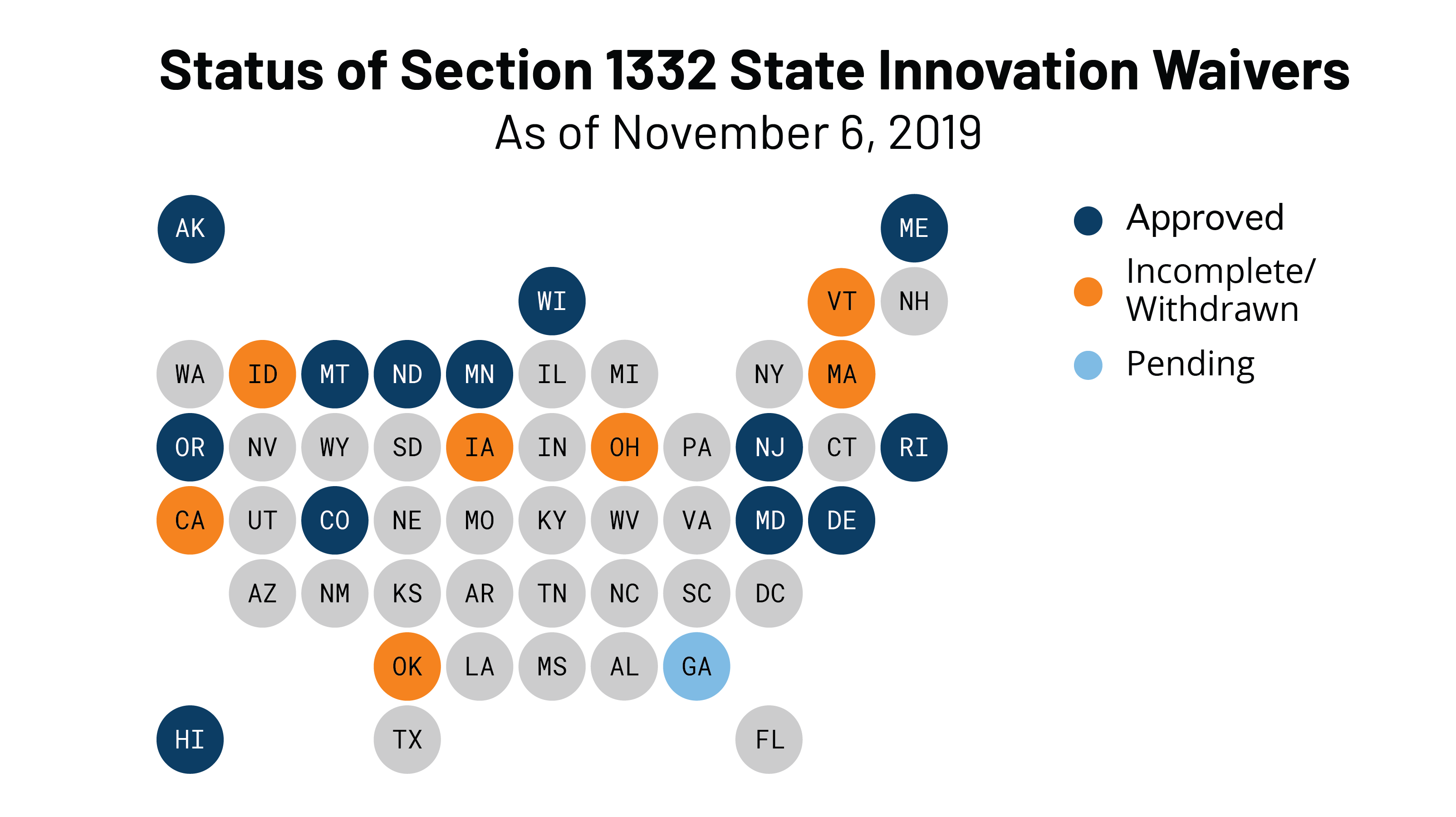
ACA Section 1332 State Innovation Waivers Update

https://www.healthaffairs.org/do/10.1377/hblog20200729.217545/full/

Tracking Section 1332 State Innovation Waivers | KFF

On July 24, 2020, the Centers for Medicare and Medicaid Services (CMS) and the Treasury Department approved Pennsylvania’s waiver application to operate a state-based reinsurance program under Section 1332 of the Affordable Care Act (ACA). This makes Pennsylvania the thirteenth state to be approved for a state-based reinsurance program. This post also summarizes the newest waiver proposal in Georgia.

Pennsylvania’s Waiver And More On Section 1332 Waivers

In late June, Pennsylvania received federal approval for a five-year reinsurance program beginning with the 2021 plan year. The state’s $139.3 million reinsurance program is expected to reduce premiums by about 4.6 percent (relative to what premiums would have been in the absence of the waiver) and increase enrollment in the individual market by about 0.5 percent in 2021. The federal government will contribute $95.1 million while state funds would account for about $44.2 million.

Implementation of the reinsurance program will coincide with a transition away from the federal marketplace to the new state-based marketplace, the Pennsylvania Health Insurance Exchange (Exchange). Both the reinsurance program and the Exchange were created in the same piece of 2019 legislation, which requires the Exchange to assess and collect fees—up to 3.5 percent of total monthly premiums—to support the reinsurance program. Pennsylvania expects to set the initial user fee at 3 percent of total monthly premiums. Each year, the Exchange will collect the user fee from insurers, deduct its operating expenses, and transfer the remaining funds to a reinsurance fund. In making reinsurance payments to insurers, Pennsylvania intends to first exhaust federal pass-through funding and then user fee revenue.

Based on CMS data, Pennsylvania insurers paid HealthCare.gov user fees of about $98.1 million for 2018 and about $83.1 million for 2019. (CMS has released 2018 and 2019 user fee data for each state that uses HealthCare.gov.) User fees in 2018 and 2019 were set at 3.5 percent of premiums, although the federal user fee was reduced to 3 percent for 2020.

Like nearly all states with reinsurance programs, Pennsylvania will use an overall attachment point model with parameters set annually by the insurance department. For 2021, the program is expected to reimburse insurers for 60 percent of claims between $60,000 and $100,000. To ensure program flexibility, the insurance department can make payments on a pro rata basis if funding is insufficient. Pennsylvania also intends to leverage the EDGE server maintained by CMS to determine how much each insurer is due. (This issue—whether and how states could leverage EDGE server infrastructure for reinsurance—has come up in at least one other state as well.)

Pennsylvania’s waiver application was submitted on February 11 and deemed complete on March 12. Federal regulators received and considered two supportive comments on the state’s application. In an approval letter to Commissioner Jessica Altman on July 24, the Departments laid out specific terms and conditions that the state must accept within 30 days for the waiver to go into effect. Once the waiver is accepted, the Departments will notify Pennsylvania of its amount of pass-through funding for 2021.

With Pennsylvania, 14 states have approved Section 1332 waivers. All but one approved waiver has been for a state-based reinsurance program, and CMS released a report on the effect of the 12 already-established state-based reinsurance programs. The report identifies the funding source for each state, program parameters, the impact on premiums by state and year, insurer participation, and enrollment. The average premium reduction for 2020 across all states was 17.7 percent. New Hampshire may be soon added to this list for 2021: the state’s waiver application was submitted in late April.

Latest On Georgia’s Waiver Application

Georgia submitted a waiver application in late December 2019. As discussed more here, Georgia’s application had two phases: phase one is for a reinsurance program and phase two involves much broader changes to the state’s individual market known as the “Georgia Access” model. Phase one was deemed complete on February 6, and review of phase two was “paused” to Georgia leaders could submit additional information.

Under the original Georgia Access Model, Georgia would have eliminated the use of HealthCare.gov, transitioned consumers to decentralized enrollment through private web-brokers and insurers, established its own subsidy structure, enabled the subsidization of plans that do not comply with all the ACA’s requirements, and capped enrollment if subsidy costs exceed federal and state funds. The proposal was criticized for jeopardizing access to comprehensive coverage and failing to satisfy Section 1332’s statutory guardrails.

About five months after review was “paused,” Georgia modified its waiver application, requesting that its reinsurance program be approved for 2022 (rather than 2021) and abandoning some initial components of phase two. The new waiver application was posted in early July and exposed for public comment until July 23.

The main change for phase two is that Georgia would no longer develop its own state-specific subsidy structure. Georgia would validate a consumer’s eligibility for premium tax credits and then send this information to the federal government. The federal government would then issue the subsidies to insurers and reconcile subsidies during tax season. Subsidies would only be available for qualified health plans under the ACA, as they are now. But Georgia wants to conduct its own eligibility determinations because it believes doing so will be more accurate: the state can leverage existing infrastructure, use more recent employment data, and integrate Medicaid eligibility determinations.

The waiver would, however, still eliminate the use of HealthCare.gov, which would make Georgia the only state to do so. Marketplace consumers would be forced to transition to a highly decentralized enrollment system that uses web-brokers and insurers. As a summary of the revised application puts it, Georgia will “transition responsibility for front-end functions of consumer outreach, customer service, plan shopping, selection, and enrollment from the [federal marketplace] to the commercial market.”

While federal subsidies could not be used towards non-ACA plans, Georgia continues to note that a benefit of moving away from HealthCare.gov to web-brokers and insurers is that residents could “view the full range of health plans” offered in the state. Georgia would leverage enhanced direct enrollment (EDE) standards which, as discussed more below, can lead to significant consumer confusion.

From here, Georgia will presumably respond to the latest round of public comment on its new proposal and then submit its revised application.


A large racial divide exists in the concern over ability to pay for COVID-19 treatment

https://www.healthcarefinancenews.com/news/large-racial-divide-exists-concern-over-ability-pay-covid-19-treatment

Nonwhite adults say they’re either “extremely concerned” or “concerned” about the potential cost of care.

People of color are far more likely to worry about their ability to pay for healthcare if they are diagnosed with COVID-19 than their white counterparts, according to a new survey from nonprofit West Health and Gallup.

By a margin of almost two to one (58% vs. 32%), nonwhite adults report that they are either “extremely concerned” or “concerned” about the potential cost of care. That concern is three times higher among lower-income than higher-income households (60% vs. 20%).

The data come from an ongoing survey about Americans’ experiences with and attitudes about the healthcare system. The latest findings are based on a nationally representative sample of 1,017 U.S. adults interviewed between June 8 and June 30.

There’s also a disturbing trend when it comes to medication insecurity. Overall, 24% of U.S. adults say they lacked money to pay for at least one prescribed medicine in the past 12 months, an increase from 19% in early 2019. Among nonwhite Americans, the burden is growing even more quickly. Medication insecurity jumped 10 percentage points, from 21% to 31%, compared with a statistically insignificant three-point increase among white Americans (17% to 20%).

WHAT’S THE IMPACT?

All of this results in what Tim Lash, chief strategy officer for West Health, called a “significant and increasing racial and socioeconomic divide” in Americans’ views on the cost of healthcare and the impact it has on their lives. When polling started in 2019, one in five Americans were unable to pay for prescription medications within the past 12 months. That number now stands at one in four. The bottom line is that the situation is getting worse.

Amid broad concern about paying for the cost of COVID-19 or other medical expenses, health insurance benefits are likely more important than ever to U.S. workers. The survey found that 12% of workers are staying in a job they want to leave because they are afraid of losing healthcare benefits, a sentiment that is about twice as likely to be held by nonwhite workers as white workers (17% vs. 9%).

However, Americans step across racial lines in their overwhelming support for disallowing political contributions by pharmaceutical companies, and for government intervention in setting price limits for government-sponsored research and a COVID vaccine.

Nearly 9 in 10 U.S. adults (89%) think the federal government should be able to negotiate the cost of a COVID-19 vaccine, while only 10% say the drug company itself should set the price. Similarly, 86% of U.S. adults say there should be limits on the price of drugs that government-funded research helped develop.

Regarding the influence of pharmaceutical companies on the political process, 78% of adults say political campaigns should not be allowed to accept donations from pharmaceutical companies during the coronavirus pandemic.

THE LARGER TREND

Concerns over payment aren’t the only race-related disparities found in healthcare. Dr. Garth Graham, the vice president of community health at CVS Health, said during AHIP’s Institute and Expo in June that although African Americans make up 13% of the U.S. population, they account for about 24% of COVID-19 deaths.

He attributed some of the driving factors for these particular COVID-19-related disparities to the social determinants of health, the over-predominance of African American and Latino frontline workers, and the higher incidence-rates of chronic illness such as diabetes and hypertension in minority groups.

On June 19 – Juneteenth, as it’s known for many Black Americans – 36 Chicago hospitals penned an open letter declaring that systemic racism is a “public health crisis.”

“Systemic racism is a real threat to the health of our patients, families and communities,” the letter reads. “We stand with all of those who have raised their voices to capture the attention of Chicago and the nation with a clear call for action.”


Some providers face daunting repayment deadline for Medicare advance loans

https://www.fiercehealthcare.com/hospitals/some-providers-face-daunting-aug-1-repayment-deadline-for-medicare-advance-loans?mkt_tok=eyJpIjoiWkRReFlqRmpaamRtWVdabSIsInQiOiJFTEp3SjQ3NG01NXcwRTg3Z0hCZkdTRlwvOURSeEVlblwvRlFUWlZcL09ONjZGNVEybzl3ekl3VFd2ZEgxSjY2NGQ0TkFIRFdtQ0ZDWUx0ak96NU15d09qMWcrdm9BMFUxOSszcVI0T21rak5raEN0aE5Kb0VUUGFcL254QnBjMjdCbzkifQ%3D%3D&mrkid=959610

Starting this month, some providers are facing the prospect of their Medicare payments garnished to repay COVID-19 loans.

The pressing Aug. 1 deadline has sparked concerns from some experts and hospital groups that worry providers couldn’t afford to lose out on Medicare revenue as they combat revenue losses caused by the pandemic. While the program was intended to be a short-term solution, COVID-19 surges are proving that is not the case for some hospitals.

At the onset of the pandemic in March, the Centers for Medicare & Medicaid Services (CMS) extended the advance payment program, which has been used previously to help providers beset by disasters such as hurricanes. Providers and suppliers could apply for advance Medicare payments to offset massive losses sparked by declines in patient volumes due to COVID-19.

Most providers could get up to 100% of their Medicare payments for a three-month period, and inpatient acute care hospitals, children’s hospitals and some cancer hospitals can request up to 100% for a six-month period. Critical access hospitals could have gotten up to 125% over six months.

CMS had given out $100 billion of loans before suspending the program.

“It was very effective because the process was already in place,” said Denise Burke, a partner with the healthcare compliance and operations group for law firm Waller Lansden Dortch & Davis.

The goal behind the program is to help providers stay afloat and was meant to be a short-term solution, as repayment starts 120 days after a provider gets the first payment. But that is the problem, experts say.

“It was intended as a short-term bridge so they could get through the summer before everything returned to normal, only problem is nothing has returned to normal,” said Dan Mendelson, founder and former president of consulting firm Avalere Health.

Now, repayment for the first loans are due on Aug. 1 as more and more states are seeing massive surges of COVID-19. Some major hospital systems, such as HCA and CHS, have been able to offset massive declines in revenue thanks to the loans and money from a $175 billion provider relief fund passed by Congress.

Hospitals have one year from the date of the accelerated payment to repay the balance of the loan, but Medicare Part A providers and Part B suppliers have 210 days from the accelerated payment to repay.

“CMS should think about relative to financial position of the provider,” Mendelson said. “Some providers are doing just fine and can repay loans just like everybody else.”

After the 120-day period is up, CMS will take 100% of Medicare claims payments that would have gone to the provider to offset the balance of the loan.

But it remains unclear whether CMS can change the terms of the repayment to give providers and suppliers more time, especially if they are struggling.

“CMS moves deadlines all the time,” Mendelson said. “The question is whether they can or are willing to exercise this discretion in this case.”

It also is unlikely that CMS will resume the program, which some provider groups have also called for.

“It seems unlikely CMS will continue to allocate money through the advance payment program that has fewer terms and conditions than allocating through provider relief fund,” Burke said, referring to the $175 billion fund that Health and Human Services is still allocating.

CMS did not return a request for comment as of press time.

A major problem for some hospitals is they may not have the liquidity available to repay the loans.

“There are a lot of hospitals struggling right now because volumes are off,” Mendelson said. “This comes down to the fact that people are staying away from the hospital to the extent they possibly can.”

Provider groups such as the American Hospital Association are imploring Congress to forgive the loans, or at the very least change the repayment terms.

For instance, some groups want to lower the interest rates to 50 or 25% of a Medicare payment as opposed to 100%.

But talks on a new COVID-19 relief package have stalled so far no deal has emerged.

Senate Republicans released their own package earlier this week that includes another $25 billion for providers and gives liability protections for hospitals and other businesses. But the package doesn’t include changes to the loans.


Appeals court upholds nearly 30% payment cut to 340B hospitals

https://www.fiercehealthcare.com/hospitals/appeals-court-upholds-nearly-30-payment-cut-to-340b-hospitals?mkt_tok=eyJpIjoiWkRReFlqRmpaamRtWVdabSIsInQiOiJFTEp3SjQ3NG01NXcwRTg3Z0hCZkdTRlwvOURSeEVlblwvRlFUWlZcL09ONjZGNVEybzl3ekl3VFd2ZEgxSjY2NGQ0TkFIRFdtQ0ZDWUx0ak96NU15d09qMWcrdm9BMFUxOSszcVI0T21rak5raEN0aE5Kb0VUUGFcL254QnBjMjdCbzkifQ%3D%3D&mrkid=959610

In court filing, AHA says HHS should make 340B hospitals 'whole ...

A federal appeals court has ruled the Trump administration can install nearly 30% cuts to the 340B drug discount program.

The ruling Friday is the latest legal setback for hospitals that have been vociferously fighting cuts the Department of Health and Human Services (HHS) announced back in 2017.

340B requires pharmaceutical manufacturers to deliver discounts to safety net hospitals in exchange for participation in Medicaid. A hospital will pay typically between 20% and 50% below the average sales price for the covered drugs.

HHS sought to address a payment gap between 340B and Medicare Part B, which reimburses providers for drugs administered in a physician’s office such as chemotherapy. There was a 25% and 55% gap between the price for a 340B drug and on Medicare Part B.

So HHS administered a 28.5% cut in the 2018 hospital payment rule. The agency also included the cuts in the 2019 payment rule.

Three hospital groups sued to stop the cut, arguing that HHS exceeded its federal authority to adjust the rates to the program.

A lower court agreed with the hospitals and called for the agency to come up with a remedy for the cuts that already went into effect.

But HHS argued that when it sets 340B payment amounts, it has the authority to adjust the amounts to ensure they don’t reimburse hospitals at higher levels than the actual costs to acquire the drugs.

If the hospital acquisition cost data are not available, HHS could determine the amount of payment equal to the average drug price. HHS argued that hospital cost acquisition data was not available and so HHS needed to determine the payment rates based on the average drug price.

The court agreed with the agency’s interpretation.

“At a minimum, the statute does not clearly preclude HHS from adjusting the [340B] rate in a focused manner to address problems with reimbursement rates applicable only to certain types of hospitals,” the ruling said.

The court added that the $1.6 billion gleaned from the cuts would go to all providers as additional reimbursements for other services.

340B groups were disappointed with the decision.

“These cuts of nearly 30% have caused real and lasting pain to safety-net hospitals and the patients they serve,” said Maureen Testoni, president and CEO of advocacy group 340B Health, which represents more than 1,400 hospitals that participate in the program. “Keeping these cuts in place will only deepen the damage of forced cutbacks in patient services and cancellations of planned care expansions.”

This is the latest legal defeat for the hospital industry. A few weeks ago, the same appeals court ruled that HHS had the legal authority to institute cuts to off-campus clinics to bring Medicare payments in line with physician offices, reversing a lower court’s ruling.

The groups behind the lawsuit — American Hospital Association, American Association of Medical Colleges and America’s Essential Hospitals — slammed the decision as hurtful to hospitals fighting the COVID-19 pandemic. But the groups didn’t say if it would appeal the decision.

“Hospitals that rely on the savings from the 340B drug pricing program are also on the front-lines of the COVID-19 pandemic, and today’s decision will result in the continued loss of resources at the worst possible time,” the groups said in a statement Friday.