


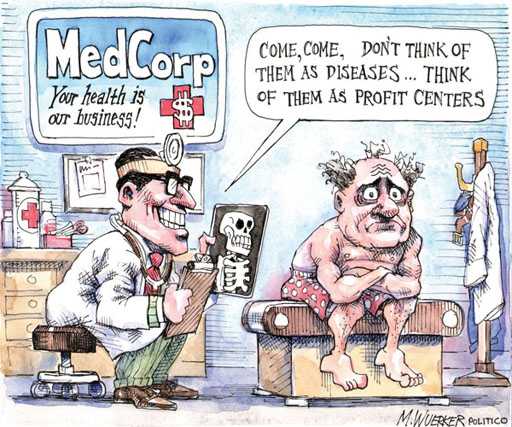
Cartoon – A Change of Business Model is in Order

Although CFOs often hold the key to resources, acting as gatekeepers, they can also be critical allies in innovation, enabling programs and initiatives, according to an April 12 McKinsey report.
While innovation is often thought of in a traditional sense, with new offerings and services coming to mind, innovation can also mean disruption and change in business models, productivity improvements and new ways to service consumers. The CFO has the perspective to see where fresh ideas are needed in the business from a financial perspective, and the power to make them happen.
Innovation also requires resources and capital, of which the CFO has control and say as to how it gets used. The CFO is an important part of determining which innovations will go ahead and is akin to a venture capitalist, deciding whether to invest in a start-up.
As members of the C-suite, CFOs also have an important role in encouraging a culture of openness and innovation where staff members feel comfortable coming to company leaders with new ideas. By creating an atmosphere of innovation, the company can build a pipeline of innovative talent and concepts, which the CFO can help bring to fruition.

Judging from our recent conversations with health system executives, we’d guess CEOs across the industry woke up this morning glad to see the first quarter in the rearview mirror.
Almost everyone we’ve spoken to has told us that the past three months have been miserable from an operating margin perspective—skyrocketing labor costs, rising drug and supply prices, and stubbornly long length of stay, particularly among Medicare patients.
In the words of one CFO, “I’ve never seen anything like this. For the first time, we budgeted for a negative margin, and still didn’t hit our target. I’m not sure how long our board will let us stay on this trajectory before things change.”
Yet few of the drivers of poor financial performance appear to be temporary. Perhaps the over-reliance on agency nursing staff will wane as COVID volumes bottom out (for how long remains unknown), but overall labor costs will remain high, there’s no immediate relief for supply chain issues, and COVID-related delays in care have left many patients sicker—and thus in need of more costly care. Plus, the lifeline of federal relief funds is rapidly dwindling, if not already gone.
Expect the next three quarters (and beyond) to bring a greater focus on cost cutting, especially as not-for-profit systems struggle to defend their bond ratings in the face of rising interest rates.
Buckle up, it’s going to be a bumpy landing.
https://mailchi.mp/92a96980a92f/the-weekly-gist-january-14-2022?e=d1e747d2d8

Large insurers Humana and Cigna, along with “insurtech” startups Bright Health and Alignment Healthcare, all lowered expectations for their MA membership growth after missing 2022 enrollment targets. The companies blamed fierce competition for the nation’s estimated 29.5M MA lives, and highlighted a focus on diversifying revenue through other business arms like healthcare delivery and service sales.
The Gist: Insurers’ missed expectations are leading some to question whether the MA market is beginning to weaken, but these concerns are overblown, with last fall’s enrollment affected by the pandemic, which hindered brokers’ ability to reach seniors.
Some MA-focused startups are finding challenges in their attempts to scale, and their stock prices will continue to retreat from the lofty valuations that drove their public offerings.
Insurers still have plenty of running room to grow their MA books of business, but will face increasing scrutiny of their ability to manage patients and control costs for the aging population.

https://mailchi.mp/161df0ae5149/the-weekly-gist-december-10-2021?e=d1e747d2d8

Attending a recent executive retreat with one of our member health systems, we heard the CEO make a statement that really resonated with us. Referring to the current workforce crisis—pervasive shortages, pressure to increase compensation, outsized reliance on contract labor to fill critical gaps—the CEO made the assertion that this situation isn’t temporary. Rather, it’s the “new normal”, at least for the next several years.
The Great Resignation that’s swept across the American economy in the wake of COVID has not spared healthcare; every system we talk to is facing alarmingly high vacancy rates as nurses, technicians, and other staff head for the exits. The CEO made a compelling case that the labor cost structure of the system has reset at a level between 20 and 30 percent more expensive than before the pandemic, and executives should begin to turn attention away from stop-gap measures (retention bonuses and the like) to more permanent solutions (rethinking care models, adjusting staffing ratios upward, implementing process automation).
That seemed like an important insight to us. It’s increasingly clear as we approach a third year of the pandemic: there is no “post-COVID world” in which things will go back to normal. Rather, we’ll have to learn to live in the “new normal,” revisiting basic assumptions about how, where, and by whom care is delivered.
If hospital labor costs have indeed permanently reset at a higher level, that implies the need for a radical restructuring of the fundamental economic model of the health system—razor-thin margins won’t allow for business to continue as usual. Long overdue, perhaps, and a painful evolution for sure—but one that could bring the industry closer to the vision of “right care, right place, right time” promised by population health advocates for over a decade.

Medicare Advantage (MA) focused companies, like Oak Street
Health (14x revenues), Cano Health (11x revenues), and Iora
Health (announced sale to One Medical at 7x revenues), reflect
valuation multiples that appear irrational to many market observers. Multiples may be
exuberant, but they are not necessarily irrational.
One reason for high valuations across the healthcare sector is the large pools of capital
from institutional public investors, retail investors and private equity that are seeking
returns higher than the low single digit bond yields currently available. Private equity
alone has hundreds of billions in investable funds seeking opportunities in healthcare.
As a result of this abundance of capital chasing deals, there is a premium attached to the
scarcity of available companies with proven business models and strong growth
prospects.
Valuations of companies that rely on Medicare and Medicaid reimbursement have
traditionally been discounted for the risk associated with a change in government
reimbursement policy. This “bop the mole” risk reflects the market’s assessment that
when a particular healthcare sector becomes “too profitable,” the risk increases that CMS
will adjust policy and reimbursement rates in that sector to drive down profitability.
However, there appears to be consensus among both political parties that MA is the right
policy to help manage the rise in overall Medicare costs and, thus, incentives for MA
growth can be expected to continue. This factor combined with strong demographic
growth in the overall senior population means investors apply premiums to companies in
the MA space compared to traditional providers.
Large pools of available capital, scarcity value, lower perceived sector risk and overall
growth in the senior population are all factors that drive higher valuations for the MA
disrupters. However, these factors pale in comparison the underlying economic driver
for these companies. Taking full risk for MA enrollees and dramatically reducing hospital
utilization, while improving health status, is core to their business model. These
companies target and often achieve reduced hospital utilization by 30% or more for their
assigned MA enrollees.
In 2019, the average Medicare days per 1,000 in the U.S. was 1,190. With about
$14,700 per Medicare discharge and a 4.5 ALOS, the average cost per Medicare day is
approximately $3,200. At the U.S. average 1,190 Medicare hospital days per thousand,
if MA hospital utilization is decreased by 25%, the net hospital revenue per 1,000 MA
enrollees is reduced by about $960,000. If one of the MA disrupters has, for example, 50,000 MA lives in a market, the
decrease in hospital revenues for that MA population would be about $48 million. This does not include the associated
physician fees and other costs in the care continuum. That same $48 million + in the coffers of the risk-taking MA
disrupters allows them deliver comprehensive array of supportive services including addressing social determinants of health. These services then further reduce utilization and improves overall health status, creating a virtuous circle. This is very profitable.
MA is only the beginning. When successful MA businesses expand beyond MA, and they will, disruption across the
healthcare economy will be profound and painful for the incumbents. The market is rationally exuberant about that
prospect.


Dallas-based Baylor Scott & White Health will outsource, lay off or retrain 1,700 employees who work in information technology, billing, revenue cycle management and other support services, according to The Dallas Morning News.
The health system said outsourcing the finance and IT jobs and other support services will help it improve efficiencies and focus on reducing costs in noncore business areas.
About two-thirds of the 1,700 employees will be joining third-party RCM, IT, billing or support staff vendors. About 600 to 650 positions will be eliminated.
Baylor Scott & White said that employees whose positions are being eliminated will be invited to participate in retraining programs.
The retraining program would allow the employees to remain employed at the health system and receive the same pay or higher, depending on their role, according to the report. Some of the retraining programs that will be available are learning to become a certified medical assistant or learning a job in patient support services.
“In no case — in no case — is anyone going to miss a paycheck,” Baylor Scott & White CEO Jim Hinton, told The Dallas Morning News. “We can afford to make these commitments, and we want to do the right thing for the great employees of Baylor, Scott & White. They’ve really done everything we’ve asked and more during this last year.”
This is the third time Baylor Scott & White has announced cost-cutting initiatives related to its workforce since the pandemic began. Last May, 930 Baylor Scott & White employees were laid off, and in December the health system said it would lay off employees and outsource 102 corporate finance jobs.
Mr. Hinton said that Baylor Scott & White has 2,000 clinical positions open, and it is investing in a new regional medical school campus and a joint venture to improve care for the underinsured.
“This is a transition to a new business model, a transition to a new way of working,” Mr. Hinton told The Dallas Morning News.
 HENRY KOTULA