

Cartoon – Operation Lowered Expectations
As some states take steps to partially re-open their economies, public health officials and local governments are trying to aggressively ramp up contact tracing to track the spread of COVID-19 in their communities.
Why it matters: If we are indeed in the midst of a war against an invisible enemy, a contact-tracing offensive — launched by both an army of human tracers and an arsenal of technological tools — will be a big part of the key to winning.
Between the lines: State and city budgets are being hammered by the economic fallout of COVID-19, making it harder to find the resources to hire and train people to contact trace or acquire needed technologies.
State and county public health officials are ramping up tracing efforts now that testing availability is improving — since tracing only works with widespread testing.
“For every case, we have an average of about 20 people to contact. … So if you have 100 cases, you’ve got 2,000 contacts you’ve got to handle for that day because you know the next day you’ll have maybe another 100–150 cases.”
— Umair Shah, executive director of Harris County Public Health
What’s happening: Other countries are relying on tech to varying degrees to augment contact tracing.
In the U.S., the most likely scenario for widespread, tech-enabled contact tracing lies with work done by Google and Apple.
The success of the effort will depend on widespread adoption of the technology so people will be notified when they come in contact with someone who tests positive.
What to watch: Zissman said MIT researchers will reverse engineer the Google/Apple programs to ensure they are following the privacy protocols, and also expect pilot testing in limited settings like hospitals or universities before states begin implementing.

Of course, no one can pinpoint the exact moment that lightning will strike. But a global pandemic? Experts have predicted it, warned about the preparedness gaps and urged action. Again and again and again.
Just look at 2019. In January, the U.S. intelligence community issued its annual global threat assessment. It declared, “We assess that the United States and the world will remain vulnerable to the next flu pandemic or large-scale outbreak of a contagious disease that could lead to massive rates of death and disability, severely affect the world economy, strain international resources, and increase calls on the United States for support. . . . The growing proximity of humans and animals has increased the risk of disease transmission. The number of outbreaks has increased in part because pathogens originally found in animals have spread to human populations.”
In September, the Johns Hopkins Center for Health Security issued a report titled “Preparedness for a High-Impact Respiratory Pathogen Pandemic.” The report found that if such a pathogen emerged, “it would likely have significant public health, economic, social, and political consequences. . . . The combined possibilities of short incubation periods and asymptomatic spread can result in very small windows for interrupting transmission, making such an outbreak difficult to contain.” The report pointed to “large national and international readiness gaps.”
In October, the Nuclear Threat Initiative, working with the Johns Hopkins center and the Economist Intelligence Unit, published its latest Global Health Security Index, examining open-source information about the state of health security across 195 nations, and scoring them. The report warned, “No country is fully prepared for epidemics or pandemics, and every country has important gaps to address.” The report found that “Fewer than 5 percent of countries scored in the highest tier for their ability to rapidly respond to and mitigate the spread of an epidemic.”
In November, the Center for Strategic and International Studies published a study by its Commission on Strengthening America’s Health Security. It warned, “The American people are far from safe. To the contrary, the United States remains woefully ill-prepared to respond to global health security threats. This kind of vulnerability should not be acceptable to anyone. At the extreme, it is a matter of life and death. . . . Outbreaks proliferate that can spread swiftly across the globe and become pandemics, disrupting supply chains, trade, transport, and ultimately entire societies and economies.” The report recommended: “Restore health security leadership at the White House National Security Council.”
Came out of nowhere? Not even close. The question that must be addressed in future postmortems is why all this expertise and warning was ignored.
https://www.axios.com/coronavirus-west-virginia-first-case-ac32ce6d-5523-4310-a219-7d1d1dcb6b44.html

The pandemic is a long way from over, and its impact on our daily lives, information ecosystem, politics, cities and health care will last even longer.
The big picture: The novel coronavirus has infected more than 939,000 people and killed over 54,000 in the U.S., Johns Hopkins data shows. More than 105,000 Americans have recovered from the virus as of Sunday.
Lockdown measures: Demonstrators gathered in Florida, Texas and Louisiana Saturday to protest stay-at-home orders designed to protect against the spread of COVID-19, following a week of similar rallies across the U.S.
Catch up quick: Deborah Birx said Sunday that it “bothers” her that the news cycle is still focused on Trump’s comments about disinfectants possibly treating coronavirus, arguing that “we’re missing the bigger pieces” about how Americans can defeat the virus.
https://www.axios.com/coronavirus-latest-developments-8b8990c4-6762-494a-8ee0-5091746bda9b.html
Children in Spain were allowed to go outside on Sunday for the first time since a nationwide lockdown aimed at slowing the spread of the novel coronavirus began six weeks ago.
By the numbers: The coronavirus has infected over 2.9 million people and killed over 200,000, Johns Hopkins data shows. More than 829,000 people have recovered from COVID-19. The U.S. has reported the most cases in the world (more than 940,000 from 5.1 million tests), followed by Spain (over 223,000).
What’s happening: Australian Health Minister Greg Hunt announced a new coronavirus tracing app on Sunday that the government hopes at least 50 percent of the population will use. A top health official said the app is “only for one purpose, to help contact tracing,” as he sought to reassure Australians on privacy issues.
The big picture: The world faces its gravest challenge in decades, but geopolitical tensions won’t wait until it’s over. Trump’s threat on Wednesday to “destroy” Iranian boats that harass U.S. ships comes amid arrests of Hong Kong pro-democracy activists and clashes in Afghanistan that could further undermine peace there.
Between the lines: Policy responses to the crisis have been every-country-for-itself and — in the case of the U.S. and China — tinged with geopolitical rivalry.
Coronavirus symptoms: Fever, cough, shortness of breath.

The coronavirus pandemic is shaking bedrock assumptions about U.S. exceptionalism. This is perhaps the first global crisis in more than a century where no one is even looking for Washington to lead.
As images of America’s overwhelmed hospital wards and snaking jobless lines have flickered across the world, people on the European side of the Atlantic are looking at the richest and most powerful nation in the world with disbelief.
“When people see these pictures of New York City they say, ‘How can this happen? How is this possible?’” said Henrik Enderlein, president of the Berlin-based Hertie School, a university focused on public policy. “We are all stunned. Look at the jobless lines. Twenty-two million,” he added.
“I feel a desperate sadness,” said Timothy Garton Ash, a professor of European history at Oxford University and a lifelong and ardent Atlanticist.
The pandemic sweeping the globe has done more than take lives and livelihoods from New Delhi to New York. It is shaking fundamental assumptions about American exceptionalism — the special role the United States played for decades after World War II as the reach of its values and power made it a global leader and example to the world.
Today it is leading in a different way: More than 840,000 Americans have been diagnosed with Covid-19 and at least 46,784 have died from it, more than anywhere else in the world.
As the calamity unfolds, President Trump and state governors are not only arguing over what to do, but also over who has the authority to do it. Mr. Trump has fomented protests against the safety measures urged by scientific advisers, misrepresented facts about the virus and the government response nearly daily, and this week used the virus to cut off the issuing of green cards to people seeking to emigrate to the United States.
“America has not done badly, it has done exceptionally badly,” said Dominique Moïsi, a political scientist and senior adviser at the Paris-based Institut Montaigne.
The pandemic has exposed the strengths and weaknesses of just about every society, Mr. Moïsi noted. It has demonstrated the strength of, and suppression of information by, an authoritarian Chinese state as it imposed a lockdown in the city of Wuhan. It has shown the value of Germany’s deep well of public trust and collective spirit, even as it has underscored the country’s reluctance to step up forcefully and lead Europe.
And in the United States, it has exposed two great weaknesses that, in the eyes of many Europeans, have compounded one another: the erratic leadership of Mr. Trump, who has devalued expertise and often refused to follow the advice of his scientific advisers, and the absence of a robust public health care system and social safety net.
“America prepared for the wrong kind of war,” Mr. Moïsi said. “It prepared for a new 9/11, but instead a virus came.”
“It raises the question: Has America become the wrong kind of power with the wrong kind of priorities?” he asked.
Ever since Mr. Trump moved into the White House and turned America First into his administration’s guiding mantra, Europeans have had to get used to the president’s casual willingness to risk decades-old alliances and rip up international agreements. Early on, he called NATO “obsolete” and withdrew U.S. support from the Paris climate agreement and the Iran nuclear deal.
But this is perhaps the first global crisis in more than a century where no one is even looking to the United States for leadership.
In Berlin, Germany’s foreign minister, Heiko Maas, has said as much.
China took “very authoritarian measures, while in the U.S., the virus was played down for a long time,” Mr. Maas recently told Der Spiegel magazine.
“These are two extremes, neither of which can be a model for Europe,” Mr. Maas said.
America once told a story of hope, and not just to Americans. West Germans like Mr. Maas, who grew up on the front line of the Cold War, knew that story by heart, and like many others in the world, believed it.
But nearly three decades later, America’s story is in trouble.
The country that helped defeat fascism in Europe 75 years ago next month, and defended democracy on the continent in the decades that followed, is doing a worse job of protecting its own citizens than many autocracies and democracies.
There is a special irony: Germany and South Korea, both products of enlightened postwar American leadership, have become potent examples of best practices in the coronavirus crisis.
But critics now see America failing not only to lead the world’s response, but letting down its own people as well.
“There is not only no global leadership, there is no national and no federal leadership in the United States,” said Ricardo Hausmann, director of the Growth Lab at Harvard’s Center for International Development. “In some sense this is the failure of leadership of the U.S. in the U.S.”
Of course, some countries in Europe have also been overwhelmed by the virus, with the number of dead from Covid-19 much higher as a percentage of the population in Italy, Spain and France than in the United States. But they were struck sooner and had less time to prepare and react.
The contrast between how the United States and Germany responded to the virus is particularly striking.
While Chancellor Angela Merkel has been criticized for not taking a forceful enough leadership role in Europe, Germany is being praised for a near-textbook response to the pandemic, at least by Western standards. That is thanks to a robust public health care system, but also a strategy of mass testing and trusted and effective political leadership.
Ms. Merkel has done what Mr. Trump has not. She has been clear and honest about the risks with voters and swift in her response. She has rallied all 16 state governors behind her. A trained physicist, she has followed scientific advice and learned from best practice elsewhere.
Not long ago, Ms. Merkel was considered a spent force, having announced that this would be her last term. Now her approval ratings are at 80 percent.
“She has the mind of a scientist and the heart of a pastor’s daughter,” Mr. Garton Ash said.
Mr. Trump, in a hurry to restart the economy in an election year, has appointed a panel of business executives to chart a course out of the lockdown.
Ms. Merkel, like everyone, would like to find a way out, too, but this week she warned Germans to remain cautious. She is listening to the advice of a multidisciplinary panel of 26 academics from Germany’s national academy of science. The panel includes not just medical experts and economists but also behavioral psychologists, education experts, sociologists, philosophers and constitutional experts.
“You need a holistic approach to this crisis,” said Gerald Haug, the academy’s president, who chairs the German panel. “Our politicians get that.”
A climatologist, Mr. Haug used to do research at Columbia University in New York.
The United States has some of the world’s best and brightest minds in science, he said. “The difference is, they’re not being listened to.”
“It’s a tragedy,” he added.
Some cautioned that the final history of how countries fare after the pandemic is still a long way from being written.
A pandemic is a very specific kind of stress test for political systems, said Mr. Garton Ash, the history professor. The military balance of power has not shifted at all. The United States remains the world’s largest economy. And it was entirely unclear what global region would be best equipped to kick-start growth after a deep recession.
“All of our economies are going to face a terrible test,” he said. “No one knows who will come out stronger at the end.”
Benjamin Haddad, a French researcher at the Atlantic Council, wrote that while the pandemic was testing U.S. leadership, it is “too soon to tell” if it would do long-term damage.
“It is possible that the United States will resort to unexpected resources, and at the same time find a form of national unity in its foreign policy regarding the strategic rivalry with China, which it has been lacking until now,” Mr. Haddad wrote.
There is another wild card in the short term, Mr. Moïsi pointed out. The United States has an election in November. That, and the aftermath of the deepest economic crisis since the 1930s, might also affect the course of history.
The Great Depression gave rise to America’s New Deal. Maybe the coronavirus will lead the United States to embrace a stronger public safety net and develop a national consensus for more accessible health care, Mr. Moïsi suggested.
“Europe’s social democratic systems are not only more human, they leave us better prepared and fit to deal with a crisis like this than the more brutal capitalistic system in the United States,” Mr. Moïsi said.
The current crisis, some fear, could act like an accelerator of history, speeding up a decline in influence of both the United States and Europe.
“Sometime in 2021 we come out of this crisis and we will be in 2030,” said Mr. Moïsi. “There will be more Asia in the world and less West.”
Mr. Garton Ash said that the United States should take an urgent warning from a long line of empires that rose and fell.
“To a historian it’s nothing new, that’s what happens,” said Mr. Garton Ash. “It’s a very familiar story in world history that after a certain amount of time a power declines.”
“You accumulate problems, and because you’re such a strong player, you can carry these dysfunctionalities for a long time,” he said. “Until something happens and you can’t anymore.”
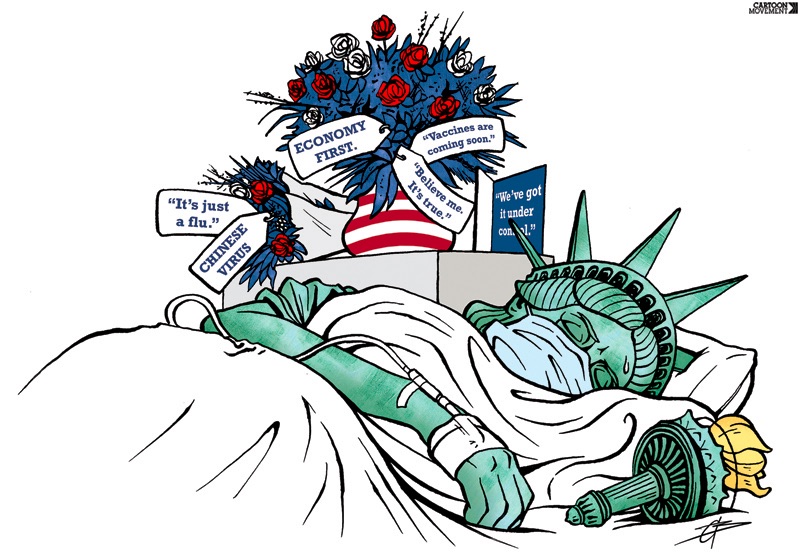
President Donald Trump’s administration stalled three key weeks in February that could have been spent enacting mitigatory measures against COVID-19 after Trump was angered by a public health official issuing a dire warning about the virus, The New York Times reported on Saturday.
On Saturday,The Times published a lengthy investigation of all the instances Trump brushed aside warnings of the severity of the coronavirus crisis, failed to act, and was delayed by significant infighting and mixed messages from the White House over what action to take and when.
The Times wrote: “These final days of February, perhaps more than any other moment during his tenure in the White House, illustrated Mr. Trump’s inability or unwillingness to absorb warnings coming at him.”
The Times conducted dozens of interviews with current and former officials and obtained 80 pages of emails from a number of public health experts both within and outside of the federal government who sounded the alarm about the severity of the crisis on an email chain they called “Red Dawn.”
One of the members of the email group, Health & Human Service disaster preparedness official Dr. Robert Kadlec, became particularly concerned about how rapidly the virus could spread when Dr. Eva Lee, a Georgia Tech researcher, shared a study with the group about a 20-year-old woman in China who spread the virus to five of her family members despite showing no symptoms.
“Eva is this true?! If so we have a huge [hole] on our screening and quarantine effort,” he replied on February 23.
At that point, researchers and top officials in the federal government determined that since it was way too late to try to keep the virus out of the United States, the best course of action was to introduce mitigatory, non-pharmaceutical interventions (NPIs) like social distancing and prohibiting large gatherings.
As officials sounded the alarm that they didn’t have any time to waste before enacting aggressive measures to contain the virus, top public health officials including Dr. Robert Kadlec concluded that it was time to present Trump with a plan to curb the virus called “Four Steps to Mitigation.”
The plan, according to The Times, included canceling large gatherings, concerts, and sporting events, closing down schools, and both governments and private businesses alike ordering employees to work from home and stay at home as much as possible, in addition to quarantine and isolating the sick.
But their entire plan was derailed by a series of events that ended up delaying the White House’s response by several weeks, wasting precious time in the process.
Trump was on a state visit to India when Dr. Kadlec and other experts wanted to present him with the plan, so they decided to wait until he came back.
But less than a day later, Dr. Nancy Messonnier, the director of the National Center for Immunization and Respiratory Diseases at the CDC, publicly sounded the alarm about the severity of the coronavirus outbreak in a February 26 press conference, warning that the outbreak would soon become a pandemic.
“It’s not so much a question of if this will happen anymore but rather more a question of exactly when this will happen and how many people in this country will have severe illness,” Messonnier said, bluntly warning that community transmission of the virus would be inevitable.
The Times reported that Trump spent the plane ride stewing in anger both over Messonnier’s comments and the resulting plummet of the stock market they caused, calling Secretary of Health & Human Services Alex Azar “raging that Dr. Messonnier had scared people unnecessarily,” The Times said.
The Times reported that the entire episode effectively killed off any efforts to persuade Trump to take aggressive, decisive action to mitigate the virus’ spread and led to Azar being sidelined, writing, ” With Mr. Pence and his staff in charge, the focus was clear: no more alarmist messages.”
In the end, Dr. Kadlec’s team never made their presentation. Trump did not issue nationwide social distancing and stay-at-home guidelines until March 16, three weeks after Messonnier warned that the US had limited time to mitigate community transmission of the virus, and several weeks after top experts started calling for US officials to implement such measures.
In those nearly three weeks between February 26 and March 16, the number of confirmed COVID-19 cases rose from just 15 to 4,226, The Times said. As of April 12, there are over half a million confirmed cases in the United States with over 21,000 deaths.

The state’s Supreme Court ruled against the governor’s last-minute effort to delay the election.
The Summer Olympics are delayed. March Madness was canceled. Even the pope celebrated Palm Sunday Mass before a nearly empty St. Peter’s Basilica.
But in Wisconsin, there could still be an election tomorrow.
Yes, you read that correctly: A state that has been under a stay-at-home order for nearly two weeks is about to hold an in-person election amid the coronavirus pandemic.
Just over an hour ago — and with just hours to go before the polls are scheduled to open — the Wisconsin Supreme Court ruled against a last-minute effort by Gov. Tony Evers to postpone the election until June 9, siding with a Republican-controlled State Legislature that has resisted making nearly any changes to voting during the worldwide crisis.
The last-minute fighting over whether it is safe for people to vote tomorrow injects even more chaos into an election already rife with legal challenges and public safety concerns.
It’s a situation that could foreshadow the kind of politically toxic battles over voting that the country may face this fall, if the virus lingers into the November election. (Wisconsin has more than 2,000 reported coronavirus cases and at least 80 deaths.)
Mr. Evers, a Democrat, had previously said that he lacked the legal authority to move the election, but today he argued that a postponement was necessary to protect voters and slow the spread of the virus.
Within minutes of his order, Republican legislative leaders called his move unconstitutional, instructing clerks to move forward with the election and challenging the order in the State Supreme Court, which has a conservative majority.
Already, 15 other states and one territory had either pushed back their presidential primaries or switched to voting by mail with extended deadlines.
Dysfunctional politics kept Wisconsin from doing the same. On Saturday, state lawmakers rejected Mr. Evers’s proposals for holding an all-mail election and extending voting to May, gaveling out a special legislative session within seconds. That prompted Mr. Evers and his team to reassess what authority he might have to postpone the election with an executive order.
Even with voters’ very lives at stake, Wisconsin’s politicians were unable to come to an agreement — a fight that mirrors the dynamics of battles over voting access already underway at the national level.
As Democrats push for billions of dollars in federal funds to bolster voting by mail and other absentee options, Republicans say those kinds of options would increase the risk of electoral fraud. Some, including President Trump, also argue it would harm the electoral prospects of Republican candidates.
“The things they had in there were crazy,” Mr. Trump said of the Democratic proposal. “They had things — levels of voting that, if you ever agreed to it, you’d never have a Republican elected in this country again.”
While Wisconsin Republicans have not made that argument explicitly, they do have a competitive State Supreme Court election on the ballot on Tuesday (along with the presidential primary and thousands of local offices).
Wisconsin, one of the most gerrymandered states in the country, has a long history of electoral shenanigans. Two years ago, the Republicans in charge tried to move Tuesday’s State Supreme Court election to a different date to help their candidate.
Even if in-person voting does happen tomorrow, the legitimacy of the election will most likely be thrown into question. Turnout is expected to be dismal, given the warnings about contracting the virus and confusion over the actual elections.
Already, more than 100 municipalities have said they lack enough staff members to run even one polling place. Milwaukee typically has about 180 sites; this election the city will have five open. The head of the state elections commission has raised the possibility that some voters may have to head to a different town because no one will be staffing the polls in their hometowns.
The poll workers who remain are overwhelmingly older. Some have serious health conditions. Many have been waiting to receive protective equipment.
In Wisconsin, it seems, maintaining democracy means risking your health — to both toxic politics and a deadly virus.

The rotating cast of officials appearing behind President Trump to detail the government’s response to the coronavirus are leading to new criticisms that they reflect a scattered approach from the White House that too often leaves states fending for themselves.
Top Trump administration officials say the appearances by a broad range of administration officials shows the “all of government” undertaken to combat the coronavirus.
But some current and former government officials see a disconnected strategy where it can be unclear who’s in charge of what or whether there is a coordinated long-term plan.
The shifting assignments and addition of officials with unclear responsibilities have contributed to the inefficient distribution of key supplies, those officials argue, which has been exacerbated by Trump’s insistence that the federal government merely play a supporting role for states.
“The approach that’s been taken at the White House with respect to critical inputs – protective gear, testing kits, ventilators, reagents, skilled personnel – there has never been a clear plan,” said Steve Morrison, director of Global Health Policy at the Center for Strategic and International Studies.
“And the alternative has been a very haphazard patchwork approach that has gone from overpromising and underdelivering multiple times and left the states on their own,” added Morrison, a former Clinton administration official.
In recent days, more than a dozen administration officials have appeared behind Trump at the daily briefings.
Attorney General William Barr rolled out new drug interdiction efforts; Defense Secretary Mark Esper spoke about the military pitching in while retaining combat readiness; Treasury Secretary Steven Mnuchin touched on economic relief for businesses; senior adviser Jared Kushner outlined partnerships with the private sector; and top trade adviser Peter Navarro elaborated on the use of the Defense Production Act.
A White House spokesman rejected criticism that the effort has been disconnected. He identified Vice President Pence as the person in charge of coordinating the entire response, and listed dozens of actions taken by the administration that include travel restrictions, disaster declarations for states and funding for businesses and families impacted by the virus.
“As both the President and Vice President have said, this is a locally executed, state managed, federally supported response to a global pandemic,” deputy press secretary Judd Deere said in a statement. “Every level of government needs to deliver solutions and that is what we are doing in partnership. During these difficult times, Americans are receiving comfort, hope and resources from their President, as well as their local officials, because this is an all-of-America effort.”
The White House has shifted responsibilities as it scrambled to get its arms around the magnitude of the pandemic, which Trump downplayed for January and most of February.
The White House created a coronavirus task force at the end of January, putting Health and Human Services (HHS) Secretary Alex Azar in charge.
Trump tapped Pence in late February to oversee the federal response as it became apparent the virus was spreading domestically. Within days, Pence was identifying himself as the leader of the task force, pushing Azar aside and adding officials from across the government to help steer the response effort.
In the weeks since, Azar and Robert Redfield, the head of the Centers for Disease Control and Prevention (CDC), have been largely absent from public briefings, and the CDC has stopped holding its own briefings for reporters even as the public health crisis worsened.
Kushner made his first appearance in the briefing room Thursday, where he elaborated on the work he’s done to facilitate the supply chain at the Federal Emergency Management Agency (FEMA) to try and get ventilators and other equipment out to states in need.
The president’s son-in-law has drawn scrutiny for his increased portfolio in responding to the virus given his lack of medical background. But Kushner rejected the idea that he is operating a “shadow task force.”
“I would just say very simply — look, the president asked the vice president to run the task force. The vice president asked me to assist,” Kushner said. “I’ve been serving really at the direction of the vice president, and he’s asked me to get involved in different projects.”
FEMA was put in charge of organizing the response to states, but only in late March, forcing an agency typically tasked with targeting relief toward a region reeling from wildfires or hurricanes to quickly grasp the logistics of responding to a nationwide pandemic.
But Kushner and some of his allies have set up shop with FEMA to mobilize the private sector. While officials describe the effort as well intentioned, it has further clouded who was responsible for getting desperately needed ventilators and personal protective gear to states facing shortages.
Trump put Navarro in charge of managing the Defense Production Act to push companies to produce essential supplies. And while Navarro spoke at length about that effort from the White House on Thursday, Trump has been the one needling companies like General Motors and 3M on Twitter and invoking the act to ramp up manufacturing of masks and ventilators.
“There have been so many iterations. Who’s in charge has been a constantly evolving item,” said one government official who requested anonymity to speak candidly.
That has been a particular point of frustration for states. Governors in both parties have pushed for the federal government to use a stronger hand in leading the process of procuring equipment so that states aren’t forced to bid against each other. Washington Gov. Jay Inslee (D) last week urged Trump to be more like Tom Brady than a backup quarterback.
But Trump has been adamant that he views the federal government’s role as secondary, going as far as to blame states who failed to foresee the pandemic for their own shortages.
“Remember, we are a backup for them. The complainers should have been stocked up and ready long before this crisis hit,” Trump tweeted Thursday. “Other states are thrilled with the job we have done. Sending many Ventilators today, with thousands being built. 51 large cargo planes coming in with medical supplies. Prefer sending directly to hospitals.”
Kushner adopted that tone on Thursday when he chided state leaders for not having a full accounting of their supplies before suggesting the national stockpile wasn’t intended for states to use.
Trump’s criticism of states; preparedness for the pandemic may be difficult for some local leaders to swallow, given the president was still comparing the death toll from the coronavirus to the flu and automobile accidents as recently as two weeks ago.
The president has adopted a more somber tone in the past week as the White House rolled out grim projections that show hundreds of thousands of Americans could die from the virus even with strong mitigation measures.
But public health experts and former health officials have expressed skepticism that Trump is thinking far enough ahead to address the supply chain and medical problems the virus will pose in the weeks and months to come.
“There is a basic playbook for how to deal with an epidemic,” said Thomas Frieden, who served as CDC director during the Obama administration.
“You have the incident manager, they control the response, they are aligned with political leadership. They tee up the decisions to be made, there are policy decisions to be made,” he said. “I don’t see that happening. That makes me really worried. I don’t see us thinking a week, two weeks, a month ahead.”

 HENRY KOTULA