HCA, Tenet profits sink: 10 things to know

HCA Healthcare and Tenet Healthcare, two of the largest for-profit hospital operators in the U.S., reported lower net income in the second quarter of this year than in the same period of 2021. 

HCA Healthcare

1. Nashville, Tenn.-based HCA Healthcare, a 182-hospital system, reported revenues of $14.82 billion in the second quarter of this year, up from $14.44 billion in the same period last year. 

2. HCA’s net income totaled $1.16 billion in the second quarter of 2022, down from $1.45 billion in the same period a year ago. The second quarter of this year included $32 million in losses on the sales of facilities and and losses on retirement of debt of $78 million. 

3. HCA said same-facility admissions declined 1.2 percent year over year in the second quarter of this year. Emergency room visits were up 7.3 percent year over year. 

4. “Many aspects of our business were positive considering the challenges we faced with the labor market and other inflationary pressures on costs,” Sam Hazen, CEO of HCA, said in a July 22 earnings release. “Our teams executed well as they have in the past through other difficult environments. Again, I want to thank them for their dedication and excellent work.”

5. For the six months ended June 30, HCA reported net income of $2.43 billion on revenues of $29.77 billion. In the same period a year earlier, the company posted net income of $2.87 billion on revenues of $28.41 billion. 

Tenet Healthcare

1. Dallas-based Tenet Healthcare reported revenues of $4.64 billion in the second quarter of this year, down from $4.95 billion in the same period a year earlier. The decrease was primarily attributed to the sale of the company’s Miami-area hospitals in the third quarter of 2021 and the impact of a cybersecurity incident. 

2. The 60-hospital system ended the second quarter of this year with net income of $38 million, down from $119 million in the same quarter last year. 

3. Same-hospital admissions adjusted for outpatient activity were down 5.3 percent year over year in the second quarter of this year. Tenet said a cybersecurity incident in April that temporarily disrupted some acute care operations contributed to the decline. 

4. “We demonstrated resilience in the face of a disruptive cyber attack and discipline through challenging market conditions,” Saum Sutaria, MD, CEO of Tenet, said in a July 21 earnings release. “The ongoing diversification of Tenet driven by our capital efficient ambulatory expansion is a key differentiator that presents compelling opportunities for growth in earnings and free cash flows.”

5. Looking at the six months ended June 30, Tenet reported net income of $178 million on revenues of $9.38 billion. In the same period of 2021, the company reported net income of $216 million on revenues of $9.74 billion. 

Hospitals need ‘transformational changes’ to stem margin erosion

https://www.healthcaredive.com/news/Fitch-ratings-nonprofit-hospital-changes/627662/

Dive Brief:

  • Nonprofit hospitals are reporting thinner margins this year, stretched by rising labor, supply and capital costs, and will be pressed to make big changes to their business models or risk negative rating actions, Fitch Ratings said in a report out Tuesday.
  • Warning that it could take years for provider margins to recover to pre-pandemic levels, Fitch outlined a series of steps necessary to manage the inflationary pressures. Those moves include steeper rate increases in the short term and “relentless, ongoing cost-cutting and productivity improvements” over the medium term, the ratings agency said.
  • Further out on the horizon, “improvement in operating margins from reduced levels will require hospitals to make transformational changes to the business model,” Fitch cautioned.

Dive Insight:

It has been a rough year so far for U.S. hospitals, which are navigating labor shortages, rising operating costs and a rebound in healthcare utilization that has followed the suppressed demand of the early pandemic. 

The strain on operations has resulted in five straight months of negative margins for health systems, according to Kaufman Hall’s latest hospital performance report.

Fitch said the majority of the hospitals it follows have strong balance sheets that will provide a cushion for a period of time. But with cost inflation at levels not seen since the late 1970s and early 1980s, and the potential for additional coronavirus surges this fall and winter, more substantial changes to hospitals’ business models could be necessary to avoid negative rating actions, the agency said.

Providers will look to secure much higher rate increases from commercial payers. However, insurers are under similar pressures as hospitals and will push back, using leverage gained through the sector’s consolidation, the report said.

As a result, commercial insurers’ rate increases are likely to exceed those of recent years, but remain below the rate of inflation in the short term, Fitch said. Further, federal budget deficits make Medicare or Medicaid rate adjustments to offset inflation unlikely.

An early look at state regulatory filings this summer suggests insurers who offer plans on the Affordable Care Act exchanges will seek substantial premium hikes in 2023, according to an analysis from the Kaiser Family Foundation. The median rate increase requested by 72 ACA insurers was 10% in the KFF study.

Inflation is pushing more providers to consider mergers and acquisitions to create economies of scale, Fitch said. But regulators are scrutinizing deals more strenuously due to concerns that consolidation will push prices even higher. With increased capital costs, rising interest rates and ongoing supply chain disruptions, hospitals’ plans for expansion or renovations will cost more or may be postponed, the report said.

Providence restructures leadership team, cuts executive jobs

https://www.healthcaredive.com/news/providence-job-cuts/627660/

Providence said Tuesday it is restructuring and reducing executive roles amid persistent operating challenges spurred by the COVID-19 pandemic.

Providence said it will reduce its regional executive teams to three divisions from seven. The Washington-based nonprofit health system also has plans to consolidate three clinical lines of business — physician enterprise, ambulatory care network and clinical institutes — down to one executive leadership team. 

“We began this journey before the pandemic, but it has become even more imperative today as health systems across the country face a new reality,” Providence President and CEO Rod Hochman said in a statement. 

The new operating model is aimed at protecting direct patient care staff and other essential roles, Melissa Tizon, vice president of communication, told Healthcare Dive. 

It’s unclear how many roles will be eliminated as part of the restructuring. Providence did not provide a specific number of job reductions. 

Erik Wexler, former president of strategy and operations in Providence’s southern regions, will step into a new role as chief operating officer and will oversee the three new divisions.

Kevin Manemann will serve as division chief executive of the South region, which includes operations in Southern and Northern California. 

Joel Gilbertson, division chief executive for the central region, will oversee operations in Eastern Washington, Montana, Oregon, Texas and New Mexico. 

Guy Hudson will lead the North Division, which includes operations in Western Washington and Alaska. Hudson will keep his role as president and CEO of Swedish Health Services in Seattle. 

David Kim, an executive vice president, will lead the three clinical business lines that were consolidated under one leadership team. 

The shakeup comes after Providence reported in March that its operating loss doubled in 2021, reaching $714 million as operating expenses climbed 8% for the year. 

The system said it treated more patients who were sicker and required a higher level of care than in 2020 and, at the same time, struggled with labor shortages.

Hospital labor expenses up 37% from pre-pandemic levels in March

Dive Brief:

  • Hospitals’ labor costs rose by more than a third from pre-pandemic levels by March 2022, according to a report out Wednesday from Kaufman Hall.
  • Heightened temporary and traveling labor costs were a main contributor, with contract labor accounting for 11% of hospitals’ total labor expenses in 2022 compared to 2% in 2019, the report found.
  • Contract nurses’ median hourly wages rose 106% over the period, from $64 an hour to $132 an hour, while employed nurse wages increased 11%, from $35 an hour to $39 an hour, the report found.

Dive Insight:

The new data from Kaufman Hall supports concerns hospital executives expressed while releasing first quarter earnings results, as higher-than expected labor costs spurred some operators, like HCA, to lower their financial full-year guidance.

The ongoing use of contract labor amid shortages driven by heightened turnover was a key factor executives cited for higher costs, and follows the findings from Kaufman Hall’s latest report.

More than a third of nurses surveyed by staffing firm Incredible Health said they plan to leave their current jobs by the end of this year, according to a March report. While burnout is driving them to leave, higher salaries are the top motivating factor for taking other positions, that report found.

Kaufman Hall’s report, which analyzes data from more than 900 hospitals across the country, found hospitals spent $5,494 in labor expenses per adjusted discharge in March compared to $4,009 roughly three years ago.

Costs rose for hospitals in every region, though the South and West experienced the largest increases from pre-pandemic levels as those expenses rose 43% and 42%, respectively.

The West and Northeast/Mid-Atlantic regions saw the highest expenses consistently from 2019 to 2022, according to the report.

“The pandemic made longstanding labor challenges in the healthcare sector much worse, making it far more expensive to care for hospitalized patients over the past two years,” said Erik Swanson, senior vice president of data and analytics at Kaufman Hall.

“Hospitals now face a number of pressures to attract and retain affordable clinical staff, maintain patient safety, deliver quality services and increase their efficiency,” Swanson said.

The report also notes that hospitals are competing with non-hospital employers also pursuing hourly staff, though those companies can pass along wage increases to consumers through higher prices “in a way healthcare organizations cannot,” the report said.

Some hospitals, like HCA Healthcare and Universal Health Services, are looking to raise prices for health plans amid rising nurse salaries, according to reporting from The Wall Street Journal.

Another recent report from group purchasing organization Premier found the CMS underestimated hospital labor spending when making payment adjustments for the 2022 fiscal year, resulting in hospitals receiving only a 2.4% rate increase compared to a 6.5% increase in hospital labor rates.

To match the rates hospitals are now paying staff, an adequate inpatient payment update for fiscal 2023 is needed, that report said.

The CMS proposed its IPPS rule for FY 2023 on April 18 that includes a 3.2% hike to inpatient hospital payments, which provider groups like the American Hospital Association rebuked as “simply unacceptable” considering inflation and rising hospital labor costs.

One-third of hospitals operating with negative margins & 6 other things to know

Hospitals and health systems have lost billions over the last two years, leaving more than 33 percent of them with negative margins, according to an April 25 report by the American Hospital Association.

Six findings:

1. Employment is down by 100,000 jobs compared to pre-pandemic levels, the U.S. Bureau of Labor Statistics found. But at a time when hospitals are desperately trying to fill positions, labor expenses per patient were 19.1 percent higher in 2021 than in 2019. Labor expenses are more than 50 percent of hospitals’ total expenses, meaning a small increase in labor costs can have a major effect on hospital’s total expenses and operating margins. 

2. The report attributed the increase in labor expenses to hospitals’ dependence on contract staff, specifically nurses. In 2019, travel nurses accounted for a median of 4.7 percent of hospitals’ total nurse labor expenses, compared to a median of 38.6 percent in January.

3. Hourly billing rates for contract employees rose 213 percent compared to pre-pandemic levels. This created a 62 percent profit margin for staff agencies.

4. Drug expenses soared by 36.9 percent per patient compared to pre-pandemic levels. 

5. Medical supply expenses also rose through 2021, by 20.6 percent, compared to pre-pandemic levels. For intensive care units and respiratory care departments — which were most involved in COVID-19 care — medical supply expenses grew 31.5 percent and 22.3 percent, respectively.

6. Economywide, the consumer price index saw major increases, the Bureau of Labor Statistics found. Meanwhile, hospital prices rose modestly, by an average of 2.1 percent per year in the last decade, about half the average annual increase in health insurance premiums. 

Investment gains masking health system operating margin difficulties 

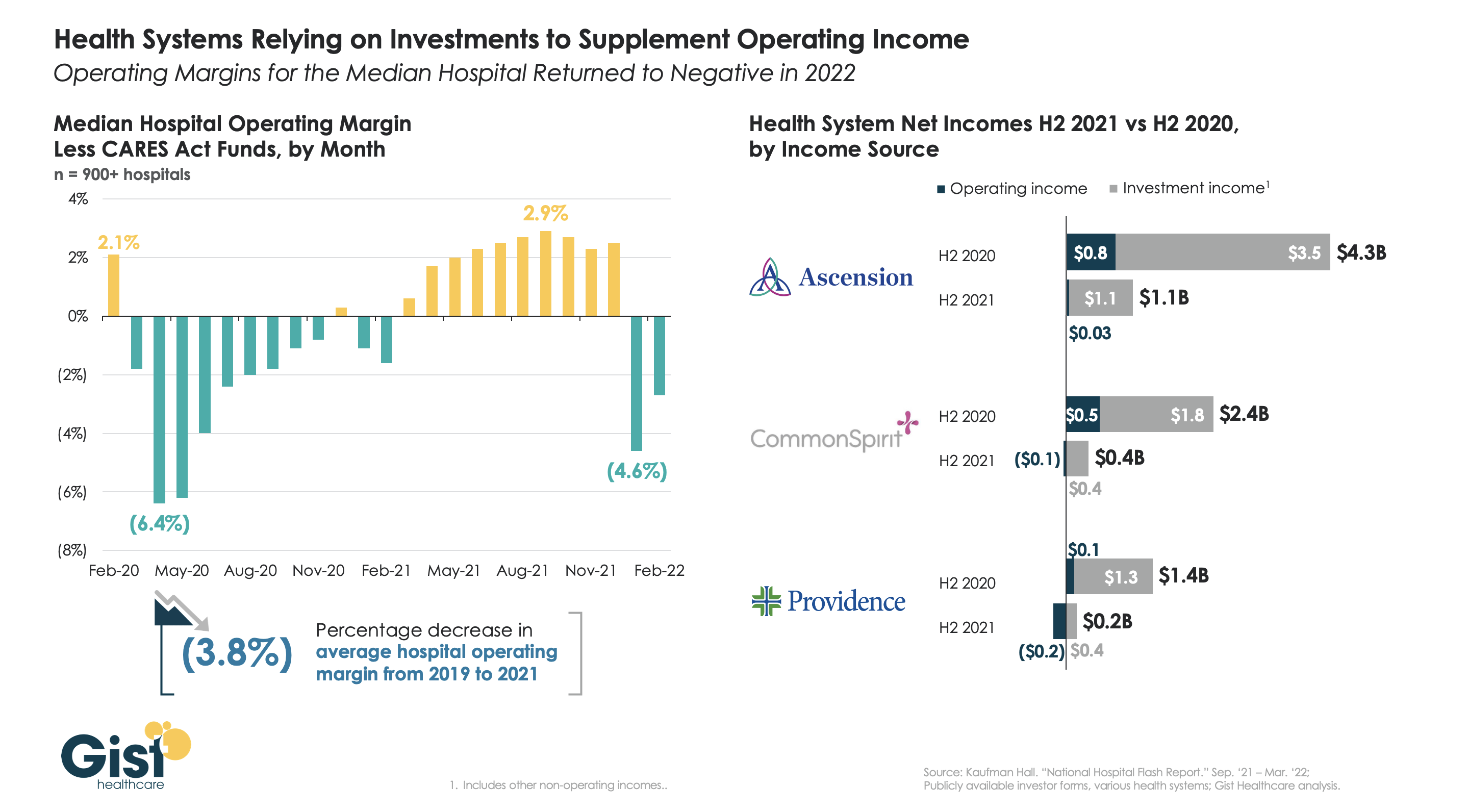
The combination of the Omicron surge, lackluster volume recovery, and rising expenses have contributed to a poor financial start of the year for most health systems. The graphic above shows that, after a healthier-than-expected 2021, the average hospital’s operating margin fell back into the red in early 2022, clocking in more than four percent lower than pre-pandemic levels. 

Despite operational challenges, however, many of the largest health systems continue to garner headlines for their sizable profits, thanks to significant returns on their investment portfolios in 2021.

While CommonSpirit and Providence each posted negative operating margins for the second half of 2021, and Ascension managed a small operating profit, all three were able to use investment income to cushion their performance.

A growing number of health systems are doubling down on investment strategies in an effort to diversify revenue streams, and capture the kind of returns from investments generated by venture capital firms. However, it is unlikely that revenue diversification will be a sustainable long-term strategy.

To succeed, health systems must look to reconfigure elements of the legacy business model that are proving financially unsustainable amid rising expenses, shifts of care to lower-cost settings, and an evolving, consumer-centric landscape.    

Saying farewell (for now) to a terrible financial quarter

Judging from our recent conversations with health system executives, we’d guess CEOs across the industry woke up this morning glad to see the first quarter in the rearview mirror.

Almost everyone we’ve spoken to has told us that the past three months have been miserable from an operating margin perspective—skyrocketing labor costs, rising drug and supply prices, and stubbornly long length of stay, particularly among Medicare patients.

In the words of one CFO, “I’ve never seen anything like this. For the first time, we budgeted for a negative margin, and still didn’t hit our target. I’m not sure how long our board will let us stay on this trajectory before things change.”

Yet few of the drivers of poor financial performance appear to be temporary. Perhaps the over-reliance on agency nursing staff will wane as COVID volumes bottom out (for how long remains unknown), but overall labor costs will remain high, there’s no immediate relief for supply chain issues, and COVID-related delays in care have left many patients sicker—and thus in need of more costly care. Plus, the lifeline of federal relief funds is rapidly dwindling, if not already gone.

Expect the next three quarters (and beyond) to bring a greater focus on cost cutting, especially as not-for-profit systems struggle to defend their bond ratings in the face of rising interest rates.

Buckle up, it’s going to be a bumpy landing.

Hospital margins ‘well below sustainable levels’: Kaufman Hall

Hospitals across the U.S. saw their operating margins remain negative for the second consecutive month in February as they continued to feel the repercussions of the winter omicron surge, according to Kaufman Hall’s “National Hospital Flash Report: March 2022” posted March 28.

The median operating margin in February was -3.45 percent, up from -4.52 percent in January, but “still well below sustainable levels,” Kaufman Hall said. 

Kaufman Hall said the improvement in hospital margin was driven by disproportionate increases among several hospitals that saw margin gains, but most hospitals reported margin declines in February. Specifically, the median operating margin was down 11.8 percent month over month.

“The second month of 2022 brought further challenges for the nation’s hospitals and health systems,” Kaufman Hall said. “Overall, the year is off to a difficult start.”

Kaufman Hall noted that patient days were down 13.3 percent month over month, and fewer severely ill COVID-19 patients also contributed to shorter hospital stays as the average length of stay dropped 5.3 percent month over month. 

Hospitals’ gross operating revenue also decreased 7.4 percent compared to January 2022, with outpatient revenue falling 5 percent and inpatient revenue declining 19.3 percent.

Kaufman Hall noted that hospitals saw some improvement month over month in terms of expenses. Total expenses per adjusted discharge fell 4.5 percent compared to January, labor expense per adjusted discharge fell 6.1 percent and non-labor expenses per adjusted discharge was down 3.6 percent. However, Kaufman Hall noted that year over year, expenses are still up significantly, with total adjusted expense per adjusted discharge rising 10.4 percent compared to February 2021.

Even the largest health systems dwarfed by industry giants

https://mailchi.mp/f6328d2acfe2/the-weekly-gist-the-grizzly-bear-conflict-manager-edition?e=d1e747d2d8

Insurers, retailers, and other healthcare companies vastly exceed health system scale, dwarfing even the largest hospital systems. The graphic above illustrates how the largest “mega-systems” lag other healthcare industry giants, in terms of gross annual revenue. 

Amazon and Walmart, retail behemoths that continue to elbow into the healthcare space, posted 2021 revenue that more than quintuples that of the largest health system, Kaiser Permanente. The largest health systems reported increased year-over-year revenue in 2021, largely driven by higher volumes, as elective procedures recovered from the previous year’s dip.

However, according to a recent Kaufman Hall report, while health systems, on average, grew topline revenue by 15 percent year-over-year, they face rising expenses, and have yet to return to pre-pandemic operating margins. 

Meanwhile, the larger companies depicted above, including Walmart, Amazon, CVS Health, and UnitedHealth Group, are emerging from the pandemic in a position of financial strength, and continue to double down on vertical integration strategies, configuring an array of healthcare assets into platform businesses focused on delivering value directly to consumers.

Facing a “new normal” of higher labor costs

https://mailchi.mp/161df0ae5149/the-weekly-gist-december-10-2021?e=d1e747d2d8

The price of higher labor costs in the consumer discretionary sector -  AlphaSense

Attending a recent executive retreat with one of our member health systems, we heard the CEO make a statement that really resonated with us. Referring to the current workforce crisis—pervasive shortages, pressure to increase compensation, outsized reliance on contract labor to fill critical gaps—the CEO made the assertion that this situation isn’t temporary. Rather, it’s the “new normal”, at least for the next several years.

The Great Resignation that’s swept across the American economy in the wake of COVID has not spared healthcare; every system we talk to is facing alarmingly high vacancy rates as nurses, technicians, and other staff head for the exits. The CEO made a compelling case that the labor cost structure of the system has reset at a level between 20 and 30 percent more expensive than before the pandemic, and executives should begin to turn attention away from stop-gap measures (retention bonuses and the like) to more permanent solutions (rethinking care models, adjusting staffing ratios upward, implementing process automation).

That seemed like an important insight to us. It’s increasingly clear as we approach a third year of the pandemic: there is no “post-COVID world” in which things will go back to normal. Rather, we’ll have to learn to live in the “new normal,” revisiting basic assumptions about how, where, and by whom care is delivered.

If hospital labor costs have indeed permanently reset at a higher level, that implies the need for a radical restructuring of the fundamental economic model of the health systemrazor-thin margins won’t allow for business to continue as usual. Long overdue, perhaps, and a painful evolution for sure—but one that could bring the industry closer to the vision of “right care, right place, right time” promised by population health advocates for over a decade.