The burden on teachers

https://www.axios.com/teachers-worry-school-reopening-coronavirus-4f173e1b-f48f-49ad-a319-0b053ddd7295.html

The burden on teachers in reopening the schools - Axios

The debate over whether and how much to re-open schools in the fall has put teachers in the precarious position of choosing between their own safety and the pressures from some parents and local officials.

Why it matters: Teachers are the core of K-12 education. The people we depend on to educate our society’s children may end up bearing the brunt of both the risk and the workload.

What’s happening: With coronavirus cases spiking in many parts of the U.S., districts are weighing the feasibility of keeping classes all virtual, as Los Angeles and San Diego are doing, or conducting a rotation of in-person and remote lessons.

While all back-to-school options have pros and cons, there are specific worries for teachers.

1. Exposure: Despite a child’s overall low health risk if they contract COVID-19, scientists still do not conclusively know if schools could become hotspots for more vulnerable populations.

  • Schools are on a time and money crunch for better ventilation, more disinfectant and masks and proper social distancing techniques. If a cluster of cases do occur, teachers and parents are short on answers about how to isolate students and contact trace.
  • Districts were already facing staffing shortages before the pandemic. And nearly 1.5 million teachers have a condition that puts them at increased risk of serious illness from coronavirus, per a Kaiser Family Foundation study. A separate KFF study out today found that 3.3 million adults age 65 or older live in a household with school-age children.
  • A study in Germany found that infections in schools had not led to outbreaks in the community. But an analysis of a surge of cases in Israel found that nearly half the reported cases in June were traced back to illness in schools.

“We as teachers prepare for active shooters, tornadoes, fires and I’m fully prepared to take a bullet or shield a child from falling debris during a tornado. But if I somehow get it and I’m asymptomatic and I get a student sick and something happens to them or one of their family members, that’s a guilt I would carry with me forever.”

— Michelle Albright, a second grade teacher from northwest Indiana

2. Difficulty of a hybrid approach: Many school districts like New York City are opting to split school between in-person and online to minimize exposure. That’s an effective but more burdensome approach for teachers, top teachers union chief Randi Weingarten told Axios’ Dan Primack Monday.

  • In-person contact with a teacher can make a big difference for students struggling with a concept or who need one-on-one time.
  • But many teachers will have to prepare virtual and in-person lessons and ensure the same learning outcomes for students in both settings — a tall order.

3. Child care availability: Teachers with children of their own are concerned about how to care for them when they are teaching.

  • States could choose to provide child care services for educators as essential employees, but it’s unclear what non-school child care options will be available in areas with high infection rates or where day care centers have struggled to stay in business.

4. Concerns of other school staff: Bus drivers, custodians, classroom aides, administrative staff, cafeteria workers, school nurses and substitute teachers may come in contact with more children throughout the day because they are less likely than teachers to be confined to a single classroom.

What to watch: School districts ought to be finding other roles for teachers who are not comfortable returning to the classroom, such as reassigning them to virtual-only roles or providing one-on-one online tutoring sessions with students, said John Bailey, visiting fellow at the American Enterprise Institute and former domestic policy adviser during the George W. Bush administration.

  • But there’s not much time to sort that out on top of getting teachers the professional development they need for effective remote learning.
  • “What I worry about is that we squandered the few months we had to make sure we can think through these challenges,” Bailey said. “This was one of the most obvious challenges facing schools with reopening and we should have been thinking about that for the last several months. Instead it’s creeping up on districts.”

The bottom line: Due to the unprecedented nature of this pandemic, teachers are worried about the uncertainties and, in some cases, lack of clear planning should conditions worsen. That may drive some to quit teaching altogether.

  • “You’ve got 25% of teachers who may be in either a high-risk situation because of pre-existing conditions or because of age, and a lot of them, if they can, they may just check out and say ‘nobody’s taking care of me. I can’t go back,'” Weingarten said.



1.3 million Americans filed first-time unemployment claims last week

https://www.cnn.com/2020/07/16/economy/unemployment-benefits-coronavirus/index.html

1.3 million people filed for first-time unemployment last week

It’s still not easy to remain employed in the US, nearly four months after the coronavirus pandemic began upending the economy.

Another 1.3 million people filed first-time jobless claims on a seasonally adjusted basis for the week ending July 11, according to the Department of Labor. That’s down 10,000 from the prior week’s revised level.
On an unadjusted basis, more than 1.5 million people filed first-time claims, up almost 109,000 from the week before. The seasonal adjustments are traditionally used to smooth out the data, but that has tended to have the opposite effect during the pandemic.
Weekly first-time unemployment applications have been on the decline for more than three months since their peak in the last week of March. But last week’s drop was less than expected.
“Overall, filings remain high and are declining at a stubbornly slow pace,” said Rubeela Farooqi, chief US economist for High Frequency Economics, noting that the risk of mounting permanent job losses is high. “The pace could slow even further or reverse in coming weeks in response to a surge in virus cases and related closures of businesses.”
Continued claims, which count workers who have filed claims for at least two weeks in a row, stood at more than 17.3 million for the week ending July 4, down 422,000 from the prior week. These claims peaked in May at nearly 25 million.
In addition, about 928,500 million people in 47 states filed for first-time pandemic unemployment assistance last week, down almost 118,000 from the week before. And almost 14.3 million people claimed continued pandemic benefits across 48 states for the week ending June 27. That’s up nearly 406,000 from the prior week.
The pandemic program was created by Congress in March to respond to the coronavirus outbreak. It provides temporary benefits to workers who typically aren’t eligible for payments, including freelancers, independent contractors, the self-employed and certain people affected by the coronavirus. It expires at the end of the year.
Looking at all workers participating in an array of unemployment programs, just over 32 million Americans claimed jobless benefits the week ending June 27, down about 433,000 from the prior week.
That total includes those in the traditional and pandemic unemployment programs, as well as the pandemic emergency unemployment compensation program, which has nearly 936,500 filers. Lawmakers created it in March to provide those who have exhausted their benefits with an additional 13 weeks of payments. It also expires at the end of 2020.


5.4 million Americans lost health insurance

https://www.axios.com/newsletters/axios-vitals-285240f4-9110-4c86-ad7e-e0c37085a957.html?utm_source=newsletter&utm_medium=email&utm_campaign=newsletter_axiosvitals&stream=top

Medicare for All (@AllOnMedicare) | Twitter

Roughly 5.4 million adults in the U.S. lost their health insurance from February to May after losing their jobs, according to a new estimate from Families USA, a group that favors the Affordable Care Act.

Why it matters: There are more adults under 65 without insurance in Southern states, which are the same states setting new records for single-day coronavirus infections along with rising hospitalizations, Axios’ Orion Rummler writes.

What they found: 3.9 million adults lost health insurance over one year during the Great Recession, per Families USA’s analysis. It only took four months in this current crisis for an estimated 5.4 million Americans to lose health insurance.

  • More than 20% of adults in Georgia, Florida, South Carolina, North Carolina, Mississippi, Oklahoma and Texas were without insurance as of May.
  • All of these states have set new records in the past two weeks for their highest number of coronavirus infections in a single day, per data from the COVID Tracking Project.
  • 46% of adults who lost coverage due to the pandemic came from five states: Florida, New York, Texas, California and North Carolina.

The backdrop: 21 million Americans were unemployed in May, according to the Bureau of Labor Statistics’ nonfarm payrolls report.


Trump admin seeks relaxed grandfathered ACA health plan rules that up out-of-pocket costs

https://www.healthcaredive.com/news/trump-admin-seeks-relaxed-grandfathered-aca-health-plan-rules-that-up-out-o/581463/

Paying for Health Insurance Out of Pocket Maximum, OOP Health ...

Dive Brief:

  • The Trump administration proposed a rule Friday to allow some group health plans grandfathered under the Affordable Care Act to raise out-of-pocket costs for enrollees but still allow them to have health savings accounts. Such plans must not discriminate against enrollees with pre-existing conditions, but are exempt from many other ACA regulations. If they violate any rules regarding costs or structure they lose their grandfathered status and are required to follow all the mandates of the landmark 2010 law.
  • The proposed rule, issued by the U.S. Department of Labor, would relax some of the complex inflation and pricing calculations grandfathered plans must follow. The department admitted that the change could lead to higher deductibles and other out-of-pocket costs for the estimated 23.1 million enrollees in such grandfathered plans.
  • The rule stems from a 2017 executive order issued by President Donald Trump that allows regulatory changes to be made in response to perceived economic burdens imposed by the ACA. However, the Labor Department conceded in its Federal Register publication of the proposed rule that the current rules for grandfathered health plans probably weren’t that burdensome.

Dive Insight:

The administration has made no secret of its ire for the ACA and is actively trying to overturn it at the U.S. Supreme Court. A release explaining the changes notes fixed cost-sharing for high-deductible health plans would be raised, and “an alternative method of measuring permitted increases in fixed-amount cost sharing” has been introduced that “would allow plans and issuers to better account for changes in the costs of health coverage over time.”

The formal 76-page proposal, published in the Federal Register on Sunday, said premiums might go down as a result of the changes, but there were no estimates provided or circumstances where that might occur.

Moreover, the proposed rule also noted that the change could lead to more people foregoing healthcare because their out-of-pocket costs might become unaffordable.

The Labor Department also noted that there have been so few fluctuations in the state of grandfathered health plans in recent years that it was likely the current regulations were not overly burdensome in the first place.

Public comments will be solicited until mid-August before a final rule is issued.

Sen. Patty Murray, D-Wash., and ranking member of the Senate Health, Education, Labor, and Pensions Committee, wasted little time late last week blasting the proposal.

“Regardless of what the president wants to believe, we’re in the middle of a pandemic that is devastating families’ health and finances,” Murray said in a statement.


Pre And Post Coronavirus Unemployment Rates By State, Industry, Age Group, And Race

https://www.forbes.com/sites/mikepatton/2020/06/28/pre-and-post-coronavirus-unemployment-rates-by-state-industry-age-group-and-race/#65c42c6555eb

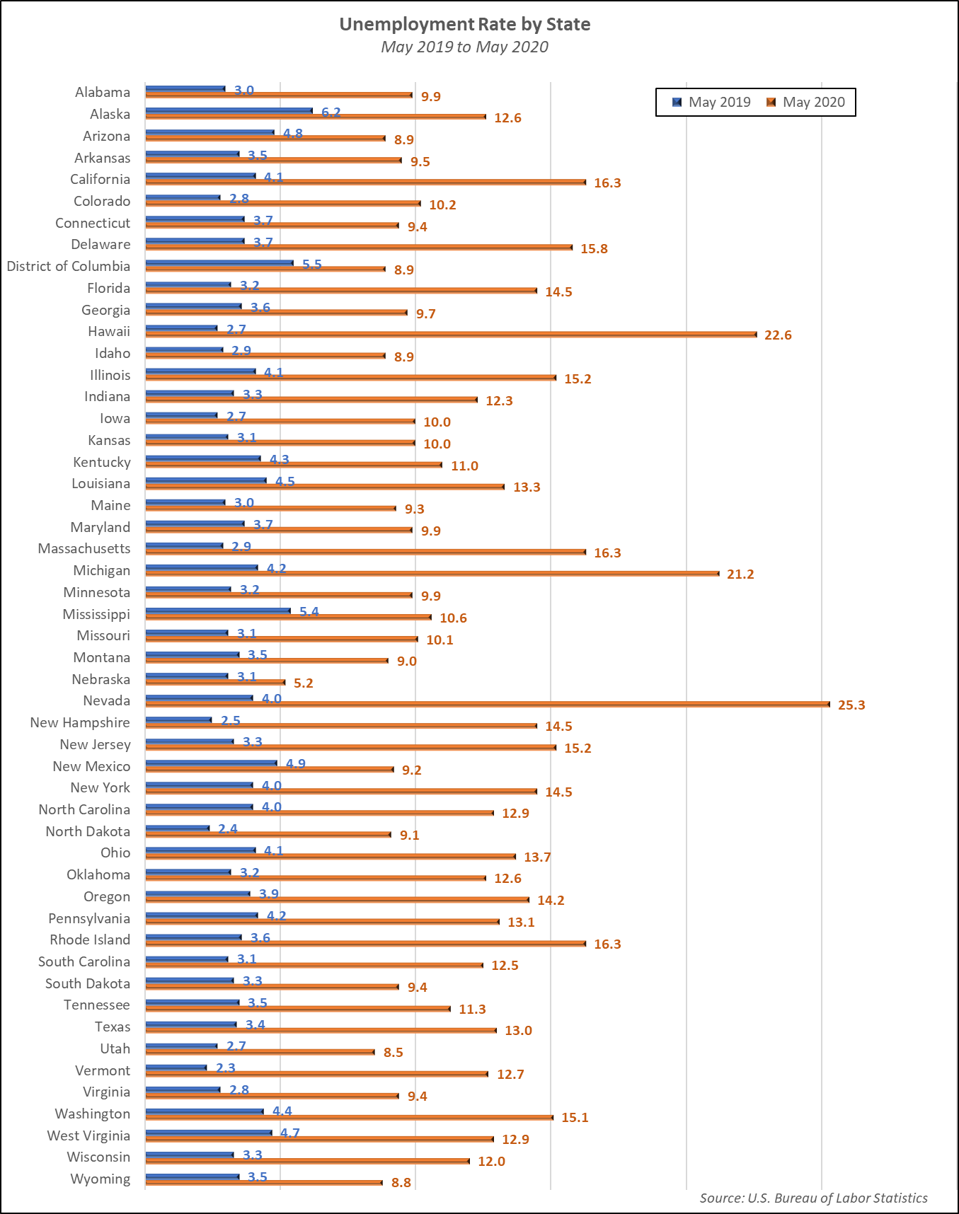
Unemployment by State-May 2019 to May 2020

The coronavirus has decimated the U.S. economy and benched nearly 40 million American workers. In the past several days, the U.S. has logged its highest number of new Covid-19 cases since the pandemic began. These combined with other factors, which we will discuss, is jeopardizing the future employment of millions of workers and the viability of thousands of businesses. Here’s how unemployment has increased for every state, industry, age group, and race, and why.

Unemployment by State

The coronavirus and subsequent stay at home orders hit the labor force especially hard. As states attempted to reopen, a resurgence in the virus is causing many businesses to close again, some by choice, others by government mandate.

Nevada has been hit the hardest as the unemployment rate in the Silver State rose from 4.0% in May 2019 to a whopping 25.3% in May 2020. Nevada’s economy is heavily reliant on leisure and hospitality, which had the brunt of the job losses. Hawaii, the second hardest hit state saw unemployment rise from 2.7% in May 2019 to 22.6% in May 2020. Which is the only other state with unemployment above 20% in May 2020? Michigan, where unemployment rose from 4.2% to 21.2% year over year. What state has fared best? Nebraska, which also has one of the most diverse economies of all states. Deriving nearly 50% of its total GDP from five different industries, unemployment in the Cornhusker State rose from 3.1% to a modest 5.2% from May 2019 to May 2020. Unemployment numbers for all states are shown in the following chart.

Unemployment by Industry

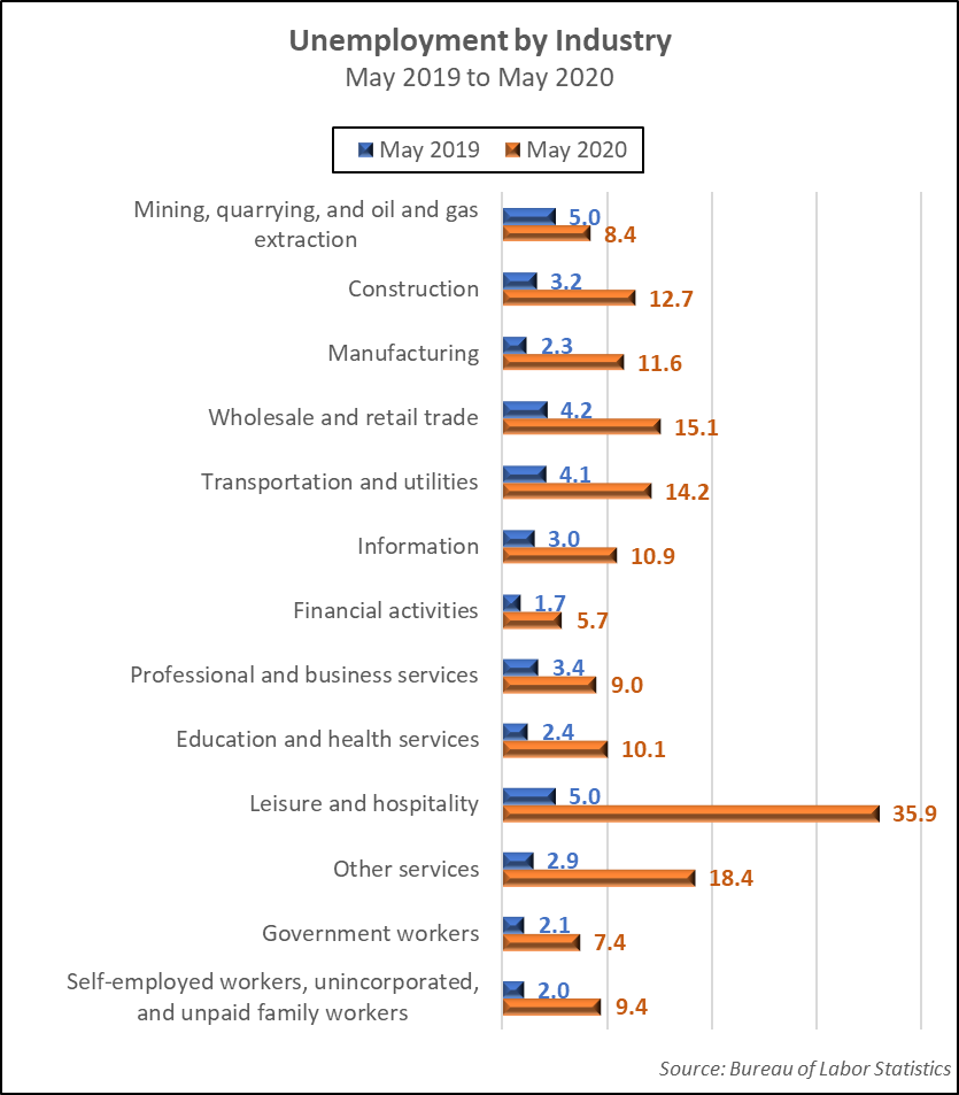
As mentioned in the previous section, the states that have fared best either have a more diverse economy or do not rely heavily on industries that have been hardest hit by the coronavirus. The most negatively affected is the leisure and hospitality industry where unemployment rose 618% from a low of 5.0% in May 2019 to a staggering 35.9% in May 2020. At a distant second, but still reeling, is the wholesale and retail trade industry, which saw unemployment rise from 4.2% to 15.1% during the same period. The rest of the industries are listed in the following chart.

Unemployment by Industry-May 2019 to May 2020

Unemployment by Age Group

Businesses need two things to exist: workers and customers. Without customers, there is no need for workers or the business for that matter. Some businesses require highly skilled workers while others operate well using unskilled labor. It is this unskilled labor group that has been hardest hit.

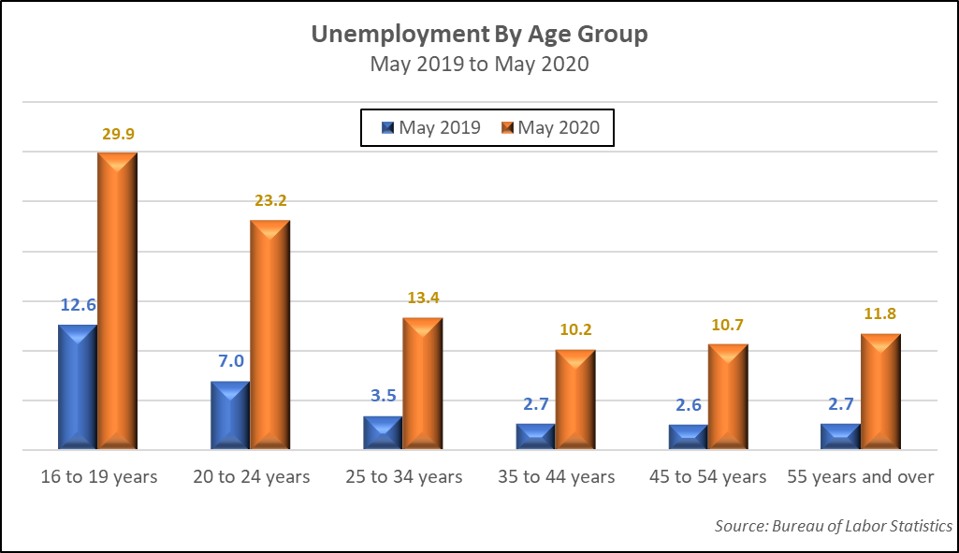
The greatest rise in unemployment is among workers under age 25. This is likely due to three factors. Younger workers typically have fewer marketable skills, less work experience, and less seniority. Many of these workers are in industries that have felt the greatest pain. Unemployment rates by age group are contained in the following chart.

Unemployment by Age Group-May 2019 to May 2020

Unemployment by Race/Ethnicity

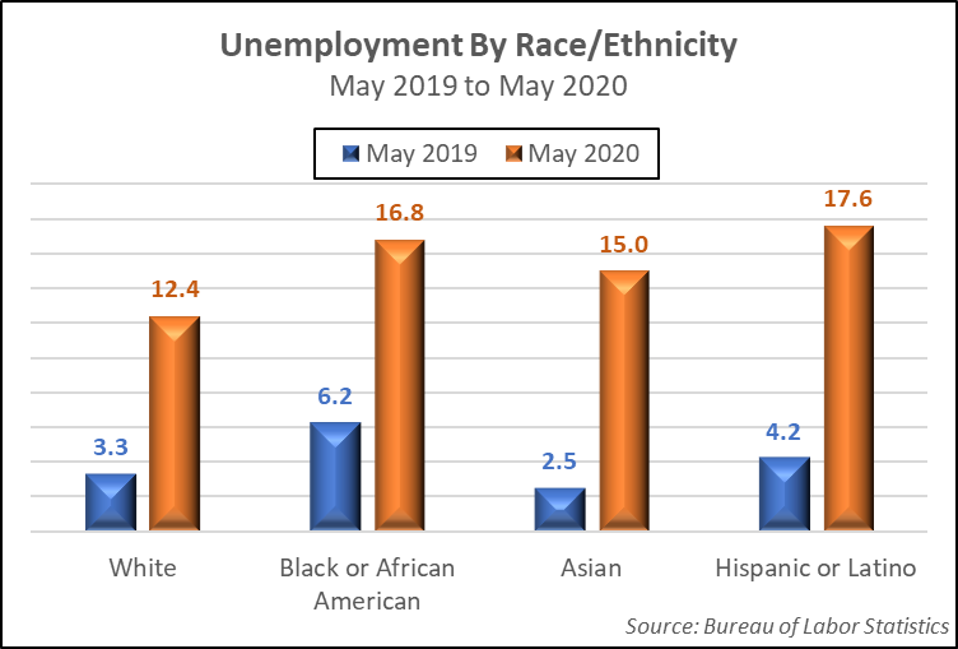
Question: Prior to Covid-19, was unemployment among blacks / African Americans at a record low as President Trump has claimed? Using the available data, which extends back to January 1972, the answer is yes. This new record low was achieved in October and November of 2019 when unemployment among black or African American workers fell to 5.1%. The previous record low was 5.2% in December 1973. The current rate is 16.8%, which is less than the highest rate of 20.7% logged in December 1982. The most recent high in unemployment for this group was 19.3% in March 2010. It has been steadily declining since then. Numbers for White, Asian, and Hispanic or Latino and black or African American workers are listed in the following chart.

Unemployment by Race or Ethnicity-May 2019 to May 2020

Businesses need workers, workers need businesses, and both depend on customers. Since the pandemic began, consumer demand has fallen sharply. With the probability that a vaccine will not be available until early 2021 at the soonest, plus a disregard for recommended safety protocols by many individuals, namely wearing masks and social distancing, it is highly unlikely that the economy will return to normal for several years.

Will the president continue to hold rallies? Will he set an example by wearing a mask? Will the protests and violence continue? Will other large gatherings continue? Unless Americans make a collective and conscious choice to mask up and social distance, we will be forced to live in a depressed economy for longer than necessary. The choice is up to us.


Short-term ‘junk’ plans widely discriminate against those with pre-existing conditions, House probe finds

https://www.healthcaredive.com/news/short-term-junk-plans-widely-discriminate-against-those-with-pre-existing/580556/

U.S. Rep. Castor's Statement Following a Federal Judge's Ruling on ...

Dive Brief:

  • A yearlong probe by the House Committee on Energy and Commerce into bare-bones insurance plans encouraged by the Trump administration found widespread discrimination against people with pre-existing conditions, even as a growing number are enrolled.
  • Top congressional Democrats investigated eight insurers selling short-term, limited duration plans, finding they all denied medical care claims if they found a consumer had a pre-existing condition. Some refused to pay for medical claims for no discernable reason, processing them only after consumers sued or complained to state regulators. Most rescinded coverage if they determined a member had a pre-existing condition or developed one later.
  • An HHS spokesperson defended the coverage as an affordable option to pricier Affordable Care Act plans, telling Healthcare Dive, “We’ve been abundantly clear that these plans aren’t for everyone.” America’s Health Insurance Plans made similar points, with spokesperson David Allen noting: “For Americans with pre-existing conditions, they may not be protected at all.”


Dive Insight:

The investigation looked at 14 companies that sell or market the plans, including eight insurers such as market giants Anthem and UnitedHealth Group, and six brokers.

It found insurers frequently turned down consumers with pre-existing conditions and discriminated against women, turning down applicants who were pregnant or planning to become pregnant and charging women more than men for the same coverage.

The plans had significant coverage limitations. Some excluded routine care like basic preventive visits and pelvic exams. Some plans had hard coverage cutoffs that left consumers with massive medical bills.

In one case, a consumer was billed a whopping $280,000 and lost coverage after being treated for an infection. The insurer said the patient previously had gotten an ultrasound that was “suspicious for deep venous thrombosis.”

AHIP spokesman Allen said it is not surprising given the plans are not intended to replace comprehensive coverage.

“They often do not cover the care and treatments that patients need throughout the year — preventive care, prescription drugs, mental health care or treatments for chronic health conditions — or if they do, they may limit or cap the benefits,” he acknowledged.

On average, short-term plans spend less than half of premium dollars collected from consumers on medical care: only 48%, the investigation found. That’s in stark contrast to plans in the ACA’s individual market, which are required to shell out at least 80% of all premium dollars on claims and benefits.

Short-term insurance represents a significant and growing share of the individual healthcare market. Roughly 3 million consumers bought the plans in 2019, a 27% growth from 2018, the investigation launched in March last year found.

The growth came after the Trump administration, in a controversial move, extended the maximum duration of the plans. The skimpy coverage, which isn’t required to cover the 10 essential benefits under the ACA, was originally designed as cheap safety net coverage for three months.

But in August 2018, HHS expanded the plans to 12 months, with a three year renewal period, and opened them up to all consumers, not just for those who can’t afford other coverage.

ACA supporters and patient advocates blasted the move, which sparked an ongoing legal challenge from safety net providers. Reports of consumers purchasing the coverage, believing it was comprehensive, then being shocked by balance bills prompted the House investigation.

The report also found brokers are paid up to 10 times more compensation for peddling short-term plans than ACA-compliant coverage. The average commission rate for short-term plans compared to ACA plans was 23% versus 2%, respectively.

Currently, 24 states ban or restrict the sale of short-term plans. Some states, including California, Massachusetts, New Jersey and New York, prohibit their sale entirely, while others like Colorado, Connecticut, New Mexico and Rhode Island have such strict regulations that no plans are sold.

Democratic leaders unveiled a bill on Wednesday to bolster the ACA and rescind the administration’s expansion of the plans and expand subsidies, allowing more people to qualify for coverage.

The effort has zero chance of moving this year with Republicans in control of the Senate, but both it and the probe are likely to play into the looming 2020 presidential and congressional elections.

“The heavy-handed tactics uncovered in this investigation demonstrate why Congress must reverse the Trump Administration’s expansion of these junk plans,” E&C Chairman Frank Pallone, D-N.J., Health Subcommittee Chairwoman Anna Eshoo, D-Calif., and Oversight and Investigations Subcommittee Chair Diana DeGette, D-Colo., wrote in a joint statement. “It also shows how dangerous a post-ACA world would be if Republican Attorneys General and the Trump Administration are successful in striking down the law and its protections.”

That lawsuit, led by 18 red states, argues the ACA, which expanded insurance to some 20 million people, is unconstitutional because a tax bill passed in 2017 zeroed out the penalty for its individual mandate. It’s currently pending before the U.S. Supreme Court.

President Donald Trump and his health officials have repeatedly promised people with pre-existing conditions will be protected if the ACA is struck down, but neither the administration nor Republicans in Congress have said specifically how.


Trinity Health expects $2B revenue plunge as it cuts, furloughs more staff

https://www.healthcaredive.com/news/trinity-health-cutting-cost-cutting-2-billion-revenue-shortfall/580738/

The Dumbest Things You Can Do With Your Money | Work + Money

Dive Brief:

  • Trinity Health, one of the nation’s largest nonprofit health systems, said Monday it will take more measures to cut costs due to the downturn spurred by the novel coronavirus. The restructuring plan includes eliminating positions, extending furloughs, severances and reductions in schedules. The decisions are being “customized” across the system based on factors that include volume projections and the cost and revenue challenges in each market.
  • The Livonia, Michigan-based hospital operator said it continues to treat COVID-19 patients, however, it has “for now seen declining numbers of very sick patients with COVID-19.”
  • The system said it expects revenue to be depressed or “below historical levels” for the remainder of this fiscal year and much of the next. It projects revenue to drop by $2 billion to $17.3 billion for fiscal year 2021, which starts after its June 30 year end.

Dive Insight:

In May, Trinity said it planned to furlough nearly 12% of its workforce — or 15,000 employees out of the 125,000 nationally.  

Trinity, one of the nation’s largest hospital operators with 92 facilities and operations across 22 states, is now broadening that restructuring, extending and adding new furloughs.

In a Monday bond filing, Trinity said its operations were “significantly” impacted by the effects of the pandemic as many operators saw depressed volumes due to shelter-in-place orders, which started in most of Trinity’s markets during the last two weeks of March.

“The effect of COVID-19 on the operating margins and financial results of Trinity Health is adverse and significant and, at this point, the duration of the pandemic and the length of time until Trinity Health returns to normal operations is unknown,” according to Monday’s bond filing.

The system said relief funds provided by the federal government have not been enough to cover its operating losses. Trinity has received $600 million in relief funds that do not have to be repaid and more in loans through the advanced Medicare payment program, according to a previous analysis by Healthcare Dive.

Still, the system said it has drawn on credit facilities totaling $1 billion to provide adequate liquidity during the pandemic. Trinity reported having 178 days cash on hand as of March 30.

Some nonprofits are faring better than Trinity and pulling back on earlier staffing cuts.

Mayo Clinic said last week it will call back its furloughed workers by the end of August and restore pay that had been cut due to the pandemic.

Mayo has some of the most cash on hand in terms of days when comparing other major nonprofit systems. Mayo had 252 days of cash on hand as of March 30, more than the other 20 largest nonprofits except Cleveland Clinic and New York-Presbyterian.


U.S. Healthcare System vs. Socialized Medicine during the Pandemic

https://www.commondreams.org/news/2020/06/25/why-socialized-system-medicare-all-beats-profit-healthcare-one-chart-covid-19?fbclid=IwAR1qT_AI5KFreoEKOqQfvdWUHPyW80fa2Iefxb5Ul5wJQtf8rSvZXkL8RHM


“All countries successfully combatting this virus have robust public health systems, which provide for coordination of effort.”

A recent rise in cases of Covid-19 and the overt failure of the for-profit healthcare system throughout the pandemic in the U.S. are making the case for Medicare for All, advocacy groups and activists say, as countries with socialized systems see their infection rates decline.

“All countries successfully combatting this virus have robust public health systems, which provide for coordination of effort,” remarked a popular healthcare advocate who uses the @AllOnMedicare handle on Twitter.

Calls for the U.S. to adopt a single-payer heathcare system have increased as the pandemic has raged around the country. Cases and deaths in the U.S are now the highest in the world, a result critics blame on both the private healthcare system and the mismanagement of the crisis by President Donald Trump.

Public Citizen’s health care policy advocate Eagan Kemp told Common Dreams that the current for-profit healthcare system that has driven millions of Americans in to bankruptcy and leaves millions more without care will only continue to exacerbate the pain of the outbreak. 

“While no health care system can completely protect a country from Covid-19, the U.S. has failed to respond for a number of reasons, not least of which is a for-profit health care system where Americans are too afraid to go to the doctors for fear of the cost,” said Kemp. “Far too many Americans will face medical debt and even bankruptcy if they are lucky enough to survive getting Covid-19, something unheard of in all other comparably wealth countries.”

As University of Massachusetts professor Dean E. Robinson wrote in a piece that appeared at Common Dreams earlier this month, the coronavirus is impacting people of color at a disproportionate rate in cities and communities nationwide—a dynamic that bolsters the call for a universal Medicare for All program to help close those gaps.

“The obvious and immediate need of Black and other working class populations caught in the teeth of the pandemic is the right to health care treatment without the burden of cost,” wrote Robinson. “Even before the pandemic, lower-income, Latino, and younger workers were more likely to be uninsured. Undocumented workers had the highest rates of uninsurance.”

On June 18, Ralph Nader in an opinion piece for Common Dreams expressed his hope that the ongoing pandemic would make essential workers in the health field “the force that can overcome decades of commercial obstruction to full Medicare for All.”


Jobless claims: Another 1.48 million Americans file for unemployment benefits

https://finance.yahoo.com/news/coronavirus-covid-weekly-initial-jobless-claims-june-20-195644738.html

More than three months into the COVID-19 crisis in the U.S., countless Americans are still unemployed. According to the U.S. Labor Department, weekly initial jobless claims data showed yet another week of claims exceeding 1 million.

Another 1.48 million Americans filed for unemployment benefits in the week ending June 20, exceeding economists’ expectations for 1.32 million. The prior week’s figure was revised higher to 1.54 million from the previously reported 1.51 million claims. While this week’s report marked 12 consecutive weeks of deceleration, more than 47 million Americans have filed for unemployment insurance over the past 14 weeks.

“Jobless claims are not falling fast enough,” Renaissance Macro’s Neil Dutta said in an email Thursday. “Everything we have seen in the last week or two between rising case counts/hospitalizations, stalling economic progress in some important states, government job cuts, means one thing: the Phase 4 of fiscal stimulus must be bigger. Things should be better in 3-4 weeks, but the news will get worse before it gets better. Take some chips off the table and reload the chamber for August.”

Continuing claims, which lags initial jobless claims data by one week, totaled 19.52 million in the week ending June 13, down from 20.29 million in the week ending June 6. Consensus expectations were for 20 million continuing claims.

“Initial jobless claims continue to moderate only gradually,” Nomura economist Lewis Alexander wrote in a note Wednesday. “While the labor market remains exceptionally weak, signs of gradual improvement suggest another month of NFP gains during June.”

In the week ending June 20, California reported the highest number of jobless claims at an estimated 287,000 on an unadjusted basis, up from 241,000 in the previous week. Georgia had 124,000, down from 132,000, Florida reported 93,000, New York had roughly 90,000 and Texas reported 89,000 jobless claims.

Additionally, Pandemic Unemployment Assistance (PUA) program claims, which include those who were previously ineligible for unemployment insurance such as self-employed and contracted workers, was also closely monitored in Thursday’s report.

PUA claims totaled 728,120 on an unadjusted basis in the week ending June 20, down from the prior week’s 770,920.

As states reopen their economies, cases and hospitalization figures are back on the rise. As of Thursday morning, there were more than 9.4 million cases and 483,000 COVID-19 deaths around the world, according to Johns Hopkins University data. The U.S. had 2.3 million cases and 121,000 deaths.


ACA enrollment up 46%

https://www.axios.com/newsletters/axios-vitals-59e9ac1a-ab86-4f8a-917a-8c9d52f5835f.html?utm_source=newsletter&utm_medium=email&utm_campaign=newsletter_axiosvitals&stream=top

Obamacare Coverage Spikes After Covid-Related Job Losses

The number of people who lost jobs and related health coverage and then signed up for Affordable Care Act health plans on the federal website was up 46% this year compared with 2019, representing an increase of 154,000 people, the federal government said in a new report.

The bottom line: The government said the rush of people going to HealthCare.gov was tied to “job losses due to COVID-19,” Bob writes.

Yes, but: Medicaid enrollment due to coronavirus-related job losses appears to be growing even faster than enrollment in ACA plans, according to the Georgetown University Health Policy Institute.

Go deeper: Medicaid will be a coronavirus lifeline