The Science Behind Campus Coronavirus Outbreaks

https://www.forbes.com/sites/johndrake/2020/08/21/the-science-of-campus-outbreaks/#4c5704ae6893
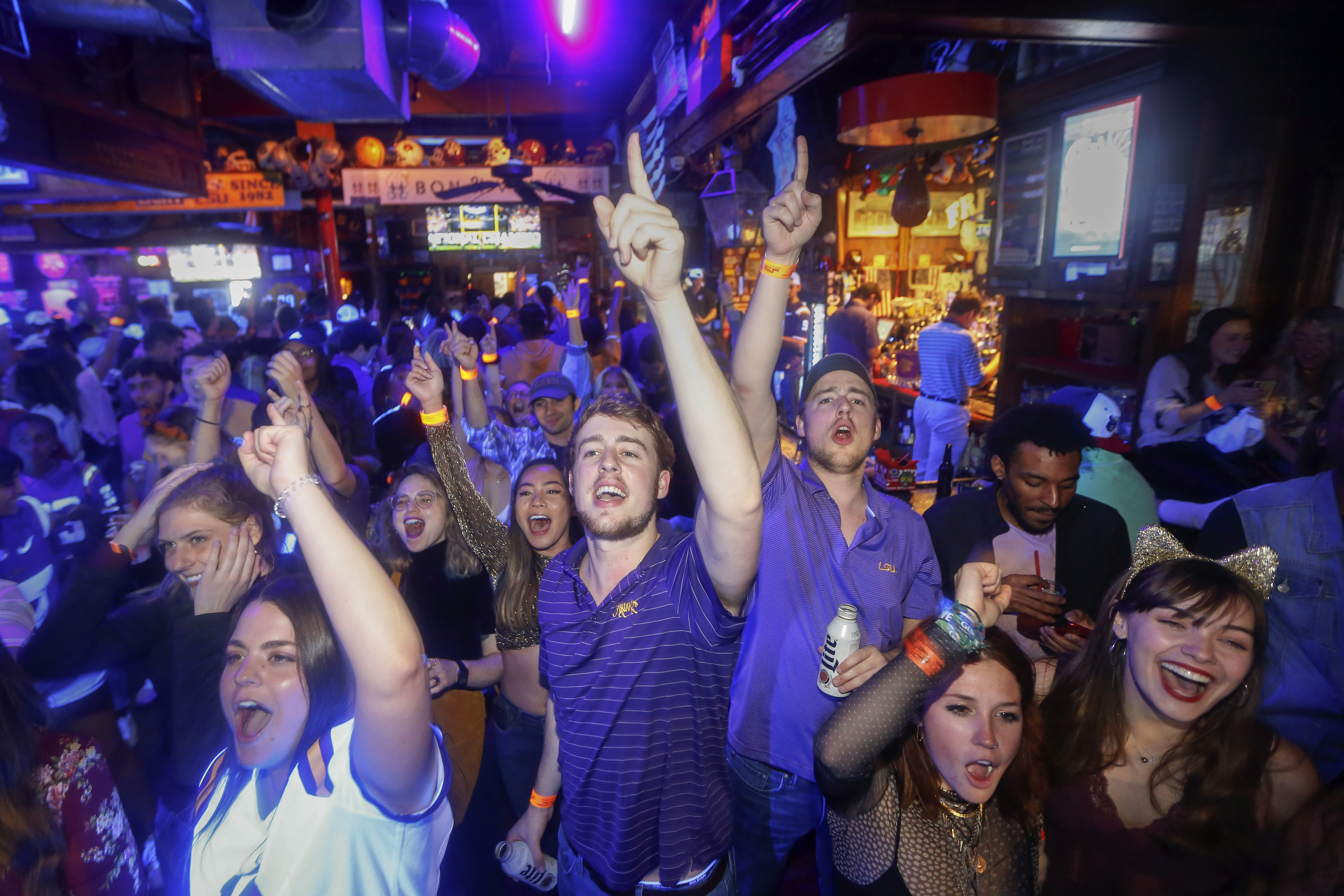
LSU frat parties become coronavirus 'superspreader events ...

Colleges And Universities Reverting To Online Instruction

On August 17, seven days after the start of in-person classes, the University of North Carolina at Chapel Hill announced that, due to a dramatic increase in Covid-19 on campus, all undergraduate classes would be held online for the remainder of the fall. Ithaca College and Michigan State pulled the plug on August 18. Two days later, N.C. State joined the club. More may follow. (The Chronicle of Higher Education maintains a live update feed.) In fact, only a minority of colleges and universities are still attempting fall instruction fully or primarily in person (about 25% at this writing).

Only time will tell if these rapid course changes were warranted and, of course, the answer may not be the same everywhere. Each institution is unique with respect to size, culture, infrastructure to provide online learning, and ability to cope with transmission.

What We Know About Infectious Diseases On College Campuses

In thinking about Covid-19 transmission on campus, it may be useful to know something about the science of epidemics among college students in general. There is a small scientific literature on disease outbreaks on campus. Campuses are special for several reasons. News photos of students lounging on green quads, engaged in late night study groups, or partying into the wee hours reminds us that if college is known for anything other than studying and college sports, it might be the unique gregariousness that attaches to what many people call the “college experience.”

Although outbreaks of infectious diseases on college campuses are routinely reported, there is little evidence that they are more explosive than in the general population. Outbreaks of directly transmitted diseases like measlesmumps, and whooping cough occur with some regularity and are typically contained through isolation and other public health measures. But, no study has been done to systematically examine how the campus environment differs from community-based transmission. 

Influenza is a particularly interesting case because, like Covid-19, it is a respiratory disease transmitted directly through close contact and also has a short incubation period. The basic reproduction number (R0) is a measure of the explosiveness of an epidemic, with anything over R0 = 1 indicating the possibility of sustained transmission.

In 2014, CDC and academic scientists compiled a list of all estimates of R0 for influenza. While most estimates for the 2009 pandemic were between 1 and 2, estimates from some schools (not necessarily colleges or universities) were noticeably higher (2.3 for a school in Japan and 3.3 for a school in the United States), although other cases (Iran and the United Kingdom) were similar to the rest of the population.

Perhaps more importantly, a study in Pullman, Washington (home to Washington State University) estimated R0 of the 2009 pandemic flu to be around 6, which is two to four times larger than most other estimates. So there is some evidence that campus contagions may be more prone to outbreak than other places.

Since Covid-19 is typically much less severe in young adults than in older adults, another question that seems particularly important now is whether transmission among students remains primarily within the student population or readily spreads to the rest of the community. 

In a measles outbreak at a university in China, the fraction of staff who were infected was not statistically different from the fraction of students. The total number of staff infected — three — was small, however, and it seems unlikely that this is the usual pattern.

A study of the 2009 influenza pandemic at the University of Delaware found that the risk of infection for people older than 30 was roughly half the risk of those that were 18 to 29.

An even more interesting aspect of the University of Delaware study is the association with student activities. Reports of influenza-like illness among students at a nearby emergency health center remained stable for almost a month after spring break. But cases increased almost five-fold following “Greek week”. In the final analysis, belonging to a fraternity or sorority doubled a student’s chances of being infected.

What’s Happening Now

This is concerning now as cases of Covid-19 are rising among college students nationwide. College leaders such as Penn State president Eric Barron, University of Kansas chancellor Douglas Girod, and University of Tennessee chancellor Donde Plowman have reproached students, especially fraternities and sororities, for ignoring guidance to avoid large gatherings.

Yesterday, J. Michael Haynie, Vice Chancellor for Strategic Initiatives and Innovation publicly excoriated students at Syracuse University for “selfishly jeopardizing” the possibility of in-person instruction this fall. “Make no mistake,” he wrote, “there was not a single student who gathered on the Quad last night who did not know and understand that it was wrong to do so.”

The science of Covid-19 tells us that students are vulnerable, just like everyone else. Although the evidence is somewhat thin, what there is points only in one direction: because of their specific social structure, college campuses are especially prone to outbreaks of infectious diseases. As in the rest of society, the only way to slow down the Covid-19 pandemic on college campuses is to reduce the rate of infectious contacts. There is too much value in the college experience to reduce it to partying, and it should not be squandered altogether for the sake of the party experience.




Sutter posts $857M loss in H1 on investment, operational declines

https://www.healthcaredive.com/news/sutter-posts-857m-loss-in-h1-on-investment-operational-declines/583910/?utm_source=Sailthru&utm_medium=email&utm_campaign=Issue:%202020-08-21%20Healthcare%20Dive%20%5Bissue:29231%5D&utm_term=Healthcare%20Dive

California's Sutter Health reaps rewards from investments in ...

Dive Brief:

  • Sutter Health had a staggering loss of $857 million in the first half of the year as the Northern California health was bruised by the pandemic. That’s almost a $1.4 billion drop in income compared to the first half of last year, a plummet Sutter management largely blamed on investment and operational losses in its latest financial filing posted Thursday.
  • The virus shuttered operations for a period of time, driving Sutter’s revenue down 8% to $6.1 billion during the first half of the year. Expenses climbed nearly 2%, contributing to an operating loss of $557 million.
  • Still, the nonprofit noted it did experience a significant rebound in its investments in the second quarter after weathering the devastating effects of the first quarter.

Dive Insight:

Sutter joins other major nonprofit health systems in posting net losses for the first half of the year despite receiving hundreds of millions in federal grants to help offset headwinds brought on by the pandemic.

Recently, both Renton, Washington-based Providence and Arizona-based Banner Health posted losses for the first half of the year — $538 million and $267 million, respectively. Dampened revenue and downturns in investments contributed to their losses.

The federal government has funneled billions of dollars to providers across the country in an attempt to help them weather the downturn in patient volumes. Sutter noted in its filing that it’s received $400 million in federal relief funds so far, though that wasn’t enough to push the health system back into the black. Sutter operates 29 hospitals and enjoys a large presence in Northern California.

Sutter reported fewer admissions and emergency room visits in the second quarter compared to the prior-year period, down about 10% and 19%, respectively.

The pandemic was quick to wreak havoc on Sutter’s finances during the first quarter, in which the system reported an operating loss of $236 million and a net loss of almost $1.1 billion.

The coronavirus is also serving as a drag on its ratings. In April, two of the three big ratings agencies downgraded Sutter Health’s rating.

In part, Moody’s attributed the downgrade to Sutter’s weaker profitability profile. In its rationale, Moody’s said, “Following a second year of weaker results, margins in 2020 are likely to remain under pressure due to COVID-19 related disruptions, ongoing performance challenges at some of Sutter’s facilities, and continued reimbursement pressure.”

Also weighing on Moody’s rating is the $575 million settlement expected to be paid this year to resolve antitrust issues. Last year, the health system averted a trial over antitrust concerns after agreeing to a settlement with California regulators. Sutter agreed it would end any contracts that require all of its facilities to be in-network or none of them and cap out-of-network charges, among other stipulations.


Cartoon – Covid Facts Don’t Matter

Facts Don't Matter (cncartoons033663-514) | Speak Up For Success

Florida Hits 10,000 Coronavirus Deaths—The Fifth State To Reach That Mark

https://www.forbes.com/sites/nicholasreimann/2020/08/20/florida-hits-10000-coronavirus-deaths-the-fifth-state-to-reach-that-mark/#29e05eb438f3

Florida Hits 10,000 Coronavirus Deaths—The Fifth State To Reach ...

TOPLINE

Over 10,000 Floridians have now died of coronavirus, marking a grim milestone that comes weeks after the state led the record U.S. coronavirus case surge earlier this summer.


KEY FACTS

10,049 Florida residents have died of coronavirus, according to the state, reaching that mark after adding 117 deaths Thursday.

Florida is the fifth state in the U.S. to record over 10,000 deaths, joining New York and New Jersey, where most deaths happened during the spring coronavirus surge, along with California and Texas, where most deaths occurred during the summer.

Florida has been the nation’s recent coronavirus epicenter, but the pandemic’s spread seems to have slowed there over the past few weeks, even as deaths, which lag behind other statistics, have been at record highs in the state.

New cases have recently reached their lowest daily increases in two months, and hospitalizations have trended downward since late July.

The testing positivity rate, seen as one of the first indicators of increased coronavirus spread, dropped below 10% Thursday—the first time the state has been below that threshold since June 21, and less than half the 20.71% positivity rate the state had at its highest point on July 8.


BIG NUMBER

23.8%. Gov. Ron DeSantis said that’s what the positivity rate was Thursday for antibody testing at state-run drive-through sites. That number suggests a massive amount of Floridians, much higher than the record-setting confirmed case counts, were infected with coronavirus this summer.


SURPRISING FACT

There are five U.S. states that have over 10,000 deaths. That’s a number that only 14 countries around the world have hit, according to Johns Hopkins University. The U.S. continues to have by far the most coronavirus deaths of any country and could reach 175,000 deaths before the weekend.


KEY BACKGROUND

The U.S. as a whole is on a downward trend when it comes to coronavirus metrics, which seems to be influenced by large states, like Florida, having a reduction in coronavirus spread.

States like California, Texas and Florida, the nation’s three most populated, were all setting records when the U.S. had its highest confirmed coronavirus spike earlier this summer. They now seem to be pushing the country in the other direction.


South Korea Warns Covid-19 Back In ‘Full Swing’ After Week-Long Case Spike

https://www.forbes.com/sites/alisondurkee/2020/08/20/south-korea-warns-covid-19-back-in-full-swing-after-week-long-case-spike

South Korea Warns Covid-19 Back In 'Full Swing' After Week-Long ...

TOPLINE

South Korea officials warned Thursday that the country is in a “grave situation” after Covid-19 cases rose by triple digits for a week straight, as one of the countries most hailed for its success in containing the coronavirus sees a new resurgence of the virus linked to a far-right church and anti-government protest.


KEY FACTS

South Korea added 288 Covid-19 cases Thursday—slightly down from 297 cases Wednesday, the highest number observed in the country since March 8.

“Consider the COVID-19 pandemic now to be in full-swing,” Korea Centers for Disease Control and Prevention deputy director Kwon Jun-wook said, warning that the country could experience similar sustained outbreaks to the U.S. and Europe without aggressive contact tracing.

The new case spikes are largely tied to Sarang Jeil Church, which has been linked to 676 recent cases, and a large anti-government rally held in Seoul Saturday in which many church members participated.

The outbreak is the second time a church has been linked to a large outbreak in the country—5,200 cases in February and March were linked to the Shincheonji Church of Jesus—but officials warn this one has the potential to be worse, and the New York Times notes anti-government sentiment among the church’s members may make efforts to contain the virus more difficult.

South Korean President Moon Jae-in has shut down churches in the country in response to the new outbreak, sparking a broader controversy as conservatives accuse the government of infringing on religious freedoms.

South Korea has been hailed for its effective response to the coronavirus, and was previously able to curb the Shincheonji church outbreak through widespread testing, self-isolation orders and contact tracing.


CRUCIAL QUOTE

“We are standing on the cusp of the nationwide outbreak,” Kwon said at a briefing Thursday. “The wider capital region should brace for a massive wave of the outbreak.”


BIG NUMBER

16,346: The total number of Covid-19 cases in South Korea since the start of the pandemic, as reported by Johns Hopkins University.


KEY BACKGROUND

South Korea is one of many countries to see a worrying resurgence of Covid-19 in recent weeks, as Europe and countries that had successfully contained the virus see new spikes.

Spain and Italy posted new Covid-19 case number highs Wednesday, while France reported Wednesday that it had recorded new Covid-19 cases at the highest rate since May.

Germany reported its highest case count since April on Thursday, with 1,707 new cases.

Outside of Europe, India experienced its highest daily total yet of new Covid-19 cases Thursday—69,672 cases, also the fourth highest daily total reported globally—while Japan reported that more than a third of its 59,213 cases have been recorded since the start of August alone.

New Zealand, one of the countries that had most successfully contained the virus, went back into lockdown last week after seeing Covid-19 spread through community transmission for the first time in 102 days; the outbreak has so far resulted in 80 new cases.


Op-Ed: American Exceptionalism or American Insanity?

https://www.medpagetoday.com/infectiousdisease/covid19/88163?xid=nl_popmed_2020-08-20&eun=g885344d0r&utm_source=Sailthru&utm_medium=email&utm_campaign=PopMedicine_082020&utm_content=Final&utm_term=NL_Gen_Int_PopMedicine_Active

We don’t have all of the answers, but that’s not our biggest problem.

Thirty years ago, in preparation for hunting season, I went to a shooting range to practice with my bow. I felt fine. When I finished, I got in my truck and began to back out. When I pressed on the brake, I felt a sharp pain in my foot. My first instinct was to go over what I did walking back and forth to pull arrows from the target. Had I twisted my foot, did I trip on something? No, I had not injured my foot in any way.

When I got home, I took off my shoe and looked. My big toe was slightly swollen and slightly red. It looked like gout. I took ibuprofen. I was better by the next day. I never had another attack until this week.

I was at a friend’s house drinking wine. My knee suddenly began to hurt. I walk or jog 6-8 miles per day, so my first thought was that all the exercise was catching up to me. I took ibuprofen. It got better. But the next day my ankle suddenly became very painful; then my wrist hurt a bit. I remembered my experience with gout. I treated myself for gout, and got better.

I feel very fortunate to live in a time when gout can be easily treated. One hundred years ago, I would have been in big trouble. Which is not to say that I would not have taken medicine in an attempt to get relief. I would have tried a variety of products that claimed to help but did no good.

Today, we can treat so many illnesses that were brutal and deadly in the past. A long time ago, all children with type 1 diabetes died. Today, we have effective therapy — insulin. When I was a resident in the early 1980s, we had no specific way of treating a heart attack. Today, we can place a stent and reverse the pathological process.

In the past, something as simple as poison ivy could make a person’s life miserable. Today, we can knock it out in a short time. Modern medicine can do amazing things. To a large extent, it can do these amazing things because of effective biomedical science.

However, it can’t cure everything. Nor can it beat death. The amazing accomplishments of the medical profession in the last 100 years seem to have led some to believe, or want to believe, that doctors can solve all medical problems. This belief system came to bear with the COVID-19 pandemic.

Many expected the medical profession to step up and solve the problem. When it didn’t, disappointment arose. Then accusations began to fly. Some claimed that there were conspiracies involving Big Pharma and doctors. Others claimed there were cures that were being suppressed by the government.

Some doctors and scientists responded to this by trying to appease. They turned to in vitro data — such as the zinc/hydroxychloroquine (HCQ) interaction — to claim that zinc and HCQ would work wonders. When other doctors and scientists pointed out flaws in that data, they were attacked. It was another conspiracy. I even heard accusations that this was a plot by Bill Gates for population control.

Some doctors also turned to poor, anecdotal trials with HCQ that supposedly showed benefit in a few patients. This led quite a few to believe that HCQ was a wonder drug. Once the exaggerations about HCQ came out, it could no longer be found in pharmacies. The panic was just that strong.

Everyone seemed to get caught up in the panic mindset, and then work under the notion that a lack of clear medical success just can’t be possible in the 21st century. Many patients in intensive care units across the country were being put on HCQ, steroids, remdesivir, anti-IL-6 medication, vitamin C, and whatever else seemed like it might do something.

Many patients who were put on that medication cocktail died, because there was no legitimate science behind this approach — whether it helped was unclear.

However, over time, it became more clear that steroids helped. It became more clear that HCQ did not help. Such revelations led to more reasonable, though not entirely proven, therapeutic approaches. But because the less scientific approaches had so much hype in the beginning, and because the panic was so strong, getting away from them has been fraught with problems and accusations, and even physical threats.

Sadly, some of these accusations and threats were fueled by irresponsible doctors in academic medical centers. Misinformation was fed to the public, and the public, being not well-versed in biomedical research, latched onto the credentials of these doctors rather than seeing through their hysterical and misguided arguments about HCQ and such.

The internet and the free flow of information allows many who don’t really understand the ins and outs of biomedical research and clinical medicine to read something that sounds good and believe it because it satisfies psychological needs. This is a clear pattern of behavior when it comes to HCQ.

But it is not just irresponsible people in academic medical centers who contribute to this process. Doctors, many of whom post on medical blogs, accuse anyone who says we should slow down and evaluate our therapy of “wanting to do nothing” or “not caring about the thousands who are dying.” Even well-intentioned doctors get caught up in this need to seem like something is being done, and so they order all sorts of useless tests.

One such useless test being ordered more commonly in COVID patients is an MRI of the heart. One study in a few patients comes out that shows that COVID can affect the heart, and the next thing you know everybody with COVID needs a heart MRI. Whether the MRI is a reliable test for this is unclear. What we do with the information from the MRI is unclear. It just makes some doctors and some patients feel good to engage in such useless practices.

This pattern of behavior, the pattern of engaging in useless practices to give the appearance of care, is quite common in the profession of medicine. I find it interesting that it has not been challenged by progressives, like those so interested in the Green New Deal. The environmental harm done along these lines by misguided doctors might do as much or more environmental harm than fracking — but at least with fracking you get something to show for your efforts.

With out-of-control doctors, ordering useless tests, running MRI machines and CT scans, etc., day in and day out, without valid justifications, produces nothing useful — unless one believes that feeding hypochondriasis and feeding poor medical judgment is useful.

The profession of medicine accomplished great things in the 21st century. These great things came through American exceptionalism. They came through valid biomedical science. These amazing accomplishments led many to believe that the profession of medicine has all the answers.

But it doesn’t. The COVID pandemic has shown us that. I’m sorry that we can’t save everyone. It is tragic. But it will be more tragic if we let our limitations along these lines lead us into a dark place of anger, lack of reason, lack of valid science, and then on to invalid conspiracy theories.

American exceptionalism does not need to die because of COVID. Instead, what needs to die is a type of insanity that makes us think we have all the answers. What needs to die is a type of insanity that makes us think that if we don’t have all the answers, we have to turn to useless testing, unproven therapies, and futile care.

What needs to die is the turning to false prophets and conspiracy theories. The profession of medicine has proven that it can do a very good job combating illness.

Good doctors are trying hard to deal with and solve this pandemic. When a type of insanity gets in the way, it is a problem.

W. Robert Graham, MD, completed medical school and residency at UTHSC-Dallas (Parkland Hospital) and served as chief resident. Graham received a National Institutes of Health fellowship at the Salk Institute for oncogene research in 1985. He was a professor of medicine at Baylor College of Medicine from 1998 through 2016. In retirement, he enjoys writing and ranching.


New unemployment claims top 1 million. Again.

https://www.washingtonpost.com/business/2020/08/20/august-unemployment-claims/?wpmk=1&wpisrc=al_business__alert-economy&utm_source=alert&utm_medium=email&utm_campaign=wp_news_alert_revere&location=alert&pwapi_token=eyJ0eXAiOiJKV1QiLCJhbGciOiJIUzI1NiJ9.eyJjb29raWVuYW1lIjoid3BfY3J0aWQiLCJpc3MiOiJDYXJ0YSIsImNvb2tpZXZhbHVlIjoiNWI2M2EzNDJhZGU0ZTI3Nzk1NTBjYTFiIiwidGFnIjoid3BfbmV3c19hbGVydF9yZXZlcmUiLCJ1cmwiOiJodHRwczovL3d3dy53YXNoaW5ndG9ucG9zdC5jb20vYnVzaW5lc3MvMjAyMC8wOC8yMC9hdWd1c3QtdW5lbXBsb3ltZW50LWNsYWltcy8_d3Btaz0xJndwaXNyYz1hbF9idXNpbmVzc19fYWxlcnQtZWNvbm9teSZ1dG1fc291cmNlPWFsZXJ0JnV0bV9tZWRpdW09ZW1haWwmdXRtX2NhbXBhaWduPXdwX25ld3NfYWxlcnRfcmV2ZXJlJmxvY2F0aW9uPWFsZXJ0In0.ns8VggWJk95qb-c_2926acWIaHxyFIBXSRn76O7Lrf0

The number of people applying for the first time for unemployment insurance ticked up last week to 1.1 million, from 970,000 the week before, a sign that job losses continue to plague the labor market five months into the coronavirus pandemic.

The weekly jobless claims had sunk slowly in recent months but have remained well above historical highs, averaging about 1.18 million a week for the last four weeks. Economists had predicted last week’s figure to approach the numbers from the previous week, which had fallen below 1 million for the first time in about five months.

Instead, the initial claims and new claims for Pandemic Unemployment Assistance, the program available to gig and self-employed workers, both went up. About 543,000 new claims were filed for PUA for the week that ended on Aug. 15, up from 488,000 the week before.

“The fact that the claims are so high this far into the crisis is concerning,” said AnnElizabeth Konkel, an economist at the job site Indeed. “Yet the depths of the damage remain to be seen. I would definitely call it a canary raising alarms in the economic coal mine.”

Data shows the number of job postings slowly recovering in recent weeks, compared with postings from the year prior. However, last week, postings took a turn for the worse. They had been running about 18 percent below normal and fell to 20.3 percent below normal last week.

“The longer we go into this crisis, the longer people that have been temporarily laid off may not get called back,” Konkel said. “Businesses can only ride out this crisis for so long.”

More than 28 million people were receiving some form of unemployment benefits as of Aug. 1, the most recent week for that statistic, about equal to the previous week.

Job loss from the pandemic remains a singular crisis, without comparison in modern times. The country’s unemployment rate, last calculated in July, was 10.2 percent, and economists have warned that it could go up in August as the virus continues to alter life around the country.

The extra $600 in unemployment benefits that many workers credit with keeping them afloat expired at the end of July. And funds from the $660 billion PPP program, which gave grants and loans to companies to keep workers on payroll, have been running out for many recipients.

Companies announcing layoffs in recent days include Wieland Copper Products, in North Carolina, a Mohegan Sun casino in Wilkes-Barre, Pa., Amsterdam Printing & Litho, a printing company in Upstate, N.Y., and Ohio sales and marketing company Maritz. School districts and local governments are also beginning to experience deep cuts: New York Mayor Bill de Blasio (D) warned last week that as many as 22,000 city workers faced possible layoffs in the fall.


School reopenings with COVID-19 offer preview of chaotic fall

https://thehill.com/policy/healthcare/public-global-health/512824-school-reopenings-with-covid-19-offer-preview-of

When Texas schools reopen, officials planning few required safety ...

Thousands of students and teachers across the country are quarantining just days into the new school year, highlighting the challenges of resuming in-person instruction during a pandemic.

While many schools aren’t scheduled to reopen until later this month or September, those that have are offering a preview of the chaos that awaits districts this fall, particularly in hot spots in the South and Midwest where the virus is spreading uncontrollably.

In Georgia’s Cherokee County School District, where students are not required to wear masks, nearly 2,200 students — mostly high schoolers — are quarantining after coming into contact with one of 116 students or 25 teachers and staff members with COVID-19. Another 53 teachers and staff members are also quarantining.

Those numbers are expected to increase with more test results. In the meantime, three of the district’s six high schools have moved classes online, at least until September.

Experts have warned for weeks that it will be extremely difficult to safely reopen schools in hot spots, but some districts are still charging ahead — some willingly, others after some prodding from state and national leaders.

The results, health officials say, are not surprising, though they are preventable.

“You go in, people get infected — boom, you close them down. So it’s better to ease in, perhaps with virtual, until you see what’s going on when you’re in a really hot zone,” Anthony Fauci said during a livestreamed event Tuesday, referring to schools that have already closed after reopening this year.

“When you’re in a red zone … you really better think twice before you do that because what might happen, is what you’ve seen,” Fauci added.

Schools in states like IndianaLouisianaOklahoma and Tennessee have shut down, at least temporarily, after finding COVID-19 in their hallways and classrooms.

The question of when and how to open schools has moved from a public health debate to a political one, with President Trump and his administration strongly advocating for full-time, in-person instruction, hoping in part that parents can then return to work and revamp an economy that’s been ravaged by the coronavirus recession.

Health experts and administration officials note that the consequences of missing in-person learning can be severe, especially for younger students. Finding a solution that minimizes harm to students while protecting public health has proven difficult.

Annette Anderson, a professor in the school of education at Johns Hopkins University, said there is no proven or agreed-upon approach to holding classes during a pandemic, no set protocols around when to return to in-person instruction or how to conduct testing and contact tracing.

“There’s a wild, wild west approach with all the different types of plans in reopening and because of that, a gold standard would just mean clarity around what schools should do. But we don’t have a tacit agreement about what that actually means,” she said.

Most states are deferring school opening decisions to local school districts. For example, while the Cherokee County School District is offering in-person learning five days a week, Atlanta Public Schools, just one county over, is beginning the year online.

Many school districts are opting for online instruction or pursuing hybrid models in which students alternate which days they are in class to limit the number of people in school buildings at one time.

Others, like some districts in Georgia, Arkansas, Florida and Texas, are moving full speed ahead with in-person learning, despite the challenges posed by cramped buildings and classrooms. Some of those districts also offer online options.

While in-person instruction might work for some states where transmission is relatively low, like New York, which gave districts the green light to fully reopen this year, it will be much harder in hot spots.

Fauci classified hot spots as areas with test positivity rates that exceed 10 percent.

While he didn’t specify any states, several across the country have positivity rates over 10 percent, according to figures compiled by Johns Hopkins University, and have districts pursuing in-person instruction. The list includes Florida, Georgia, Idaho, Iowa, Kansas, Mississippi and Texas.

“There’s one opportunity to do this well, because once you open you want the schools to stay open as much as possible, given how disruptive isolating schools and teachers can be,” said Thomas Tsai, assistant professor in the Department of Health Policy and Management at Harvard T.H. Chan School of Public Health.

He recommended schools consider shutting down if the virus appears to be widespread. If cases appear to be isolated to one cluster in a classroom, the rest of the school can probably remain open, while exposed students isolate at home.

That’s why it’s especially important for students to wear masks and keep their desks at least 6 feet apart, and avoid gatherings outside of classrooms, he said, otherwise the number of contacts per case can quickly grow, resulting in more students and teachers needing to be quarantined.

If there are clusters in multiple classrooms and hundreds of students and teachers need to quarantine, schools might need to consider shutting down, Tsai added.

The Centers for Disease Control and Prevention says in “most instances” a single case of COVID-19 should not warrant a school closure.

But if the spread of COVID-19 at a school is higher than within the community, or if the school is becoming the source of an outbreak, administrators should work with local health officials to determine whether temporary closures are needed.

Mississippi State Health Officer Thomas Dobbs said Monday that 245 teachers and 199 students have tested positive for the coronavirus in 71 of the state’s 82 counties. Almost 600 teachers and more than 2,000 students are now in quarantine, but none of the schools have closed.

Dobbs said many of the teachers and students likely contracted the virus outside of school but unknowingly “brought it with them” to class.

Classes are canceled indefinitely at a school district in Pinal County, Ariz., after more than 100 teachers and staff members refused to come to work, citing a concern with the spread of COVID-19 in the community.

The school district planned to resume in-person learning Monday, despite the county not meeting metrics recommended by the state’s health department for safely reopening, including a drop in the number of new cases, new COVID-19 hospitalizations and the percentage of people testing positive.

In Florida, 13 counties have reopened schools in the past week for in-person instruction; at least three districts have reported COVID-19 cases. In Martin County, more than 300 students and teachers are quarantining after coming into contact with infected classmates.

County officials said some parents are not keeping their kids at home while awaiting the results of COVID-19 tests. Instead, they’re waiting until the test is positive before notifying the school.

And in Florida’s Dade County, about 70 students and staff are quarantining after 11 people in the district tested positive. County officials have said that cases are to be expected and superintendents should call them before making any decisions about closures.

The confusion at all levels of government has frustrated both parents and school officials. In the lead-up to the new school year, Trump has offered mixed messages.

Last month, he said schools in hot spots might need to delay their reopening plans, but in August he renewed his push for a return to in-person instruction by tweeting: “OPEN THE SCHOOLS!!!”


The Sudden Departures of CFOs

https://www.kornferry.com/insights/articles/the-sudden-departures-of-cfos?utm_source=marketo&utm_medium=email&utm_campaign=2020-08-twil&mkt_tok=eyJpIjoiWlRFMk16bG1OamczTVRrdyIsInQiOiI5aitPUVlWMjlGbDlWTDhneWpcL0VCeEMyNzAzMjErNVd4SUtSNkRFaktCTkg0SEs3RHg5M0RteVhkd2FyZVAxWUpXZGhBNERwNldZRUd4Y2R3XC9tekcrOG1pRjBXWTcrbkZkMEg3SVN2Y0htV3dSY1A4NGhBWEM4T1wvanp0WWJ4aSJ9

The Sudden Departures of CFOs

Though critical to operations, chief financial officers are finding new roles or retiring at a blistering pace. What that means to firms.

Rewriting corporate budgets seemingly daily. Bargaining with banks over broken loan covenants. Answering constant calls from investors and board directors. And, in extreme cases, figuring out how to make payroll. All while working with no colleagues around. Is it any wonder now that so many chief financial officers have recently said, “It’s time to do something else”?

The number of CFOs—usually the second in command at a corporation—who are leaving their current job or looking for something new has surged over the summer. In just one week in early August, the high-profile CFOs at General Motors, Cisco Systems, and Avis Budget Group announced they were departing. According to one survey, 80 finance chiefs of S&P 500- or Fortune 500-listed firms left their positions through the start of August, compared with 84 at this point last year–a remarkable figure, experts say, because there was a period of about six weeks during the spring when there were almost no CFO changes.

It’s a trend that experts believe will likely continue as the pandemic continues to disrupt the finances of organizations in every industry everywhere. “This crisis will create a demand for radical, creative thinking that has often been lacking from finance leaders,” says Beau Lambert, a Korn Ferry senior client partner in the firm’s Financial Officers practice.

Experts attribute the surge in movement to a variety of reasons. Some CFOs, after helping their companies get through the period where lockdowns crippled revenues, have decided they’ve had enough. “They’re saying, ‘I have an amazing career—I’m taking the chips off the table and going home,’” Lambert says.

The lockdown period was a time when CFOs were working nonstop just to keep their organizations afloat, or if that was impossible, guide them into bankruptcy. Now these top finance leaders have had a chance to self-reflect, something they may have never done before because they’ve always been “knee-deep in the mess,” says Barry Toren, leader of Korn Ferry’s Financial Officers practice. The process has left some energized and looking for a new challenge at a different organization.

That recent career decision hasn’t always been in the CFO’s hands, however. Some company CEOs, recognizing that the financial road ahead is not going to look like it did before the pandemic, are looking for new financial talent they think is better suited to the task. “We see seasoned CFOs stepping down—of their own volition or otherwise—in order to allow a new, perhaps better-equipped, generation of finance leaders to navigate through the uncertain present and future,” says Katie Gleber, an associate in Korn Ferry’s Financial Officers practice.

Experts say the pandemic has accelerated some trends impacting CFOs that were already in place. Organizations were already looking for CFOs who could do more than just sit in the back office and handle the money. Modern-day CFOs need to be as well or more skilled in business partnering as they are in financial engineering, Lambert says. Today’s CFOs also need to have a much higher tolerance for ambiguity and the ability to inspire others.

One of the offshoots of the pandemic pushing millions to work remotely is that it has made it easier for CFOs to explore the job market. In the past, CFOs usually had to travel for a couple of days to their prospective employer to meet the senior leaders of the organization. Now, Toren says, those job-hunting CFOs can talk to CEOs and directors at two organizations in one day without leaving their house. 


Getting a flu shot this year is more important than ever because of COVID-19

https://theconversation.com/getting-a-flu-shot-this-year-is-more-important-than-ever-because-of-covid-19-144034?utm_medium=email&utm_campaign=Latest%20from%20The%20Conversation%20for%20August%2019%202020%20-%201707616486&utm_content=Latest%20from%20The%20Conversation%20for%20August%2019%202020%20-%201707616486+Version+A+CID_ee5f6e1a20d69ba14ac919d3b2025202&utm_source=campaign_monitor_us&utm_term=Getting%20a%20flu%20shot%20this%20year%20is%20more%20important%20than%20ever%20because%20of%20COVID-19

Flu shot more important than ever during COVID-19 pandemic, expert ...

With the coronavirus still spreading widely, it’s time to start thinking seriously about influenza, which typically spreads in fall and winter. A major flu outbreak would not only overwhelm hospitals this fall and winter, but also likely overwhelm a person who might contract both at once.

Doctors have no way of knowing yet what the effect of a dual diagnosis might be on a person’s body, but they do know the havoc that the flu alone can do to a person’s body. And, we know the U.S. death toll of COVID-19 as of Aug. 17, 2020 was 170,000, and doctors are learning more each day about the effects of the disease on the body. Public health officials in the U.S. are therefore urging people to get the flu vaccine, which is already being shipped in many areas to be ready for September vaccinations.

Flu cases are expected to start increasing early in October and could last late into May. This makes September and early October the ideal time to get your flu shot.

But there’s reason to be concerned that flu vaccination rates could be lower this year than in past years, even though the risk of getting seriously ill may be higher because of widespread circulation of the coronavirus.

In an effort to avoid getting sick, millions of Americans avoided seeing their health care provider the past few months. Social distancing and stay-at-home orders have resulted in a decreased use of routine medical preventive services such as vaccinations. Many employers that often provide the flu shot at no cost to employees are allowing employees to work from home, potentially limiting the number of people who will get the flu shot at their jobs.

As a health care professional, I urge everyone to get the flu vaccine in September. Please do not wait for flu cases to start to peak. The flu vaccine takes up to two weeks to reach peak effectiveness, so getting the vaccine in September will help provide the best protection as the flu increases in October and later in the season.

A lifesaver in previous years, but more so now

Both COVID-19 and the flu are contagious respiratory illness that present with similar symptoms. Both viruses can impact the elderly and those with certain chronic conditions, such as heart and lung disease, the hardest.

Data on flu vaccination rates from 2018-2019 show that only 49% of Americans six months of age and older received the flu vaccine. The vaccine’s effectiveness varies each season, with early data from the 2019-2020 flu season indicating a vaccine effectiveness rate of 50% overall, and 55% in youth.

While some may think this effectiveness rate is low, the flu vaccine remains the single best way to prevent the flu and related complications. For example, during the 2018-2019 flu season, flu vaccination was estimated to prevent 4.4 million flu illnesses, 58,000 flu hospitalizations and 3,500 deaths. Early data from the 2019-2020 flu season estimates there were 39-56 million flu illnesses, 18-26 million flu-related medical visits, 410-740,000 hospitalizations and up to 62,000 deaths. Much of this disease burden is preventable from higher flu vaccination rates.

It is now quite apparent that COVID-19 will still be circulating during flu season, which makes getting a flu vaccine more important than ever. As schools, our communities and our economy continue to reopen, it is vital to get the flu vaccine for personal, family and community protection.

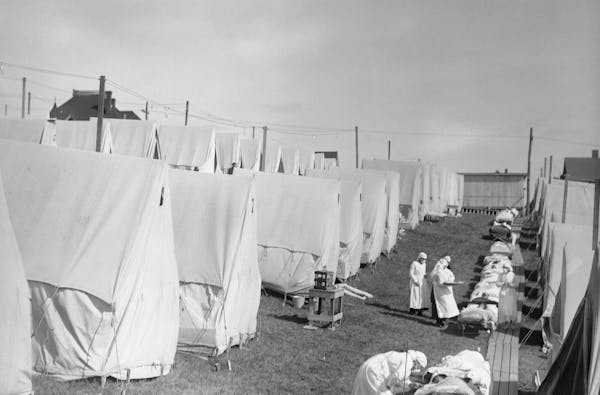
A flu camp in Lawrence, Maine during the 1918 influenza pandemic. Nurses and doctors tried desperate measures to stop the spread of the disease, which ultimately killed more than 675,000 people in the U.S. alone. Bettmann/Getty Images

Severe cases of both COVID-19 and the flu require the same lifesaving medical equipment. This highlights the importance of getting the flu vaccine for not only your own personal health but also the health of your community. Receiving the flu vaccine will help reduce the burden of respiratory illness on our already very overstretched health care system. By increasing flu vaccination rates, we can reduce the overall impact of respiratory illnesses on the population and hence lower the resulting burden on the health care system during the COVID-19 pandemic.

Because flu vaccination protects against one of these respiratory illnesses, the CDC recommends everyone (with few exceptions) six months of age and older get an annual flu vaccine. While the flu vaccine will not protect you against COVID-19, the flu vaccine will reduce your risk of developing the flu as well as reduce your risks of flu-related complications including hospitalization and even death.

While it may seem like there is so much out of our control during this pandemic, getting the flu vaccine, practicing proper hand washing, social distancing and wearing face coverings are within our control and will protect not only you but also your family and community.

If you are not getting the flu vaccine from your employer, think about alternative sources now. Vaccines should be available in most areas by Sept. 1.

  • Call you doctor’s office to ask how you can get a flu shot.
  • Call your local public health department.
  • Consider getting a vaccine while you are grocery shopping or picking up prescriptions.

Mainly, make sure you take advantage of this potentially lifesaving vaccine. Get it on your calendar for early September now. And remember, the flu shot cannot give you the flu.