Primary care physicians could take $15 billion hit due to COVID-19 in 2020

https://www.healthcaredive.com/news/primary-care-physicians-could-take-15-billion-hit-due-to-covid-19-in-2020/580600/

Dive Brief:

  • The financial impact on primary care practices due to the COVID-19 pandemic has been profound and will likely continue in the months ahead, according to a new study published in Health Affairs.
  • Visits of all types to medical practices declined 58% in March and April compared to the baseline average, and in-person patient encounters declined by 69%, the study found. Although visits are expected to have rebounded by June, volumes are still below pre-COVID-19 levels.
  • The drop in fee-for-service revenue for the 2020 calendar year is nearly $68,000 per physician, contributing to an estimated revenue decline of 12.5%. That’s a steep enough loss to threaten the financial viability of many practices. Losses to primary care practices nationwide could top $15 billion over the year — a number that could grow if the federal government reverts increased telemedicine payment rates.

Dive Insight:

Medical practices across the United States have been hit hard by the COVID-19 outbreak.

The new study by researchers from Harvard Medical School and the American Board of Family Medicine attempts to put a price tag on that hit by running a microsimulation for projected 2020 revenues based on volume data for general practices, general internal medicine practices, general pediatric practices and family medicine practices.

As a result, they concluded that the average revenue loss per practice per physician will be $67,774, even taking into account revenue generated by telemedicine visits, which did not make up for the massive loss of patient volume during the spring.

That loss could be cut to as little as $28,265 per full-time physician if other staff is furloughed and salaries are cut to the 25th percentile of such cuts that took place during the peak of the stay-at-home orders.

Some practices are also projected to have steeper losses. Rural primary care practices are projected to lose $75,274 per physician. Other studies have suggested that pediatric practices have been hit harder than other primary care fields. Some organizations, such as the American Medical Group Association, say revenue won’t rebound fully even next year.

The study also conducted various alternate scenarios for the remainder of 2020, including a second wave of COVID-19 in the fall. The researchers estimated that would cut patient volumes by about half as much as what occurred during the spring. However, the financial hit would deepen even further, reaching $85,666 per physician.

Altogether, the study projects primary care practices will lose $15.1 billion in fee-for-service revenue this year, not even accounting for a second wave of the coronavirus. The study’s authors note that “this loss would balloon substantially if telemedicine payment rates revert back to pre-COVID-19 levels towards the end of the year.”

The study concluded that while primary care physicians as a whole have not been as hard hit as the hospital sector, the services they provide in managing chronic diseases such as diabetes and as the port of entry for many into the healthcare system makes them too valuable to suffer sustained levels of financial damage.


5 health systems cutting physician salaries

https://www.beckershospitalreview.com/compensation-issues/5-health-systems-cutting-physician-salaries.html?utm_medium=email

Pay Cuts, Furloughs, Redeployment for Doctors and Hospital Staff ...

To help offset revenue losses attributed to the COVID-19 pandemic, many hospitals have implemented pay cuts for staff, including physicians.

Below are five hospitals or health systems that have announced pay cuts for clinicians, reported by Becker’s Hospital Review in the last month.

1. ThedaCare physicians, advanced practice clinicians take pay cuts
ThedaCare physicians and advanced practice clinicians will take a 10 percent pay cut to help reduce the Appleton, Wis.-based health system’s financial hit due to the COVID-19 pandemic.

2. Providence to cut salaries of 1,200 providers
Renton, Wash.-based Providence plans to reduce the salaries of 1,200 high-paid medical providers in its Oregon division to help offset losses from the COVID-19 pandemic. Providence told Becker’s Hospital Review that the decision to cut salaries was made by local leadership and is limited to Oregon-based providers.

3. Cleveland’s University Hospitals to cut all physician, clinical leader pay
University Hospitals, based in Cleveland, said it will temporarily cut pay for all physicians and clinical leaders in the organization to help offset losses driven by the pandemic.

4. Sentara executives, physicians take pay cuts
Senior leaders, executives and physicians at Norfolk, Va.-based Sentara Healthcare are taking pay cuts to help address an anticipated $778 million shortfall against projected revenue due to COVID-19, the organization confirmed to Becker’s Hospital Review.

5. Loyola Medicine CEO, physicians take pay cuts amid pandemic
Leadership and faculty physicians at Maywood, Ill.-based Loyola Medicine will take three-month pay cuts in response to the COVID-19 pandemic, CEO Shawn Vincent said in an interview with Becker’s Hospital Review.


A deeper look at a new(ish) model of primary care delivery

https://mailchi.mp/f2774a4ad1ea/the-weekly-gist-may-22-2020?e=d1e747d2d8

Direct Primary Care: What Does it Mean for Independent and ...

Cometh the moment, cometh the care model. That’s one way of interpreting a new study commissioned by the Society of Actuaries, and performed by Milliman researchers, that evaluates the direct primary care (DPC) model. Often touted by advocates as a way to “cut out the middleman” and allow for greater patient-physician engagement, DPC is membership-model primary care, with a monthly or annual fee paid by the patient (or their employer) for unlimited access to a range of services for no additional out-of-pocket payment, and without billing insurance for care delivery.

In the study, Milliman reviewed existing literature, conducted a survey of nearly 200 DPC practices, and performed an in-depth analysis of one employer’s DPC offering. Their findings: higher physician satisfaction; smaller panel sizes (on average 445 patients per practice); and statistically significant decreases in overall demand for services (down 12.6 percent) and ED utilization (down 40.5 percent). All that for a monthly fee of between $65 and $85 per adult patient—resulting in a slight net increase in employer benefit costs (1.3 percent) but higher enrollee satisfaction.

The Milliman study is one of the first detailed analyses of the potential benefits of this newish care model, and the results suggest that there is promise for the approach. Critics rightly raise some doubts: could there could ever be enough physician supply to make this model work at national scale? And does the model encourage cherry-picking of more affluent, lower-utilizing patients, making the remaining risk pool more costly to cover?

But in a post-COVID world, with primary care doctors increasingly concerned about revenue stability, and employers looking to control spend (and searching for sweeteners to offset a potential shift to narrower referral networks), the model has the potential to play a greater role in future benefit design. Especially if coupled with a (potentially lower-cost) virtual-first approach, DPC could prove an attractive option for physicians and patients to move away from the fee-for-service, productivity-driven primary care model.


Michigan Medicine accused of exploiting 1,300 resident physicians in labor dispute

https://www.beckershospitalreview.com/hr/michigan-medicine-accused-of-exploiting-1-300-resident-physicians-in-labor-dispute.html?utm_medium=email

Watch The Resident on TiVo.

The union that represents 1,300 resident physicians at Ann Arbor-based Michigan Medicine said the health system is exploiting its members as both sides negotiate a new contract, according to Michigan Radio.

The University of Michigan House Officers Association and Michigan Medicine are trying to reach an agreement before the current contract expires in late June. But compensation remains a key sticking point.

Ruth Bickett-Hickok, MD, a second-year anesthesiology resident, told reporters May 18 she’s been treating COVID-19 patients and seeks a cost-of-living raise, according to Michigan Radio.

“Frankly I’m here because, for lack of a better term, Michigan [Medicine] residents right now are being exploited for their labor. Especially during this crisis,” said Dr. Bickett-Hickok, who is on the union board. She also cited her debt load for undergraduate and medical school in her reasoning for seeking a cost-of-living raise.

Overall, the union says it wants fair wages that recognize the risks physician residents have been willing to take on during the pandemic.

In a statement provided to Becker’s Hospital Review, Michigan Medicine spokesperson Mary Masson said the health system “recognizes the important role of the [union] members” and amid the pandemic “has honored the compensation package previously proposed to the HOA, which includes salary increases.”

Ms. Masson said Michigan Medicine is undergoing a $400 million expense reduction plan with furloughs and layoffs affecting about 1,400 full-time employees. Physician residents’ salaries range from $58,500 to $82,900 annually based on experience. Ms. Masson said to provide even higher salary increases, Michigan Medicine would have to eliminate additional jobs.

The union proposes that the health system use part of the university’s endowment funds to help cover the new labor deal.


Facing a reckoning on physician compensation?

https://mailchi.mp/f4f55b3dcfb3/the-weekly-gist-may-15-2020?e=d1e747d2d8

Doctor salaries have shot up 30% in past decade over fears of ...

As health systems take tentative steps to resume non-emergent procedures and office visits, it’s increasingly clear that volume will not quickly return to pre-COVID levels. According to a health system chief physician executive we spoke with this week, this has forced medical group leadership to reevaluate physician compensation, at least for the rest of 2020.

“We’ve kept our doctors pretty much whole for the past three months,” she said, “but given the losses we’re facing for the rest of the year, we can’t keep it up much longer.” We’ve had a flurry of calls in the past two weeks with systems in the same position. Most of their doctors are primarily paid based on their productivity. “We all loved the upside opportunity,” mused one physician leader, “but we never thought something could happen that would completely wipe us out.”

This point got us wondering whether we might be seeing the beginning of the end of RVU-based physician compensation, as physicians seek greater stability and safety. But moving to a salary-driven model is far from easy. How much upside are doctors willing to trade off for security? The survey data used to benchmark compensation, based on last year’s business model, is essentially irrelevant—and likely will be for next year as well. According to one consultant, “Given that there’s no consistency in volume or compensation strategy, the 2020 data will be garbage, too.” Not to mention, dramatically shifting the way doctors are paid has huge cultural and operational ramifications.

There are no easy answers, but we think this conversation about the future of compensation, and the larger issues it raises about doctors’ relationship to, and role in, the health system, is long overdue. One executive shared his system’s plan to pay their doctors 85 percent of their 2019 compensation through the summer. He’s not sure yet what the other side of August looks like. “Maybe we’ll have physicians who want to continue to be paid on productivity like a car salesman. But if you want that kind of upside now, the safety net likely won’t be there the next time.” However, he hopes this experience “provides a reset point that gets us to a more sustainable—and professional—way of working together for the future.”  


Pay Cuts, Furloughs, Redeployment for Doctors and Hospital Staff

https://www.medpagetoday.com/infectiousdisease/covid19/85827?xid=nl_mpt_investigative2020-04-08&eun=g885344d0r&utm_source=Sailthru&utm_medium=email&utm_campaign=InvestigativeMD_040820&utm_term=NL_Gen_Int_InvestigateMD_Active

Pay Cuts, Furloughs, Redeployment for Doctors and Hospital Staff ...

— Health systems see massive disruption from COVID-19

In Michigan, Trinity Health is furloughing 2,500 of its 24,000 employees. In Florida, Sarasota Memorial Health Care is taking “immediate steps to reduce costs, including temporary furloughs and reduced hours” for workers.

In less than 1 month, COVID-19 has made swift, deep cuts in hospital billings. Despite high volumes in the first 2 weeks, March revenue plunged by $16 million at Sarasota Memorial. Surgery cases fell by more than 50%, and volumes dropped by 45% at two emergency care centers and by 66% at seven urgent care centers.

Squeezed by plummeting income and climbing COVID-19 expenses, hospitals and health systems are bracing themselves for system-wide disruption by announcing temporary layoffs, reassignments, and pay cuts.

Many changes, like Trinity’s furloughs in Michigan, affect mainly non-clinical workers. Some alter compensation or duties for doctors, nurses, and other healthcare providers.

“In all parts of the country, physicians are being asked to sign agreements or acknowledgments for pay cuts ranging from 20% to 75%, depending on what their specialty is, where they are, and what the institutions are doing,” said Scott Weavil, JD, a California lawyer who counsels physicians nationwide about employment contracts.

“Many of these providers are not on the front lines of COVID, but they are still working,” Weavil noted. “Babies are being born. People are having accidents and visiting emergency departments. Urgent surgeries are happening. Physicians are at work or on call and ready to help if needed. And in most of these environments, there are patients who have tested positive for COVID-19,” he told MedPage Today.

“Ob/gyns aren’t doing a lot of elective procedures like hysterectomies, but they are delivering babies for COVID-positive patients, wearing donated cloth masks that may or may not be effective,” Weavil added.

In some cases, doctors have been sidelined and face the prospect of dwindling income as patient volumes fall. “We have 2,600 physicians and advanced-practice providers,” said Mark Briesacher, MD, senior vice president and chief physician executive of Intermountain Healthcare in Salt Lake City. “About 800 of them are on a patient volume-related type of contract, similar to what you would have in private practice.”

Because non-urgent and elective procedures are being delayed, some of these clinicians now see 30% to 50% fewer patients and could face big income drops, Briesacher told MedPage Today. “But we’ve put a floor in place,” he said: these providers will receive their usual pay until May 30, then 85% of that amount until normal patient volumes resume.

Redeployment can help practitioners make up lost income, Briesacher added. “A general surgeon often has critical care training,” he noted. “When this increase in patient care needs due to COVID-19 does come to Utah, we can deploy that surgeon to work in our ICUs with a critical care doctor, and if they’re working fulltime, they’ll get paid the same as they were before.”

Reassignment does not stop with doctors at Intermountain: hospital nurses can be deployed to screening desks, drive-through testing sites, or telehealth centers and will keep their current rate of pay, spokesperson Daron Crowley said.

“I recently reviewed a COVID-19 compensation plan of a health system in Florida that would give physicians their base or draw, or a midpoint between their 2019 base and their 2019 overall compensation,” noted Weavil, the attorney. “That seemed pretty good, but it came at a cost: the physicians had to agree to practice outside of their normal setting, as long as they were credentialed for the work.”

“At first blush, the credentialing requirement sounded like a protection; if you are a psychiatrist, you’d think ‘they’re not going to send me to the ICU,’ and normally, that’s correct,” Weavil continued.

But hospitals are adopting emergency credentialing provisions during COVID-19 and “doctors can be forced to practice pretty far afield of their specialty,” he said. In some ways, the situation resembles residency, he pointed out: “You have an attending physician who knows what she’s doing directing fish-out-of-water physicians who have been conscripted into service beyond their specialties.”

The list of hospital systems announcing major changes — including pay cuts for hospital executives, as Trinity Health in Michigan has done — grows each day. Boston Medical Center Health System has furloughed 700 employees; Cincinnati-based Bon Secours Mercy Health has announced it will do the same. Kentucky’s Appalachian Regional Healthcare will furlough about 500 staff members. South Carolina’s Prisma Health will lay off an undisclosed number of clinical, corporate, and administrative workers. Tenet Healthcare in Dallas has furloughed 500 fulltime positions.

Furloughing staff “was an extremely difficult decision, and one that we did not make lightly,” Sarasota Memorial CEO David Verinder wrote in a letter to employees.

“Staff have gone above and beyond to care for our patients throughout this crisis, even as they have been anxious about the health and well-being of themselves and their families,” he continued. “But as the health care safety net for the region, we must do all we can to continue fulfilling that critical role in the weeks ahead and for the long-term.”


During a Pandemic, an Unanticipated Problem: Out-of-Work Health Workers

https://www.yahoo.com/news/during-pandemic-unanticipated-problem-health-150355070.html
Jordan Schachtel on Twitter: "The people at The New York Times are ...

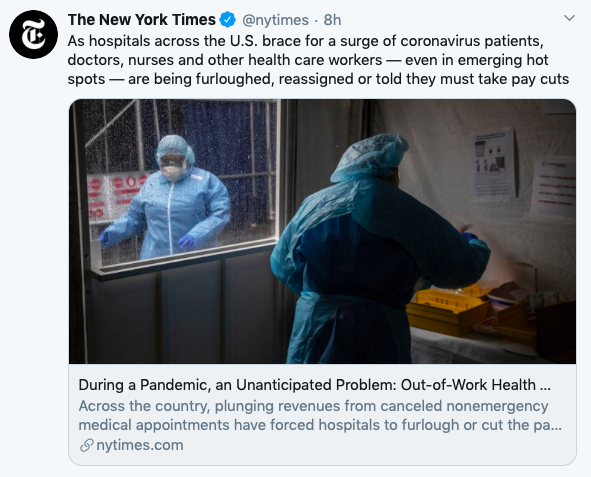
As hospitals across the country brace for an onslaught of coronavirus patients, doctors, nurses and other health care workers — even in emerging hot spots — are being furloughed, reassigned or told they must take pay cuts.

The job cuts, which stretch from Massachusetts to Nevada, are a new and possibly urgent problem for a business-oriented health care system whose hospitals must earn revenue even in a national crisis. Hospitals large and small have canceled many elective services — often under state government orders — as they prepare for the virus, sending revenues plummeting.

That has left trained health care workers sidelined, even in areas around Detroit and Washington, where infection rates are climbing, and even as hard-hit hospitals are pleading for help.

“I’m 46. I’ve never been on unemployment in my life,” said Casey Cox, who three weeks ago worked two jobs, one conducting sleep research at the University of Michigan and another as a technician at the St. Joseph Mercy Chelsea Hospital near Ann Arbor, Michigan. Within a week, he had lost both.

Mayor Bill de Blasio of New York has begged doctors and other medical workers from around the country to come to the city to help in areas where the coronavirus is overwhelming hospitals.

“Unless there is a national effort to enlist doctors, nurses, hospital workers of all kinds and get them where they are needed most in the country in time, I don’t see, honestly, how we’re going to have the professionals we need to get through this crisis,” de Blasio said Friday morning on MSNBC.

And the Department of Veterans Affairs is scrambling to hire health care workers for its government-run hospitals, especially in hard-hit New Orleans and Detroit, where many staff members have fallen ill. The department moved to get a federal waiver to hire retired medical workers to beef up staff levels.

But even as some hospitals are straining to handle the influx of coronavirus patients, empty hospital beds elsewhere carry their own burden.

“We’re in trouble,” said Gene Morreale, the chief executive of Oneida Health Hospital in upstate New York, which has not yet seen a surge in coronavirus patients.

Governors in dozens of states have delivered executive orders or guidelines directing hospitals to stop nonurgent procedures and surgeries to various degrees. Last month, the U.S. surgeon general, Dr. Jerome M. Adams, also implored hospitals to halt elective procedures.

That has left many health systems struggling to survive.

Next week, Morreale said, Oneida will announce that it is putting 25% to 30% of its employees on involuntary furlough. They will have access to their health insurance through June. Physicians and senior staff at the hospital have taken a 20% pay cut.

“We’ve been here 121 years, and I’m hoping we’re still there on the other side of this,” Morreale said.

Appalachian Regional Healthcare, a 13-hospital system in eastern Kentucky and southern West Virginia, has seen a 30% decrease in its overall business because of a decline in patient volume and services related to the pandemic. Last week, the hospital system announced it would furlough about 8% of its workforce — around 500 employees.

Hospital executives across the country are cutting pay while also trying to repurpose employees for other jobs.

At Intermountain Healthcare, which operates 215 clinics and 24 hospitals in Utah, Idaho and Nevada, about 600 of the 2,600 physicians, physicians assistants and registered nurses who are compensated based on volume will see their pay dip by about 15%, said Daron Cowley, a company spokesman.

Those reductions are tied to the drop in procedures, which has fallen significantly for some specialties, he said. The organization is working to preserve employment as much as possible, in part by trying to deploy 3,000 staff members into new roles.

“You have an endoscopy tech right now that may be deployed to be at hospital entrances” where they would take the temperatures of people coming in, Cowley explained.

In Boston, a spokesman for Partners HealthCare, with 12 hospitals, including Massachusetts General and Brigham and Women’s, said staff members whose work has decreased are being deployed to other areas or will be paid for up to eight weeks if no work is available.

But redeployment is not always an option. Janet Conway, a spokeswoman for Cape Fear Valley Health System in Fayetteville, North Carolina, said many of the company’s operating room nurses trained in specialized procedures have been furloughed because their training did not translate to other roles.

“Those OR nurses, many have never worked as a floor nurse,” she said.

Conway said nearly 300 furloughed staff members have the option to use their paid time off, but beyond that, the furlough would be unpaid. Most employees are afforded 25 days per year.

Some furloughed hospital workers are likely to be asked to return as the number of coronavirus cases rise in their communities. But the unpredictable virus has offered little clarity and left hospitals, like much of the economy, in a free fall.

Many health systems are making direct cuts to their payrolls, eliminating or shrinking performance bonuses and prorating paychecks to mirror reduced workload until operations stabilize.

Scott Weavil, a lawyer in California who counsels physicians and other health care workers on employment contracts, said he was hearing from doctors across the country who were being asked to take pay cuts of 20% to 70%.

The requests are coming from hospital administrators or private physician groups hired by the hospitals, he said, and are essentially new contracts that doctors are being asked to sign.

Many of the contracts do not say when the cuts might end, and are mostly affecting doctors who are not treating coronavirus patients on the front lines, such as urologists, rheumatologists, bariatric surgeons, obstetricians and gynecologists.

Such doctors are still being asked to work — often in a decreased capacity — yet may be risking their health going into hospitals and clinics.

“It’s just not sitting well,” Weavil said, noting that he tells doctors they unfortunately have few options if they want to work for their institution long term.

“If you fight this pay cut, administration could write your name down and remember that forever,” he said he tells them.

In other cases, physicians are continuing to find opportunities to practice in a more limited capacity, like telemedicine appointments. But that has not eliminated steep pay cuts.

“Physicians are only paid in our clinic based on their productivity in the work they do,” said Dr. Pam Cutler, the president of Western Montana Clinic in Missoula. “So they’re automatically taking a very significant — usually greater than 50% or 25% — pay cut just because they don’t have any work.”

In some areas, layoffs have left behind health care workers who worry that they will not be able to find new roles or redeploy their skills.

Cox in Michigan said he was briefly reassigned at his hospital, helping screen and process patients coming in with coronavirus symptoms, but eventually the people seeking reassignments outgrew the number of roles.

He also expressed concern that inevitable changes in the health care industry after the pandemic — paired with the possibility of a lengthy period of unemployment — could make it difficult to get his job back.

“I’m just concerned that the job I got laid off from may not be there when this is over,” Cox said. “The longer you’re away, the more you worry, ‘Am I going to be able to come back?’ So there’s a lot of anxiety about it.”

Even as many of the largest hospital networks grapple with sudden financial uncertainty, much smaller practices and clinics face a more immediate threat.

According to a statistical model produced by HealthLandscape and the American Academy of Family Physicians, by the end of April, nearly 20,000 family physicians could be fully out of work, underemployed or reassigned elsewhere, particularly as cities like New York consider large-scale, emergency reassignments of physicians.

“Many of these smaller practices were living on a financial edge to start with, so they’re not entering into this in a good position at all,” said Dr. Gary Price, the president of the Physicians Foundation. “Their margins are narrower, their patients don’t want to come in, and many of them shouldn’t anyway, so their cash flow has been severely impacted and their overhead really hasn’t.”


MedPAC’s report to Congress: 7 takeaways

https://www.beckershospitalreview.com/finance/medpac-s-report-to-congress-7-takeaways.html?utm_medium=email

Image result for MedPAC

The Medicare Payment Advisory Commission released its March 2020 report on Medicare payment policy to Congress, which includes a chapter analyzing the effects of hospital and physician consolidation in the healthcare sector.

Here are seven takeaways:

1. Medicare’s Insurance Trust Fund is likely to run out without changes. Trustees from Medicare estimate that the program’s Hospital Insurance Trust Fund, mostly funded through a payroll tax, will be depleted by 2026. To keep the fund solvent for the next 25 years, Medicare trustees advise that the payroll tax immediately be raised from 2.9 percent to 3.7 percent, or Part A spending to be reduced by 18 percent.

2. MedPAC recommends boosting payment rate for three sectors:

  • Hospitals. MedPAC recommended a 3.3 percent raise in Medicare payments for hospitals next year. The commission said it wants to give hospitals a 2 percent boost overall and tie the other 1.3 percent to quality metrics to motivate hospitals to reduce mortality and improve patient satisfaction. Currently, CMS has scheduled a 2.8 percent increase in 2021 Medicare payments.
  • Outpatient dialysis services. MedPAC recommended that the End Stage Renal Disease Prospective Payment System base payment rate is raised by the amount determined under current law. This is projected to be a boost of 2 percent
  • Long-term care hospitals. The commission recommended a 2 percent increase in the payment rates for long-term care hospitals in 2021.

3. MedPAC recommends unchanged payment rates for four sectors:

  • Physicians: Under current law, there is no update to the 2021 Medicare fee schedule base payment rate for physicians who treat Medicare patients. MedPAC is recommending that CMS keeps the physician rate the same as it is this year.
  • Surgery centers. MedPAC recommended eliminating an expected 2.8 percent payment rate bump for surgery centers next year. It said its decision was due to not having enough cost data from surgery centers.
  • Skilled nursing. MedPAC is recommending skilled nursing facilities receive no change to their base rate next year to better align payments with costs while exerting pressure on providers to keep their cost growth low.
  • Hospice. MedPAC recommends that the hospice payment rates in 2021 be held at their 2020 levels

4. MedPAC recommends payment rate reductions for two sectors: 

  • Home health. The commission recommended a 7 percent reduction in home health payment rates for 2021.
  • Inpatient rehabilitation hospitals. MedPAC is recommending that CMS reduce the payment rate to inpatient rehabilitation facilities by 5 percent for fiscal year 2021.

5. MedPAC builds on its recommendation to revamp quality programs. MedPAC is furthering its recommendation to replace Medicare’s four current hospital quality programs with a single hospital value incentive program. MedPAC said it believes that this recommendation would provide hospitals  higher aggregate payments than they would get under current law.

6. MedPAC’s findings on hospital and physician consolidation. MedPAC said that consolidation gives providers greater market power, which has a statistically significant association with higher profit margins for treating non-Medicare patients. Higher non-Medicare margins also are associated with higher standardized costs per discharge. But the direct association between market power and standardized costs per discharge is statistically insignificant, the commission found.

“The effect of consolidation on hospitals’ costs is not clear in theory or from our current analysis. From a theoretical standpoint, the merger of two hospitals could initially create some efficiencies and bargaining power with suppliers. But over time, higher prices from commercial payers could loosen hospitals’ budget constraints and lead to higher cost growth, thus offsetting any efficiency gains,” MedPAC’s report states.

7. MedPAC’s findings on the 340B Drug Discount Program. MedPAC was asked to analyze whether the availability of 340B drug discounts creates incentives for hospitals to choose more expensive products than they would without the program. MedPAC studied the effect of 340B market share on higher drug spending on cancer treatments between 2009 and 2017. The commission found that for two of the five cancer types studied, 340B participation boosted prices by about $300 per patient per month. However, the boost in spending attributed to 340B was much smaller than the general increase in oncology spending, which includes rising prices and the launch of new products with high drug prices. For example, cancer drug spending grew by more than $2,000 per patient month for patients with breast cancer, lung cancer, and leukemia/lymphoma.

“The MedPAC report released today uses rigorous analysis and finds little evidence 340B participation influences cancer drug spending. Modest differences may be attributable to the types of patients treated in 340B facilities. The safety-net hospitals that participate in the 340B drug-pricing program are essential providers of cancer care in this nation, especially to patients who are living with low incomes, those living with disabilities, and patients requiring more complex oncology care,” said Maureen Testoni, president and CEO of 340B Health, an association that represents more than 1,400 hospitals participating in the 340B program.

Access MedPAC’s full report here. 


Every American family basically pays an $8,000 ‘poll tax’ under the U.S. health system, top economists say

https://www.washingtonpost.com/business/2020/01/07/every-american-family-basically-pays-an-poll-tax-under-us-health-system-top-economists-say/?utm_campaign=post_most&utm_medium=Email&utm_source=Newsletter&wpisrc=nl_most&wpmm=1

Princeton economist Anne Case speaks about “deaths of despair” in the United States at the American Economic Association's annual meeting in San Diego this past weekend. (Heather Long/The Washington Post)

America’s sky-high health-care costs are so far above what people pay in other countries that they are the equivalent of a hefty tax, Princeton University economists Anne Case and Angus Deaton say. They are surprised Americans aren’t revolting against these taxes.

“A few people are getting very rich at the expense of the rest of us,” Case said at conference in San Diego on Saturday. The U.S. health-care system is “like a tribute to a foreign power, but we’re doing it to ourselves.”

The U.S. health-care system is the most expensive in the world, costing about $1 trillion more per year than the next-most-expensive system — Switzerland’s. That means U.S. households pay an extra $8,000 per year, compared with what Swiss families pay. Case and Deaton view this extra cost as a “poll tax,” meaning it is levied on every individual regardless of their ability to pay. (Most Americans think of a poll tax as money people once had to pay to register to vote, but “polle” was an archaic German word for “head.” The idea behind a poll tax is that it falls on every head.)

Despite paying $8,000 more a year than anyone else, American families do not have better health outcomes, the economists argue. Life expectancy in the United States is lower than in Europe.

“We can brag we have the most expensive health care. We can also now brag that it delivers the worst health of any rich country,” Case said.

Case and Deaton, a Nobel Prize winner in economics, made the critical remarks about U.S. health care during a talk at the American Economic Association’s annual meeting, where thousands of economists gather to discuss the health of the U.S. economy and their latest research on what’s working and what’s not.

The two economists have risen to prominence in recent years for their work on America’s “deaths of despair.” They discovered Americans between the ages of 25 and 64 have been committing suicide, overdosing on opioids or dying from alcohol-related problems like liver disease at skyrocketing rates since 2000. These “deaths of despair” have been especially large among white Americans without college degrees as job options have rapidly declined for them.

Their forthcoming book, Deaths of Despair and the Future of Capitalism,” includes a scathing chapter examining how the U.S. health-care system has played a key role in these deaths. The authors call out pharmaceutical companies, hospitals, device manufacturers and doctors for their roles in driving up costs and creating the opioid epidemic.

In the research looking at the taxing nature of the U.S. health-care system compared with others, Deaton is especially critical of U.S. doctors, pointing out that 16 percent of people in the top 1 percent of income earners are physicians, according to research by Williams College professor Jon Bakija and others.

“We have half as many physicians per head as most European countries, yet they get paid two times as much, on average,” Deaton said in an interview on the sidelines of the AEA conference. “Physicians are a giant rent-seeking conspiracy that’s taking money away from the rest of us, and yet everybody loves physicians. You can’t touch them.”

As calls grow among the 2020 presidential candidates to overhaul America’s health-care system, Case and Deaton have been careful not to endorse a particular policy.

“It’s the waste that we would really like to see disappear,” Deaton said.

After looking at other health systems around the world that deliver better health outcomes, the academics say it’s clear that two things need to happen in the United States: Everyone needs to be in the health system (via insurance or a government-run system like Medicare-for-all), and there must be cost controls, including price caps on drugs and government decisions not to cover some procedures.

The economists say they understand it will be difficult to alter the health-care system, with so many powerful interests lobbying to keep it intact. They pointed to the practice of “surprise billing,” where someone is taken to a hospital — even an “in network” hospital covered by their insurance — but they end up getting a large bill because a doctor or specialist who sees them at the hospital might be considered out of network.

Surprise billing has been widely criticized by people across the political spectrum, yet a bipartisan push in Congress to curb it was killed at the end of last year after lobbying pressure.

“We believe in capitalism, and we think it needs to be put back on the rails,” Case said.


The Health 202: Here’s what doctors, drugmakers and politicians are thankful for

https://www.washingtonpost.com/news/powerpost/paloma/the-health-202/2019/11/27/the-health-202-here-s-what-doctors-drugmakers-and-politicians-are-thankful-for/5ddd69ec88e0fa652bbbda64/

A turkey pardoned by President Trump yesterday. REUTERS/Tom Brenner

It’s Thanksgiving Eve. Which for Health 202 begs this question: What is everyone thankful for this year when it comes to health policy?

We suspect that maybe – just maybe –you’d get vastly different answers from doctors versus insurers versus drugmakers versus consumers versus any other stakeholder in the $3.6 trillion U.S. health-care industry complex. Everyone has competing interests, which is a prime reason why the country’s besetting problems of ever-rising costs and subpar medical outcomes never quite seem to get solved.

So before you tune out the news cycle for Turkey Day, here’s our best guess at what’s giving each health-care stakeholder an attitude of gratitude.

—The White House and Republicans: Democrats are fixated on Medicare-for-all.

The GOP could hardly be more eager to focus on Medicare-for-all proposals from the Democratic presidential candidates. They view it as a way to veer the political conversation away from their own, unpopular actions on health-care policy and to depict Democrats as out-of-touch with voters.

President Trump and his top health officials have repeatedly decried Medicare-for-all, including during an October speech where the president announced an executive order boosting the role of private plans in the Medicare program.

“Every major Democrat in Washington has backed a massive government health care takeover that would totally obliterate Medicare,” the president said during that address. “These Democratic policy proposals … may go by different names, whether it’s single payer or the so-called public option, but they’re all based on the totally same terrible idea: They want to raid Medicare to fund a thing called socialism.”

—Democrats: The Trump administration is refusing to defend the Affordable Care Act.

Democrats are well aware that the refusal by Trump’s Justice Department to defend the Affordable Care Act from a challenge by GOP-led states is a political gift. They spent the 2018 election castigating the administration for not standing by the health-care law’s protections for patients with preexisting conditions – and it helped them win the House majority.

They plan to hammer that message again in 2020, as they seek the White House.

—The Department of Health and Human Services: Obamacare hasn’t been struck down (yet).

A federal appeals court is expected to rule any time now on the challenge to the ACA, which was upheld by a lower court last year. As The Health 202 has written, the decision against defending the law was a deeply controversial one inside the administration.

HHS Secretary Alex Azar and Seema Verma, administrator of the Centers for Medicare and Medicaid Services, tried to persuade the White House to defend the law. If the courts ultimately strike down the ACA, the administration will be on the hook to propose a replacement that would preserve health coverage for millions of Americans who gained it under the health-care law.

—Health-care advocates: Marketplace premiums are somewhat more affordable.

After several rough years for the ACA’s individual marketplaces, they got some good news this year. Average premiums for mid-level “silver” plans fell four percent for 2020 – a marked shift from the double-digit increases shoppers have typically seen.

That doesn’t mean plans are suddenly affordable for consumers ineligible for government subsidies. But it does mean insurers have found a sustainable way to keep participating in the marketplaces – and the marketplaces are here to stay for people without access to employer-sponsored coverage.

—Drugmakers: Chances for a major, bipartisan drug pricing deal this year are fading.

One of the pharmaceutical industry’s biggest fears is that Congress passes legislation allowing the federal government to directly negotiate lower prices in the Medicare program – a move the industry describes as government “price-fixing.”

Trump used to support allowing direct negotiations, and his staff was even in discussions with House Speaker Nancy Pelosi’s (D-Calif.) office earlier this fall over the potential for a bipartisan effort along these lines.

But the president and his aides have increasingly distanced themselves from Pelosi’s bill to allow direct negotiations. Now it looks like House Democrats will pass that measure as a messaging tactic, only to see it blocked in the GOP-led Senate. A bipartisan Senate bill capping how much drugmakers can annually raise prices has somewhat better prospects, but even that measure has made many Republicans suspicious.

In the end, only minor and less-controversial drug pricing measures may end up being attached to a longer-term spending bill.

—Doctors and hospitals: Any legislation protecting patients from “surprise” medical bills will almost certainly include arbitration – an approach that means higher payments for them.

Virtually every member of Congress agrees American patients should be protected from the surprise bills that can result when they visit an emergency department outside their health plan’s provider network or get care from an out-of-network provider at an in-network hospital.

But how to solve that has turned into an insurers-versus-doctors food fight.

Insurers and the Trump administration want to use a benchmarking approach to resolve out-of-network bills, in which the payments are tied to average prices in the same geographic area. That approach would save the government money, the Congressional Budget Office has said.

But doctors – and some dark-money groups that represent their interests – have been spending millions of dollars to push Congress toward adopting an approach called arbitration. In arbitration, which CBO has said would cost the government more money, the medical provider and the insurer each submit a bid to a third party arbiter, who then make a final decision.

Doctors believe arbitration would translate to beefier payments for them – and outcomes from New York’s arbitration system supports that notion. So if Congress passes surprise billing legislation, it will likely include some element of arbitration given the heavy influence by the doctor lobby.

—Regular Americans: Not much.

We hate to say it, readers, but there’s little for you to be thankful for this year when it comes to health-care policy. Costs for employer-sponsored coverage are going up and coverage plans are getting less generous. Congress appears unable to pass major reforms on the biggest consumer concerns. And the next election is likely to result in a government severely split over how to improve health-care – making it likely the status quo will prevail for some time.

But Happy Thanksgiving, anyway!