Talk Is Cheap: Now Trump Must Deliver On His Healthcare Promises

https://www.forbes.com/sites/robertpearl/2025/06/09/talk-is-cheap-now-trump-must-deliver-on-his-healthcare-promises/

President Donald Trump has made big promises about fixing American healthcare. Now comes the moment that separates talk from action.

With the 2026 midterms fast approaching and congressional attention soon shifting to electoral strategy, the window for legislative results is closing quickly. This summer will determine whether the administration turns promises into policy or lets the opportunity slip away.

Trump and his handpicked healthcare leaders — HHS Secretary Robert F. Kennedy Jr. and FDA Commissioner Dr. Marty Makary — have identified three major priorities: lowering drug prices, reversing chronic disease and unleashing generative AI. Each one, if achieved, would save tens of thousands of lives and reduce costs.

But promises are easy. Real change requires political will and congressional action. Here are three tests that Americans can use to gauge whether the Trump administration succeeds or fails in delivering on its healthcare agenda.

Test No. 1: Have Drug Prices Come Down?

Americans pay two to four times more for prescription drugs than citizens in other wealthy nations. This price gap has persisted for more than 20 years and continues to widen as pharmaceutical companies launch new medications with average list prices exceeding $370,000 per year.

One key reason for the disparity is a 2003 law that prohibits Medicare from negotiating prices directly with drug manufacturers. Although the Inflation Reduction Act of 2022 granted limited negotiation rights, the initial round of price reductions did little to close the gap with other high-income nations.

President Trump has repeatedly promised to change that. In his first term, and again in May 2025, he condemned foreign “free riders,” promising, “The United States will no longer subsidize the healthcare of foreign countries and will no longer tolerate profiteering and price gouging.”

To support these commitments, the president signed an executive order titled “Delivering Most-Favored-Nation (MFN) Prescription Drug Pricing to American Patients.” The order directs HHS to develop and communicate MFN price targets to pharmaceutical manufacturers, with the hope that they will voluntarily align U.S. drug prices with those in other developed nations. Should manufacturers fail to make significant progress toward these targets, the administration said it plans to pursue additional measures, such as facilitating drug importation and imposing tariffs. However, implementing these measures will most likely require congressional legislation and will encounter substantial legal and political challenges.

The pharmaceutical industry knows that without congressional action, there is no way for the president to force them to lower prices. And they are likely to continue to appeal to Americans by arguing that lower prices will restrict innovation and lifesaving drug development.

But the truth about drug “innovation” is in the numbers: According to a study by America’s Health Insurance Plans, seven out of 10 of the largest pharmaceutical companies spend more on sales and marketing than on research and development. And if drugmakers want to invest more in R&D, they can start by requiring peer nations to pay their fair share — rather than depending so heavily on U.S. patients to foot the bill.

If Congress fails to act, the president has other tools at his disposal. One effective step would be for the FDA to redefine “drug shortages” to include medications priced beyond the reach of most Americans. That change would enable compounding pharmacies to produce lower-cost alternatives just as they did recently with GLP-1 weight-loss injections.

If no action is taken, however, and Americans continue paying more than twice as much as citizens in other wealthy nations, the administration will fail this crucial test.

Test No. 2: Did Food Health, Quality Improve?

Obesity has become a leading health threat in the United States, surpassing smoking and opioid addiction as a cause of death.

Since 1980, adult obesity rates have surged from 15% to over 40%, contributing significantly to chronic diseases, including type 2 diabetes, heart disease and multiple types of cancers.

A major driver of this epidemic is the widespread consumption of ultra-processed foods: products high in added sugar, unhealthy fats and artificial additives. These foods are engineered to be hyper-palatable and calorie-dense, promoting overconsumption and, in some cases, addictive eating behaviors.

RFK Jr. has publicly condemned artificial additives as “poison” and spotlighted their impact on children’s health. In May 2025, he led the release of the White House’s Make America Healthy Again (MAHA) report, which identifies ultra-processed foods, chemical exposures, lack of exercise and excessive prescription drug use as primary contributors to America’s chronic disease epidemic.

But while the report raises valid concerns, it has yet to produce concrete reforms.

To move from rhetoric to results, the administration will need to implement tangible policies.

Here are three approaches (from least difficult to most) that, if enacted, would signify meaningful progress:

  • Front-of-package labeling. Implement clear and aggressive labeling to inform consumers about the nutritional content of food products, using symbols to indicate healthy versus unhealthy options.
  • Taxation and subsidization. Impose taxes on unhealthy food items and use the revenue to subsidize healthier food options, especially for socio-economically disadvantaged populations.
  • Regulation of food composition. Restrict the use of harmful additives and limit the total amount of fat and sugar included, particularly for foods aimed at kids.

These measures will doubtlessly face fierce opposition from the food and agriculture industries. But if the Trump administration and Congress manage to enact even one of these options — or an equivalent reform — they can claim success.

If, instead, they preserve the status quo, leaving Americans to decipher nutritional fine print on the back of the box, obesity will continue to rise, and the administration will have failed.

Test No. 3: Are Patients Using Generative AI To Improve Health?

The Trump administration has signaled a strong commitment to using generative AI across various industries, including healthcare. At the AI Action Summit in Paris, Vice President JD Vance made the administration’s agenda clear: “I’m not here this morning to talk about AI safety … I’m here to talk about AI opportunity.”

FDA Commissioner Dr. Marty Makary has echoed that message with internal action. After an AI-assisted scientific review pilot program, he announced plans to integrate generative AI across all FDA centers by June 30.

But internal efficiency alone won’t improve the nation’s health. The real test is whether the administration will help develop and approve GenAI tools that expand clinical access, improve outcomes and reduce costs.

To these ends, generative AI holds enormous promise:

  • Managing chronic disease: By analyzing real-time data from wearables, GenAI can empower patients to better control their blood pressure, blood sugar and heart failure. Instead of waiting months between doctor visits for a checkup, patients could receive personalized analyzes of their data, recommendations for medication adjustments and warnings about potential risk in real time.
  • Improving diagnoses: AI can identify clinical patterns missed by humans, reducing the 400,000 deaths each year caused by misdiagnoses.
  • Personalizing treatment: Using patient history and genetics, GenAI can help physicians tailor care to individual needs, improving outcomes and reducing side effects.

These breakthroughs aren’t theoretical. They’re achievable. But they won’t happen unless federal leaders facilitate broad adoption.

That will require investing in innovation. The NIH must provide funding for next-generation GenAI tools designed for patient empowerment, and the FDA will need to facilitate approval for broad implementation. That will require modernizing current regulations. The FDA’s approval process wasn’t built for probabilistic AI models that rely on continuous application training and include patient-provided prompts. Americans need a new, fit-for-purpose framework that protects patients without paralyzing progress.

Most important, federal leaders must abandon the illusion of zero risk. If American healthcare were delivering superior clinical outcomes, managing chronic disease effectively and keeping patients safe, that would be one thing. But medical care in the United States is far from that reality. Hundreds of thousands of Americans die annually from poorly controlled chronic diseases, medical errors and misdiagnoses.

If generative AI technology remains confined to billing support and back-office automation, the opportunity to transform American healthcare will be lost. And the administration will have failed to deliver on this promise.

When I teach strategy at Stanford’s Graduate School of Business, I tell students that the best leaders focus on a few high-priority goals with clear definitions of success — and a refusal to accept failure. Based on the administration’s own words, grading the administration on these three healthcare tests will fulfill those criteria.

However, with Labor Day just months away, the window for action will soon close. The time for presidential action is now.

JPM 2024 just wrapped. Here are the key insights

https://www.advisory.com/daily-briefing/2024/01/23/jpm-takeaways-ec#accordion-718cb981ab-item-4ec6d1b6a3

Earlier this month, leaders from more than 400 organizations descended on San Francisco for J.P. Morgan‘s 42nd annual healthcare conference to discuss some of the biggest issues in healthcare today. Here’s how Advisory Board experts are thinking about Modern Healthcare’s 10 biggest takeaways — and our top resources for each insight.

How we’re thinking about the top 10 takeaways from JPM’s annual healthcare conference 

Following the conference, Modern Healthcare  provided a breakdown of the top-of-mind issues attendees discussed.  

Here’s how our experts are thinking about the top 10 takeaways from the conference — and the resources they recommend for each insight.  

1. Ambulatory care provides a growth opportunity for some health systems

By Elizabeth Orr, Vidal Seegobin, and Paul Trigonoplos

At the conference, many health system leaders said they are evaluating growth opportunities for outpatient services. 

However, results from our Strategic Planner’s Survey suggest only the biggest systems are investing in building new ambulatory facilities. That data, alongside the high cost of borrowing and the trifurcation of credit that Fitch is predicting, suggests that only a select group of health systems are currently poised to leverage ambulatory care as a growth opportunity.  

Systems with limited capital will be well served by considering other ways to reach patients outside the hospital through virtual care, a better digital front door, and partnerships. The efficiency of outpatient operations and how they connect through the care continuum will affect the ROI on ambulatory investments. Buying or building ambulatory facilities does not guarantee dramatic revenue growth, and gaining ambulatory market share does not always yield improved margins.

While physician groups, together with management service organizations, are very good at optimizing care environments to generate margins (and thereby profit), most health systems use ambulatory surgery center development as a defensive market share tactic to keep patients within their system.  

This approach leaves margins on the table and doesn’t solve the growth problem in the long term. Each of these ambulatory investments would do well to be evaluated on both their individual profitability and share of wallet. 

On January 24 and 25, Advisory Board will convene experts from across the healthcare ecosystem to inventory the predominant growth strategies pursued by major players, explore considerations for specialty care and ambulatory network development, understand volume and site-of-care shifts, and more. Register here to join us for the Redefining Growth Virtual Summit.  

Also, check out our resources to help you plan for shifts in patient utilization:  

2. Rebounding patient volumes further strain capacity

By Jordan Peterson, Eliza Dailey, and Allyson Paiewonsky 

Many health system leaders noted that both inpatient and outpatient volumes have surpassed pre-pandemic levels, placing further strain on workforces.  

The rebound in patient volumes, coupled with an overstretched workforce, underscores the need to invest in technology to extend clinician reach, while at the same time doubling down on operational efficiency to help with things like patient access and scheduling. 

For leaders looking to leverage technology and boost operational efficiency, we have a number of resources that can help:  

3. Health systems aren’t specific on AI strategies

By Paul Trigonoplos and John League

According to Modern Healthcare, nearly all health systems discussed artificial intelligence (AI) at the conference, but few offered detailed implementation plans and expectations.

Over the past year, a big part of the work for Advisory Board’s digital health and health systems research teams has been to help members reframe the fear of missing out (FOMO) that many care delivery organizations have about AI.  

We think AI can and will solve problems in healthcare. Every organization should at least be observing AI innovations. But we don’t believe that “the lack of detail on healthcare AI applications may signal that health systems aren’t ready to embrace the relatively untested and unregulated technology,” as Modern Healthcare reported. 

The real challenge for many care delivery organizations is dealing with the pace of change — not readiness to embrace or accept it. They aren’t used to having to react to anything as fast-moving as AI’s recent evolution. If their focus for now is on low-hanging fruit, that’s completely understandable. It’s also much more important for these organizations to spend time now linking AI to their strategic goals and building out their governance structures than it is to be first in line with new applications.  

Check out our top resources for health systems working to implement AI: 

4. Digital health companies tout AI capabilities

By Ty Aderhold and John League

Digital health companies like TeladocR1 RCMVeradigm, and Talkspace all spoke out about their use of generative AI. 

This does not surprise us at all. In fact, we would be more surprised if digital health companies were not touting their AI capabilities. Generative AI’s flexibility and ease of use make it an accessible addition to nearly any technology solution.  

However, that alone does not necessarily make the solution more valuable or useful. In fact, many organizations would do well to consider how they want to apply new AI solutions and compare those solutions to the ones that they would have used in October 2022 — before ChatGPT’s newest incarnation was unveiled. It may be that other forms of AI, predictive analytics, or robotic process automation are as effective at a better cost.  

Again, we believe that AI can and will solve problems in healthcare. We just don’t think it will solve every problem in healthcare, or that every solution benefits from its inclusion.  

Check out our top resources on generative AI: 

5. Health systems speak out on denials

By Mallory Kirby

During the conference, providers criticized insurers for the rate of denials, Modern Healthcare reports. 

Denials — along with other utilization management techniques like prior authorization — continue to build tension between payers and providers, with payers emphasizing their importance for ensuring cost effective, appropriate care and providers overwhelmed by both the administrative burden and the impact of denials on their finances. 

  Many health plans have announced major moves to reduce prior authorizations and CMS recently announced plans to move forward with regulations to streamline the prior authorization process. However, these efforts haven’t significantly impacted providers yet.  

In fact, most providers report no decrease in denials or overall administrative burden. A new report found that claims denials increased by 11.99% in the first three quarters of 2023, following similar double digit increases in 2021 and 2022. 

  Our team is actively researching the root cause of this discrepancy and reasons for the noted increase in denials. Stay tuned for more on improving denials performance — and the broader payer-provider relationship — in upcoming 2024 Advisory Board research. 

For now, check out this case study to see how Baptist Health achieved a 0.65% denial write-off rate.  

6. Insurers are prioritizing Star Ratings and risk adjustment changes

By Mallory Kirby

Various insurers and providers spoke about “the fallout from star ratings and risk adjustment changes.”

2023 presented organizations focused on MA with significant headwinds. While many insurers prioritized MA growth in recent years, leaders have increased their emphasis on quality and operational excellence to ensure financial sustainability.

  With an eye on these headwinds, it makes sense that insurers are upping their game to manage Star Ratings and risk adjustment. While MA growth felt like the priority in years past, this focus on operational excellence to ensure financial sustainability has become a priority.   

We’ve already seen litigation from health plans contesting the regulatory changes that impact the bottom line for many MA plans. But with more changes on the horizon — including the introduction of the Health Equity Index as a reward factor for Stars and phasing in of the new Risk Adjustment Data Validation model — plans must prioritize long-term sustainability.  

Check out our latest MA research for strategies on MA coding accuracy and Star Ratings:  

7. PBMs brace for policy changes

By Chloe Bakst and Rachael Peroutky 

Pharmacy benefit manager (PBM) leaders discussed the ways they are preparing for potential congressional action, including “updating their pricing models and diversifying their revenue streams.”

Healthcare leaders should be prepared for Congress to move forward with PBM regulation in 2024. A final bill will likely include federal reporting requirements, spread pricing bans, and preferred pricing restrictions for PBMs with their own specialty pharmacy. In the short term, these regulations will likely apply to Medicare and Medicaid population benefits only, and not the commercial market. 

Congress isn’t the only entity calling for change. Several states passed bills in the last year targeting PBM transparency and pricing structures. The Federal Trade Commission‘s ongoing investigation into select PBMs looks at some of the same practices Congress aims to regulate. PBM commercial clients are also applying pressure. In 2023, Blue Cross Blue Shield of California‘s (BSC) decided to outsource tasks historically performed by their PBM partner. A statement from BSC indicated the change was in part due to a desire for less complexity and more transparency. 

Here’s what this means for PBMs: 

Transparency is a must

The level of scrutiny on transparency will force the hand of PBMs. They will have to comply with federal and state policy change and likely give something to their commercial partners to stay competitive. We’re already seeing this unfold across some of the largest PBMs. Recently, CVS Caremarkand Express Scripts launched transparent reimbursement and pricing models for participating in-network pharmacies and plan sponsors. 

While transparency requirements will be a headache for larger PBMs, they might be a real threat to smaller companies. Some small PBMs highlight transparency as their main value add. As the larger PBMs focus more on transparency, smaller PBMs who rely on transparent offerings to differentiate themselves in a crowded market may lose their main competitive edge. 

PBMs will have to try new strategies to boost revenue

PBM practice of guiding prescriptions to their own specialty pharmacy or those providing more competitive pricing is a key strategy for revenue. Stricter regulations on spread pricing and patient steerage will prompt PBMs to look for additional revenue levers.   

PBMs are already getting started — with Express Scripts reporting they will cut reimbursement for wholesale brand name drugs by about 10% in 2024. Other PBMs are trying to diversify their business opportunities. For example, CVS Caremark’s has offered a new TrueCost model to their clients for an additional fee. The model determines drug prices based on the net cost of drugs and clearly defined fee structures. We’re also watching growing interest in cross-benefit utilization management programs for specialty drugs.  These offerings look across both medical and pharmacy benefits to ensure that the most cost-effective drug is prescribed for patients. 

Check out some of our top resources on PBMs:  

To learn more about some of the recent industry disruptions, check out:   

8. Healthcare disruptors forge on

 By John League

At the conference, retailers such as CVS, Walgreens, and Amazon doubled down on their healthcare services strategies.

Typically, disruptors do not get into care delivery because they think it will be easy. Disruptors get into care delivery because they look at what is currently available and it looks so hard — hard to access, hard to understand, and hard to pay for.  

Many established players still view so-called disruptors as problematic, but we believe that most tech companies that move into healthcare are doing what they usually do — they look at incumbent approaches that make it hard for customers and stakeholders to access, understand, and pay for care, and see opportunities to use technology and innovative business models in an attempt to target these pain points.

CVS, Walgreens, and Amazon are pursuing strategies that are intended to make it more convenient for specific populations to get care. If those efforts aren’t clearly profitable, that does not mean that they will fail or that they won’t pressure legacy players to make changes to their own strategies. Other organizations don’t have to copy these disruptors (which is good because most can’t), but they must acknowledge why patient-consumers are attracted to these offerings.  

For more information on how disruptors are impacting healthcare, check out these resources:  

9. Financial pressures remain for many health systems

By Vidal Seegobin and Marisa Nives

Health systems are recovering from the worst financial year in recent history. While most large health systems presenting at the conference saw their finances improve in 2023, labor challenges and reimbursement pressures remain.  

We would be remiss to say that hospitals aren’t working hard to improve their finances. In fact, operating margins in November 2023 broke 2%. But margins below 3% remain a challenge for long-term financial sustainability.  

One of the more concerning trends is that margin growth is not tracking with a large rebound in volumes. There are number of culprits: elevated cost structures, increased patient complexity, and a reimbursement structure shifting towards government payers.  

For many systems, this means they need to return to mastering the basics: Managing costs, workforce retention, and improving quality of care. While these efforts will help bridge the margin gap, the decoupling of volumes and margins means that growth for health systems can’t center on simply getting bigger to expand volumes.

Maximizing efficiency, improving access, and bending the cost curve will be the main pillars for growth and sustainability in 2024.  

 To learn more about what health system strategists are prioritizing in 2024, read our recent survey findings.  

Also, check out our resources on external partnerships and cost-saving strategies:  

10. MA utilization is still high

By Max Hakanson and Mallory Kirby  

During the conference, MA insurers reported seeing a spike in utilization driven by increased doctor’s visits and elective surgeries.  

These increased medical expenses are putting more pressure on MA insurers’ margins, which are already facing headwinds due to CMS changes in MA risk-adjustment and Star Ratings calculations. 

However, this increased utilization isn’t all bad news for insurers. Part of the increased utilization among seniors can be attributed to more preventive care, such as an uptick in RSV vaccinations.  

In UnitedHealth Group‘s* Q4 earnings call, CFO John Rex noted that, “Interest in getting the shot, especially among the senior population, got some people into the doctor’s office when they hadn’t visited in a while,” which led to primary care physicians addressing other care needs. As seniors are referred to specialty care to address these needs, plans need to have strategies in place to better manage their specialist spend.   

To learn how organizations are bringing better value to specialist care in MA, check out our market insight on three strategies to align specialists to value in MA. (Kacik et al., Modern Healthcare, 1/12)

*Advisory Board is a subsidiary of UnitedHealth Group. All Advisory Board research, expert perspectives, and recommendations remain independent. 

Biden administration seeks to compel insurers to cover mental healthcare

https://mailchi.mp/c02a553c7cf6/the-weekly-gist-july-28-2023?e=d1e747d2d8

On Tuesday, the White House issued a proposal to enhance the 2008 Mental Health Parity and Addiction Equity Act, which requires insurers to cover mental healthcare at the same level as physical care.

Health plans would be required to evaluate mental health coverage policies, including network size, prior authorization rules, and out-of-network payment policies.

The proposal also includes closing a loophole in the original law that excludes non-federal government health plans from these parity standards. 

The Gist: Fewer than half of the one in five US adults experiencing mental illness in 2020 received care for their illness, and fewer than one in 10 received treatment for a substance abuse disorder.

But while insurance companies’ failure to establish adequate mental health networks is part of the problem, there are other, larger access issues at play, including the nationwide shortage of mental health clinicians, many of whom don’t accept insurance.

Where are the 20 Leapfrog straight-‘A’ hospitals?

Twenty U.S. hospitals have received consecutive “A” safety grades from The Leapfrog Group since 2012, according to the group’s spring safety grades released May 3. 

Since 2012, Leapfrog has assigned letter grades to nearly 3,000 acute-care general hospitals across the nation every fall and spring. The safety grades evaluate hospitals’ performance on up to 22 patient safety measures from CMS, the Leapfrog Hospital survey and other supplemental sources. The safety grades are the only hospital ratings program solely based on hospitals’ ability to protect patients from preventable errors, accidents, injuries and infections. 

Twenty hospitals have received 23 consecutive “A” grades since the launch. 

Last fall, 22 hospitals achieved consecutive “A” grades. For the spring grades, two hospitals lost their consecutive “A” streak: Sentara Williamsburg Regional Medical Center in Virginia and Sierra Vista Regional Medical Center in San Luis Obispo, Calif., both earned a “B.”

Read more about Leapfrog’s hospital safety grade methodology here

Here are the 20 hospitals that have achieved 23 consecutive “A” grades:

Arizona 

Mayo Clinic Hospital (Phoenix) 

California

French Hospital Medical Center (San Luis Obispo) 

Kaiser Permanente Orange County-Anaheim Medical Center 

Colorado

Rose Medical Center (Denver) 

Florida 

AdventHealth Daytona Beach

Illinois 

Elmhurst Memorial Hospital 

University of Chicago Medical Center

Northwestern Medicine Central DuPage Hospital (Winfield) 

Massachusetts 

Beverly Hospital 

Saint Anne’s Hospital (Fall River) 

Michigan 

University of Michigan Health (Ann Arbor) 

Mississippi 

Baptist Memorial Hospital Golden Triangle (Columbus) 

North Carolina 

Rex Hospital (Raleigh) 

Ohio

OhioHealth Dublin Methodist Hospital 

OhioHealth Grady Memorial Hospital (Delaware)

Texas

St. David’s Medical Center (Austin) 

Virginia

Inova Loudoun Hospital (Leesburg)

Sentara CarePlex Hospital (Hampton) 

Sentara Leigh Hospital (Norfolk) 

Washington 

Virginia Mason Medical Center (Seattle) 

The 6 challenges facing health care in 2023—and how to handle them

With input from stakeholders across the industry, Modern Healthcare outlines six challenges health care is likely to face in 2023—and what leaders can do about them.

1. Financial difficulties

In 2023, health systems will likely continue to face financial difficulties due to ongoing staffing problems, reduced patient volumes, and rising inflation.

According to Tina Wheeler, U.S. health care leader at Deloitte, hospitals can expect wage growth to continue to increase even as they try to contain labor costs. They can also expect expenses, including for supplies and pharmaceuticals, to remain elevated.

Health systems are also no longer able to rely on federal Covid-19 relief funding to offset some of these rising costs. Cuts to Medicare reimbursement rates could also negatively impact revenue.

“You’re going to have all these forces that are counterproductive that you’re going to have to navigate,” Wheeler said.

In addition, Erik Swanson, SVP of data and analytics at Kaufman Hall, said the continued shift to outpatient care will likely affect hospitals’ profit margins.

“The reality is … those sites of care in many cases tend to be lower-cost ways of delivering care, so ultimately it could be beneficial to health systems as a whole, but only for those systems that are able to offer those services and have that footprint,” he said.

2. Health system mergers

Although hospital transactions have slowed in the last few years, market watchers say mergers are expected to rebound as health systems aim to spread their growing expenses over larger organizations and increase their bargaining leverage with insurers.

“There is going to be some organizational soul-searching for some health systems that might force them to affiliate, even though they prefer not to,” said Patrick Cross, a partner at Faegre Drinker Biddle & Reath. “Health systems are soliciting partners, not because they are on the verge of bankruptcy, but because they are looking at their crystal ball and not seeing an easy road ahead.”

Financial challenges may also lead more physician practices to join health systems, private-equity groups, larger practices, or insurance companies.

“Many independent physicians are really struggling with their ability to maintain their independence,” said Joshua Kaye, chair of U.S. health care practice at DLA Piper. “There will be a fair amount of deal activity. The question will be more about the size and specialty of the practices that will be part of the next consolidation wave.”

3. Recruiting and retaining staff

According to data from Fitch Ratings, health care job openings reached an all-time high of 9.2% in September 2022—more than double the average rate of 4.2% between 2010 and 2019. With this trend likely to continue, organizations will need to find effective ways to recruit and retain workers.

Currently, some organizations are upgrading their processes and technology to hire people more quickly. They are also creating service-level agreements between recruiting and hiring teams to ensure interviews are scheduled within 48 hours or decisions are made within 24 hours.

Eric Burch, executive principal of operations and workforce services at Vizient, also predicted that there will be a continued need for contract labors, so health systems will need to consider travel nurses in their staffing plans.

“It’s really important to approach contract labor vendors as a strategic partner,” Burch said. “So when you need the staff, it’s a partnership and they’re able to help you get to your goals, versus suddenly reaching out to them and they don’t know your needs when you’re in crisis.”

When it comes to retention, Tochi Iroku-Malize, president of the American Academy of Family Physicians (AAFP), said health systems are adequately compensated for their work and have enough staff to alleviate potential burnout.

AAFP also supports legislation to streamline prior authorization in the Medicare Advantage program and avoid additional cuts to Medicare payments, which will help physicians provide care to patients with less stress.

4. Payer-provider contract disputes

A potential recession, along with the ensuing job cuts that typically follow, would limit insurers’ commercial business, which is their most profitable product line. Instead, many people who lose their jobs will likely sign up for Medicaid plans, which is much less profitable.

Because of increased labor, supply, and infrastructure costs, Brad Ellis, senior director at Fitch Ratings, said providers could pressure insurers into increasing the amount they pay for services. This will lead insurers to passing these increased costs onto members’ premiums.

Currently, Ellis said insurers are keeping an eye on how legislators finalize rules to implement the No Surprise Act’s independent resolution process. Regulators will also begin issuing fines for payers who are not in compliance with the law’s price transparency requirement.

5. Investment in digital health

Much like 2022, investment in digital health is likely to remain strong but subdued in 2023.

“You’ll continue to see layoffs, and startup funding is going to be hard to come by,” said Russell Glass, CEO of Headspace Health.

However, investors and health care leaders say they expect a strong market for digital health technology, such as tools for revenue cycle management and hospital-at-home programs.

According to Julian Pham, founding and managing partner at Third Culture Capital, he expects corporations such as CVS Health to continue to invest in health tech companies and for there to be more digital health mergers and acquisitions overall.

In addition, he predicted that investors, pharmaceutical companies, and insurers will show more interest in digital therapeutics, which are software applications prescribed by clinicians.

“As a physician, I’ve always dreamed of a future where I could prescribe an app,” Pham said. “Is it the right time? Time will tell. A lot needs to happen in digital therapeutics and it’s going to be hard.”

6. Health equity efforts

This year, CMS will continue rolling out new health equity initiatives and quality measurements for providers and insurers who serve marketplace, Medicare, and Medicaid beneficiaries. Some new quality measures include maternal health, opioid related adverse events, and social need/risk factor screenings.

CMS, the Joint Commission, and the National Committee for Quality Assurance are also partnering together to establish standards for health equity and data collection.

In addition, HHS is slated to restore a rule under the Affordable Care Act that prohibits discrimination based on a person’s gender identity or sexual orientation. According to experts, this rule may conflict with recently passed state laws that ban gender-affirming care for minors.

“It’s something that’s going to bear out in the courts and will likely lack clarity. We’ll see differences in what different courts decide,” said Lindsey Dawson, associate director of HIV policy and director of LGBTQ health policy at the Kaiser Family Foundation. “The Supreme Court acknowledged that there was this tension. So it’s an important place to watch and understand better moving forward.”

U.S. healthcare: A conglomerate of monopolies

The Taylor Swift ticketing debacle of 2022 left thousands of frustrated ‘Swifties’ without a chance to see their favorite artist in concert. And it also highlighted the trouble that arises when companies like Ticketmaster gain monopolistic control.

In any industry, market consolidation limits competition, choice and access to goods and services, all of which drive up prices.

But there’s another—often overlooked—consequence.

Market leaders that grow too powerful become complacent. And, when that happens, innovation dies. Healthcare offers a prime example.

And industry of monopolies

De facto monopolies abound in almost every healthcare sector: Hospitals and health systems, drug and device manufacturers, and doctors backed by private equity. The result is that U.S. healthcare has become a conglomerate of monopolies.  

For two decades, this intense concentration of power has inflicted harm on patients, communities and the health of the nation. For most of the 21st century, medical costs have risen faster than overall inflation, America’s life expectancy (and overall health) has stagnated, and the pace of innovation has slowed to a crawl.

 This article, the first in a series about the ominous and omnipresent monopolies of healthcare, focuses on how merged hospitals and powerful health systems have raised the price, lowered the quality and decreased the convenience of American medicine.

Future articles will look at drug companies who wield unfettered pricing power, coalitions of specialist physicians who gain monopolistic leverage, and the payers (businesses, insurers and the government) who tolerate market consolidation. The series will conclude with a look at who stands the best chance of shattering this conglomerate of monopolies and bringing innovation back to healthcare.

How hospitals consolidate power

The hospital industry is now home to a pair of seemingly contradictory trends. On one hand, economic losses in recent years have resulted in record rates of hospital (and hospital service) closures. On the other hand, the overall market size, value and revenue of U.S. hospitals are growing.

This is no incongruity. It’s what happens when hospitals and health systems merge and eliminate competition in communities.  

Today, the 40 largest health systems own 2,073 hospitals, roughly one-third of all emergency and acute-care facilities in the United States. The top 10 health systems own a sixth of all hospitals and combine for $226.7 billion in net patient revenues.

Though the Federal Trade Commission and the Antitrust Division of the DOJ are charged with enforcing antitrust laws in healthcare markets and preventing anticompetitive conduct, legal loopholes and intense lobbying continue to spur hospital consolidation. Rarely are hospital M&A requests denied or even challenged.

The ills of hospital consolidation

The rapid and recent increase in hospital consolidation has left hundreds of communities with only one option for inpatient care.

But the lack of choice is only one of the downsides.

Hospital administrators know that state and federal statutes require insurers and self-funded businesses to provide hospital care within 15 miles of (or 30 minutes from) a member’s home or work. And they understand that insurers must accept their pricing demands if they want to sell policies in these consolidated markets. As a result, studies confirm that hospital prices and profits are higher in uncompetitive geographies.

These elevated prices negatively impact the pocketbooks of patients and force local governments (which must balance their budgets) to redirect funds toward hospitals and away from local police, schools and infrastructure projects.

Perhaps most concerning of all is the lack of quality improvement following hospital consolidation. Contrary to what administrators claim, clinical outcomes for patients are no better in consolidated locations than in competitive ones—despite significantly higher costs.

How hospitals could innovate (and why they don’t)

Hospital care in the United States accounts for more than 30% of total medical expenses (about $1.5 trillion). Even though fewer patients are being admitted each year, these costs continue to rise at a feverish pace.

If our nation wants to improve medical outcomes and make healthcare more affordable, a great place to start would be to innovate care-delivery in our country’s hospitals.

To illuminate what’s possible, below are three practical innovations that would simultaneously improve clinical outcomes and lower costs. And yet, despite the massive benefits for patients, few hospital-system administrators appear willing to embrace these changes.

Innovation 1: Leveraging economies of scale

In most industries, bigger is better because size equals cost savings. This advantage is known as economies of scale.

Ostensibly, when bigger hospitals acquire smaller ones, they gain negotiating power—along with plenty of opportunities to eliminate redundancies. These factors could and should result in lower prices for medical care.

Instead, when hospitals merge, the inefficiencies of both the acquirer and the acquired usually persist. Rather than closing small, ineffective clinical services, the newly expanded hospital system keeps them open. That’s because hospital administrators prefer to raise prices and keep people happy rather than undergo the painstaking process of becoming more efficient.

The result isn’t just higher healthcare costs, but also missed opportunities to improve quality.

Following M&A, health systems continue to schedule orthopedic, cardiac and neurosurgical procedures across multiple low-volume hospitals. They’d be better off creating centers of excellence and doing all total joint replacements, heart surgeries and neurosurgical procedures in a single hospital or placing each of the three specialties in a different one. Doing so would increase the case volumes for surgeons and operative teams in that specialty, augmenting their experience and expertise—leading to better outcomes for patients.

But hospital administrators bristle at the idea, fearing pushback from communities where these services close.   

Innovation 2: Switching to a seven-day hospital

When patients are admitted on a Friday night, rather than a Monday or Tuesday night, they spend on average an extra day in the hospital.

This delay occurs because hospitals cut back services on weekends and, therefore, frequently postpone non-emergent procedures until Monday. For patients, this extra day in the hospital is costly, inconvenient and risky. The longer the patient stays admitted, the greater the odds of experiencing a hospital acquired infection, medical error or complications from underlying disease.

It would be possible for physicians and staff to spread the work over seven days, thus eliminating delays in care. By having the necessary, qualified staff present seven days a week, inpatients could get essential, but non-emergent treatments on weekends without delay. They could also receive sophisticated diagnostic tests and undergo procedures soon after admission, every day of the week. As a result, patients would get better sooner with fewer total inpatient days and far lower costs.  

Hospital administrators don’t make the change because they worry it would upset the doctors and nurses who prefer to work weekdays, not weekends.

Innovation 3: Bringing hospitals into homes

During Covid-19, hospitals quickly ran out of staffed beds. Patients were sent home on intravenous medications with monitoring devices and brief nurse visits when needed.

Clinical outcomes were equivalent to (and often better than) the current inpatient care and costs were markedly less.

Building on this success, hospitals could expand this approach with readily available technologies.

Whereas doctors and nurses today check on hospitalized patients intermittently, a team of clinicians set up in centralized location could monitor hundreds of patients (in their homes) around the clock.

By sending patients home with devices that continuously measure blood pressure, pulse and blood oxygenation—along with digital scales that can calibrate fluctuations in a patient’s weight, indicating either dehydration or excess fluid retention—patients can recuperate from the comforts of home. And when family members have questions or concerns, they can obtain assistance and advice through video.

Despite dozens of advantages, use of the “hospital at home” model is receding now that Covid-19 has waned.

That’s because hospital CEOs and CFOs are paid to fill beds in their brick-and-mortar facilities. And so, unless their facilities are full, they prefer that doctors and nurses treat patients in a hospital bed rather than in people’s own homes.

Opportunities for hospital innovations abound. These three are just a few of many changes that could transform medical care. Instead of taking advantage of them, hospital administrators continue to construct expensive new buildings, add beds and raise prices.

Adverse events in inpatient care still common

https://mailchi.mp/59374d8d7306/the-weekly-gist-january-13-2023?e=d1e747d2d8

Published this week in the New England Journal of Medicine, this concerning study found that seven percent of all inpatient hospital admissions feature at least one preventable adverse event, and that nearly a quarter of all adverse events are preventable, with drug administration errors the most frequent. While the complexities behind studying adverse events make it difficult to measure progress over time, the authors assert that these episodes are still far too common, and advocate for establishing standard approaches to measure the frequency of adverse events more reliably. 

The Gist: Health systems had been making at least some progress in their decades-long effort to reduce adverse events before COVID turned the industry upside down, drawing clinical leaders’ focus to the crisis and upending industry benchmarks. 

Today’s short-staffed, traveler-dependent labor force presents yet another challenge to hospitals aiming to achieve quality benchmarks. COVID has also accelerated the outpatient shift, heightening the importance of tracking quality metrics in non-hospital settings. 

As more complex procedures are performed in ambulatory surgery centers, and more hospital care is administered at home, there’s also a concern that hospital-based quality measures are not telling the whole story on the state of patient safety. 

A rethinking of quality metrics and processes to measure and prevent adverse events across the continuum is long overdue.  

Value-based care isn’t yielding much “value.”

https://mailchi.mp/ff342c47fa9e/the-weekly-gist-july-22-13699925?e=d1e747d2d8

Despite the hype, accountable care organizations (ACOs) and other Medicare-driven payment reform programs intended to improve quality and lower healthcare spending haven’t bent the cost curve to the extent many had hoped.

A recent and provocative opinion piece in STAT News, from health policy researcher Kip Sullivan and two single-payer healthcare advocates, calls for pressing pause on value-based payment experimentation. The authors argue that current attempts to pay for value have ill-defined goals and hard-to-measure quality metrics that incentivize reducing care and upcoding, rather than improving outcomes. 

The Gist: We agree with the authors that current value-based care experiments have been disappointing.

The intention is good, but the execution has been bogged down by entrenched industry dynamics and slow-to-move incumbents. One fair criticism: ACOs and other “total cost management” reforms largely focus on the wrong problem. They address utilization, rather than excessive price. 

But we’re having a price problem in the US, not a utilization problem. Europeans, for example, have more physician visits each year than Americans, yet spend less per-person on healthcare. It’s our high prices—for everything from physician visits to hospital stays to prescription drugs—that drive high healthcare spending. 

The root cause: our third-party payer structure actively discourages real efforts to lower price—every player in the value chain, including providers, brokers, and insurers, does better economically as prices increase. That’s why price control measures like reference pricing or price caps have been nonstarters among industry participants. 

Recent reforms that increase price transparency, while not the entire solution, at least shine a light on the real challenges our healthcare system faces.

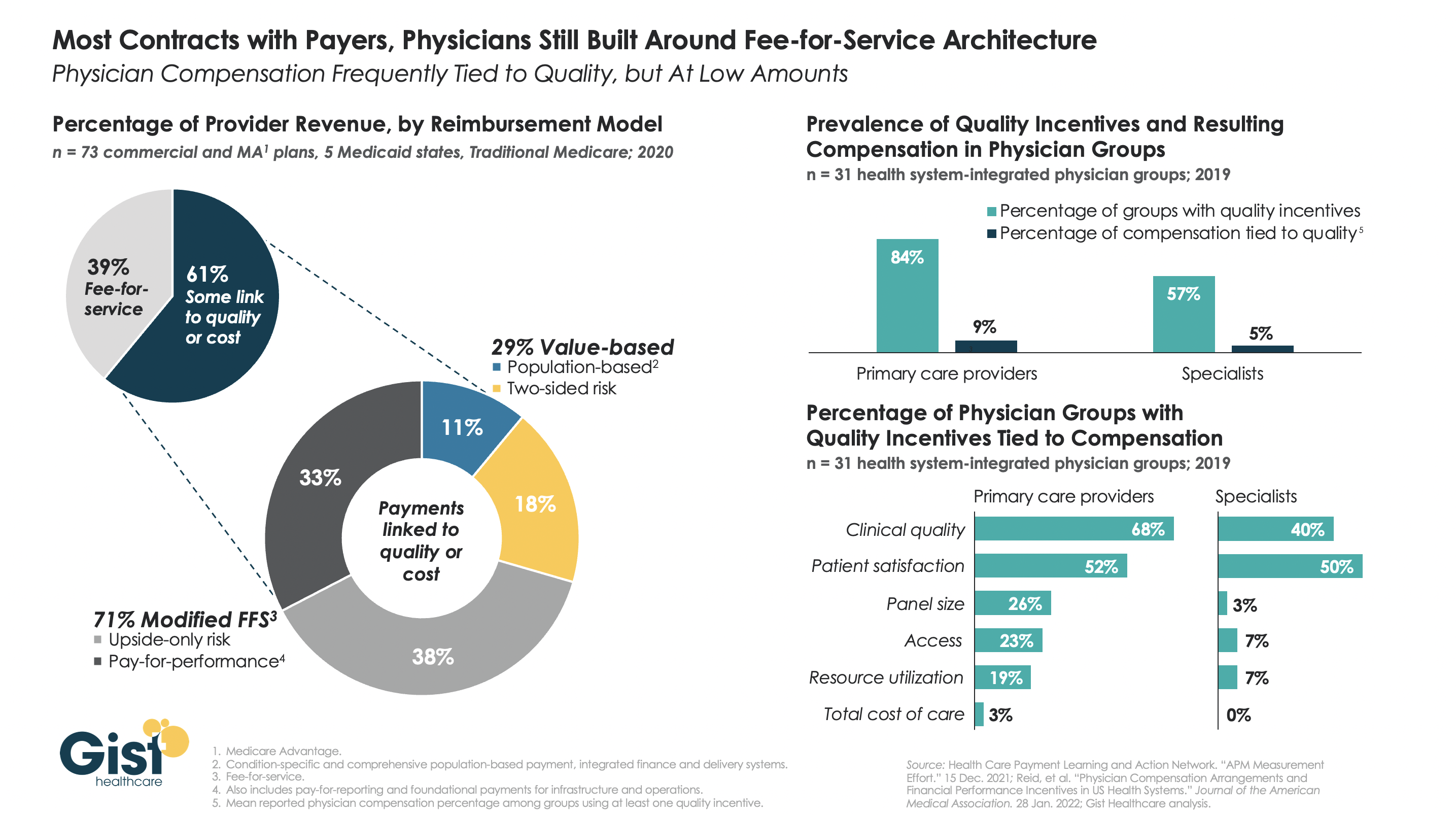
Payer contracts, physician pay still anchored in fee-for-service

The healthcare industry has made some strides in the “journey to value” across the last decade, but in reality, most health systems and physician groups are still very much entrenched in fee-for-service incentives.

While many health plans report that significant portions of their contract dollars are tied to cost and quality performance, what plans refer to as “value” isn’t necessarily “risk-based.” 

The left-hand side of the graphic below shows that, although a majority of payer contracts now include some link to quality or cost, over two-thirds of those lack any real downside risk for providers. 

Data on the right show a similar parallel in physician compensation. While the majority of physician groups have some quality incentives in their compensation models, less than a tenth of individual physician compensation is actually tied to quality performance. 

Though myriad stakeholders, from the federal government to individual health systems and physician groups, have collectively invested billions of dollars in migrating to value-based payment over the last decade, we are still far from seeing true, performance-based incentives translate into transformation up and down the healthcare value chain.  

Higher prices correlated with lower mortality in competitive hospital markets

https://mailchi.mp/f6328d2acfe2/the-weekly-gist-the-grizzly-bear-conflict-manager-edition?e=d1e747d2d8

A National Bureau of Economic Research working paper found that higher-priced hospitals in competitive markets were associated with lower patient mortality—flying in the face of the common policy narrative that higher-priced care is not higher quality. However, in more concentrated, less-competitive healthcare markets (in which over two-thirds of the nation’s hospitals are located), the study found no correlation between price and quality. Authors of the study analyzed patient outcomes from more than 200K admissions among commercially insured patients, transported by ambulance to about 1,800 hospitals between 2007 and 2014.   

The Gist: As hospitals have consolidated, prices have risen by about 30 percent between 2015 to 2019, leading policy experts and regulators to search for ways to rein in price inflation. 

While there continues to be widespread consensus that industry consolidation has resulted in unsustainable cost growth, the new study’s findings bring a bit of welcome nuance around impact on quality and outcomes to an otherwise one-sided, price-centric policy narrative.