Health systems in 10 years: 20 predictions from top executives

The executives featured in this article are all speaking at the Becker’s Healthcare 13th Annual Meeting April 3-6, 2023, at the Hyatt Regency in Chicago.

Question: What will hospitals and health systems look like in 10 years? What will be different and what will be the same?

Michael A. Slubowski. President and CEO of Trinity Health (Livonia, Mich.): In 10 years, inpatient hospitals will be more focused on emergency care, intensive/complex care following surgery or complex medical conditions, and short-stay/observation units. Only the most complex surgical cases and complex medical cases will be inpatient status. Most elective surgery and diagnostic services will be done in freestanding surgery, procedural and imaging centers. Many patients with chronic medical conditions will be managed at home using digital monitoring. More seniors will be cared for in homes and/or in PACE programs versus skilled nursing facilities.

Mark A. Schuster, MD, PhD. Founding Dean and Chief Executive Officer of Kaiser Permanente Bernard J. Tyson School of Medicine (Pasadena, Calif.): The future of hospitals might not actually unfold in hospitals. I expect that more and more of what we now do in hospitals will move into the home. The technology that makes this transition possible is already out there: Remote monitoring of vital signs and lab tests, remote visual exams, and videoconferencing with patients. And all of this technology will improve even more over the next 10 years — turning at-home care from a dream into a reality. 

Imagine no longer being kept awake all night by beeps and alarms coming from other patients’ rooms or kept away from family by limited visiting hours. The benefits are especially welcome for people who live in rural places and other areas with limited medical facilities. Who knows? Maybe robotics will make some in-home surgeries not so far off! 

Of course, not all patients have a safe or stable home environment where they could receive care, so hospitals aren’t going away anytime soon. I’m not suggesting that most current patients could be cared for remotely in a decade — but I do think we’re moving in that direction. So those of us who work in education will need to train medical, nursing, and other students for a healthcare future that looks quite different from the healthcare present and takes place in settings we couldn’t imagine 10 years ago.

Shireen Ahmad. System Director, Operations and Finance of CommonSpirit Health (Chicago): The biggest change I anticipate is a continuation in the decentralization of health services delivery that has typically been provided by hospitals. This will result in a reduction of hospitals with fewer services performed in acute settings and with more services provided in non-acute ones.

With recent reimbursement changes, CMS is helping to set the tone of where care is delivered. Hospitals are beginning to rationalize services, including who and where care is delivered. For example, pharmacies often carry clinics that provide vaccinations, but in France, one can go to a pharmacy for care and sterilization of minor wounds while only paying for bandages, medication and other supplies used in the visit. I would not be surprised if, in 10 years, one could get an MRI at their local Walmart or schedule routine screenings and tests at the grocery store with faster, more accurate results as they check out their produce.

If the pandemic has taught us anything, there will always be a need for acute care and our society will always need hospitals to provide care to sick patients. This is not something I would anticipate changing. However, the need to provide most care in a hospital will change with the result leading to fewer hospitals in total. Far from being a bleak outlook, however, I believe that healthier, sustainable health systems will prevail if they are able to provide a greater spectrum of care in broader settings focussing on quality and convenience.

Gerard Brogan. Senior Vice President and Chief Revenue Officer of Northwell Health (New Hyde Park, N.Y.): Operationally, hospitals and health systems will be more designed around the patient experience rather than the patient accommodating to the hospital design and operations. Specifically, more geared toward patient choice, shopping for services, and price competition for out-of-pocket expenses. In order to bring costs down, rational control of utilization will be more important than ever. Hopefully, we will be able to shrink the administrative costs of delivering care.  Structurally, more care will continue to be done ambulatory, with hospitals having a greater proportion of beds having critical care capability and single rooms for infection control, putting pressure on the cost per square foot to operate. Sustainable funding strategies for safety net hospitals will be needed.

Mike Gentry. Executive Vice President and COO of Sentara Healthcare (Norfolk, Va.): During the next 10 years, more rural hospitals will become critical assessment facilities. The legislation will be passed to facilitate this transition. Relationships with larger sponsoring health systems will support easy transitions to higher acuity services as required. In urban areas, fewer hospitals with greater acuity and market share will often match the 50 percent plus market share of health plans. The ambulatory transition will have moved beyond only surgical procedures into outpatient but expanded historical medical inpatient status in ED/observation hubs. 

The consumer/patient experience will be vastly improved. Investments in mobile digital applications will provide greatly enhanced communication, transparency of clinical status, timelines, the likelihood of expected outcomes and cost. Patients will proactively select from a menu of treatment options provided by predictive AI. The largest 10 health systems will represent 25 percent of the total U.S. acute care market share, largely due to consumer-centric strategic investments that have outpaced their competitors. Health systems will have vastly larger pharma operations/footprints. 

Ketul J. Patel. CEO of Virginia Mason Franciscan Health (Seattle) and Division President, Pacific Northwest of CommonSpirit Health (Chicago): This is a transformative time in the healthcare industry, as hospitals and healthcare systems are evolving and innovating to meet the growing and changing needs of the communities we serve. The pandemic accelerated the digital transformation of healthcare. We have seen the proliferation of new technologies — telemedicine, artificial intelligence, robotics, and precision medicine — becoming an integral part of everyday clinical care. Healthcare consumers have become empowered through technology, with greater control and access to care than ever before.  

Against this backdrop, in the next decade we’ll see healthcare consumerism influencing how health systems transform their hospitals. We will continue incorporating new technologies to improve healthcare delivery, offering more convenient ways to access high-quality care, and lowering the overall cost of care. 

SMART hospitals, including at Virginia Mason Franciscan Health, are utilizing AI to harness real-time data and analysis to revolutionize patient and provider experiences and improve the quality of care. VMFH was the first health system in the Pacific Northwest to introduce a virtual hospital nearly a decade ago, which provides virtual services in the hospital across the continuum of care to improve quality and safety through remote patient monitoring and care delivery. 

As hospitals become more high-tech, more nimble, and more efficient over the next 10 years, there will be less emphasis on brick-and-mortar buildings as we continue to move care away from the hospital toward more convenient settings for the patient. We recently launched VMFH Home Recovery Care, which brings all the essential elements of hospital-level care into the comfort and convenience of patients’ homes, offering a safe and effective alternative to the traditional inpatient stay. 

Health systems and hospitals must simplify the care experience while reducing the overall cost of care. VMFH is building Washington state’s first hybrid emergency room/urgent care center, which eliminates the guesswork for patients unsure of where to go for care. By offering emergent and urgent care in a single location, patients get the appropriate level of care, at the right price, in one convenient location. 

As healthcare delivery becomes more sophisticated in this digital age, we must not lose sight of why we do this work: our patients. There is no device or innovation that can truly replace the care and human intelligence provided by our nurses, APPs and physicians. So, while hospitals and health systems might look and feel different in 2033, our mission will remain the same: to provide exceptional, compassionate care to all — especially the most vulnerable.

David Sylvan. President of University Hospitals Ventures (Cleveland): American healthcare is facing an imperative. It’s clear that incremental improvements alone won’t manifest the structural outcomes that are largely overdue. The good news is that the healthcare industry itself has already initiated the disruption and self-disintermediation. I would hope that in the next 10 years, our offerings in healthcare truly reflect our efforts to adopt consumerism and patient choice, alleviate equity barriers and harness efficiencies while reducing time waste. 

We know that some of this will come about through technology design, build and adoption, especially in the areas of generative artificial intelligence. But we also know that some of this will require a process overhaul, with learnings gleaned from other industries that have already solved adjacent challenges. What won’t change in 10 years will be the empathy and quality of care that the nation’s clinicians provide to patients and their caregivers daily.

Joseph Webb. CEO of Nashville (Tenn.) General Hospital: The United States healthcare industry operates within a culture that embraces capitalism as an economic system. The practice of capitalism facilitates a framework that is supported by the theory of consumerism. This theory posits that the more goods and services are purchased and consumed, the stronger an economy will be. With that in mind, healthcare is clearly a driver in the U.S. economy, and therefore, major capital and technology are continuously infused into healthcare systems. Healthcare is currently approaching 20 percent of the U.S. gross domestic product and will continue to escalate over the next 10 years.

Also, in 10 years, there will be major shifts in ownership structures, e.g., mergers, acquisitions, and consolidations. Many healthcare organizations/hospitals will be unable to sustain operations due to shrinking profit margins. This will lead to a higher likelihood of increasing closures among rural hospitals due to a lack of adequate reimbursement and rising costs associated with salaries for nurses, respiratory therapists, etc., as well as purchasing pharmaceuticals.

Aging baby boomers with chronic medical conditions will continue to dominate healthcare demand as a cohort group. To mitigate the rising costs of care, healthcare systems and providers will begin to rely even more heavily on artificial intelligence and smart devices. Population health initiatives will become more prevalent as the cost to support fragmented care becomes cost-prohibitive and payers such as CMS will continue to lead the way toward value-based care.  

Because of structural and social conditions that tend to drive social determinants of health, which are fundamental causes of health disparities, achieving health equity will continue to be a major challenge in the U.S.  Health equity is an elusive goal that can only be achieved when there is a more equitable distribution of SDOH.

Gary Baker. CEO, Hospital Division of HonorHealth (Scottsdale, Ariz.): In 10 years, I would expect hospitals in health systems to become more specialized for higher acuity service lines. Providing similar acute services at multiple locations will become difficult to maintain. Recruiting and retaining specialty clinical talent and adopting new technologies will require some redistribution of services to improve clinical quality and efficiency. Your local hospital may not provide a service and will be a navigator to the specialty facilities. Many services will be provided in ambulatory settings as technology and reimbursement allow/require. Investment in ambulatory services will continue for the next 10 years.

Michael Connelly. CEO Emeritus of Bon Secours Mercy Health (Cincinnati): Our society will be forced to embrace economic limits on healthcare services. The exploding elderly population, in combination with a shrinking workforce to fund Medicare/Medicaid and Social Security, will force our health system to ration care in new ways. These realities will increase the role of primary care as the needed coordinator of health services for patients. Diminishing fragmented healthcare and redundant care will become an increasing focus for health policy.

David Rahija. President of Skokie Hospital, NorthShore University HealthSystem (Evanston, Ill.): Health systems will evolve from being just a collection of hospitals, providers, and services to providing and coordinating care across a longitudinal care continuum. Health systems that are indispensable health partners to patients and communities by providing excellent outcomes through seamless, coordinated, and personalized care across a disease episode and a life span will thrive. Providers that only provide transactional care without a holistic, longitudinal relationship will either close or be consolidated. Care tailored to the personalized needs of patients and communities using team care models, technology, genomics, and analytics will be key to executing a personalized, seamless, and coordinated model of care.

Alexa Kimball, MD. President and CEO of Harvard Medical Faculty Physicians at Beth Israel Deaconess Medical Center (Boston): Ten years from now, hospitals will largely look the same — at least from the outside. Brick-and-mortar buildings aren’t going away anytime soon. What will differ is how care is delivered beyond the traditional four walls. Expect to see a more patient-centered and responsive system organized around what individuals need — when and where they need it. 

Telehealth and remote patient monitoring will enable greater accessibility for patients in underserved areas and those who cannot get to a doctor’s office. Technology will not only enable doctors to deliver more personalized treatment plans but will also dramatically reshape physician workflows and processes. These digital tools will streamline administrative tasks, integrate voice commands, and provide more conducive work environments. I also envision greater access to data for both providers and patients. New self-service solutions for care management, scheduling, pricing, shopping for services, etc., will deliver a more proactive patient experience and make it easier to navigate their healthcare journey. 

Ronda Lehman, PharmD. President of Mercy Health – Lima (Ohio): 

This is a highly challenging question to address as we continue to reevaluate how healthcare is being delivered following several difficult years and knowing that financial challenges still loom. That said, when I am asked what it will look like, I am keenly aware of the fact that it only will look that way if we can envision a better way to improve the health of our communities. So 10 years from now, we need to have easier and more patient-driven access to care. 

We will need to stop doing ‘to people’ and start caring ‘with people.’ Artificial intelligence and proliferous information that is readily available to consumers will continue to pave the way to patients being more empowered and educated about their options. So what will differentiate healthcare of the future? Enabling patients to make informed decisions. 

Undoubtedly, technology will continue to advance, and along with it, the associated costs of research and development, but healthcare can only truly change if providers fundamentally shift their approach to how we care for patients. It is imperative that we need to transform from being the gatekeepers of valuable resources and services to being partners with patients on their journey. If that is what needs to be different, then what needs to be the same? We need the same highly motivated, highly skilled and perhaps most importantly, highly compassionate caregivers selflessly caring for one another and their communities.  

Mike Young. President and CEO of Temple University Health System (Philadelphia): Cell therapy, gene therapy, and immunotherapy will continue to rapidly improve and evolve, replacing many traditional procedures with precise therapies to restore normal human function — either through cell transfer, altering of genetic information, or harnessing the body’s natural immune system to attack a particular disease like cancer, cystic fibrosis, heart disease, or diabetes. As a result, hospitals will decrease in footprint, while the labs dedicated to defining precision medicine will multiply in size to support individual- and disease-specific infusion, drug, and manipulative therapies. 

Hospitals will continue to shepherd the patient journey through these therapies and also will continue to handle the most complex cases requiring high-tech medical and surgical procedures. Medical education will likely evolve in parallel, focusing more on genetic causation and treatment of disease, as well as proficiency with increasingly sophisticated AI diagnostic technologies to provide adaptive care on a patient-by-patient basis.

Tom Siemers. Chief Executive Officer of Wilbarger General Hospital (Vernon, Texas): My predictions include the national healthcare landscape will be dominated by a dozen or so large systems. ‘Consolidation’ will be the word that describes the healthcare industry over the next 10 years.  Regional systems will merge into large, national systems. Independent and rural hospitals will become increasingly rare. They simply won’t be able to make the capital investments necessary to replace outdated facilities and equipment while vying with other organizations for scarce, licensed personnel.

Jim Heilsberg. CFO of Tri-State Memorial Hospital & Medical Campus (Clarkston, Wash.): Tri-State Hospital continues to expand services for outpatient services while maintaining traditionally needed inpatient services. In 10 years, there will be expanded outpatient services that include leveraged technology that will allow the patient to be cared for in a yet-to-be-seen care model, including traditional hospital settings and increasing home care setting solutions. 

Jennifer Olson. COO of Children’s Minnesota (St. Paul, Minn.): I believe we will see more and better access to healthcare over the next 10 years. Advances in diagnostics, monitoring, and artificial intelligence will allow patients to access services at more convenient times and locations, including much more frequently at home, thereby extending health systems’ reach well beyond their walls.  

What I don’t think will ever change is the heart our healthcare professionals bring with them to work every day. I see it here at Children’s Minnesota and across our industry: the unwavering commitment our caregivers have to help people live healthier lives.   

If I had one wish for the future, it would be that we become better equipped to address the social determinants of health: all of the factors outside the walls of our hospitals and clinics that affect our patients’ well-being. Part of that means relaxing regulations to allow better communication and sharing of information among healthcare providers and public and private entities, so we can take a more holistic approach to improve health and decrease disparities. It also will require a fundamental shift in how health and healthcare are paid for.   

Stonish Pierce. COO of Holy Cross Health, Trinity Health Florida: Over the next decade, many health systems will pivot from being ‘hospital’ systems to true ‘health’ systems. Based largely on responding to The Joint Commission’s New Requirements to Reduce Health Care Disparities, many health systems will place greater emphasis on reducing health disparities, enhanced attention to providing culturally competent care, addressing social determinants of health (including, but not limited to food, housing and transportation) and health equity. I’m proud to work for Trinity Health, a system that has already directed attention toward addressing health disparities, cultural competency and health equity. 

Many systems will pivot from offering the full continuum of services at each hospital and instead focus on the core services for their respective communities, which enables long-term financial sustainability. At the same time, we will witness the proliferation of partnerships as adept health systems realize that they cannot fulfill every community’s needs alone. Depending upon the specialty and region of the country, we may see some transitioning away from the RVU physician compensation model to base salaries and value-based compensation to ensure health systems can serve their communities in the long term. 

Driven largely by continued workforce supply shortages, we will also see innovation achieve its full potential. This will include, but not be limited to, virtual care models, robots to address functions currently performed by humans, and increased adoption of artificial intelligence and remote monitoring. Healthcare overall will achieve parity in technological adoption and innovation that we take for granted and have grown accustomed to in industries such as banking and the consumer service industries. 

For what will remain the same, we can anticipate that government reimbursement will still not cover the cost of providing care, although systems will transition to offering care models and services that enable the best long-term financial sustainability. We will continue to see payers and retail pharmacies continue to evolve as consumer-friendly providers. We will continue to see systems make investments in ambulatory care and the most critically ill patients will remain in our hospitals. 

Jamie Davis. Executive Director, Revenue Cycle Management of Banner Health (Phoenix): I think that we will see a continued shift in places of service to lower-cost delivery sources and unfavorable payer mix movement to Medicare Advantage and health exchange plans, degrading the value of gross revenue. The increased focus on cost containment, value-based care, inflation, and pricing transparency will hopefully push payers and providers to move to a more symbiotic relationship versus the adversarial one today. Additionally, we may see disruption in the technology space as the venture capital and private equity purchase boom that happened from 2019 to 2021 will mature and those entities come up for sale. If we want to continue to provide the best quality health outcomes to our patients and maintain profitability, we cannot look the same in 10 years as we do today.

James Lynn. System Vice President, Facilities and Support Services of Marshfield Clinic Health System (Wis.): There will be some aspects that will be different. For instance, there will be more players in the market and they will begin capturing a higher percentage of primary care patients.  Walmart, Walgreens, CVS, Amazon, Google and others will begin to make inroads into primary care by utilizing VR and AI platforms. More and more procedures will be the same day. Fewer hospital stays will be needed for recovery as procedures become less invasive and faster. There will be increasing pressure on the federal government to make healthcare a right for all legal residents and it will be decoupled from employment status. On the other hand, what will stay the same is even though hospital stays will become shorter for some, we will also be experiencing an ever-aging population, so the same number of inpatient beds will likely be needed. 

10 Key Medtech Themes for 2023

https://medcitynews.com/2023/01/10

We expect 2023 to be a pivotal year for the industry, as the accelerated acceptance of virtual care and demographic trends, such as an aging population, increasing chronic illnesses and healthcare worker shortages, sustain demand for medtech-enabled solutions.

The combination of rapid developments in novel healthcare technology and heightened demand for integrated tech-enabled care has continued to fuel innovation in the medtech industry.  At the same time, medtech innovators – whether in digital health, wearables and AI-driven offerings in healthcare, or diagnostics, telemedicine and health IT solutions – continue to face a patchwork of laws, rules and norms across the world. Life sciences and healthcare innovators and regulators are also looking to medtech to increase access to care and health equity. Here are ten global medtech themes we are tracking in the coming year:

Focus on digital tuck-in acquisitions in medtech M&A

Despite continued uncertainty in the overall financial market, medtech M&A activity continued at a steady pace in 2022.  This year witnessed a rise in tuck-in acquisitions of smaller companies that can be easily integrated into buyers’ existing infrastructure and product offerings, as opposed to significantly sized takeovers of businesses that aren’t squarely aligned with buyers’ existing businesses lines.  Medtech acquirers have been particularly focused on developing their digital capabilities to innovate and reach customers in new ways.  As digitization continues to transform the industry, we expect acquirers to continue to prioritize the value of digital and data assets as they evaluate potential targets.

Continued interest by private equity and other financial sponsors

Private equity firms, healthcare-focused funds and other financial sponsors have continued to display a strong appetite for investing in Medtech companies, with top targets in subsectors such as diagnostics and healthcare IT solutions.  Later-stage medtech companies in particular are gaining a larger share of venture capital funding, as later-stage investments allow financial sponsors to focus on businesses with higher yields, as well as less time to market and capital reimbursement.  Demographic trends, including an aging population and the increasing prevalence of chronic diseases, coupled with healthcare technology advancements have created robust demand for medtech-enabled solutions.  Additionally, medtech offerings have broad applications that can extend beyond stakeholders in a specific therapy area, product category or care setting, offering the ability to satisfy unmet needs with large patient bases.

Strategic medtech collaborations as the new norm

Strategic medtech collaborations and partnerships have become the new norm in our increasingly connected digital healthcare ecosystem.  In response to heightened consumer demand for tech-enabled care, pharmaceutical and medtech companies are collaborating to use digital technologies to engage with consumers, unlocking a vast range of treatments such as personalized medicine.  Additionally, as the market rapidly evolves towards data-driven healthcare, we expect medtech companies to continue to work collaboratively to address existing barriers to data sharing and promote interoperability of healthcare data.

Continued scrutiny by antitrust and competition authorities 

As expected, global antitrust and competition authorities continued to focus on the tech, life sciences and medtech sectors in 2022.  The US, UK and EU authorities have stepped up efforts to investigate and challenge conduct by large pharma and technology companies pursuing mergers and acquisitions.  We expect these authorities to assess similar concerns in the digital health context in an effort to account for the value of combined datasets and the interoperability of various offerings that could be derived from digital health mergers and acquisitions.  Furthermore, geopolitical tensions have resulted in new and expanded foreign investment regimes to improve the resilience of domestic healthcare systems.  Notably this year, the UK government implemented the National Security and Investment Act that allows it to restrict transactions that may threaten national security, including in the AI and data infrastructure sectors.  Sensitive data continues to be a recurring theme for foreign investment review for Committee on Foreign Investment in the US  and that of the EU as well.

Growing importance of data privacy and security

Increasing regulatory attention to sensitive health data and the escalating rise of ransomware attacks has made data privacy and security more important than ever for medtech innovators.  The Federal Trade Commission has issued several statements about its willingness to “fully” enforce the law against the illegal use and sharing of highly sensitive data.  Additionally, several state privacy laws coming into effect in 2023 create new categories of sensitive personal data, including health data, and impose novel obligations on innovators to obtain data-related consents.  As ransomware continues to pose security-related threats, the US Department of Health and Human Services renewed calls for all covered entities and business associates to prioritize cybersecurity.  New standards, such as cybersecurity label rating programs for connected devices, aim to address security risks.  In the EU, medtech providers will need to consider how the launch of the European Health Data Space and newly proposed data regulation, such as the Data Act and AI Act, could impact their data use and sharing practices.

More active engagement with FDA/EMA/MHRA

We expect companies active in the medtech sector, particularly those that make use of AI and other advanced technologies, to continue their conversations with the U.S. Food and Drug Administration (“FDA”), the European Medicines Agency (“EMA”), the Medicines and Healthcare Products Regulatory Agency (“MHRA”) and other regulators as such companies grow their medtech business lines and establish their associated regulatory compliance infrastructure. Given the unique regulatory issues arising from the implementation of digital health technologies, we expect the FDA, EMA and MHRA to provide additional guidance on AI/ML-based software-as-a-medical device and the remote management of clinical trials.  2022 saw stakeholders in the life sciences and medtech industries collaborate with regulatory authorities to push forward the acceptance of digital endpoints that rely on sensor-generated data collected outside of a clinical setting.  As the industry shifts to decentralized clinical trials, we expect both innovators and regulators to work together to evaluate the associated clinical, privacy and safety risks in the development and use of such digital endpoints.

Increasing medtech localization in the Asia Pacific region

2022 saw multinational companies (“MNCs”), including American pharma/device makers make an active effort to expand their medtech business lines in the Asia Pacific region.   At the same time, government authorities in the region have been increasingly focused on incentivizing local innovation, approving government grants and prohibiting the importation of non-approved medical equipment. In light of MNCs’ market share of the medical device market in the Asia Pacific region, especially in China, we expect the emergence of the domestic medtech industry to prompt discussions among MNCs, local innovators and government authorities over the long-term development of the global market for medical technology.

Long-term adoption of telehealth and remote patient monitoring technologies 

The Covid-19 pandemic saw the rise of telehealth and remote patient monitoring technologies as key modes of healthcare delivery.  The telehealth industry remains focused on enabling remote consultations and long-term patient management for patients with chronic conditions.  Looking forward, we expect to see increased innovation in non-invasive technologies that can provide early diagnostics and ongoing disease management in a low-friction manner.  At the same time, we anticipate telehealth companies to face increasing scrutiny from regulatory authorities around the world for fraud and abuse by patients and providers.  Consumer and patient data privacy and security in connection with telehealth and remote patient monitoring continue to remain top of mind for regulators as well.

Women’s health and privacy concerns for medtech

We expect to see increased consumer health tech adoption for reproductive care, especially in light of the U.S. Supreme Court’s decision to overturn Roe v. Wade.  Following the Dobbs decision, a number of states introduced or passed legislation that prohibits or restricts access to reproductive health services beyond abortion.  In response, women’s health-focused companies are expanding their virtual fertility and pregnancy, telemedicine and other services to patients.  At the same time, such companies need to assess the legal risks stemming from the collection and storage of their customers’ personal health information, which could then be used as evidence to prosecute customers for obtaining illegal reproductive health services.  We expect companies active in this space to take steps to navigate the patchwork of data privacy and security laws across jurisdictions while establishing clear digital health governance mechanisms to safeguard their customers’ data privacy and security.

Addressing inequities in the implementation of digital healthcare technologies

Medtech innovators and regulators have been increasingly focused on addressing inequities in the healthcare system and the data used to train AI and ML-based digital healthcare technologies.  In 2022, a number of medtech companies collaborated to provide technologies that result in improved patient outcomes across all populations, as well as boost participation of diverse populations in clinical trials.  In parallel, we are seeing increased interest from regulators to reduce bias in digital health technologies and the accompanying datasets, as evidenced by the EU’s proposed AI Act and the UK’s health data strategy. In the US, which currently lacks comprehensive government regulation of AI in healthcare, there have been increasing calls for institutional commitments in the area of algorithmovigilance.  Because of the inaccurate conclusions that may result from biased technologies and data, MedTech companies must prioritize health equity in the implementation of digital healthcare technologies so that everyone can benefit from the latest scientific advances.

In conclusion, the medtech industry has remained resilient amidst the challenging macroeconomic environment.  We expect 2023 to be a pivotal year for the industry, as the accelerated acceptance of virtual care and demographic trends, such as an aging population, increasing chronic illnesses and healthcare worker shortages, sustain demand for medtech-enabled solutions.  At the same time, the rapidly changing legal and regulatory landscape will continue to be a key issue for medtech innovators moving forward. Adopting a global, forward-thinking regulatory compliance strategy can help MedTech companies stay competitive and ultimately, achieve better outcomes for patients.

Drug Prices: We’ve Seen This Movie Before

As happened with cars in the 1960s, price competition among brand-name drugs is hard to find.

Before 1973, when the Arab oil embargo upended the U.S. auto industry, Americans witnessed an annual ritual by carmakers. In the late summer, the Big Three — Ford, Chrysler, and General Motors — would release sticker prices for their products, always showing increases, of course.

Almost always, the increases from each company for similar models were nearly identical. If one company’s was out of line — substantially bigger or smaller than its erstwhile competitors’ — it quickly made an adjustment. Explicit collusion to fix prices was never proven, but the effect for consumers was the same.

Now, researchers report that something very similar seems to be occurring for big-market brand-name drugs, including anti-diabetic medications and blood thinners.

Average wholesale prices for products in five classes — direct-acting oral anticoagulants (DOACs), P2Y12 inhibitors, glucagon-like peptide-1 (GLP-1) agonists, dipeptidyl dipeptidase-4 (DPP-4) inhibitors, and sodium-glucose transport protein-2 (SGLT-2) inhibitors — increased in “lock-step” each year from 2015 to 2020, according to Joseph Ross, MD, of Yale University in New Haven, Connecticut, and colleagues writing in JAMA Network Open.

These increases ranged from annual averages of 6.6% for DDP4 inhibitors to 13.5% for P2Y12 inhibitors — far outpacing not only inflation in general, but even the 2.1% average for all prescription drugs.

Within each class, Kendall τb correlation coefficients for average wholesale prices were as follows:

  • DOACs: 0.98
  • SGLT-2 inhibitors: 0.98
  • DPP-4 inhibitors: 0.96
  • GLP-1 agonists: 0.92
  • P2Y12 inhibitors: 0.75

“These results suggest there was little price competition among the sponsors of these products,” Ross and colleagues wrote.

Although the analysis came with significant limitations — it didn’t account for rebates or other discounts, for example — the researchers said some patients must suffer from these increases.

“Rebates, list prices, and net prices have been growing for brand-name medications, and rebate growth has been shown to positively correlate with list price growth, thereby impacting costs faced by patients paying a percentage of (or the full) list price, the group noted. “Therefore, the lock-step price increases of brand-name medications, without evidence of price competition, raise concerns and would be expected to adversely affect patient adherence to medications and thus clinical outcomes.”

For the car buyers, the solution to lock-step price increases was imposed from outside: soaring gas prices in the mid-1970s prompted demand for vehicles with better fuel economy than domestic makers were prepared to sell. That opened the market to Japanese cars that not only got better mileage, but were also more reliable and (in many cases) cheaper than Big Three products. Thus ended Detroit’s ability to set prices.

How to rein in Big Pharma is less clear. For their part, Ross and colleagues suggested policies to limit such lock-step price hikes, shortened patent exclusivity periods, and faster introduction of generic equivalents.

New unemployment claims jump to nearly 1 million, the highest level since August

Unemployment rate remains at 6.7%, employers cut 140,000 jobs last month -  ABC News

The number of new unemployment claims filed last week jumped by 181,000 the week before to 965,000, the largest increase since the beginning of the pandemic.

It was the largest number of new unemployment claims since August.

An additional 284,000 claims were filed for the Pandemic Unemployment Assistance, the insurance for gig and self-employed workers.

The weekly report is President Trump’s last before President-elect Joe Biden is sworn in on Jan. 20. Biden will inherit a labor market badly weakened by the coronavirus pandemic and an economic recovery that appears to have stalled: 140,000 people lost their jobs in December, the first decline in months, with the U.S. still down millions of jobs since February.

The dire numbers will serve as a backdrop for Biden as he formally unveils an ambitious stimulus package proposal on Thursday, which could top $1 trillion, and is expected include an expansion of the child tax credit, a $2,000 stimulus payment, and other assistance for the economy.

Democrats were already using the weak labor to argue about the necessity of more aid.

Economists say that the economy’s struggles could be explained, in part, by the delay Congress allowed between the summer, when many fiscal aid programs expired and December, when lawmakers finally agreed on a new package after months of stalemate.

The number of new jobless claims has come down since the earliest days of the pandemic, but remains at a extremely high level week in and week out.

The total number of continuing people in any of the unemployment programs at the end of the year was 18.4 million, although officials have cautioned that the number is inflated by accounting issues and duplicate claims.

The increase in claims is not entirely unexpected. As the aid package passed by Congress in December kicks in, including a $300 a week unemployment supplement, some economists expected that to result in more workers filing claims.

Notes for the 39th Annual J.P Morgan Healthcare Conference, 2021

https://www.sheppardhealthlaw.com/articles/healthcare-industry-news/

2021 JP Morgan Healthcare Conference | Zoetis

Sitting in the dark before 6 am in my Los Angeles house with my face lit up by yet another Zoom screen, wearing a stylish combination of sweatpants, dress shirt and last year’s JPM conference badge dangling around my neck for old times’ sake, I wonder at the fact that it’s J.P. Morgan Annual Healthcare Conference week again and we are where we are. Quite a year for all of us – the pandemic, the healthcare system’s response to the public health emergency, the ongoing fight for racial justice, the elections, the storming of the Capital – and the subject of healthcare winds its way through all of it – public health, our healthcare system’s stability, strengths and weaknesses, the highly noticeable healthcare inequities, the Affordable Care Act, Medicaid and vaccines, healthcare politics and what the new administration will bring as healthcare initiatives.

I will miss seeing you all in person this year at the J.P. Morgan Annual Healthcare Conference and our annual Sheppard Mullin reception – previously referred to as “standing room only” events and now as “possible superspreader events.” What a difference a year makes. I admit that I will miss the feeling of excitement in the rooms and hallways of the Westin St. Francis and all of the many hotel lobbies and meeting rooms surrounding it. Somehow the virtual conference this year lacks that je ne sais quoi of being stampeded by rushing New York-style street traffic while in an antiquated San Francisco hotel hallway and watching the words spoken on stage transform immediately into sharp stock price increases and drops. There also is the excitement of sitting in the room listening to paradigm shifting ideas (teaser – read the last paragraph of this post for something truly fascinating). Perhaps next year, depending on the vaccine…

So, let’s start there. Today was vaccine day at the JPM Conference, with BioNTech, Moderna, Novovax and Johnson & Johnson all presenting. Lots of progress reported by all of the companies working on vaccines, but the best news of the day was the comment from BioNTech that the UK and South Africa coronavirus variants likely are still covered by the BioNTech/Pfizer vaccine. BioNTech’s CEO, Prof. Uğur Şahin, M.D., promised more data and analysis to be published shortly on that.

We also saw continued excitement for mRNA vaccines, not only for COVID-19 but also for other diseases. There is a growing focus (following COVID-19 of course) on vaccines for cancer through use of neoantigen targets, and for a long list of infectious disease targets.  For cancer, though, there continues to be a growing debate over whether the best focus is on “personalized” vaccines or “off the shelf” vaccines – personalized vaccines can take longer to make and have much, much higher costs and infrastructure requirements. We expect, however, to see very exciting news on the use of mRNA and other novel technologies in the next year or two that, when approved and put into commercialization, could radically change the game, not only as to mortality, but also by eliminating or significantly reducing the cost of care with chronic conditions (which some cancers have become, thanks to technological advancement). We are fortunate to be in that gap now between “care” and “cure,” where we have been able with modern medical advances to convert many more disease states into manageable chronic care conditions. Together with today’s longer lifespans, that, however, carries a much higher price tag for our healthcare system. Now, with some of these recent announcements, we look forward to moving from “care” to “cure” and substantially dropping the cost of care to our healthcare system.

Continuing consolidation also was a steady drumbeat underlying the multiple presentations today on the healthcare services side of the conference – health plans, health systems, physician organizations, home health. The drive to scale continues, as we have seen from the accelerated pace of mergers and acquisitions in the second half of 2020, which continues unabated in January 2021. There was today’s announcement of the acquisition by Amerisource Bergen of Walgreens Boots Alliance’s Alliance Healthcare wholesale business (making Walgreens Boots Alliance the largest single shareholder of Amerisource Bergen at nearly 30% ownership), following the announcement last week of Centene’s acquisition of Magellan Health (coming fast on the heels of Molina Healthcare’s purchase of Magellan’s Complete Care line of business).

On the mental health side – a core focus area for Magellan Health – Centene’s Chief Executive Officer, Michael Neidorff, expressed the common theme that we have been seeing in the past year that mental health care should be integrated and coordinated with primary and specialty care. He also saw value in Magellan’s strong provider network, as access to mental health providers can be a challenge in some markets and populations. The behavioral/mental health sector likely will see increased attention and consolidation in the coming year, especially given its critical role during the COVID-19 crisis and also with the growing Medicaid and Medicare populations. There are not a lot of large assets left independent in the mental health sector (aside from inpatient providers, autism/developmental disorder treatment programs, and substance abuse residential and outpatient centers), so we may see more roll-up focus (such as we have seen recently with the autism/ABA therapy sector) and technology-focused solutions (text-based or virtual therapy).

There was strong agreement among the presenting health plans and capitated providers (Humana, Centene, Oak Street and multiple health systems) today that we will continue to see movement toward value-based care (VBC) and risk-based reimbursement systems, such as Medicare Advantage, Medicare direct contracting and other CMS Innovation Center (CMMI) programs and managed Medicaid. Humana’s Chief Executive Officer, Bruce Broussard, said that the size of the MA program has grown so much since 2010 that it now represents an important voting bloc and one of the few ways in which the federal government currently is addressing healthcare inequities – e.g., through Over-the-Counter (OTC) pharmacy benefits, benefits focused on social determinants of health (SDOH), and healthcare quality improvements driven by the STARS rating program. Broussard also didn’t think Medicare Advantage would be a negative target for the Biden administration and expected more foreseeable and ordinary-course regulatory adjustments, rather than wholesale legislative change for Medicare Advantage.

There also was agreement on the exciting possibility of direct contracting for Medicare lives at risk under the CMMI direct contracting initiative. Humana expressed possible interest in both this year’s DCE program models and in the GEO regional risk-based Medicare program model that will be rolling out in the next year. Humana sees this as both a learning experience and as a way to apply their chronic care management skills and proprietary groups and systems to a broader range of applicable populations and markets. There is, however, a need for greater clarity and transparency from CMMI on program details which can substantially affect success and profitability of these initiatives.

Humana, Centene and Oak Street all sang the praises of capitated medical groups for Medicare Advantage and, per Michael Neidorff, the possibility of utilizing traditional capitated provider models for Medicaid membership as well. The problem, as noted by the speakers, is that there is a scarcity of independent capitated medical groups and a lack of physician familiarity and training. We may see a more committed effort by health plans to move their network provider groups more effectively into VBC and risk, much like we have seen Optum do with their acquired fee for service groups. Privia Health also presented today and noted that, while the market focus and high valuations today are accorded to Medicare lives, attention needs to be paid to the “age in” pipeline, as commercial patients who enroll in original Medicare and Medicare Advantage still would like to keep their doctors who saw them under commercial insurance. Privia’s thesis in part is to align with patients early on and retain them and their physicians, so as to create a “farm system” for accelerated Medicare population growth. Privia’s Chief Executive Officer, Shawn Morris, also touted Privia’s rapid growth, in part attributable to partnering with health systems.

As written in our notes from prior JPM healthcare conferences, health systems are continuing to look outside to third parties to gain knowledge base, infrastructure and management skills for physician VBC and risk arrangements. Privia cited their recent opening of their Central Florida market in partnership with Health First and rapid growth in providers by more than 25% in their first year of operations.

That being said, the real market sizzle remains with Medicare Advantage and capitation, percent of premium arrangements and global risk. The problem for many buyers, though, is that there are very few assets of size in this line of business. The HealthCare Partners/DaVita Medical Group acquisition by Optum removed that from the market, creating a high level of strategic and private equity demand and a low level of supply for physician organizations with that expertise. That created a focus on groups growing rapidly in this risk paradigm and afforded them strong valuation, like with Oak Street Health this past year as it completed its August 2020 initial public offering. Oak Street takes on both professional and institutional (hospital) risk and receives a percent of premium from its contracting health plans. As Oak Street’s CEO Mike Pykosz noted, only about 3% of Medicare dollars are spent on primary care, while approximately two-thirds are spent on hospital services. If more intensive management occurs at the primary care level and, as a result, hospitalizations can be prevented or reduced, that’s an easy win that’s good for the patient and the entire healthcare system (other than a fee for service based hospital). Pykosz touted his model of building out new centers from scratch as allowing greater conformity, control and efficacy than buying existing groups and trying to conform them both physically and through practice approaches to the Oak Street model. He doesn’t rule out some acquisitions, but he noted as an example that Oak Street was able to swiftly role out COVID-19 protocols rapidly and effectively throughout his centers because they all have the same physical configuration, the same staffing ratio and the same staffing profiles. Think of it as a “franchise” model where each Subway store, for example, will have generally the same look, feel, size and staffing. He also noted that while telehealth was very helpful during the COVID-19 crisis in 2020 and will continue as long as the doctors and patients wish, Oak Street believes that an in-person care management model is much more effective and telehealth is better for quick follow-ups or when in-person visits can’t occur.

Oak Street also spoke to the topic of Medicare Advantage member acquisition, which has been one of the more difficult areas to master for many health plans and groups, resulting in many cases with mergers and acquisitions becoming a favored growth vehicle due to the difficulties of organic membership growth. Interestingly, both Oak Street and Humana reported improvements in membership acquisition during the COVID-19 crisis. Oak Street credited digital marketing and direct response television, among other factors. Humana found that online direct-to-consumer brokers became an effective pathway during the COVID-19 crisis and focused its energy on enhancing those relationships and improving hand-offs during the membership enrollment process. Humana also noted the importance of brand in Medicare Advantage membership marketing.

Staying with Medicare Advantage, there is an expectation of a decrease in Medicare risk adjustment revenue in 2021, in large part due to the lower healthcare utilization during the COVID crisis and the lesser number of in-person visits during which HCC-RAF Medicare risk adjustment coding typically occurs. That revenue drop however likely will not significantly decrease Medicare Advantage profitability though, given the concomitant drop in healthcare expenses due to lower utilization, and per conference reports, is supposed to return to normal trend in 2022 (unless we see utilization numbers fall back below 90% again). Other interesting economic notes from several presentations, when taken together, suggest that while many health systems have lost out on elective surgery revenue in 2020, their case mix index (CMI) in many cases has been much higher due to the COVID patient cases. We also saw a number of health systems with much lower cash days on hand numbers than other larger health systems (both in gross and after adjusting for federal one-time stimulus cash payments), as a direct result of COVID. This supports the thesis we are hearing that, with the second wave of COVID being higher than expected, in the absence of further federal government financial support to hospitals, we likely will see an acceleration of partnering and acquisition transactions in the hospital sector.

Zoetis, one of the largest animal health companies, gave an interesting presentation today on its products and service lines. In addition to some exciting developments re: monoclonal antibody treatments coming on line for dogs with pain from arthritis, Zoetis also discussed its growing laboratory and diagnostics line of business. The animal health market, sometime overshadowed by the human healthcare market, is seeing some interesting developments as new revenue opportunities and chronic care management paradigms (such as for renal care) are shifting in the animal health sector. This is definitely a sector worth watching.

We also saw continuing interest, even in the face of Congressional focus this past year, on growing pharmacy benefit management (PBM) companies, which are designed to help manage the pharmacy spend. Humana listed growth of its PBM and specialty pharmacy lines of business as a focus for 2021, along with at-home care. In its presentation today,  SSM Health, a health system in Wisconsin, Oklahoma, Illinois, and Missouri, spotlighted Navitus, its PBM, which services 7 million covered lives in 50 states.

One of the most different, interesting and unexpected presentations of the day came from Paul Markovich, Chief Executive Officer of Blue Shield of California. He put forth the thesis that we need to address the flat or negative productivity in healthcare today in order to both reduce total cost of care, improve outcomes and to help physicians, as well as to rescue the United States from the overbearing economic burden of the current healthcare spending. Likening the transformation in healthcare to that which occurred in the last two decades with financial services (remember before ATMs and banking apps, there were banker’s hours and travelers cheques – remember those?), he described exciting pilot projects that reimagine healthcare today. One project is a real-time claims adjudication and payment program that uses smart watches to record physician/patient interactions, natural language processing (NLP) to populate the electronic medical record, transform the information concurrently into a claim, adjudicate it and authorize payment. That would massively speed up cash flow to physician practices, reduce paperwork and many hours of physician EMR and billing time and reduce the billing and collection overhead and burden. It also could substantially reduce healthcare fraud.

Paul Markovich also spoke to the need for real-time quality information that can result in real-time feedback and incentivization to physicians and other providers, rather than the costly and slow HEDIS pursuits we see today. One health plan noted that it spends about $500 million a year going into physician offices looking at medical records for HEDIS pursuits, but the information is totally “in the rearview mirror” as it is too old when finally received and digested to allow for real-time treatment changes, improvement or planning. Markovich suggested four initiatives (including the above, pay for value and shared decision making through better, more open data access) that he thought could save $100 billion per year for the country. Markovich stressed that all of these four initiatives required a digital ecosystem and asked for help and partnership in creating one. He also noted that the State of California is close to creating a digital mandate and statewide health information exchange that could be the launching point for this exciting vision of data sharing and a digital ecosystem where the electronic health record is the beginning, but not the end of the healthcare data journey.

Unemployment claims rose sharply last week as economic crisis grinds on

U.S. Unemployment Claims Rise Amid Coronavirus Surge - WSJ

Applications for jobless benefits resumed their upward march last week as the worsening pandemic continued to take a toll on the economy.

More than 947,000 workers filed new claims for state unemployment benefits last week, the Labor Department said Thursday. That was up nearly 229,000 from the week before, reversing a one-week dip that many economists attributed to the Thanksgiving holiday. Applications have now risen three times in the last four weeks, and are up nearly a quarter-million since the first week of November.

On a seasonally adjusted basis, the week’s figure was 853,000, an increase of 137,000.

Nearly 428,000 applied for Pandemic Unemployment Assistance, a federal program that covers freelancers, self-employed workers and others who don’t qualify for regular state benefits.

Unemployment filings have fallen greatly since last spring, when as many as six million people a week applied for state benefits. But progress had stalled even before the recent increases, and with Covid-19 cases soaring and states reimposing restrictions on consumers and businesses, economists fear that layoffs could surge again.

“It’s very clear the third wave of the pandemic is causing businesses to have to lay people off and consumers to cut back spending,” said Daniel Zhao, senior economist for the career site Glassdoor. “It seems like we’re in for a rough winter economically.”

Jobless claims rose in nearly every state last week. In California, where the state has imposed strict new limits on many businesses, applications jumped by 47,000, more than reversing the state’s Thanksgiving-week decline.

The monthly jobs report released on Friday showed that hiring slowed sharply in early November and that some of the sectors most exposed to the pandemic, like restaurants and retailers, cut jobs for the first time since the spring. More up-to-date data from private sources suggests that the slowdown has continued or deepened since the November survey was conducted.

Every month, we’re just seeing the pace of the recovery get slower and slower,” said AnnElizabeth Konkel, an economist with the job site Indeed. Now, she said, the question is, “Are we actually going to see it slide backward?”

Many economists say the recovery will continue to slow if the government does not provide more aid to households and businesses. After months of gridlock in Washington, prospects for a new round of federal help have grown in recent days, with congressional leaders from both parties signaling their openness to a compromise and the White House proposing its own $916 billion spending plan on Tuesday. But the two sides remain far apart on key issues.

The stakes are particularly high for jobless workers depending on federal programs that have expanded and extended unemployment benefits during the pandemic. Those programs expire later this month, potentially leaving millions of families with no income during what epidemiologists warn could be some of the pandemic’s worst months.

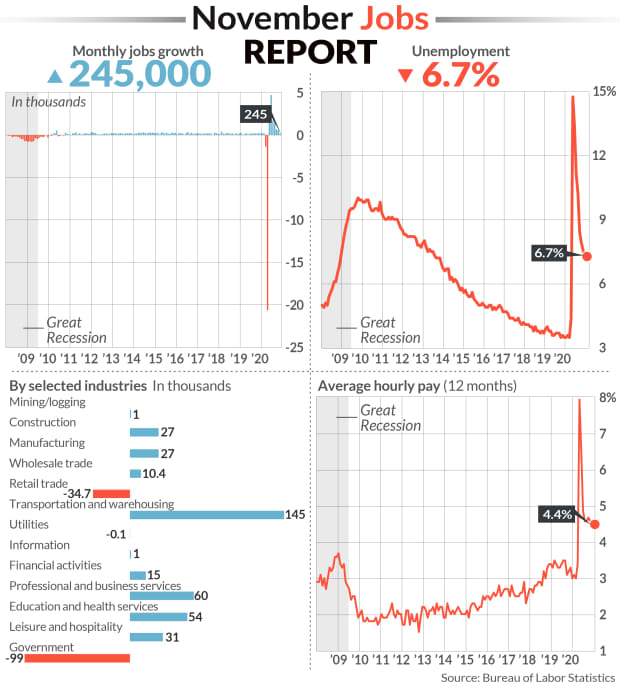
November jobs report: US economy adds 245,000 jobs, unemployment rate falls to 6.7%

https://finance.yahoo.com/news/november-2020-jobs-report-labor-market-coronavirus-pandemic-unemployment-183714326.html

The 245,000 new jobs added last month is smallest since U.S. recovery began  in May - MarketWatch

The U.S. economy added back the smallest number of jobs in seven months in November, as the labor market endured mounting pressure from the coronavirus pandemic while businesses wait for a vaccine to be distributed next year.

The U.S. Department of Labor released its monthly jobs report Friday morning at 8:30 a.m. ET. Here were the main results from the report, compared to Bloomberg consensus data as of Friday morning:

  • Change in non-farm payrolls: +245,000 vs. +460,000 expected and a revised +610,000 in October
  • Unemployment rate: 6.7% vs. 6.7% expected and 6.9% in October
  • Average Hourly Earnings month-over-month: 0.3% vs. +0.1% expected and +0.1% in October
  • Average Hourly Earnings year-over-year: 4.4% vs. +4.2% expected and a revised +4.4% in October

During November, a plethora of new stay-in-place measures and curfews swept the nation as COVID-19 cases, hospitalizations and deaths swelled to record levels. These renewed restrictions weighed on the rate of the recovery in the labor market, which had already been slowing after a record surge in rehiring followed the initial wave of lockdowns in the spring.

To that end, job gains in November sharply missed expectations. Non-farm payrolls grew by just 245,000 during the month for the smallest number since April’s record, virus-induced decline. October’s payroll gain was downwardly revised to 610,000 from the 638,000 reported earlier, while September’s gain was raised to 711,000 from 672,000.

A third straight month of declining government employment served as a drag on the headline payrolls figure, as another 93,000 temporary workers hired for the 2020 Census were let go.

In the private sector, retail trade industries shed nearly 35,000 jobs following a gain of 95,000 in October. Leisure and hospitality employers added just 31,000 jobs during November, declining by nearly 90% from October. And in goods-producing industries, manufacturing jobs rose by only 27,000 for the month, falling short of the 40,000 expected.

But a handful of other industries added more jobs in November from October: Transportation and warehousing jobs grew by 145,000 to more than double October’s advance, and growth in wholesale trade positions also doubled to 10,400.

November’s unemployment rate also improved just marginally to 6.7% from the 6.9% reported in October. While down from a pandemic-era high of 14.7% in April, the jobless rate remains nearly double that from before the pandemic.

Other employment reports this week underscored the decelerating trend. Private-sector hiring fell to the lowest level in four months in November, according to data tracked by ADP. New weekly jobless claims began rising again around the 12th of the month, when the Labor Department conducts its surveys for its monthly jobs report. And in the Federal Reserve’s November Beige Book, the central bank noted that nearly all districts reported rising employment, “but for most, the pace was slow, at best, and the recovery remained incomplete.”

The U.S. economy still has a ways to go before fully making up for the drop in payrolls induced by the pandemic. Even with a seventh straight month of net job gains, the economy remains about 9.8 million jobs short of its pre-pandemic level in February. The U.S. economy lost more than 22 million jobs between March and April.

And worryingly, the number of the long-term unemployed has kept climbing. Those classified as “permanent job losers” totaled 3.7 million in November, eclipsing the number of individuals on temporary layoff for the second time since the start of the pandemic. Permanent job losers have increased by 2.5 million since February, before the pandemic meaningfully hit the U.S. economy.

In Washington, congressional lawmakers have for months been at a stalemate over the size and scope of another stimulus package, which could help provide funds for businesses to help keep workers employed, and offer extended unemployment benefits for those the pandemic has kept out of work. Federal unemployment programs authorized under the CARES Act in the spring are poised to expire at the end of the month. These include the Pandemic Emergency Unemployment Compensation and Pandemic Unemployment Assistance programs, which together provide benefits for more than 13 million Americans.

“The only thing that matters about today’s NFP [non-farm payrolls] report is whether it increases the likelihood of a stimulus deal getting done during the lame duck session,” Peter Tchir, head of macro strategy for Academy Securities, said in an email Friday morning. “While the unemployment rate shrunk and wages ticked up nicely, the headline number dropped significantly, was well below average expectations, and included some downward revisions to last month (and upward revisions to 2 months ago)all of which point to a less robust job market.”

Affordable Care Act market for 2021 sees strong insurer participation

https://www.healthcarefinancenews.com/news/ffordable-care-act-market-2021-sees-strong-insurer-participation

Insurer Participation on the ACA Marketplaces, 2014-2021 | KFF

Some 30 insurers are entering the individual market, and an additional 61 are expanding their service area within states, a KFF report says. 

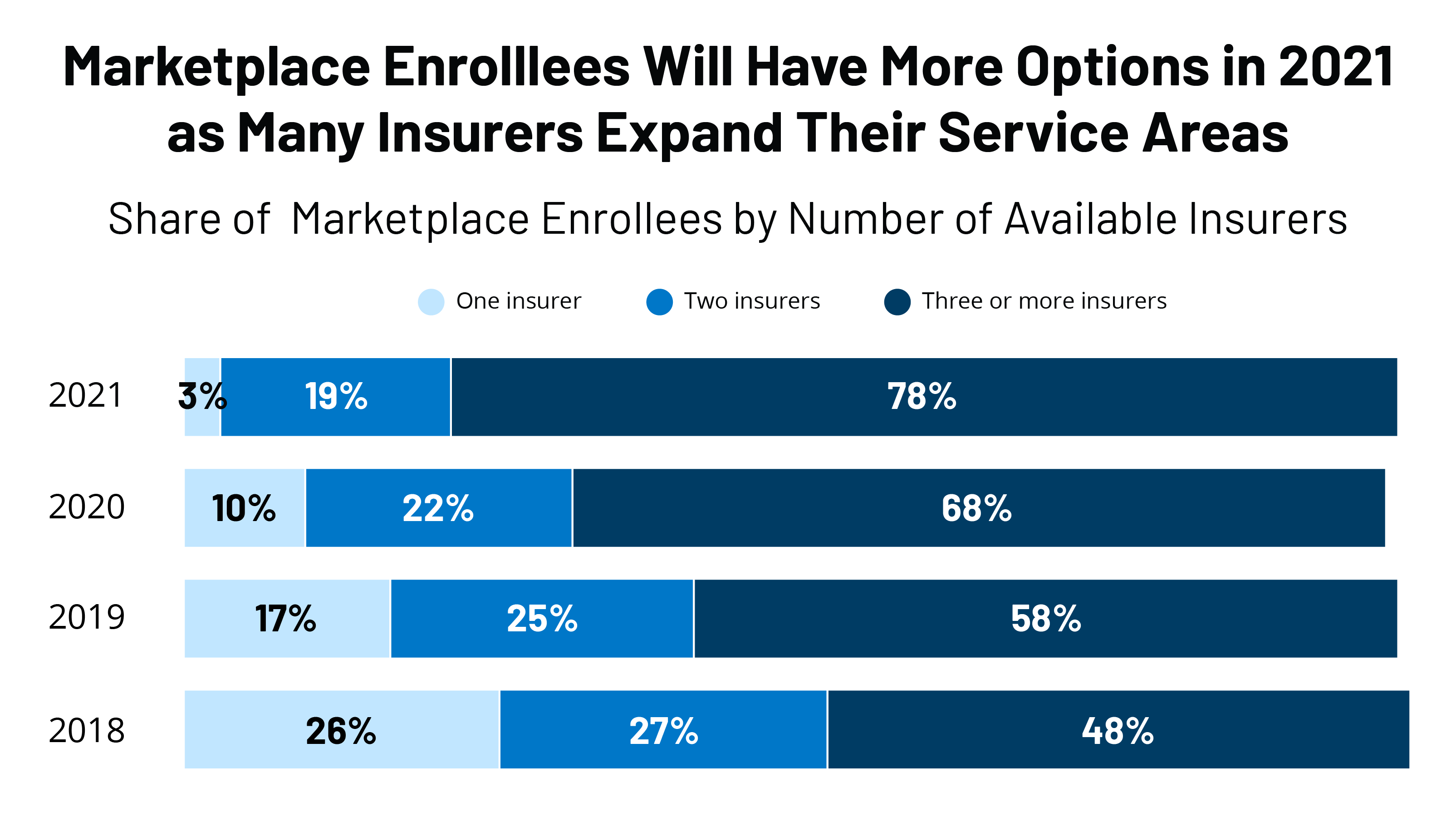
Insurer participation in the Affordable Care Act marketplace in 2021 is seeing a third straight year of growth as several insurers are entering the market or expanding their service area, according to a recent Kaiser Family Foundation report.

For instance, in 2020, UnitedHealthcare, the nation’s largest insurer, became a new entrant in five states, according to the report: Arizona, Maryland, North Carolina, Tennessee and Virginia. Twenty states had new entrants to the market.

For 2021, 30 insurers are entering the individual market, and an additional 61 are expanding their service area within states. 

There will be an average of five insurers per state in 2021, up from a low of 3.5 in 2018, but still below the peak of six in 2015. Only 10% of counties will have a single insurer offering in 2021, down from 52% of counties in 2018, the report said. Rural areas tend to have fewer insurers in the ACA market.

Often, when there is only one insurer participating on the exchange, that company is a Blue Cross Blue Shield or Anthem plan, the report said. Before the ACA, state individual markets were often dominated by a single Blue Cross Blue Shield plan.

WHY THIS MATTERS

Despite uncertainties surrounding the ongoing pandemic, the end of the individual mandate and the question of whether the Supreme Court will rule next year to invalidate the entire ACA, the numbers show that insurers appear bullish on participation.

Insurers remained profitable during the pandemic due to decreases in healthcare utilization and claims costs. They are on track yet again to owe substantial rebates to consumers based on low medical loss ratios in 2021.

Even with the lack of a mandate, individuals continue to enroll in ACA plans, with enrollment this year more than keeping pace with last year’s figures. Premiums for 2021 are 1-4% below the average.

THE LARGER TREND

The enrollment numbers continue a trend of rising insurer participation in the ACA going into the 2020 market, and lower premiums.

Insurer participation next year equals the average participation levels at the outset of the marketplaces in 2014, according to the KFF report. 

Since 2014, the number of insurers participating on the exchanges has been in flux. Going into the 2018 plan year, many insurers left the market or reduced their footprint due to losses in the market.

Nearly 19 million Americans could lose their homes when eviction limits expire Dec. 31

https://www.cbsnews.com/news/eviction-19-million-americans-risk-moratorium-coronavirus/?fbclid=IwAR00kcIsPPl3eqPlHJ_fbcUUPOGHlfe3zniscQZw5HagvgRGso7DwHNKveg

Nearly 19 million Americans could lose their homes when eviction limits  expire Dec. 31 - CBS News

Millions of Americans are in danger of losing their homes when federal and local limits on evictions expire at the end of the year, a growing body of research shows.

report issued this month from the National Low Income Housing Coalition (NLIHC) and the University of Arizona estimates that 6.7 million households could be evicted in the coming months. That amounts to 19 million people potentially losing their homes, rivaling the dislocation that foreclosures caused after the subprime housing bust.

Apart from being a humanitarian disaster, the crisis threatens to exacerbate the coronavirus pandemic, according to a forthcoming study in the Journal of Urban Health.

Our concern is we’re going to see a huge increase in evictions after the CDC moratorium is lifted,” said Andrew Aurand, vice president of research at the NLIHC and a co-author of the report.

The number of Americans struggling to pay rent has steadily risen since this summer, according to the Census Bureau’s Household Pulse Survey. In the latest survey, from early November, 11.6 million people indicated they wouldn’t be able to pay the rent or mortgage next month.

Meanwhile, some renters who are still paying rent are relying on “unsustainable” income to make ends meet. Among those who report trouble making rent, “More than half are borrowing from family and friends to meet their spending needs, one-third are using credit cards, and one-third are spending down savings,” the NLIHC report found.

Approaching a “payment cliff”

In early September, the U.S. Centers for Disease Control and Prevention barred evictions through year-end, describing the move as a public health measure to reduce spread of the coronavirus. The CDC order protects renters earning less than $99,000 if they have lost income during the pandemic and are likely to become homeless if they’re evicted. 

Many states and cities also imposed renter protections during the spring and summer, and others established rental assistance programs to help tenants make ends meet. However, both types of programs are quickly expiring.

Once the CDC moratorium expires,Aurand said, “We expect to see a jump in [eviction] filings, and we know that even now, filings are already occurring. Come January, sadly, for a number of tenants, the next step is the landlord will evict them.”

The situation could reach crisis levels in the new year. With Congress yet to pass another coronavirus relief package, about 12 million Americans are set to lose their unemployment benefits the day after Christmas, a sharp fall in income that would make it harder for many people to pay rent. An abrupt cutoff would slash income by about $19 billion per month, Nancy Vanden Houten, lead economist at Oxford Economics, said in a research note.

Although the Trump Administration has restricted evictions for most households through the end of the year, it did not relieve renters of the need to pay rent. That means many renters may face a “payment cliff” at year’s end, when they must pay several months’ worth of back rent or face eviction.  

“If renters are required to quickly repay past due rent or face eviction, the hardship will fall predominantly on lower-income families who have already been disproportionately affected by the coronavirus crisis,” Vanden Houten wrote.

Said Aurand, “If you were a low-income renter before the pandemic and you were hit financially, even if your income starts to recover, you’re going to have a very hard time paying back that rental debt.”

“What we really need is rental assistance,” he noted. “The underlying problem is renters struggling to pay their rent because we’re in an economic crisis, and the moratorium doesn’t address that.”

Long-term impact

Academics have also pushed for direct aid to renters and homeowners, citing the extreme economic fallout from the coronavirus and related shutdowns. In Los Angeles, where 1 in 5 renters were late on rent at some point this summer, residents are facing “an income crisis layered atop of a housing crisis,” researchers at the University of California – Los Angeles have said.

“Delivering assistance to renters now can not just stave off looming evictions, but also prevent quieter and longer-term problems that are no less serious, such as renters struggling to pay back credit card or other debt, struggling to manage a repayment plan, or emerging from the pandemic with little savings left,” they wrote in August report. “Renter assistance can also help the smaller landlords who are disproportionately seeing tenants unable to pay.”

A groundswell of evictions would cause enormous financial hardship. Losing a home is one of the most traumatic events a family can experience, with research showing that people who have experienced eviction are more likely to lose their jobs, fall ill or suffer from mental-health consequences. Children whose families are evicted are more likely to drop out of school, while evictions also contribute to the spread of COVID-19, according to a forthcoming study from UCLA viewed by “60 Minutes.

“We’ve got a country that’s about to witness evictions like they’ve never witnessed before,” Laura Tucker, a social worker for Florida’s Hillsborough County School District, told “60 Minutes.”

“An eviction can impact a family’s ability to re-house for more than 10 years,” she said.

For that reason, housing and public health experts have said that rental aid now

“Now is the time for action to provide emergency rental assistance. A failure to do so will result in millions of renters spiraling deeper into debt and housing poverty, while public costs and public health risks of eviction-related homelessness increase,” the NLIHC report says. “These outcomes are preventable.”

Biden Wants To Lower Medicare Eligibility Age To 60, But Hospitals Push Back

Biden Plan To Lower Medicare Eligibility Age Faces Hostility From Hospitals  : Shots - Health News : NPR

Of his many plans to expand insurance coverage, President-elect Joe Biden’s simplest strategy is lowering the eligibility age for Medicare from 65 to 60.

But the plan is sure to face long odds, even if the Democrats can snag control of the Senate in January by winning two runoff elections in Georgia.

Republicans, who fought the creation of Medicare in the 1960s and typically oppose expanding government entitlement programs, are not the biggest obstacle. Instead, the nation’s hospitals — a powerful political force — are poised to derail any effort. Hospitals fear adding millions of people to Medicare will cost them billions of dollars in revenue.

“Hospitals certainly are not going to be happy with it,” said Jonathan Oberlander, professor of health policy and management at the University of North Carolina at Chapel Hill.

Medicare reimbursement rates for patients admitted to hospitals are on average half what commercial or employer-sponsored insurance plans pay.

“It will be a huge lift [in Congress] as the realities of lower Medicare reimbursement rates will activate some powerful interests against this,” said Josh Archambault, a senior fellow with the conservative Foundation for Government Accountability.

Biden, who turns 78 this month, said his plan will help Americans who retire early and those who are unemployed or can’t find jobs with health benefits.

“It reflects the reality that, even after the current crisis ends, older Americans are likely to find it difficult to secure jobs,” Biden wrote in April.

Lowering the Medicare eligibility age is popular. About 85% of Democrats and 69% of Republicans favor allowing those as young as 50 to buy into Medicare, according to a Kaiser Family Foundation tracking poll from January 2019. (Kaiser Health News is an editorially independent program of the Kaiser Family Foundation.)

Although opposition from the hospital industry is expected to be fierce, it is not the only obstacle to Biden’s plan.

Critics, especially Republicans on Capitol Hill, will point to the nation’s $3 trillion budget deficit as well as the dim outlook for the Medicare Hospital Insurance Trust Fund. That fund is on track to reach insolvency in 2024. That means there won’t be enough money to pay hospitals and nursing homes fully for inpatient care for Medicare beneficiaries.

It’s also unclear whether expanding Medicare will fit on the Democrats’ crowded health agenda, which includes dealing with the COVID-19 pandemic, possibly rescuing the Affordable Care Act (if the Supreme Court strikes down part or all of the law in a current case), expanding Obamacare subsidies and lowering drug costs.

Biden’s proposal is a nod to the liberal wing of the Democratic Party, which has advocated for Sen. Bernie Sanders’ government-run “Medicare for All” health system that would provide universal coverage. Biden opposed that effort, saying the nation could not afford it. He wanted to retain the private health insurance system, which covers 180 million people.

To expand coverage, Biden has proposed two major initiatives. In addition to the Medicare eligibility change, he wants Congress to approve a government-run health plan that people could buy into instead of purchasing coverage from insurance companies on their own or through the Obamacare marketplaces. Insurers helped beat back this “public option” initiative in 2009 during the congressional debate over the ACA.

The appeal of lowering Medicare eligibility to help those without insurance lies with leveraging a popular government program that has low administrative costs.

“It is hard to find a reform idea that is more popular than opening up Medicare” to people as young as 60, Oberlander said. He said early retirees would like the concept, as would employers, who could save on their health costs as workers gravitate to Medicare.

The eligibility age has been set at 65 since Medicare was created in 1965 as part of President Lyndon Johnson’s Great Society reform package. It was designed to coincide with the age when people at that time qualified for Social Security. Today, people generally qualify for early, reduced Social Security benefits at age 62, but full benefits depend on the year you were born, ranging from age 66 to 67.

While people can qualify on the basis of other criteria, such as having a disability or end-stage renal disease, 85% of the 57 million Medicare enrollees are in the program simply because they’re old enough.

Lowering the age to 60 could add as many as 23 million people to Medicare, according to an analysis by the consulting firm Avalere Health. It’s unclear, however, if everyone who would be eligible would sign up or if Biden would limit the expansion to the 1.7 million people in that age range who are uninsured and the 3.2 million who buy coverage on their own.

Avalere says 3.2 million people in that age group buy coverage on the individual market.

While the 60-to-65 group has the lowest uninsured rate (8%) among adults, it has the highest health costs and pays the highest rates for individual coverage, said Cristina Boccuti, director of health policy at West Health, a nonpartisan research group.

About 13 million of those between 60 and 65 have coverage through their employer, according to Avalere. While they would not have to drop coverage to join Medicare, they could possibly opt to pay to join the federal program and use it as a wraparound for their existing coverage. Medicare might then pick up costs for some services that the consumers would have to shoulder out of pocket.

Some 4 million people between 60 and 65 are enrolled in Medicaid, the state-federal health insurance program for low-income people. Shifting them to Medicare would make that their primary health insurer, a move that would save states money since they split Medicaid costs with the federal government.

Chris Pope, a senior fellow with the conservative Manhattan Institute, said getting health industry support, particularly from hospitals, will be vital for any health coverage expansion. “Hospitals are very aware about generous commercial rates being replaced by lower Medicare rates,” he said.

“Members of Congress, a lot of them are close to their hospitals and do not want to see them with a revenue hole,” he said.

President Barack Obama made a deal with the industry on the way to passing the ACA. In exchange for gaining millions of paying customers and lowering their uncompensated care by billions of dollars, the hospital industry agreed to give up future Medicare funds designed to help them cope with the uninsured. Showing the industry’s prowess on Capitol Hill, Congress has delayed those funding cuts for more than six years.

Jacob Hacker, a Yale University political scientist, noted that expanding Medicare would reduce the number of Americans who rely on employer-sponsored coverage. The pitfalls of the employer system were highlighted in 2020 as millions lost their jobs and their workplace health coverage.

Even if they can win the two Georgia seats and take control of the Senate with the vice president breaking any ties, Democrats would be unlikely to pass major legislation without GOP support — unless they are willing to jettison the long-standing filibuster rule so they can pass most legislation with a simple 51-vote majority instead of 60 votes.

Hacker said that slim margin would make it difficult for Democrats to deal with many health issues all at once.

“Congress is not good at parallel processing,” Hacker said, referring to handling multiple priorities at the same time. “And the window is relatively short.”