UnitedHealth Group posts $6.6B in Q2 profit amid COVID-19 care deferrals

https://www.fiercehealthcare.com/payer/unitedhealth-group-posts-6-6b-q2-profit-amid-covid-19-care-deferrals?utm_medium=nl&utm_source=internal&mrkid=959610&mkt_tok=eyJpIjoiTldOaVpEUTJOMk0yTWpNNSIsInQiOiJJcFROOCtmWDU4TEhnT0FkTFFCTHZmRHpVWHBJV015M0QzQSswV3llT2liQzFsXC9wM1VYXC8yT2xsREdQVVh1WnhvNHk3TEdHNEtrTlZcL2s5WXlWZXZVMjR1TUdPZEgrNnVPOTVuYUNJSVo5VmFhT05XQlZYYmlJTHE2ekhwZENDdCJ9

The outside of UnitedHealth Group's headquarters

UnitedHealth Group reported $6.6 billion in profit for the second quarter, beating Wall Street projections.

That’s also a significant increase in profit compared to the second quarter of 2019, where the healthcare giant brought in $3.3 billion, according to its earnings report (PDF) issued Wednesday.

UnitedHealth’s mid-year profits sit at $10 billion, compared to $6.8 billion in the first half of 2019.

The insurer also reported $62.1 billion in revenue for the quarter, an increase year-over-year but a number that fell short of analysts’ expectations. UnitedHealth brought in $60.6 billion in revenue in the second quarter of 2019.

Through the first half of 2020, UnitedHealth has earned $126.6 billion in revenue, up from $120.9 billion in the first six months of 2019.

The insurer attributes the unexpectedly high profit to large amounts of care deferral due to the coronavirus pandemic and said it’s likely to see that offset in future quarters as elective procedures and other services resume.

In the earnings release, CEO David Wichmann touted the company’s efforts to combat the pandemic in the second quarter.

“Our 325,000 dedicated team members, including the 120,000 clinicians serving on the front lines of care, have tirelessly responded to COVID-19 with agility, innovation and compassion,” Wichmann said in a statement.

“We moved swiftly to assist the people we serve and their care providers, including the provision of $3.5 billion in proactive voluntary customer assistance and accelerated care provider funding. We remain committed to taking further actions to address any future imbalances as a result of the pandemic,” he said.

Though COVID-19’s full impact on finances remains unclear, UnitedHealth maintained its full-year earnings guidance of between $15.45 and $15.75 per share.


5.4 million Americans lost health insurance

https://www.axios.com/newsletters/axios-vitals-285240f4-9110-4c86-ad7e-e0c37085a957.html?utm_source=newsletter&utm_medium=email&utm_campaign=newsletter_axiosvitals&stream=top

Medicare for All (@AllOnMedicare) | Twitter

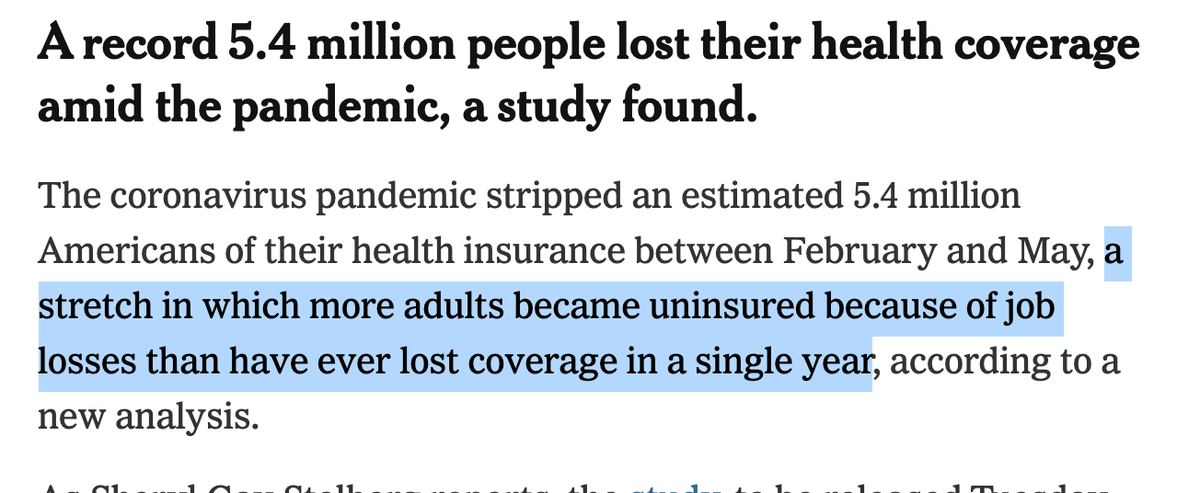
Roughly 5.4 million adults in the U.S. lost their health insurance from February to May after losing their jobs, according to a new estimate from Families USA, a group that favors the Affordable Care Act.

Why it matters: There are more adults under 65 without insurance in Southern states, which are the same states setting new records for single-day coronavirus infections along with rising hospitalizations, Axios’ Orion Rummler writes.

What they found: 3.9 million adults lost health insurance over one year during the Great Recession, per Families USA’s analysis. It only took four months in this current crisis for an estimated 5.4 million Americans to lose health insurance.

  • More than 20% of adults in Georgia, Florida, South Carolina, North Carolina, Mississippi, Oklahoma and Texas were without insurance as of May.
  • All of these states have set new records in the past two weeks for their highest number of coronavirus infections in a single day, per data from the COVID Tracking Project.
  • 46% of adults who lost coverage due to the pandemic came from five states: Florida, New York, Texas, California and North Carolina.

The backdrop: 21 million Americans were unemployed in May, according to the Bureau of Labor Statistics’ nonfarm payrolls report.


Trump admin seeks relaxed grandfathered ACA health plan rules that up out-of-pocket costs

https://www.healthcaredive.com/news/trump-admin-seeks-relaxed-grandfathered-aca-health-plan-rules-that-up-out-o/581463/

Paying for Health Insurance Out of Pocket Maximum, OOP Health ...

Dive Brief:

  • The Trump administration proposed a rule Friday to allow some group health plans grandfathered under the Affordable Care Act to raise out-of-pocket costs for enrollees but still allow them to have health savings accounts. Such plans must not discriminate against enrollees with pre-existing conditions, but are exempt from many other ACA regulations. If they violate any rules regarding costs or structure they lose their grandfathered status and are required to follow all the mandates of the landmark 2010 law.
  • The proposed rule, issued by the U.S. Department of Labor, would relax some of the complex inflation and pricing calculations grandfathered plans must follow. The department admitted that the change could lead to higher deductibles and other out-of-pocket costs for the estimated 23.1 million enrollees in such grandfathered plans.
  • The rule stems from a 2017 executive order issued by President Donald Trump that allows regulatory changes to be made in response to perceived economic burdens imposed by the ACA. However, the Labor Department conceded in its Federal Register publication of the proposed rule that the current rules for grandfathered health plans probably weren’t that burdensome.

Dive Insight:

The administration has made no secret of its ire for the ACA and is actively trying to overturn it at the U.S. Supreme Court. A release explaining the changes notes fixed cost-sharing for high-deductible health plans would be raised, and “an alternative method of measuring permitted increases in fixed-amount cost sharing” has been introduced that “would allow plans and issuers to better account for changes in the costs of health coverage over time.”

The formal 76-page proposal, published in the Federal Register on Sunday, said premiums might go down as a result of the changes, but there were no estimates provided or circumstances where that might occur.

Moreover, the proposed rule also noted that the change could lead to more people foregoing healthcare because their out-of-pocket costs might become unaffordable.

The Labor Department also noted that there have been so few fluctuations in the state of grandfathered health plans in recent years that it was likely the current regulations were not overly burdensome in the first place.

Public comments will be solicited until mid-August before a final rule is issued.

Sen. Patty Murray, D-Wash., and ranking member of the Senate Health, Education, Labor, and Pensions Committee, wasted little time late last week blasting the proposal.

“Regardless of what the president wants to believe, we’re in the middle of a pandemic that is devastating families’ health and finances,” Murray said in a statement.


June’s cautious economic recovery is based in part-time work and vulnerable industries

https://www.washingtonpost.com/business/2020/07/02/junes-cautious-economic-recovery-is-based-part-time-work-vulnerable-industries/?fbclid=IwAR290sM5RZgwuxNMBDi1chv_i1ulzy4zY2KF4f1cDUMCsiTTpME2wkGVM6s&utm_campaign=wp_main&utm_medium=social&utm_source=facebook


The June unemployment rate of 11.1 percent, down from a peak of 14.7 percent in April, reflects a continuing, cautious economic recovery. What those numbers don’t show is an increase in employment driven disproportionately by part-time work and industries that are vulnerable to another shutdown.

The unemployment rate is a blunt tool. It takes into account anyone who works, even if they work for only one hour a week. And part-time employment has recovered much more quickly from April’s catastrophic losses than full-time employment. While full-time employment is still 12 percent lower than it was in February, part-time employment is back to pre-pandemic levels.

According to the Labor Department’s survey of American households, many of those workers would work full-time if they could and are working part-time only because of poor economic conditions. The number of people pushed into part-time work has more than doubled since February. Meanwhile, the number of people who work part-time by choice is still down by 23 percent.


The unemployment rate isn’t wrong: Part-time work is still work. However, those jobs have already proved to be vulnerable to a slowing economy. Anyone pushed into part-time work by the coronavirus’s initial shock to the economy may be even more vulnerable in the case of future shutdowns. And part-time workers may not have access to benefits such as health insurance that are available to full-time workers.

The industries that bounced back in May and June are also at the mercy of future shutdowns as coronavirus cases surge across the Sun Belt. For instance, unemployment in leisure and hospitality is still very high but dropped by 10 percentage points from April’s staggering 40 percent. Retail and wholesale unemployment dropped by a third. In contrast, finance, government and professional services have had a slow start to recovery. Unemployment in the information industry actually increased from May to June.


If the greatest gains in employment are in industries that suffered most in the early stages of the pandemic, those gains are vulnerable to future waves of shutdowns. Meanwhile, less-volatile industries may continue to be slow to bounce back. A Congressional Budget Office report predicted that the unemployment rate is expected to stay above its pre-pandemic levels through the end of 2030.


12 hospitals laying off workers in response to COVID-19

https://www.beckershospitalreview.com/finance/12-hospitals-laying-off-workers-in-response-to-covid-19.html?utm_medium=email

Facing a financial squeeze, hospitals nationwide are cutting jobs

To address the financial fallout from the COVID-19 pandemic, hospitals across the nation are looking to cut costs by implementing furloughs, layoffs or pay cuts. 

U.S. hospitals are expected to lose $323.1 billion this year due to the pandemic, according to a recent report from the American Hospital Association. The total includes $120.5 billion in financial losses that hospitals are projected to see from July through December, as well as $202.6 billion in losses that were projected between March and June. The losses were largely due to a lower patient volume after canceling elective procedures. 

Although Congress allocated $175 billion to help hospitals offset some of the revenue losses and expense increases to prepare for the pandemic, hospitals have said it is not enough.

Nearly 270 hospitals and health systems have furloughed workers in response to the pandemic and several others have implemented layoffs. 

Below are 12 hospitals and health systems that have announced layoffs since June 1:

1. Trinity Health furloughs, lays off another 1,000 workers
Trinity Health, a 92-hospital system based in Livonia, Mich., will lay off and reduce work schedules of 1,000 employees.

2. Ohio children’s hospital cuts jobs
Dayton (Ohio) Children’s Hospital said it has cut jobs to help offset financial losses due to the COVID-19 pandemic.

3. Munson Healthcare to cut 25 leadership positions
Traverse City, Mich.-based Munson Healthcare cut 25 leadership positions to help offset financial losses amid the COVID-19 pandemic.

4. Erlanger lays off 93 nonclinical employees
Chattanooga, Tenn.-based Erlanger Health System has cut 93 nonclinical positions to help offset financial damage from the COVID-19 pandemic. The layoffs come after the health system cut 11 leadership positions June 12, including the CEO of Erlanger Western Carolina Hospital in Murphy, N.C., and made staff and pay cuts in March.

5. Michigan Medicine to lay off 738 employees by end of June
Ann Arbor-based Michigan Medicine planned to eliminate 738 positions by the end of June amid financial challenges from the COVID-19 pandemic.

6. Pennsylvania health system cuts 10% of workforce amid pandemic losses
As part of a restructuring effort to cut pandemic-related losses, State College, Pa.-based Mount Nittany Health System plans to lay off 10 percent of its workforce, or about 250 employees.

7. TriHealth eliminates 440 positions to cut costs
Cincinnati-based TriHealth cut 440 positions as part of a plan to trim at least $140 million in expenditures this year.

8. Layoffs hit U of Kansas Health System
The University of Kansas Health System St. Francis Campus in Topeka laid off employees after previously implementing furloughs.

9. Tower Health to cut 1,000 jobs
Citing a $212 million loss in revenue through May due to the COVID-19 pandemic, West Reading, Pa.-based Tower Health plans to cut 1,000 jobs.

10. Colorado hospital cuts 22 positions
Parkview Medical Center in Pueblo, Colo., eliminated 22 positions in response to the COVID-19 pandemic.

11. Arkansas Children’s cuts 42 positions
Little Rock-based Arkansas Children’s Hospital said it is eliminating 42 jobs as part of cost-savings measures in response to the COVID-19 pandemic.

12. North Carolina health system cuts 10% of workforce, closes clinics
Citing a financial hit from the COVID-19 pandemic, Lumberton, N.C.-based Southeastern Health will permanently close several clinics, cut 10 percent of its workforce and reduce executive pay.


Pre And Post Coronavirus Unemployment Rates By State, Industry, Age Group, And Race

https://www.forbes.com/sites/mikepatton/2020/06/28/pre-and-post-coronavirus-unemployment-rates-by-state-industry-age-group-and-race/#65c42c6555eb
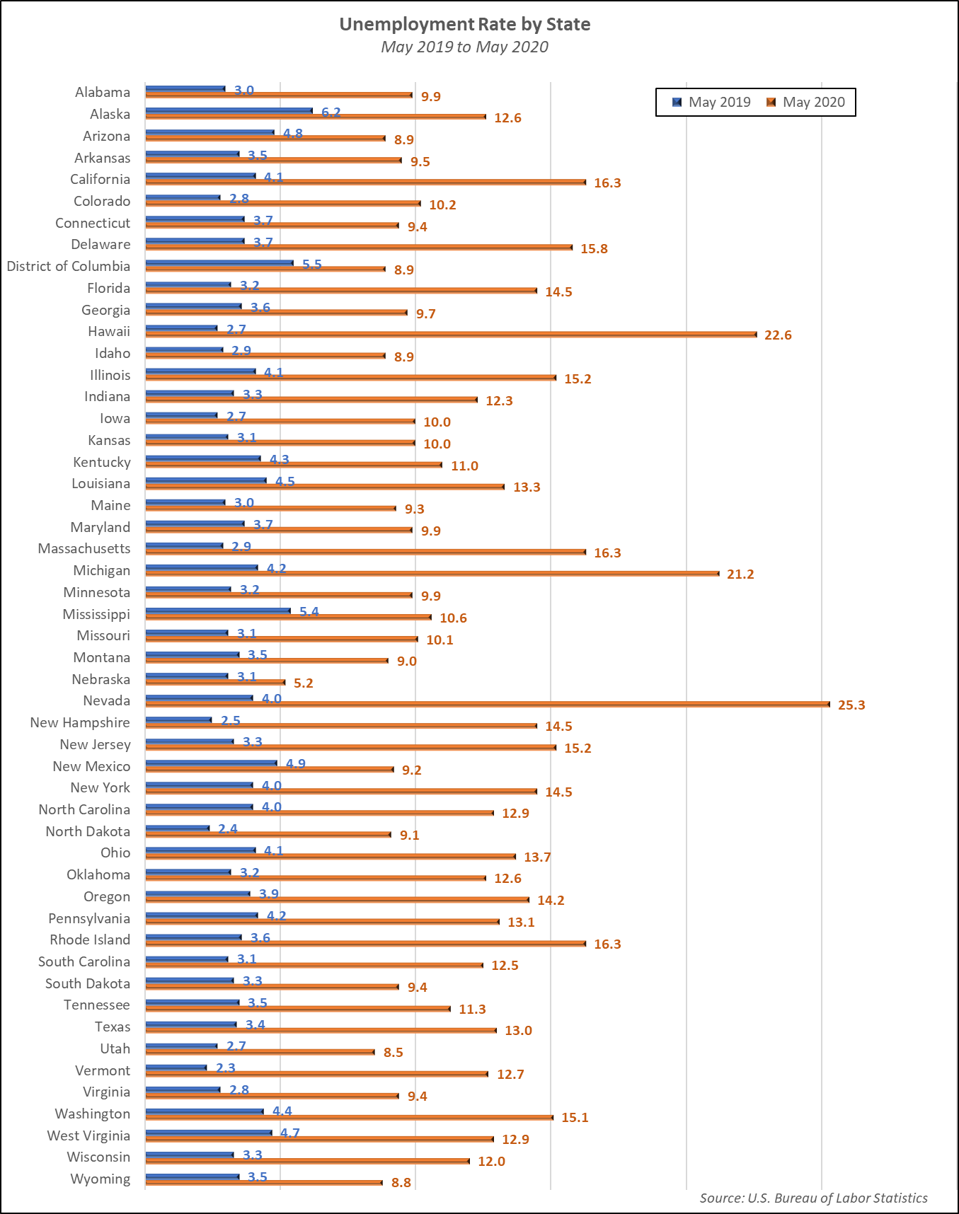
Unemployment by State-May 2019 to May 2020

The coronavirus has decimated the U.S. economy and benched nearly 40 million American workers. In the past several days, the U.S. has logged its highest number of new Covid-19 cases since the pandemic began. These combined with other factors, which we will discuss, is jeopardizing the future employment of millions of workers and the viability of thousands of businesses. Here’s how unemployment has increased for every state, industry, age group, and race, and why.

Unemployment by State

The coronavirus and subsequent stay at home orders hit the labor force especially hard. As states attempted to reopen, a resurgence in the virus is causing many businesses to close again, some by choice, others by government mandate.

Nevada has been hit the hardest as the unemployment rate in the Silver State rose from 4.0% in May 2019 to a whopping 25.3% in May 2020. Nevada’s economy is heavily reliant on leisure and hospitality, which had the brunt of the job losses. Hawaii, the second hardest hit state saw unemployment rise from 2.7% in May 2019 to 22.6% in May 2020. Which is the only other state with unemployment above 20% in May 2020? Michigan, where unemployment rose from 4.2% to 21.2% year over year. What state has fared best? Nebraska, which also has one of the most diverse economies of all states. Deriving nearly 50% of its total GDP from five different industries, unemployment in the Cornhusker State rose from 3.1% to a modest 5.2% from May 2019 to May 2020. Unemployment numbers for all states are shown in the following chart.

Unemployment by Industry

As mentioned in the previous section, the states that have fared best either have a more diverse economy or do not rely heavily on industries that have been hardest hit by the coronavirus. The most negatively affected is the leisure and hospitality industry where unemployment rose 618% from a low of 5.0% in May 2019 to a staggering 35.9% in May 2020. At a distant second, but still reeling, is the wholesale and retail trade industry, which saw unemployment rise from 4.2% to 15.1% during the same period. The rest of the industries are listed in the following chart.
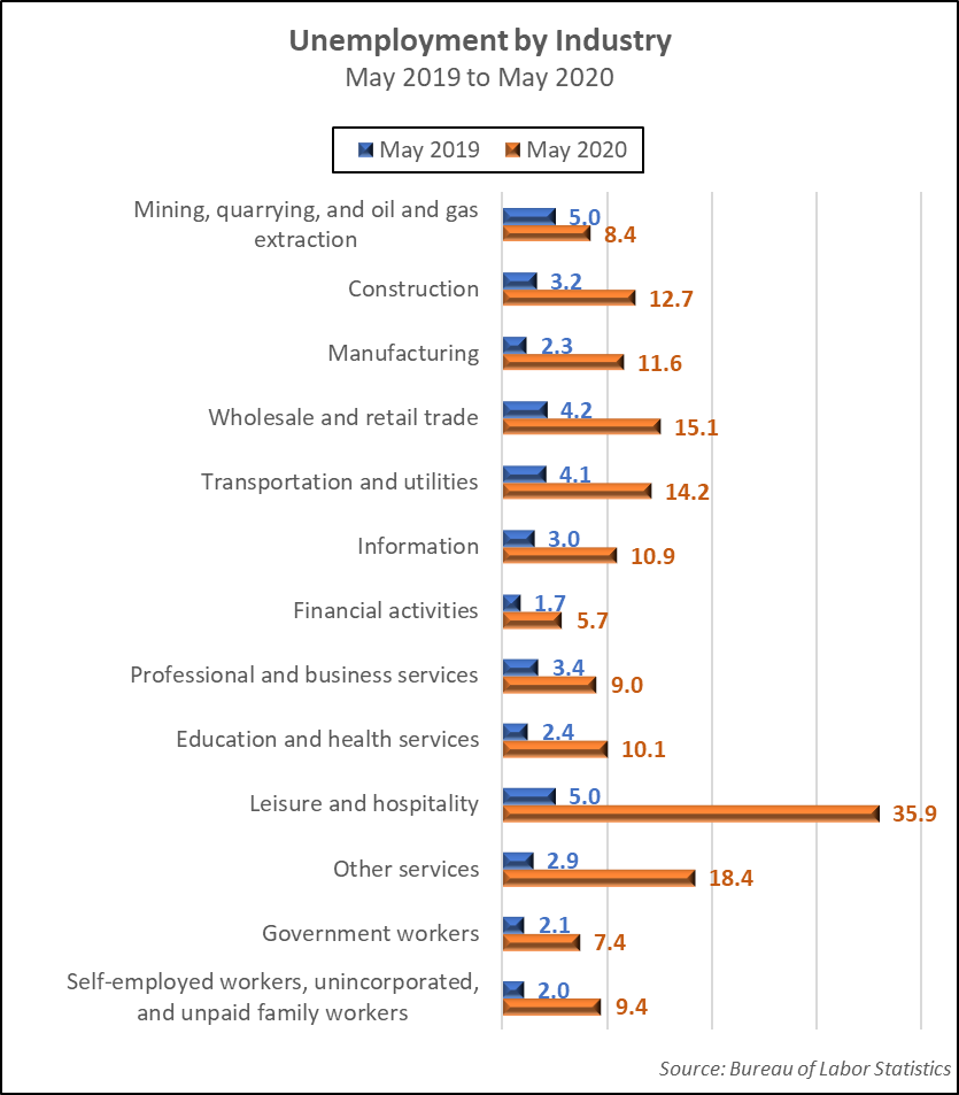
Unemployment by Industry-May 2019 to May 2020

Unemployment by Age Group

Businesses need two things to exist: workers and customers. Without customers, there is no need for workers or the business for that matter. Some businesses require highly skilled workers while others operate well using unskilled labor. It is this unskilled labor group that has been hardest hit.

The greatest rise in unemployment is among workers under age 25. This is likely due to three factors. Younger workers typically have fewer marketable skills, less work experience, and less seniority. Many of these workers are in industries that have felt the greatest pain. Unemployment rates by age group are contained in the following chart.
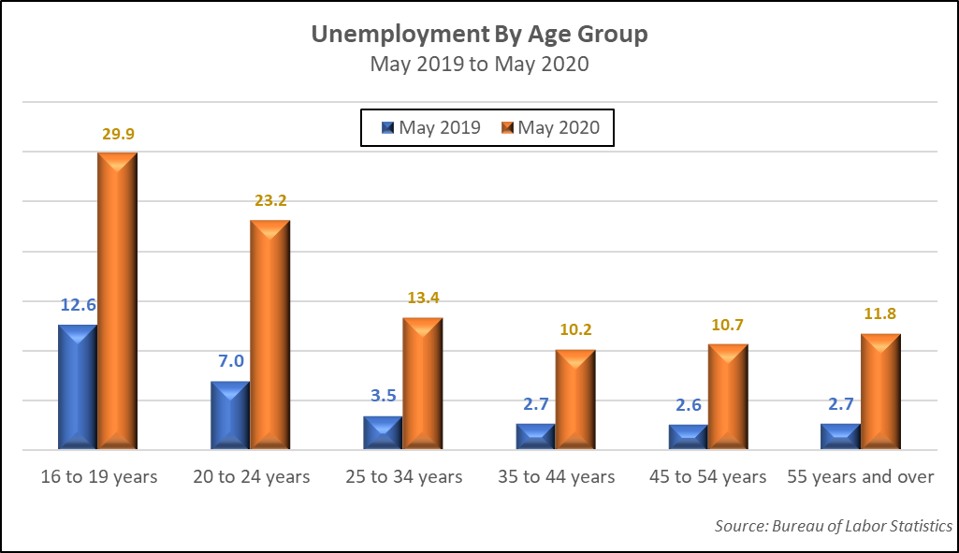
Unemployment by Age Group-May 2019 to May 2020

Unemployment by Race/Ethnicity

Question: Prior to Covid-19, was unemployment among blacks / African Americans at a record low as President Trump has claimed? Using the available data, which extends back to January 1972, the answer is yes. This new record low was achieved in October and November of 2019 when unemployment among black or African American workers fell to 5.1%. The previous record low was 5.2% in December 1973. The current rate is 16.8%, which is less than the highest rate of 20.7% logged in December 1982. The most recent high in unemployment for this group was 19.3% in March 2010. It has been steadily declining since then. Numbers for White, Asian, and Hispanic or Latino and black or African American workers are listed in the following chart.
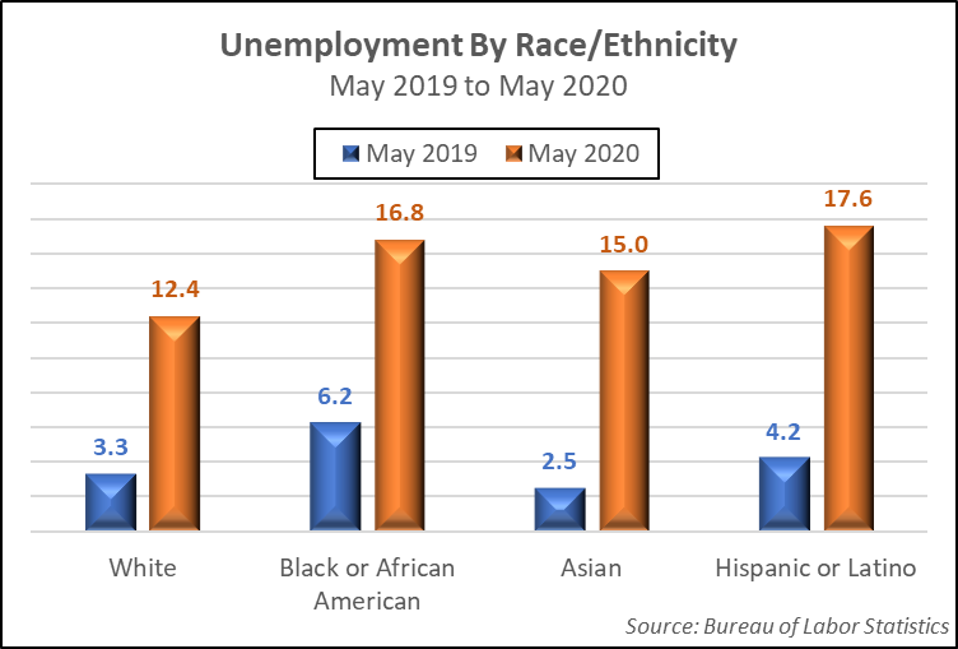
Unemployment by Race or Ethnicity-May 2019 to May 2020

Businesses need workers, workers need businesses, and both depend on customers. Since the pandemic began, consumer demand has fallen sharply. With the probability that a vaccine will not be available until early 2021 at the soonest, plus a disregard for recommended safety protocols by many individuals, namely wearing masks and social distancing, it is highly unlikely that the economy will return to normal for several years.

Will the president continue to hold rallies? Will he set an example by wearing a mask? Will the protests and violence continue? Will other large gatherings continue? Unless Americans make a collective and conscious choice to mask up and social distance, we will be forced to live in a depressed economy for longer than necessary. The choice is up to us.


As Americans lose job-based coverage, ACA marketplace sets record with near 500K signups

https://www.healthcaredive.com/news/as-americans-lose-job-based-coverage-aca-marketplace-sets-record-with-near/580623/

Dive Brief:

  • Millions of individuals have lost their jobs as a result of the pandemic, allowing them to enroll in Affordable Care Act marketplace coverage via Healthcare.gov due to their special circumstances. CMS said this week that this special enrollment coverage due to job loss specifically has reached a record, with about 487,000 consumers gaining coverage, a 46% increase compared with the same time last year.
  • April saw the biggest jump in enrollment following job loss, an increase of 139% compared to April of last year.
  • Due to a number of factors, CMS said it “remains unclear how many people will eventually look to Exchanges using HealthCare.gov to replace job-based coverage.”

Dive Insight:

The pandemic has battered the economy, causing historic levels of unemployment. For many Americans, healthcare coverage is tethered to their jobs. As such, the pandemic is not only a threat to Americans’ health but their ability to pay for the care they need, sick with COVID-19 or not.

As many as 27 million Americans may have lost job-based coverage between March and May of this year, according to a recent analysis from the Kaiser Family Foundation. 

Of the newly uninsured, about half (12.7 million) would be eligible for Medicaid coverage, according to Kaiser’s estimates. There are a few options for workers out of a job and insurance. They can opt to extend their coverage through COBRA, enroll in coverage through the exchanges, or check to see if they qualify for Medicaid.

This week, CMS attempted to quantify just how many out-of-work Americans were turning to the exchanges.

About 500,000 out-of-work consumers enrolled in coverage so far this year. However, there are other life events that qualify a consumer to shop for coverage during a special enrollment period. Overall, special enrollment period sign-ups garnered more than 890,000 enrollees, dwarfing other periods. 

If the trend continues, it may fuel a significant shift in health insurance. For years, a majority have received commercial coverage through work. Even health insurers recognize disruption is on the horizon.

Many of the nation’s largest insurers are bracing for a shift from their commercial book of business to covering more Medicaid enrollees through their contracts with states. Earlier this year, Molina, Centene and Anthem all said they expect upticks in their Medicaid membership and exchange products.

Molina executives said in April they already saw 30,000 more Medicaid members from the prior-year period.


Trinity Health expects $2B revenue plunge as it cuts, furloughs more staff

https://www.healthcaredive.com/news/trinity-health-cutting-cost-cutting-2-billion-revenue-shortfall/580738/

The Dumbest Things You Can Do With Your Money | Work + Money

Dive Brief:

  • Trinity Health, one of the nation’s largest nonprofit health systems, said Monday it will take more measures to cut costs due to the downturn spurred by the novel coronavirus. The restructuring plan includes eliminating positions, extending furloughs, severances and reductions in schedules. The decisions are being “customized” across the system based on factors that include volume projections and the cost and revenue challenges in each market.
  • The Livonia, Michigan-based hospital operator said it continues to treat COVID-19 patients, however, it has “for now seen declining numbers of very sick patients with COVID-19.”
  • The system said it expects revenue to be depressed or “below historical levels” for the remainder of this fiscal year and much of the next. It projects revenue to drop by $2 billion to $17.3 billion for fiscal year 2021, which starts after its June 30 year end.

Dive Insight:

In May, Trinity said it planned to furlough nearly 12% of its workforce — or 15,000 employees out of the 125,000 nationally.  

Trinity, one of the nation’s largest hospital operators with 92 facilities and operations across 22 states, is now broadening that restructuring, extending and adding new furloughs.

In a Monday bond filing, Trinity said its operations were “significantly” impacted by the effects of the pandemic as many operators saw depressed volumes due to shelter-in-place orders, which started in most of Trinity’s markets during the last two weeks of March.

“The effect of COVID-19 on the operating margins and financial results of Trinity Health is adverse and significant and, at this point, the duration of the pandemic and the length of time until Trinity Health returns to normal operations is unknown,” according to Monday’s bond filing.

The system said relief funds provided by the federal government have not been enough to cover its operating losses. Trinity has received $600 million in relief funds that do not have to be repaid and more in loans through the advanced Medicare payment program, according to a previous analysis by Healthcare Dive.

Still, the system said it has drawn on credit facilities totaling $1 billion to provide adequate liquidity during the pandemic. Trinity reported having 178 days cash on hand as of March 30.

Some nonprofits are faring better than Trinity and pulling back on earlier staffing cuts.

Mayo Clinic said last week it will call back its furloughed workers by the end of August and restore pay that had been cut due to the pandemic.

Mayo has some of the most cash on hand in terms of days when comparing other major nonprofit systems. Mayo had 252 days of cash on hand as of March 30, more than the other 20 largest nonprofits except Cleveland Clinic and New York-Presbyterian.


U.S. Healthcare System vs. Socialized Medicine during the Pandemic

https://www.commondreams.org/news/2020/06/25/why-socialized-system-medicare-all-beats-profit-healthcare-one-chart-covid-19?fbclid=IwAR1qT_AI5KFreoEKOqQfvdWUHPyW80fa2Iefxb5Ul5wJQtf8rSvZXkL8RHM


“All countries successfully combatting this virus have robust public health systems, which provide for coordination of effort.”

A recent rise in cases of Covid-19 and the overt failure of the for-profit healthcare system throughout the pandemic in the U.S. are making the case for Medicare for All, advocacy groups and activists say, as countries with socialized systems see their infection rates decline.

“All countries successfully combatting this virus have robust public health systems, which provide for coordination of effort,” remarked a popular healthcare advocate who uses the @AllOnMedicare handle on Twitter.

Calls for the U.S. to adopt a single-payer heathcare system have increased as the pandemic has raged around the country. Cases and deaths in the U.S are now the highest in the world, a result critics blame on both the private healthcare system and the mismanagement of the crisis by President Donald Trump.

Public Citizen’s health care policy advocate Eagan Kemp told Common Dreams that the current for-profit healthcare system that has driven millions of Americans in to bankruptcy and leaves millions more without care will only continue to exacerbate the pain of the outbreak. 

“While no health care system can completely protect a country from Covid-19, the U.S. has failed to respond for a number of reasons, not least of which is a for-profit health care system where Americans are too afraid to go to the doctors for fear of the cost,” said Kemp. “Far too many Americans will face medical debt and even bankruptcy if they are lucky enough to survive getting Covid-19, something unheard of in all other comparably wealth countries.”

As University of Massachusetts professor Dean E. Robinson wrote in a piece that appeared at Common Dreams earlier this month, the coronavirus is impacting people of color at a disproportionate rate in cities and communities nationwide—a dynamic that bolsters the call for a universal Medicare for All program to help close those gaps.

“The obvious and immediate need of Black and other working class populations caught in the teeth of the pandemic is the right to health care treatment without the burden of cost,” wrote Robinson. “Even before the pandemic, lower-income, Latino, and younger workers were more likely to be uninsured. Undocumented workers had the highest rates of uninsurance.”

On June 18, Ralph Nader in an opinion piece for Common Dreams expressed his hope that the ongoing pandemic would make essential workers in the health field “the force that can overcome decades of commercial obstruction to full Medicare for All.”


Jobless claims: Another 1.48 million Americans file for unemployment benefits

https://finance.yahoo.com/news/coronavirus-covid-weekly-initial-jobless-claims-june-20-195644738.html

More than three months into the COVID-19 crisis in the U.S., countless Americans are still unemployed. According to the U.S. Labor Department, weekly initial jobless claims data showed yet another week of claims exceeding 1 million.

Another 1.48 million Americans filed for unemployment benefits in the week ending June 20, exceeding economists’ expectations for 1.32 million. The prior week’s figure was revised higher to 1.54 million from the previously reported 1.51 million claims. While this week’s report marked 12 consecutive weeks of deceleration, more than 47 million Americans have filed for unemployment insurance over the past 14 weeks.

“Jobless claims are not falling fast enough,” Renaissance Macro’s Neil Dutta said in an email Thursday. “Everything we have seen in the last week or two between rising case counts/hospitalizations, stalling economic progress in some important states, government job cuts, means one thing: the Phase 4 of fiscal stimulus must be bigger. Things should be better in 3-4 weeks, but the news will get worse before it gets better. Take some chips off the table and reload the chamber for August.”

Continuing claims, which lags initial jobless claims data by one week, totaled 19.52 million in the week ending June 13, down from 20.29 million in the week ending June 6. Consensus expectations were for 20 million continuing claims.

“Initial jobless claims continue to moderate only gradually,” Nomura economist Lewis Alexander wrote in a note Wednesday. “While the labor market remains exceptionally weak, signs of gradual improvement suggest another month of NFP gains during June.”

In the week ending June 20, California reported the highest number of jobless claims at an estimated 287,000 on an unadjusted basis, up from 241,000 in the previous week. Georgia had 124,000, down from 132,000, Florida reported 93,000, New York had roughly 90,000 and Texas reported 89,000 jobless claims.

Additionally, Pandemic Unemployment Assistance (PUA) program claims, which include those who were previously ineligible for unemployment insurance such as self-employed and contracted workers, was also closely monitored in Thursday’s report.

PUA claims totaled 728,120 on an unadjusted basis in the week ending June 20, down from the prior week’s 770,920.

As states reopen their economies, cases and hospitalization figures are back on the rise. As of Thursday morning, there were more than 9.4 million cases and 483,000 COVID-19 deaths around the world, according to Johns Hopkins University data. The U.S. had 2.3 million cases and 121,000 deaths.