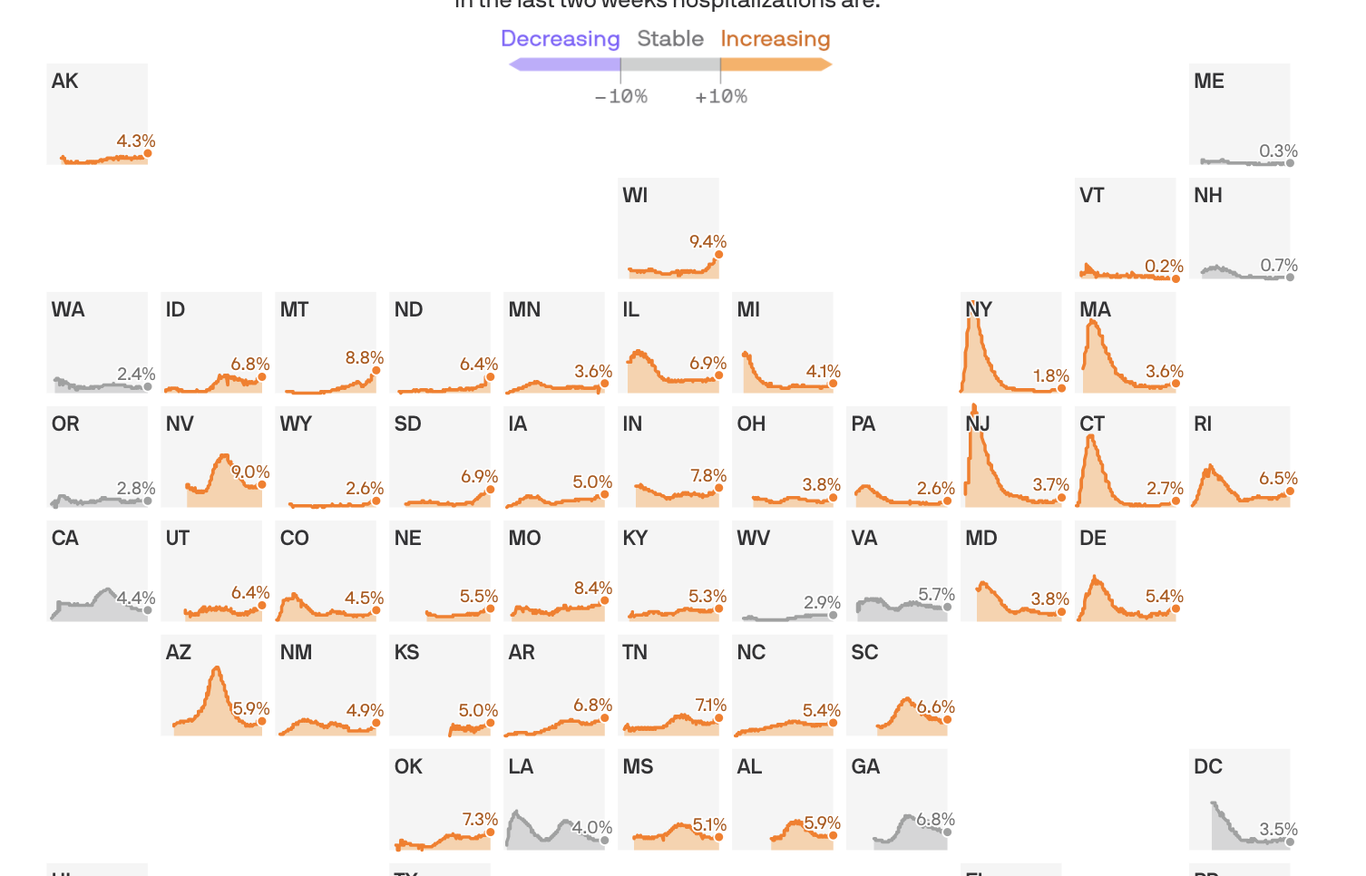
Coronavirus hospitalizations are on the rise

https://www.axios.com/coronavirus-hospitalizations-increasing-abc7e1f7-51b1-4b5c-a2e8-ab55685ac522.html

Share of hospital beds occupied
by COVID-19 hospitalizations

States shown from first date of reported data, from March 17 to Oct. 17, 2020

  • In the last two weeks hospitalizations are:
Coronavirus hospitalizations are on the rise - Axios

Coronavirus hospitalizations are increasing in 39 states, and are at or near their all-time peak in 16.

The big picture: No state is anywhere near the worst-case situation of not having enough capacity to handle its COVID-19 outbreak. But rising hospitalization rates are a sign that things are getting worse, at a dangerous time, and a reminder that this virus can do serious harm.

By the numbers: 39 states saw an increase over the past two weeks in the percentage of available hospital beds occupied by coronavirus patients.

  • Wisconsin is faring the worst, with 9.4% of the state’s beds occupied by COVID patients.
  • Sixteen states are at or near the highest hospitalization rates they’ve seen at any point in the pandemic.

Yes, but: The all-time peak of coronavirus hospitalizations happened in the spring, when 40% of New Jersey’s beds were occupied by COVID patients. Thankfully, even the the worst-performing states today are still a far cry from that.

Between the lines: These numbers, combined with the nationwide surge in new infections, confirm that the pandemic in the U.S. is getting worse — just as cold weather begins to set in in some parts of the country, which experts have long seen as a potentially dangerous inflection point.

  • They also suggest that most parts of the country won’t need to pause or scale back non-coronavirus treatments, as hospitals did in the spring when no one was quite sure how bad things could get.
  • In rural areas, however, even a modestly sized outbreak can strain local hospital capacity.

Jobless claims increase to 898,000, a sign the recovery could be stalling

The number of new unemployment claims jumped last week, the latest sign of the toll the coronavirus pandemic continues to take on the economy.

States across the country processed 898,000 new unemployment claims, up more than 50,000 from the previous week, the largest increase in first-time jobless applications since August.

These numbers marked another unfortunate milestone: The number of unemployment claims has been above the pre-pandemic one-week record of 695,000 for 30 weeks now.

Claims for Pandemic Unemployment Assistance, for gig and self-employed workers, went down, to 373,000 from about 460,000.

And the total number of people on all unemployment programs dropped slightly, to 25.3 million for the last week of September, down from 25.5 million the previous week.

The number of new claims has fallen greatly from its peak in the spring, but economists say they are concerned that the number remains so high.

“No question this report casts doubt on the recovery,” said Andrew Chamberlain, the chief economist at Glassdoor. “This is a sign covid is still dealing heavy blows to the labor market. We’re nowhere near having the virus under control.”

The news comes amid a string of poor economic news, with headlines punctuated with reports of large companies announcing layoffs in recent weeks.

These companies include Disney, insurance company Allstate, American and United Airlines, Aetna, and Chevron.

“It’s not coming down quickly,” said Julia Pollak, a labor economist at the jobs site ZipRecruiter. “It’s unclear how quickly we can recover. We’re likely to see additional layoffs and high numbers of unemployment for the foreseeable future.”

Pollak said there are indications that consumer spending has fallen since the expiration of government aid programs — another warning sign about more economic trouble ahead.

Many economists, including those at the Federal Reserve, have urged Congress and the White House to pass a new package of aid. House Democrats passed a $2.2 trillion plan earlier this month that Republicans have declined to advance, while Treasury Secretary Steven Mnuchin has been pushing a $1.8 trillion plan.

Still, there are signs that Senate Republicans would not be willing to accept that plan, either. Senate Majority Leader Mitch McConnell told reporters that he would not bring the plan to the floor, saying Senate Republicans believed the deal should top out at $1.5 trillion.

One sign of the severity of the economic crisis is the growing number of people who are transitioning to Pandemic Emergency unemployment compensation — for those who hit the maximum number of time that their state plans allow for. That number grew 818,000, according to the most recent figures, from the end of September.

Questions remain about the integrity of the data, as well.

A number of issues have complicated a straightforward read of the weekly release, such as issues with fraud, which are believed to have driven up these numbers an unknown amount, and backlogs in states like California. The country’s largest state typically accounts for about 20-28 percent of the country’s total weekly claims, but has put its claims processing on hold temporarily.

Instead, the Department of Labor is using a placeholder number for the state — 226,000, the number of new initial claims in the state from mid-September.

But some economists like Chamberlain are critical of this method.

“The idea of cutting and pasting the data from a state is so absurd,” he said. “They could at least use a model. But instead they’re carrying over the number. It’s quite a crisis.”

Quirks in the new filing process require people to apply for traditional unemployment and get rejected before applying for PUA — a source of potential duplicate claims.

Economists have been warning for months that the unemployment rate, which has improved steadily since its nadir in April, is at risk of getting worse without further government intervention.

States that saw significant jumps in unemployment claims last week include Indiana, Alaska, Arizona, Illinois, New Mexico and Washington.

Still, some economists have found reasons to hope. Pollak said job postings on ZipRecruiter have topped 10 million for the first time since the start of the pandemic, equaling a number last seen in January.

The jobs are different now, she said — fewer tech and business jobs and more warehousing jobs, temporary opportunities and contracting work.

America’s most prestigious medical journal makes a political statement

https://mailchi.mp/45f15de483b9/the-weekly-gist-october-9-2020?e=d1e747d2d8

In Rare Step, Esteemed Medical Journal Urges Voters To Oust Trump | KPCW

For its first 208 years, the New England Journal of Medicine has never endorsed a political candidate. But this week the journal published an editorial outlining its political position in the upcoming Presidential election, signed unanimously by all editors who are US citizens.

The editors did not explicitly endorse former Vice President Biden, but rather offered a scathing condemnation of the current administration’s performance during the COVID pandemic: “Reasonable people will certainly disagree about the many political positions taken by candidates.

But truth is neither liberal nor conservative. When it comes to the response to the largest public health crisis of our time, our current political leaders have demonstrated that they are dangerously incompetent. We should not abet them and enable the deaths of thousands more Americans by allowing them to keep their jobs.” (Formally endorsing Biden last month, Scientific American also made the first political endorsement in its 175-year history.)
 
Much of the media coverage of the NEJM statement has centered on the question of whether medicine should involve itself in politics, or “live above it”

Medicine has been drawn into political disputes before, but now the nature of the involvement has changed. In the past, debates largely centered around regulation, payment or policy—but now the science itself has become a fundamentally political issue. 

The very nature of the coronavirus has become a matter of political belief, not just an indisputable scientific fact.

Public trust in both scientific institutions and the government, and their ability to work together, has been damaged. We fear this will lead to poorer health outcomes regardless of who wins the upcoming election.

The Flu Shot

Image may contain: 1 person, indoor

“Last night I shared a post on Facebook that said, ‘Hey, the flu shot isn’t about you.’ Sitting here, soaking up every ounce of caffeine before my night shift, I figured I should elaborate.

The flu shot is for Influenza, a severe respiratory illness that can lead to death. Have you ever had it? I have, and it’s awful. You spike fevers, every bone and muscle in your body aches, and no matter how hard you try, you just can’t seem to catch your breath.

You get the flu shot not always for you, but for those around you. For the grandparents, whose bodies are not what they used to be, and they just can’t kick an illness in the butt like when they were young.

For the 30 year old, with HIV or AIDS, who has a weakened immune system.

For the 25-year-old mother of 3 who has cancer. She has absolutely zero immune system because of chemotherapy.

For the newborn baby who was just welcomed into the world, and isn’t quite strong enough to fight off infections on his own.

For the nurses and doctors that take care of you. If they get sick, they can’t go to work and take care of the countless patients that need them.

For the 50-year-old husband who needs a medication for his chronic illness, and that medication also weakens his immune system.

For the pregnant mom that has been trying to get pregnant for years, and now she’s trying to stay healthy for her unborn baby.

For the single dad who can’t take any more sick days and needs to provide for his kids.

For the 7-year-old boy that just wants to play with his friends. But he has a disease that puts him at a higher risk for infection, so he has to stay inside.

The flu shot is NOT always about you. It’s about protecting those around you, who cannot always protect themselves. I have been in the room as a patient has passed away, because of influenza. I have watched patients struggle to breathe, because of influenza. I have busted my butt to provide tylenol, warm blankets, nebulizers, etc. to keep that patient comfortable and fighting a terrible respiratory infection.

Herd immunity is a thing.

Influenza killing people is a thing.

You getting the flu shot, should be a thing.

Credit: Nurse Amanda Catherine Bitz

Jobless claims: Another 840,000 Americans filed new unemployment claims last week

https://finance.yahoo.com/news/jobless-claims-coronavirus-unemployment-week-ended-october-3-2020-164918818.html

U.S. states saw another 840,000 jobless claims filed last week, as the number of Americans applying for first-time unemployment insurance benefits each week continues to hover at a historically high level.

The U.S. Department of Labor (DOL) released its weekly jobless claims report at 8:30 a.m. ET Thursday. Here were the main metrics from the report, compared to Bloomberg estimates:

  • Initial jobless claims, week ended Oct. 3: 840,000 vs. 820,000 expected and 849,000 during the prior week
  • Continuing claims, week ended Sept. 26: 10.976 million vs. 11.4 million expected and 11.979 million during the prior week

New weekly unemployment insurance claims have held below the psychologically important 1 million mark for the past six consecutive weeks, but have so far failed to break below 800,000 since the start of the pandemic. At 840,000 last week’s new claims remained at a level still handily above the pre-pandemic record high of 695,000 from 1982.

The past two weeks’ jobless claims totals have also been flattered by an absence of updated new claims out of California. The state – which has consistently been one of the biggest contributors to new weekly claims – announced last week it was taking a two-week pause in processing initial claims to “reduce its claims processing backlog and implement fraud prevention technology,” according to the Labor Department’s statement.

Across all programs, the total number of jobless claims decreased for the week ending Sept. 19. Total claims came in at 25.5 million, down from the about 26.5 million during the previous week, as a smaller number of self-employed or gig workers not eligible for regular state programs claimed Pandemic Unemployment Assistance. But the number of workers collecting benefits through the Pandemic Emergency Unemployment Compensation Program – which offers an extra 13 weeks’ worth of federal benefits to those who had exhausted previous state or federal compensation – rose by 154,000 to 1.96 million.

Continuing jobless claims, which are reported on a one-week lag and represent the total number of individuals still receiving state unemployment benefits, continued their gradual downtrend last week. But as with new jobless claims, continuing claims have held well above pre-pandemic levels, and have not broken below the 10 million mark in more than 6 months.

“Net, initial filings fell less than expected last week. The improvement in continuing claims is reflecting people being hired but also individuals exhausting their benefits,” Rubeela Farooqi, chief economist for High Frequency Economics, said in an email. Overall, the signal from the claims data is still one of ongoing weak conditions in the labor market. Even as filings are declining, levels remain extraordinarily high. Employment growth has already slowed and without fiscal support that protected jobs, risks are skewed to the downside for payrolls going forward.”

The latest jobless claims report comes amid dimming hopes for another round of virus relief measures out of Congress, despite increasingly urgent calls from Federal Reserve officials for more fiscal stimulus to support individual Americans more directly.

President Donald Trump said Tuesday he had asked his negotiators to halt further stimulus talks until after the election, but added that he would support standalone measures providing tens of billions of dollars for airline payroll support and the Paycheck Protection Program. House Democrats, however, have previously balked at the notion of passing slimmed down versions of a stimulus package – meaning the prospect of further fiscal stimulus in the next month remains unlikely.

States ranked by uninsured rates

https://www.beckershospitalreview.com/rankings-and-ratings/states-ranked-by-uninsured-rates-100720.html?utm_medium=email

Uninsured Rate by State: Percentage of People Without Health Insurance

Texas has the highest uninsured rate in the U.S., and Massachusetts has the lowest, according to an analysis by WalletHub, a personal finance website. 

To measure the rates of uninsured by state, analysts compared the overall insurance rates of each state in 2019 using U.S. Census Bureau data. Analysts also examined the state rates based on age, race and income. Access more information about the methodology here.

Massachusetts has the lowest uninsured rate for adults and children, at 3.39 percent and 1.52 percent, respectively. In Texas, which ranked last, the children’s uninsured rate is 12.75 percent and the adults’ uninsured rate is 20.47 percent. 

Here is each state ranked from lowest to highest uninsured rate, according to the analysis: 

1. Massachusetts

2. Rhode Island

3. Hawaii

4. Vermont

5. Minnesota

6. Iowa

7. New York

8. Wisconsin

9. Pennsylvania

10. Michigan

11. Connecticut

12. Maryland

13. New Hampshire

14. Kentucky

15. Delaware

16. Ohio

17. Washington

18. West Virginia

19. North Dakota

20. Oregon

21. Illinois

22. California

23. New Jersey

24. Virginia

25. Colorado

26. Maine

27. Montana

28. Nebraska

29. Indiana

30. Louisiana

31. Arkansas

32. Kansas

33. Utah

34. Alabama

35. New Mexico

36. Missouri

37. Tennessee

38. South Dakota

39. Idaho

40. South Carolina

41. North Carolina

42. Arizona

43. Nevada

44. Alaska

45. Wyoming

46. Mississippi

47. Florida

48. Georgia

49. Oklahoma

50. Texas

State autonomy versus a fundamental right: VP debate will spotlight divergent healthcare views

https://www.healthcarefinancenews.com/news/vice-presidential-debate-will-likely-spotlight-divergent-views-healthcare

Mike Pence and Kamala Harris take the debate stage Wednesday night. (Kamala (Harris photo by Ethan Miller; Pence photo by Joshua Roberts. Both Getty Images)

The undercurrent of the VP debate is the age and health of the two men vying for the presidency.

The two remaining presidential debates, scheduled for October 15 and 22, are in question due to President Trump’s positive COVID-19 and quarantine status, making the vice presidential debate this Wednesday at 9 p.m. even more important than VP debates of past elections.

The undercurrent in the debate consists of the ages of challenger Biden, who is 77 and turning 78 before the end of the year, and Trump, 74, who has been hospitalized for COVID-19 and was released from Walter Reed Army Medical Center on Monday afternoon. Trump has said he plans to debate Biden on October 15.

This VP debate is big, said Paul Keckley, a healthcare policy analyst and managing editor of the Keckley Report. 

“The reason is not so much the two are debating,” Keckley said. “We have a 77- year-old challenger and a 74-year-old incumbent. Voters are expecting the odds are one will become disabled and the vice president is going to step in. That’s the undercurrent of this debate.”

Healthcare is an obvious dominant theme Wednesday night beyond the health of the two men seeking the presidency. 

It is expected that Biden’s running mate, Kamala Harris will challenge Vice President Mike Pence on his role heading the coronavirus task force when close to 7.5 million people in this country have been infected with COVID-19 and more than 200,000 have died.

Pence will likely challenge Harris on her support for Medicare for All before she backtracked to support Biden’s public-private option for healthcare coverage.

Pence and Harris are expected to lay out the healthcare plans of their respective Republican and Democratic nominees less than four weeks before the election, in a way the lead candidates failed to get across during the first presidential debate that presented more chaos than clarity.

TRUMP AND BIDEN PLANS

Trump and Biden differ fundamentally on whether the federal government should be involved in the business of providing healthcare coverage.

Trump’s guiding principles rest on the pillar of state autonomy as opposed to a federalized healthcare system and Biden’s maxim that healthcare is a right, not a privilege. 

Trump believes that private solutions are better than government solutions, according to Keckley. He is much less restrained on private equity and the Federal Trade Commission’s scrutiny of vertical integration. States become the gateway to the market as private solutions are sold to states as innovation.

Trump’s other concept is that the door to engaging consumers in healthcare is price transparency. His view is that price transparency will spawn consumer engagement.

Centers for Medicare and Medicaid Services Administrator Seema Verma, who was appointed by Trump in 2016 based largely on the recommendation of Pence, is instituting a rule, starting January 1, 2021, requiring hospitals to have price transparency for 300 shoppable services. Hospitals are being required to make their contract terms with payer accessible.

This is separate from CMS’s interoperability rule aimed at payers that also goes into effect on January 1.

Trump believes healthcare is a personal responsibility, not a public obligation. To Trump, healthcare is a marketplace where there are winners and losers, according to Keckley.

Biden has a more developed policy platform on making healthcare a universal right, starting with strengthening the Affordable Care Act that was passed while Biden was vice president during President Barack Obama’s terms.

Biden wants to increase the eligibility for tax subsidies in the ACA up to 400% of the federal poverty level, which would expand access to subsidized health insurance.

He also wants to reduce the affordability threshold for employer insurance. Currently, if employees pay more than 9.7% of their adjusted income for their workplace coverage, they can seek a plan in the ACA marketplace. Biden would lower that eligibility for ACA coverage to 8.5%, opening the door for many more consumers to be insured through the ACA, at a lower cost.

Biden would also lower the age of eligibility for Medicare from 65 to 60.

For companies such as manufacturing and transportation, in which individuals can retire after 30 years of service, this lets them into the Medicare system earlier to fill that gap between retirement and Medicare eligibility.

Biden’s public option would create insurance plans that would compete with private plans. 

The other factor to watch on the Biden side, Keckley said, is his clear focus on equity and diversity in healthcare. 

AFFORDABLE CARE ACT

Biden wants to strengthen Obamacare while Trump is actively pursuing a repeal of the law through the Supreme Court. 

President Trump’s debate prep and the White House Rose Garden event announcing the nomination of Judge Amy Coney Barrett to replace the late Supreme Court Justice Ruth Bader Ginsburg, border on the definition of super spreader events.

The Justices, perhaps with the addition of Trump’s pick, Amy Coney Barrett, if there are enough Republican senators well enough and in attendance to vote for confirmation, are scheduled to hear oral arguments in the case brought by 18 GOP-led states on November 10, the week after the election.

Senators must be present to vote, and Republicans, who have a majority of 53 to 47 seats, need a four-vote majority. Two Republican senators – Susan Collins of Maine and Lisa Murkowski of Alaska – have said they wouldn’t vote on a nominee prior to the election. Vice President Mike Pence could cast the deciding vote in a tie.

Three Republican senators have tested positive for the coronavirus. Sens. Mike Lee of Utah and Thom Tillis of North Carolina, who sit on the Judiciary Committee, tested positive for COVID-19 days after attending the White House Rose Garden event on September 26. Republican Sen. Ron Johnson of Wisconsin is now the third to test positive, though he did not attend that event.

There was a lack of social distancing and mask wearing at both the Rose Garden nomination and at a meeting between Trump and staff for debate prep. Twelve people in Trump’s inner circle, including his wife Melania, former New Jersey governor Chris Christie and White House Press Secretary Kayleigh McEnany, have tested positive since attending.

Senate Majority Leader Mitch McConnell wrote in an email to GOP senators obtained by CNN that he needs all Republican senators back in Washington by October 19.

COVID-19

Trump announced in a tweet Monday that he would be leaving Walter Reed later in the afternoon, saying he felt “really good!” and adding, “Don’t be afraid of Covid. Don’t let it dominate your life. We have developed, under the Trump Administration, some really great drugs & knowledge. I feel better than I did 20 years ago!”

Trump has been criticized for leaving the hospital on Monday to take a drive-by ride to wave to supporters. Attending physician Dr. James Phillips called the action “insanity” and “political theater” that put the lives of Secret Service agents in the car with him at risk.

Trump has downplayed the virus in an effort to reopen the country and the economy, and has put the blame on China, where the coronavirus originated.

Trump told Biden during the debate, “We got the gowns; we got the masks; we made the ventilators. You wouldn’t have made ventilators – and now we’re weeks away from a vaccine.” 

Biden puts the blame squarely on Trump for delaying action to stop the spread.

Biden said during the debate: “Look, 200,000 dead. You said over seven million infected in the United States. We in fact have 5% or 4% of the world’s population – 20% of the deaths. Forty thousand people a day are contracting COVID. In addition to that, about between 750 and 1,000 people, they’re dying. When [Trump] was presented with that number he said ‘It is what it is’ – what it is what it is – because you are who you are. That’s why it is. The president has no plan. He hasn’t laid out anything.”

Biden said that back in July he laid out a plan for providing protective gear and providing money the House passed to get people the help they need to keep their businesses open and open schools. 

Under Trump’s Administration, Congress passed $175 billion in provider relief funds for hospitals, small businesses, individuals and others – $100 billion from the CARES Act and $75 billion from the Paycheck Protection Program and Healthcare Enhancement Act.

MEDICAID EXPANSION

CMS Administrator Seema Verma was healthcare advisor to Pence while he was governor of Indiana. Her consulting firm, SVC, Inc., worked closely with Pence to design Indiana’s Medicaid expansion under the Affordable Care Act. They developed a unique Medicaid expansion program called Health Indiana Plan 2.0, which mandated low income adults above the poverty level pay monthly premiums for their healthcare. 

Members who did not pay faced being disenrolled for six months. 

As administrator, Verma has initiated similar work requirements for Medicaid coverage nationwide.

While as governor Pence implemented Medicaid expansion, as vice president he has supported torpedoing the ACA, and has pushed the Graham-Cassidy plan for healthcare reform that would have replaced the ACA.

DRUG PRICES

Neither Trump nor Biden has taken on the pharmaceutical industry in a meaningful way, though both have voiced a strong belief that drug manufacturers are egregious to the system, according to Keckley.

“Both camps are saying, we’re really going to take them on,” he said. 

During the debate, Trump said he was cutting drug prices by allowing American consumers to buy drugs from Canada and other countries under a favored nation status. 

“Drug prices will be coming down, 80 or 90 percent,” Trump said during the debate, telling Biden he hadn’t done anything similar during his 47 years in government.

If Trump gets a second term, there will likely be more industry folks in his circle, following up on his first term of stacking his cabinet with business people.

Biden would be more likely to lean toward a blend of public health officials and industry executives. There would be more of a spotlight on wealth creation in healthcare and executive pay.

In the $1.1 trillion world of prescription drugs, the United States makes up 40% of the market. 

“We’re the hub of the prescription drug industry,” Keckley said. 

How Much Would Trump’s Coronavirus Treatment Cost Most Americans?

https://news.yahoo.com/much-trumps-coronavirus-treatment-cost-130318676.html

President Donald Trump's physician, Dr. Sean Conley, accompanied by other medical staff members, briefing reporters outside of Walter Reed National Military Medical Center in Bethesda Md., on Oct. 4, 2020. (Anna Moneymaker/The New York Times)

President Donald Trump spent three days in the hospital. He arrived and left by helicopter. And he received multiple coronavirus tests, oxygen, steroids and an experimental antibody treatment.

For someone who isn’t president, that would cost more than $100,000 in the American health system. Patients could face significant surprise bills and medical debt even after health insurance paid its share.

The biggest financial risks would come not from the hospital stay but from the services provided elsewhere, including helicopter transit and repeated coronavirus testing.

Trump has praised the high quality of care he received at Walter Reed National Military Medical Center, and has played down the risk of the virus. “Don’t be afraid of Covid,” Trump tweeted on Monday, before returning to the White House. “Don’t let it dominate your life.”

Across the country, patients have struggled with both the long-term health and financial effects of contracting coronavirus. Nearly half a million have been hospitalized. Routine tests can result in thousands of dollars in uncovered charges; hospitalized patients have received bills upward of $400,000.

Trump did not have to worry about the costs of his care, which are covered by the federal government. Most Americans, including many who carry health coverage, do worry about receiving medical care they cannot afford.

For some Americans, the bills could start mounting with frequent tests. Insurers are generally required to pay for those tests when physicians order them, but not when employers do.

The Trump administration made that clear in June, when it issued guidance stating that insurers do not have to pay for “testing conducted to screen for general workplace health and safety.” Instead, patients need to pay for that type of testing themselves. Some might be able to get free tests at public sites, and some employers may voluntarily cover the costs. Others could face significant medical debt from tests delivered at hospitals or urgent care centers.

COVID tests can be expensive. Although they typically cost $100, one emergency room in Texas has charged as much as $6,408 for a drive-through test. About 2.4% of coronavirus tests billed to insurers leave the patient responsible for some portion of payment, according to the health data firm Castlight. With 108 million tests performed in the United States, that could amount to millions of tests that leave patients responsible for some share of the cost.

Marta Bartan, who works as a hair colorist in New York City, needed a coronavirus test to return to her job this summer. She received a $1,394 bill from the hospital running the drive-through site where she was tested.

“I was so confused,” said Bartan, who is contesting the bill. “You go in to get a COVID test expecting it to be free. What could they have possibly charged me $1,400 for?”

The bills for the typical American would continue at the hospital, with the routine monitoring that any patient would receive and the drugs provided in the course of care.

Remdesivir, a new coronavirus treatment created by Gilead, costs $3,120 when purchased by private insurers and $2,340 with public programs like Medicare and Medicaid.

Trump also received an experimental antibody treatment from Regeneron. It’s currently available to clinical trial participants or to those granted a “compassionate use” exemption. In either situation, the drug would typically be provided to the patient at no charge. This will most likely change, however, when the treatment finishes trials and hits the commercial market. These types of drugs are hard to manufacture, and other monoclonal antibodies cost thousands of dollars.

Health economists are only starting to understand the full costs of coronavirus treatment, just as scientists are mapping out how the disease works and spreads. They do have some early estimates: The median charge for a coronavirus hospitalization for a patient over 60 is $61,912, according to a claims database, FAIR Health

That figure includes any medical care during the hospital stay, such as an emergency room visit that led to admission or drugs provided by the hospital.

For insured patients, that price would typically be negotiated lower by their health plan. FAIR Health estimates that the median amount paid is $31,575. That amount, like most things in American health care, varies significantly from one patient to another.

In the FAIR Health data on coronavirus patients over 60, one-quarter face charges less than $26,821 for their hospital stay. Another quarter face charges higher than $193,149, in part because of longer stays.

Many, but not all, health insurers have said they will not apply copayments or deductibles to patients’ coronavirus hospital stays, which could help shield patients from large bills.

Uninsured patients, however, could be stuck with the entire hospital charges and not receive any discounts. While the Trump administration did set up a fund to cover coronavirus testing and treatment costs for the uninsured, The New York Times has reported that some Americans without health insurance have received large bills for their hospital stays.

The biggest billing risk for a patient receiving treatment similar to Trump’s would probably come from helicopter rides to the hospital.

Air ambulances are expensive and often not in major health insurance plans’ networks. The median charge for an air ambulance is $38,770, according to a study in the journal Health Affairs published this year. When the helicopter trip is out of network — as about three-quarters of them are — patients are left with a median charge of $21,698 after the insurance payout.

Taking two helicopter rides, as Trump did, could plausibly result in more than $40,000 in medical debt for patients without access to their own aircraft (though of course most people do not leave the hospital by helicopter).

The financial consequences of a coronavirus hospitalization could be long-lasting, if a new Supreme Court challenge to the Affordable Care Act is successful. That case argues that all of Obamacare is unconstitutional, including the health law’s protections for preexisting conditions. The administration filed a brief in June supporting the challenge.

The Supreme Court hears that case on Nov. 10. If the challenge succeeds, COVID-19 could join a long list of preexisting conditions that would leave patients facing higher premiums or denials of coverage. In that case, coronavirus survivors could face a future in which their hospital stays increase their health costs for years to come.

This article originally appeared in The New York Times.

Election 2020: Trump and Biden’s starkly diverging views on healthcare

https://www.healthcaredive.com/news/presidential-election-2020-trump-biden-different-healthcare-policies-ACA-coronavirus/585184/?utm_source=Sailthru&utm_medium=email&utm_campaign=Issue:%202020-10-01%20Healthcare%20Dive%20%5Bissue:29992%5D&utm_term=Healthcare%20Dive

Spoiler: the 2 nominees differ on almost everything.

President Donald Trump and Democrat nominee Joe Biden’s starkly contrasting views on healthcare were laid bare during this week’s chaotic debate. But some major industry executives noted at a recent conference they’ve done relatively well under Trump and could likely weather a Biden presidency, given his moderate stance and rejection of liberal dreams of “Medicare for All.”

The former vice president stresses incremental measures to shore up President Barack Obama’s landmark Affordable Care Act. Trump’s campaign website has no list of healthcare priorities, making his record even more relevant to attempts to forecast his future policies.

“I think a lot of the president’s second term agenda will be extensions of things he’s done in his first term,” Lanhee Chen, domestic policy director at Stanford University’s Public Policy program, said at AHIP in September.

Either way, the impact of whoever lands in the White House next year still matters for the industry’s future.

And 33 seats in the Senate are also up for grabs in November, complicating the outlook. Two scenarios would likely lead to health policy gridlock, according to analysts and DC experts: Trump wins regardless of Senate outcome, or Biden wins and Republicans maintain control of the Senate. A third scenario, where Biden wins and Democrats retake the Senate, would be the most negative for healthcare stocks, Jefferies analysts say, while the other two outcomes would be a net positive or mostly neutral.

Here’s a look at where the candidates stand on the biggest healthcare issues: the coronavirus pandemic, the Affordable Care Act, changes to Medicare and Medicaid and lowering skyrocketing healthcare costs.

COVID-19 response

Trump

Of all wealthy nations, the U.S. has been particularly unsuccessful in mitigating the pandemic. The U.S. makes up 4% of the global population, but accounted for 23% of all COVID-19 cases and 21% of all deaths as of early September.

Public health experts assign the majority of the blame to an uncoordinated federal response, with the president electing to take a largely hands-off approach to the virus that’s killed nearly 207,000 people in the U.S. to date. That backseat stance is unlikely to change if Trump is elected to a second term.

In March, Trump said a final COVID-19 death toll in the range of 100,000 to 200,000 Americans would mean he’s “done a very good job.”

Critics blame shortages of supplies like test materials, personal protective equipment and ventilators, especially in the crucial early days of the pandemic, on Trump’s approach. States and healthcare companies have also reported challenges with shifting federal guidelines on topics from risk of infection to hospital requirements for reporting COVID-19 caseloads.

Trump has also pushed unproven treatments for COVID-19, giving rise to concerns about political influence on traditionally nonpartisan agencies like the Food and Drug Administration and the Centers for Disease Control and Prevention.

These concerns have colored Operation Warp Speed, the administration’s public-private partnership to fast-track viable vaccines. The operation received $10 billion in funds from Congress, but administration officials have also pulled $700 million from the CDC, even as top health officials face accusations of trying to manipulate CDC scientific research publications.

Fears that political motivations, not clinical rigor, are driving the historically speedy timeline could lower public trust in a vaccine once it’s eventually approved.

Trump has also repeatedly refused to endorse basic protections like widespread mask wearing, often eschewing the face covering himself in public appearances. He’s consistently downplayed the severity of the pandemic, saying it’ll go away on its own while suggesting falsely that rising COVID-19 cases were solely due to increased testing.

While Trump’s list of priorities for his second term include “eradicating COVID-19,” the plan is short on details. His most aggressive promise has been approval of a vaccine by the end of this year and creating all “critical medicines and supplies for healthcare workers” for a planned return to normal in 2021, along with refilling stockpiles to prepare for future pandemics.

Biden

Biden, for his part, would likely work to enact COVID-19 legislation and dramatically change the role of the federal government in pandemic response first thing if elected.

The Democratic candidate says he would re-assume primary responsibility for the pandemic. He plans to “dramatically scale up testing” and “giving states and local governments the resources they need to open schools and businesses safely,” per an August speech in Wilmington, Delaware.

Biden says he’d take a backseat to scientists and allow FDA to unilaterally make decisions on emergency authorizations and approvals.

The candidate supports reopening an ACA enrollment period for the uninsured, eliminating out-of-pocket costs for COVID-19 treatment, enacting additional pay and protective equipment for essential workers, increasing the federal match rate for Medicaid by at least 10%, covering COBRA with 100% premium subsidies during the emergency, expanding unemployment insurance and sick leave, reimbursing employers for sick leave and giving them tax credits for COVID-19 healthcare costs.

Trump opposes most of these measures, though he did sign COVID-19 relief legislation that upped the Medicaid match rate by 6.2% and extended the COBRA election period, though without subsidies.

Biden has said he’d be willing to use executive power for a national mask mandate, though ensuring compliance would be difficult. He’d also rejoin the World Health Organization, which Trump pulled the U.S. out of in May.

Affordable Care Act

Trump

On his first day in office, Trump issued an executive order saying: “It is the policy of my Administration to seek the prompt repeal of the Patient Protection and Affordable Care Act.” But after the Republican repeal-and-replace effort floundered in 2017, the administration began steadily chipping away at key tenets of the decade-old law through regulatory avenues.

Trump has maintained he’ll protect the 150 million people with preexisting conditions in the U.S. But despite publicly promising a comprehensive replacement plan on the 2015 campaign trail (and at least five times this year alone), Trump has yet to make one public. The president did in September sign a largely symbolic executive order that it’s the stance of his administration to protect patients with preexisting conditions.

The president doesn’t mention the ACA in his list of second term priorities. The omission could have been intentional, as Trump is backing a Republican state-led lawsuit seeking to overturn the sweeping law, now pending in front of the U.S. Supreme Court and scheduled for oral arguments one week after the election.

The death of liberal justice Ruth Bader Ginsburg puts the law in an even more precarious position.

And Trump’s health agencies have enacted myriad policies keeping the law from functioning as designed.

The president signed legislation zeroing out the individual mandate penalty requiring people to be insured in 2017. The same year, he ended cost-sharing reduction payments to insurers, suggesting that would cause the ACA to become “dead.” But the marketplace generally stabilized.

The administration has also increased access to skimpier but cheaper coverage that doesn’t have to comply with the 10 essential health benefits under the ACA. The short-term insurance plans widely discriminate against people with pre-existing health conditions, even as a growing number of Americans, facing rising healthcare costs, enrolled, according to a probe conducted by House Democrats this year.

Trump has also encouraged state waivers that promote non-ACA plans, cut funding for consumer enrollment assistance and outreach, shortened the open enrollment period and limited mid-year special enrollments.

​Despite his efforts, the ACA has grown in popularity among voters on both sides of the aisle, mostly due to provisions like shoring up pre-existing conditions and allowing young adults to stay on their parent’s insurance until age 26.

Biden

If elected, Biden would likely roll back Trump-era policies that allowed short-term insurance to proliferate, and restore funding for consumer outreach and assistance, political consultants say.

Building on the law is the linchpin of Biden’s healthcare plan. The nominee has pledged to increase marketplace subsidies to help more people afford ACA plans through a number of policy tweaks, including lowering the share of income subsidized households pay for their coverage; determining subsidies by setting the benchmark plan at the pricier “gold” level; and removing the current cap limiting subsidies to people making 400% of the federal poverty level or below.

Biden maintains as a result of these changes, no Americans would have to pay more than 8.5% of their annual income toward premiums. They could save millions of people hundreds of dollars a month, according to a Kaiser Family Foundation analysis. Commercial payers mostly support these efforts, hoping they’ll stabilize the exchanges.

But a second prong of Biden’s health strategy is deeply unpopular with private insurers: the public option. Biden’s called for a Medicare-like alternative to commercial coverage, available to anyone, including people who can’t afford private coverage or those living in a state that hasn’t expanded Medicaid.

The rationale of the public plan is that it can directly negotiate prices with hospitals and other providers, lowering costs across the board. However, market clout will depend on enrollment, which is still to-be-determined.

Critics see the plan, which by Biden’s estimate would cost $750 billion over 10 years, as a down payment on Medicare for All. And the private sector worries it could threaten the very profitable healthcare industry, which makes up about a fifth of the U.S. economy.

Medicare

Trump

Neither Trump nor Biden supports Medicare for All, dashing the hopes of supporters of the sweeping insurance scheme for at least another four years.

“It has a pulse — it’s not dead — I just don’t see it happening in any near term,” John Cipriani, vice president at public affairs firm Global Strategy Group, said at AHIP.

Trump has promised to protect Medicare if elected to a second term, and it’s unlikely he’d make any major changes to the program’s structure or eligibility requirements, experts say.

But Medicare is quickly running out of money, and neither Trump nor Biden has issued a complete plan to ensure it survives beyond 2024. Political consultants think it’ll teeter right up to the edge of insolvency before lawmakers feel compelled to act.

The president’s administration has allowed Medicare to pay for telehealth and expanding supplemental benefits in privately run Medicare Advantage programs, efforts that would likely bleed into his second term — or Biden’s first, given general bipartisan support on both, experts say.

Under Trump, HHS did pass a site-neutral payment policy, cutting Medicare payments for hospital outpatient visits in a bid to save money. But Democratic lawmakers have argued Trump’s calls to get rid of the federal payroll tax, which partially funds Medicare, could throw the future of the cash-strapped program in jeopardy.

The president has also signed legislation experts say accelerated insolvency, including the Tax Cuts and Jobs Act of 2017, the Bipartisan Budget Act of 2018 and the Further Consolidated Appropriations Act of 2020, which repealed the ACA’s Cadillac tax — a tax on job-based insurance premiums above a certain level.

Nixing that tax lowered payroll tax revenue, also dinging Medicare’s shrinking trust fund.

Trump’s proposed budget for the 2021 fiscal year floated culling about $450 billion in Medicare spending over a decade. And repealing the ACA would also nix provisions that closed the Medicare prescription drug “donut hole,” that added free coverage of preventive services and reduced spending to strengthen Medicare’s winnowing Hospital Insurance Trust Fund.

Biden

Biden has proposed lowering the Medicare age of eligibility to 60 years, with the option for people aged 60-64 to keep their coverage if they like it. The idea is popular politically, though providers oppose it, fearful of losing more lucrative commercial revenue.

It would make about 20 million more people eligible for the insurance, but could also add even more stress onto the program, experts say. Biden’s campaign says it would be financed separately from the current Medicare program, with dollars from regular tax revenues, and will reduce hospital costs.

Biden also says he’d add hearing, vision and dental benefits to Medicare.

Medicaid

Trump

Trump’s tenure has also been defined by repeated efforts to prune Medicaid. The president has consistently backed major cuts to the safety net insurance program, along with stricter rules for who can receive coverage. That’s likely to continue.

Republican lawmakers maintain the program costs too much and discourages low-income Americans from getting job-based coverage, and have enacted policies trying to privatize Medicaid. The Trump administration took a step toward a long-held conservative dream earlier this year, when CMS invited state waivers that would allow states to deviate from federal standards in program design and oversight, in exchange for capped funding.

So far, no states have enacted the block grants.

The administration also aggressively encouraged states to adopt work requirements, programs tying Medicaid coverage to work or volunteering hours. A handful of states followed suit, but all halted implementation or rolled back the idea following fierce public backlash and legal ramifications.

And repealing the ACA would ax Medicaid expansion, which saved some 20,000 lives between 2014 and 2017, according to the Center on Budget and Policy Priorities.

Biden

Biden, however, wants to preserve expansion, and would take a number of other steps to bolster the program, including increasing federal Medicaid funding for home- and community-based services. The roughly 4.8 million adults in states that elected not to expand Medicaid would be automatically enrolled into his public option, with no premium and full Medicaid benefits.

Additionally, states that have expanded Medicaid could elect to move their enrollees into the public option, with a maintenance-of-effort payment.

Lowering costs of drugs and services

Trump

Efforts to lower prescription drug costs have defined Trump’s healthcare agenda in his first term, and been a major talking point for the president. That’s more than likely to continue into a second term, experts say, despite a lack of results.

Trump did cap insulin costs for some Medicare enrollees, effective 2021. He also signed legislation in 2018 banning gag clauses preventing pharmacists from telling customers about cheaper options.

But despite fiery rhetoric and a litany of executive orders, Trump has made little if any concrete progress on actually lowering prices. One week into 2020, drugmakers had announced price hikes for almost 450 drugs, despite small price drops earlier in Trump’s tenure.

Trump has proposed several ideas either dropped later or challenged successfully by drugmakers in court, including allowing patients to import drugs from countries like Canada, banning rebates paid to pharmacy benefit manufacturers in Medicare and forcing drugmakers to disclose the list prices of drugs in TV ads.

The president has signed recent executive orders to lower costs largely viewed as pre-election gambits, including one tying drug prices in Medicare to other developed nations and another directing his agencies to end surprise billing. Implementation on both is months away. Trump has also promised to send Medicare beneficiaries $200 in drug discount cards before the election, an effort slammed as vote-buying that would cost Medicare at least $6.6 billion.

Both Trump and Biden support eliminating surprise bills but haven’t provided any details how. That “how” is important, as hospitals and payers support wildly different solutions.

Biden

Biden also has a long list​ of proposals to curb drug costs, including allowing the federal government to negotiate directly with drug manufacturers on behalf of Medicare and some other public and private purchasers, with prices capped at the level paid by other wealthy countries. Trump actually supported this proposal in his 2016 campaign, but quickly dropped it amid fierce opposition from drugmakers and free market Republican allies.

Biden would also cap out-of-pocket drug costs in Medicare Part D — but wouldn’t ban rebates, as of his current plan, allow consumers to import drugs (subject to safeguards) and eliminate tax breaks for drug advertising expenses.

He would also prohibit prices for all brand-name and some generic drugs from rising faster than inflation under Medicare and his novel public option. Biden would create a board to assess the value of new drugs and recommend a market-based price, in a model that’s shown some efficacy in other wealthy countries like Germany.

Both Biden and Trump say they support developing alternative payment models to lower costs. But they diverge on the role of competition versus transparency in making healthcare more affordable. In a rule currently being challenged in court, Trump’s HHS required hospitals to disclose private negotiated prices between hospitals and insurers, with the hope price transparency will allow consumers to shop between different care sites and shame companies into lowering their prices.

Biden, by comparison, says he would enforce antitrust laws to prevent anti-competitive healthcare consolidations, and other business practices that jack up spending. Trump has been mum on the role of M&A in driving healthcare costs, and inherited a complacent Federal Trade Commission that’s done little to reduce provider consolidation. Until a contentious hospital merger in February this year, the FTC hadn’t opposed a hospital merger since 2016.