Hospital purchasing still buffeted by trade winds

https://www.axios.com/2025/06/18/hospital-purchasing-tariffs-trump-ppe

Tariffs and supply chain uncertainty are playing havoc with hospitals’ purchasing plans, especially for lower-margin products like gloves, gowns and syringes.

Why it matters: 

The uncertainty is in some cases delaying spending decisions, including capital improvements, as health system administrators wait to see the effect of increased duties and whether manufacturers win exemptions from the Trump administration.

What they’re saying: 

“Hospitals are definitely feeling a pinch,” Mark Hendrickson, director of Premier’s supply chain policy, told Axios. “We’ve never seen tariffs for this long a period of time for this broad a portfolio of products in basically all of our lifetimes.”

  • “It’s really an uncertain enough environment that we’re cautioning members from panic buying and buying ahead,” he added. “We don’t want to drive artificial shortages of products that could be avoided.”

The big picture: 

The health care supply chain is already hard enough to navigate, with certain sterile injectable drugs and other essentials regularly going into shortage.

  • But President Trump’s existing and threatened tariffs are scrambling the calculus for health systems and the group purchasing organizations they contract with, as they seek a steady supply of what they need and identify possible new sources.
  • “Everyone in the supply chain, from hospitals to suppliers to manufacturers, is grappling with how to plan thoughtfully and proceed in a way that doesn’t either under- or over-correct for the potential impacts of these tariffs,” Akin Demehin, the American Hospital Association’s vice president of quality and patient safety policy, told Axios.

Between the lines: 

So far, there haven’t been clear price hikes or shortages.

  • But certain types of products are being watched more closely, starting with low-cost, high-volume items often imported from China such as PPE and disposable medical devices.
  • “Are there going to be instances where those low margin products are just not worth manufacturing anymore?,” Hendrickson said.

U.S. manufacturing of protective gear picked up during the pandemic, to alleviate foreign supply chain disruptions. But some of those sources dried up with the end of mask mandates and other public health measures, when hospitals went back to buying from overseas.

  • The hospital association is particularly concerned about critical minerals and derivatives used in medical imaging, radioactive drugs and other applications, which could be subject to sectoral levies imposed in the interests of national security.
  • Last month, the AHA sent a letter to the Trump administration calling for medical exemptions.

The bottom line: 

“We haven’t seen the bottom fall out,” Hendrickson said. “I’m hoping we don’t.”

Hospitals begin to grapple with tariff fallout

Hospitals across the country are starting to reckon with the effects President Trump’s tariffs are having on medical supplies like syringes and PPE, and in some cases freezing spending and making other contingencies.

Why it matters: 

A global trade war could bring a return to pandemic disruptions if imported goods that health systems purchase in high volumes from China can’t be replenished. And there’s still the prospect of Trump’s tariffs on pharmaceuticals.

  • Ultimately, experts warn, supply disruptions and price hikes could drive up the price of patient care.

“Tariffs have the potential to add a layer of complication to [hospitals’] ability to get all of those medical goods, the drugs and the devices that they need to deliver care,” said Akin Demehin, the American Hospital Association’s vice president of quality and patient safety policy.

State of play: 

So far, there have been no widespread shortages or price spikes.

  • What most concerns the providers is a reliance on medical gear from China. Enteral syringes used to deliver drugs or nutrition through feeding tubes have no alternative sources and are subject to a 245% tariff, according to group purchasing organization Premier.
  • “With the consumables — the gowns, the gloves, masks … hospitals go through an enormous volume of those every year. Certainly there is some risk there,” said Kyle MacKinnon, senior director of operational excellence at Premier.

The pandemic spawned more domestic manufacturing of medical gear — and an anticipated reduction in dependence on overseas suppliers. But many of the startups have since disappeared, the New York Times reported, leaving the health system once again vulnerable to supply shocks amid threats like measles outbreaks and avian flu.

Between the lines: 

The situation could be further complicated by tariffs on pharmaceuticals that could weigh particularly hard on imported generics.

  • Cancer and cardiovascular medications, as well as immunosuppressives and antibiotics, are of great concern to hospitals, per a letter the American Hospital Association sent earlier this year to Trump. MD Anderson Cancer Center in Houston instituted a hiring freeze due to uncertainty, in part, from the tariffs’ impact on drug prices.
  • Medical devices are also facing a high level of exposure with roughly 70% of U.S. marketed medical devices manufactured exclusively outside the U.S., Premier wrote.
  • The American Hospital Association on Wednesday pointed to data that found 82% of health care experts expect tariff-related expenses to raise hospital costs by at least 15% over the next six months.
  • 94% of health care administrators expected to put off equipment upgrades, in response.

Reality check: 

Many hospitals may still be insulated from the worst effects because of long-term purchasing contracts.

  • Universal Health Services CFO Steve Filton said during an earnings call that three-quarters of the company’s supply chain had fixed contracted prices, Fierce Healthcare reported.
  • The company had begun to see “fees or stipends” on invoices with vendors with fixed contracted prices but had been ignoring them. “At the moment, it feels like there’s not a great deal of pressure,” he said.
  • But a dramatic reduction in goods from a major trading partner will eventually hit multiple players needing to replenish inventories, experts predict.

What to watch: 

Hospitals are among trade groups lobbying for tariff exemptions for critical medical supplies, including drugs. One question is whether pharmaceutical manufacturers can limit their exposure by “reshoring” more intellectual property in order to pay more U.S. taxes, Leerink Partners wrote in an investor note on Wednesday.

  • As supplies that have been stockpiled by hospitals begin to run low or as contracted prices expire, the true costs will begin to be felt.
  • “We especially worry about the potential impacts to vulnerable and to rural health care providers who already are operating on thin margins, and for whom changes in the cost of those kinds of goods could have a disproportionate impact,” Demehin said.

How supply costs have grown at 20 health systems

On average, supply costs comprise about 10.5% of a hospital’s budget, the American Hospital Association said its May 2 “Cost of Caring” report, citing data from Strata Decision Technology. 

Having adequate and up-to-date medical supplies, devices and equipment are necessary for hospitals to deliver high quality care to patients, AHA said, but “most of these items are expensive to acquire and maintain and rely on increasingly volatile global supply chains.”

Here is a look at how supply costs have grown year over year at 20 hospitals for the quarter ended March 31:

Orlando (Fla.) Health

2023: $302,384,000

2024: $366,542,000 

Increase: 21.2%

ProMedica (Toledo, Ohio)

2023: $60,652,000

2024: $70,739,000

Increase: 16.6%

Norton Healthcare (Louisville, Ky.)

2023: $108,786,000

2024: $126,019,000

Increase: 15.8%

Renown Health (Reno, Nev.)

2023: $70,224,000

2024: $80,459,000

Increase: 14.6%

Banner Health (Phoenix)

2023: $547,407,000

2024: $610,207,000 

Increase: 11.5%

Sanford Health (Sioux Falls, S.D.)

2023: $320,412,000

2024: $357,347,000

Increase: 11.5%

Allegheny Health Network (Pittsburgh) 

2023: $265,424,000

2024: $295,289,000 

Increase: 11.3%

Bon Secours Mercy Health (Cincinnati) 

2023: $608,040,000

2024: $671,213,000

Increase: 10.4%

Henry Ford Health (Detroit)

2023: $387,681,000

2024: $426,960,000

Increase: 10.1%

Premier Health (Dayton, Ohio) 

2023: $111,150,000

2024: $121,494,000

Increase: 9.3%

CommonSpirit (Chicago) 

2023: $1,380,000,000

2024: $1,506,000,000

Increase: 9.1%

Cleveland Clinic

2023: $356,084,000

2024: $384,359,000

Increase: 7.9%

Texas Health Resources (Arlington)

2023: $229,059,000

2024: $247,157,000

Increase: 7.9% 

HonorHealth (Scottsdale, Ariz.)

2023: $112,685,000

2024: $121,326,000

Increase: 7.7%

SSM Health (St. Louis)

2023: $399,185,000

2024: $421,995,000 

Increase: 5.7%

Providence (Renton, Wash.)

2023: $1,103,000,000

2024: $1,161,000,000

Increase: 5.3%

Prime Healthcare (Ontario, Calif.) 

2023: $29,381,000

2024: $30,584,000 

Increase: 4.1%

Intermountain Health (Salt Lake City)

2023: $703,000,000

2024: $731,000,000

Increase: 4%

Ascension (St. Louis) 

2023: $1,011,232,000

2024: $1,043,882,000

Increase: 3.2%

Sharp HealthCare (San Diego) 

2023: $147,430,000

2024: $152,206,000

Increase: 3.2%

Contract labor costs may be easing but still top of mind

There may be signs of costs coming down when it comes to contract labor in the healthcare world, but such workforce costs, as well as inflationary and supply pressures, continue to cause anxiety for industry administrators, according to the Institute of Supply Management.

“Employment continued to improve, with comments suggesting hospitals have been able to shift from temporary, agency staffing to permanent employees,” said Nancy LeMaster, chair of the ISM.

However, “the pressure on hospital margins from inflationary conditions and labor and supply costs were top-of-mind concerns.”

The March 2023 Hospital ISM Report on Business, published April 7, registered a Hospital Purchase Managers Index of 53.4 percent in March, the 34th straight month of growth. An index reading above 50 percent indicates that the hospital subsector is generally expanding.

Some shortages persist in the supply chain, particularly with products made from resin, while there has been a shift away from personal protective equipment toward complex medical devices on the inventory side. Prices for supplies and pharmaceuticals generally remain elevated, the ISM said.

A contentious time for payer-provider negotiations

https://mailchi.mp/59374d8d7306/the-weekly-gist-january-13-2023?e=d1e747d2d8

In our decades of working in healthcare, we’ve never seen a time when payer-provider negotiations have been more tense. Emboldened insurers, having seen strong growth during the pandemic, are entering contract negotiations with an aggressive posture.

“They weren’t even willing to discuss a rate increase,” one CFO shared as he described his health system’s recent negotiations with a large national insurer. “The plan’s opening salvo was a fifteen percent rate cut!”

Health systems are feeling lucky to get even a two or three percent rate bump, well short of the historical average of seven percent—and far short of what would be needed to account for skyrocketing labor, supply, and drug costs. According to executives we work with, efforts to describe the current labor crisis and resulting cost impacts with payers are largely falling on deaf ears.  
 
This scenario is playing out in markets across the country, with more insurers and health systems announcing that they are “terming” their contract, publicly stating they will cut ties should the stalemate in negotiations persist.

Speaking off the record, a system executive shared how this played out for them. With negotiations at an impasse, a large insurer began the process of notifying beneficiaries that the system would soon be out-of-network, and patients would be reassigned to new primary care providers. The health plan assumed that the other systems in the market would see this as a growth opportunity—and was shocked when they discovered that other providers were already operating at capacity, unable to accommodate additional patients from the “terminated” system. 

Mounting concerns about access brought the plan back to the table. Even in the best of times, a major insurer cutting ties with a health system is extremely disruptive for consumers, who must shift their care to new providers or pay out-of-network rates. But given current capacity challenges in hospitals nationwide, major network disruptions can be even more dire for patients—and may force payers and providers to walk back from the brink of contract termination. 

Consumer prices fell in December as inflation continues to cool

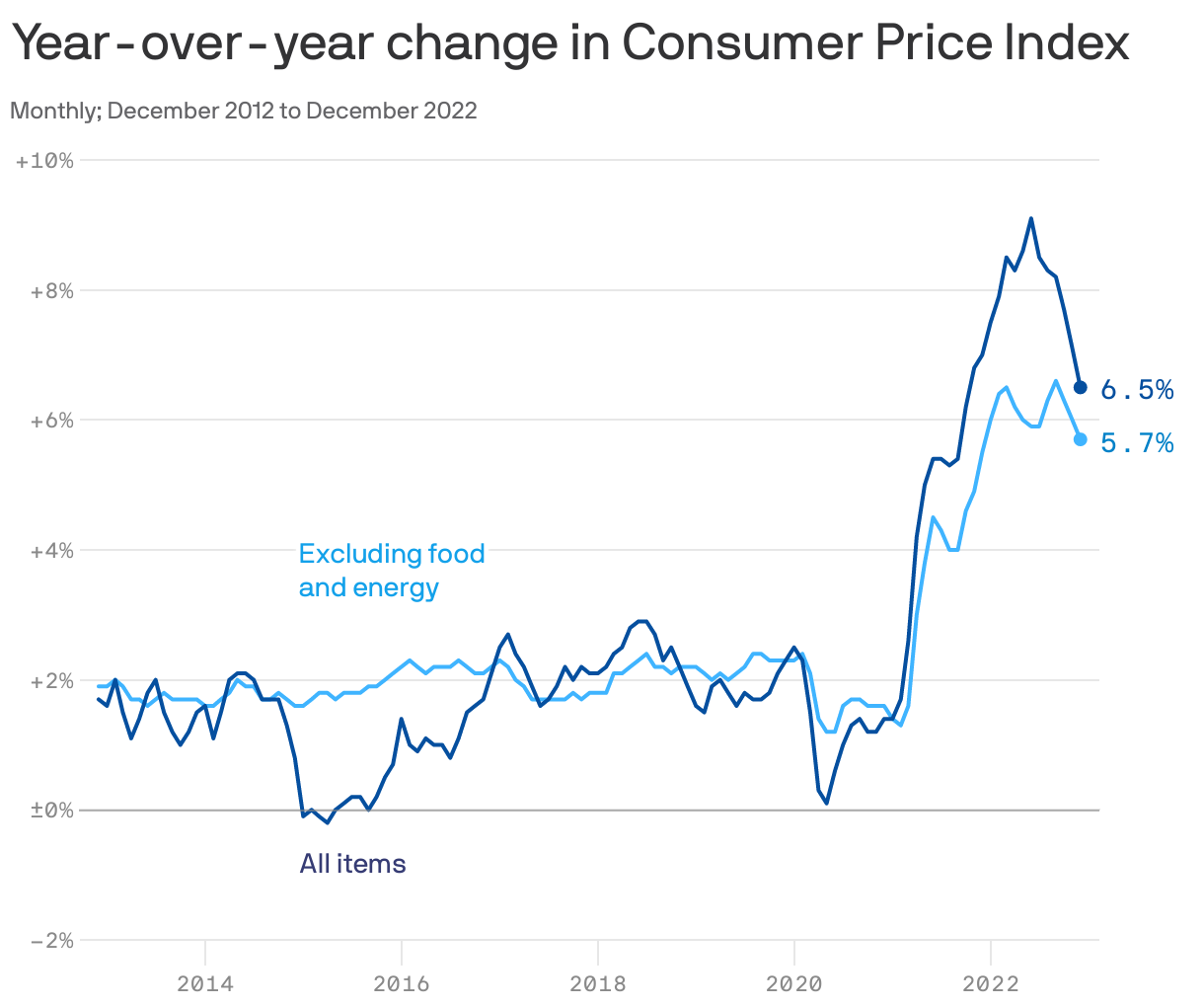
U.S. consumers got a reprieve from soaring costs in December: the Consumer Price Index declined on a monthly basis, the first drop since last summer as falling prices for items including gasoline and used cars dragged the overall index down.

By the numbers:

The index, which captures price changes across a basket of consumer goods and services, fell 0.1%, following an increase by the same amount in November. Over the past 12 months ending in December, the index is up 6.5%, falling from 7.1% through November.

  • Core CPI, which excludes food and fuel costs, rose by 0.3% last month. Over the last 12 months through December, the index rose 5.7%. In November, those figures were 0.2% and 6%, respectively.

Why it matters:

The hot inflation that persisted through much of last year continues to show signs of receding — offering at least some relief for shoppers, the White House and the Federal Reserve, though some underlying inflation pressure remains.

Where it stands:

The data caps a year in which consumer prices rose rapidly, though the pace of cost increases began to slow in the final months of the year.

  • As consumers shifted spending and supply chains began to heal, price increases for a range of goods have cooled or, in some cases, costs have fallen outright.

Between the lines:

The Federal Reserve, which has been raising interest rates aggressively to tame inflation, is watching the services sector closely, where inflation can be more challenging to stamp out.

  • A sub-index measuring price moves within the services category (excluding housing) accelerated by 0.4%, after two straight months of cooler readings
  • Still, in the 12 months through December, this sub-index is up 7.4% (compared to 7.3% in November).

The dire state of hospital finances (Part 1: Hospital of the Future series)

About this Episode

The majority of hospitals are predicted to have negative margins in 2022, marking the worst year financially for hospitals since the beginning of the Covid-19 pandemic.

In Part 1 of Radio Advisory’s Hospital of the Future series, host Rachel (Rae) Woods invites Advisory Board experts Monica WestheadColin Gelbaugh, and Aaron Mauck to discuss why factors like workforce shortages, post-acute financial instability, and growing competition are contributing to this troubling financial landscape and how hospitals are tackling these problems.

Links:

As we emerge from the global pandemic, health care is restructuring. What decisions should you be making, and what do you need to know to make them? Explore the state of the health care industry and its outlook for next year by visiting advisory.com/HealthCare2023.

Blood banks grapple with summer slowdown amid historic blood crisis

With the impending summer dip in donors, blood centers across the U.S. face a tall hurdle during a national blood shortage. 

Six months ago, the organization that supplies nearly half of the nation’s blood supply, Red Cross, declared the first-ever national crisis. Summer has always slowed donors, a trend often attributed to closed schools and people busy on vacations, but with COVID-19 already hurting blood donation numbers, blood banks face an unsteady season. 

“It’s a very challenging time, and it does put a lot of stress on the organization because we take saving lives very seriously,” the executive director of the Arkansas Blood Institute, Mario Sedlock, told radio station KUAR. “We just want to make sure that our hospitals have what they need to take care of the patients and that’s essentially what we’re all about.”

An Ohio blood center issued an emergency plea in mid-June for O-negative donors because of a “dangerously low” supply, and some blood centers are offering free movie tickets and baseball tickets to entice donors. 

The tight labor market is impacting provider volumes

https://mailchi.mp/8e26a23da845/the-weekly-gist-june-17th-2022?e=d1e747d2d8

Health systems are on edge after two quarters of shaky financial performance, with skyrocketing labor and supply costs compressing margins. But in addition to cost challenges, many are also reporting a softening of demand, with profitable surgeries and other procedures and diagnostics being hit hard. Some report seeing a drop in elective services (as one COO told us, “We may have finally worked our way through the backlog of delayed procedures from 2020 and 2021”), but in many cases, hospitals are missing the staff necessary to open up much-needed surgical capacity.

One system reported having to shut down operating rooms due to a lack of surgical techsEven more pressing is a shortage in anesthesia capacity, with systems across the country having trouble staffing anesthesiologists and nurse anesthetists. Some practitioners have been rolled up into large, investor-owned groups, which then have taken providers out-of-network for key insurers.

But regardless of ownership structure, a shortage of providers has led to “shoestring staffing” with little ability to cover absences or departures, leading to last-minute cancellations of procedures. Pediatric hospitals have been particularly hard-hit. Most rely on subspecialty-trained anesthesiologists, and as one physician leader pointed out, children’s hospitals use anesthesia not just for surgeries, but also for diagnostics, radiation therapy and other treatments where sedation isn’t required for adults. 

All in, the shortage of anesthesiologists is leading to critical treatment delays and exacerbating revenue concerns. Moreover, systems are facing frustrated consumers, who care little about the complexities of the healthcare workforce shortage and supply chain challenges that led to an abrupt cancellation of their care. 

Hospitals and imaging centers forced to limit scans amid IV contrast shortage

 Due to global shortages of iohexol and iodixanol, contrast media products injected into patients during CT scans and other commonly used diagnostic imaging studies, some providers are having to postpone non-emergency imaging.

GE Healthcare, one of two major suppliers of contrast media in the US, has experienced manufacturing disruptions at its Shanghai facility amid China’s COVID lockdowns, and the company estimates the shortages could last through June. It is increasing production at an Ireland factory, and shipping via air cargo to the US, to speed up delivery.

The Gist: This shortage will have wider ranging impacts than just
delayed imaging procedures, as so many treatment decisions rely on the results of imaging tests. Contrast fluids are also used for vascular imaging, heart catheterization, and spinal interventions. A prolonged shortage could have far-reaching implications, limiting doctors’ ability to plan surgeries, monitor cancer progression, and perform imaging-guided treatments. 

Like so many recent supply shortages, this latest one shines a spotlight on providers’ “just-in-time” supply chain, and their over-reliance on single-source vendors.