Primary care physicians could take $15 billion hit due to COVID-19 in 2020

https://www.healthcaredive.com/news/primary-care-physicians-could-take-15-billion-hit-due-to-covid-19-in-2020/580600/

Dive Brief:

  • The financial impact on primary care practices due to the COVID-19 pandemic has been profound and will likely continue in the months ahead, according to a new study published in Health Affairs.
  • Visits of all types to medical practices declined 58% in March and April compared to the baseline average, and in-person patient encounters declined by 69%, the study found. Although visits are expected to have rebounded by June, volumes are still below pre-COVID-19 levels.
  • The drop in fee-for-service revenue for the 2020 calendar year is nearly $68,000 per physician, contributing to an estimated revenue decline of 12.5%. That’s a steep enough loss to threaten the financial viability of many practices. Losses to primary care practices nationwide could top $15 billion over the year — a number that could grow if the federal government reverts increased telemedicine payment rates.

Dive Insight:

Medical practices across the United States have been hit hard by the COVID-19 outbreak.

The new study by researchers from Harvard Medical School and the American Board of Family Medicine attempts to put a price tag on that hit by running a microsimulation for projected 2020 revenues based on volume data for general practices, general internal medicine practices, general pediatric practices and family medicine practices.

As a result, they concluded that the average revenue loss per practice per physician will be $67,774, even taking into account revenue generated by telemedicine visits, which did not make up for the massive loss of patient volume during the spring.

That loss could be cut to as little as $28,265 per full-time physician if other staff is furloughed and salaries are cut to the 25th percentile of such cuts that took place during the peak of the stay-at-home orders.

Some practices are also projected to have steeper losses. Rural primary care practices are projected to lose $75,274 per physician. Other studies have suggested that pediatric practices have been hit harder than other primary care fields. Some organizations, such as the American Medical Group Association, say revenue won’t rebound fully even next year.

The study also conducted various alternate scenarios for the remainder of 2020, including a second wave of COVID-19 in the fall. The researchers estimated that would cut patient volumes by about half as much as what occurred during the spring. However, the financial hit would deepen even further, reaching $85,666 per physician.

Altogether, the study projects primary care practices will lose $15.1 billion in fee-for-service revenue this year, not even accounting for a second wave of the coronavirus. The study’s authors note that “this loss would balloon substantially if telemedicine payment rates revert back to pre-COVID-19 levels towards the end of the year.”

The study concluded that while primary care physicians as a whole have not been as hard hit as the hospital sector, the services they provide in managing chronic diseases such as diabetes and as the port of entry for many into the healthcare system makes them too valuable to suffer sustained levels of financial damage.


Labs warn COVID-19 testing demand will top capacity soon as new hotspots emerge

https://www.healthcaredive.com/news/labs-warn-covid-19-testing-demand-will-top-capacity-hotspots-new-surge/580730/

Dive Brief:

  • With the spike in coronavirus cases in Southern and Western states, commercial laboratories say they do not have the capacity to keep up with growing demand for their testing services and predict longer turnaround times for results over the coming weeks.
  • The American Clinical Laboratory Association, which represents LabCorp, Quest Diagnostics and other labs, said Saturday its members have seen a steady increase in the volume of COVID-19 test orders recently, specifically calling out the fact that critical testing materials are in short supply.
  • Quest on Thursday issued its own warning that despite the rapid expansion of its testing capacity, demand has been growing faster. In particular, the lab giant noted that orders for molecular diagnostic services have increased by about 50% over the past three weeks.

Dive Insight:

U.S. commercial labs had made “significant strides” during the coronavirus pandemic by expanding testing capacity from about 100,000 tests per day in early April to more than 300,000 currently, according to ACLA.

But newly emerging hotspots like Arizona, California and Texas are putting a strain on labs and an already limited supply of testing materials, the group said.

While labs nationwide are trying to increase capacity by purchasing more testing machines and attempting to secure additional test materials from suppliers, ACLA President Julie Khani cautioned, “the reality of this ongoing global pandemic is that testing supplies are limited” and “every country across the globe is in need of essential testing supplies, like pipettes and reagents, and that demand is likely to increase in the coming months.”

Khani said ACLA has been in talks with the Trump administration and supply chain partners about the challenges labs face as they try to increase their level of respective COVID-19 testing abilities to meet the anticipated increase in U.S. demand for tests over the coming weeks.

In the absence of a solution, Khani warned that significant demand “will likely exceed” labs’ testing capacities and “could extend turnaround times for test results.”

For its part, Quest’s statement on Thursday described the U.S. coronavirus outbreak as an “evolving” situation that is putting a “strain” on the company’s COVID-19 testing resources.

“Today, we have the capacity to perform approximately 110,000 of these tests a day (770,000 a week). Despite the rapid expansion of our testing capacity, demand for testing has been growing faster,” according to Quest.

Currently, Quest’s average turnaround time for test results are one day for hospital patients, pre-operative patients in acute care settings, and symptomatic healthcare workers, and two to three days for all other patient populations. However, the company warned that “given increased demand, we expect average turnaround times near term to extend in excess of 3 days.”

Nonetheless, Quest said it is taking actions to try to increase COVID-19 testing scale, with the goal of being able to perform 150,000 tests per day. Toward that end, the company is installing additional testing platforms in its network of U.S. labs and said it is collaborating with independent labs who currently have underused capacity.

Quest’s rival LabCorp was not immediately available for comment on its testing capacity amid reports of demand increasing across the country.


Trinity Health expects $2B revenue plunge as it cuts, furloughs more staff

https://www.healthcaredive.com/news/trinity-health-cutting-cost-cutting-2-billion-revenue-shortfall/580738/

The Dumbest Things You Can Do With Your Money | Work + Money

Dive Brief:

  • Trinity Health, one of the nation’s largest nonprofit health systems, said Monday it will take more measures to cut costs due to the downturn spurred by the novel coronavirus. The restructuring plan includes eliminating positions, extending furloughs, severances and reductions in schedules. The decisions are being “customized” across the system based on factors that include volume projections and the cost and revenue challenges in each market.
  • The Livonia, Michigan-based hospital operator said it continues to treat COVID-19 patients, however, it has “for now seen declining numbers of very sick patients with COVID-19.”
  • The system said it expects revenue to be depressed or “below historical levels” for the remainder of this fiscal year and much of the next. It projects revenue to drop by $2 billion to $17.3 billion for fiscal year 2021, which starts after its June 30 year end.

Dive Insight:

In May, Trinity said it planned to furlough nearly 12% of its workforce — or 15,000 employees out of the 125,000 nationally.  

Trinity, one of the nation’s largest hospital operators with 92 facilities and operations across 22 states, is now broadening that restructuring, extending and adding new furloughs.

In a Monday bond filing, Trinity said its operations were “significantly” impacted by the effects of the pandemic as many operators saw depressed volumes due to shelter-in-place orders, which started in most of Trinity’s markets during the last two weeks of March.

“The effect of COVID-19 on the operating margins and financial results of Trinity Health is adverse and significant and, at this point, the duration of the pandemic and the length of time until Trinity Health returns to normal operations is unknown,” according to Monday’s bond filing.

The system said relief funds provided by the federal government have not been enough to cover its operating losses. Trinity has received $600 million in relief funds that do not have to be repaid and more in loans through the advanced Medicare payment program, according to a previous analysis by Healthcare Dive.

Still, the system said it has drawn on credit facilities totaling $1 billion to provide adequate liquidity during the pandemic. Trinity reported having 178 days cash on hand as of March 30.

Some nonprofits are faring better than Trinity and pulling back on earlier staffing cuts.

Mayo Clinic said last week it will call back its furloughed workers by the end of August and restore pay that had been cut due to the pandemic.

Mayo has some of the most cash on hand in terms of days when comparing other major nonprofit systems. Mayo had 252 days of cash on hand as of March 30, more than the other 20 largest nonprofits except Cleveland Clinic and New York-Presbyterian.


Pandemic Graphic of the Day

Image may contain: text

Live updates: U.S. sets another single-day record for new coronavirus cases, surpassing 40,000 for first time

https://www.washingtonpost.com/nation/2020/06/26/coronavirus-live-updates-us/?fbclid=IwAR2rv7BC74tY4bLlGXlh70tcuv3V3vGz52MCFrCX2FYdMvhkOxd_XJoUsgM&utm_campaign=wp_main&utm_medium=social&utm_source=facebook

Coronavirus latest: Global coronavirus infections top 1 million ...

The United States has set a record for new covid-19 cases for the third time in three days, passing the 40,000 mark for the first time, according to tracking by The Washington Post.

Twelve states set their own records for the average number of new cases reported over the past seven days: Arizona, California, Florida, Georgia, Mississippi, Missouri, Oklahoma, South Carolina, Tennessee, Texas, Idaho and Utah.

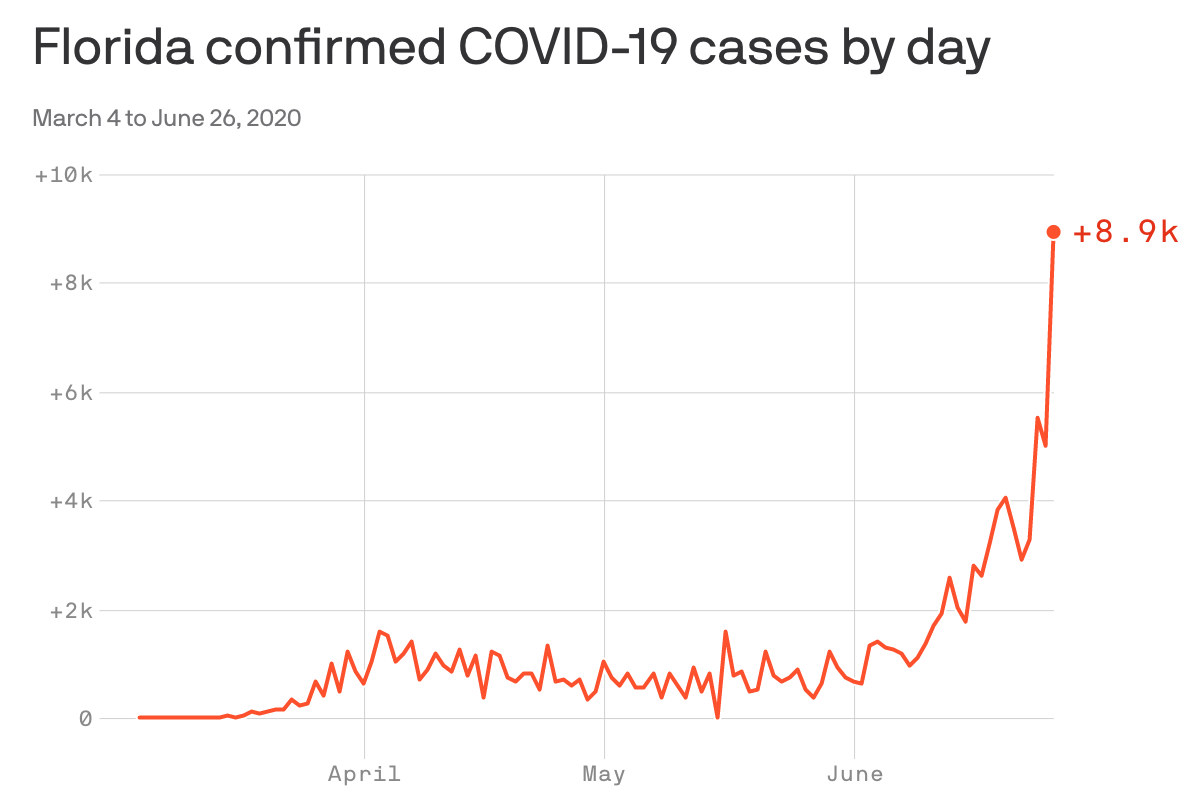
Six states set new single-day highs, led by Florida with 8,942 cases, more than 60 percent higher than its previous high set on Wednesday. Georgia, South Carolina, Tennessee, Idaho and Utah also set new single-day records.

Florida announced Friday morning that bars must close immediately, a move echoed by Texas, a state also dealing with a surge in cases and nearing its capacity to care for those suffering.

“The trajectory that we’re on right now has our hospitals being overwhelmed, probably about mid-July,” Austin Mayor Steve Adler (D) said during an appearance on CNN.

Texas Gov. Greg Abbott (R) issued an executive order that revives restrictions on bars, restaurants and certain types of outdoor recreation, one day after suggesting he would not.

Here are some significant developments:

  • The Dow Jones industrial average slid 730.05 points, about 2.8 percent, as rising coronavirus infections roiled investors Friday.
  • Vice President Pence said during a White House coronavirus task force news briefing that it is “very encouraging news” that half of the increasing cases in Florida and Texas are among Americans under 35, because younger people tend to have less-serious outcomes.
  • The Trump administration official coordinating tests for the novel coronavirus did a partial pivot Friday, announcing that the government would briefly extend its management of five testing sites in Texas, a state with a recent spike of cases and hospitalizations.
  • Anthony S. Fauci, the nation’s leading infectious-disease doctor, urged Americans to see their role in taking safety precautions as a “societal responsibility.” He begged them not to let their guards down even if the risk to their own health is considered minimal, because they can still transport it.
  • In another sign that hopes of a swift economic recovery may be losing steam, the number of homeowners delaying their mortgage payments shot up by 79,000.
  • Portugal is reinstating lockdown measures for about 700,000 people in 19 civil parishes around Lisbon next week after a worrying rise in cases in communities in the capital’s outskirts.

Six states set record number of new cases

As the United States logged a record number of infections Friday, six states announced their own new single-day high case totals: Georgia, Utah, South Carolina, Tennessee, Idaho and Florida.

Georgia reported four straight days of more than 1,700 new infections and two days in a row of records. The 1,900 cases reported by state health officials Friday surpassed the previous record, 1,714 cases, announced Thursday.

The seven-day average of new infections also hit a new high — 1,569 — and has been rising steadily since late May. That figure is up about 77 percent from a week ago and nearly 115 percent since Memorial Day.

In Utah, the single-day case total hit 676 and set a record for the fourth day in a row. The rolling average has also been on a steady upward swing for 10 days.

Current hospitalizations of Utah’s confirmed covid-19 patients are rising quickly, from 149 a week ago to 174 on Friday. Hospitalizations were at 102 when the month began.

South Carolina’s 1,301 new cases and 1,094 rolling average also set records. The state started the month with an average of 281 daily cases.

Tennessee announced 1,410 new infections, surpassing its previous record number of single-day cases by more than 200.

Current hospitalizations are also rising in South Carolina and Tennessee.

In addition to the states that set records, Louisiana has joined the states with rapidly increasing case numbers. Health officials announced 1,354 new cases Friday, compared with 523 two weeks ago and none two weeks before that.


Florida reports massive single-day increase of 9,000 coronavirus cases

https://www.axios.com/florida-single-day-increase-coronavirus-cases-a6d5578b-527c-4be4-88e6-eb7289a7be97.html?stream=health-care&utm_source=alert&utm_medium=email&utm_campaign=alerts_healthcare

Florida reports massive single-day increase of 9,000 coronavirus ...

Florida on Friday reported nearly 9,000 new coronavirus cases in 24 hours totaling 122,960 cases.

Why it matters: The state is one of many that are experiencing a fresh surge of infections.

Go deeper: The coronavirus surge is real, and it’s everywhere


Coronavirus Dashboard

https://www.axios.com/coronavirus-latest-news-quick-highlights-57a186a3-7547-45bf-852a-83019849d8d5.html

Coronavirus dashboard: Catch up fast - Axios


  1. Global: Total confirmed cases as of 9 a.m. ET: 9,635,935 — Total deaths: 489,922 — Total recoveries — 4,861,715 — Map.
  2. U.S.: Total confirmed cases as of 9 a.m ET: 2,422,312 — Total deaths: 124,415 — Total recoveries: 663,562 — Total tested: 29,207,820 — Map.
  3. Public health: America’s workers still aren’t protected from the coronavirus — Gilead says coronavirus drug should likely cost no more than $2,800.
  4. White House: Trump administration asks Supreme Court to overturn ACA during pandemic.
  5. Sports: Universities cut sports teams, as they struggle with coronavirus fallout.


The U.S. divide on coronavirus masks

https://www.axios.com/political-divide-coronavirus-masks-1053d5bd-deb3-4cf4-9570-0ba492134f3e.html

Politics, not public health, drive Americans' attitudes toward ...

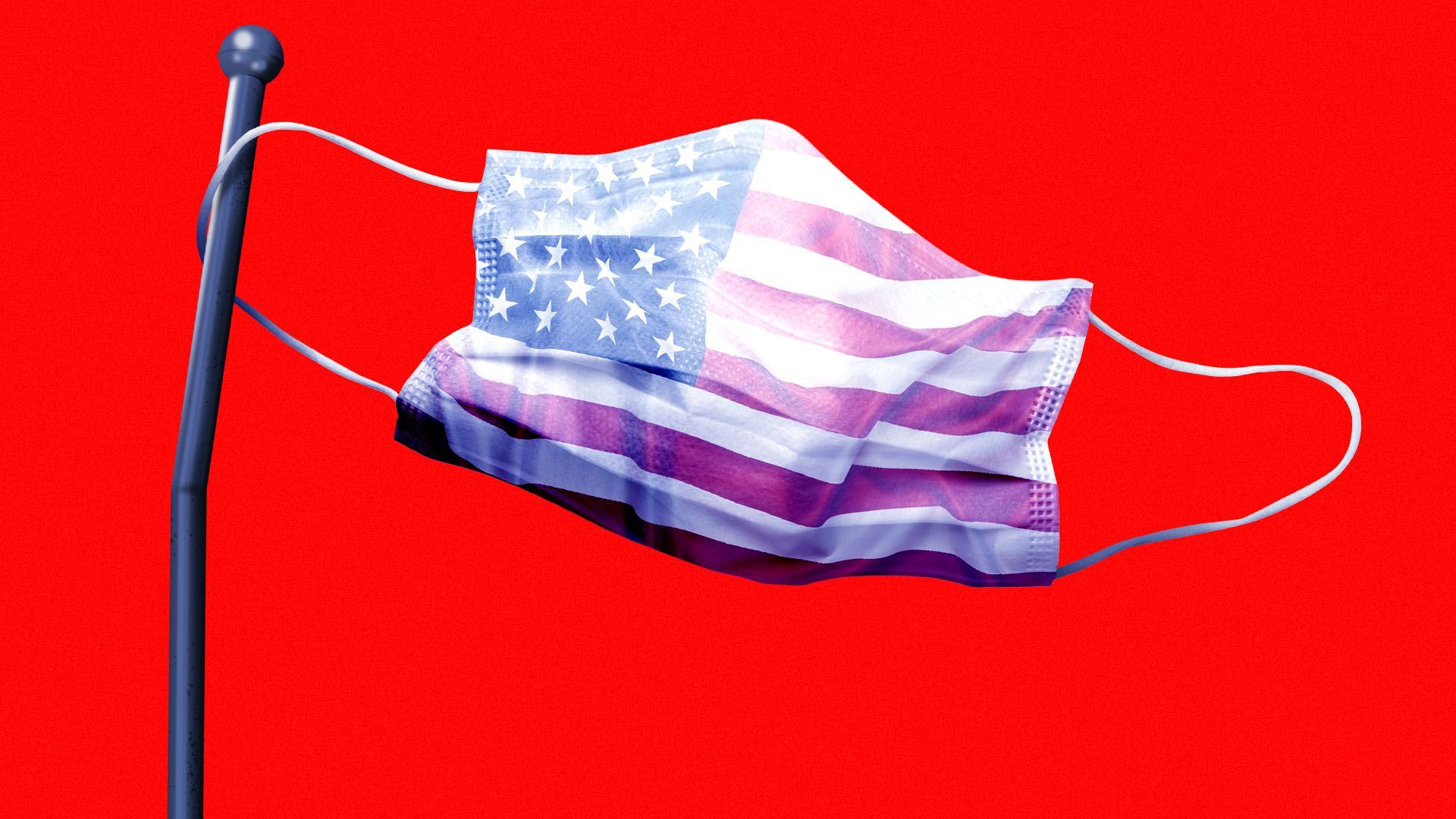
Mask-wearing has become the latest partisan division in an increasingly politically divided pandemic.

Why it matters: It’s becoming increasingly clear that wearing even a basic cloth mask is one of the most effective ways to prevent the spread of COVID-19. But whether or not people are willing to wear one has less to do with the risk of the pandemic than their political affiliation.

By the numbers: Results from months of the Axios-Ipsos coronavirus polls show a clear and growing political divide between Democrats and Republicans on mask-wearing habits.

  • Nationally, the percentage of Democrats who reported wearing a mask all the time when leaving home rose from 49% between April 10 and May 4 to 65% between May 8 and June 22.
  • During the same time period, the percentage of Republicans who reported constant mask-wearing rose from 29% to just 35%.

Context: The political divide Americans are reporting on mask use echoes one seen within nearly all levels of the government.

  • President Trump has not been seen to wear a mask, and he told Axios last week that attendees at his Tulsa campaign event on June 20 should “do what they want” on masks, which were not required at the rally.
  • Governors in many red states like Nebraska have refused to mandate facial masks in public, even as cases have begun to rise in recent weeks. At the same time, leaders in blue states — especially those that grappled with large outbreaks of COVID-19 — have urged residents to wear masks, with California Gov. Gavin Newsom mandating their use last week as cases in the state passed 4,000 a day.
  • The situation is even more divided at the local level, with leaders of red towns in blue states pushing back against mask mandates, and vice versa.

Flashback: Some of the blame for the divide can be traced back to muddled public health messaging on mask use in the early stages of the pandemic, when Americans were urged not to go out and buy masks in bulk because of concerns that there wasn’t enough personal protective equipment for front-line health care workers.

  • Those fears were real, as government virus expert Anthony Fauci pointed out in congressional testimony on Tuesday. And public health officials worried that pushing masks would inadvertently encourage Americans to continue going out in public at a moment when lockdowns demanded they stay inside.
  • Like the divide among experts on whether mass protests would increase coronavirus cases, just the perception that health advice might be based on politics rather than science gives cover to those who would forego masks, especially since the outbreak itself initially seemed like a blue state problem.

Health experts now know that cloth masks are most effective not so much at protecting individuals from infection as protecting the community from infected individuals. But that makes masks as much about social signaling as they are about public health.

  • Conservatives who prize individual autonomy over social responsibility experience “a massive pushback of psychological resistance” when presented with mask mandates, says Steven Taylor, the author of “The Psychology of Pandemics.”
  • That reaction is reinforced “if leaders like Trump downplay the significance of COVID-19 or if they won’t wear masks,” says Taylor. As a result, wearing a mask in conservative communities means visibly going against public opinion, while the opposite is true in communities where mask use is common.
  • The Axios-Ipsos data reflects this reality, showing that while Republicans in blue states use masks less than Democrats, they wear them at higher rates than Republicans in red states, just as Democrats in red states use masks at lower rates than Democrats in blue states.

What to watch: The one factor that seems capable of breaking the political deadlock is the outbreak itself. As cases have skyrocketed in red states like Arizona recently, there’s been a significant increase in Google searches for masks.


Credit downgrades aren’t attributable to COVID-19 but cash flow will be a challenge

https://www.healthcarefinancenews.com/news/credit-downgrades-arent-attributable-covid-19-cash-flow-will-be-ongoing-challenge?mkt_tok=eyJpIjoiTUdSbVptVmhaR0ZpT0RJMyIsInQiOiJ2TVwvb3g5VWF4R05DeWFScVJ4U0lXeW9xWG1cL0pVMWo1RE1cL24rd21ySEErbk9kZWNIXC9hdmZYYmJBcGU1RDQ5MDVDNXVyZ2RZSWo2djRRSXhSOVFVQk1yNjFWOTVoVjlkTXVxXC95QXU1SU8yMEhJcEtHZXJ3ZDhDc2RMb2RcLzlMcSJ9

Just How Bad Is My Bad Credit Score? | Credit.com

The coronavirus is mainly affecting the credit outlook for the rest of the year and beyond as hospitals adapt to new financial realities.

While the COVID-19 coronavirus is likely to cause cash flow and liquidity issues for hospitals through the end of the year and into 2021, the credit outlook for the healthcare industry isn’t as dire as some had feared. While there have been some downgrades this year, most of those are attributable to healthcare financial performance at the end of 2019.

At a virtual session of the Healthcare Financial Management Association on Wednesday, Lisa Goldstein, associate managing director at Moody’s Investors Service, said the agency is taking a measured approach to issuing credit ratings and will “triage” these ratings based on factors such as liquidity and cash flow.

“Changes are happening daily, and sometimes hourly with funding coming from the federal government,” said Goldstein, “so we’re taking a very measured approach.”

Healthcare is among the most volatile industries being affected by the coronavirus due to the fact that it operates like a business, with a general lack of government support to pay off debt.

Credit downgrades are on the rise, but there’s historical precedent at play. Looking at data beginning with the 2008 financial crisis, there were consistently more downgrades than upgrades in the healthcare industry, owing to its inherent volatility. It was and has generally been subject to public policy and competitive forces. In any given year, downgrades exceed upgrades.

After passage of the Affordable Care Act, however, the number of uninsured Americans hit an all-time low. Hospitals grew in occupancy and revenues improved. The situation started to worsen once more when it became clear that there was a national nursing shortage, as well as top-line revenue pressure from government and commercial payers lowering their rates, but credit downgrades didn’t truly explode until this year. There have been 24 downgrades so far this year, already exceeding the 13 downgrades in all of 2019.

The rub is that it’s not the coronavirus’s fault.

“Most downgrades were in the first quarter of the year,” said Goldstein. “We did have a lot of downgrades in March, which is when the pandemic really started – when it became a pandemic – but even though there were 11 downgrades in March, it was based on what we’d seen through the end of 2019. There were problems that were appearing that had nothing to do with the pandemic.”

Basic fundamental operating challenges were becoming more pronounced during that time. A decline in inpatient cases, a rapid rise in observation stays, a decline in outpatient cases to competing clinics and health centers, and staffing and productivity challenges all contributed to material increases in debt.

COVID-19’s effects on hospital credit ratings are in the outlook for the rest of the year and beyond. Interestingly, in March, Moody’s changed its outlook from negative to stable.

“We haven’t seen anything like this,” said Goldstein. “The industry has been through shocks, but something this long in duration has been something we think will have an impact on financial performance going forward.”

Moody’s anticipates cash flow will remain low into 2021, mostly from the suspension of elective surgeries, rising staffing expenses and uncertainty around securing enough personal protective equipment. Liquidity is still a concern, but is more of a side issue due to Medicare funding providing a Band-Aid of sorts. The CARES act will help to fill some of that gap, but not all of it, said Goldstein.

She added that the $175 billion in stimulus funding is favorable, but modestly so, since it is estimated to cover only about two months’ worth of spending. The good news is that the opportunity to apply for grant money, which doesn’t have to be repaid, can help to fill some of the gap.

Some hospital leaders are concerned that if they violate covenants – also known as a technical default – their credit outlook will be downgraded. Goldstein sought to assuage those concerns.

“Debt service covenants are expected to rise, but an expected covenant breach or violation won’t have an impact on credit quality because it’s driven by an unusual event happening,” she said. “It doesn’t speak to your fundamental history as an operating entity.”


500 Delta Airline Staff Test Positive for Coronavirus, 10 Dead

https://www.newsweek.com/500-delta-airline-staff-test-positive-coronavirus-10-dead-1513016

Coronavirus Travel: What Happens to Planes Grounded by Covid-19 ...

Hundreds of staff at Delta Air Lines have tested positive for the novel coronavirus. Ten workers have died after contracting the virus, the company confirmed.

According to a transcript of the company’s latest shareholders meeting held on a phone conference June 18, Delta’s Chief Executive Officer Ed Bastian said: “We have had approximately 500 employees that have tested positive for COVID-19. The vast majority have recovered, thankfully. Unfortunately, we have lost 10 employees to the disease.”

Speaking to Newsweek, a spokesperson for Delta noted the latest tally of infected employees is “inclusive of all positive cases reported to us since March out of our 90,000 employees worldwide.

“Since initial reporting in March, Delta has seen a significant reduction in positive employee COVID-19 tests and is currently tracking at a rate five times lower than the national average.”

Bastian said: “We have recently announced that we are going to be testing all of our employees. In fact, we started this week in Minneapolis for both the blood serology, as to whether they have already been exposed to the disease and have antibodies, as well as the active test to see if they, indeed, are carrying the virus. And that test is being led by Mayo Clinic.”

“And we are also working very closely with Quest Diagnostics in that we will have all 90,000 of our employees available to be tested. And from getting a good baseline, we will be able to provide better protection for our people and then, eventually, certainly, our customers as we go forward,” Bastian confirmed on the call.

It is unknown whether the infected staff members are cabin crew or ground-level workers and which flights they may have been operating. The majority of Delta’s employees are reported to be flight attendants, pilots and airport agents, while less than 10,000 are administrative staff, most of whom are working from home, according to Bastian.

“Given that we are a frontline customer service business, the majority of our employees need to be at work to conduct business,” Bastian said.

On Monday, Delta announced it will resume flights between the U.S. and China. The carrier will operate a service between Seattle and China’s Shanghai Pudong International Airport via South Korea’s Incheon International Airport twice a week from June 25.

From July, the airline will operate weekly flights from Seattle and Detroit to Shanghai, also via Incheon International Airport. Delta is the first U.S. airline to resume services between the U.S. and China since the temporary suspension of flights in February following the outbreak.

Earlier this month, Delta announced it will be suspending flights to 11 U.S. airports from July 8 while “customer volume is significantly reduced,” the carrier confirmed in a statement.

These airports make up five percent of the airline’s domestic operations. “All of these airports will continue to receive service from at least one other carrier after Delta suspends its operations,” the statement added.

The 11 airport locations include Aspen in Colorado (ASE), Bangor in Maine (BGR), Erie, PA (ERI), Flint in Michigan (FNT), Fort Smith in Arkansas (FSM), Lincoln in Nebraska (LNK), New Bern/Morehead/Beaufort in North Carolina (EWN), Peoria in Illinois (PIA), Santa Barbara, California (SBA), Scranton/Wilkes-Barre, Pennsylvania (AVP) and Williston in North Dakota (XWA).

“Delta has announced an 85 percent reduction in our second-quarter schedule, which includes reductions of 80 percent in U.S. domestic capacity and 90 percent internationally,” including service to Canada’s Ottawa International Airport in the province of Ontario which was suspended indefinitely from June 21, the statement confirmed.

Last month, Delta also announced the temporary suspension of operations at airports in locations with “more than one Delta-served airport to allow more frontline employees to minimize COVID-19 exposure risk while customer traffic is low.”

“Delta will continue providing essential service to impacted communities via neighboring airports,” the statement said.

The 10 airports where operations were temporarily suspended include Chicago Midway International Airport (MDW) in Illinois, Oakland International Airport (OAK), Hollywood Burbank Airport (BUR) and Long Beach Airport (LGB) in California, T. F. Green International Airport (PVD) in Rhode Island, Westchester County Airport (HPN) and Stewart International Airport (SWF) in New York, Akron-Canton Airport (CAK) in Ohio, Manchester-Boston Regional Airport (MHT) in New Hampshire and Newport News/Williamsburg International Airport (PHF) in Virginia.

Services at Canada’s Saskatoon International Airport were also temporarily suspended last month.

Delta extended its waiving of change fees and the flexibility to travel through September 30, 2022, to customers with canceled flights through September 2020.

“Eligible customers include those who have upcoming travel already booked between now and September 30 as of April 17, 2020,” and those with “canceled travel on flights between March 2020 and September 2020,” the airline said.

From May 4, Delta has required all passengers to wear a face mask or other appropriate face covering on its flights. Other safety measures introduced include sanitizing all aircraft with electrostatic spraying before departure and disinfecting all high-touch points throughout the aircraft interior.

Aircraft are also equipped with “state-of-the-art air circulation systems with HEPA [high efficiency particulate absorbing] filters that extract more than 99.99 percent of particles, including viruses,” the company said in a statement Monday.

Last week, American Airlines flight crew asked a passenger to disembark a plane after the man refused to wear a mask on board a flight.

In the same week, a survey by the International Air Transport Association (IATA) found that 45 percent of travelers said they would fly within two months after the novel coronavirus is no longer seen as a threat, down from 60 percent in April.

The novel coronavirus, first reported in Wuhan, China, has infected more than 9.2 million people across the globe, including over 2.3 million in the U.S. More than 477,800 have died following infection, while over 4.6 million have reportedly recovered from infection, as of Wednesday, according to the latest figures from Johns Hopkins University.