Applications for jobless benefits resumed their upward march last week as the worsening pandemic continued to take a toll on the economy.
More than 947,000 workers filed new claims for state unemployment benefits last week, the Labor Department said Thursday. That was up nearly 229,000 from the week before, reversing a one-week dip that many economists attributed to the Thanksgiving holiday. Applications have now risen three times in the last four weeks, and are up nearly a quarter-million since the first week of November.
On a seasonally adjusted basis, the week’s figure was 853,000, an increase of 137,000.
Nearly 428,000 applied for Pandemic Unemployment Assistance, a federal program that covers freelancers, self-employed workers and others who don’t qualify for regular state benefits.
Unemployment filings have fallen greatly since last spring, when as many as six million people a week applied for state benefits. But progress had stalled even before the recent increases, and with Covid-19 cases soaring and states reimposing restrictions on consumers and businesses, economists fear that layoffs could surge again.
“It’s very clear the third wave of the pandemic is causing businesses to have to lay people off and consumers to cut back spending,” said Daniel Zhao, senior economist for the career site Glassdoor. “It seems like we’re in for a rough winter economically.”
Jobless claims rose in nearly every state last week. In California, where the state has imposed strict new limits on many businesses, applications jumped by 47,000, more than reversing the state’s Thanksgiving-week decline.
The monthly jobs report released on Friday showed that hiring slowed sharply in early November and that some of the sectors most exposed to the pandemic, like restaurants and retailers, cut jobs for the first time since the spring. More up-to-date data from private sources suggests that the slowdown has continued or deepened since the November survey was conducted.
“Every month, we’re just seeing the pace of the recovery get slower and slower,” said AnnElizabeth Konkel, an economist with the job site Indeed. Now, she said, the question is, “Are we actually going to see it slide backward?”
Many economists say the recovery will continue to slow if the government does not provide more aid to households and businesses. After months of gridlock in Washington, prospects for a new round of federal help have grown in recent days, with congressional leaders from both parties signaling their openness to a compromise and the White House proposing its own $916 billion spending plan on Tuesday. But the two sides remain far apart on key issues.
The stakes are particularly high for jobless workers depending on federal programs that have expanded and extended unemployment benefits during the pandemic. Those programs expire later this month, potentially leaving millions of families with no income during what epidemiologists warn could be some of the pandemic’s worst months.
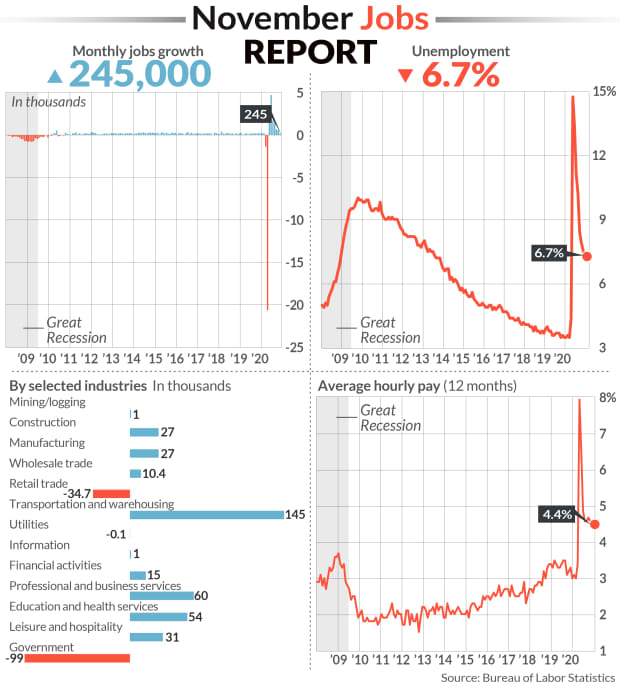
The U.S. economy added back the smallest number of jobs in seven months in November, as the labor market endured mounting pressure from the coronavirus pandemic while businesses wait for a vaccine to be distributed next year.
The U.S. Department of Labor released its monthly jobs report Friday morning at 8:30 a.m. ET. Here were the main results from the report, compared to Bloomberg consensus data as of Friday morning:
Change in non-farm payrolls: +245,000 vs. +460,000 expected and a revised +610,000 in October
Unemployment rate: 6.7% vs. 6.7% expected and 6.9% in October
Average Hourly Earnings month-over-month: 0.3% vs. +0.1% expected and +0.1% in October
Average Hourly Earnings year-over-year: 4.4% vs. +4.2% expected and a revised +4.4% in October
During November, a plethora of new stay-in-place measures and curfews swept the nation as COVID-19 cases, hospitalizations and deaths swelled to record levels. These renewed restrictions weighed on the rate of the recovery in the labor market, which had already been slowing after a record surge in rehiring followed the initial wave of lockdowns in the spring.
To that end, job gains in November sharply missed expectations. Non-farm payrolls grew by just 245,000 during the month for the smallest number since April’s record, virus-induced decline. October’s payroll gain was downwardly revised to 610,000 from the 638,000 reported earlier, while September’s gain was raised to 711,000 from 672,000.
A third straight month of declining government employment served as a drag on the headline payrolls figure, as another 93,000 temporary workers hired for the 2020 Census were let go.
In the private sector, retail trade industries shed nearly 35,000 jobs following a gain of 95,000 in October. Leisure and hospitality employers added just 31,000 jobs during November, declining by nearly 90% from October. And in goods-producing industries, manufacturing jobs rose by only 27,000 for the month, falling short of the 40,000 expected.
But a handful of other industries added more jobs in November from October: Transportation and warehousing jobs grew by 145,000 to more than double October’s advance, and growth in wholesale trade positions also doubled to 10,400.
November’s unemployment rate also improved just marginally to 6.7% from the 6.9% reported in October. While down from a pandemic-era high of 14.7% in April, the jobless rate remains nearly double that from before the pandemic.
Other employment reports this week underscored the decelerating trend. Private-sector hiring fell to the lowest level in four months in November, according to data tracked by ADP. New weekly jobless claims began rising again around the 12th of the month, when the Labor Department conducts its surveys for its monthly jobs report. And in the Federal Reserve’s November Beige Book, the central bank noted that nearly all districts reported rising employment, “but for most, the pace was slow, at best, and the recovery remained incomplete.”
The U.S. economy still has a ways to go before fully making up for the drop in payrolls induced by the pandemic.Even with a seventh straight month of net job gains, the economy remains about 9.8 million jobs short of its pre-pandemic level in February. The U.S. economy lost more than 22 million jobs between March and April.
And worryingly, the number of the long-term unemployed has kept climbing. Those classified as “permanent job losers” totaled 3.7 million in November, eclipsing the number of individuals on temporary layoff for the second time since the start of the pandemic. Permanent job losers have increased by 2.5 million since February, before the pandemic meaningfully hit the U.S. economy.
In Washington, congressional lawmakers have for months been at a stalemate over the size and scope of another stimulus package, which could help provide funds for businesses to help keep workers employed, and offer extended unemployment benefits for those the pandemic has kept out of work. Federal unemployment programs authorized under the CARES Act in the spring are poised to expire at the end of the month. These include the Pandemic Emergency Unemployment Compensation and Pandemic Unemployment Assistance programs, which together provide benefits for more than 13 million Americans.
“The only thing that matters about today’s NFP [non-farm payrolls] report is whether it increases the likelihood of a stimulus deal getting done during the lame duck session,” Peter Tchir, head of macro strategy for Academy Securities, said in an email Friday morning. “While the unemployment rate shrunk and wages ticked up nicely, the headline number dropped significantly, was well below average expectations, and included some downward revisions to last month (and upward revisions to 2 months ago) – all of which point to a less robust job market.”
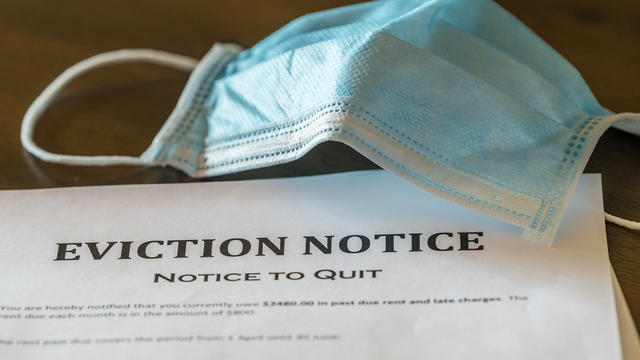
Millions of Americans are in danger of losing their homes when federal and local limits on evictions expire at the end of the year, a growing body of research shows.
A report issued this month from the National Low Income Housing Coalition (NLIHC) and the University of Arizona estimates that 6.7 million households could be evicted in the coming months. That amounts to 19 million people potentially losing their homes, rivaling the dislocation that foreclosures caused after the subprime housing bust.
Apart from being a humanitarian disaster, the crisis threatens to exacerbate the coronavirus pandemic, according to a forthcoming study in the Journal of Urban Health.
“Our concern is we’re going to see a huge increase in evictions after the CDC moratorium is lifted,” said Andrew Aurand, vice president of research at the NLIHC and a co-author of the report.
The number of Americans struggling to pay rent has steadily risen since this summer, according to the Census Bureau’s Household Pulse Survey. In the latest survey, from early November, 11.6 million people indicated they wouldn’t be able to pay the rent or mortgage next month.
Meanwhile, some renters who are still paying rent are relying on “unsustainable” income to make ends meet. Among those who report trouble making rent, “More than half are borrowing from family and friends to meet their spending needs, one-third are using credit cards, and one-third are spending down savings,” the NLIHC report found.
Approaching a “payment cliff”
In early September, the U.S. Centers for Disease Control and Prevention barred evictions through year-end, describing the move as a public health measure to reduce spread of the coronavirus. The CDC order protects renters earning less than $99,000 if they have lost income during the pandemic and are likely to become homeless if they’re evicted.
Many states and cities also imposed renter protections during the spring and summer, and others established rental assistance programs to help tenants make ends meet. However, both types of programs are quickly expiring.
Once the CDC moratorium expires,Aurand said, “We expect to see a jump in [eviction] filings, and we know that even now, filings are already occurring. Come January, sadly, for a number of tenants, the next step is the landlord will evict them.”
The situation could reach crisis levels in the new year. With Congress yet to pass another coronavirus relief package, about 12 million Americans are set to lose their unemployment benefits the day after Christmas, a sharp fall in income that would make it harder for many people to pay rent. An abrupt cutoff would slash income by about $19 billion per month, Nancy Vanden Houten, lead economist at Oxford Economics, said in a research note.
Although the Trump Administration has restricted evictions for most households through the end of the year, it did not relieve renters of the need to pay rent. That means many renters may face a “payment cliff” at year’s end, when they must pay several months’ worth of back rent or face eviction.
“If renters are required to quickly repay past due rent or face eviction, the hardship will fall predominantly on lower-income families who have already been disproportionately affected by the coronavirus crisis,” Vanden Houten wrote.
Said Aurand, “If you were a low-income renter before the pandemic and you were hit financially, even if your income starts to recover, you’re going to have a very hard time paying back that rental debt.”
“What we really need is rental assistance,” he noted. “The underlying problem is renters struggling to pay their rent because we’re in an economic crisis, and the moratorium doesn’t address that.”
Long-term impact
Academics have also pushed for direct aid to renters and homeowners, citing the extreme economic fallout from the coronavirus and related shutdowns. In Los Angeles, where 1 in 5 renters were late on rent at some point this summer, residents are facing “an income crisis layered atop of a housing crisis,” researchers at the University of California – Los Angeles have said.
“Delivering assistance to renters now can not just stave off looming evictions, but also prevent quieter and longer-term problems that are no less serious, such as renters struggling to pay back credit card or other debt, struggling to manage a repayment plan, or emerging from the pandemic with little savings left,” they wrote in August report. “Renter assistance can also help the smaller landlords who are disproportionately seeing tenants unable to pay.”
A groundswell of evictions would cause enormous financial hardship. Losing a home is one of the most traumatic events a family can experience, with research showing that people who have experienced eviction are more likely to lose their jobs, fall ill or suffer from mental-health consequences. Children whose families are evicted are more likely to drop out of school, while evictions also contribute to the spread of COVID-19, according to a forthcoming study from UCLA viewed by “60 Minutes.“
“We’ve got a country that’s about to witness evictions like they’ve never witnessed before,” Laura Tucker, a social worker for Florida’s Hillsborough County School District, told “60 Minutes.”
“An eviction can impact a family’s ability to re-house for more than 10 years,” she said.
For that reason, housing and public health experts have said that rental aid now
“Now is the time for action to provide emergency rental assistance. A failure to do so will result in millions of renters spiraling deeper into debt and housing poverty, while public costs and public health risks of eviction-related homelessness increase,” the NLIHC report says. “These outcomes are preventable.”
Of his many plans to expand insurance coverage, President-elect Joe Biden’s simplest strategy is lowering the eligibility age for Medicare from 65 to 60.
But the plan is sure to face long odds, even if the Democrats can snag control of the Senate in January by winning two runoff elections in Georgia.
Republicans, who fought the creation of Medicare in the 1960s and typically oppose expanding government entitlement programs, are not the biggest obstacle.Instead, the nation’s hospitals — a powerful political force — are poised to derail any effort. Hospitals fear adding millions of people to Medicare will cost them billions of dollars in revenue.
“Hospitals certainly are not going to be happy with it,” said Jonathan Oberlander, professor of health policy and management at the University of North Carolina at Chapel Hill.
Medicare reimbursement rates for patients admitted to hospitals are on average half what commercial or employer-sponsored insurance plans pay.
“It will be a huge lift [in Congress] as the realities of lower Medicare reimbursement rates will activate some powerful interests against this,” said Josh Archambault, a senior fellow with the conservative Foundation for Government Accountability.
Biden, who turns 78 this month, said his plan will help Americans who retire early and those who are unemployed or can’t find jobs with health benefits.
“It reflects the reality that, even after the current crisis ends, older Americans are likely to find it difficult to secure jobs,” Biden wrote in April.
Lowering the Medicare eligibility age is popular. About 85% of Democrats and 69% of Republicans favor allowing those as young as 50 to buy into Medicare, according to a Kaiser Family Foundation tracking poll from January 2019. (Kaiser Health News is an editorially independent program of the Kaiser Family Foundation.)
Although opposition from the hospital industry is expected to be fierce, it is not the only obstacle to Biden’s plan.
Critics, especially Republicans on Capitol Hill, will point to the nation’s $3 trillion budget deficit as well as the dim outlook for the Medicare Hospital Insurance Trust Fund. That fund is on track to reach insolvency in 2024. That means there won’t be enough money to pay hospitals and nursing homes fully for inpatient care for Medicare beneficiaries.
It’s also unclear whether expanding Medicare will fit on the Democrats’ crowded health agenda, which includes dealing with the COVID-19 pandemic, possibly rescuing the Affordable Care Act (if the Supreme Court strikes down part or all of the law in a current case), expanding Obamacare subsidies and lowering drug costs.
Biden’s proposal is a nod to the liberal wing of the Democratic Party, which has advocated for Sen. Bernie Sanders’ government-run “Medicare for All” health system that would provide universal coverage. Biden opposed that effort, saying the nation could not afford it. He wanted to retain the private health insurance system, which covers 180 million people.
To expand coverage, Biden has proposed two major initiatives. In addition to the Medicare eligibility change, he wants Congress to approve a government-run health plan that people could buy into instead of purchasing coverage from insurance companies on their own or through the Obamacare marketplaces. Insurers helped beat back this “public option” initiative in 2009 during the congressional debate over the ACA.
The appeal of lowering Medicare eligibility to help those without insurance lies with leveraging a popular government program that has low administrative costs.
“It is hard to find a reform idea that is more popular than opening up Medicare” to people as young as 60, Oberlander said. He said early retirees would like the concept, as would employers, who could save on their health costs as workers gravitate to Medicare.
The eligibility age has been set at 65 since Medicare was created in 1965 as part of President Lyndon Johnson’s Great Society reform package. It was designed to coincide with the age when people at that time qualified for Social Security. Today, people generally qualify for early, reduced Social Security benefits at age 62, but full benefits depend on the year you were born, ranging from age 66 to 67.
While people can qualify on the basis of other criteria, such as having a disability or end-stage renal disease, 85% of the 57 million Medicare enrollees are in the program simply because they’re old enough.
Lowering the age to 60 could add as many as 23 million people to Medicare, according to an analysis by the consulting firm Avalere Health. It’s unclear, however, if everyone who would be eligible would sign up or if Biden would limit the expansion to the 1.7 million people in that age range who are uninsured and the 3.2 million who buy coverage on their own.
Avalere says 3.2 million people in that age group buy coverage on the individual market.
While the 60-to-65 group has the lowest uninsured rate (8%) among adults, it has the highest health costs and pays the highest rates for individual coverage, said Cristina Boccuti, director of health policy at West Health, a nonpartisan research group.
About 13 million of those between 60 and 65 have coverage through their employer, according to Avalere. While they would not have to drop coverage to join Medicare, they could possibly opt to pay to join the federal program and use it as a wraparound for their existing coverage. Medicare might then pick up costs for some services that the consumers would have to shoulder out of pocket.
Some 4 million people between 60 and 65 are enrolled in Medicaid, the state-federal health insurance program for low-income people. Shifting them to Medicare would make that their primary health insurer, a move that would save states money since they split Medicaid costs with the federal government.
Chris Pope, a senior fellow with the conservative Manhattan Institute, said getting health industry support, particularly from hospitals, will be vital for any health coverage expansion. “Hospitals are very aware about generous commercial rates being replaced by lower Medicare rates,” he said.
“Members of Congress, a lot of them are close to their hospitals and do not want to see them with a revenue hole,” he said.
President Barack Obama made a deal with the industry on the way to passing the ACA. In exchange for gaining millions of paying customers and lowering their uncompensated care by billions of dollars, the hospital industry agreed to give up future Medicare funds designed to help them cope with the uninsured. Showing the industry’s prowess on Capitol Hill, Congress has delayed those funding cuts for more than six years.
Jacob Hacker, a Yale University political scientist, noted that expanding Medicare would reduce the number of Americans who rely on employer-sponsored coverage. The pitfalls of the employer system were highlighted in 2020 as millions lost their jobs and their workplace health coverage.
Even if they can win the two Georgia seats and take control of the Senate with the vice president breaking any ties, Democrats would be unlikely to pass major legislation without GOP support — unless they are willing to jettison the long-standing filibuster rule so they can pass most legislation with a simple 51-vote majority instead of 60 votes.
Hacker said that slim margin would make it difficult for Democrats to deal with many health issues all at once.
“Congress is not good at parallel processing,” Hacker said, referring to handling multiple priorities at the same time. “And the window is relatively short.”
Two conservative justices on the Supreme Court appeared prepared to preserve at least some of the major components of ObamaCare, including its protections for people with preexisting conditions, as they heard arguments Tuesday in a suit challenging the law.
Chief Justice John Roberts and Justice Brett Kavanaugh seemed to express the view that if the court were to strike down the provision of the law mandating the purchase of health insurance, the rest of the law should be allowed to survive.
“Looking at our severability precedents, it does seem fairly clear that the proper remedy would be to sever the mandate provision and leave the rest of the act in place, the provisions regarding preexisting conditions and the rest,” Kavanaugh said.
President-elect Joe Biden’s healthcare agenda: building on the ACA, value-based care, and bringing down drug prices.
In many ways, Joe Biden is promising a return to the Obama administration’s approach to healthcare:
Building on the Affordable Care Act (ACA) through incremental expansions in government-subsidized coverage
Continuing CMS’ progress toward value-based care
Bringing down drug prices
Supporting modernization of the FDA
Bolder ideas, such as developing a public option, resolving “surprise billing,” allowing for negotiation of drug prices by Medicare, handing power to a third party to help set prices for some life sciences products, and raising the corporate tax rate, could be more challenging to achieve without overwhelming majorities in both the House and the Senate.
Biden is likely to mount an intensified federal response to the COVID-19 pandemic, enlisting the Defense Production Act to compel companies to produce large quantities of tests and personal protective equipment as well as supporting ongoing deregulation around telehealth. The Biden administration also will likely return to global partnerships and groups such as the World Health Organization, especially in the area of vaccine development, production and distribution.
What can health industry executives expect from Biden’s healthcare proposals?
Broadly, healthcare executives can expect an administration with an expansionary agenda, looking to patch gaps in coverage for Americans, scrutinize proposed healthcare mergers and acquisitions more aggressively and use more of the government’s power to address the pandemic. Executives also can expect, in the event the ACA is struck down, moves by the Biden administration and Democratic lawmakers to develop a replacement. Healthcare executives should scenario plan for this unlikely yet potentially highly disruptive event, and plan for an administration marked by more certainty and continuity with the Obama years.
All healthcare organizations should prepare for the possibility that millions more Americans could gain insurance under Biden. His proposals, if enacted, would mean coverage for 97% of Americans, according to his campaign website. This could mean millions of new ACA customers for payers selling plans on the exchanges, millions of new Medicaid beneficiaries for managed care organizations, millions of newly insured patients for providers, and millions of covered customers for pharmaceutical and life sciences companies. The surge in insured consumers could mirror the swift uptake in the years following the passage of the ACA.
Biden’s plan to address the COVID-19 pandemic
Biden is expected to draw on his experience from H1N1 and the Ebola outbreaks to address the COVID-19 pandemic with a more active role for the federal government, which many Americans support. These actions could shore up the nation’s response in which the federal government largely served in a support role to local, state and private efforts.
Three notable exceptions have been the substantial federal funding for development of vaccines against the SARS-CoV-2 virus, Congress’ aid packages and the rapid deregulatory actions taken by the FDA and CMS to clear a path for medical products to be enlisted for the pandemic and for providers, in particular, to be able to respond to it.
Implications of Biden’s 2020 health agenda on healthcare payers, providers and pharmaceutical and life sciences companies
The US health system has been slowly transforming for years into a New Health Economy that is more consumer-oriented, digital, virtual, open to new players from outside the industry and focused on wellness and prevention. The COVID-19 pandemic has accelerated some of those trends. Once the dust from the election settles, companies that have invested in capabilities for growth and are moving forcefully toward the New Health Economy stand to gain disproportionately.
Shortages of clinicians and foreign medical students may continue to be an issue for a while
The Trump administration made limiting the flow of immigrants to the US a priority. The associated policy changes have the potential to exacerbate shortages of physicians, nurses and other healthcare workers, including medical students. These consequences have been aggravated by the pandemic, which dramatically curtailed travel into the US.
Healthcare organizations, especially rural ones heavily dependent on foreign-born employees, may find themselves competing fiercely for workers, paying higher salaries and having to rethink the structure of their workforces.
Providers should consider reengineering primary care teams to reflect the patients’ health status and preferences, along with the realities of the workforce on the ground and new opportunities in remote care.
Focus on modernizing the supply chain
Biden and lawmakers from both parties have been raising questions about life sciences’ supply chains. This focus has only intensified because of the pandemic and resulting shortages of personal protective equipment (PPE), pharmaceuticals, diagnostic tests and other medical products.
Investment in advanced analytics and cybersecurity could allow manufacturers to avoid disruptive stockouts and shortages, and deliver on the promise of the right treatment to the right patient at the right time in the right place.
Drug pricing needs a long-term strategy
Presidents and lawmakers have been talking about drug prices for decades; few truly meaningful actions have been implemented. Biden has made drug pricing reform a priority.
Drug manufacturers may need to start looking past the next quarter to create a new pricing strategy that maximizes access in local markets through the use of data and analytics to engage in more value-based pricing arrangements.
New financing models may help patients get access to drugs, such as subscription models that provide unlimited access to a therapy at a flat rate.
Companies that prepare now to establish performance metrics and data analytics tools to track patient outcomes will be well prepared to offer payers more sustainable payment models, such as mortgage or payment over time contracts, avoiding the sticker shock that comes with these treatments and improving uptake at launch.
Pharmaceutical and life sciences companies will likely have to continue to offer tools for consumers like co-pay calculators and use the contracting process where possible to minimize out-of-pocket costs, which can improve adherence rates and health outcomes.
View interoperability as an opportunity to embrace, not a threat to avoid or ignore
While the pandemic delayed many of the federal interoperability rule deadlines, payers and providers should use the extra time to plan strategically for an interoperable future.
Payers should review business partnerships in this new regulatory environment.
Digital health companies and new entrants may help organizations take advantage of the opportunities that achieving interoperability may present.
Companies should consider the legal risks and take steps to protect their reputations and relationships with customers by thinking through issues of consent and data privacy.
Health organizations should review their policies and consider whether they offer protections for customers under the new processes and what data security risks may emerge. They should also consider whether business associate agreements are due in more situations.
Plan for revitalized ACA exchanges and a booming Medicare Advantage market
The pandemic has thrown millions out of work, generating many new customers for ACA plans just as the incoming Biden administration plans to enrich subsidies, making more generous plans within reach of more Americans.
Payers in this market should consider how and where to expand their membership and appeal to those newly eligible for Medicare. Payers not in this market should consider partnerships or acquisitions as a quick way to enter the market, with the creation of a new Medicare Advantage plan as a slower but possibly less capital-intensive entry into this market.
Payers and health systems should use this opportunity to design more tailored plan options and consumer experiences to enhance margins and improve health outcomes.
Payers with cash from deferred care and low utilization due to the pandemic could turn to vertical integration with providers as a means of investing that cash in a manner that helps struggling providers in the short term while positioning payers to improve care and reduce its cost in the long term.
Under the Trump administration, the FDA has approved historic numbers of generic drugs, with the aim of making more affordable pharmaceuticals available to consumers. Despite increased FDA generics approvals, generics dispensed remain high but flat, according to HRI analysis of FDA data.
Pharmaceutical company stocks, on average, have climbed under the Trump administration, with a few notable dips due to presidential speeches criticizing the industry and the pandemic.
Providers have faced some revenue cuts, particularly in the 340B program, and many entered the pandemic in a relatively weak liquidity position. The pandemic has led to layoffs, pay cuts and even closures. HRI expects consolidation as the pandemic continues to curb the flow of patients seeking care in emergency departments, orthopedic surgeons’ offices, dermatology suites and more.
Lawmakers and politicians often use bold language, and propose bold solutions to problems, but the government and the industry itself resists sudden, dramatic change, even in the face of sudden, dramatic events such as a global pandemic. One notable exception to this would be a decision by the US Supreme Court to strike down the ACA, an event that would generate a great deal of uncertainty and disruption for Americans, the US health industry and employers.
The financial challenges caused by the COVID-19 pandemic have forced hundreds of hospitals across the nation to furlough, lay off or reduce pay for workers, and others have had to scale back services or close.
Lower patient volumes, canceled elective procedures and higher expenses tied to the pandemic have created a cash crunch for hospitals. U.S. hospitals are estimated to lose more than $323 billion this year, according to a report from the American Hospital Association. The total includes $120.5 billion in financial losses the AHA predicts hospitals will see from July to December.
Hospitals are taking a number of steps to offset financial damage. Executives, clinicians and other staff are taking pay cuts, capital projects are being put on hold, and some employees are losing their jobs. More than 260 hospitals and health systems furloughed workers this year and dozens of others have implemented layoffs.
Below are 11 hospitals and health systems that announced layoffs since Sept. 1, most of which were attributed to financial strain caused by the pandemic.
1. NorthBay Healthcare, a nonprofit health system based in Fairfield, Calif., is laying off 31 of its 2,863 employees as part of its pandemic recovery plan, the system announced Nov. 2.
2. Minneapolis-based Children’s Minnesota is laying off 150 employees, or about 3 percent of its workforce. Children’s Minnesota cited several reasons for the layoffs, including the financial hit from the COVID-19 pandemic. Affected employees will end their employment either Dec. 31 or March 31.
3. Brattleboro Retreat, a psychiatric and addiction treatment hospital in Vermont, notified 85 employees in late October that they would be laid off within 60 days.
4. Citing a need to offset financial losses, Minneapolis-basedM Health Fairview said it plans to downsize its hospital and clinic operations. As a result of the changes, 900 employees, about 3 percent of its 34,000-person workforce, will be laid off.
5. Lake Charles (La.) Memorial Health Systemlaid off 205 workers, or about 8 percent of its workforce, as a result of damage sustained from Hurricane Laura. The health system laid off employees at Moss Memorial Health Clinic and the Archer Institute, two facilities in Lake Charles that sustained damage from the hurricane.
6. Burlington, Mass.-based Wellforce laid off 232 employees as a result of operating losses linked to the COVID-19 pandemic. The health system, comprising Tufts Medical Center, Lowell General Hospital and MelroseWakefield Healthcare,experienced a drastic drop in patient volume earlier this year due to the suspension of outpatient visits and elective surgeries. In the nine months ended June 30, the health system reported a $32.2 million operating loss.
7. Baptist Health Floyd in New Albany, Ind., part of Louisville, Ky.-based Baptist Health, eliminated 36 positions. The hospital said the cuts, which primarily affected administrative and nonclinical roles, are due to restructuring that is “necessary to meet financial challenges compounded by COVID-19.”
8. Cincinnati-based UC Health laid off about 100 employees. The job cuts affected both clinical and non-clinical staff. A spokesperson for the health system said no physicians were laid off.
9. Mercy Iowa City(Iowa) announced in September that it will lay off 29 employees to address financial strain tied to the COVID-19 pandemic.
10. Springfield, Ill.-based Memorial Health Systemlaid off 143 employees, or about 1.5 percent of the five-hospital system’s workforce. The health system cited financial pressures tied to the pandemic as the reason for the layoffs.
11. Watertown, N.Y.-based Samaritan Healthannounced Sept. 8 that it laid off 51 employees and will make other cost-cutting moves to offset financial stress tied to the COVID-19 pandemic.
In swing states from Georgia to Arizona, the Affordable Care Act — and concerns over protecting preexisting conditions — loom over key races for Congress and the presidency.
“I can’t even believe it’s in jeopardy,” says Noshin Rafieei, a 36-year-old from Phoenix. “The people that are trying to eliminate the protection for individuals such as myself with preexisting conditions, they must not understand what it’s like.”
In 2016, Rafieei was diagnosed with colon cancer. A year later, her doctor discovered it had spread to her liver.
“I was taking oral chemo, morning and night — just imagine that’s your breakfast, essentially, and your dinner,” Rafieei says.
In February, she underwent a liver transplant.
Rafieei does have health insurance now through her employer, but she fears whether her medical history could disqualify her from getting care in the future.
“I had to pray that my insurance would approve of my transplant just in the nick of time,” she says. “I had that Stage 4 label attached to my name and that has dollar signs. Who wants to invest in someone with Stage 4?”
“That is no way to feel,” she adds.
After doing her research, Rafieei says she intends to vote for Joe Biden, who helped get the ACA passed in this first place.
“Health care for me is just the driving factor,” she says.
Even 10 years after the Affordable Care Act locked in a health care protection that Americans now overwhelmingly support — guarantees that insurers cannot deny coverage or charge more based on preexisting medical conditions — voters once again face contradicting campaign promises over which candidate will preserve the law’s legacy.
A majority of Democrats, independents and Republicans say they want their new president to preserve the ACA’s provision that protects as many as 135 million people from potentially being unable to get health care because of their medical history.
President Trump has pledged to keep this in place, even as his administration heads to the U.S Supreme Court the week after Election Day to argue the entire law should be struck down.
“We’ll always protect people with preexisting,” Trump said in the most recent debate. “I’d like to terminate Obamacare, come up with a brand new, beautiful health care.”
And yet the Trump administration has not unveiled a health care plan or identified any specific components it might include. In 2017, the administration joined with congressional Republicans to dismantle the Affordable Care Act, but none of the GOP-backed replacement plans could summon enough votes. The Republicans’ final attempt, a limited “skinny repeal” of parts of the ACA, failed in the Senate because of resistance within their own party.
In an attempt to reassure wary voters, Trump recently signed an executive order that asserts protections for preexisting conditions will stay in place, but legal experts say this has no teeth.
“It’s basically a pinky promise, but it doesn’t have teeth,” says Swapna Reddy, a clinical assistant professor at Arizona State University’s College of Health Solutions. “What is the enforceability? The order really doesn’t have any effect because it can’t regulate the insurance industry.”
Since the 2017 repeal and replace efforts, the health care law has continued to gain popularity.
Public approval is now at an all-time high, but polling shows many Republicans still don’t view the ACA as synonymous with its most popular provision — protections for preexisting conditions.
Democrats hope to change that.
“If you have a preexisting condition — heart disease, diabetes, breast cancer — they are coming for you,” said Biden’s running mate, California Sen. Kamala Harris, during her recent debate with Vice President Pence.
Voters support maintaining ACA’s legal protections
In key swing states, many voters say protecting preexisting conditions is their top health concern.
Rafieei, the Phoenix woman with colon cancer, still often has problems getting her treatments covered. Her insurance has denied medications that help quell the painful side effects of chemotherapy or complications related to her transplant.
“During those chemo days, I’d think, wow, I’m really sick, and I just got off the phone with my pharmacy and they’re denying me something that could possibly help me,” she says.
Because of her transplant, she will be on medication for the rest of her life, and sometimes she even has nightmares about being away and running out of it.
“I will have these panic attacks like, ‘Where’s my medicine? Oh my god, I have to get back to get my medicine?'”
Election season and talk of eliminating the ACA has not given Rafieei much reassurance, though.
“I cannot stomach politics. I am beyond terrified,” she says.
And yet she plans to head to the polls — in person — despite having a compromised immune system.
“It might be a long day. But you know what? I want to fix whatever I can,” she says.
A few days after she votes, she’ll get a coronavirus test and go in for another round of surgery.
A key health issue in political swing states
Rafieei’s home state of Arizona is emblematic of the political contradictions around the health care law.
The Republican-led state reaped the benefits of the ACA. Arizona’s uninsured rate dropped considerably since 2010, in part because it expanded Medicaid.
But the state’s governor also embraced the Republican effort to repeal and replace the law in 2017, and now Arizona’s attorney general is part of the lawsuit that will be heard by the Supreme Court on Nov. 10 that could topple the entire law.
Depending on how the Supreme Court rules, ASU’s Reddy says any meaningful replacement for preexisting conditions would involve Congress and the next president.
“At the moment, we have absolutely no national replacement plan,” she says.
Meanwhile, some states have passed their own laws to maintain protections for preexisting conditions, in the event the ACA is struck down. But Reddy says those vary considerably from state to state.
For example, Arizona’s law, passed just earlier this year, only prevents insurers from outright denying coverage — consumers with preexisting conditions can be charged more.
“We are in this season of chaos around the Affordable Care Act,” says Reddy. “From a consumer perspective, it’s really hard to decipher all these details.”
As in the congressional midterm election of 2018, Democrats are hammering away at Republican’s track record on preexisting conditions and the ACA.
In Arizona, Mark Kelly, the Democratic candidate running for Senate, has run ads and used every opportunity to remind voters of Republican Sen. Martha McSally’s votes to repeal the law.
In Georgia, Democratic challenger Jon Ossoff has taken a similar approach.
“Can you look down the camera and tell the people of this state why you voted four times to allow insurance companies to deny us health care coverage because we may suffer from diabetes or heart disease or have cancer in remission?” Ossoff said during a debate with his opponent, Republican Sen. David Purdue.
Republicans have often tried to skirt health care as a major issue this election cycle because there isn’t the same political advantage to pushing the repeal and replace argument, says Mark Peterson, a professor of public policy, political science and law at UCLA.
“It’s political suicide, there doesn’t seem to be any real political advantage anymore,” says Peterson.
But the timing of the Supreme Court case — exactly a week after election day — has somewhat obscured the issue for voters.
Republicans have chipped away at the health care law by reducing the individual mandate — the provision requiring consumers to purchase insurance — to zero dollars.
The premise of the Supreme Court case is that the ACA no longer qualifies as a tax because of this change in the penalty.
“It is an extraordinary stretch, even among many conservative legal scholars, to say that the entire law is predicated on the existence of an enforced individual mandate,” says Peterson.
The court could rule in a very limited way that does not disrupt the entire law or protections for preexisting conditions, he says.
Like many issues this election, Peterson says there is a big disconnect between what voters in the two parties believe is at stake with the ACA.
“Not everybody, particularly Republicans, associates the ACA with protecting preexisting conditions,” he says. “But it is pretty striking that overwhelmingly Democrats and Independents do — and a number of Republicans — that’s enough to give a significant national supermajority.”
Since the Affordable Care Act (ACA) was signed into law a little more than a decade ago, it has fundamentally reshaped the American healthcare system. As the graphic below highlights, the far-reaching law expanded insurance coverage, increased consumer protections, led to new payment models, established minimum coverage standards, reformed the Indian Health Service—and even gave us calorie counts on menus, among myriad other things.
The fate of the ACA is once again in the Supreme Court’s hands—and the nine Justices, now including Amy Coney Barrett, are scheduled to hear arguments starting November 10th. Eighteen states with Republican leadership are asking the court to determine whether the individual mandate is constitutional without a financial penalty, and whether the mandate is severable from the rest of the law.
The process of unwinding a law that touches nearly every facet of the US healthcare system would mean a confusing and financially detrimental road ahead for many.Although we believe it’s unlikely that the entire law will be ruled unconstitutional, if it is—and no replacement legislation is passed—the effects could be devastating.
An estimated 21 million people would be at serious risk of losing their health insurance. This risk is magnified for Hispanic and Black Americans, who are also hardest hit by COVID-19. As many as 133M people with pre-existing conditions could face insurance disqualification or significantly higher premiums.
The lost coverage would result in a significant revenue hit for doctors and hospitals. While the impact would vary by state depending on Medicaid expansion terms, an Urban Institute report projects that total uncompensated care would grow an average of 78 percent for hospitals and 68 percent for physician services if the ACA is struck down. Although the Court is not expected to rule on the fate of the law until mid-2021, the direction and pace of future health reform legislation will be set by the ruling, under either a Trump or Biden administration.







 HENRY KOTULA