‘We feel bullish’: Payers look ahead to 2021

https://www.healthcaredive.com/news/we-feel-bullish-payers-look-ahead-to-2021/585211/

Amazon.com: I'm Feeling Bullish, Stock Trading Log Book: Day Trading Log  Journal, Stock Trading Log for active traders of stocks, Log Trade.  (9798600033962): Publishing, Stockers & Brokers: Books

Top executives at some of the biggest commercial insurers outlined their shifting strategies and what markets are growth opportunities in light of the recession at Morgan Stanley’s annual conference.

Top executives at some of the biggest commercial insurers provided a peak behind their curtains at Morgan Stanley’s annual investor conference this week, discussing the pace of utilization recovery and how they’re approaching rate setting and risk going into next year

Though there’s significant uncertainty around the future of the insurance industry, many remarks can be summed up in a line from Cigna CEO David Cordani: “We feel bullish on 2021.”

And despite the major role of government in regulating healthcare, most officials seemed agnostic on the presidential election looming in less than two months.

Payers are reporting skyrocketing profits amid the COVID-19 pandemic as patients deferred care in droves in the second quarter, sparking a congressional investigation into business practices. Use of healthcare services continues to recover from a nadir in March and April, and that recovery has continued into the third quarter, payer executives said. But the pace has differed by segment.

At the start of the pandemic, Humana saw beneficiary use drop to about 30% of pre-COVID-19 levels until mid-May, when it slowly started to tick back up. The Louisville, Kentucky-based insurer’s utilization is now still “a little below par,” but well above that depression and meeting internal expectations, CEO Bruce Broussard said.

CVS Health-owned Aetna has seen its commercial business come back faster than Medicare, CFO Eva Boratto said. Primary care and labs have seen a quicker rebound, but it’s been slower in inpatient and ambulatory.

Centene CEO Michael Neidorff predicts utilization will be between 65% to 80% of normal by the end of the year, but remains cautious due to the shifting nature of the pandemic, and how it could coincide with a potentially nasty flu season.

“We don’t know what other peaks we’re going to see,” Neidorff said.

2021 rate setting, strategic pivots

Unsurprisingly, COVID-19 is also shaping major payer’s go-to-market approaches and how they’re thinking about 2021 bids.

Humana, for example, studied both historical data prior to COVID-19 and did scenario planning around what the pandemic could do to factors like utilization, testing and treatment if it continued throughout the year. Eventually, the payer decided to base bid assumptions off trending historical information forward, according to Broussard.

“We were very oriented to pricing that was more conservative as we thought about the approach,” he said.

It appears Centene, contrastingly, is using 2020 data to risk score. When asked how the payer is approaching rate setting, Neidorff said: “We’re dealing with this year. And we’re saying that any concessions this year should not necessarily carry into next year, which is an entirely different year.”

Employers and plans nationwide are struggling with this issue. Only about 60% of employers are using 2020 claims to set rates for next year, while another 26% are calculating expected medical costs based on data from 2019, and 9% are using data from the first two months of 2020 alone, according to Credit Suisse.

The pandemic has also shifted insurers’ broader strategic priorities in 2021 and beyond, especially by hammering home the need for diversified revenue streams to keep afloat, top execs said.

“We’re in 37 states. If you have a stock that’s not performing well in your portfolio, you probably have some that are offsetting it,” Centene’s Neidorff said.

Humana has been investing in telesales, at-home and in-community offerings and digital capabilities, with an eye for growth. Broussard said Humana’s customers have been mostreactive to an omnichannel approach to care delivery.

For example, the payer is seeing home as an increasingly valid path for care a little more acute in service than in the past. As a result, Humana plans to continue investing in areas that dovetail with that trend, and those with biggest impact on downstream healthcare costs, including primary care, social determinants of health, behavioral health and pharmacy.

CVS has also accelerated development of its virtual care offering, eClinic, as a result of the pandemic and relaxed federal regulations. Visits are up 40% since the end of June, CEO Larry Merlo said, noting he believes the future of healthcare delivery is at the intersection between digital and physical.

Because of the pandemic, “we are seeing an accelerated shift to this multichannel, integrated approach,” Merlo said. “We did change some of our priorities, and accelerate some things that may have been further down the road.”

CVS is continuing to convert existing stores to health- and wellness-focused locations, called HealthHUBs, which devote a fifth of floor space to healthcare products and services. Currently, the Rhode Island-based giant has 275 HUBs up and running, despite pausing conversions for a time in March.

Cigna is also looking to drive revenue by moving beyond a payer’s traditional wheelhouse. On Wednesday, the insurer announced it was rebranding its health services division as Evernorth, in a next step for the Cigna-Express Scripts megamerger completed almost two years ago.

For its part, Centene is introducing more value-based contracts in 2021, after seeing providers it contracts with in alternative payment models are reporting stronger cash flow and patient relationships amid COVID-19 than those in fee-for-service relationships.

Going into next year, the payer is also focused on margin expansion, working with states to set rates and federal lobbying for friendly policies like an increased Medicaid match rate, Neidorff said.

Attractive markets

The COVID-19 recession booted millions of Americans off employer-sponsored insurance, though the full scope of the insurance crisis isn’t yet clear. Cigna’s Cordani noted the disenrollment in the first half of the year in its commercial population was lower than expected, helped by the fact the payer is less active in sectors hit hardest by the pandemic like travel and leisure.

But disenrollment could still snowball in the second half of 2020. As a result, a number of major commercial payers are building out offerings in two coverage backstops in the market: Medicaid and the Affordable Care Act exchanges.

Broussard said Humana sees ample opportunity in Medicaid — including the dually eligible — but wants to be more surgical in expansion moving forward, especially as states look for a more contemporary delivery of services and engagement with clinical programs. Humana is going to look for tuck-in acquisitions.

“Is there a way to enter the market in a small way, and leverage our capabilities and grow from that?,” Broussard said.

Cordani agreed that budget-strapped states are looking for new ways to lower costs, but said “Medicaid has always been a lower priority growth platform” for Cigna. Instead, the insurer sees the safety net program as an opportunity for Evernorth in the near term, more than its government business.

Of the 1.1 million new members Centene added from March through August, the majority were in Medicaid, but a significant portion were in the ACA exchanges, Neidorff said. Capitalizing on that momentum, Centene — already the largest payer in the exchanges — is adding 2 new states to its footprint for 2021. “I think we’ll grow in marketplace, given the level of people and the subsidies they get,” Neidorff said. “I see it as a positive going forward.”

Humana, however, is leery on entering the exchange market, given political uncertainty around the upcoming 2020 presidential election, according to its top exec.

“The exchange market has stabilized in a lot of different ways, but still has elements where it tends to be a sicker, more transient population,” Broussard said. “We’d rather not be in the situation where we go in and have to pull out because of the political realm.”

Payers also continue to forecast strong growth in Medicare Advantage. Currently, about 34% of Medicare beneficiaries are in the privately run Medicare plans. It’s a popular program: The Congressional Budget Office predicts MA’s share of the overall Medicare population will swell to 47% by 2029.

CVS is currently on track for mid-single-digit growth next year, and sees Aetna’s continued growth in MA as one of the building blocks to continued earnings power, Boratto said. 

Similarly, Cigna is well on track to meeting its goal of 10% to 15% annual organic growth in MA, Cordani said. Historically, Cigna has only been present in about 18% to 19% of the addressable government market, but is trying to eventually expand to 50%.​

Shrugging off election

Unlike years past when some payers worried of Democratic plans for Medicare and other aspects of insurance, most executives seemed to shrugged off the coming presidential election.

President Donald Trump has made undermining the ACA one of the chief goals of his first term, while Democrat nominee former Vice President Joe Biden’s healthcare plan revolves around shoring up the decade-old law, enacting a public option and lowering Medicare’s age of eligibility.

But executives noted Trump’s tenure hasn’t necessarily been bad for them, and having Biden at the helm could provide some opportunity for savvy operators.

Humana could be particularly at risk going into a period of political uncertainty. The payer has a smaller portfolio and fewer assets than some of its bigger peers, Ricky Goldwasser, managing director at Morgan Stanley, said.

But Broussard said regardless of whether the inhabitant of the White House is blue or red, they’ll likely support value-based payment models — a key tenet of its strategy. Additionally, the seemingly-threatening Medicare buy-in option is “very similar to MA,” Broussard said. “We’d see that as the opportunity to expand our ability to bring our capabilities to maybe a younger population, but with a lot of the same elements.”

Some industry experts see the public option, which has bipartisan support among voters, as a potential benefit for companies with leading market share in MA, like UnitedHealth, Humana and Aetna.

“We’ve had public options and done well in public options. So history says that’s fine,” Centene’s Neidorff said. “I think Biden would not be a threat, but an opportunity. I think a Trump re-election would just be more of what we’ve seen. And we’ve done OK with that.”

No more snow days in the clinic

https://mailchi.mp/e38b070b8787/the-weekly-gist-december-18-2020?e=d1e747d2d8

Snow Days and Health Care…No Such Thing. | The CureTalks Blog

It turns out it’s not just the kids who aren’t getting snow days this year. This week, we spoke with an executive at a health system hit hard by Wednesday’s Nor’easter, and asked how the system was faring with the expected 18 inches of snowfall. He replied that the medical group was as busy as usual.

With all the work this spring to expand telemedicine capabilitiesclinic staff were able to reach out to patients the day before the storm, and proactively convert a majority of scheduled in-person clinic visits to telemedicine. “Normally we would’ve been closed, and most appointments rescheduled for weeks down the road,” he told us. Instead, they were able to keep most of those visits in their scheduled time slot.

Now that we have a systemwide process for telemedicine, I don’t think we’ll have a reason for the clinic to take a snow day again.” It’s a clear win-win for the system and patients: patient care seamlessly goes on. It’s easy to see the many use cases for the ability to toggle between in-person and virtual visits. A parent is stuck at home with a sick kid, and can’t make her endocrinologist appointment? Moved to virtual! A patient has an unexpected business trip taking him out of town? Don’t cancel, let’s do that follow-up visit via telemedicine.

We’ve been worried about the slowdown in progress made on telemedicine as patients switched back to in-person visits across the summer and fall. The ability to continue patient care during a record-breaking snowstorm is a perfect illustration of why it’s critical not to “backslide” with virtual care: meeting patients where they are, regardless of circumstances, is an essential part of building long-term loyalty and care continuity.

The pandemic is causing an unprecedented drop in health spending

https://www.axios.com/the-pandemic-is-causing-an-unprecedented-drop-in-health-spending-b4801ec8-8da5-42a5-a66c-68c78dbd6e13.html

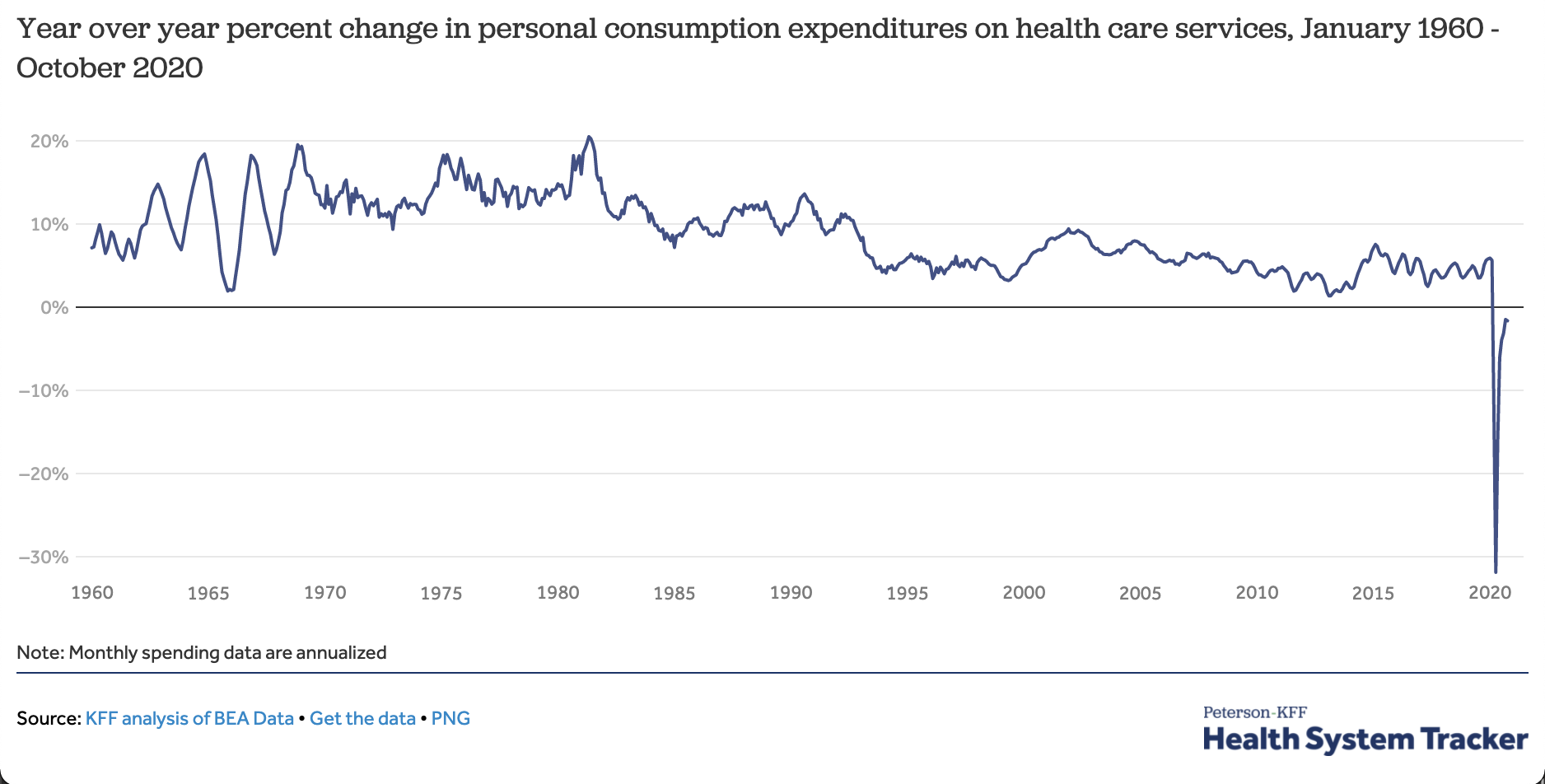
The coronavirus pandemic has caused national health care spending to go down this year — the first time that’s ever happened.

The big picture: Any big recession depresses the use of health services because people have less money to spend. But this pandemic has also directly attacked the health system, causing people to defer or skip care for fear of becoming infected.

By the numbers: Year-to-date spending on health services is down about 2% from last year. Health spending for the calendar year may end up lower than it was in 2019.

  • In April, when the pandemic forced many facilities to temporarily close, spending on health services had fallen an eye-popping 32% on an annualized basis.
  • The largest drop-offs were in outpatient care. Telehealth visits increased dramatically but did not make up all of the difference.

Context: This is the first time expenditures for patient care have fallen year-over-year since data became available in the 1960s.

What’s next: Spending and utilization have been recovering, but could fall again if the current spike in cases prompts either hospitals or patients to again hold off on elective care.

  • There has been a decline in cancer screenings and visits to manage chronic conditions, but it will take more research before we know precisely how this has affected outcomes.

Go deeper.

10 healthcare execs share predictions for nursing in the next 5 years

https://www.beckershospitalreview.com/nursing/10-healthcare-execs-share-predictions-for-nursing-in-the-next-5-years.html?utm_medium=email

The future of nursing infographic | Cipherhealth

The pandemic put nurses on the front lines of the battle against COVID-19 and caused shifts in the way they provide care.

During this year, nurses have adapted to increased adoption of telehealth and virtual patient monitoring, as well as constantly evolving staffing needs. 

These factors — and others, such as the physical and emotional conditions nurses have faced due to the public health crisis — are sure to affect nursing in the years to come. Here, 10 healthcare executives and leaders share their predictions for nursing in the next five years.

Editor’s note: Responses were edited lightly for length and clarity.

Beverly Bokovitz, DNP, RN. Vice President and Chief Nurse Executive of UC Health (Cincinnati): In the next five years, as we continue to encounter a national nursing shortage, I expect to see additional innovative strategies to complement the care provided at the bedside. 

One of these strategies will be some type of robot-assisted care. From delivery of medications to answering call lights — and completing simple tasks like needing a blanket or requesting that the heat be adjusted — we will see more electronic solutions. These solutions will allow for a better patient experience and help to exceed the expectations of our patients as customers.

Of course, nothing can take the place of skilled and compassionate bedside care, but many tasks could be automated — and will be — to supplement the professional nursing shortage.

Natalia Cineas, DNP, RN. Senior Vice President and Chief Nurse Executive of NYC Health + Hospitals (New York City): Nurses will continue to play a vital role in addressing the health inequities and social determinants of health among vulnerable populations as the nursing workforce itself becomes more diverse and inclusive. As the largest segment of the healthcare workforce — with some 4 million nurses active in the U.S. — nurses represent the faces of the communities in which they serve. As America becomes a more diverse and inclusive society, so too will the nursing profession become more diverse and inclusive. Currently, industry estimates indicate that between one quarter to one-third of all U.S. nurses identify as a member of a minority group, with between 19 percent and 24 percent of U.S. nurses identifying themselves as Black/African-American; 5 percent to 9 percent identifying themselves as Hispanic; and about 3 percent identifying themselves as Asian. The percentage of minority nurses has been rising steadily for the past two decades and is expected to continue to climb in the coming years.

Blacks and underserved minority populations face numerous genetic, environmental, cultural and socioeconomic factors that account for health disparities, and the impact is particularly visible in the areas of cardiovascular disease, diabetes, pregnancy and childbirth mortality, and cancer outcomes, as well as the enormous toll of the current novel coronavirus global pandemic, where communities of color have been among the hardest hit populations. 

In New York City alone, statistics compiled by the city’s health department show Blacks and Hispanics together account for 65 percent of all COVID-19 cases; represented 70 percent of all hospitalizations due to COVID-19; and, sadly, 68 percent of all deaths caused by COVID-19. As demonstrated during this pandemic, in the future, technology such as telehealth and virtual patient monitoring will play a major role in the care of patients. There will be a vast need to address social determinants of health by educating and providing resources to allow utilization of this technology such as using “wearable tech” to monitor ongoing health issues, such as high blood pressure, diabetes, heart conditions and other chronic illnesses.

Ryannon Frederick, MSN, RN. Chief Nursing Officer of Mayo Clinic (Rochester, Minn.): Nursing research will experience extraordinary demand and growth driven by a realization that both complex and unmet patient needs can often be best served by the role of a professional registered nurse. Nurses are uniquely positioned to implement symptom and self-management interventions for patients and their caregivers. Significant disruption in healthcare, including increasing use of technology, will lead to a dramatic shift to understand the role of the RN in improving patient outcomes and implementing interventions using novel approaches. Nursing researchers will provide a scientific body of evidence proving equivalent, if not better, patient care outcomes that can be obtained at a lower cost than traditional models, leading to an even greater demand for the role of the professional nurse in patient care. 

Karen Higdon, DNP, RN, Vice President and Chief Nursing Officer of Baptist Health Louisville (Ky.): The value of nursing has never been more apparent. Nurses have led the front line during this pandemic. In the next five years, we must be flexible and creative in establishing new models of care, specifically around roles that support nursing, such as assistant and tech roles. Creating roles with clear role definition, that are attractive and meaningful for nursing support will help build consistent, high-quality models for nursing to lead. This consistency, along with IT capabilities that enhance workflow, will better allow nurses to work at the top of their scope.

Karen Hill, DNP, RN. COO and Chief Nursing Officer of Baptist Health Lexington (Ky.): 2020 was declared the “Year of the Nurse” and this reality has never been more true than realizing the personal and professional sacrifices of nurses in dealing with issues surrounding the pandemic. The next five years will require nursing professionals to be flexible to address new, unknown emerging issues in all settings, to be open to new opportunities for leadership in hospitals, schools and communities and to use technology and telehealth to provide safer care to patients. Nurses need to evaluate our practices and traditions that are value-added and leave behind the task orientation of the past. We need to honor our legacy and create our path.

Therese Hudson-Jinks, MSN, RN. Chief Nursing Officer and Chief Patient Experience Officer at Tufts Medical Center and Tufts Children’s Hospital (Boston): Over the next five years, I expect that the support and retention of clinical nurses will become the top priority of every CNO and executive team, given nurses’ direct impact on supporting the business of healthcare. This will be particularly critical because there will be a concerning shortage of experienced clinical nurses as a result of advancing technologies increasing complexity in care, additional nurse roles created outside traditional areas, fierce competition for talent between large healthcare systems, aging baby boom workforce retiring at higher rates year over year, and a lack of sufficient numbers of PhD-prepared nurses working in academia and supporting higher enrollments.

I also believe that CNOs will be laser-focused on creating the practice environment that enhances retention of top, talented clinical nurses, and we will put a greater emphasis on the influence of effective nursing leadership in reaching that goal. In addition, I fully expect that nurses will be seen more as individuals with talents and experience than ever before — not just a number on a team, but rather a professional with specific, unique, talents that are highly sought after in competitive markets.

Finally, I anticipate that nursing innovation will blossom, given the exposure of the “innovation/solutionist superpower” within nurses during the pandemic. Philanthropy will grow exponentially in support of nursing innovation as a result.

Carol Koeppel-Olsen, MSN, RN. Vice President of Patient Care Services at Abbott Northwestern Hospital (Minneapolis): During the COVID-19 pandemic nurses have been working in difficult physical and emotional conditions, which may lead to significant turnover after the pandemic resolves. Nurses have a commitment to serving others and will persevere until the crisis is past; however, when conditions improve, many nurses may decide to pursue careers outside acute care settings. A possible turnover, coupled with a service economy that has been devastated, may result in large numbers of former service workers seeking stable jobs in nursing. Hospitals will have to be nimble and creative to onboard an influx of new nurses that are not only new to the profession but new to healthcare. Tactics to onboard these new nurses may include the use of retired RNs as mentors, instructor-model clinical groups in the work setting, job shadowing and aptitude testing to determine the best clinical fit.

Jacalyn Liebowitz, DNP, RN. Senior Vice President and System Chief Nurse Officer of Adventist Health (Roseville, Calif.): Over the next five years, I see nurses providing more hospital-based care in the home using remote technology. Based on that shift, we will see lower-acuity patients move into home-based care, and higher-acuity care in hospitals will increase. With that, hospital beds will be used at a different level. My bold prediction is that we will not need as many beds, but we will need higher acute care in the hospitals.

Nurses will learn differently. As we are seeing now, nurses have not been able to train in the traditional way. They are already using more remote technology to educate, onboard and orient to their roles. It looks and feels vastly different, and nurses need to be comfortable with that.

As for patient care, I think data that can be gleaned from wearable biometrics, and the use of artificial intelligence will help predict patient care on a patient-by-patient basis. Nurses will work with AI as part of their thought process, instead of completely focusing on their own judgment and assessment. 

I also believe we are going to face a nursing shortage post-COVID for a few reasons. Due to the emotional and physical toll of responding to a pandemic, some nurses will decide to retire, and another group will leave based on the risks that go hand-in-hand with the profession. 

As for patient care, we are going to collaborate differently. There will be more video conferencing regarding collaboration around the patient. And I think in the future we will see that the full continuum of care will include a wellness plan.

Debi Pasley, MSN, RN. Senior Vice President Chief Nursing Officer of Christus Health (Irving, Texas): I believe the demand for nurses will become increasingly visible and newsworthy throughout the pandemic. This could drive increases in salaries and numbers of qualified candidates seeking nursing as a profession in the medium and long term. The shortage will, however, continue to be a factor, leading to more remote work options to both supplement nursing at the bedside and substitute for in-person care.

Denise Ray, RN. Chief Nursing Executive of Piedmont Healthcare (Atlanta): Nursing schools will need to focus on emergency management and critical care training utilizing a team nursing model. While nursing has become very specialty-driven, the pandemic has demonstrated gaps in our ability to adapt as quickly utilizing a team model where nurses lead and direct care teams. By implementing a team model and enhancing education in the areas of emergency management and critical care, nursing can adapt quickly to the ever-changing environment.

Also, communication with patients and families will take on different dimensions with wider use of tele-therapeutic communication. Nurses will be leaders and liaisons in the process, connecting physicians, patients and patient families virtually. Nurses will play a key role in integrating patient family members as true patient care partners — making sure they have the information they need to serve an active caregiving role for their family members during and after hospitalization. We’ll also see more nurses becoming advanced nurse practitioners, playing an expanded role in all healthcare settings.

What can Whole Foods tell us about integrating telemedicine?

https://mailchi.mp/f2794551febb/the-weekly-gist-october-23-2020?e=d1e747d2d8

How Whole Foods' Suppliers Are Shifting From Shelves to Screens to Better  Sell on Amazon | Inc.com

A quick stop at the local Whole Foods Market recently yielded surprising insights into the dilemma faced by physician practices in the COVID-era telemedicine boom.

The store location opened just last year, part of a brand-new residential and shopping complex designed for busy professionals. It’s larger than the old-style, pre-Amazon era stores, and was designed to integrate Amazon’s online grocery operations into the bricks-and-mortar retail setting. There’s a portion of the store set aside for Amazon “shoppers” to receive and pack online orders for pickup and delivery, along with an expanded array of convenience-food offerings for the app-powered consumer to scan and purchase.

But when COVID hit, the volume of online orders went through the roof, and the store hired a small army of Amazon shoppers (including one of our own adult children who’s on a “gap year”) to keep up with demand. The result has been barely controlled chaos—easily 70 percent of the shoppers in the aisles last weekend were young Amazon employees “shopping” on behalf of online customers. They’re all held to an Amazon-level productivity standard, which makes the pace of their cart-pushing somewhat frantic and erratic. And the discreet area at the front of the store for managing the Amazon orders has become a noisy hub, making entering and exiting the store problematic. Even the “regular” store employees at Whole Foods have begun to complain about the disruption caused by the Amazon fulfillment operation.
 
It’s a cautionary tale for traditional physician practices and other care delivery organizations looking to “integrate” telemedicine into normal operations. Integration sounds great in theory, but in practice raises important questions:

1) What physical space should be set aside for delivering virtual care?

2) Should telemedicine work be done in a separate, centralized location, or in existing clinic space?

3) How does the staffing of clinics need to change to meet the demand for virtual care?

4) How can we flex staffing up and down based on demand for telemedicine?

5) If new staff are required, how will they be incorporated into the existing team—or should they be managed separately?

6) What operational metrics will they be held accountable for, and what impact will those metrics have on other operational goals? 

If Amazon, a worldwide leader online, renowned for running tight, precision, productivity-driven operations, is having trouble figuring out physical-virtual integration at the front end of their business, imagine how difficult these challenges will be for healthcare providers. The sooner we start to dig into these issues and find sustainable solutions, the better.

Virtual visits have declined, but the emails haven’t

https://mailchi.mp/45f15de483b9/the-weekly-gist-october-9-2020?e=d1e747d2d8

Why Are Doctors Now Billing Patients For Some Phone Chats That Used To Be  Free? : Shots - Health News : NPR

While telemedicine visits have decreased sharply since their early pandemic peak, we’re hearing from providers across the country that patient demand for email communication has persisted. 

Many patients have missed meaningful in-person interactions with their doctors. But once they sign up for the portal and realize they can email, they don’t want to go back to spending time on hold or scheduling a visit to get a prescription refill or the answer to a simple question.

Email and messaging saves patients a lot of time, but the sheer amount has quickly become unmanageable for many doctors. “Last year I got half a dozen emails per week from patients,” one primary care physician told us. “Now I’m spending two hours a day answering MyChart messages, and I’m still not keeping up.”

And as many are quick to point out, there is little to no compensation for time spent emailing. Health systems and physician practices can’t “roll back” this service—removing this satisfier would expose them to losing patients altogether. 

In the near term, systems must invest in the staff and infrastructure to create a centralized process to triage messages. And longer-term, they must align physician compensation and payment models away from visit-based economics and toward comprehensive patient communication and management.

Sam’s Club launches $1 telehealth visits for members: 7 details

https://www.beckershospitalreview.com/telehealth/sam-s-club-launches-1-telehealth-visits-for-members-7-details.html?utm_medium=email

On-Demand Text-Based Primary Care App | 98point6

Sam’s Club partnered with primary care telehealth provider 98point6 to offer members virtual visits.

Seven details:

1. Sam’s Club now offers members access to telehealth visits through a text-based app run by 98point6.

2. Members can purchase a $20 quarterly subscription for the first three months; the regular sign-up fee is $30 per person. After the first three months, members pay $33.50 every three months.

3. The subscription gives members unlimited telehealth visits for $1 per visit. The service has board-certified physicians available 24 hours per day, seven days a week.

4. Members can also subscribe for pediatric care.

5. Physicians can diagnose and treat 400 conditions including cold and flu-like symptoms as well as allergies. They can also monitor chronic conditions including diabetes, depression and anxiety.

6. Members can use the app to obtain prescriptions and lab orders as well.

7. Sam’s Club has around 600 stores in the U.S. and Puerto Rico and millions of members.

Offering access to telemedicine was on our roadmap in the pre-COVID world, but the current environment expedited the need for this service to be easily accessible, readily available and most of all, affordable,” said John McDowell, vice president of pharmacy operations and divisional merchandise at Sam’s Club. “Through providing access to the 98point6 app in a pilot, we quickly realized that our members were eager to have mobile telehealth options and we wanted to provide this healthcare solution to all of our members as a standalone option.”


Will ED volumes ever bounce back?

https://mailchi.mp/f5713fcae702/the-weekly-gist-september-18-2020?e=d1e747d2d8

Hospitals' ED volumes rebounding slower than other areas

We’re hearing from health systems across the country that physician office, surgery and diagnostic volumes have mostly returned to pre-pandemic levels. Consumers appear to feel comfortable coming back to scheduled appointments as long as social distancing and capacity can be managed. But they’re more reticent to return to “unscheduled” care settings that may involve a long wait, like urgent care clinics and emergency departments, where visits have stabilized at 75 to 85 percent of pre-pandemic levels.

The latter in particular has proved concerning to hospitals leaders, who have begun to ask, what if ED volumes never fully come back? (Around 15 percent of ED visits convert to inpatient stays, on average, making the ED an important source of downstream revenue for hospitals.) We spoke recently with a health system COO who realistically thinks that 10 percent of the volume could be gone for good, and recognizes that “from a public health perspective, that’s probably a good thing”, given that lower-acuity, non-emergent patients account for a portion of the “lost” volume.

But concerns about patients delaying much-needed care persist—amplifying the need for alternate channels, both virtual and in-person, for patients to access care and quickly connect to more intensive services if needed. Hospital leaders would be wise to prepare for a “90 percent future”, and adjust revenue models and cost structures to be less dependent on admissions and procedures that come through the emergency department.


Losing the edge on telemedicine?

https://mailchi.mp/365734463200/the-weekly-gist-september-11-2020?e=d1e747d2d8

What8217s Missing in the Health Care Tech Revolution

At the beginning of the pandemic, physicians and health systems implemented telemedicine solutions with unprecedented speed. In doing so, they went from mostly lagging behind payers and disruptors in digital medicine, to becoming the anchors who kept patients and doctors connected during the greatest health crisis in a century.

But over the past few weeks, we’ve detected a marked shift in the tone and focus of conversations around telemedicine with doctors and executives. Universally, systems have seen a drop in virtual visits as in-person care has returned—and most agree that today’s levels of telemedicine visits are lower than ideal.

“We peaked at 45 percent of outpatient visits delivered virtually in early May. Now telemedicine accounts for just five percent,” one physician leader told us. “I don’t know what ‘percent virtual’ is ideal, but I’m pretty sure it’s more than five percent.” Another leader described a shift from “rally to reality”.

At the height of the crisis, the entire system was singularly focused on keeping patients connected to care, bolstered by a loosening of regulatory and payment restrictions.

As systems now plan for a long-term virtual care strategy, we’re sensing a shift in focus to pre-COVID challengesoperations (centralization is needed to create a sustainable model, but each doctor wants to do virtual visits his own way), payment (should we really invest before we’re sure health plans will continue to pay at parity?), and turf battles (reemerging political discussions of who “owns” virtual care strategy).

Health plans, retailers and disruptors recognize the power of virtual care to build relationships and loyalty with consumers—and will invest heavily behind it. Providers have the advantage today. But to keep it, they’ll have to get out of their own way and continue to build, scale and refine their virtual care platforms.


HAP and Henry Ford collaboration creates new health plan for Michigan businesses

https://www.healthcarefinancenews.com/news/hap-and-henry-ford-collaboration-creates-new-health-plan-michigan-businesses

HAP introduces innovative health plan for Michigan businesses in  collaboration with Henry Ford Health System

Health Alliance Plan (HAP) and Henry Ford Health System have furthered their partnership through the release of Pivotal, a new health plan for Michigan-based businesses.

The plan was created for businesses with more than 100 employees and offers customized benefit options for each company.

WHAT’S THE IMPACT

Pivotal’s network includes seven hospitals, more than 6,000 physicians and 3,500 ancillary providers including urgent care, labs, radiology, imaging, rehab services, long-term care and nursing facilities, and physical, occupational and speech therapy.

Its members will have access to providers within the Henry Ford Health System, Henry Ford Physician and Jackson Health networks, Henry Ford Allegiance Health, as well as HAP’s ancillary provider and pharmacy network, and its contracted pediatric providers.

The plan recognizes the current need for telehealth services by offering virtual care for zero cost-share for in-network visits.

Members can use Pivotal’s telehealth offerings in three different ways: through at-home video visits, clinic-to-clinic video visits where providers can connect with specialists at other facilities, and with e-visits where non-emergency visits are conducted through email.

Pivotal plans also come with concierge services that include personalized onboarding for every employer group, phone support, as well as guaranteed same-day appointments with a primary care physician for sick visits and specialist appointments within 10 business days.

THE LARGER TREND

HAP has been working with Henry Ford since it became a subsidiary of the health system in 1986.

Henry Ford leveraged another partnership with CarePort during the COVID-19 public health emergency to communicate directly with post-acute care providers to share the COVID-19 testing status of patients. This allows providers to take the necessary safety precautions, including deciding if the facility can admit the patient at all, triaging care and managing the use of personal protective equipment.

ON THE RECORD

“HAP and Henry Ford have a long history of working together and sharing the same focus,” Genord said Dr. Michael Genord, president and CEO of HAP. “Working together, we’ve made sure that as many Michigan businesses as possible have access to high-quality affordable care, whether they’re in Detroit or Jackson or anywhere in between.”