From Budget Battles to Consumer Backlash: Paul Keckley on the Future of U.S. Health Care

https://strategichcmarketing.com/from-budget-battles-to-consumer-backlash-paul-keckley-on-the-future-of-u-s-health-care/?access_code=667226

The U.S. health care industry is approaching a critical inflection point, according to veteran health care strategist Paul Keckley. In a candid and thought-provoking keynote at the 2025 Healthcare Marketing & Physician Strategies Summit (HMPS) in Orlando, Keckley outlined the challenges and potential opportunities health care leaders must navigate in an era of unprecedented economic uncertainty, regulatory disruption, and consumer discontent.

Drawing on decades of policy experience and his signature candid style, Keckley delivered a sobering yet actionable assessment of where the industry stands and what lies ahead.

Paul Keckley, PhD, health care research and policy expert and managing editor of The Keckley Report

Health care now accounts for a staggering 28 percent of the federal budget, with Medicaid expenditures alone ranging from the low 20s to 34 percent of individual state budgets. Despite its fiscal significance, Keckley points out that health care remains “not really a system, but a collection of independent sectors that cohabit the economy.”

In the article that follows, Keckley warns of a reckoning for those who remain entrenched in legacy assumptions. On the flip side, he notes, “The future is going to be built by those who understand the consumer, embrace transparency, and adapt to the realities of a post-institutional world.”

A Fractured System in a Fractured Economy

Fragmentation complicates any effort to meaningfully address rising costs or care quality. It also heightens the stakes in a political climate marked by what Keckley termed “MAGA, DOGE, and MAHA” factions, shorthand for various ideological forces shaping health care policy under the Trump 2.0 administration.

Meanwhile, macroeconomic conditions are only adding to the strain. At the time of Keckley’s address, the S&P 500 was down 8 percent, the Dow down 10 percent, and inflationary pressures were squeezing both provider margins and household budgets.

Economic uncertainty is not just about Wall Street,” Keckley warns. “It’s about kitchen-table economics — how households decide between paying for care or paying the cable bill.”

Traditional Forecasting Is Failing

One of Keckley’s key messages was that conventional methods of strategic planning in health care, based on lagging indicators like utilization rates and demographics, are no longer sufficient. Instead, leaders must increasingly look to external forces such as capital markets, regulatory volatility, and consumer behavior.

“Think outside-in,” he urges. “Forces outside health care are shaping its future more than forces within.”

He encourages health systems to go beyond isolated market studies and adopt holistic scenario planning that considers clinical innovation, workforce shifts, AI and tech disruption, and capital availability as interconnected variables.

Affordability and Accountability: The Hospital Reckoning

Keckley pulls no punches in addressing the mounting criticism of hospitals on Capitol Hill, particularly not-for-profit health systems. Public perception is faltering, with hospital pricing increasing faster than other categories in health care and only a third of providers in full compliance with price transparency rules.

“Economic uncertainty is not just about Wall Street. It’s about kitchen-table economics — how households decide between paying for care or paying the cable bill.”

“We have to get honest about trust, transparency, and affordability,” he says. “I’ve been in 11 system strategy sessions this year. Only one even mentioned affordability on their website, and none defined it.”

Keckley also predicts that popular regulatory targets like site-neutral payments, the 340B program, and nonprofit tax exemptions will face intensified scrutiny.

“Hospitals are no longer viewed as sacred institutions,” he says. “They’re being seen as part of the problem, especially by younger, more educated, and more skeptical Americans.”

The Consumer Awakens

Perhaps the most urgent shift Keckley outlines is the redefinition of the health care consumer. “We call them patients,” he says, “but they are consumers. And they are not happy.”

Keckley cites polling data showing that two out of three Americans believe the health care system needs to be rebuilt from the ground up. Roughly 40 percent of U.S. households have at least one unpaid medical bill, with many choosing intentionally not to pay. Among Gen Y and younger households, dissatisfaction is particularly acute.

“[Consumers] expect digital, personalized, seamless experiences — and they don’t understand why health care can’t deliver.”

These consumers aren’t just passive recipients of care; they’re voters, payers, and critics. With 14 percent of health care spending now coming directly from households, Keckley argues, health systems must engage consumers with the same sophistication that retail and tech companies use.

“They expect digital, personalized, seamless experiences — and they don’t understand why health care can’t deliver.”

Tech Disruption Is Real

Keckley underscores the transformative potential of AI and emerging clinical technologies, noting that in the next five years, more than 60 GLP-1-like therapeutic innovations could come to market. But the deeper disruption, he warns, is likely to come from outside the traditional industry.

Citing his own son’s work at Microsoft, Keckley envisions a future where a consumer’s smartphone, not a provider or insurer, is the true hub of health information. “Health care data will be consumer-controlled. That’s where this is headed.”

The takeaway for providers: Embrace data interoperability and consumer-centric technology now, or risk irrelevance. “The Amazons and Apples of the world are not waiting for CMS to set the rules,” Keckley says.

Capital, Consolidation, and Private Equity

Capital constraints and the shifting role of private equity also featured prominently in Keckley’s remarks. With declining non-operating revenue and shrinking federal dollars, some health systems increasingly rely on investor-backed funding.

But this comes with reputational and operational risks. While PE investments have been beneficial to shareholders, Keckley says, they’ve also produced “some pretty dire results for consumers” — particularly in post-acute care and physician practice consolidation.

“Policymakers are watching,” he says. “Expect legislation that will limit or redefine what private equity can do in health care.”

Politics and Optics: Navigating the Policy Minefield

In the regulatory arena, Keckley emphasizes that perception often matters more than substance. “Optics matter often more than the policy itself,” he says.

He cautions health leaders not to expect sweeping policy reform but to brace for “de jure chaos” as the current administration focuses on symbolic populist moves — cutting executive compensation, promoting price transparency, and attacking nonprofit tax exemptions.

With the 2026 midterm elections looming large, Keckley predicts a wave of executive orders and rhetorical grandstanding. But substantive policy change will be incremental and unpredictable.

“Don’t wait for a rescue from Washington. The future is going to be built by those who understand the consumer, embrace transparency, and adapt to the realities of a post-institutional world.”

The Workforce Crisis That Wasn’t Solved

Keckley also addresses the persistent shortage of health care workers and the failure of Title V of the ACA, which had promised to modernize the workforce through new team-based models. “Our guilds didn’t want it,” Keckley notes, bluntly. “So nothing happened.”

He argues that states, not the federal government, will drive the next chapter of workforce reform, expanding the scope of practice for pharmacists, nurse practitioners, and even lay caregivers, particularly in behavioral health and primary care.

What Should Leaders Do Now?

Keckley closed his keynote with a challenge for marketers and strategists: Get serious about defining affordability, understand capital markets, and stop defaulting to legacy assumptions.

“Don’t wait for a rescue from Washington,” he says. “The future is going to be built by those who understand the consumer, embrace transparency, and adapt to the realities of a post-institutional world.”

He encouraged leaders to monitor shifting federal org charts, track state-level policy moves, and scenario-plan for a future where trust, access, and consumer empowerment define success.

Conclusion: A Health Care Reckoning in the Making

Keckley’s keynote was more than a policy forecast; it was a wake-up call. In a landscape shaped by economic headwinds, political volatility, and consumer rebellion, health care leaders can no longer afford to stay in their lane. They must engage, adapt, and transform, or risk becoming casualties of a system under siege.

“Health care is not just one of 11 big industries,” Keckley says. “It’s the one that touches everyone. And right now, no one is giving us a standing ovation.”


The Perfect Storm facing the Healthcare Workforce: Eight Current Issues frame the Challenge

Tonight at midnight, thousands of federal workers face the possibility their jobs will be eliminated as part of the Department of Government Efficiency (DOGE) federal cost reduction initiative under Elon Musk’ leadership. Already, thousands who serve in federal healthcare roles at the NIH, CDC and USAID have been terminated and personnel in agencies including CMS, HHS and the FDA are likely to follow.

The federal healthcare workforce is large exceeding more than 2.5 million who serve agencies and programs as providers, clerks, administrators, scientists, analysts, counselors and more. More than half work on an hourly basis, and 95% work outside DC in field offices and clinics. For the vast majority, their work goes unnoticed except when “government waste” efforts like DOGE spring up. In those times, they’re relegated to “expendables” status and their numbers are cut.

The same can be said for the larger private U.S. healthcare workforce. Per the U.S. Bureau of Labor Statistics, industry employment was 21.4 million, or 12.8% of total U.S. employment in 2023 and is expected to reach 24 million by 2030. It’s the largest private employer in the U.S. economy and includes many roles considered “expendable” in their organizations.

Facts about the U.S. healthcare workforce:

  • More than 70% of the healthcare workforce work in provider settings including 7.4 million who work in hospitals.
  • More than half work in non-clinical roles.
  • Home health aides is the highest growth cohort and hospitals employ the biggest number (7.4 million).
  • 29% of physicians and 15% of nurses are foreign born, almost three-fourths of the workforce are women, two-thirds are non-Hispanic whites, and the majority are older than 50.
  • Its licensed professions enjoy public trust ranking among Gallup’s highest rated though all have declined:
 % 2023‘19-‘23’23 Rank % 2023‘19-‘23’23 Rank
Nurses78-71Pharmacists55-96
Dentists59-2 Psychiatrists36-79
Medical doctors56-95Chiropractors33-810

The Perfect storm

The healthcare workforce is unsteady: while stress and burnout are associated with doctors and nurses primarily, they cut across every workgroup and setting.

Eight fairly recent issues complicate efforts to achieve healthcare workforce stability:

Increased costs of living: 

Consumers are worried about their costs of living: it hits home hardest among young, low-income households including dual eligible seniors for whom gas, food and transportation are increasing faster than their incomes, and rents exceed 50% of their income. The healthcare workforce takes a direct hit: one in five we employ cannot pay their own medical bills.

Slowdown in consolidation: 

The Federal Trade Commission’s new pre-merger notification mandate that went in effect today essentially requires greater pre-merger/acquisition disclosures and a likely slowdown in deals.  Organizations anticipating deals might default to layoffs to strengthen margins while the regulatory consolidation dust settles. Expendables will take a hit.

Uncertainty about Medicaid cuts: 

In the House’ budget reconciliation plan, Medicaid cuts of up to $880 billion/10 years are contemplated. A cut of that magnitude will accelerate closure of more than 400 rural hospitals already at risk and throw the entire Medicaid program into chaos for the 79 million it serves—among them 3 million low-hourly wage earners in the healthcare workforce and at least 2 million in-home unpaid caregivers who can’t afford paid assistance. The impact of Medicaid cuts on the healthcare workforce is potentially catastrophic for their jobs and their health.

Heightened attention to tax exemptions for not-for-profit hospitals: 

Large employers sent this recommendation to Congressional leaders last week as spending cuts were being considered: “Nonprofit hospitals, despite their tax-exempt status, frequently prioritize profits over patient care. Many have deeply questionable arrangements with for-profit entities such as management companies or collections agencies, while others have “joint ventures” with Wall Street hedge funds or other for-profit provider or staffing companies. Nonprofit hospitals often shift the burden of their costs onto taxpayers and the communities they serve by overcharging for health care services, or abusing programs intended to provide access to low-cost care and prescription drugs for low-income patients. By eliminating nonprofit hospital status, resources could be more evenly distributed across the healthcare system, ensuring that hospitals are held accountable for their charitable care both to their communities and the tax laws that govern them.” Pressures on NFP hospitals to lower costs and operate more transparently are gaining momentum in state legislatures and non-healthcare corporate boardrooms. Belt tightening is likely. Layoffs are underway.

Heightened attention to executive compensation in healthcare organizations: 

Executive compensation, especially packages for CEO’s, is a growing focus of shareholder dissent, Congressional investigation, media coverage and employee disgruntlement. Compensation committee deliberations and fair market comparison data will be more publicly accessible to communities, rank and file employees, media, regulators and payers intensifying disparities between “labor” and “management”.

Increased tension between providers and insurers:

Health insurers are now recovering from 2 years of higher utilization and lower profits; hospitals did the same in 2022 and 2023. Neither is out of the woods and both are migrating to tribal warfare based on ownership (not-for-profit vs. investor owned vs. government owned), scale and ambition. Bigger, better-capitalized organizations in their ranks are faring better while many struggle. The workforce is caught in the crossfire.

Increased pressure on private equity-backed employers to exit: 

The private equity market for healthcare services has experienced a slow recovery after 2 disappointing years peppered by follow-on offerings in down rounds. Exit strategies are front and center to PE sponsors; workforce stability and retention is a means to an end to consummate the deal—that’s it.

The AI Yellow Brick Road: 

Last and potentially the most disruptive is the role artificial intelligence will play in redefining healthcare tasks and reorganizing the system’s processes based on large-language models and massive investments in technology. Job insecurity across the entire healthcare workforce is more dependent on geeks and less on licensed pro’s going forward.

These eight combine to make life miserable most days in health human resource management. DOGE will complicate matters more. It’s a concern in every sector of healthcare, and particularly serious in hospitals, medical practices, long-term and home care settings.

‘Modernizing the healthcare workforce’ sounds appealing, but for now, navigating these issues requires full attention. They require Board understanding and creative problem-solving by managers. And they merit a dignified and respectful approach to interactions with workers displaced by these circumstances: they’re not expendables, they’re individuals like you and me.

The Healthcare Workforce Crossroad: Incrementalism or Transformation

Congress returns from its July 4 break today and its focus will be on the President: will he resign or tough it out through the election in 120 days. But not everyone is paying attention to this DC drama.  

In fact, most are disgusted with the performance of the political system and looking for something better. Per Gallup, trust and confidence in the U.S. Congress is at an all-time low.

The same is true of the healthcare system:

69% think it’s fundamentally flawed and in need of systemic change vs. 7% who think otherwise (Keckley Poll). And 60% think it puts its profits above all else, laying the blame at all its major players—hospitals, insurers, physician, drug companies and their army of advisors and suppliers.

These feelings are strongly shared by its workforce, especially the caregivers and support personnel who service patient in hospital, clinic and long-term care facilities. Their ranks are growing, but their morale is sinking.

Career satisfaction among clinical professionals (nurses, physicians, dentists, counselors) is at all time low and burnout is at an all-time high.

Last Friday, the Bureau of Labor issued its June 2024 Jobs report. To no one’s surprise, job growth was steady (+206,000 for the month) –slightly ahead of its 3-month average (177,000) despite a stubborn inflation rate that’s hovered around 3.3% for 15 months. Healthcare providers accounted for 49,000 of those jobs–the biggest non-government industry employer.

But buried in the detail is a troubling finding: for hospital employment (NAICS 6221.3): productivity was up 5.9%, unit labor costs for the month were down 1.1% and hourly wages grew 4.8%–higher than other healthcare sectors.

For the 4.7 million rank and file directly employed in U.S. hospitals, these productivity gains are interpreted as harder work for less pay.  Their wages have not kept pace with their performance improvements while executive pay seems unbridled.

Next weekend, the American Hospital Association will host its annual Leadership Summit in San Diego: 8 themes are its focus: 

Building a More Flexible and Sustainable Workforce is among them. That’s appropriate and it’s urgent.

An optimistic view is that emergent technologies and AI will de-lever hospitals from their unmanageable labor cost spiral. Chief Human Resource Officers doubt it. Energizing and incentivizing technology-enabled self-care, expanding scope of practice opportunities for mid-level professionals and moving services out of hospitals are acknowledged keys, but guilds that protect licensing and professional training push back.

By contrast, the application of artificial intelligence to routine administrative tasks is more promising: reducing indirect costs (overhead) that accounts for a third of total spending is the biggest near-term opportunity and a welcome focus to payers and consumers.

Thus, most organizations advance workforce changes cautiously. That’s the first problem.

The second problem is this:

lack of a national healthcare workforce modernization strategy to secure, prepare and equip the health system to effectively perform.  Section V of the Affordable Care Act (March 2010) authorized a national workforce commission to modernize the caregiver workforce. Due to funding, it was never implemented. It’s needed today more than ever. The roles of incentives, technologies, AI, data and clinical performance measurement were not considered in the workforce’ ACA charter: Today, they’re vital.

Transformational changes in how the healthcare workforce is composed, evaluated and funded needs fresh thinking and boldness. It must include input from new players and disavow sacred cows. It includes each organization’s stewardship and a national spotlight on modernization.

It’s easier to talk about healthcare’s workforce issues but It’s harder to fix them. That’s why incrementalism is the rule and transformational change just noise.

PS: In doing research for this report, I found wide variance in definitions and counts for the workforce. It may be as high as 24 million, and that does not include millions of unpaid caregivers. All the more reason to urgently address its modernization.

Healthcare 2024: The 10 Themes that will Dominate Discussion

The U.S. health system has experienced three major shifts since the pandemic that set the stage for its future:

  • From trust to distrust: Every poll has chronicled the decline in trust and confidence in government: Congress, the Presidency, the FDA and CDC and even the Supreme Court are at all-time lows. Thus, lawmaking about healthcare is met with unusual hostility.
  • From big to bigger: The market has consistently rewarded large cap operators, giving advantage to national and global operators in health insurance, information technology and retail health. In response, horizontal consolidation via mergers and acquisitions has enabled hospitals, medical practices, law firms and consultancies to get bigger, attracting increased attention from regulators. Access to private capital and investor confidence is a major differentiator for major players in each sector.
  • From regulatory tailwinds to headwinds: in the last 3 years, regulators have forced insurers, hospitals and drug companies to disclose prices and change business practices deemed harmful to fair competition and consumer choice. Incumbent-unfriendly scrutiny has increased at both the state and federal levels including notable bipartisan support for industry-opposed legislation. It will continue as healthcare favor appears to have run its course.

Some consider these adverse; others opportunistic; all consider them profound. All concede the long-term destination of the U.S. health system is unknown. Against this backdrop, 2024 is about safe bets.

These 10 themes will be on the agenda for every organization operating in the $4.5 trillion U.S. healthcare market:

  1. Not for profit health: “Not-for-profit” designation is significant in healthcare and increasingly a magnet for unwelcome attention. Not-for-profit hospitals, especially large, diversified multi-hospital systems, will face increased requirements to justify their tax exemptions. Special attention will be directed at non-operating income activities involving partnerships with private equity and incentives used in compensating leaders. Justification for profits will take center stage in 2024 with growing antipathy toward organizations deemed to put profit above all else.
  2. Insurer coverage and business practices: State and federal regulators will impose regulatory constraints on insurer business practices that lend to consumer and small-business affordability issues.
  3. Workforce wellbeing: The pandemic hangover, sustained impact of inflation on consumer prices, increased visibility of executive compensation and heightened public support for the rank-and-file workers and means wellbeing issues must be significant in 2024.
  4. Board effectiveness: The composition, preparedness, compensation and independent judgement of Boards will attract media scrutiny; not-for-profit boards will get special attention in light of 2023 revelations in higher education.
  5. Employer-sponsored health benefits: The cost-effectiveness of employee health benefits coverage will prompt some industries and large, self-insured companies to pursue alternative strategies for attracting and maintaining a productive workforce. Direct contracting, on-site and virtual care will be key elements.
  6. Physician independence: With 20% of physicians in private equity-backed groups, and 50% in hospital employed settings, ‘corporatization’ will encounter stiff resistance from physicians increasingly motivated to activism believing their voices are unheard.
  7. Data driven healthcare: The health industry’s drive toward interoperability and transparency will will force policy changes around data (codes) and platform ownership, intellectual property boundaries, liability et al. Experience-based healthcare will be forcibly constrained by data-driven changes to processes and insights.
  8. Consolidation: The DOJ and FTC will expand their activism against vertical and horizontal consolidation that result in higher costs for consumers. Retrospective analyses of prior deals to square promises and actual results will be necessary.
  9. Public health: State and federal funding for public health programs that integrate with community-based health providers will be prioritized. The inadequacy of public health funding versus the relative adequacy of healthcare’s more lucrative services will be the centerpiece for health reforms.
  10. ACO 2.0: In Campaign 2024, abortion and the Affordable Care Act will be vote-getters for candidates favoring/opposing current policies. Calls to “Fix and Repair” the Affordable Care Act will take center stage as voters’ seek affordability and access remedies.

Every Board and C suite in U.S. healthcare will face these issues in 2024.

COVID’s lingering effects on the US workforce

https://mailchi.mp/f1c5ab8c3811/the-weekly-gist-october-28-2022?e=d1e747d2d8

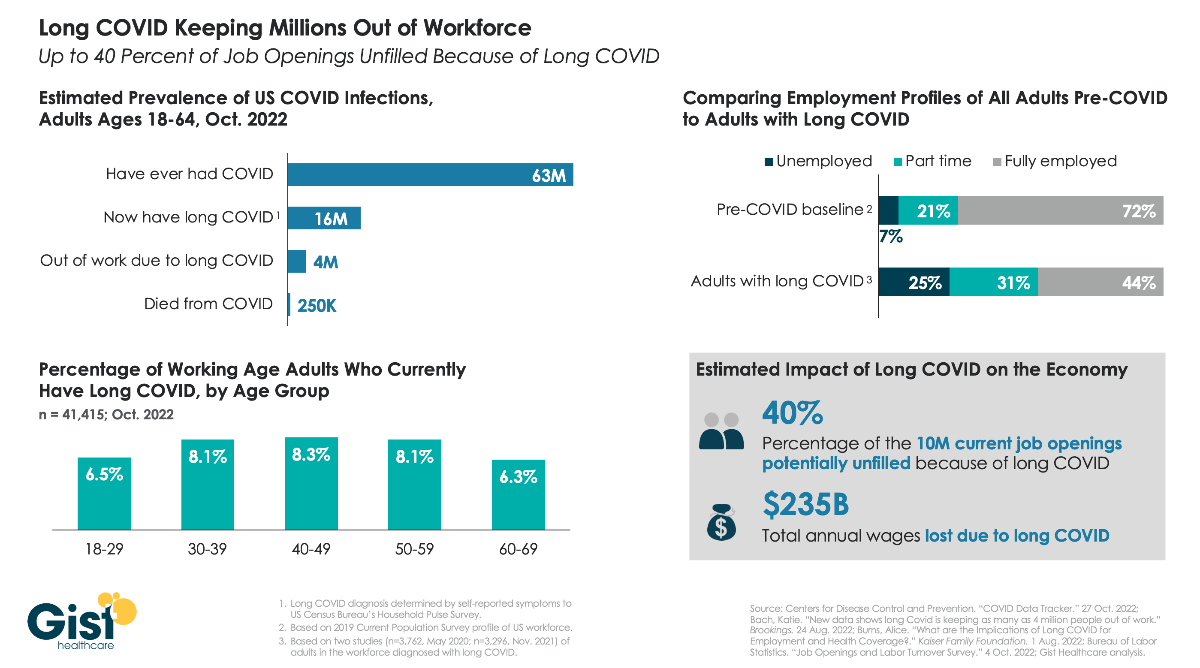
As the nation continues to grapple with the fallout from COVID, one of the greatest unknowns is “long COVID”, the broad range of health problems experienced by a significant number of individuals after contracting the virus. The Centers for Disease Control and Prevention defines long COVID as any post-COVID condition lasting three months or longer.

In the graphic above, we aim to quantify the prevalence of long COVID and its ongoing impact on the US workforce. While estimates for these numbers vary, data compiled by Brookings show that COVID infections in roughly one in four working age adults have resulted in long COVID, and up to one in four individuals with long COVID are unable to work due to their lingering health problems. Long COVID is also more prevalent in middle-aged adults, who are often at the peak of their working years. Dealing with symptoms like chronic fatigue and brain fog, long COVID patients are more likely to be unemployed or working reduced hours, compared to a pre-COVID baseline of the general adult population. 

While it’s difficult to assess the precise impact on the nation’s current labor shortage, the estimate that 4M working age adults are no longer working because of long COVID equals about 40 percent of the 10M total job openings in August of this year, undoubtedly exacerbating ongoing economic challenges. 

Thought of the Day: On Toxic Culture

5 key strategy trends to watch in 2022

The 5 Biggest Technology Trends In 2022

Another challenging year defined by the continued COVID-19 fight and vaccination drives has created a unique healthcare landscape. Pandemic-induced telehealth booms, continued strain due to understaffing and pressure from big tech disruptors are just some of the issues that have presented themselves this year.

Here are five major trends that hospitals and health systems may see in 2022. While some present challenges, others present significant opportunities for healthcare facilities.

Workforce pressure 

Record numbers of workers have quit their jobs in 2021, with some 4.4 million people quitting in September. That means that 1 in 4 people quit their jobs this year across all industries. Around 1 in 5 healthcare workers have left their positions, creating issues with understaffing and lack of resources in hospitals and health systems. Stress, burnout and lack of balance have all been cited as reasons for staff leaving their roles. An increase in violence toward medical professionals, continued COVID-19 surges and low pay and benefits have contributed to the exodus of healthcare workers. None of those problems seems poised to disappear come 2022, so the new year could bring continued workforce and staffing challenges. 

Pressure from disruptors 

Big tech and retail giants have continued their push into healthcare this year. Companies like Apple, Amazon and Google stepped up their game in the wearables market. Pharmacy and retail chains Walmart and CVS Health both detailed their intended expansions into primary care. The pandemic also encouraged big corporations outside the healthcare sector, like Pepsi and Delta Airlines, to consider hiring CMOs to make sense of public health regulations guide them on their policy. These moves all mean there is a tightening of competition for the top physicians and hospital executives. Going into 2022, health systems may be under pressure to hang onto top talent and keep patients from using other convenient health services offered by retail giants.

Health equity 

The unequal toll of the pandemic on people of color both medically and economically helped shed a light on the rampant inequities in American healthcare and society at large. Indigineous, Black and Hispanic people were much more likely than white or Asian people to suffer severe illness or require hospitalization as a result of COVID-19. Increasing numbers of hospitals, health systems and organizations are starting initiatives to advance health equity and focus on the socioeconomic drivers of health. The American Medical Association launched a language guide to encourage greater awareness about the power of language. Z-code usage has also been encouraged by CMS to increase knowledge and data about the social determinants of health. Next year, the perspective of health as holistic instead of just a part of an individual’s life will continue, with special attention being paid to social drivers.

Telehealth expansion

The pandemic helped the telemedicine industry take off in a big way. Telehealth was often the only healthcare option for many patients during the height of the lockdown measures introduced during the pandemic. Despite a return to in-person visits, telehealth has retained its popularity with patients. Some advocates argue that telehealth can help increase access to healthcare and improve health equity. About 40 percent of patients said that telehealth makes them more engaged and interact more frequently with their providers. However, while Americans see telehealth as the future of healthcare, a majority still prefer in-person visits. Regardless of patient opinion, telehealth will remain a key part of health strategy. In late December, the FCC approved $42.7 million in funding for telehealth for 68 healthcare providers. This suggests that there are investments and subsidies available in the future for health systems to bolster their telehealth services. 

Climate change

At the 2021 UN Climate Conference, Cop26, in Glasgow, Scotland, hospitals and health systems acknowledged the role they have to play in mitigating the effects of climate change. Hospitals and health systems shed light on the health-related effects of climate change, such as illness and disease from events like wildfires and extreme weather. Health systems are also becoming more aware of their own contributions to climate change, with the U.S. healthcare system emitting 27 percent of healthcare emissions worldwide. To that end, HHS created an office of climate change and health equity that will work alongside regulators to reduce carbon emissions from hospitals. More health systems too are taking charge and pledging net neutrality and zero carbon emissions goals, including Kaiser Permanente and UnitedHealth group. It’s expected that more systems will follow suit in the coming year and make more concrete plans to address emissions reduction.

A “perfect storm” is brewing in the healthcare workforce

https://mailchi.mp/bade80e9bbb7/the-weekly-gist-june-18-2021?e=d1e747d2d8

Plastic Possibilities: Resin Production Meets the Perfect Storm |  plasticstoday.com

A topic that’s come up in almost every discussion we’ve had with health system executive teams and boards recently is workforce strategy. Beyond the immediate political debate about whether temporary unemployment benefits are exacerbating a shortage of workers, there’s a growing recognition that the healthcare workforce is approaching something that looks like a “perfect storm”.

The workforce is mentally and physically exhausted from the pandemic, which has taken a toll both professionally and personally. Many workers are rethinking their work-life balance equations in the wake of a difficult year, during which working conditions and family responsibilities shifted dramatically. That, along with broader economic inflation, is driving demands for higher wages and a more robust set of benefits.

Meanwhile, many health systems are shifting into cost-cutting mode, due to COVID-related shifts in demand patterns and continued downward pressure on reimbursement rates, forcing a renewed focus on workforce productivity.

These combined forces threaten to create a negative spiral, which could lead to even worse shortages and deteriorating workplace engagement. It’s striking how quickly the “hero” narrative has shifted to a “crisis” narrative, and we agree completely with one health system board member who told us recently that workforce strategy is now the number one issue on his agenda.

No easy answers here, but we’ll continue to report on innovative approaches to addressing these difficult challenges.

Biden Seeks $400 Billion to Buttress Long-Term Care

Biden Seeks $400 Billion to Buttress Long-Term Care. A Look at What's at  Stake. | Kaiser Health News

There’s widespread agreement that it’s important to help older adults and people with disabilities remain independent as long as possible. But are we prepared to do what’s necessary, as a nation, to make this possible?

That’s the challenge President Joe Biden has put forward with his bold proposal to spend $400 billion over eight years on home and community-based services, a major part of his $2 trillion infrastructure plan.

It’s a “historic and profound” opportunity to build a stronger framework of services surrounding vulnerable people who need considerable ongoing assistance, said Ai-jen Poo, director of Caring Across Generations, a national group advocating for older adults, individuals with disabilities, families and caregivers.

It comes as the coronavirus pandemic has wreaked havoc in nursing homes, assisted living facilities and group homes, killing more than 174,000 people and triggering awareness of the need for more long-term care options.

“There’s a much greater understanding now that it is not a good thing to be stuck in long-term care institutions” and that community-based care is an “essential alternative, which the vast majority of people would prefer,” said Ari Ne’eman, senior research associate at Harvard Law School’s Project on Disability.

“The systems we do have are crumbling” due to underfunding and understaffing, and “there has never been a greater opportunity for change than now,” said Katie Smith Sloan, president of LeadingAge, at a recent press conference where the president’s proposal was discussed. LeadingAge is a national association of more than 5,000 nonprofit nursing homes, assisted living centers, senior living communities and home care providers.

But prospects for the president’s proposal are uncertain. Republicans decry its cost and argue that much of what the proposed American Jobs Plan contains, including the emphasis on home-based care, doesn’t count as real infrastructure.

“Though this [proposal] is a necessary step to strengthen our long-term care system, politically it will be a challenge,” suggested Joseph Gaugler, a professor at the University of Minnesota’s School of Public Health, who studies long-term care.

Even advocates acknowledge the proposal doesn’t address the full extent of care needed by the nation’s rapidly growing older population. In particular, middle-income seniors won’t qualify directly for programs that would be expanded. They would, however, benefit from a larger, better paid, better trained workforce of aides that help people in their homes — one of the plan’s objectives.

“This [plan] isn’t everything that’s needed, not by any step of the imagination,” Poo said. “What we really want to get to is universal access to long-term care. But that will be a multistep process.”

Understanding what’s at stake is essential as communities across the country and Congress begin discussing Biden’s proposal.

The services in question. Home and community-based services help people who need significant assistance live at home as opposed to nursing homes or group homes.

Services can include home visits from nurses or occupational therapists; assistance with personal care such as eating or bathing; help from case managers; attendance at adult day centers; help with cooking, cleaning and other chores; transportation; and home repairs and modifications. It can also help pay for durable medical equipment such as wheelchairs or oxygen tanks.

The need. At some point, 70% of older adults will require help with dressing, hygiene, moving around, managing finances, taking medications, cooking, housekeeping and other daily needs, usually for two to four years. As the nation’s aging population expands to 74 million in 2030 (the year all baby boomers will have entered older age), that need will expand exponentially.

Younger adults and children with conditions such as cerebral palsy, blindness or intellectual disabilities can similarly require significant assistance.

The burden on families. Currently, 53 million family members provide most of the care that vulnerable seniors and people with disabilities require — without being paid and often at significant financial and emotional cost. According to AARP, family caregivers on average devote about 24 hours a week, to helping loved ones and spend around $7,000 out-of-pocket.

This reflects a sobering reality: Long-term care services are simply too expensive for most individuals and families. According to a survey last year by Genworth, a financial services firm, the hourly cost for a home health aide averages $24. Annually, assisted living centers charge an average $51,600, while a semiprivate room in a nursing home goes for $93,075.

Medicare limitations. Many people assume that Medicare — the nation’s health program for 61 million older adults and people with severe disabilities — will pay for long-term care, including home-based services. But Medicare coverage is extremely limited.

In the community, Medicare covers home health only for older adults and people with severe disabilities who are homebound and need skilled services from nurses and therapists. It does not pay for 24-hour care or care for personal aides or homemakers. In 2018, about 3.4 million Medicare members received home health services.

In nursing homes, Medicare pays only for rehabilitation services for a maximum of 100 days. It does not provide support for long-term stays in nursing homes or assisted living facilities.

Medicaid options. Medicaid — the federal-state health program for 72 million children and adults in low-income households — can be an alternative, but financial eligibility standards are strict and only people with meager incomes and assets qualify.

Medicaid supports two types of long-term care: home and community-based services and those provided in institutions such as nursing homes. But only care in institutions is mandated by the federal government. Home and community-based services are provided at the discretion of the states.

Although all states offer home and community-based services of some kind, there’s enormous variation in the types of services offered, who is served (states can set caps on enrollment) and state spending. Generally, people need to be frail enough to need nursing home care to qualify.

Nationally, 57% of Medicaid’s long-term care budget goes to home and community-based services — $92 billion in the 2018 federal budget year. But half of states still spend twice as much on institutional care as they do on community-based care. And 41 states have waiting lists, totaling nearly 820,000 people, with an average wait of 39 months.

Based on the best information available, between 4 million and 5 million people receive Medicaid-funded home and community-based services — a fraction of those who need care.

Workforce issues. Biden’s proposal doesn’t specify how $400 billion in additional funding would be spent, beyond stating that access to home and community-based care would be expanded and caregivers would receive “a long-overdue raise, stronger benefits, and an opportunity to organize or join a union.”

Caregivers, including nursing assistants and home health and personal care aides, earn $12 an hour, on average. Most are women of color; about one-third of those working for agencies don’t receive health insurance from their employers.

By the end of this decade, an extra 1 million workers will be needed for home-based care — a number of experts believe will be difficult, if not impossible, to reach given poor pay and working conditions.

“We have a choice to keep these poverty-wage jobs or make them good jobs that allow people to take pride in their work while taking care of their families,” said Poo of Caring Across Generations.

Next steps. Biden’s plan leaves out many details. For example: What portion of funding should go to strengthening the workforce? What portion should be devoted to eliminating waiting lists? What amount should be spent on expanding services?

How will inequities of the current system — for instance, the lack of accessible services in rural counties or for people with dementia — be addressed? “We want to see funding to states tied to addressing those inequities,” said Amber Christ, directing attorney of the health team at Justice in Aging, an advocacy organization.

Meanwhile, supporters of the plan suggest it could be just the opening of a major effort to shore up other parts of the safety net. “There are huge gaps in the system for middle-income families that need to be addressed,” said David Certner, AARP’s legislative counsel.

Reforms that should be considered include tax credits for caregivers, expanding Medicare’s home health benefit and removing the requirement that people receiving Medicare home health be homebound, said Christ of Justice in Aging.

We should be looking more broadly at potential solutions that reach people who have some resources but not enough to pay for these services as well,” she said.