Payers win again, court rules Admininistration violated law in axing ACA cost-sharing payments

https://www.healthcaredive.com/news/payers-win-again-court-rules-trump-admin-violated-law-in-axing-aca-cost-sh/583565/?utm_source=Sailthru&utm_medium=email&utm_campaign=Issue:%202020-08-17%20Healthcare%20Dive%20%5Bissue:29123%5D&utm_term=Healthcare%20Dive

Payers win again, court rules Trump admin violated law in axing ...

Dive Brief:

  • A federal court ruled Friday that insurers are owed subsidies mandated by the Affordable Care Act to help them cover people with low incomes in the exchanges and the Trump administration violated the law when it halted the payments in 2017.
  • In a separate but related ruling, the same court found that payers that were able to raise premiums to offset the loss of those payments in 2018, however, should not receive the entire unpaid amount.
  • The judges with the U.S. Court of Appeals for the Federal District in their decision relied on a recent ruling in favor of insurers from the U.S. Supreme Court on a separate cost-sharing program in the ACA. “We see no sufficient basis for reaching a different conclusion,” they wrote.

Dive Insight:

The Affordable Care Act took into account that payers participating in the exchanges it created would be somewhat flying blind when setting premium rates for a new population. To safeguard them, multiple programs were established to help manage the inherent risk.

One of them was the risk corridors program, which was supposed to redistribute some of the profits insurers received in the exchanges to other companies seeing losses. But far more companies reported losses than profits, and the program quickly ran out of funds to pay out.

The Trump administration argued the ACA does not properly appropriate the funding anyway. 

The high court, however, ruled in April those insurers are owed about $12 billion from the program and that the language indeed creates what is called a money-mandating provision.

The decisions released Friday use that precedent for one of the other risk programs, which provided the subsidies for coverage of people with low-incomes, called cost-sharing reduction payments.

HHS abruptly stopped making the payments in October 2017, making the argument that the money had not been appropriated. But litigation of the issue goes back farther. Republicans in Congress sued HHS in 2014 making the same claim.

In 2018, with the payments still halted, payers increased their premium rates to help account for the lack of cost-sharing reduction payments, and thus received additional premium tax credits (a practice known as silver loading). The judges Friday said that although they agreed with a February 2019 decision from the U.S. Court of Federal Claims that the payers were owed the payments, they disagreed that insurers should be reimbursed in full despite the 2018 premium adjustments.

“The complexity of the process cannot obscure the underlying economic reality that the government is paying at least some of the increased costs that the insurers incurred as a result of the government’s failure to make cost-sharing reduction payments,” they wrote.

The judges remanded the case back to the Court of Federal Claims to determine the amount Maine Community Health Options is owed, and instructed them to take into account what amount of silver loading can be attributed to the loss of the payments.

Montana Co-op is owed $1.23 million for missed 2017 payments and Sanford Health Plan is owed $360,254.


Patient-provider encounter trends have stabilized, but remain significantly lower than before COVID-19

https://www.healthcaredive.com/news/patient-provider-encounter-trends-stabilized-below-normal/583599/?utm_source=Sailthru&utm_medium=email&utm_campaign=Issue:%202020-08-17%20Healthcare%20Dive%20%5Bissue:29123%5D&utm_term=Healthcare%20Dive

Measuring a patient's vital signs without any contact - ISRAEL21c

Dive Brief:

  • In-person doctor visits plummeted during the start of the COVID-19 crisis in the United States, but have rebounded to a rate somewhat below pre-pandemic levels, according to a new analysis issued by The Commonwealth Fund and conducted by researchers from Harvard Medical School, Harvard University and the life sciences firm Phreesia.
  • According to data compiled through Aug. 1, all physician visits were down 9% from pre-pandemic levels. That’s significantly improved compared to data from late March, when visits were down 58%. Although the rebound got major traction beginning in late April, it began plateauing in early June, when all visits were 13% lower than normal. As of early August, in-person visits were down 16% compared to pre-COVID levels. States that are currently coronavirus hot spots are seeing bigger declines than states where the case levels are lower.
  • Meanwhile, telemedicine encounters have settled in at rates much higher than pre-pandemic levels. However, they still make up just a fraction of patient-provider encounters for care. As of the start of this month, they comprised 7.8% of all such encounters. That’s compared to a peak of 13.8% in the latter part of April. Prior to COVID-19, they were only 0.1% of all visits.

Dive Insight:

COVID-19 has widely disrupted healthcare delivery in the United States. However, it is becoming clear that as the pandemic has become a part of everyday life for the time being, how patients visit their medical providers has also settled into a pattern.

According to Harvard researchers using data from Phreesia’s more than 50,000 provider clients, the plunge in patients seeing their physicians has rebounded from its nearly 60% dive in early spring. However, with all patient-physician encounters still consistently down from pre-COVID levels, the study’s authors warn that “the cumulative number of lost visits since mid-March remains substantial and continues to grow.”

Meanwhile, COVID-19 hotspots in the South and Southwest are depressing patient-provider encounters for the time being. Encounters were down as of late July by 15% in Arizona, Florida and Texas, compared to 12% in the Northeast and 8% in all other states.

Among medical specialties, only dermatology has seen a rebound beyond pre-COVID levels, with encounters up about 8% overall. But primary care visits are down 2%; surgery encounters, 9%; orthopedics, 18%; and pediatrics are in a 26% decline.

That the encounters between patients, doctors and other providers remains lower than normal has sparked some concerns about practices and other medical enterprises moving forward. HHS just earmarked $1.4 billion for nearly 80 children’s hospitals across the United States to try to shore them up financially.

The private sector has also undertaken an initiative to encourage patients to return to their providers. Insurer Humana, along with the Providence and Baylor Scott & White healthcare systems, launched an advertising campaign last month to encourage patients to seek out healthcare needs, even during the historic pandemic.


Prime adds 46th hospital

https://www.beckershospitalreview.com/hospital-transactions-and-valuation/prime-adds-46th-hospital-4-things-to-know-about-the-350m-deal.html?utm_medium=email

SEIU: Hospital Chain with Record of Bilking Taxpayers and Cutting ...

Ontario, Calif.-based Prime Healthcare announced Aug. 14 that it has completed the acquisition of St. Francis Medical Center, a 384-bed hospital in Lynwood, Calif. 

Here are four things to know about the deal: 

1. Prime purchased St. Francis Medical Center out of bankruptcy. The hospital entered bankruptcy in 2018 when its previous owner, El Segundo, Calif.-based Verity Health, filed for Chapter 11 protection.

2. Under the $350 million deal, which closed after a four-month review process, Prime committed to invest $47 million in capital improvements at the hospital. Those investments include installing Epic’s EHR and Omnicell systems for automated medication dispensing. Prime said it also plans to expand the hospital’s service lines.

3. A spokesperson told Becker’s Hospital Review that Prime extended offers to approximately 80 percent of the more than 2,000 employees at St. Francis Medical Center. “In the midst of this pandemic and economic challenges, Prime has remained deeply committed to St. Francis, the caregivers, patients and community, and we continue to evaluate staffing and will post additional positions based on future community needs,” the spokesperson said.

4. With the addition of St. Francis Medical Center, Prime owns and operates 46 hospitals in 14 states. The company has nearly 40,000 employees. 


‘We’ve got to do better than this’: College students raise alarm by packing bars, avoiding masks

https://www.washingtonpost.com/nation/2020/08/17/alabama-georgia-college-parties-covid/?utm_campaign=wp_main&utm_medium=social&utm_source=facebook&fbclid=IwAR12brHn8KNahffNq1suWFbq1vjIJUj-LH8Y911HNVw-hhjhA-RIYiZqKdo

As college students pack bars, local officials sound a dire ...

Music blared outside a row of off-campus houses on Saturday near the University of North Georgia as hundreds of students packed the streets and front yards. Virtually no one wore a mask.

The huge party in Dahlonega, Ga., captured in a viral Twitter video, was one of a number of mass gatherings around the country this weekend as tens of thousands of students returned to college towns already on edge amid the novel coronavirus pandemic.

Local officials from Georgia to Alabama to Oklahoma reacted with horror and anger on Sunday, warning that unless students take social distancing and mask rules seriously, the fall semester could come to a swift end.

“Why?” tweeted Walt Maddox, mayor of Tuscaloosa, Ala., above a photo of hundreds of mostly mask-free University of Alabama students outside downtown restaurants. “We are desperately trying to protect @tuscaloosacity.”

Some universities are already battling coronavirus outbreaks, including the University of North Carolina at Chapel Hill — where four viral clusters have emerged one week after in-person classes started — and Oklahoma State University, where a single sorority house has 23 confirmed cases.

There’s no national consensus on how to approach college this fall, with many schools going at least partially online and others trying mass testing of students. But other large schools are welcoming everyone back to campus and relying on masks and social distancing to avoid outbreaks — a plan, as local leaders noted this past weekend, that could crumble if students don’t abide by the recommendations.

In Dahlonega, university officials chided the hundreds of students who gathered at an off-campus housing complex for the Saturday night party. In-person classes are scheduled to start Monday for the school’s roughly 19,000 students.

“We are disappointed that many of our students chose to ignore COVID-19 public health guidance by congregating in a large group without social distancing or face coverings,” a school spokeswoman told the Gainesville Times.

At Alabama’s two biggest schools, football players were particularly vocal in sounding the alarm as they watched fellow students congregate without face coverings. Although many of college football’s biggest conferences have canceled their fall seasons, the Big 12, ACC and SEC are pushing ahead — assuming campus outbreaks don’t interfere.

At Auburn University, wide receiver Anthony Schwartz tweeted Saturday that he had “seen crowds of people and none of them are wearing masks.” Chris Owens, a center at the University of Alabama, tweeted a photo on Sunday afternoon of a crowd of students with barely any face coverings in sight, asking: “How about we social distance and have more than a literal handful of people wear a mask? Is that too much to ask Tuscaloosa?”

Alabama’s athletic director, Greg Byrne, also warned that the scenes in Tuscaloosa put the season at risk.

“Who wants college sports this fall?? Obviously not these people!!” he tweeted Sunday. “We’ve got to do better than this for each other and our campus community. Please wear your masks!”

Maddox, the mayor, said he would ask the school’s police force to help Tuscaloosa police enforce mask rules. “Wearing a mask and practicing social distancing is not much to ask for to protect yourself, your family, your friends … and the jobs of thousands of people,” he tweeted.

In Stillwater, Okla., the editor at Oklahoma State’s student newspaper shot videos this weekend of packed clubs and bars and long lines outside downtown establishments.

The campus was already on high alert after the school announced Saturday it had quarantined dozens of students inside the Pi Beta Phi sorority house following at least 23 positive tests on Friday. “I’ve decided.. I’m not going to class on Monday,” Tre Sterling, a defensive back on OSU’s football team, tweeted above videos of student crowds downtown.

Stillwater Mayor Will Joyce said the city council would consider new pandemic rules on Monday, including an “emergency declaration, if necessary.”

“Every single person in Stillwater has a responsibility to help,” he tweeted. “Take every precaution you can to slow the spread. Wear your mask, avoid crowded areas, wash your hands, be a good neighbor.”


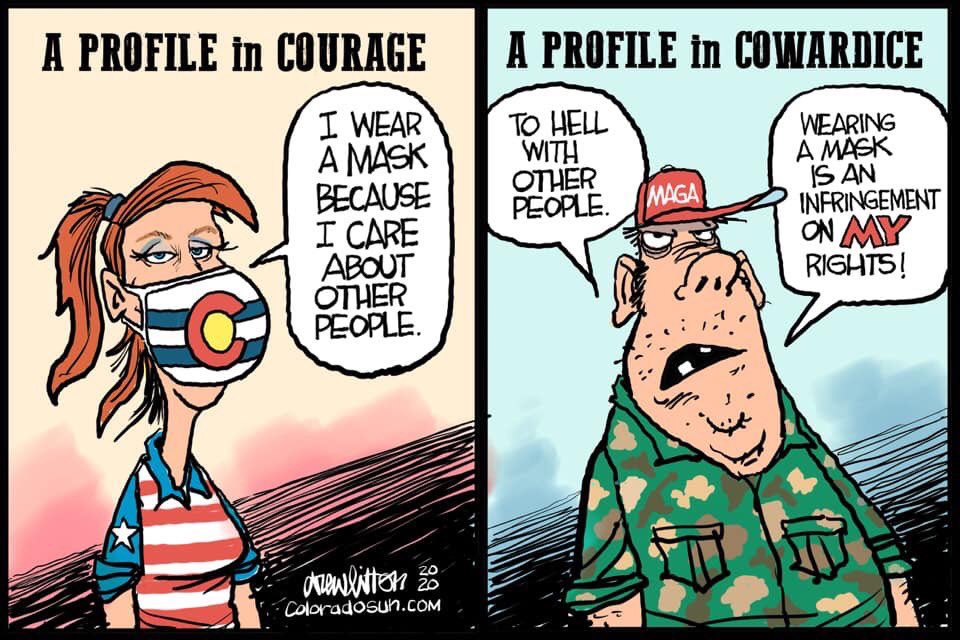
Cartoon – What does your mask say about you?

Jim Morrissey: What does your coronavirus mask say about you ...

Cartoon – Profile in Courage vs. Cowardice

COVID-19 News - Updated Daily

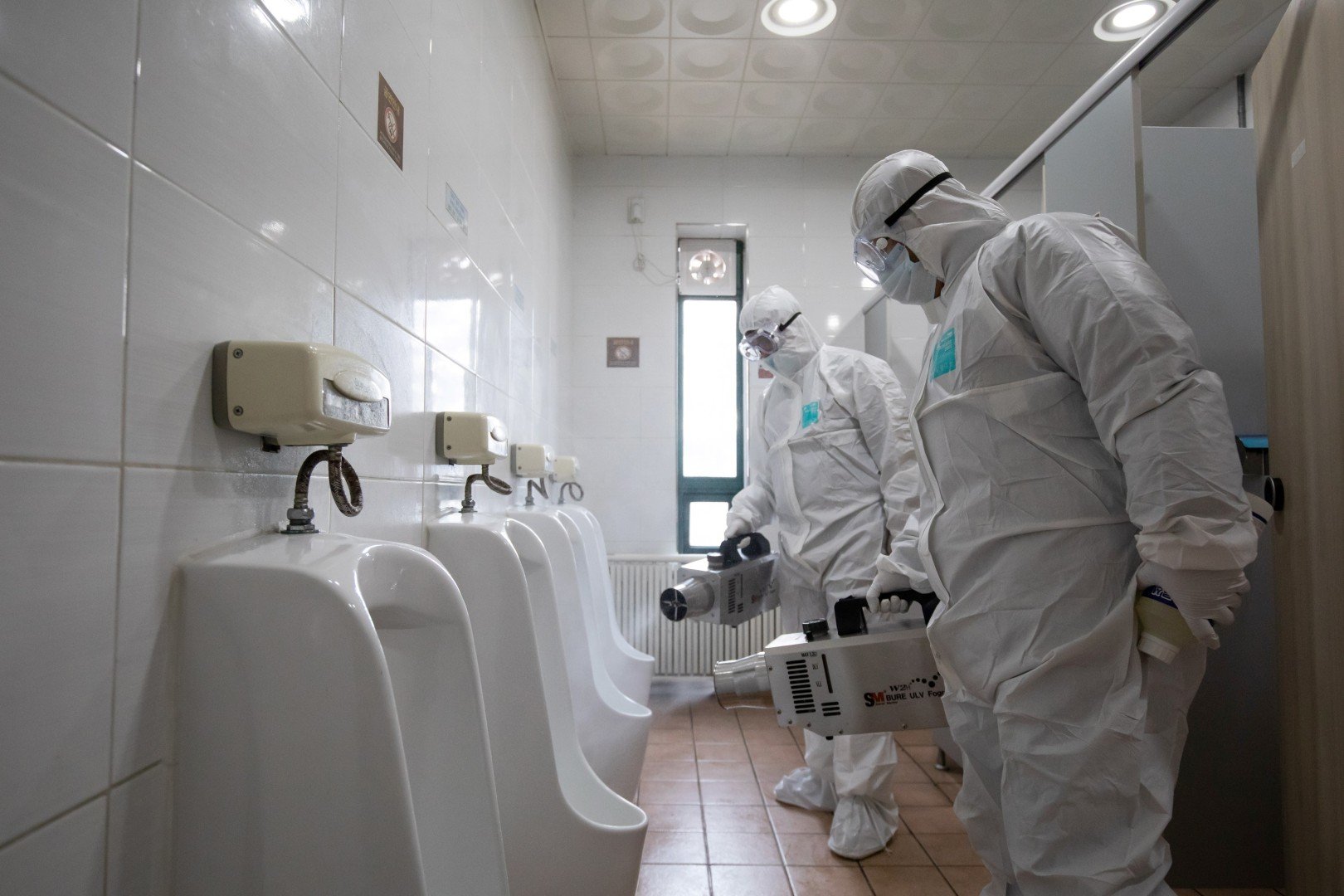
Beware the office toilet

https://mailchi.mp/647832f9aa9e/the-weekly-gist-august-14-2020?e=d1e747d2d8

Coronavirus can be killed with disinfectant but beware high-touch ...

Returning to the office after months of lockdown may bring an unexpected risk for workers. According to the New York Times, the CDC recently closed some of its Atlanta offices after finding that its water sources contained Legionella, the bacteria that causes Legionnaire’s disease.

The bacteria can grow in stagnant water systems, including plumbing and air conditioning units. After a prolonged absence, inhaled vapors from flushing toilets, running taps or restarted air conditioners can carry Legionella into the lungs.

While older individuals with lung conditions are most vulnerable, Legionnaire’s pneumonia carries a 10 percent fatality rate—leading the CDC to publish reopening guidelines for building operators that include flushing long-dormant systems with heated water and additional disinfectant in advance of reopening, and the suggestion that at-risk individuals should wear an N95 respirator or facepiece when aerosol generation is likely. (Unsurprisingly, the guidelines have been criticized as overly vague and lacking prescriptive advice.)

As if we all didn’t have enough to worry about, don’t forget to bring a N95 mask for any bathroom breaks during your first day back at the office! (Or maybe just hold it.)


Home as the center of “care anywhere”

https://mailchi.mp/647832f9aa9e/the-weekly-gist-august-14-2020?e=d1e747d2d8

We’re increasingly convinced that virtual physician visits are just one part of a continuum of care that can be delivered in the convenience and safety of the patient’s home. Health systems that can deliver “care anywhere”—an integrated platform of virtual services consumers can access from home (or wherever they are) for both urgent needs and overall health management, coordinated with in-person resources—have an unprecedented opportunity to build loyalty at a time when consumers are seeking a trusted source of safe, available care solutions.

The graphic above outlines the key components of a comprehensive home-based care model,

which requires the integration of three main elements:

a technology backbone,

a supply chain to provide services like labs and diagnostics,

and a tiered, flexible workforce. 

Of course, these infrastructure needs will increase with care acuity level, ranging from a simple virtual visit to home-delivered vaccination, all the way to hospital-level care at home. Delivering safe, accessible care within the home can be the foundation for an access platform that creates ongoing consumer loyalty—especially for systems who can build a financial model less dependent on payers’ long-term support for telemedicine reimbursement “parity”.


Prosecuting the case against the COVID response

https://mailchi.mp/647832f9aa9e/the-weekly-gist-august-14-2020?e=d1e747d2d8

Bruce Plante Cartoon: Corona virus denial

This week, in her debut as running mate to presidential candidate Joe Biden, California Sen. Kamala Harris gave a preview of one of the Democratic ticket’s key arguments for the fall campaign, making a full-throated, prosecutorial case against the Trump administration’s handling of the coronavirus pandemic.

“The virus has impacted almost every country,” Harris said, “but there’s a reason it has hit America worse than any other advanced nation. It’s because of Trump’s failure to take it seriously from the start.”

After receiving a briefing from public health experts on Thursday, Biden and Harris argued for a more comprehensive, aggressive national strategy to battle the virus, including major federal investment in contact tracing, a national mask mandate, and guaranteed free access to a COVID vaccine when it becomes available.

The remarks came as the US experienced the deadliest day of the summer so far, with nearly 1,500 COVID fatalities on Wednesday, and a seven-day rolling average of over 1,000 deaths per day for the last 17 days. Meanwhile, a new analysis by the New York Times, using data from the Centers for Disease Control and Prevention (CDC), indicated that the true US death toll from COVID may be as much as 35 percent higher than the reported total of 167K—a finding based on “excess deaths” above normal levels since March.

As President Trump continued to urge schools to reopen for in-person instruction nationwide, the White House released new guidance for ensuring students’ safe return to school. The guidance encouraged social distancing, frequent handwashing, better ventilation of school facilities, and the use of outdoor settings wherever possible.

Despite the President’s claim last week that children are “virtually immune” from the virus, a new analysis from the American Academy of Pediatrics and the Children’s Hospital Association showed that 97,000 children tested positive for COVID in the last two weeks of July alone, a 40 percent increase in the total number of known cases over that period.

About 340,000 children have tested positive so far, representing about 9 percent of all US cases. As schools face pressure to reopen, those numbers are likely to mount, and early-opening school districts in Georgia, Tennessee, Indiana, and Mississippi are already struggling to keep schools open amid rising cases.

Federal assistance to help schools deal with what seems like inevitable rounds of positive cases and closures is not forthcoming, however: after failing to reach a deal on another round of COVID relief, lawmakers have left Washington until September.

US coronavirus update: 5.2M cases; 167K deaths; 64.6M tests conducted.