ACA enrollment up 46%

https://www.axios.com/newsletters/axios-vitals-59e9ac1a-ab86-4f8a-917a-8c9d52f5835f.html?utm_source=newsletter&utm_medium=email&utm_campaign=newsletter_axiosvitals&stream=top

Obamacare Coverage Spikes After Covid-Related Job Losses

The number of people who lost jobs and related health coverage and then signed up for Affordable Care Act health plans on the federal website was up 46% this year compared with 2019, representing an increase of 154,000 people, the federal government said in a new report.

The bottom line: The government said the rush of people going to HealthCare.gov was tied to “job losses due to COVID-19,” Bob writes.

Yes, but: Medicaid enrollment due to coronavirus-related job losses appears to be growing even faster than enrollment in ACA plans, according to the Georgetown University Health Policy Institute.

Go deeper: Medicaid will be a coronavirus lifeline


America’s workers still aren’t protected from the coronavirus

https://www.axios.com/americas-workers-vulnerable-coronavirus-944e3451-4458-4f1d-83d2-c86a1beb1117.html

America's workers still aren't protected from the coronavirus - Axios

Essential workers have borne the brunt of the coronavirus pandemic for months, but the U.S. is still doing relatively little to protect them.

Why it matters: With no end to the pandemic in sight, America’s frontline workers still must choose between risking their health and losing their source of income.

Driving the news: The Trump administration said this week that health insurers aren’t required to cover coronavirus diagnostic tests performed as part of workplace safety or public health surveillance efforts.

  • It didn’t say who is supposed to pay for these tests. If employers are stuck footing the bill, that makes the testing less likely to happen.

The big picture: There’s been no national effort or initiative to protect essential workers, and America is still failing to implement basic public health measures as new cases skyrocket.

  • Masks have become a political flashpoint and aren’t required in many of the states that are emerging coronavirus hotspots.
  • That means essential workers go to work each day without any guarantee that the people they’re interacting with will take one of the most basic and effective steps to prevent transmission of the virus.
  • No one is even talking about mass distribution of personal protective equipment beyond health care workers. And even some health care workers — particularly those who work in nursing homes — don’t have the protective gear that they need.

More broadly, the financial incentives for frontline workers, particularly those who are low-income, to keep working make it nearly impossible for them to avoid health risks.

  • At least 69 million American workers are potentially ineligible for the emergency paid sick leave benefits that Congress passed earlier this year, per the Kaiser Family Foundation.
  • An estimated 25-30 million people — particularly lower-wage workers in service industries — are unable to work from home but also face a high risk of severe infection, KFF’s Drew Altman wrote earlier this week.

What we’re watching: The line between essential workers and those who are required to return to the office by their employer has become blurry, and millions more Americans are facing dilemmas similar to those faced by grocers and bus drivers.

  • The sickest — and thus most vulnerable — Americans may feel the most pressure to return to work, as that’s often where they get their health insurance, the NYT points out.
  • Nearly a quarter of adult workers are vulnerable to severe coronavirus infections, per KFF.

The bottom line: Essential workers and their families will continue to feel the impact of America’s coronavirus failures most acutely.

Go deeper: “Disposable workers” doing essential jobs


White House set to ask Supreme Court this week to overturn ACA: 4 things to know

https://www.beckershospitalreview.com/hospital-management-administration/white-house-to-ask-supreme-court-this-week-to-overturn-aca-4-things-to-know.html?utm_medium=email

New rules for Supreme Court justices as they plan their first-ever ...

The White House is expected to file legal briefs with the Supreme Court this week that will ask the justices to end the ACA, according to The New York Times

Four things to know:

1. The filings are in relation to Texas v. United States, the latest legal challenge to the ACA. Arguments around the case center on whether the ACA’s individual mandate was rendered unconstitutional when the penalty associated with it was erased by the 2017 tax law. Whether that decision invalidates the entire law or only certain parts of it is at question.

2. The White House is set to ask the Supreme Court June 25 to invalidate the law. The filings come at a time when the COVID-19 pandemic has caused millions of Americans to lose their jobs and their employer-based health coverage.

3. Republicans have said they want to “repeal and replace” the ACA, but there is no agreed upon alternative, according to The New York Times. Party strategists told the publication that Republicans will be in a tricky spot if they try to overturn the ACA ahead of the November elections and amid a pandemic. 

4. In addition to the filings, Democratic House speaker Nancy Pelosi is expected to reveal a bill this week that would boost the ACA. Proposals include more subsidies for healthcare premiums, expanding Medicaid coverage for uninsured pregnant women and offering states incentives to expand Medicaid.

Read the full report here


Why People Are Still Avoiding the Doctor (It’s Not the Virus)

Why People Are Still Avoiding the Doctor (It's Not the Virus ...

At first, people delayed medical care for fear of catching Covid. But as the pandemic caused staggering unemployment, medical care has become unaffordable for many.

At first, Kristina Hartman put off getting medical care out of concern about the coronavirus. But then she lost her job as an administrator at a truck manufacturer in McKinney, Texas.

While she still has health insurance, she worries about whether she will have coverage beyond July, when her unemployment is expected to run out.

“It started out as a total fear of going to the doctor,” she said.

“I definitely am avoiding appointments.”

Ms. Hartman, who is 58, skipped a regular visit with her kidney doctor, and has delayed going to the endocrinologist to follow up on some abnormal lab results.

While hospitals and doctors across the country say many patients are still shunning their services out of fear of contagion — especially with new cases spiking — Americans who lost their jobs or have a significant drop in income during the pandemic are now citing costs as the overriding reason they do not seek the health care they need.

“We are seeing the financial pressure hit,” said Dr. Bijoy Telivala, a cancer specialist in Jacksonville, Fla. “This is a real worry,” he added, explaining that people are weighing putting food on the table against their need for care. “You don’t want a 5-year-old going hungry.”

Among those delaying care, he said, was a patient with metastatic cancer who was laid off while undergoing chemotherapy. He plans to stop treatments while he sorts out what to do when his health insurance coverage ends in a month.

The twin risks in this crisis — potential infection and the cost of medical care — have become daunting realities for the millions of workers who were furloughed, laid off or caught in the economic downturn. It echoes the scenarios that played out after the 2008 recession, when millions of Americans were unemployed and unable to afford even routine visits to the doctor for themselves or their children.

Almon Castor’s hours were cut at the steel distribution warehouse in Houston where he works about a month ago. Worried that a dentist might not take all the precautions necessary, he had been avoiding a root canal.

But the expense has become more pressing. He also works as a musician. “It’s not feasible to be able to pay for procedures with the lack of hours,” he said.

Nearly half of all Americans say they or someone they live with has delayed care since the onslaught of coronavirus, according to a survey last month from the Kaiser Family Foundation. While most of those individuals expected to receive care within the next three months, about a third said they planned to wait longer or not seek it at all.

While the survey didn’t ask people why they were putting off care, there is ample evidence that medical bills can be a powerful deterrent. “We know historically we have always seen large shares of people who have put off care for cost reasons,” said Liz Hamel, the director of public opinion and survey research at Kaiser.

And, just as the Great Recession led people to seek less hospital care, the current downturn is likely to have a significant impact, said Sara Collins, an executive at the Commonwealth Fund, who studies access to care. “This is a major economic recession,” she said. “It’s going to have an effect on people’s demand for health care.”

The inability to afford care is “going to be a bigger and bigger issue moving forward,” said Chas Roades, the co-founder of Gist Healthcare, which advises hospitals and doctors. Hospital executives say their patient volumes will remain at about 20 percent lower than before the pandemic.

“It’s going to be a jerky start back,” said Dr. Gary LeRoy, a physician in Dayton, Ohio, who is the president of the American Academy of Family Physicians. While some of his patients have returned, others are staying away.

But the consequences of these delays can be troubling. In a recent analysis of the sharp decline in emergency room visits during the pandemic, officials from the Centers for Disease Control and Prevention said there were worrisome signs that people who had heart attacks waited until their conditions worsened before going to the hospital.

Without income, many people feel they have no choice. Thomas Chapman stopped getting paid in March and ultimately lost his job as a director of sales. Even though he has high blood pressure and diabetes, Mr. Chapman, 64, didn’t refill any prescriptions for two months. “I stopped taking everything when I just couldn’t pay anymore,” he said.

After his legs began to swell, and he felt “very, very lethargic,” he contacted his doctor at Catalyst Health Network, a Texas group of primary care doctors, to ask about less expensive alternatives. A pharmacist helped, but Mr. Chapman no longer has insurance, and is not sure what he will do until he is eligible for Medicare later this year.

“We’re all having those conversations on a daily basis,” said Dr. Christopher Crow, the president of Catalyst, who said it was particularly tough in states, like Texas, that did not expand Medicaid. While some of those who are unemployed qualify for coverage under the Affordable Care Act, they may fall in the coverage gap where they do not receive subsidies to help them afford coverage.

Even those who are not concerned about losing their insurance are fearful of large medical bills, given how aggressively hospitals and doctors pursue people through debt collections, said Elisabeth Benjamin, a vice president at Community Service Society of New York, which works with people to get care.

“Americans are really very aware that their health care coverage is not as comprehensive as it should be, and it’s gotten worse over the past decade,” Ms. Benjamin said. After the last recession, they learned to forgo care rather than incur bills they can’t pay.

Geralyn Cerveny, who runs a day care in Kansas City, Mo., said she had Covid-19 in early April and is recovering. But her income has dropped as some families withdrew their children. Although her daughter is urging her to get some follow-up testing because she has some lingering symptoms from the virus, she is holding off because she does not want to end up with more medical bills if her health plan will not cover all of the care she needs. She said she would dread “a fight with the insurance company if you don’t meet their guidelines.”

Others are weighing what illness or condition merits the expense of a doctor or tests and other services. Eli Fels, a swim instructor and personal trainer who is pregnant, has been careful to stay up-to-date with her prenatal appointments in Cambridge, Mass. She and her doctor have relied on telemedicine appointments to reduce the risk of infection.

But Ms. Fels, who also lost her jobs but remains insured, has chosen not to receive care for her injured wrist in spite of concern over lasting damage. “I’ve put off medical care that doesn’t involve the baby,” she said, noting that her out-of-pocket cost for an M.R.I. to find out what was wrong “is not insubstantial.”

At Maimonides Medical Center in Brooklyn, doctors have already seen the impact of delaying care. During the height of the pandemic, people who had heart attacks and serious fractures avoided the emergency room. “It was as if they disappeared, but they didn’t disappear,” said Dr. Jack Choueka, the chair of orthopedics. “People were dying in home; they just weren’t coming into the hospital.”

In recent weeks, people have begun to return, but with conditions worsened because of the time they had avoided care. A baby with a club foot will now need a more complicated treatment because it was not addressed immediately after birth.

Another child who did not have imaging promptly was found to have a tumor. “That tumor may have been growing for months unchecked,” Dr. Choueka said.


A 70-year-old man was hospitalized with COVID-19 for 62 days. Then he received a $1.1 million hospital bill, including over $80,000 for using a ventilator.

https://www.yahoo.com/news/70-old-man-hospitalized-covid-170112895.html

Man, 70, hospitalized with COVID-19 for 62 days gets $1.1 million ...

  • A man in Washington state who spent more than two months in the hospital and more than a month in the Intensive Care Unit with COVID-19 received a 181-page itemized bill that totals more than $1.1 million, The Seattle Times reported.
  • Michael Flor, 70, will likely foot little of the bill due to his being insured through Medicare, according to the report.
  • “I feel guilty about surviving,” Flor told The Seattle Times. “There’s a sense of ‘why me?’ Why did I deserve all this? Looking at the incredible cost of it all definitely adds to that survivor’s guilt.”

A 70-year-old man in Seattle, Washington, was hit with a $1.1 million 181-page long hospital bill following his more than two-month stay in a local hospital while he was treated for — and nearly died from — COVID-19. 

“I opened it and said ‘holy (expletive)!’ ” the patient, Michael Flor, who received the $1,122,501.04 bill told The Seattle Times.

He added: “I feel guilty about surviving. There’s a sense of ‘why me?’ Why did I deserve all this? Looking at the incredible cost of it all definitely adds to that survivor’s guilt.”

According to the report, Flor will not have to pay for the majority of the charges because he has Medicare, which will foot the cost of most if not all of his COVID-19 treatment. The 70-year-old spent 62 days in the Swedish Medical Center in Issaquah, Washington, 42 days of which he spent isolated in the Intensive Care Unit (ICU). 

Of the more than one month he spent in a sealed-off room in the ICU, Flor spent 29 days on a ventilator. According to the Seattle Times, a nurse on one occasion even helped him call his loved ones to say his final goodbyes, as he believed he was close to death from the virus.

While in the ICU, Flor was billed $9,736 each day; more than $80,000 of the bill is made up of charges incurred from his use of a ventilator, which cost $2,835 per day, according to the report. A two-day span of his stay in the hospital when his organs, including his kidneys, lungs, and heart began to fail, cost $100,000, according to the report.  

In total, there are approximately 3,000 itemized charges on Flor’s bill — about 50 charges for each day of his hospital stay, according to The Seattle Times. Flor will have to pay for little of the charges — including his Medicare Advantage policy’s $6,000 out-of-pocket charges — due to $100 billion set aside by Congress to help hospitals and insurance companies offset the costs of COVID-19.

Flor is recovering in his home in West Seattle, according to the report.


How Many More Will Die From Fear of the Coronavirus?

Fear of contracting the coronavirus has resulted in many people missing necessary screenings for serious illnesses, like cancer and heart disease.

Seriously ill people avoided hospitals and doctors’ offices. Patients need to return. It’s safe now.

More than 100,000 Americans have died from Covid-19. Beyond those deaths are other casualties of the pandemic — Americans seriously ill with other ailments who avoided care because they feared contracting the coronavirus at hospitals and clinics.

The toll from their deaths may be close to the toll from Covid-19. The trends are clear and concerning. Government orders to shelter in place and health care leaders’ decisions to defer nonessential care successfully prevented the spread of the virus. But these policies — complicated by the loss of employer-provided health insurance as people lost their jobs — have had the unintended effect of delaying care for some of our sickest patients.

To prevent further harm, people with serious, complex and acute illnesses must now return to the doctor for care.

Across the country, we have seen sizable decreases in new cancer diagnoses (45 percent) and reports of heart attacks (38 percent) and strokes (30 percent). Visits to hospital emergency departments are down by as much as 40 percent, but measures of how sick emergency department patients are have risen by 20 percent, according to a Mayo Clinic study, suggesting how harmful the delay can be. Meanwhile, non-Covid-19 out-of-hospital deaths have increased, while in-hospital mortality has declined.

These statistics demonstrate that people with cancer are missing necessary screenings, and those with heart attack or stroke symptoms are staying home during the precious window of time when the damage is reversible. In fact, a recent poll by the American College of Emergency Physicians and Morning Consult found that 80 percent of Americans say they are concerned about contracting the coronavirus from visiting the emergency room.

Unfortunately, we’ve witnessed grievous outcomes as a result of these delays. Recently, a middle-aged patient with abdominal pain waited five days to come to a Mayo Clinic emergency department for help, before dying of a bowel obstruction. Similarly, a young woman delayed care for weeks out of a fear of Covid-19 before she was transferred to a Cleveland Clinic intensive care unit with undiagnosed leukemia. She died within weeks of her symptoms appearing. Both deaths were preventable.

The true cost of this epidemic will not be measured in dollars; it will be measured in human lives and human suffering. In the case of cancer alone, our calculations show we can expect a quarter of a million additional preventable deaths annually if normal care does not resume. Outcomes will be similar for those who forgo treatment for heart attacks and strokes.

Over the past 12 weeks, hospitals deferred nonessential care to prevent viral spread, conserve much-needed personal protective equipment and create capacity for an expected surge of Covid-19 patients. During that time, we also have adopted methods to care for all patients safely, including standard daily screenings for the staff and masking protocols for patients and the staff in the hospital and clinic. At this point, we are gradually returning to normal activities while also mitigating risk for both patients and staff members.

The Covid-19 crisis has changed the practice of medicine in fundamental ways in just a matter of months. Telemedicine, for instance, allowed us to pivot quickly from in-person care to virtual care. We have continued to provide necessary care to our patients while promoting social distancing, reducing the risk of viral spread and recognizing patients’ fears.

Both Cleveland Clinic and Mayo Clinic have gone from providing thousands of virtual visits per month before the pandemic to hundreds of thousands now across a broad range of demographics and conditions. At Cleveland Clinic, 94 percent of diabetes patients were cared for virtually in April.

While virtual visits are here to stay, there are obvious limitations. There is no substitute for in-person care for those who are severely ill or require early interventions for life-threatening conditions. Those are the ones who — even in the midst of this pandemic — must seek the care they need.

Patients who need care at a clinic or hospital or doctor’s office should know they have reduced the risk of Covid-19 through proven infection-control precautions under guidelines from the Centers for Disease Control and Prevention. We’re taking unprecedented actions, such as restricting visiting hours, screening patient and caregiver temperatures at entrances, encouraging employees to work from home whenever possible, providing spaces that allow for social distancing, and requiring proper hand hygiene, cough etiquette and masking.

All of these strategies are intended to significantly reduce risk while allowing for vital, high-quality care for our patients.

The novel coronavirus will not go away soon, but its systemic side effects of fear and deferred care must.

We will continue to give vigilant attention to Covid-19 while urgently addressing the other deadly diseases that haven’t taken a pause during the pandemic. For patients with medical conditions that require in-person care, please allow us to safely care for you — do not delay. Lives depend on it.


Few U.S. adults say they’ve been diagnosed with coronavirus, but more than a quarter know someone who has

https://www.pewresearch.org/fact-tank/2020/05/26/few-u-s-adults-say-theyve-been-diagnosed-with-coronavirus-but-more-than-a-quarter-know-someone-who-has/?utm_source=Pew+Research+Center&utm_campaign=ef5ba73bf3-EMAIL_CAMPAIGN_2020_05_29_05_11&utm_medium=email&utm_term=0_3e953b9b70-ef5ba73bf3-400197657

28% of U.S. adults say they know someone diagnosed with COVID-19 ...

Relatively few Americans say they have been diagnosed with COVID-19 or tested positive for coronavirus antibodies, but many more believe they may have been infected or say they personally know someone who has been diagnosed.

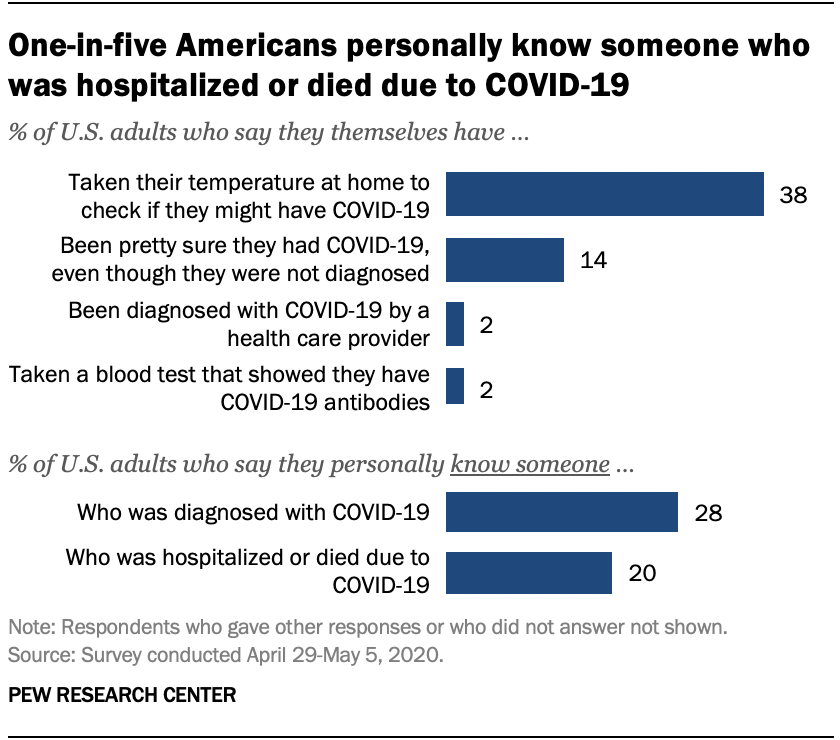
Only 2% of U.S. adults say they have been officially diagnosed with COVID-19 by a health care provider, according to a new Pew Research Center survey. And 2% say they have taken a blood test that showed they have COVID-19 antibodies, an indication that they previously had the coronavirus. But many more Americans (14%) say they are “pretty sure” they had COVID-19, despite not getting an official diagnosis. And nearly four-in-ten (38%) say they’ve taken their temperature to check if they might have the disease.

Although few Americans have been diagnosed with COVID-19 themselves, many more say they know someone with a positive diagnosis. More than one-in-four U.S. adults (28%) say they personally know someone who has been diagnosed by a health care provider as having COVID-19. A smaller share of Americans (20%) say they know someone who has been hospitalized or who has died as a result of having the coronavirus.

Some groups are more likely than others to report personal experiences with COVID-19. For instance, black adults are the most likely to personally know someone who has been hospitalized or died as a result of the disease. One-third of black Americans (34%) know someone who has been hospitalized or died, compared with 19% of Hispanics and 18% of white adults. Black Americans (32%) are also slightly more likely than Hispanic adults (26%) to know someone diagnosed with COVID-19. Public health studies have found black Americans are disproportionately dying or requiring hospitalization as a result of the coronavirus.

28% of U.S. adults say they know someone diagnosed with COVID-19 ...

Areas in the northeastern United States have recorded some of the highest rates of coronavirus cases and fatalities, and this is reflected in the Center’s survey. About four-in-ten adults living in the Northeast (42%) say they personally know someone diagnosed with COVID-19, significantly more than among adults living in any other region. People living in the Northeast (31%) are also the most likely to know someone who has been hospitalized or died as a result of the disease.

One aspect of personal risk for exposure to the coronavirus is whether someone is employed in a setting where they must have frequent contact with other people, such as at a grocery store, hospital or construction site. Given the potential for the spread of the coronavirus within households, risk to individuals is also higher if other members of the household are employed in similar settings. Among people who are currently employed full-time, 35% are working in a job with frequent public contact. Among those working part-time, almost half work (48%) in such a setting. For those living in a household with other adults, 35% report that at least one of those individuals is working in a job that requires frequent contact with other people.

Taken together, nearly four-in-ten Americans (38%) have this type of exposure – either currently working in a job that requires contact with others, living in a household with others whose jobs require contact, or both.

Hispanics (at 48%) are more likely than either blacks (38%) or whites (35%) to have this type of personal or household exposure. An earlier Center analysis of government data found Hispanic adults were slightly more likely to work in service-sector jobs that require customer interaction, and that are at higher risk of layoffs as a result of the virus. In fact, the current Center survey found Hispanics were among the most likely to have experienced pay cuts or job losses due to the coronavirus outbreak.

28% of U.S. adults say they know someone diagnosed with COVID-19 ...

Interpersonal exposure in the workplace is also more widespread among younger adults. And there is a 10 percentage point difference between upper- and lower-income Americans in exposure, with lower-income adults more likely to work in situations where they have to interact with the public, or to live with people who do.

Health experts warn that COVID-19 is particularly dangerous to people who have underlying medical conditions. In the survey, one-third of adults say they have such a condition. Among this group, nearly six-in-ten (58%) say that the coronavirus outbreak is a major threat to their personal health. Among those who do not report having an underlying medical condition, just 28% see the outbreak as a major threat to their health. Americans who have an underlying health condition are also more likely than those who do not to say they’ve taken their temperature to check if they might have COVID-19 (47% vs. 33% of those without a health condition).

Self-reports of an underlying health condition vary greatly by age. Among those ages 18 to 29, just 16% say they have a condition; this rises steadily with age to 56% among those 65 and older. Whites are a little more likely than blacks and Hispanics to report having a health condition, but both blacks (at 54%) and Hispanics (52%) are far more likely than whites (32%) to say that the coronavirus outbreak is “a major threat” to their health.


Congress headed toward unemployment showdown

Congress headed toward unemployment showdown

Alabama Starts Giving $600 Federal Stimulus Payments to the ...

A debate over whether to extend enhanced unemployment benefits is emerging as a significant obstacle to getting a deal on another round of coronavirus relief legislation.

With the national unemployment rate expected to creep toward 20 percent in the months ahead, the fight over whether to boost benefits for Americans who lose their jobs or to keep benefits lean to motivate laid-off employees to rejoin the workforce is set to become a defining issue ahead of the election.

Senate Majority Leader Mitch McConnell (R-Ky.) says that Senate Republicans don’t have any interest in extending the $600 federal increase to state unemployment benefits that was a core component of the $2.2 trillion CARES Act.

The enhanced benefits are due to expire at the end of July, making them a principal topic of the upcoming negotiations.

McConnell told House GOP lawmakers in a conference call Wednesday that the Senate will not extend the beefed-up federal unemployment benefits, which GOP senators say has become a disincentive for middle- and lower-wage workers to return to the job.

But not all Republicans are on board with McConnell.

Sen. Pat Roberts (R-Kan.) said “my inclination would say that that’s going to have to continue for a while.”

“I get it, I talk to a lot of business people in Kansas — and South Carolina — about that and the disincentive if you continue to pay it to work. So I say it’s a tough a choice. But I think under the circumstances it should be continued in some form,” he added.

The employment picture grew darker on Thursday after the Labor Department announced that another 2.4 million Americans filed unemployment claims last week, bringing the total for the past nine weeks to 38 million new claims.

Sen. Thom Tillis (R), who faces a tough reelection race in North Carolina, said he wants to wait and see how the unemployment numbers play out.

“I think a lot of it really depends on how well the business openings go. I for one think that anything we do has to be tailored to where we’re not in the situation where the benefit’s greater than the salary it was replacing,” he said.

Other Republicans, however, say there is strong support for shutting off the federal boost to unemployment insurance after July.

“They think it is a huge disincentive to get the economy back and growing again. They’re not happy it was done in the first place,” said Sen. Rob Portman (R-Ohio), who helped craft the unemployment benefits section of the CARES Act, referring to complaints he has heard from GOP colleagues about the beefed-up benefits.

Sen. Rand Paul (R-Ky.) on Thursday warned: “When the government wage exceeds the market wage you’ll get institutionalized unemployment.”

“It was a mistake to make it so high to begin with. It would be a mistake to extend it,” he added. “If you favor extending it, basically you’re favoring institutionalized unemployment.”

Other Republicans are raising concerns that adding $600 in federal assistance to weekly state unemployment compensation creates a benefit that exceeds the hourly wage for many jobs in their states.

“I think it needs to end,” said Sen. John Boozman (R-Ark.). “Hopefully the economy will start to be getting back on track and we’ll be able to get rid of it.”

Portman has proposed a bill that he hopes will give laid-off workers incentive to give up their enhanced benefits and look for new jobs before the July 31 expiration of the $600 federal add-on.

His legislation would let these workers continue collecting $450 of the $600 weekly benefit if they find work in the next nine weeks.

This sets up a major fight with Democrats, who see expanded unemployment benefits as the most effective way to help Americans hit hardest economically by the pandemic.

Speaker Nancy Pelosi (D-Calif.) and House Democrats have passed a $3 trillion coronavirus relief bill that would extend the $600 federal add-on to state unemployment benefits through July.

Sen. Sherrod Brown (D-Ohio) said Democrats “absolutely” will insist on extending the federal increase to state unemployment benefits.

“It’s been a longtime Republican plan to reduce the amount of UI to workers, to shrink the number of weeks and to make fewer people eligible. In Ohio, only a quarter of unemployed workers are eligible for Ohio unemployment,” he said.

He said Democrats will make extending the program a top priority.

“Democrats are the party of workers, clearly, and they aren’t,” he said of his GOP colleagues.

The debate is just beginning, but it will grow heated in the weeks ahead as both sides begin to negotiate in earnest the size and scope of the next relief bill.

Senate Democratic Whip Dick Durbin (Ill.) predicted: “Republicans will catch … hell back home when they try to explain cutting off unemployment.”

He also predicted fallout for not reforming the Small Business Administration’s Paycheck Protection Program or providing more aid to state and local governments.

Durbin warned that failing to extend enhanced unemployment benefits would be a “disastrous mistake.”

“The economists tell us it is probably the single best stimulus that we can put into this economy,” he said

Durbin said if McConnell blocks extending beefed-up unemployment benefits past July 31, there will be hardship across America and in the commonwealth of Kentucky that “he doesn’t even begin to contemplate at this moment.”

Sen. Bernie Sanders (I-Vt.), who was a competitive candidate in the Democratic presidential primary and whose support is seen as crucial to turning out voters in the fall, also weighed in Thursday.

“Republicans are going nuts about the $600 per week expanded unemployment benefits that workers now receive. Imagine that! Americans not forced to live on starvation wages. What a frightening precedent. What will they want next? Health care as a human right?” Sanders tweeted Thursday afternoon.

Some Democratic moderates, however, have signaled in private talks that they’re open to negotiating with Republicans to scaling down the $600 in additional weekly assistance after July.

A Republican source familiar with the preliminary talks said that moderate Sens. Christopher Coons (D-Del.), Bob Menendez (D-N.J.) and Joe Manchin (D-W.Va.) have expressed interest in finding a compromise.

Sen. Michael Bennet (D-Colo.) has also signaled a willingness in reviewing the impact of the generous federal payment on people rejoining the workforce.


Fighting for Coverage

https://www.managedhealthcareexecutive.com/news/fighting-coverage?rememberme=1&elq_mid=12155&elq_cid=876742&GUID=A13E56ED-9529-4BD1-98E9-318F5373C18F

Fighting for Coverage | Managed Healthcare Executive

One of the main goals of the ACA, sometimes referred to as Obamacare, was to provide affordable health insurance to every American.

The law’s passage in 2010 made it possible for nearly 54 million Americans—previously denied coverage due to pre-existing medical conditions—to purchase coverage, as well as landmark provisions to protect those who developed an expensive medical condition while insured from being unexpectedly dropped by their health plan.

By all accounts, such provisions helped a record number of Americans procure medical insurance coverage—and, by extension, reduce healthcare costs and avoid medical bankruptcies.

Yet, with the elimination of the individual mandate penalty in 2017, and other policy changes that have forced up the cost of premiums, many Americans are looking for options off the healthcare exchange.

One such option is the short-term limited duration insurance (STLDI) plan, loosely defined as bare bones medical coverage that can last up to 12 months with the potential for renewal. Managed Healthcare Executive® Editorial Advisor Margaret Murray, chief executive officer of the Association for Community Affiliated Plans (ACAP), said such plans “are not really insurance,”—and refers to them as “junk insurance.” With a new 2018 HHS rule that dramatically expands access to this type of coverage, she worries that their availability will hurt consumers.

“Insurance brokers may offer these plans to consumers and those consumers may not realize that they largely reverse ACA protections regarding pre-existing conditions and coverage limits,” she says. “These plans don’t cover what you think they will cover, the insurance companies can cancel your policy at any time, and they can deny your access to maternity care and certain drugs. It’s not really major medical insurance and it’s not always easy for your average consumer to see that.”

Changing regulations

The Trump Administration contends, with rising insurance premiums, that such short-term plans make health insurance more affordable for the average American.

Cathryn Donaldson, a spokesperson for America’s Health Insurance Plans, a health insurance trade association, says such plans “can provide a temporary bridge for those who are going through a life transition or gap in coverage such as having a baby or changing jobs.”

Yet, Karen Pollitz, a senior fellow at the Kaiser Family Foundation, says STLDI plans embody the old adage about getting what you pay for. STLDI are not required to comply with many of the ACA’s most important protections, which means insurance companies can exclude coverage for pre-existing conditions, charge higher premiums based on health status, impose annual and/or lifetime caps, and opt out of coverage for things like maternity care or mental health treatment. They can also revoke coverage at will.

“Under the ACA, it used to be that short term and minimum essential coverage [MEC] policies had to have a prominent warning printed on the front place that said, if you buy this, you are not getting full coverage and may even owe a tax penalty,” she explains. “Those warnings are no longer there and that’s of concern.”

Furthermore, late last year, HHS put forth a final rule extending the duration of STLDI from a mere three months up to 364 days. In addition, insurers can offer renewals and extensions for up to three years. What is even more concerning, Murray says, is the current Administration is now actively promoting the use of private web broker sites to market STLDI. This can make it more difficult for consumers to understand which plans offer comprehensive medical coverage and which are the riskier STLDI plans.

“The current administration says such plans offer consumers more affordable options—and more choice,” Murray explains. “But the marketing for these plans is really disingenuous. It’s not just that they are just short-term. They don’t cover what people think they will cover. They are very profitable for insurance companies. But they can be very costly for consumers, who likely won’t realize they don’t have comprehensive coverage until they are sick or injured.”

The fall-out

Over the past few months, several high-profile publications like Consumer Reports and the Washington Post have printed stories about the dangers, and unexpected costs, of STLDI for consumers.

“It’s like you are in the market for a car and someone offers you a really affordable roller-skate,” says Pollitz. “But a roller-skate is not the same thing as a car. It’s not going to get you as far if you really need to travel. And it’s going to cost you more in the long run.”

Murray also cautions more widespread adoption of such plans can affect the entire insurance market, siphoning cost-conscious consumers from risk pools and driving up premium costs for everyone.

“There are always some young invincibles, who think they won’t get sick—and there are some invincibles, too—and they will be attracted by the lower premiums,” she says. “But in doing so, that will leave people who are sicker to pay higher rates by moving people out of the ACA marketplace.”

That’s one reason why ACAP, as well as six other health organizations, filed a lawsuit in the U.S. District Court for the District of Columbia on September 14, 2018 in order to roll back the new STLDI rule and stop the expansion of such plans. Murray said the HHS rule violates the ACA, “undercutting plans that comply” with the still active legislation. They argue the Trump Administration is using these new rules to try to overturn the ACA—which they have not yet been able to successfully repeal in Congress.

“We thought this was important enough that it was worth suing the federal government in order to try and stop it,” she says. “We had hoped to get a summary judgment last year because we wanted to stop the spread of STLDI plans for the 2020 open enrollment. Unfortunately, we didn’t get that. The judge ruled against us. But we are appealing it—and the hope is that we will have a decision to stop these things being sold in 2021.

The take-home message

Donaldson says it is vital the healthcare community educate consumers about the risks of STLDI plans and make sure they are better aware of what sort of comprehensive plans are available on the Healthcare.gov marketplace.

“While alternative plans such as association health plans and STLDI may present more affordable premiums, they are not a replacement for comprehensive coverage and may not cover the treatments or prescriptions an individual may need throughout the year,” she says.

Pollitz agrees.

“We understand that life happens and there may be all manner of reasons why you are separated from coverage,” she says. “But it is becoming harder and harder to distinguish these plans from real coverage especially now that they are now being aggressively marketed to people all over the country. And it’s vital that people understand that 90% of consumers will play less than the listed price on Healthcare.gov marketplace because they qualify for subsidies. It really does pay to take the time to look before you sign up for one of these short-term plans.”


All 50 states have partially reopened; U.S. death toll surpasses 90,000

https://www.washingtonpost.com/nation/2020/05/20/coronavirus-update-us/?utm_campaign=wp_post_most&utm_medium=email&utm_source=newsletter&wpisrc=nl_most

NC coronavirus update May 18: Wake County leaders meet to discuss ...

Ready or not, the United States is reopening. All 50 states have started easing coronavirus-related restrictions — even though many of them do not meet federal benchmarks — leading public health experts to warn that a new surge of infections could be imminent.

As the U.S. death toll surpassed 90,000, White House officials continued to defend the push to reopen and optimistically predicted a swift economic recovery. As part of the focus on states’ efforts to revive their economies, Vice President Pence on Wednesday traveled to Florida while Trump was set to host the governors of Arkansas and Kansas at the White House.

Here are some significant developments:

  • Trump ramped up his rhetoric against China, claiming on Twitter that the nation’s “incompetence” was responsible for “this mass Worldwide killing!” Secretary of State Mike Pompeo also denounced China as a “brutal authoritarian regime” and described its relationship with the director of the World Health Organization as “troubling.”
  • A worker at a mink farm in the Netherlands may have contracted the novel coronavirus from an animal there, the country’s agricultural minister said. If confirmed, this is would be first recorded incident of animal-to-human transmission. 
  • A church in Houston and another in Georgia are closing for a second time after faith leaders and congregants tested positive for the virus shortly after the two churches reopened.
  • The president drew criticism for saying Tuesday it’s “a badge of honor” that America leads the world with more than 1.5 million confirmed cases of the novel coronavirus because “it means our testing is much better.” The United States has more than 30 percent of the world’s known coronavirus infections but accounts for less than 5 percent of the global population.
  • The Centers for Disease Control and Prevention laid out a detailed, delayed road map for reopening schools, child-care facilities, restaurants and mass transit, weeks after governors began opening states on their own terms.
  • The president privately expressed opposition to extending unemployment benefits for workers affected by the pandemic.