Amwell CEOs on the telehealth boom and why it will ‘democratize’ healthcare

https://www.fiercehealthcare.com/tech/amwell-ceos-telehealth-boom-will-democratize-healthcare?mkt_tok=eyJpIjoiWmpobE5XVmlaRGd6T0dFdyIsInQiOiJsQmxnbVNxNVlISVNkczJIZkJXb3ZFZG9tVlpMblZ1XC9oVVB6SlRINzNhOXE4MWQzNk1cL3JTaDlcL2l0MGdhSnk0NUtqY1RzdThCN1wvZ1ZoVUxqOHJwZFJcL1wvK3FtS0o5NFwvSHA0WHhTUnhVNnY3bk5RNmhRQTdxYzYwclhYN3JTRW8ifQ%3D%3D&mrkid=959610

Amwell CEOs on the telehealth boom and why it will 'democratize ...

The COVID-19 pandemic has catapulted the telehealth industry forward by decades in a matter of months, according to Amwell’s Roy Schoenberg.

That not only benefits the Amwell’s business, but it’s a win for patients, said Schoenberg, who serves as the company’s president and co-CEO.

“We are going to see an enormous amount of change, nothing short of a revolution, going forward,” he told Fierce Healthcare.

Roy and his brother Ido Schoenberg have been telehealth advocates for more than a decade since launching Amwell, formerly American Well, in 2006. The Boston-based telehealth company works with more than 240 health systems comprised of 2,000 hospitals and 55 health plan partners with over 36,000 employers, reaching over 150 million lives.

Like other virtual care companies, Amwell has seen skyrocketing demand for its services during the COVID-19 pandemic as stay-at-home orders and social distancing guidelines prevented many patients from visiting doctors in person. Shares in public digital health companies like Teladoc and Livongo have grown by double digits during the health crisis.

The momentum around telehealth also has attracted investors. The company recently raised $194 million in a series C funding round.

Amwell also is gearing up to go public later this year, according to CNBC’s Christina Farr and Ari Levy. The company confidentially filed for an IPO earlier this week and has hired Goldman Sachs and Morgan Stanley to lead the deal, Farr and Levy reported last week, citing people who asked not to be named because the plans have not been announced.

The company declined to comment on the CNBC report.

Before the COVID-19 pandemic began, Amwell was providing an average of 5,000 telehealth visits a day. That has jumped to 45,000 to 50,000 virtual visits a day due to the coronavirus, said Ido Schoenberg, who serves as chairman and co-CEO. 

“We saw 30 times, 40 times higher volumes and we have clients that had 2% to 3% of their patient volume online that now have 75% of visits online,” he said. “It’s truly incredible. The number of active providers on our platform grew seven times over in two months.”

As visits surged, technology companies struggled to keep up with demand, and patients reported long wait times for virtual visits on some platforms.

Roy Schoenberg acknowledged Amwell also faced challenges rapidly scaling its technology and services almost overnight as it was “thrown into the center stage of trying to save the world.”

The company leverages automation for processes such as onboarding physicians, credentialing, licensing, and working with health plans and that capability proved critical to scaling its services, the executives said.

“We needed to allow 40,000 to 50,000 physicians to come on to our system and begin to use it. If this was a manual process, it would have been broken,” Roy Schoenberg said.

Regulatory barriers to telehealth also quickly fell away, at least temporarily. The Centers for Medicare and Medicaid Services and commercial health plans have expanded access to telehealth by offering payment parity for many telehealth services for the first time.

While questions remain about what regulatory flexibilities will remain in place to support the ongoing demand for telehealth, Amwell executives believe virtual care has proven its value to providers, payers and patients.

CMS will likely tighten up some of the relaxed requirements around telehealth which is a “fiscally responsible approach,” Roy Schoenberg said.

“At the end of the day, even though the government tends to be a little bit slow, it gravitates to where the value is. How long will it take for the payment structure to retract and then expand, that’s anyone’s guess. We have an election year coming in. Who knows what that is going to do? There may be some changes, but I think overall, the genie is out of the bottle, the toothpaste is out of the tube, or whatever phrase you want to use,” he said.

The executives never doubted that telehealth would, at some point, reach the mainstream. Now that it’s happened, health systems and patients have become advocates for the technology and that will also put pressure on CMS and commercial payers to continue to support it, they said.

The executives now see an opportunity for Amwell to use its platform to expand the reach of healthcare to more patients. There is a growing industry of telehealth providers, device makers, and technology-enabled disease management companies that will enable digital home healthcare services, they said.

“What we built is something way bigger than a video conference between doctor and patient, which you can easily do using Zoom or FaceTime,” Ido Schoenberg said.

Digital connectivity will enable providers to gather health data on patients from wearables and devices to better understand gaps in care, get an overall picture of patients’ health and then provide more effective interventions, all without patients leaving their living rooms. The combination of telehealth and remote devices will enable elderly, frail patients to receive care at home, where they want to be, rather than being moved to a skilled nursing facility, they said.

“It’s about the ability to democratize healthcare and make great care available to many more people that today don’t always have access to it,” Ido Schoenberg said.

Roy Schoenberg added, “These are the opportunities opening fast and furious in front of us and the promise is to make healthcare less painful as an individual experience. That’s the value proposition.”



Dubai’s Super-Ambulance Is a Mini Hospital-on-Wheels with an Operating Room and X-Ray Unit

https://www.techthatmatters.com/dubais-super-ambulance-is-a-mini-hospital-on-wheels-with-an-operating-room-and-x-ray-unit/?fbclid=IwAR0MQS2H3VZyMPozU_MqVSZ2BeYDKOelYqvWi6MHBLiMguiN9eIe7cjoF0U

Dubai’s Super-Ambulance Is a Mini Hospital-on-Wheels with an Operating Room and X-Ray Unit

Dubai is proud to introduce its impressive fleet of the “world’s largest ambulances,” or “Mercedes-Benz large-capacity ambulances” which were created to give rapid medical assistance in the event of major emergencies with large numbers of causalities. These new emergency vehicles offer a fully-equipped, mobile clinic with an intensive-care unit and an operating room.

Equipped with an X-ray unit and ultrasonic equipment for further evaluation, each super ambulance bus carries 12,000 liters of oxygen, which ensures a dependable supply for up to three days. With the press of a button, oxygen masks fall from special holders, and the oxygen flow to each mask can be individually controlled.

They’re also equipped with an ECG and an InSpectra shock monitor, which monitors the oxygen saturation in tissue-matter and warns doctors of the onset of shock minutes before it occurs. This unit can also detect and monitor internal bleeding. If an emergency caesarian birth is needed, essential obstetrical instruments, including an incubator, are on board.


Even health care jobs aren’t safe

https://www.axios.com/newsletters/axios-vitals-cacbbdf4-4694-4db3-9299-5a7e29ebee7e.html?utm_source=newsletter&utm_medium=email&utm_campaign=newsletter_axiosvitals&stream=top

Unemployment rate soars to 14.7% in April - Axios

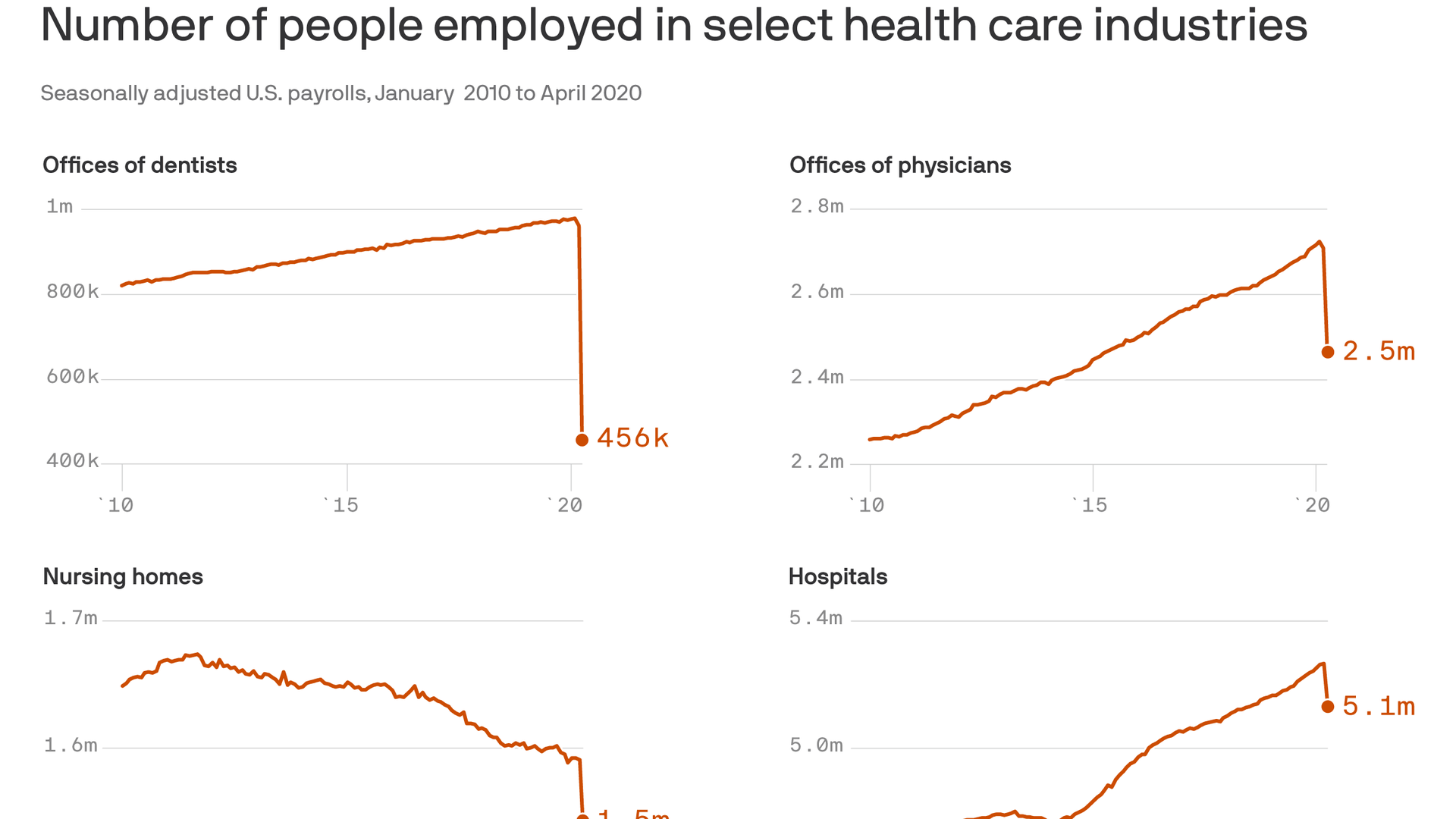
The coronavirus pandemic is a health care crisis, but health care still isn’t immune from the rampant job losses the pandemic has wrought, Axios’ Bob Herman reports.

By the numbers: The health care industry lost more than 1.4 million jobs in April.

The reason: These jobs have gone away because outpatient care has dried up, as providers postponed elective procedures.

  • More than four out of five of those lost jobs were at dentists, doctors’ offices, chiropractors and other outpatient settings.
  • Technicians, billing clerks and medical assistants who work in outpatient settings — many of whom are not highly paid — have felt the brunt of the job losses.

What’s next: Don’t expect a quick return, even as elective procedures are able to come back online.

  • Patients who have lost their insurance or are worried about catching the coronavirus in a waiting room will likely stay away even from outpatient facilities.
  • “Of all the places people want to come back to quickly, a health care setting is probably not at the top of the list,” said Ani Turner, a health economist at Altarum.

What we’re watching: All of these delays in elective care a boon to insurers, who are saving a lot of money while outpatient procedures are on ice.

  • Some insurers will likely have to pay big rebates to their customers as a result. UnitedHealth Group is getting a jump start on that process, announcing $1.5 billion worth of voluntary premium credits and waived fees.


Doctors Without Patients: ‘Our Waiting Rooms Are Like Ghost Towns’

18 of the Spookiest Ghost Towns in America - Most Haunted Places

As visits plummet because of the coronavirus, small physician practices are struggling to survive.

Autumn Road in Little Rock, Ark., is the type of doctor’s practice that has been around long enough to be treating the grandchildren of its eldest patients.

For 50 years, the group has been seeing families like Kelli Rutledge’s. A technician for a nearby ophthalmology practice, she has been going to Autumn Road for two decades.

The group’s four doctors and two nurse practitioners quickly adapted to the coronavirus pandemic, sharply cutting back clinic hours and switching to virtual visits to keep patients and staff safe.

When Kelli, 54, and her husband, Travis, 56, developed symptoms of Covid-19, the couple drove to the group’s office and spoke to the nurse practitioner over the phone. “She documented all of our symptoms,” Ms. Rutledge said. They were swabbed from their car.

While the practice was never a big moneymaker, its revenues have plummeted. The number of patients seen daily by providers has dropped to half its average of 120. The practice’s payments from March and April are down about $150,000, or roughly 40 percent.

“That won’t pay the light bill or the rent,” said Tabitha Childers, the administrator of the practice, which recently laid off 12 people.

While there are no hard numbers, there are signs that many small groups are barely hanging on. Across the country, only half of primary care doctor practices say they have enough cash to stay open for the next four weeks, according to one study, and many are already laying off or furloughing workers.

“The situation facing front-line physicians is dire,” three physician associations representing more than 260,000 doctors, wrote to the secretary of health and human services, Alex M. Azar II, at the end of April. “Obstetrician-gynecologists, pediatricians, and family physicians are facing dramatic financial challenges leading to substantial layoffs and even practice closures.”

By another estimate, as many as 60,000 physicians in family medicine may no longer be working in their practices by June because of the pandemic.

The faltering doctors’ groups reflect part of a broader decline in health care alongside the nation’s economic downturn. As people put off medical appointments and everything from hip replacements to routine mammograms, health spending dropped an annualized rate of 18 percent in the first three months of the year, according to recent federal data.

While Congress has rushed to send tens of billions of dollars to the hospitals reporting large losses and passed legislation to send even more, small physician practices in medicine’s least profitable fields like primary care and pediatrics are struggling to stay afloat. “They don’t have any wiggle room,” said Dr. Lisa Bielamowicz, a co-founder of Gist Healthcare, a consulting firm.

None of the money allocated by lawmakers has been specifically targeted to the nation’s doctors, although the latest bill set aside funds for community health centers. Some funds were also set aside for small businesses, which would include many doctors’ practices, but many have faced the same frustration as other owners in finding themselves shut out of much of the funding available.

Federal officials have taken some steps to help small practices, including advancing Medicare payments and reimbursing doctors for virtual visits. But most of the relief has gone to the big hospital and physician groups. “We have to pay special attention to these independent primary care practices, and we’re not paying special attention to them,” said Dr. Farzad Mostashari, a former health official in the Obama administration, whose company, Aledade, works with practices like Autumn Road.

“The hospitals are getting massive bailouts,” said Dr. Christopher Crow, the president of Catalyst Health Network in Texas. “They’ve really left out primary care, really all the independent physicians,” he said.

“Here’s the scary thing — as these practices start to break down and go bankrupt, we could have more consolidation among the health care systems,” Dr. Crow said. That concerns health economists, who say the steady rise in costs is linked to the clout these big hospital networks wield with private insurers to charge high prices.

While the pandemic has wreaked widespread havoc across the economy, shuttering restaurants and department stores and throwing tens of millions of Americans out of work, doctors play an essential role in the health of the public. In addition to treating coronavirus patients who would otherwise show up at the hospital, they are caring for people with chronic diseases like diabetes and asthma.

Keeping these practices open is not about protecting the doctors’ livelihoods, said Michael Chernew, a health policy professor at Harvard Medical School. “I worry about how well these practices will be able to shoulder the financial burden to be able to meet the health care needs people have,” he said.

“If practices close down, you lose access to a point of care,” said Dr. Chernew, who was one of the authors of a new analysis published by the Commonwealth Fund that found doctor’s visits dropped by about 60 percent from mid-March to mid-April. The researchers used visit data from clients of a technology firm, Phreesia.

Nearly 30 percent of the visits were virtual as doctors rushed to offer telemedicine as the safest alternative for their staff and patients. “It’s remarkable how quickly it was embraced,” said Dr. Ateev Mehrotra, a hospitalist and associate professor of health policy at Harvard Medical School, who was also involved in the study. But even with virtual visits, patient interaction was significantly lower.

Almost half of primary care practices have laid off or furloughed employees, said Rebecca Etz, an associate professor of family medicine at Virginia Commonwealth University and co-director of the Larry A. Green Center, which is surveying doctors with the Primary Care Collaborative, a nonprofit group. Many practices said they did not know if they had enough cash to stay open for the next month.

Pediatricians, which are among the lowest paid of the medical specialties, could be among the hardest hit. Federal officials used last year’s payments under the Medicare program to determine which groups should get the initial $30 billion in funds. Because pediatricians don’t generally treat Medicare patients, they were not compensated for the decline in visits as parents chose not to take their children to the doctor and skipped their regular checkups.

“This virus has the potential to essentially put pediatricians out of business across the country,” said Dr. Susan Sirota, a pediatrician in Chicago who leads a network of a dozen pediatric practices in the area. “Our waiting rooms are like ghost towns,” she said.

Pediatricians have also ordered tens of thousands of dollars on vaccines for their patients at a time when vaccine rates have plunged because of the pandemic, and they are now working with the manufacturers to delay payments for at least a time. “We don’t have the cash flow to pay them,” said Dr. Susan Kressly, a pediatrician in Warrington, Pa.

Even those practices that quickly ramped up their use of telemedicine are troubled. In Albany, Ga., a community that was an unexpected hot spot for the virus, Dr. Charles Gebhardt, a doctor who is treating some infected patients, rapidly converted his practice to doing nearly everything virtually. Dr. Gebhardt also works with Aledade to care for Medicare patients.

But the telemedicine visits are about twice as long as a typical office visit, Dr. Gebhardt said. Instead of seeing 25 patients a day, he may see eight. “We will quickly go broke at this rate,” he said.

Although he said the small-business loans and advance Medicare payments are “a Godsend, and they will help us survive the next few months,” he also said practices like his need to go back to seeing patients in person if they are to remain viable. Medicare will no longer be advancing payments to providers, and many of the small-business funding represents a short-term fix.

While Medicare and some private insurers are covering virtual visits, which would include telephone calls, doctors say the payments do not make up for the lost revenue from tests and procedures that help them stay in business. “Telehealth is not the panacea and does not make up for all the financial losses,” said Dr. Patrice Harris, the president of the American Medical Association.

To keep the practices open, Dr. Mostashari and others propose doctors who treat Medicare and Medicaid patients receive a flat fee per person.

Even more worrisome, doctors’ groups may not be delivering care to those who need it, said Dr. Mehrotra, the Harvard researcher, because the practices are relying on patients to get in touch rather than reaching out.

Some doctors are already voicing concerns about patients who do not have access to a cellphone or computer or may not be adept at working with telemedicine apps. “Not every family has access to the technology to connect with us the right way,” said Dr. Kressly, who said the transition to virtual care “is making disparities worse.”

Some patients may also still prefer traditional office visits. While the Rutledges appreciated the need for virtual visits, Kelli said there was less time to “talk about other things.”

“Telehealth is more inclined to be about strictly what you are there for,” she said.

Private equity firms and large hospital systems are already eying many of these practices in hopes of buying them, said Paul D. Vanchiere, a consultant who advises pediatric practices.

“The vultures are circling here,” he said. “They know these practices are going to have financial hardship.”


CMS rolls back more Medicare, telehealth regs for providers working through pandemic

https://www.healthcaredive.com/news/CMS-second-round-COVID-rollbacks/577199/


How Telemedicine Is Changing Healthcare

Dive Brief:

  • CMS issued a another round of sweeping regulatory rollbacks Thursday that will temporarily change how some providers care for patients and get compensated during the ongoing pandemic.
  • Practitioners such as therapists previously restricted from providing telehealth services for reimbursement can now do so, and CMS is also upping payments for telephone-only telehealth visits. Accountable care organizations also scored a major win in the Thursday rule drop, with CMS pledging they wouldn’t be dinged financially for lower-than-expected health outcomes in their patient populations from COVID-19.​
  • Other major changes are related to COVID-19 testing for Medicare and Medicaid beneficiaries. A written practitioner’s order is no longer needed for diagnostic testing for Medicare payment purposes. The agency also said it will cover serology, or antibody testing, including certain FDA-authorized tests that patients self-collect at home.

Dive Insight:

The new rules come out of the recent public health emergency declaration, building on others announced in late March and early April. This round of changes, which take effect immediately, focuses on expanding testing capacity to help reopen the U.S. economy, according to CMS, along with delivering expanded care to seniors.

Major provider lobbies the American Hospital Association and American Medical Association praised the changes, noting that Medicare patients have been canceling needed medical appointments because of physical distancing and transportation challenges.

The Trump administration, which allowed traditional Medicare to temporarily cover telehealth in March, continues to expand virtual care access. CMS is expanding the types of specialists allowed to provide telehealth services for reimbursement to include physical therapists, occupational therapists, speech language pathologists and others. In the past, only doctors, nurse practitioners, physician assistants and certain others could do so.

Earlier changes included waiving the video requirement for telehealth patients without access to interactive audio-video technology – particularly those in rural areas. CMS is increasing payments for telephone visits from a range of about $14-$41 to about $46-$110, according to the release.

The rollbacks are a “major victory for medicine that will enable physicians to care for their patients, especially their elderly patients with chronic conditions who may not have access to audio-visual technology or high-speed Internet,” the AMA said.

Michael Abrams, managing partner of Numerof & Associates, a healthcare consulting firm, said the current, rapid adoption of telehealth is an experiment, and depending on the results, waivers could eventually become permanent.

“Once you increase pricing, you almost never roll it back,” Abrams said. “If this new pricing on telehealth visits makes it more attractive, attractive enough to substitute telehealth for in-office visits, that not only lowers the cost of care, but makes it very much more accessible, particularly for those whose ability to see a physician is limited.”

In a victory for ACOs, CMS said the value-based organizations wouldn’t incur any financial penalties because of COVID-19 testing and treatment for their patient populations. Roughly 60% of ACOs said previously they were likely to drop out of their risk-based model to avoid potential losses, according to the National Association of ACOs.

CMS is also allowing ACOs to remain at the same level of risk for another year, instead of bumping them up to the next risk level. NAACOs said it was “appreciative” of the changes in a statement, though they asked for additional relief for providers in two-sided risk arrangements.

Other loosened restrictions include those on who can administer COVID-19 diagnostic tests for payment to include any healthcare professional authorized to do so under state law, including pharmacists. Medicare and Medicaid recipients can now get tested at parking lot sites operated by pharmacies and other entities for reimbursement.

Outpatient hospital services such as wound care, drug administration, and behavioral health services can now be delivered in temporary expansion locations, including parking lot tents, converted hotels or patients’ homes for reimbursement, so long as they’re temporarily designated as part of a hospital.

Hospital outpatient departments that relocate off-campus are paid at lower rates under current law, but CMS is making a temporary exception to continue paying those physicians at their standard rates.

The agency will also pay for certain partial hospitalization services – that is, individual psychotherapy, patient education, and group psychotherapy – that are delivered in temporary expansion locations, including patient homes.

CMS is also now requiring nursing homes to inform residents, their families, and representatives of COVID-19 outbreaks in their facilities.


Half of insured adults are skipping primary care visits. Cost a major reason why

https://www.beckershospitalreview.com/finance/half-of-insured-adults-are-skipping-primary-care-visits-cost-a-major-reason-why.html?utm_medium=email

Image result for Half of insured adults are skipping primary care visits. Cost a major reason why.

In a given year by 2016, almost 50 percent of adults with commercial insurance hadn’t visited a primary care physician, according to a study published in the Annals of Internal Medicine.

For the study, researchers from Harvard Medical School in Boston, the Icahn School of Medicine at Mount Sinai in New York City and the University of Pittsburgh School of Medicine wanted to better characterize primary care declines among adults. To do so, the study authors analyzed deidentified claims data from a national private insurer that covers roughly 20 million members each year, according to NPR.

They found from 2008-16, adult visits to primary care physicians fell by nearly 25 percent. The decline was largest among younger adults. The proportion of adults with no visits to primary care physicians in a given year climbed from 38.1 percent to 46.4 percent within the same period.

While the number of preventive checkups rose — likely because the ACA made the appointments cost-free — problem-based visits, such as going to a primary care physician for sickness or injury, declined more than 30 percent, according to NPR.

Problem-based visits saw out-of-pocket costs increase 31.5 percent during the study period, which could have affected the decline, according to researchers. Additionally, visits to alternative sites like urgent care clinics grew by 46.9 percent in the study period.

“Our results suggest that this decline may be explained by decreased real or perceived visit needs, financial deterrents, and use of alternative sources of care,” the study authors concluded. 


Ochsner to pay tuition for future physicians, nurses who pledge to 5 years with system

https://www.beckershospitalreview.com/hospital-physician-relationships/ochsner-to-pay-tuition-for-future-physicians-nurses-who-pledge-to-5-years-with-system.html%20?utm_medium=email

Image result for Ochsner Health System

New Orleans-based Ochsner Health System created a $10 million tuition fund to grow its own workforce amid current labor market challenges, according to The Advocate, a Louisiana news outlet.

The system will begin by paying tuition for a cohort of 30 primary care physicians and psychiatrists. The physicians must commit to working in Louisiana with the health system for at least five years to receive the funding.

Ochsner has plans to offer similar scholarship opportunities for employees who want to become licensed practical nurses or registered nurses. It plans to ultimately cover tuition for about 1,000 employees, according to the report.

Read the full story here.


The health system “black market” for care

https://mailchi.mp/192abb940510/the-weekly-gist-february-7-2020?e=d1e747d2d8

Image result for black market

Recently we’ve been working with one of our member health systems to build a comprehensive plan for ambulatory access. As we were brainstorming a list of success metrics, one physician leader made an interesting comment: “I’ll know we’re successful at improving access when people stop calling me asking to get their mom or husband or friend into a specialist.”

The other leaders in the room all nodded in agreement. While we’re all happy to assist friends and family with finding the best doctor for their problem, or getting in more quickly, these leaders recognized that these informal channels represent yet another level of inequality in our healthcare system: patients and families who can tap into “insider” provider connections have access to a “black market” of enhanced access and information that can expedite treatment, assuage worry, and potentially provide better outcomes.

Thinking about eliminating the need for the healthcare black market broadened our discussion of a successful access solution. Getting a quick appointment doesn’t fully solve the problem, patients want to be assured they’re seeing the “best” doctor for their problem—meaning the system needs to have a better process for matching new patients to the most appropriate provider.

One call to tap into the “black market” can eliminate a dozen frustrating calls and dead ends; any solution must also address the many friction points in finding the right care. A tall order for sure, but one that could address one large inequity in our healthcare system: the difference between people who know someone on the inside and those who don’t.


Humana doubles down on its primary care strategy

https://mailchi.mp/192abb940510/the-weekly-gist-february-7-2020?e=d1e747d2d8

Image result for Humana doubles down on its primary care strategy

Humana, the nation’s second largest Medicare Advantage (MA) insurer, is partnering with a private equity (PE) firm to expand its senior-focused subsidiary medical group, Partners in Primary Care.

The arrangement will be structured as a joint venture between Humana and Welsh, Carson, Anderson & Stowe, with a combined initial $600M investment that will give the PE firm majority ownership of the medical group. The new venture is likely to double the number of centers that Humana’s Partners in Primary Care operates—currently 47 throughout Texas, Kansas, Missouri, Florida and the Carolinas.

While Humana has been looking to grow its MA membership, patients need not be Humana members to access care at the centers. Humana has established other partnerships in the physician practice space, including last fall’s announcement that it is teaming up with Iora Health to add 11 additional Iora-branded primary care practices to its MA networks in Arizona, Georgia, and Texas.

Humana has previously partnered with private equity to acquire postacute providers Kindred Healthcare and Curo Health Services. These latest moves suggest the company is shifting its focus to the front end of the delivery system, looking to control costs of care for seniors by quickly building a primary care physician network focused on reducing high-cost referrals to hospitals and specialists.


We’re going to our primary care doctors less

https://www.axios.com/newsletters/axios-vitals-ded63eb6-2431-48d0-a186-2f3b52417f2f.html?utm_source=newsletter&utm_medium=email&utm_campaign=newsletter_axiosvitals&stream=top

Image result for primary care physician"

Adults in the U.S. are visiting primary care doctors less often, according to a new study in the Annals of Internal Medicine, which could foreshadow worse health outcomes and higher costs.

By the numbers: The study focused on adults enrolled with a large commercial insurer.

  • Between 2008 and 2016, visits to primary care physicians declined by 24.2%, and nearly half of adults didn’t visit one in any given year by the end of the time frame.
  • Groups with the largest declines were young adults, adults without chronic conditions, and those living in the lowest-income areas.

Meanwhile, visits to alternative facilities like urgent care clinics increased by 46.9%.

The big picture: Primary care doctors are there to keep people healthy. The less often we go to them, the more likely we are to get or remain sick, which ultimately costs the health care system more money.