Can we ‘TRUST’ the ‘CARES ACT’ to ‘HEAL’ our nation?

https://www.washingtonpost.com/business/2020/08/01/cares-trust-heals-heroes-congress-stimulus/?utm_campaign=wp_post_most&utm_medium=email&utm_source=newsletter&wpisrc=nl_most

Social Security Error Leads to Unpaid Medicare Coverage

A groan-up look at Congress’s aspirational acronyms for its various stimulus bills.

Two of the things missing from the increasingly bitter debate about how to handle covid-19’s effect on our people, our businesses and our economy are a sense of humor and bipartisanship.

So as a public service, let me try to bring both of those to bear by doing a deep dive into the various pieces of stimulus legislation currently running around in Our Nation’s Capital.

No, I’m not going to give you a detailed, sleep-inducing analysis featuring numbers and experts opining about various provisions. Instead, I’m going to look at the names — which I find hilariously tortured — of the various pieces of legislation.

Possibly because I’m both a recovering English major and a non-Washingtonian, I like to know the full names of the legislation — like the Cares Act — that I’m writing about. And these names are just great. Let’s start with the Cares (or as I prefer to call it, CARES) Act.

Do you know what the full name of that legislation is? Probably not. Okay, I’ll tell you. It’s the Coronavirus Aid, Relief and Economic Security Act. A name clearly invented to produce a seemingly empathetic acronym.

Now, let’s move on to two total groaners — the Democrats’ and Republicans’ proposals for more stimulus legislation. Remember, I’m not talking about the proposals’ provisions — I’m talking about their names. The Democrats’ candidate in the current stimulus battle is the Heroes (or rather HEROES) Act. The full name of this piece of work, which has been passed by the House, is the Health and Economic Recovery Omnibus Emergency Solutions Act. My favorite part is “Omnibus,” which clearly is in the title because an acronym meister needed an O, and Omnibus was better than Outsized or Over-the-top.

Showing that they would not be out-acronymed, the Republicans named their legislation, which is currently kicking around (and being kicked around) in the Senate, the Heals (or HEALS) Act. That stands for Health, Economic Assistance, Liability protection and Schools Act. The lowercase p in “protection” let the acronym mavens call the legislation HEALS rather than HEALPS.

And finally, there’s legislation that’s been around for several years but that I discovered only recently when Mitch McConnell and his crew stuck it into the HEALS Act. It’s a proposal that would let a congressional committee, operating outside of public sight, propose cuts and changes to Social Security, Medicare and some other federal programs that use trust funds. It’s called the Time to Rescue United States Trusts (or TRUST) Act. I’ve looked at it only superficially — but from what I’ve seen, I don’t think there’s any reason to trust it.

I hope you’ve noticed that I’m doing equal-opportunity name mocking: the Cares and Trust acts, which are bipartisan; the Heroes Act, which is Democratic; and the Heals (or HEALPS) Act, which is Republican.

What do I propose to do about these contorted names? I’m glad you asked. My answer, naturally, is to propose a piece of legislation of my own: The Get Rid Of Acronyms Now Act. That, my friends, would be a true GROAN-er.


Three Predictable Covid Nightmares — and How Congress Can Help Prevent Them

https://www.politico.com/news/agenda/2020/07/29/states-congress-covid-nightmare-vaccine-385217?mkt_tok=eyJpIjoiTVRNNU0yWXpNMlk1TVRsaiIsInQiOiJ1Vlg3dlBCYytaWTdtcGtMd3ZaUVh6TTBZRlMxXC9MaW9UMk9MRHhpdkFpSFFJMHFVWWpocUhWR1ZEZTM2NFBXb0xOVUZTSXNJMzYxWk90Yld

Opinion | Three Predictable Covid Nightmares — and How Congress ...

The good news is that they aren’t partisan, and they’re fixable.

In our response to the Covid-19 pandemic, the United States has all too often been caught flat-footed. Our public officials have tried to avoid or deny problems until they have been right on top of us, and legislative measures have tended to react to major challenges rather than avert them.

That has left policymakers with a lot to react to. And the relief and assistance bill now being worked out in the Senate will need to do that on several fronts. But to do better in the future, that bill should also take on several predictable problems that will face our country over the remainder of the year and which could benefit enormously from some advance attention and action.

Three sets of such predictable problems stand out above all, and in all three cases there are measures that can be taken now that should be able to attract bipartisan support.

First, states are going to face a monumental fiscal crisis.

The pandemic and the ensuing shutdowns of economic activity have left state governments with immense revenue shortages. Balanced-budget amendments in all but one state severely restrict their capacity to run deficits, in many cases even in major emergencies. That means states will have to either find other ways to raise revenue quickly or make major cuts to basic services. Such cuts in spending, jobs and public assistance would exacerbate the deep recession we are in and leave millions who need help in the lurch.

Most state fiscal years begin in July, so in many cases budgets designed or enacted before the severity of the crisis was clear are now starting to take effect, leaving states facing gaps they can easily predict but haven’t formally accounted for. In fact, 16 states are now starting the second year of biennial budgets enacted in 2019, before anyone could have imagined the sort of crisis we now face. Over the coming months, there will be no avoiding the fiscal crunch.

The states have already begun pleading with Congress for help, and sooner or later Congress will need to provide it. Taking steps sooner rather than later would make an enormous difference. The federal government has often been called on to serve as a fiscal backstop for states in extreme emergencies, since its borrowing power vastly exceeds that of the states. And that role is particularly appropriate in a truly national—indeed global—crisis of this magnitude.

But to provide such help responsibly, Congress will need to clearly delineate what kinds of assistance it can offer and on what terms. Congressional Republicans are not wrong to be wary of state efforts to use the emergency to fill fiscal holes dug over decades of irresponsible state policies. Yet that can’t mean that they deny state governments the help they need to contend with this crisis. Rather, it means they must draw some distinctions.

As I’ve argued elsewhere, Congress would do well to divide state needs into three tranches: direct pandemic spending (which should be covered by federal dollars), lost state revenue (which states should be given the opportunity to make up with federally guaranteed loans on favorable terms), and longstanding obligations like pension and retiree health costs made untenable by the recession (for which affected states should be given options only for strictly conditional support, like a new state bankruptcy code or federal support conditioned on major pension reforms).

To be effective, that sort of response would need to take shape now, before states have truly hit the wall. It should be part of the bill the parties are now beginning to negotiate.

Second, this fall’s election is going to be seriously complicated by the pandemic.

There is pretty much no way around that. We’ll be voting while the virus is still spreading, which means that far more people than usual will vote by mail. Only a few states have real experience with voting by mail in large numbers, and the logistics involved are not simple. Primary elections in many states have already made the challenge clear.

To take just one example among many, mailed ballots require signature verification. In states that haven’t spent years building the required infrastructure, such verification will probably need to be done by hand, creating huge risks of confusion and error. States will need to develop new processes to handle this, to train election workers to use unfamiliar equipment, and to take on problems in real time. Signature verification also requires a process for notifying voters whose handwriting is challenged and giving them time to respond. All that, and similar challenges on other election administration fronts, makes it easy to imagine that many races will be impossible to call on election night, and perhaps for quite some time afterward.

Particularly in an era already overflowing with cynical mistrust and conspiracy mongering, such problems raise the prospect of a legitimacy crisis around the election. And policymakers need to take steps now to reduce the risk of such a crisis.

The first step must be to prepare the public. Elected officials, candidates, journalists and others must start speaking plainly about the likelihood of logistical challenges around the election so that voters are not shocked if things don’t go smoothly. People must know in advance that we should not expect every race to be called straight away and that results which take days or even weeks to determine are not therefore illegitimate.

But beyond setting voter expectations, policymakers should also be looking for ways to reduce the strain on the system and to deal with predictable problems. One simple step Congress could take now is to push back the deadlines involved in the work of the Electoral College, to give the states more time to count votes in the presidential race if they need it. A simple change in the federal law governing these dates, which wouldn’t give either party an advantage, could give every state about three more weeks to count. Such a change would be essentially impossible after the election—when partisans looking at partial results would argue over which side it would advantage. But it could easily be done today, it would just take a few sentences of legislative language, and it too should be part of the relief bill now being worked out.

Opinion | Three Predictable Covid Nightmares — and How Congress ...

Finally, if we’re lucky, we’re going to need to figure out how to distribute a Covid-19 vaccine early next yearThat would be a good problem to have, of course, but a huge problem nonetheless. And getting it wrong could catastrophically undermine the effort to defeat the virus.

Vaccine development itself is one area where our country has not been behind the curve: The federal government has invested heavily in the effort, the National Institutes of Health has played a key coordinating role, and the administration is prepared to pay for “at risk” manufacturing of millions of doses of any vaccine that makes it into Phase III trials, so that if a vaccine is found to be safe and effective there will immediately be doses to provide to high-risk individuals. But who will be first in line to get these early doses? And who will decide?

Here, too, there is an enormous danger of a legitimacy crisis. Both public fear about the safety of a vaccine (building on decades of anti-vaccine conspiracy theories on the right and left alike) and the danger of corruption, or at least perceived corruption, in the distribution of doses could undermine the potential of effective vaccination to end the nightmare of this pandemic.

Widespread uptake is essential to the effectiveness of any vaccine. It is not so much by protecting each vaccinated individual as by vaccinating enough Americans to achieve broad-based communal (or “herd”) immunity that a vaccine could truly change the game. That means public trust in the process and wholesale vaccination across our society will be crucial.

To achieve that, it is essential that both the safety of the vaccine-development process and the basic fairness of the ultimate distribution formula be established in advance, and in a very public way. Congress has a crucial role to play here, too. Hearings should begin very soon to put before the public all available information about the efforts taken by the Food and Drug Administration to ensure the safety of the vaccine-development process, even as that process proceeds with unprecedented speed. And Congress should establish, ideally in this next relief bill, a public commission to develop a formula for equitable distribution of early vaccine doses: setting out tiers of priority (for front-line health workers, vulnerable populations, the elderly, and those with particular preexisting conditions), and seeking out ways to make sure that economic and other disadvantages do not translate into lesser or later access to vaccination.

The work of such a group should be reasonably transparent and would need to begin very soon if it is to bear fruit in time to be useful. Policymakers must not underestimate the danger of a loss of public confidence in a Covid-19 vaccine, and must take steps now to avoid such a foreseeable disaster.

The same is true on all three of these fronts. These may not be the greatest problems we confront in the remainder of this dark and difficult year, but they share some features that ought to make them high priorities: All three are predictable and serious, each would amount to a disaster if left unchecked, but each could be made much easier to handle with some straightforward preparation. The relief bill being negotiated this summer could easily, without sparking a partisan war, take concrete steps on all three fronts.

Leadership in a crisis demands a combination of planning for foreseeable difficulties and responding to the unexpected. Getting the former right can make the latter far more doable. To make the rest of this year less disastrous, our leaders need to look ahead.


6 months in: Following the flow of CARES hospital funding

https://www.healthcaredive.com/news/6-months-cares-hospital-funding-covid/581506/

Congress has allocated $175 billion to help providers respond to the COVID-19 crisis, but HHS has been hit with multiple complaints about distribution as that money goes out the door.

The COVID-19 pandemic created massive upheaval for the nation’s healthcare system still evident six months after the U.S. declared it a national public health crisis.

The virus continues to surge, reaching new heights with more than 4 million confirmed cases and more than 143,000 deaths. No other country has experienced more deaths or cases than the U.S., data with Johns Hopkins Coronavirus Research Center show.

Parts of the country are facing the prospect of another lockdown as cases overwhelm healthcare facilities.

Forced into quickly responding to the pandemic, health systems have taken substantial financial hits. While the impact has been far from even, one estimate from the American Hospital Association estimates the nation’s health systems’ financial losses in the first four months of the outbreak reached nearly $203 billion.

To help staunch the free fall, Congress earmarked $175 billion in two pieces of legislation in an attempt to keep providers afloat as the virus wreaked havoc on the economy. The majority of that was from the Coronavirus Aid, Relief, and Economic Security Act passed in late March.

Yet, about 65% of the money has yet to go out to providers, with just $61 billion delivered and attested to by providers by mid-July, a senior HHS official told Healthcare Dive.

Still, with no end in sight for the pandemic, at least on U.S. shores, providers are ramping up lobbying in an effort to secure more funding as case counts soar. AHA is asking for another $100 billion in the next round of congressional relief now under discussion.

Many healthcare providers stopped profitable elective procedures as stay-at-home orders blanketed parts of the country to contain the spread of the disease. This also allowed providers to conserve much needed resources such as personal protective equipment that proved hard to procure amid the crisis.

But revenue quickly plummeted as providers delayed care in preparing for a surge of COVID-19 patients.

“The funding hospitals and health systems have received to date, while helpful, is just a small fraction of what we estimate they will lose this year,” Lisa Kidder Hrobsky, group vice president of federal relations for AHA, told Healthcare Dive in a statement.

Where did the money go?

So far, HHS has outlined a spending plan for $125 billion of the $175 billion in provider relief funds.

The program has been met with an array of criticism, including whether the distribution of funds went to those most in need and whether the fine print has deterred providers from taking a piece of the massive financial package.

https://www.datawrapper.de/_/7PvZ4/

In response to those critiques, HHS has sent out additional federal funding in more targeted waves since April.

The first tranche of money — $30 billion in April — was designed to get out the door quickly, as providers were struggling. From there, HHS has attempted to pinpoint the money to certain providers and geographic areas to appease the needs of various providers.

To even out distribution, HHS began sending targeted funding, such as to hospitals overrun with COVID-19 patients, mainly in New York and other hard hit areas. The agency also funneled money to rural providers and skilled-nursing facilities, among others.

After HHS was met with the argument that wealthier hospitals, or those that had larger shares of privately-insured patients, received more funding, it allocated money for those taking care of the neediest.

At the same time, as the agency doles out the rest of the $175 billion, it has promised to reimburse providers for uninsured COVID-19 patients. That has raised questions about whether HHS will have enough for uninsured care and additional tranches.  

However, a senior HHS official said it has only paid out $340 million to providers for uninsured COVID-19 patients, less than what they had expected. So low, that HHS has been trying to encourage providers to apply for such funding.

Timeline of HHS funding

  • AprilHHS​ released $30 billion from the first tranche of money based on a provider’s 2018 Medicare fee-for-service revenue. By the end of April, an additional $20 billion from general distribution was released, for a total of $50 billion.
  • MayMore than $26 billion was sent to rural, skilled-nursing facilities and those hit hard by the virus.
  • JuneHHS released an additional $25 billion earmarked for safety-net providers and those that cater to large populations of Medicaid patients.
  • JulyHHS​ said it would release another $4 billion for safety-net providers and certain specialty rural providers missed in earlier rounds, along with another $10 billion for those in hot spots.

Fears eased over fine print

Some providers declined or returned funding they had received, worried about the fine print or the terms and conditions, like how to appropriately spend the money.

However, HHS has relaxed some of those conditions, easing the fears of some.

For a lot of providers, it was a sigh of relief, causing many to say, “‘Great, we can feel comfortable participating in this program’,” Tim Fry, an attorney with McGuireWoods, told Healthcare Dive.

In particular, HHS recently said that if at the end of this pandemic, providers didn’t use all of the funding for lost revenue or healthcare related expenses, there will be a process to return the money. Initially, providers expressed concern that it was an all-or-nothing program.

Plus, HHS provided clarity on how the money can be used, stipulating that the funds go to healthcare-related expenses or lost revenue attributable to the coronavirus. HHS has provided more guidance and examples of appropriate uses, a relief to many, Fry said.

Earlier, health systems were overwhelmed by the administrative burden and fearful over how to appropriately spend the money without running afoul of new rules.

“We are not infinitely flexible around those requirements, but when we hear from providers of issues that they’re having — and we think we can be reasonably [accommodating], we try to be,” a senior HHS official said.


KHN’s ‘What The Health?’: Trump Twists on Virus Response

https://khn.org/news/khn-podcast-what-the-health-trump-twists-on-virus-response/

KHN's 'What The Health?': Trump Twists on Virus Response | Kaiser ...

President Donald Trump — who has spent the past six months trying to play down the coronavirus pandemic — seems to have pivoted. In back-to-back briefings on July 21 and 22, Trump cautioned that the U.S. is in a dangerous place vis-a-vis the pandemic. He urged the public to wear masks — although he has rarely worn one in public.

Meanwhile, Republicans in the Senate are scrambling to put together a package for the next COVID-19 relief bill, facing a July 31 deadline, when some of the benefits passed in the spring expire. House Democrats passed their bill in May.

This week’s panelists are Julie Rovner of Kaiser Health News, Joanne Kenen of Politico, Margot Sanger-Katz of The New York Times and Tami Luhby of CNN.

Among the takeaways from this week’s podcast:

  • Although Trump’s renewed emphasis on COVID-19 has surprised some of his critics, it may persuade his supporters to take actions promoted by public health officials. Trump’s emphasis on the importance of face coverings, perhaps coupled with the rising number of cases in parts of the country, could convince people who were otherwise dismissive of masks. People who do not necessarily trust public health officials may listen to Trump.
  • Republicans on Capitol Hill are in disarray on how to approach the next coronavirus relief bill. They are not in lockstep with the White House and are not supporting Trump’s call for a payroll tax cut.
  • One reason members of Congress are not eager to cut the payroll taxes is that the economic downturn has spurred concerns the Medicare and Social Security trust funds are being depleted faster than expected. However, analysts point out that when employment rises again, some of those concerns could dissipate.
  • A key sticking point in the economic relief package is whether to extend the bump in unemployment benefits that Congress approved in the spring. Lawmakers are facing a hard deadline on the issue because that money runs out next week, and the prohibition on evictions that was also part of an earlier COVID-19 relief bill ends even sooner. With rent, mortgages and other bills coming due Aug. 1, unemployed consumers could face a tough beginning of the month.
  • The Food and Drug Administration has approved limited use of pool testing for COVID-19. That allows approved labs to put together a small number of tests to run at once, thus conserving some of the materials needed for the process. If the pool tests positive, then those people whose results were pooled have to be tested again individually. The efforts have limited usefulness when rates of transmission are high in a community, but they may be helpful in specific settings, such as schools or workplaces.
  • New data shows that opioid addiction ticked back up in 2019, after a slight decline. Part of the problem is the growing use of the powerful — and dangerous — drug fentanyl. Economic woes also play a role. Addiction is often referred to as an epidemic of despair.
  • Although it’s unlikely the judicial system will overrule the administration’s efforts to bolster short-term insurance plans — which are generally less expensive but don’t offer as much protection for consumers as policies sold on the Affordable Care Act’s marketplaces — they could be circumvented if Democrats take over the White House. Even still, Democrats would likely have to find a way to make ACA plans more affordable.


Canceled elective procedures putting pressure on nation’s hospitals

https://www.healthcarefinancenews.com/news/canceled-elective-procedures-putting-pressure-nations-hospitals

U.S. Hospitals Brace for 'Tremendous Strain' from New Virus - JEMS

Even upticks in COVID-19 patients haven’t made up for the revenue losses, since reimbursement for those services is comparatively slim.

Elective procedures are in a strange place at the moment. When the COVID-19 pandemic started to ramp up in the U.S., many of the nation’s hospitals decided to temporarily cancel elective surgeries and procedures, instead dedicating the majority of their resources to treating coronavirus patients. Some hospitals have resumed these surgeries; others resumed them and re-cancelled them; and still others are wondering when they can resume them at all.

In a recent HIMSS20 digital presentation, Reenita Das, a senior vice president and partner at Frost and Sullivan, said that during the pandemic, plastic surgery activity declined by 100%, ENT surgeries declined by 79%, cardiovascular surgeries declined by 53% and neurosurgery surgeries declined by 57%.

It’s hard to overstate the financial impact this is likely to have on hospitals’ bottom lines. Just this week, American Hospital Association President and CEO Rick Pollack, pulling from Kaufman Hall data, said the cancellation of elective surgeries is among the factors contributing to a likely industry-wide loss of $120 billion from July to December alone. When including data from earlier in the pandemic, the losses are expected to be in the vicinity of $323 billion, and half of the nation’s hospitals are expected to be in the red by the end of the year.

Doug Wolfe, cofounder and managing partner of Miami-based law firm Wolfe Pincavage, said this has amounted to a “double-whammy” for hospitals, because on top of elective procedures being cancelled, the money healthcare facilities received from the federal Coronavirus Aid, Relief, and Economic Security Act was an advance on future Medicare payments – which is coming due. While hospitals perform fewer procedures, they will now have to start paying that money back.

All hospitals are hurting, but some are in a more precarious position than others.

“Some hospital systems have had more cash on hand and more liquidity to withstand some of the financial pressure some systems are facing,” said Wolfe. “Traditionally, the smaller hospital systems in the healthcare climate we face today have faced a lot more financial pressure. They’re not able to control costs the same way as a big system. The smaller hospitals and systems were hurting to begin with.”

LOWER REVENUE, HIGHER COSTS

Some hospitals, especially ones in hot spots, are seeing a surge in COVID-19 patients. While this has kept frontline healthcare workers scrambling to care for scores of sick Americans, COVID-19 treatments are not reimbursed at the same level as surgeries. Hospital capacity is being stretched with less lucrative services.

“Some hospitals may be filling up right now, but they’re filling up with lower-reimbursing volume,” said Wolfe. “Inpatient stuff is lower reimbursement. It’s really the perfect storm for hospitals.”

John Haupert, CEO of Grady Health in Atlanta, Georgia, said this week that COVID-19 has had about a $115 million negative impact on Grady’s bottom line. Some $70 million of that is related to the reduction in the number of elective surgeries performed, as well as dips in emergency department and ambulatory visits. 

During one week in March, Grady saw a 50% reduction in surgeries and a 38% reduction in ER visits. The system is almost back to even in terms of elective and essential surgeries, but due to a COVID-19 surge currently taking place in Georgia, it has had to suspend those services once again. ER visits have only come back about halfway from that initial 38% dip, and the system is currently operating at 105% occupancy.

“Part of what we’re seeing there is reluctance from patients to come to hospitals or seek services,” said Haupert. “Many have significantly exacerbated chronic disease conditions.”

Patient hesitation has been an ongoing problem, as has the associated cost of treating coronavirus patients, said Wolfe.

“When they were ramping up to resume the elective stuff, there was a problem getting patients comfortable,” he said. “And the other thing was that the cost of treating patients in this environment has gone up. They’ve put up plexiglass everywhere, they have more wiping-down procedures, and all of these things add cost and time. They need to add more time between procedures so they can clean everything … so they’re able to do less, and it costs more to do less. Even when elective procedures do resume, it’s not going back to the way it was.”

Most hospitals have adjusted their costs to mitigate some of the financial hit. Even some larger systems, such as 92-hospital nonprofit Trinity Health in Michigan, have taken to measures such as laying off and furloughing workers and scaling back working hours for some of its staff. At the top of the month, Trinity announced another round of layoffs and furloughs – in addition to the 2,500 furloughs it announced in April – citing a projected $2 billion in revenue losses in fiscal year 2021, which began on June 1.

Hospitals are at the mercy of the market at the moment, and Wolfe anticipates there could be an uptick in mergers and consolidation as organizations look to partner with less cash-strapped entities. 

“Whether reorganization will work remains to be seen, but there will definitely be a fallout from this,” he said.


Former Fed Chairs Bernanke and Yellen testified on COVID-19 and response to economic crisis

https://www.brookings.edu/blog/up-front/2020/07/17/former-fed-chairs-bernanke-and-yellen-testified-on-covid-19-and-response-to-economic-crisis/?utm_campaign=Economic%20Studies&utm_source=hs_email&utm_medium=email
Former Fed Chairs Bernanke and Yellen testified on COVID-19 and ...

In many respects this recession is unique. Most recessions result from developments inside the economy, but an external shock—the public health crisis—caused this one. To avoid getting sick, people have curtailed working, shopping, and attending school. Whatever the cause, the coronavirus recession, like all recessions, is imposing heavy costs. Many workers have lost jobs and income, and many business owners’ financial survival is at risk. The economy’s extraordinarily rapid decline earlier this year—as well as the sharp but incomplete rebound following the first steps toward reopening—reflect this recession’s unusual source. In addition, the sectors suffering most differ from past recessions. The heaviest blows have fallen on service industries that involve close personal contact (including retail trade, leisure and hospitality, and transportation) rather than, as is more typical, on the housing, capital investment, and durable goods sectors. Lower-paid workers, as well as women and minorities, are over-represented in the most-affected sectors, and thus have borne a disproportionate share of the job and income losses. And, the virus has affected almost every country, with potentially devastating consequences for trade and international investment.

Because this recession is unprecedented in so many ways, forecasting the recovery is difficult. The course of the pandemic itself is by far the most important factor. As long as people fear catching a potentially deadly illness from other people, they will be cautious about resuming normal activities, even after state and local governments lift lockdowns. Thus, controlling the spread of the virus must be the first priority for restoring more-normal levels of economic activity—but, more importantly, for saving possibly tens of thousands of lives. Members of Congress, local leaders, and other policymakers need to do all they can to support testing and contact tracing, medical research, and sufficient hospital capacity, and they must work to ensure that businesses, schools, and public transportation have what they need to operate safely. Both authors of this testimony are serving on state re-opening commissions, which has provided us insight into the substantial challenges to safe re-opening.

If the pandemic comes under better control, economic recovery should follow. However, the pace of the recovery could be slow and uneven, for several reasons. First, in the face of ongoing uncertainty, households and businesses may remain cautious for a time. They may increase saving and reduce spending, hiring, and capital investment. The longer the recession lasts, the greater the damage it will inflict on household and business balance sheets and the longer it will take to repair the damage. Second, the depth of the recession may leave scars—business closures and the deterioration of unemployed workers’ skills—that will affect growth for several years. Third, depending on the course of the virus, some restructuring of the economy may be needed. For example, people and resources will need to be redeployed out of the sectors most damaged by the pandemic, and business operations will need to be reorganized to protect workers and customers. All of that will take time and money. Fiscal and monetary policies must aim to speed the recovery and minimize the recession’s lasting effects.

ACTIONS BY THE FEDERAL RESERVE

The Federal Reserve has moved swiftly and forcefully in this crisis. It eased monetary policy in March by lowering the federal funds rate, the overnight interest rate on loans between banks, nearly to zero and indicating that it plans to keep rates low for several years. Low interest rates probably had limited economic benefits in the spring. Lockdowns prevented people from spending or working more. However, we expect low rates will spur spending in sectors like housing as the economy reopens. And the Fed may well do more in coming months as re-opening proceeds and as the outlook for inflation, jobs, and growth becomes somewhat clearer. In particular, to maintain downward pressure on longer-term interest rates, the Federal Open Market Committee (FOMC) likely will provide forward guidance about the economic conditions it would need to see before it considers raising its overnight target rate.  And it likely will clarify its plans for further securities purchases (quantitative easing). It is possible, though not certain, that the FOMC will also implement yield-curve control by targeting medium-term interest rates. It could, for example, target two-year rates by announcing its willingness to buy two-year Treasury notes at a fixed yield. The completion of the Fed’s internal review of its tools and framework in coming months will help guide these decisions.

The Fed also has been active beyond monetary policy.

First, the Fed has served as market maker of last resort by acting to stabilize critical financial markets when capital or other regulatory constraints have interfered with normal market-making or arbitrage. The Fed has served this role for repurchase agreements (repos) since September, when intermittent liquidity shortages led to spikes in repo rates. Banks did not provide liquidity to offset these spikes, as they normally would, citing balance sheet limits and other constraints. Because repo markets are critical to the functioning of broader financial and credit markets, as well as for the transmission of monetary policy, the Fed has restored more-normal function in repo markets by conducting large-scale repo operations and by steadily increasing the quantity of reserves in the banking system.

An even larger shock occurred in March, when uncertainty about the pandemic led hedge funds and others to scramble to raise cash by selling longer-term securities. The upsurge in the supply of longer-term securities, including Treasuries, was more than dealers and other market-makers could handle. Key financial markets, including for Treasury securities, experienced substantial volatility. To stabilize these markets, which like the repo market play a critical role in our financial system, the Fed purchased large quantities of Treasuries and mortgage-backed securities, again serving as market maker of last resort. It also set up a new repo facility to allow foreign official institutions to borrow dollars, using their Treasury reserves as collateral, thus avoiding the need to sell those Treasuries. Although risk and liquidity premiums in these key markets have returned closer to normal, at some point the Fed and the Treasury will need to review why the market-making facilities in place before the pandemic hit did not work more efficiently.

Second, the Fed has served as lender of last resort to the financial system, a classic function of central banks. Banks and other financial intermediaries typically borrow short and lend long—that is, they rely heavily on short-term funding to finance long-term loans and investments. If they lose their short-term funding—because their funders lose confidence or for other reasons—they can be forced to sell their assets in fire sales, restrict credit to customers, and, in extreme cases, become insolvent. Central banks can short-circuit that dangerous dynamic by lending to financial institutions against good collateral, replacing the lost liquidity. In the 2007-2009 crisis, which centered on the financial system and included a global financial panic, the Fed as lender of last resort took many actions to provide liquidity to financial institutions, with the goal of stabilizing the system and preserving the flow of credit to the economy.

Fortunately, the financial system is in much better shape today than in was during the financial crisis. Banks in particular are strong, with much higher levels of capital and liquidity. The Fed nevertheless has once again taken steps to ensure that the financial system has sufficient liquidity. Largely replicating our playbook from the crisis era, the Fed has eased terms on the discount window (which provides short-term loans to banks); re-established the Primary Dealer Credit Facility (which lends to broker-dealers); and established a facility that lends indirectly to money market mutual funds, ensuring that the funds can meet depositor withdrawals. In a novel step, the Fed also created a facility that lends to banks, without recourse, against Payroll Protection Program loans, ensuring that banks have sufficient funds to make those loans.

Under the heading of lender of last resort to the financial system, establishing currency swap lines with fourteen foreign central banks was one of the most important actions the Fed took in the 2007-2009 crisis. The Fed has revived this program. Currency swap lines allow foreign central banks (who assume all the credit risk) to lend dollars to banks in their jurisdictions. The broad availability of dollar liquidity is essential because most global banks do substantial borrowing and lending in dollars, including lending within the United States. The swap lines sustain the flow of dollar credit and reduce volatility in dollar-based markets, to the benefit of the U.S. economy.

Third, the Federal Reserve, with the support of the Congress and the Treasury, has also served during the current crisis as a lender of last resort to the non-financial sector, backstopping key credit markets facing the prospect of severe disruption from the pandemic. To take on this role, the Fed invoked its emergency lending powers under Section 13(3) of the Federal Reserve Act. Since those powers require that the Fed’s lending be well secured, it has had to rely on funds appropriated by the Congress and allocated by the Treasury to cover possible losses. Using these authorities, the Fed revived financial crisis-era facilities to stabilize commercial paper and asset-backed securities markets. Going beyond the financial crisis playbook, the Fed has also added new facilities to lend to corporations and state and local governments and to buy outstanding corporate bonds.

These programs have not extended much credit, so far, but that does not mean they have not succeeded. By establishing the programs, the Fed gave private investors the confidence to re-engage by reassuring them that the government would not allow these critical markets to become dysfunctional. Indeed, the corporate and municipal bond markets largely stabilized after the announcements, before any loans were made. Of course, if these markets seize up again, the Fed’s programs can extend credit.

The Fed also established the Main Street Lending Program to lend (through banks) to medium-sized companies. It is too soon, however, to judge its performance. This program is very different from anything the Fed has attempted before and poses difficult technical challenges. Although the Fed took many public comments while setting up the program, and made substantial changes, questions remain about how many banks and borrowers will participate. The Fed and Treasury may have to further ease terms for borrowers and increase incentives for banks for this program to have the desired effect. Or, the Fed and Treasury could add a new facility, along the lines of funding-for-lending programs run by the Bank of England and the European Central Bank, that simply subsidize banks for making additional loans to qualifying borrowers (for example, businesses below a certain size). That approach leaves the underwriting decision completely with the banks, while the size of the subsidy can be adjusted as needed to achieve the desired level of lending.

Finally, the Fed has also taken actions as a bank regulator—for example, encouraging banks to work with borrowers hobbled by the pandemic. It decided recently, based on stress test results, to bar stock buybacks by banks and to limit—but not eliminate—their dividends.  Based on our experience in the global financial crisis, we think the Fed may find it needs to go further. Although banks are currently strong, it is possible the pandemic will so damage the economy that credit losses mount rapidly. For a successful recovery, the banking system must remain strong and able to lend.

Is there more the Fed could do? As we noted, the Fed likely will provide more clarity about its monetary policy plans, and it may need to adjust the terms or borrower eligibility requirements of its various lending facilities. Broadly speaking, though, the Fed’s response has been forceful, forward-looking, and comprehensive. But, as Chair Powell often notes, the Fed’s authorities allow it to lend, not spend. Some households and firms will need subsidies or grants, rather than loans, and spending is, of course, the province of the Congress.

WHAT FISCAL POLICY MIGHT DO

The fiscal response to the pandemic has thus far been quite effective. Enhanced unemployment insurance and the Paycheck Protection Program have helped unemployed workers and their families, together with many businesses, survive the spring shutdowns. The fiscal support for the Fed’s lending programs likely will help preserve credit availability, possibly with only a portion of the allocated funds being spent.

However, some programs authorized by the Congress are ending, and new actions are necessary. Our recommendations for further fiscal action are:

First, Congress should develop a comprehensive plan to support medical research; increase testing, contact tracing and hospital capacity; make available critical supplies; and support state and local efforts to safely open businesses, schools, and public transportation.

Nothing is more important for restoring economic growth than improving public health. Investments in this area are likely to pay off many times over.


Hospital margins could sink to a negative 7% this year: 5 things to know

https://www.beckershospitalreview.com/finance/hospital-margins-could-sink-to-a-negative-7-this-year-5-things-to-know.html?utm_medium=email

New Kaufman Hall Report: Hospital Finances Crashed in April ...

The COVID-19 pandemic has created financial challenges for hospitals and health systems, and, without additional federal aid, half of US hospitals could be operating in the red in the second half of this year, according to an analysis released by the American Hospital Association on July 21.

Five takeaways from the analysis: 

1. Before the COVID-19 pandemic, the median hospital margin was 3.5 percent. COVID-19 is expected to drive the median hospital margin from positive to negative. 

2. Without funding from the Coronavirus Aid, Relief and Economic Security Act, hospital margins would have been a negative 15 percent in the second quarter of 2020. Margins are still expected to drop to a negative 3 percent in the second quarter.

3. Without additional aid from the federal government, hospital margins could sink to a negative 7 percent in the second half of this year. 

4. In the second quarter of this year, nearly half of U.S. hospitals had negative margins. Those hospitals will remain with negative margins without further financial support.  

5. “Heading into the COVID-19 crisis, the financial health of many hospitals and health systems were challenged, with many operating in the red,” said hospital association President and CEO Rick Pollack in a news release. “As today’s analysis shows, this pandemic is the greatest financial threat in history for hospitals and health systems and is a serious obstacle to keeping the doors open for many.” 

The full report, prepared by Kaufman, Hall & Associates and released by the AHA, is available here


12 hospitals laying off workers in response to COVID-19

https://www.beckershospitalreview.com/finance/12-hospitals-laying-off-workers-in-response-to-covid-19.html?utm_medium=email

Facing a financial squeeze, hospitals nationwide are cutting jobs

To address the financial fallout from the COVID-19 pandemic, hospitals across the nation are looking to cut costs by implementing furloughs, layoffs or pay cuts. 

U.S. hospitals are expected to lose $323.1 billion this year due to the pandemic, according to a recent report from the American Hospital Association. The total includes $120.5 billion in financial losses that hospitals are projected to see from July through December, as well as $202.6 billion in losses that were projected between March and June. The losses were largely due to a lower patient volume after canceling elective procedures. 

Although Congress allocated $175 billion to help hospitals offset some of the revenue losses and expense increases to prepare for the pandemic, hospitals have said it is not enough.

Nearly 270 hospitals and health systems have furloughed workers in response to the pandemic and several others have implemented layoffs. 

Below are 12 hospitals and health systems that have announced layoffs since June 1:

1. Trinity Health furloughs, lays off another 1,000 workers
Trinity Health, a 92-hospital system based in Livonia, Mich., will lay off and reduce work schedules of 1,000 employees.

2. Ohio children’s hospital cuts jobs
Dayton (Ohio) Children’s Hospital said it has cut jobs to help offset financial losses due to the COVID-19 pandemic.

3. Munson Healthcare to cut 25 leadership positions
Traverse City, Mich.-based Munson Healthcare cut 25 leadership positions to help offset financial losses amid the COVID-19 pandemic.

4. Erlanger lays off 93 nonclinical employees
Chattanooga, Tenn.-based Erlanger Health System has cut 93 nonclinical positions to help offset financial damage from the COVID-19 pandemic. The layoffs come after the health system cut 11 leadership positions June 12, including the CEO of Erlanger Western Carolina Hospital in Murphy, N.C., and made staff and pay cuts in March.

5. Michigan Medicine to lay off 738 employees by end of June
Ann Arbor-based Michigan Medicine planned to eliminate 738 positions by the end of June amid financial challenges from the COVID-19 pandemic.

6. Pennsylvania health system cuts 10% of workforce amid pandemic losses
As part of a restructuring effort to cut pandemic-related losses, State College, Pa.-based Mount Nittany Health System plans to lay off 10 percent of its workforce, or about 250 employees.

7. TriHealth eliminates 440 positions to cut costs
Cincinnati-based TriHealth cut 440 positions as part of a plan to trim at least $140 million in expenditures this year.

8. Layoffs hit U of Kansas Health System
The University of Kansas Health System St. Francis Campus in Topeka laid off employees after previously implementing furloughs.

9. Tower Health to cut 1,000 jobs
Citing a $212 million loss in revenue through May due to the COVID-19 pandemic, West Reading, Pa.-based Tower Health plans to cut 1,000 jobs.

10. Colorado hospital cuts 22 positions
Parkview Medical Center in Pueblo, Colo., eliminated 22 positions in response to the COVID-19 pandemic.

11. Arkansas Children’s cuts 42 positions
Little Rock-based Arkansas Children’s Hospital said it is eliminating 42 jobs as part of cost-savings measures in response to the COVID-19 pandemic.

12. North Carolina health system cuts 10% of workforce, closes clinics
Citing a financial hit from the COVID-19 pandemic, Lumberton, N.C.-based Southeastern Health will permanently close several clinics, cut 10 percent of its workforce and reduce executive pay.


COVID-19 to cost hospitals $323 billion, American Hospital Association says

https://www.beckershospitalreview.com/finance/covid-19-to-cost-hospitals-323-billion-american-hospital-association-says.html?utm_medium=email

Catastrophic financial impact of COVID-19 expected to top $323 ...

Hospitals will lose $323.1 billion this year because of the COVID-19 pandemic, according to a new report from the American Hospital Association. 

The total includes $120.5 billion in financial losses the association predicts hospitals will see from July through December on top of $202.6 billion in losses they estimated between March and June. The losses are in large part due to lower patient volumes.

“While potentially catastrophic, these projected losses still may underrepresent the full financial losses hospitals will face in 2020, as the analysis does not account for currently increasing case rates in certain states, or potential subsequent surges of the pandemic occurring later this year,” the AHA said.

Hospitals and health systems are reporting an average decline of 19.5 percent in inpatient volume and 34.5 percent in outpatient volume when compared to baseline levels from last year. Most hospitals don’t expect to return to last year’s levels in 2020.

Read the full report here.


Pre And Post Coronavirus Unemployment Rates By State, Industry, Age Group, And Race

https://www.forbes.com/sites/mikepatton/2020/06/28/pre-and-post-coronavirus-unemployment-rates-by-state-industry-age-group-and-race/#65c42c6555eb

Unemployment by State-May 2019 to May 2020

The coronavirus has decimated the U.S. economy and benched nearly 40 million American workers. In the past several days, the U.S. has logged its highest number of new Covid-19 cases since the pandemic began. These combined with other factors, which we will discuss, is jeopardizing the future employment of millions of workers and the viability of thousands of businesses. Here’s how unemployment has increased for every state, industry, age group, and race, and why.

Unemployment by State

The coronavirus and subsequent stay at home orders hit the labor force especially hard. As states attempted to reopen, a resurgence in the virus is causing many businesses to close again, some by choice, others by government mandate.

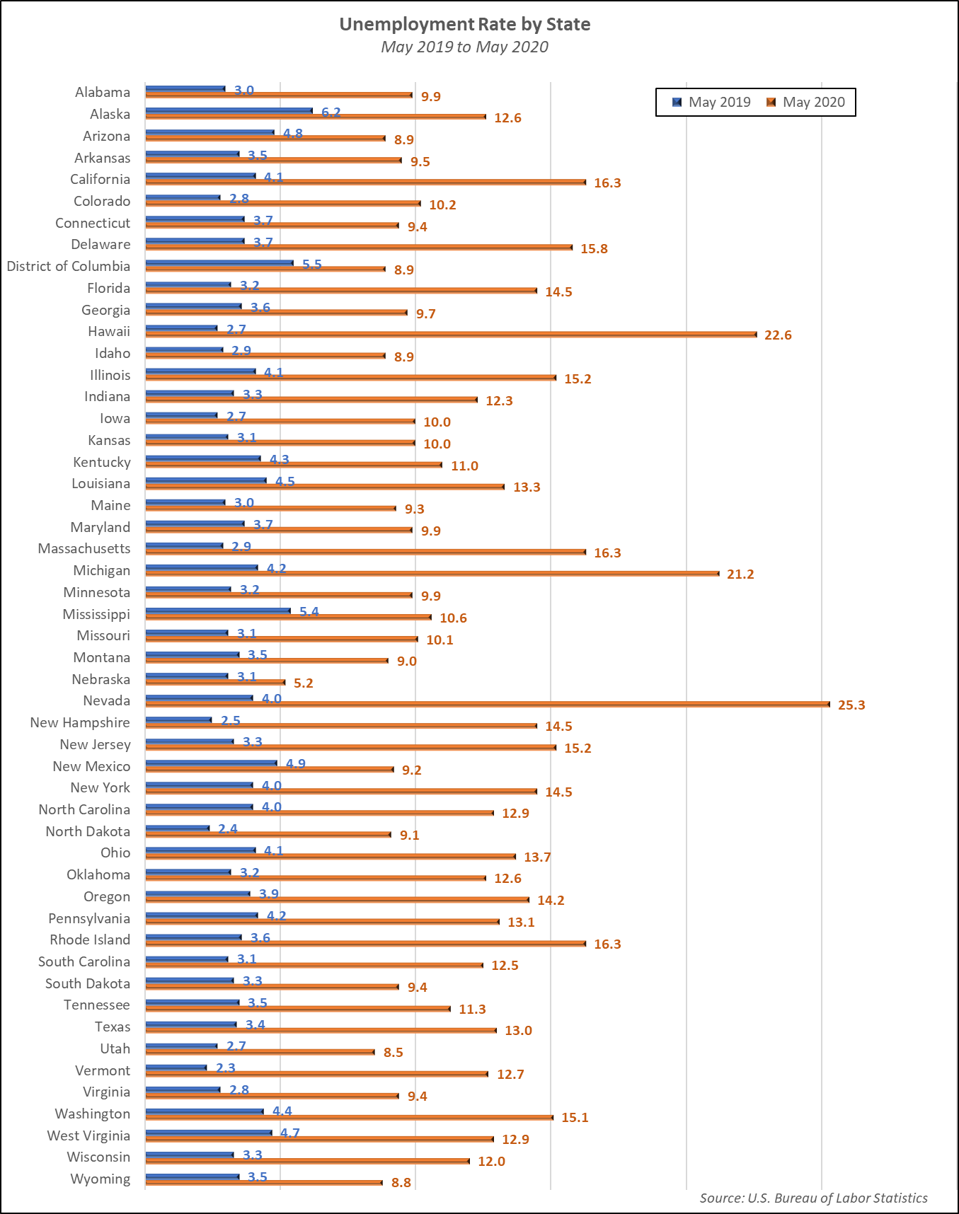
Nevada has been hit the hardest as the unemployment rate in the Silver State rose from 4.0% in May 2019 to a whopping 25.3% in May 2020. Nevada’s economy is heavily reliant on leisure and hospitality, which had the brunt of the job losses. Hawaii, the second hardest hit state saw unemployment rise from 2.7% in May 2019 to 22.6% in May 2020. Which is the only other state with unemployment above 20% in May 2020? Michigan, where unemployment rose from 4.2% to 21.2% year over year. What state has fared best? Nebraska, which also has one of the most diverse economies of all states. Deriving nearly 50% of its total GDP from five different industries, unemployment in the Cornhusker State rose from 3.1% to a modest 5.2% from May 2019 to May 2020. Unemployment numbers for all states are shown in the following chart.

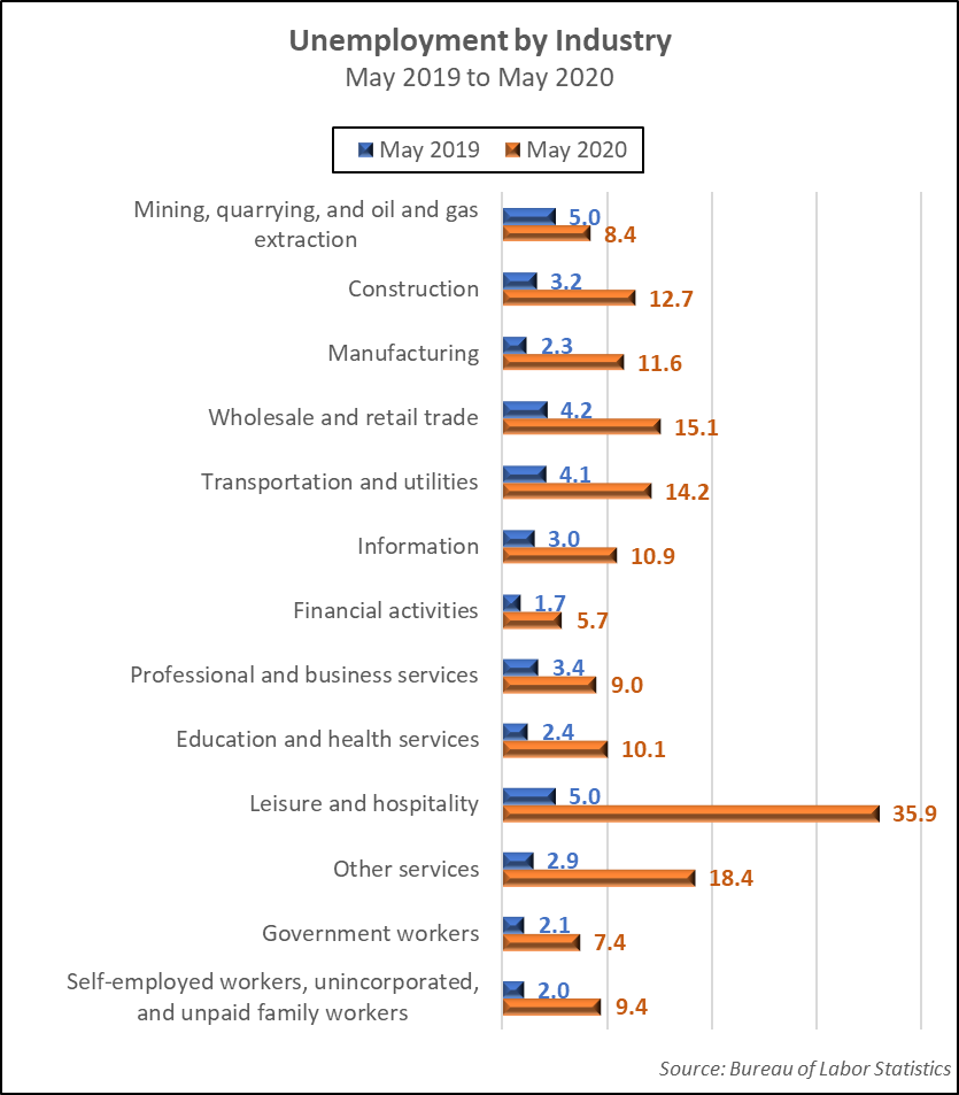
Unemployment by Industry

As mentioned in the previous section, the states that have fared best either have a more diverse economy or do not rely heavily on industries that have been hardest hit by the coronavirus. The most negatively affected is the leisure and hospitality industry where unemployment rose 618% from a low of 5.0% in May 2019 to a staggering 35.9% in May 2020. At a distant second, but still reeling, is the wholesale and retail trade industry, which saw unemployment rise from 4.2% to 15.1% during the same period. The rest of the industries are listed in the following chart.

Unemployment by Industry-May 2019 to May 2020

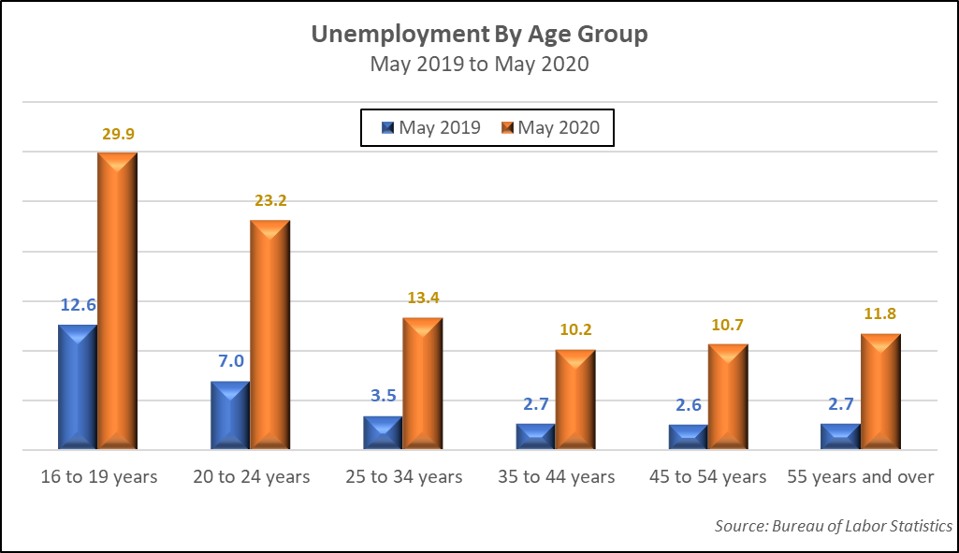
Unemployment by Age Group

Businesses need two things to exist: workers and customers. Without customers, there is no need for workers or the business for that matter. Some businesses require highly skilled workers while others operate well using unskilled labor. It is this unskilled labor group that has been hardest hit.

The greatest rise in unemployment is among workers under age 25. This is likely due to three factors. Younger workers typically have fewer marketable skills, less work experience, and less seniority. Many of these workers are in industries that have felt the greatest pain. Unemployment rates by age group are contained in the following chart.

Unemployment by Age Group-May 2019 to May 2020

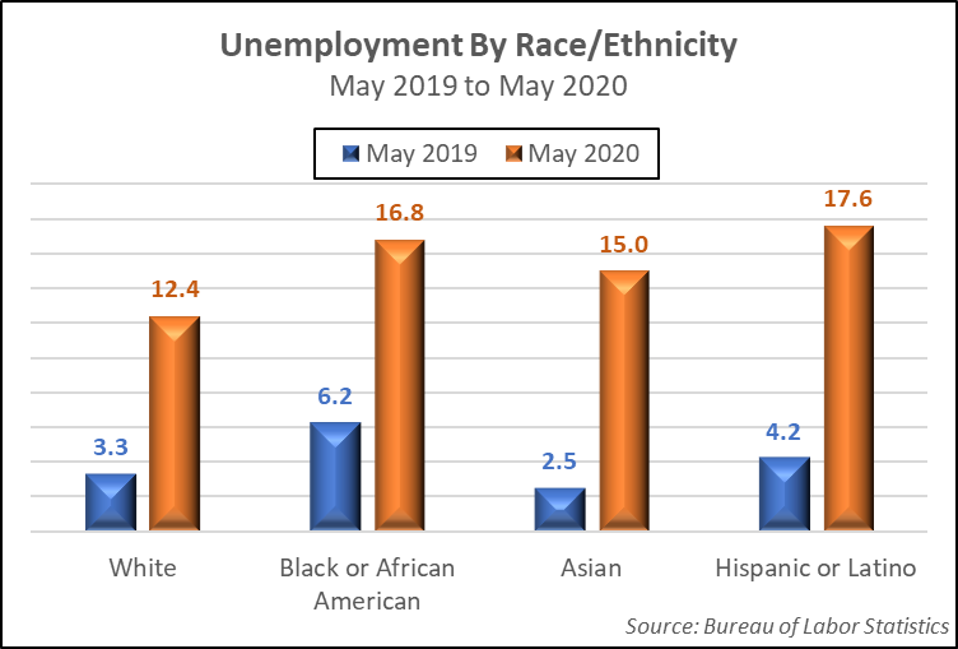
Unemployment by Race/Ethnicity

Question: Prior to Covid-19, was unemployment among blacks / African Americans at a record low as President Trump has claimed? Using the available data, which extends back to January 1972, the answer is yes. This new record low was achieved in October and November of 2019 when unemployment among black or African American workers fell to 5.1%. The previous record low was 5.2% in December 1973. The current rate is 16.8%, which is less than the highest rate of 20.7% logged in December 1982. The most recent high in unemployment for this group was 19.3% in March 2010. It has been steadily declining since then. Numbers for White, Asian, and Hispanic or Latino and black or African American workers are listed in the following chart.

Unemployment by Race or Ethnicity-May 2019 to May 2020

Businesses need workers, workers need businesses, and both depend on customers. Since the pandemic began, consumer demand has fallen sharply. With the probability that a vaccine will not be available until early 2021 at the soonest, plus a disregard for recommended safety protocols by many individuals, namely wearing masks and social distancing, it is highly unlikely that the economy will return to normal for several years.

Will the president continue to hold rallies? Will he set an example by wearing a mask? Will the protests and violence continue? Will other large gatherings continue? Unless Americans make a collective and conscious choice to mask up and social distance, we will be forced to live in a depressed economy for longer than necessary. The choice is up to us.