Will Telemedicine Be the Blockbuster or Netflix of Healthcare?

https://www.medpagetoday.com/practicemanagement/telehealth/87662?xid=fb_o&trw=no&fbclid=IwAR1IRS5lgPjbTxkXuMS0fnFmvdkywSyf20YaJ-RElRIGCzU3_GY_W6rTwXw

Netflix Vs Blockbuster – The New DVD Viewing Experience

New approaches need to recognize patients’ wants and needs

One component of Blockbuster’s financial model was the late fees it charged to customers who did not return a video tape to the store in time. These fees accounted for up to 16% of its revenue. In 1997, Reed Hastings was one of the customers affected by these fees. After one late rental, he was charged a hefty $40 late fee. His frustration inspired him to help create a company that would have no late charges. This new company also had the audacious idea to send DVDs straight to the customer’s home for a flat monthly fee. The company that Reed Hastings co-founded was Netflix.

Over time, Netflix changed and adapted with new technology and shifting consumer preferences. It moved on from mailing DVDs to using a streaming platform. It developed an algorithm to help make personalized video recommendations to Netflix users. It started producing its own video content. Over time, the company planted itself firmly within many homes and routines. Conversely, Blockbuster adapted to new platforms too slowly and too late. After its peak in 2004, Blockbuster started losing market share and relevance. Today, there is only one Blockbuster store left, a curious tourist attraction in Bend, Oregon.

Markets and industries change all the time. Distinguishing these important changes from temporary fads is essential. History has many examples of companies and organizations that did not sense important changes, did not change their approach, and as a result, ended up obsolete and irrelevant. A similar shift is happening today in healthcare, but there is more at stake than a late fee. Like Netflix, the healthcare industry needs to shift and adapt to consumer preferences.

The COVID-19 pandemic has had an immediate impact on the health of our country and has also indelibly changed how patients interact with the healthcare system. Hospitals and providers around the country have had to quickly develop new strategies to connect with patients – to comply with social distancing guidelines, in an effort to slow down the spread of the virus. Consistent communication and accessibility is vital, especially given the disturbing trends in decreased preventive care visits and delayed emergency care. One solution is telehealth.

During this pandemic, we have seen that remote patient monitoring is valuable for patients with a wide variety of needs: certainly, those quarantined with coronavirus, but for healthy patients too – children in need of regularly scheduled well-child visits and adults who need routine care. Many patients have experienced telehealth for the first time and many have positive impressions, with nearly three quarters of patients who had a recent telehealth visit describing it as good or very good, according to a recent survey.

Even after the COVID-19 pandemic settles, these “temporary” approaches will permanently change patient attitudes towards technology and force healthcare providers to reexamine their approach to care. Telehealth will remain a convenient option and, in some cases, a necessary way to receive care. Embedding telehealth into standard practice of care enables providers to expand the access to people who otherwise might forgo care, and to people who may face barriers getting to a clinic, for example patients with inflexible job schedules or limited transportation.

Patients and providers are not the only people recognizing the benefits; government officials are too. While reimbursement rules were temporarily expanded to include telehealth, some states, such as Colorado and Idaho, are making COVID-19 telehealth expansions permanent.

There are many parallels to borrow from the Blockbuster example. As healthcare providers, we cannot be complacent and stick with old business models because they are what we are used to. We cannot wait for people to come to us. We cannot ignore these changing times and consumers’ changing preferences. In fact, if we adapt and provide care in ways that patients prefer, we could improve health outcomes.

The healthcare institutions that will grow and be successful during this time are those who are more like Netflix. Instead of waiting for patients to decide to seek healthcare when it may be too late (e.g., just like a Blockbuster “late fee”), we will actively reach out and remind our patients about the importance of timely healthcare services. Instead of ignoring changes in patient preferences and new technology, we will adapt quickly to new platforms for healthcare visits. Instead of waiting for patients to feel comfortable to return to a healthcare facility, we will show patients what our healthcare system is doing to ensure patient safety and protection from COVID-19. Most importantly, instead of being complacent, we will accept and develop new ways of providing care.

There was once a time that we thought that getting in a car, driving to a strip mall, and walking through aisles with thousands of video tapes was the only option to watch a movie at home. Now, many of us can get thousands of titles on our televisions, computers, and phones through several movie streaming platforms. The COVID-19 pandemic has forced healthcare systems to quickly adapt to new constraints; however, it may really be an opportunity to develop new models of care, to engage with our patients, and to make healthcare more accessible. As healthcare providers, we need to make the choice to be more like Netflix, and less like Blockbuster.



Coronavirus’s painful side effect is deep budget cuts for state and local government services

https://theconversation.com/coronaviruss-painful-side-effect-is-deep-budget-cuts-for-state-and-local-government-services-141105

Coronavirus's painful side effect is deep budget cuts for state ...

Nationwide, state and local government leaders are warning of major budget cuts as a result of the pandemic. One state – New York – even referred to the magnitude of its cuts as having “no precedent in modern times.”

Declining revenue combined with unexpected expenditures and requirements to balance budgets means state and local governments need to cut spending and possibly raise taxes or dip into reserve funds to cover the hundreds of billions of dollars lost by state and local government over the next two to three years because of the pandemic.

Without more federal aid or access to other sources of money (like reserve funds or borrowing), government officials have made it clear: Budget cuts will be happening in the coming years.

And while specifics are not yet available in all cases, those cuts have already included reducing the number of state and local jobs – from firefighters to garbage collectors to librarians – and slashing spending for education, social services and roads and bridges.

In some states, agencies have been directed to cut their budget as much as 15% or 20% – a tough challenge as most states prepared budgets for a new fiscal year that began July 1.

As a scholar of public administration who researches how governments spend money, here are the ways state and local governments have reduced spending to close the budget gap.

Cutting jobs

State and local governments laid off or furloughed 1.5 million workers in April and May.

They are also reducing spending on employees. According to surveys, government workers are feeling personal financial strain as many state and local governments have cut merit raises and regular salary increases, frozen hiring, reduced salaries and cut seasonal employees.

Washington state, for example, cut both merit raises and instituted furloughs.

survey from the National League of Cities shows 32% of cities will have to furlough or lay off employees and 41% have hiring freezes in place or planned as a result of the pandemic.

Employment reductions have met some resistance. In Nevada, for example, a state worker union filed a complaint against the governor to the state’s labor relations board for violating a collective bargaining statute by not negotiating on furloughs and salary freezes.

Most of the employee cuts have been made in education. Teachers, classroom aids, administrators, staff, maintenance crews, bus drivers and other school employees have seen salary cuts and layoffs.

The job loss has hurt public employees beyond education, too: librarians, garbage collectors, counselors, social workers, police officers, firefighters, doctors, nurses, health aides, park rangers, maintenance crews, administrative assistants and others have been affected.

Residents also face the consequences of these cuts: They can’t get ahold of staff in the city’s water and sewer departments to talk about their bill; they can’t use the internet at the library to look for jobs; their children can’t get needed services in school.

Most of these cuts have been labeled temporary, but with the extensions to stay-at-home orders and a mostly closed economy, it will be some time before these employees are back to work.

Suspending road, bridges, building and water system projects

As another way to reduce costs quickly, a National League of Cities survey shows 65% of the municipalities surveyed are stopping temporarily, or completely, capital expenditure and infrastructure projects like roads, bridges, buildings, water systems or parking garages.

In New York City, there is a US$2.3 billion proposed cut to the capital budget, a fund that supports large, multiyear investments from sidewalk and road maintenance, school buildings, senior centers, fire trucks, sewers, playgrounds, to park upkeep. There are potentially serious consequences for residents. For example, New York housing advocates are concerned that these cuts will hurt plans for 21,000 affordable homes.

Suspending these big money projects will save the government money in the short term. But it will potentially harm the struggling economy, since both public and private sectors benefit from better roads, bridges, schools and water systems and the jobs these projects create.

Delaying maintenance also has consequences for the deteriorating infrastructure in the U.S. The costs of unaddressed repairs could increase future costs. It can cost more to replace a crumbling building than it does to fix one in better repair.

Cities and towns hit

In many states, the new budgets severely cut their aid to local governments, which will lead to large local cuts in education – both K-12 and higher education – as well as social programs, transportation, health care and other areas.

New York state’s budget proposes that part of its fiscal year 2021 budget shortfall will be balanced by $8.2 billion in reductions in aid to localities. This is the state where the cuts were referred to in the budget as “not seen in modern times.” This money is normally spent on many important services that residents need everyday –mass transit, adult and elderly care, mental health support, substance abuse programs, school programs like special education, children’s health insurance and more. Lacking any of these support services can be devastating to a person, especially in this difficult time.

Fewer workers, less money

As teachers and administrators figure out how to teach both online and in person, they and their schools will need more money – not less – to meet students’ needs.

Libraries, which provide services to many communities, from free computer use to after-school programs for children, will have to cut back. They may have fewer workers, be open for fewer hours and not offer as many programs to the public.

Parks may not be maintained, broken playground equipment may stay that way, and workers may not repave paths and mow lawns. Completely separate from activists’ calls to shift police funding to other priorities, police departments’ budgets may be slashed just for lack of cash to pay the officers. Similar cuts to firefighters and ambulance workers may mean poorly equipped responders take longer to arrive on a scene and have less training to deal with the emergency.

To keep with developing public safety standards, more maintenance staff and materials will be needed to clean and sanitize schools, courtrooms, auditoriums, correctional facilitiesmetro stations, buses and other public spaces. Strained budgets and employees will make it harder to complete these new essential tasks throughout the day.

To avoid deeper cuts, state and local government officials are trying a host of strategies including borrowing money, using rainy day funds, increasing revenue by raising tax rates or creating new taxes or fees, ending tax exemptions and using federal aid as legally allowed.

Colorado was able to hold its budget to only a 3% reduction, relying largely on one-time emergency reserve funds. Delaware managed to maintain its budget and avoided layoffs largely through using money set aside in a reserve account.

Nobody knows how long the pandemic, or its economic effects, will last.

In the worst-case scenario, budget officials are prepared to make steeper cuts in the coming months if more assistance does not come from the federal government or the economy does not recover quickly enough to restore the flow of money that governments need to operate.


14 hospitals bringing back furloughed workers

https://www.beckershospitalreview.com/workforce/9-hospitals-bringing-back-furloughed-employees.html?utm_medium=email

COVID-19 Return To Work Quiz! | Constangy, Brooks, Smith ...

Many U.S. hospitals and health systems have furloughed staff to help offset revenue losses from the COVID-19 pandemic. Now, some are starting to bring furloughed workers back as they resume nonemergency procedures and medical appointments. 

Here are 14 reported in July and June:

Editor’s Note: This webpage will be updated routinely. 

July

1. Elmeria, N.Y.-based Arnot Health said it brought back about half of the about 400 people it furloughed in mid-April, according to WETM-TV .

2. Guthrie said most furloughed staff have returned to the Sayre, Pa.-based health system, according to WETM-TV .

3. Charlottesville-based University of Virginia Health System will end some of its pandemic-related furloughs and pay cuts by the end of July and others in August.

4. Holyoke (Mass.) Medical Center brought back nearly 170 of 250 furloughed employees at the start of July, and another 80 to 90 are expected to return at month’s end, President and CEO Spiros Hatiras told BusinessWest.

5. Sarasota (Fla.) Memorial Health Care System brought back 640 furloughed workers.

June

6. MUSC Health, an eight-hospital system based in Charleston, S.C., called back nearly half of the employees who had been furloughed.

7. Lewiston-based Central Maine Healthcare has recalled about three-quarters of its 300 employees furloughed in April, spokesperson Kate Carlisle told the Sun Journal. The remaining furloughed employees are expected to return by mid-July.

8. Lewiston, Maine-based St. Mary’s Health System has recalled 80 percent to 85 percent of its 77 employees furloughed in April, spokesperson Steve Costello told the Sun Journal. Others are expected to return in July.

9. About 3,000 furloughed workers at hospitals in the Dayton, Ohio, region have been called back to work, according to the Springfield News-Sun. As of June 24, 2,606 workers remained on furlough, Sarah Hackenbracht, CEO of the Greater Dayton Area Hospital Association, told the newspaper. Initially, 5,648 hospital employees were furloughed in the 11-county region during the pandemic.

10. As of June 1, Claxton-Hepburn Medical Center in Ogdensburg, N.Y., brought back 34 employees, including nurses and staff for surgery, according to WWNY-TV. This is out of about 175 employees who were furloughed in April.

11. St. Lawrence Health System, a three-hospital system in Potsdam, N.Y., had called 80 furloughed employees back to work as of June 1, according to WWNY-TV. The health system furloughed about 400 workers.

12. St. Joseph’s Health in Syracuse, N.Y., had brought back 135 workers as of June 1, according to Syracuse.com. The organization, a member of Livonia, Mich.-based Trinity Health, furloughed 500 employees in April.

13. Crouse Health in Syracuse, N.Y., an affiliate of New Hyde Park, N.Y.-based Northwell Health, had brought back 63 of its 278 furloughed workers as of June 1, according to Syracuse.com.

14. Lewis County Health System CEO Gerald Cayer said June 12 that the Lowville, N.Y.-based organization soon will end the eight-week furlough that put 14 percent of its workforce on unpaid leave, according to nny360.com. Ten furloughed employees had returned to work as of June 12, and Mr. Cayer said other employees would return to work beginning June 21.


700+ Chicago nurses reach labor deal after 2-week strike

https://www.beckershospitalreview.com/hr/700-chicago-nurses-reach-labor-deal-after-2-week-strike.html?utm_medium=email

How Have Health Workers Won Improvements to Patient Care? Strikes.

More than 700 nurses who walked off the job for two weeks approved a new contract July 20 with Amita Health Saint Joseph Medical Center Joliet (Ill.), hospital and union officials confirmed to Becker’s.

The nurses are represented by the Illinois Nurses Association, and both sides had been negotiating a new contract since early spring. Nurses had worked without a contract since May 9 and went on strike July 4.

Pay and benefits have been key sticking points at the bargaining table. Additionally, the Illinois Nurses Association had claimed the hospital was not adequately addressing staffing issues.

The new contract includes agreements by the hospital to improve the staffing guidelines on certain units before Dec. 31 and to meet and confer with the union by that date to improve staffing throughout the facility, the union said in a news release. Health insurance premium contributions were also capped at 25 percent for full-time nurses and 35 percent for part-time nurses, the union said.

“While a majority of nurses voted for this contract, there are still many nurses who want to see more progress on safe staffing,” said Pat Meade, RN, one of the lead union negotiators. “We will continue the fight for safe staffing through enforcement of our contract and in Springfield.”

In an emailed statement to Becker’s, hospital spokesperson Tim Nelson said Amita Health is pleased with the agreement and called it “fair and just for all involved.”

The hospital hired temporary nurses from an outside agency to fill in during the strike.

Mr. Nelson said the hospital’s nurses will return to work July 22 for their regularly scheduled shifts.


Hospital margins could sink to a negative 7% this year: 5 things to know

https://www.beckershospitalreview.com/finance/hospital-margins-could-sink-to-a-negative-7-this-year-5-things-to-know.html?utm_medium=email

New Kaufman Hall Report: Hospital Finances Crashed in April ...

The COVID-19 pandemic has created financial challenges for hospitals and health systems, and, without additional federal aid, half of US hospitals could be operating in the red in the second half of this year, according to an analysis released by the American Hospital Association on July 21.

Five takeaways from the analysis: 

1. Before the COVID-19 pandemic, the median hospital margin was 3.5 percent. COVID-19 is expected to drive the median hospital margin from positive to negative. 

2. Without funding from the Coronavirus Aid, Relief and Economic Security Act, hospital margins would have been a negative 15 percent in the second quarter of 2020. Margins are still expected to drop to a negative 3 percent in the second quarter.

3. Without additional aid from the federal government, hospital margins could sink to a negative 7 percent in the second half of this year. 

4. In the second quarter of this year, nearly half of U.S. hospitals had negative margins. Those hospitals will remain with negative margins without further financial support.  

5. “Heading into the COVID-19 crisis, the financial health of many hospitals and health systems were challenged, with many operating in the red,” said hospital association President and CEO Rick Pollack in a news release. “As today’s analysis shows, this pandemic is the greatest financial threat in history for hospitals and health systems and is a serious obstacle to keeping the doors open for many.” 

The full report, prepared by Kaufman, Hall & Associates and released by the AHA, is available here


The surge in coronavirus hospitalizations is severe

https://www.axios.com/newsletters/axios-vitals-b0ebd340-d76f-49c3-8f02-cb2896ae2e8d.html?utm_source=newsletter&utm_medium=email&utm_campaign=newsletter_axiosvitals&stream=top

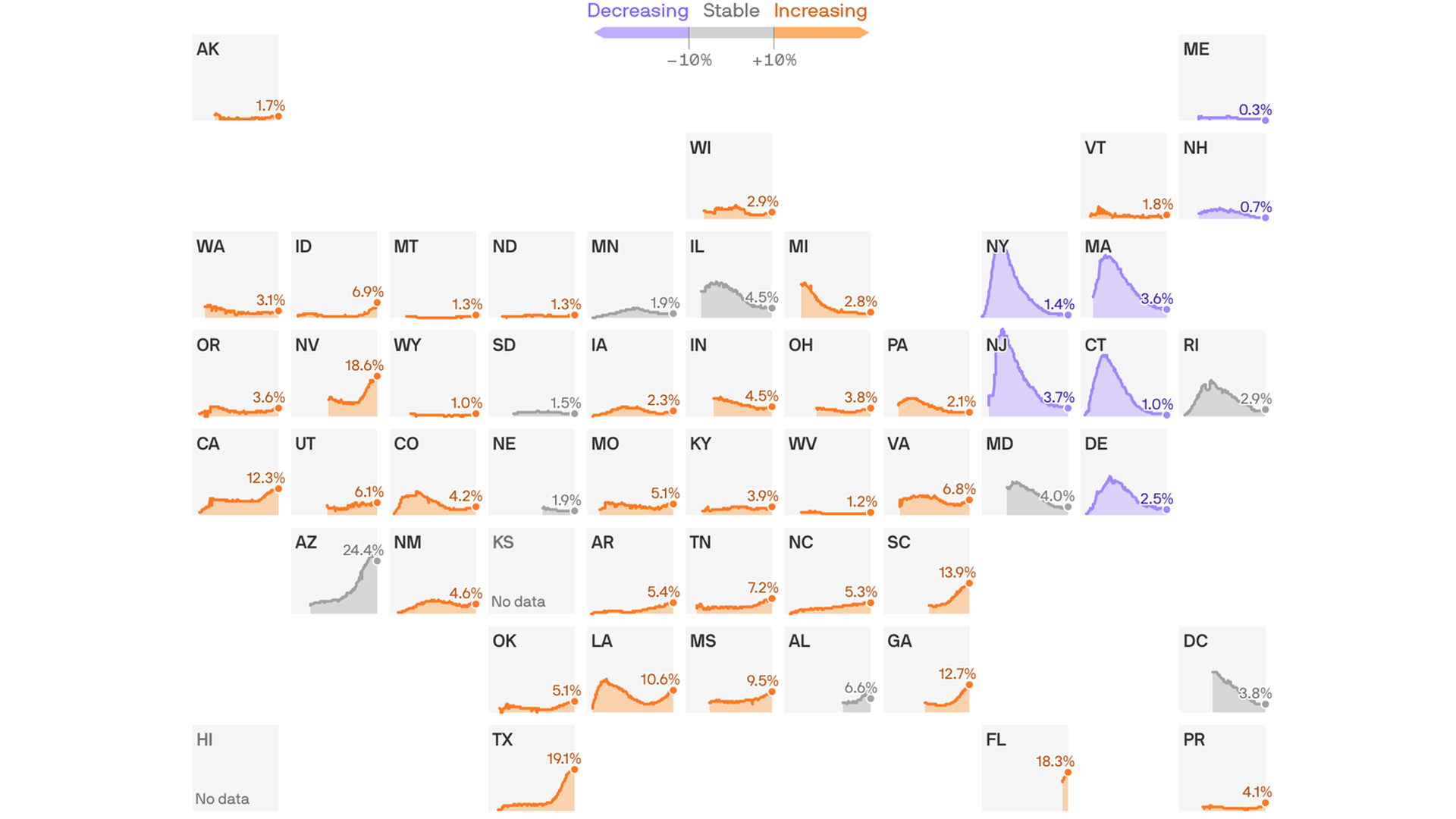
Share of hospital beds occupied
by COVID-19 hospitalizations

States shown from first date of reported data, from March 17 to July 19, 2020

  • In the last two weeks hospitalizations are:

The coronavirus surge is real, and it's everywhere - Axios


Coronavirus hospitalizations are skyrocketing, even beyond the high-profile hotspots of Arizona, Florida and Texas, Axios’ Bob Herman and Andrew Witherspoon report.

Why it matters: The U.S. made it through the spring without realizing one of experts’ worst fears — overwhelming hospitals’ capacity to treat infected people. But that fear is re-emerging as the virus spreads rapidly throughout almost every region of the country.

Where things stand: Arizona remains in the worst shape; 27.1% of all hospital beds in the state are occupied by COVID-19 patients as of July 15, according to an analysis combining data from the COVID Tracking Project and the Harvard Global Health Institute. Texas is second at 18.8%.

  • Nevada is the next worst, with COVID-19 patients taking up 18.7% of all hospital beds. That’s up significantly from 11.2% at the start of July.
  • Florida just started tallying current hospitalization data, showing more than 16% of all hospital beds occupied.

It gets worse: Many other states are showing significant upticks in coronavirus hospitalizations during the first half of July, including Alabama, California, Louisiana, Mississippi, South Carolina and Tennessee.

  • Many of these states, which reopened a lot of their economies in May, do not have mask mandates.

Between the lines: Intensive-care unit beds, reserved for the sickest patients, are completely full in parts of ArizonaFloridaMississippi and Texas.

  • Hospitals can convert other areas into ICUs, but that’s not all that useful if hospitals don’t have enough staff and supplies.

The bottom line: Cases have soared over the past 45 days, and hospitalizations naturally follow many of those cases.

  • Rising hospitalizations mean the outbreaks in many areas are not close to being controlled, and some percentage of those hospitalizations will end as deaths.


Appeals court rules HHS has authority to implement site-neutral payments, dealing blow to hospitals

https://www.fiercehealthcare.com/hospitals/appeals-court-rules-hhs-has-authority-to-implement-site-neutral-payments-dealing-blow-to?mkt_tok=eyJpIjoiWXpGa016azRZekJqTTJZeSIsInQiOiJ6ajZGSWlYUGh1TTZqTFBDMEgwaXk3ZFZZSCtBVkdUWHNhemZ0SDJZWnhJVHlHVUpjRTdFVUlpbVBSdng4dTFXUEhhOGV2S3lRcElVVWNuZWpqakdEZE1DRmhleHRzdlY4RDRxYkxtZUNYNVI3Rmg5Kys5SVd1aGdseUR6Y1hxSCJ9&mrkid=959610

Appeals court rules HHS has authority to implement site-neutral ...

A federal appeals court ruled the Department of Health and Human Services has the authority to cut Medicare payments to off-campus clinics to bring them in line with independent physician practices, reversing a lower court’s decision.

The ruling from the U.S. Court of Appeals for the District of Columbia delivered Friday strikes a major blow to the hospital industry which has been fighting HHS over the controversial rule.

The American Hospital Association (AHA) led a lawsuit against HHS arguing it did not have the statutory authority to cut payments to the off-campus, provider-based departments. HHS made the cuts in its annual hospital payments rule and the hospitals argued they were unlawful because the cuts were not budget-neutral, a requirement of the payment rule.

But the appeals court agreed with HHS that it had the authority to make the change in the payment rule because of how the law is structured.


619-bed California hospital to join Cedars-Sinai

https://www.beckershospitalreview.com/hospital-transactions-and-valuation/619-bed-california-hospital-to-join-cedars-sinai.html?utm_medium=email

Cedars-Sinai Medical Center halts use of heart compressor device ...Contact Huntington Hospital | Huntington Hospital


Huntington Hospital in Pasadena, Calif., has entered into a definitive agreement to join Los Angeles-based Cedars-Sinai Health System, roughly four months after the organizations signed a letter of intent to explore an affiliation. 

The agreement calls for investments in 619-bed Huntington Hospital’s information technology, ambulatory services and physician development. Under the agreement, Huntington Hospital would be governed by a local board and its philanthropy and volunteer support would be locally controlled, the organizations said.

“On behalf of everyone at Huntington Hospital, we are all very pleased to have reached this important milestone,” said Jaynie Studenmund, chair of the Huntington Hospital board of directors, in a news release. “We pledge to work cooperatively with all the relevant parties and believe that this proposed affiliation is in the best interest of all of our stakeholders and the greater San Gabriel Valley community.”

The definitive agreement will now be submitted for regulatory review and approval. The review process is expected to take several months.


Fitch: Nonprofit hospital margins unlikely to recover until COVID-19 vaccine

https://www.beckershospitalreview.com/finance/fitch-nonprofit-hospital-margins-unlikely-to-recover-until-covid-19-vaccine.html?utm_medium=email

What Happens When A Nonprofit Hospital Goes 'For-Profit' : Shots ...

Median financial ratios for nonprofit hospitals and health systems improved before the COVID-19 pandemic, which will provide some financial cushion to withstand financial pressures, according to a report from Fitch Ratings. 

The medians for 2019, based on 2018 data, showed the nonprofit hospital and health system sector stabilized after a period of operational softness. The medians for 2020, based on 2019 audited data, are expected to show improvement in operating margins driven by higher revenues, cost reductions and increased cash flow, Fitch said.

“We expect the 2020 medians will represent peak performance levels until the sector is able to recover from the effects of the pandemic on operations,” Fitch said. 

The credit rating agency said the nonprofit healthcare sector is unlikely to stabilize until a COVID-19 vaccine is widely available.

“The sector has shown considerable resiliency over the years, weathering significant events such as the Great Recession and legislative changes to funding,” Fitch said. “However, the coronavirus presents entirely new and fundamental challenges for the sector in the short term in the form of volume and revenue disruption, and over the medium to longer term with expected deterioration of individual provider payor mixes and possible changes in the behavior of healthcare consumers.”


12-hospital CHI Franciscan-Virginia Mason system would be part of CommonSpirit under new deal

https://www.beckershospitalreview.com/hospital-transactions-and-valuation/12-hospital-chi-franciscan-virginia-mason-system-would-be-part-of-commonspirit-under-new-deal.html?utm_medium=email

CHI Franciscan and Virginia Mason moving toward merger | Tacoma ...

Washington health systems CHI Franciscan and Virginia Mason agreed to explore a combination through a joint operating company that would be part of CommonSpirit Health, the organizations said July 16. 

The proposed 12-hospital system would include more than 250 care sites and nearly 5,000 employed and affiliated providers. Combining the two systems would allow Tacoma-based CHI Franciscan and Seattle-based Virginia Mason to “shape healthcare nationally,” according to Virginia Mason CEO Gary Kaplan, MD. He told Becker’s Hospital Review in an interview that the organizations “envision creating a health system of the future.”

Ketul Patel, the CEO of CHI Franciscan and president of the Pacific Northwest division at parent system CommonSpirit Health, said in the same interview that, “Together, we’re going to not only be able to boast that we have the largest access point in the state, but we are going to be the largest and best-quality [system] in the state of Washington. We’re in a unique place to scaling and being a showcase for the entire country.” 

Dr. Kaplan and Mr. Patel would serve as co-CEOs of the organization, and the health system’s board would have equal representation from both organizations.

Quality and innovation are major focuses of the proposed deal. Virginia Mason is one of only 32 hospitals in the U.S. and the only hospital in Washington to receive an A grade in quality and patient safety from The Leapfrog Group every spring and fall since the organization started publishing grades. All but two of CHI Franciscan’s hospitals received A rankings from Leapfrog this spring, Dr. Kaplan said. Outside of that, Virginia Mason and CHI Franciscan draw patients nationally for cardiology and complex spine programs, Mr. Patel said.

Dr. Kaplan said details of the deal will be hammered out as the organizations move toward a final agreement, with hopes to finalize the process by the end of the year. The joint operating company would be in addition to the organizations’ prior relationships, which include partnerships in obstetrics and women’s health, as well as radiation oncology.

No financial information about the proposal was disclosed. Virginia Mason reported total revenues of $1.2 billion in fiscal year 2019, while Chicago-based CommonSpirit’s totaled nearly $21 billion.