What Trump and the GOP have planned for healthcare

Health systems are rightly concerned about Republican plans to cut Medicaid spending, end ACA subsidies and enact site neutral payments, says consultant Michael Abrams, managing partner of Numerof, a consulting firm.

“Health systems have reason to worry,” Abrams said shortly after President Donald Trump was inaugurated on Monday. 

While Trump mentioned little about healthcare in his inauguration speech, the GOP trifecta means spending cuts outlined in a one-page document released by Politico and another 50-pager could get a majority vote for passage.

Of the insurers, pharmaceutical manufacturers and health systems that Abrams consults with, healthcare systems are the ones that are most concerned, Abrams said.

At the top of the Republican list targeting $4 trillion in healthcare spending is eliminating an estimated $2.5 billion from Medicaid. 

“There’s no question Republicans will find savings in Medicaid,” Abrams said.

Medicaid has doubled its enrollment in the last couple of years due to extended benefits made possible by the Affordable Care Act, despite disenrolling 25 million people during the redetermination process at the end of the public health emergency, according to Abrams.

Upward of 44 million people, or 16.4% of the non-elderly U.S. population are covered by an Affordable Care Act initiative, including a record high of 24 million people in ACA health plans and another 21.3 million in Medicaid expansion enrollment, according to a KFF report. Medicaid expansion enrollment is 41% higher than in 2020.

The enhanced subsidies that expanded eligibility for Medicaid and doubled the number of enrollees are set to expire at the end of 2025 and Republicans are likely to let that happen, Abrams said. Eliminating enhanced federal payments to states that expanded Medicaid under the ACA are estimated to cut the program by $561 billion.

If enhanced subsidies end, the Congressional Budget Office has estimated that the number of people who will become uninsured will increase by 3.8 million each year between 2026 and 2034. 

The enhanced tax subsidies for the ACA are set to expire at the end of 2025. This could result in another 2.2 million people losing coverage in 2026, and 3.7 million in 2027, according to the CBO.

WHY THIS MATTERS

For hospitals, loss of health insurance coverage means an increase in sicker, uninsured patients visiting the emergency department and more uncompensated care.

“Health systems are nervous about people coming to them who are uninsured,” Abrams said. “There will be people disenrolled.”

The federal government allowed more people to be added to the Medicaid rolls during the public health emergency to help those who lost their jobs during the COVID-19 pandemic, Numerof said. Medicaid became an open-ended liability which the government wants to end now that the unemployment rate is around 4.2% and jobs are available.

An idea floating around Congress is the idea of converting Medicaid to a per capita cap and providing these funds to the states as a block grant, Abrams said. The cost of those programs would be borne 70% by the federal government and 30% by states.

This fixed amount based on a per person amount would save money over the current system of letting states report what they spent.

Another potential change under the new administration includes site neutral Medicare payments to hospitals for outpatient services.

The HFMA reported the site neutral policy as a concern in a list it published Monday of preliminary federal program cuts totaling more than $5 trillion over 10 years. The 50-page federal list is essentially a menu of options, the HFMA said, not an indication that programs will actually be targeted leading up to the March 14 deadline to pass legislation before federal funding expires.

Other financial concerns for hospitals based on that list include: the elimination of the tax exemption for nonprofit hospitals, bringing in up to $260 billion in estimated 10-year savings; and phasing out Medicare payments for bad debt, resulting in savings of up to $42 billion over a decade.

Healthcare systems are the ones most concerned over GOP spending cuts, according to Abrams. Pharmacy benefit managers and pharmaceutical manufacturers also remain on edge as to what might be coming at them next.

THE LARGER TREND

President Donald Trump mentioned little about healthcare during his inauguration speech on Monday.

Trump said the public health system does not deliver in times of disaster, referring to the hurricanes in North Carolina and other areas and to the fires in Los Angeles.

Trump also mentioned giving back pay to service members who objected to getting the COVID-19 vaccine.

He also talked about ending the chronic disease epidemic, without giving specifics.

“He didn’t really talk about healthcare even in the campaign,” Abrams said.

However, in his consulting work, Abrams said, “The common thread is the environment is changing quickly,” and that healthcare organizations need to do the same “in order to survive.”

8 Reasons Hospitals must Re-think their Future

Today is the federal income Tax Day. In 43 states, it’s in addition to their own income tax requirements. Last year, the federal government took in $4.6 trillion and spent $6.2 trillion including $1.9 trillion for its health programs. Overall, 2023 federal revenue decreased 15.5% and spending was down 8.4% from 2022 and the deficit increased to $33.2 trillion. Healthcare spending exceeded social security ($1.351 trillion) and defense spending ($828 billion) and is the federal economy’s biggest expense.

Along with the fragile geopolitical landscape involving relationships with China, Russia and Middle East, federal spending and the economy frame the context for U.S. domestic policies which include its health system. That’s the big picture.

Today also marks the second day of the American Hospital Association annual meeting in DC. The backdrop for this year’s meeting is unusually harsh for its members:

Increased government oversight:

Five committees of Congress and three federal agencies (FTC, DOJ, HHS) are investigating competition and business practices in hospitals, with special attention to the roles of private equity ownership, debt collection policies, price transparency compliance, tax exemptions, workforce diversity, consumer prices and more.

Medicare payment shortfall: 

CMS just issued (last week) its IPPS rate adjustment for 2025: a 2.6% bump that falls short of medical inflation and is certain to exacerbate wage pressures in the hospital workforce. Per a Bank of American analysis last week, “it appears healthcare payrolls remain below pre-pandemic trend” with hospitals and nursing homes lagging ambulatory sectors in recovering.”

Persistent negative media coverage:

The financial challenges for Mission (Asheville), Steward (Massachusetts) and others have been attributed to mismanagement and greed by their corporate owners and reports from independent watchdogs (Lown, West Health, Arnold Ventures, Patient Rights Advocate) about hospital tax exemptions, patient safety, community benefits, executive compensation and charity care have amplified unflattering media attention to hospitals.

Physicians discontent: 

59% of physicians in the U.S. are employed by hospitals; 18% by private equity-backed investors and the rest are “independent”. All are worried about their income. All think hospitals are wasteful and inefficient. Most think hospital employment is the lesser of evils threatening the future of their profession. And those in private equity-backed settings hope regulators leave them alone so they can survive. As America’s Physician Group CEO Susan Dentzer observed: “we knew we’re always going to need hospitals; but they don’t have to look or operate the way they do now. And they don’t have to be predicated on a revenue model based on people getting more elective surgeries than they actually need. We don’t have to run the system that way; we do run the healthcare system that way currently.”

The Value Agenda in limbo:

Since the Affordable Care Act (2010), the CMS Center for Innovation has sponsored and ultimately disabled all but 6 of its 54+ alternative payment programs. As it turns out, those that have performed best were driven by physician organizations sans hospital control. Last week’s release of “Creating a Sustainable Future for Value-Based Care: A Playbook of Voluntary Best Practices for VBC Payment Arrangements.” By the American Medical Association, the National Association of ACOs (NAACOs) and AHIP, the trade group representing America’s health insurance payers is illustrative. Noticeably not included: the American Hospital Association because value-pursuers think for hospitals it’s all talk.

National insurers hostility:  

Large, corporate insurers have intensified reimbursement pressure on hospitals while successfully strengthening their collective grip on the U.S. health insurance sector. 5 insurers control 50% of the U.S. health insurance market: 4 are investor owned. By contrast, the 5 largest hospital systems control 17% of the hospital market: 1 is investor-owned. And bumpy insurer earnings post-pandemic has prompted robust price increases: in 2022 (the last year for complete data and first year post pandemic), medical inflation was 4.0%, hospital prices went up 2.2% but insurer prices increased 5.9%.

Costly capital: 

The U.S. economy is in a tricky place: inflation is stuck above 3%, consumer prices are stable and employment is strong. Thus, the Fed is not likely to drop interest rates making hospital debt more costly for hospitals—especially problematic for public, safety net and rural hospitals. The hospital business is capital intense: it needs $$ for technologies, facilities and clinical innovations that treat medical demand. For those dependent on federal funding (i.e. Medicare), it’s unrealistic to think its funding from taxpayers will be adequate.  Ditto state and local governments. For those that are credit worthy, capital is accessible from private investors and lenders. For at least half, it’s problematic and for all it’s certain to be more expensive.

Campaign 2024 spotlight:

In Campaign 2024, healthcare affordability is an issue to likely voters. It is noticeably missing among the priorities in the hospital-backed Coalition to Strengthen America’s Healthcare advocacy platform though 8 states have already created “affordability” boards to enact policies to protect consumers from medical debts, surprise hospital bills and more.

Understandably, hospitals argue they’re victims. They depend on AHA, its state associations, and its alliances with FAH, CHA, AEH and other like-minded collaborators to fight against policies that erode their finances i.e. 340B program participation, site-neutral payments and others. They rightfully assert that their 7/24/365 availability is uniquely qualifying for the greater good, but it’s not enough. These battles are fought with energy and resolve, but they do not win the war facing hospitals.

AHA spent more than $30 million last year to influence federal legislation but it’s an uphill battle. 70% of the U.S. population think the health system is flawed and in need of transformative change. Hospitals are its biggest player (30% of total spending), among its most visible and vulnerable to market change.

Some think hospitals can hunker down and weather the storm of these 8 challenges; others think transformative change is needed and many aren’t sure. And all recognize that the future is not a repeat of the past.

For hospitals, including those in DC this week, playing victim is not a strategy. A vision about the future of the health system that’s accessible, affordable and effective and a comprehensive plan inclusive of structural changes and funding is needed. Hospitals should play a leading, but not exclusive, role in this urgently needed effort.

Lacking this, hospitals will be public utilities in a system of health designed and implemented by others.

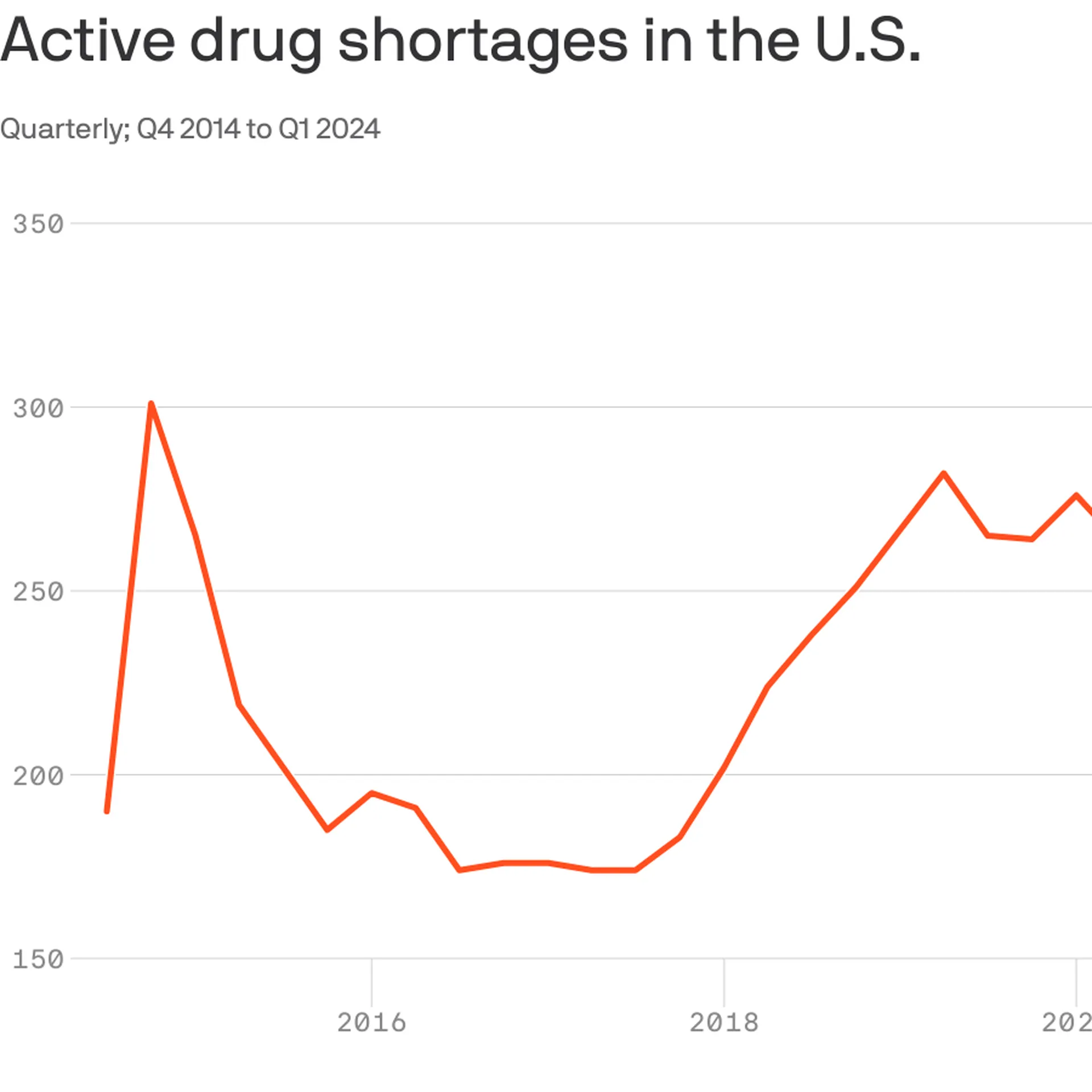
Drug shortages reach all-time high

https://www.axios.com/2024/04/11/drug-shortage-record-high

With 323 medicines in short supply, U.S. drug shortages have risen to their highest level since the American Society of Health-System Pharmacists began tracking in 2001.

Why it matters: 

This high-water mark should energize efforts in Congress and federal agencies to address the broken market around what are often critical generic drugs, the organization says.

  • The Biden administration last week issued a drug-shortage plan that called on Congress to pass legislation that would reward hospitals for maintaining an adequate supply of key drugs, among other measures.
  • As a “first step,” Medicare yesterday proposed incentives for roughly 500 small hospitals to establish and maintain a six-month buffer stock of essential medicines.

The big picture: 

Many of the issues behind shortages are tied to low prices for generics that leave manufacturers competing on price.

  • “It’s been a race to the bottom. We need more transparency around quality so that buyers have a reason to not chase the lowest price,” said Michael Ganio, senior director at the ASHP.
  • Drugmakers that can demonstrate safer, higher-quality manufacturing practices should earn a higher price, he said.
  • Manufacturing quality concerns in particular have fueled shortages of chemotherapy drugs and some antibiotics.

Between the lines: Other factors are also driving drug shortages.

  • Controlled substances, such as pain and sedation medications, account for 12% of active shortages, which are tied to recent legal settlements and Drug Enforcement Administration changes to production limits, per ASHP.
  • Not surprisingly, the blockbuster category of anti-obesity drugs known as GLP-1s are in shortage largely because of outsized demand.
  • That’s also the case for ADHD drugs and hormone therapies used in gender-affirming care.

What will end with the COVID public health emergency?

https://mailchi.mp/d62b14db92fb/the-weekly-gist-february-10-2023?e=d1e747d2d8

Last week the Biden Administration announced that the federal COVID public health emergency (PHE) will expire on May 11. While the recent Omnibus law will lessen the impact, the graphic above highlights several important provisions for providers which are currently set to end with the PHE.

The Centers for Medicare and Medicaid Services (CMS) will no longer provide hospitals with a 20 percent inpatient payment boost for treating traditional Medicare patients hospitalized with COVIDThe cost of COVID testing and treatments will shift from the federal government to consumers as private and public insurers can charge for tests and care, while the uninsured will bear the full costs of COVID vaccines and treatment. 

Medicare’s current flexibilities around skilled nursing facility (SNF) admissions will end, as it reinstates the three-day prior hospitalization rule for SNF transfers, and ceases paying for SNF stays beyond 100 days.

The end of the PHE also means that providers will no longer be able to prescribe controlled substances virtually, without an initial in-person evaluation. This is especially significant given the volume of mental health and substance abuse treatment that shifted to telehealth across the course of the pandemic.

While the Drug Enforcement Agency has been working on regulations to address this, a proposed rule has not yet been released. Together, these changes amount to lower payments for health systems, COVID cost exposure for patients, and fewer flexibilities for providers managing care, even as thousands of patients are still being hospitalized with COVID each week.

Purported Medicare profits spark criticism of North Carolina hospitals’ charity care spending

https://mailchi.mp/f1c5ab8c3811/the-weekly-gist-october-28-2022?e=d1e747d2d8

Drawing on a report published by the North Carolina State Health Plan for Teachers and State Employees, a recent Kaiser Health News article shines a light on the lack of transparency in financial reporting of not-for-profit hospitals’ community benefit obligations.

The report claims many North Carolina hospitals—including the state’s largest system, Atrium Health—show profits on Medicare patients in their cost report filings, while at the same time claiming sizable unrecouped losses on Medicare patients as a part of their overall community benefit analyses.

The Gist: These kind of reporting discrepancies draw attention to the controversial issue of whether not-for-profit hospitals provide sufficient community benefit to compensate for their tax-exempt status, which was worth nearly $2 billion in 2020 for North Carolina hospitals alone. 

Greater transparency around charity care, community benefit, and losses sustained from public payers could go a long way toward shoring up stakeholder support for not-for-profit institutions at a time when their political goodwill has deteriorated. Hospitals should be proactive on this front, as political leaders increasingly train their sites on high hospital spending in the current tight economic environment. 

Medicare finalizes its hospital payment policy for next year

https://mailchi.mp/ef14a7cfd8ed/the-weekly-gist-august-6-2021?e=d1e747d2d8

CMS finalizes $2.3B pay bump for hospitals in federal fiscal 2022 |  FierceHealthcare

The Centers for Medicare & Medicaid Services (CMS) issued its final payment rule for inpatient hospitals for FY22 this week, giving providers a 2.5 percent pay increase, and implementing a number of other regulatory changes. Of particular note, the rule puts in place a requirement for hospitals and long-term care providers to report on COVID vaccination rates among their workers, amid growing calls for healthcare organizations to mandate vaccines.

The final rule will also extend additional payments to hospitals for delivering COVID care until the end of the public health emergency is declared.

On top of a number of changes to quality reporting programs aimed at reducing the adverse impact of the pandemic on hospital metrics, CMS also used the final inpatient rule to begin acting on the Biden administration’s stated desire of improving health equity by adding a maternal morbidity measure to hospital quality reporting requirements.

The measure will require hospitals to report whether they participate in initiatives to improve perinatal health, an area in which unequal treatment has led to disproportionately adverse outcomes for women of color. In what will surely be welcome news for hospitals, CMS will no longer require disclosure of the contract terms providers strike with Medicare Advantage insurers, which was a key provision of Trump-era transparency regulations.

Nevertheless, based on earlier proposed changes to physician and outpatient surgery payment rules, and the President’s recent executive order on competition policy, we’d anticipate the Biden administration will continue to boost efforts to increase transparency of provider pricing.

First things first, however: there’s a pandemic to get through, and this final inpatient payment rule should largely come as good news to hospitals who are increasingly feeling the strain of a fourth surge of COVID cases.

Senate votes to delay sequester cuts to Medicare payment

https://mailchi.mp/3e9af44fcab8/the-weekly-gist-march-26-2021?e=d1e747d2d8

Democrats ran and won on health care. Now what? - CNN Politics

If you’re looking for an issue that can unite a heavily divided Congress, it seems nearly all Senators can get behind delaying payment cuts to providers during a pandemic. On Thursday the Senate voted 90-2 to pause the 2 percent sequester cuts to Medicare payment slated to go into effect on April 1.

The bill is expected to be passed by the House and signed into law by President Biden, delaying the cuts through the coronavirus public emergency. While hospitals, many of whom are still recovering from increased costs and volume loss during the pandemic, can breathe a sigh of relief, providers face an even larger 4 percent payment cut in the fall due to the PAYGO, or “pay as you go”, statute, which would trigger automatic payments cuts due to the deficit increases caused by the COVID relief bill. 

We’d gamble that intense industry lobbying to delay the PAYGO cuts will prove successful—again, legislators will be reticent to dock provider payment as pandemic recovery continues. But eventually, in a more normal world, hospitals can expect policymakers to shift their focus from pandemic relief to cost control—and it will likely not prove possible to delay the inevitable reckoning over the high cost of our health system.

MedPAC calls for 2% bump to hospital payments, no update for docs in 2022

MedPAC March 2019 Report to the Congress Released - ehospice

A key Medicare advisory panel is calling for a 2% bump to Medicare payments for acute care hospitals for 2022 but no hike for physicians.

The report, released Monday from the Medicare Payment Advisory Commission (MedPAC)—which recommends payment policies to Congress—bases payment rate recommendations on data from 2019. However, the commission did factor in the pandemic when evaluating the payment rates and other policies in the report to Congress, including whether policies should be permanent or temporary.

“The financial stress on providers is unpredictable, although it has been alleviated to some extent by government assistance and rebounding service utilization levels,” the report said.

MedPAC recommended that targeted and temporary funding policies are the best way to help providers rather than a permanent hike for payments that gets increased over time.

“Overall, these recommendations would reduce Medicare spending while preserving beneficiaries’ access to high-quality care,” the report added.

MedPAC expects the effects of the pandemic, which have hurt provider finances due to a drop in healthcare use, to persist into 2021 but to be temporary.

It calls for a 2% update for inpatient and outpatient services for 2022, the same increase it recommended for 2021.

The latest report recommends no update for physicians and other professionals. The panel also does not want any hikes for four payment systems: ambulatory surgical centers, outpatient dialysis facilities, skilled nursing facilities and hospices.

MedPAC also recommends Congress reduce the aggregate hospice cap by 20% and that “ambulatory surgery centers be required to report cost data to [Centers for Medicare & Medicaid Services (CMS)],” the report said.

But it does call for long-term care hospitals to get a 2% increase and to reduce payments by 5% for home health and inpatient rehabilitation facilities.

The panel also explores the effects of any policies implemented under the COVID-19 public health emergency, which is likely to extend through 2021 and could continue into 2022.

For instance, CMS used the public health emergency to greatly expand the flexibility for providers to be reimbursed for telehealth services. Use of telehealth exploded during the pandemic after hesitancy among patients to go to the doctor’s office or hospital for care.

“Without legislative action, many of the changes will expire at the end of the [public health emergency],” the report said.

MedPAC recommends Congress temporarily continue some of the telehealth expansions for one to two years after the public health emergency ends. This will give lawmakers more time to gather evidence on the impact of telehealth on quality and Medicare spending.

“During this limited period, Medicare should temporarily pay for specified telehealth services provided to all beneficiaries regardless of their location, and it should continue to cover certain newly-covered telehealth services and certain audio-only telehealth services if there is potential for clinical benefit,” according to a release on the report.

After the public health emergency ends, Medicare should also return to paying the physician fee schedule’s facility rate for any telehealth services. This will ensure Medicare can collect data on the cost for providing the services.

“Providers should not be allowed to reduce or waive beneficiary cost-sharing for telehealth services after the [public health emergency],” the report said. “CMS should also implement other safeguards to protect the Medicare program and its beneficiaries from unnecessary spending and potential fraud related to telehealth.”

A large pay gap exists between independent and hospital-employed doctors

https://www.healthcarefinancenews.com/news/large-pay-gap-exists-between-independent-and-hospital-employed-doctors

Physician practices with more female doctors have smallest gender pay gaps  | Healthcare Finance News

The payment gap was $63,000 for primary care doctors, $178,000 for medical specialists and $150,000 for surgeons.

Doctors who work for hospital outpatient facilities get much higher payments for their services from Medicare than doctors who practice independently, according to a new study.

The research, based on Medicare claims data from 2010-2016, found that the program’s payments for doctors’ work were, on average, $114,000 higher per doctor per year when billed by a hospital than when billed by a doctor’s independent practice.

Published in Health Services Research, results found that the amount Medicare would pay for outpatient care at doctors’ offices would have been 80% higher if the services had been billed by a hospital outpatient facility. In 2010, the average set of Medicare services independent doctors performed annually for patients was worth $141,000, but charging for the same group of services would have grossed $240,000 if a hospital outpatient facility billed for them.

The payment difference varied by specialty. The payment gap was $63,000 for primary care doctors, $178,000 for medical specialists and $150,000 for surgeons.

Moreover, the study found the differential grew over time. From 2010-2016, the average difference between hospital outpatient and private practice payments grew from 80% higher to 99% higher.

WHAT’S THE IMPACT?

The main reason for these large payment differences: facility fees. For each service a doctor performs, Medicare pays hospital outpatient facilities both a fee for the doctor’s work and a fee for the facility, whereas private practices receive only doctor fees.

Although the doctor fees are a bit lower in hospital outpatient locations, the facility fees more than make up for the difference, and the total payments to hospitals are reflected in higher doctor salaries and bonuses.

The Centers for Medicare and Medicaid Services has been trying to correct this imbalance for years with policies that would pay both sites the same amount. In 2015, the Bipartisan Budget Act authorized CMS to impose site-neutral payments but grandfathered existing hospital outpatient facilities. Later, CMS expanded the equal payments to other hospital outpatient facilities, but the American Hospital Association sued to overturn this regulation.

In July 2020, the Appeals Court sided with HHS. The American Hospital Association and the Association of American Medical Colleges said they would seek to have the ruling overturned.

The groups filed for a petition for a rehearing, which was denied.

In February, the Supreme Court acknowledged the AHA’s request for judicial review. The government response was due by March 15, but on March 3, Norris Cochran, acting Secretary of Health and Human Service asked for an extension until April 14 to file the government’s response, according to court documents.

The significant difference between Medicare payments to hospital outpatient facilities and independent offices has encouraged hospitals and health systems to buy doctor practices, but the study noted that good research about this has been lacking up to now.

It found little evidence of a direct relationship linking the size of the pay gap between hospital outpatient facilities and independent offices, with hospitals buying doctor practices, in particular medical specialties. But it did find that doctors whose services had larger pay gaps were more likely to have a hospital buy their practice than doctors whose services had a smaller pay gap.

In an accompanying commentary, Dr. Michael Chernew of Harvard Medical School in Boston said the study had found that the ability of hospitals and employed doctors to earn more from Medicare had resulted in a greater amount of integration.

THE LARGER TREND

However, the authors pointed out that the Medicare payment difference is only one of many factors that have contributed to the huge increase in the share of doctors employed at hospitals over the past decade. For example, they found a higher probability of a doctor going to work for a hospital in highly concentrated hospital markets and rural areas.

Other studies, they said, have established that some health systems use integration with doctors’ offices as a bargaining chip with commercial health insurance plans. Also, some doctors may find that independent practice is less viable than it used to be for a variety of reasons.

It has also been suggested that many younger doctors prefer hospital employment to private practice because they crave economic security and work-life balance.

It’s been estimated that even the payments to hospitals vs. doctors could save CMS $11 billion over 10 years. But the paper illustrates that the payment disparities can also create broader market distortions because consolidation of hospitals and doctors’ offices has been shown to lead to higher prices overall.

RemoteICU sues HHS for not reimbursing for telehealth provided by physicians outside of the country

https://www.healthcarefinancenews.com/news/remoteicu-sues-hhs-not-reimbursing-telehealth-provided-physicians-outside-country

Tele ICU - What It Is, How It Works & Its Advantages

The Medicare Act “prohibits Medicare payment for services that are not furnished within the United States,” according to the filing.

RemoteICU, a telemedicine provider group, is suing the Department of Health and Human Services and the Centers for Medicare and Medicaid Services for not reimbursing telehealth services provided by physicians who are located outside the United States, according to a federal lawsuit filed last week in Washington.

RICU wants reimbursement for telehealth services provided within the U.S., but not necessarily by a physician who lives within its borders.

The company employs physicians who live outside the country, but are U.S. board-certified critical-care specialists and licensed in one or more U.S. jurisdictions. With RICU’s telecommunications system, these physicians can provide critical-care services in U.S. hospital ICUs, the lawsuit said.

“Although RICU’s physicians live abroad, they serve as full-time, permanent staff members of the U.S. hospitals at which they serve patients,” the company said in the court filing.

“By employing U.S.-licensed intensivists who live overseas, RICU has enabled the American healthcare system to recapture talent that would otherwise be lost to it – and this has helped to alleviate the ongoing shortage of intensivists in American hospitals.

When CMS expanded the list of telehealth services for which it reimbursed in December 2020 to include critical care services, RICU began offering its physicians to hospitals that couldn’t afford ICU telehealth without Medicare reimbursement, the court filing said.

However, after the company reached out to several officials from HHS and CMS, it was notified that Medicare could not reimburse the client hospitals for RICU’s services, because the Medicare Act “prohibits Medicare payment for services that are not furnished within the United States,” according to the filing.

The company is seeking a preliminary injunction to stop HHS and CMS from denying Medicare reimbursement for telehealth services on the basis of a provider’s physical location outside of the United States at the time of service.

WHAT’S THE IMPACT?

RICU claims that, by failing to reimburse for the critical care telehealth services provided by its physicians, HHS and CMS are causing “immediate harm both to RICU and to the public.”

It argues that it’s filling a gap in critical care that has been exacerbated by the pandemic.

“There remains [a] significant unmet need for critical care services, as desperately sick patients have overwhelmed ICU resources across the country,” RICU said in the court filing.

“In some cases, lack of adequate care can mean the difference between life or death. And one of the groups most at risk from death and serious illness due to COVID-19 is the elderly – the very same population that relies upon Medicare.”

Without reimbursement, RICU says that some of its current clients, as well as potential customers, will not be able to offer its services.

The company argues that this causes “significant, unrecoverable monetary damages” because tele-ICU providers that use physicians located within the U.S. are eligible for reimbursement and therefore have a competitive edge over RICU.

Further, it says that it has already begun losing business because of hospitals’ inability to receive Medicare reimbursement.

THE LARGER TREND

CMS has widely expanded the list of telehealth services it will reimburse for during the pandemic to include services such as emergency department visits, initial inpatient and nursing facility visits, and discharge-day management.

While only 14 states currently have true “payment parity” for telehealth, 43 states and D.C. have implemented a telemedicine coverage law, according to Foley & Lardner report.

That report, among others, claims telehealth will continue to grow as an integral part of healthcare as time goes on.

Last year, Geisinger health system in Danville, Pennsylvania, implemented telehealth ICU technology in several of its hospitals to support its in-person clinical staff.

ON THE RECORD

“The Critical Care Ban is causing irreparable harm to RICU, which is suffering ongoing financial and reputational harms that cannot be remedied in the future,” the court filing said.

The balance of the equities favors an injunction, because Defendants have already admitted that there is a desperate medical need for the critical care that RICU would provide but for the Critical Care Ban.

“And, finally, preliminary injunction would be in the public interest because, across the United States, Americans stricken by the COVID-19 pandemic are in desperate need of critical care – a need that RICU can help meet. It is not hyperbole to say that the requested injunctive relief is in the public interest because it could save lives.”