Healthcare Finance Trends for 2023: Multiple Intersecting Challenges

https://www.commercehealthcare.com/trends-insights/2023/healthcare-finance-trends-for-2023

This annual look at high-impact trends affecting healthcare in the coming year is based on evaluation of current industry research data. Healthcare Finance Trends for 2023 (Trends) explores eight themes identified by CommerceHealthcare® ranging across four areas:

  • Financial. Providers enter the year contending with multiple financial stress points. They will also seek growth in technology-enabled remote care.
  • Patient financial experience. The need to drive not only improvement but also personalization of the financial experience is paramount. A central role will be played by patient financing programs which will see growing demand in 2023.
  • Trust. Building trust with all constituencies is explored as a linchpin for long-term provider success. The latest findings on cybersecurity show that this contributor to trust will continue to consume leadership attention.
  • Digital transformation. Pursuit of digital-first operations is accelerating, with the finance area an important focus. Emerging payment modes are finding a home in healthcare’s digital finance landscape.

This report’s consistent message is that these trends intersect in ways that compound both the challenges and the upside potential of strategies that address them.

1. Multiple Financial Stress Points Will Constrain Options

Healthcare’s financial predicament for the next 12–18 months is being described in strong terms. Citing $450 billion of EBITDA that could be in jeopardy, more than half of the industry’s project profit pool by 2027, one analyst suggests “a gathering storm.” Another perceives “broad and serious threats” as “elevated expenses” erode margins and exact “a profound financial toll.” Fitch Ratings issued a “deteriorating” outlook for nonprofit health systems.

These financial headwinds are upending healthcare’s traditional status as “recession-proof.” It is helpful to probe the multiple forces in play, the urgent workforce management challenge, and the varied solution set.

Multiple stress factors at work

Observing that margins will be down 37% in 2022 relative to pre-pandemic, a recent stark assessment concluded, “U.S. hospitals are likely to face billions of dollars in losses — which would result in the most difficult year for hospitals and health systems since the beginning of the pandemic.”

A confluence of factors is exacerbating the stress for 2023:

  • Rising acuity levels. Over two-thirds of surveyed C-suite executives said patient health has worsened from pandemic-induced delayed care. The upshot, stated by 27% of CFOs, is rising expenses due to higher acuity. Inpatient days are projected to increase at an 8% rate over the coming decade.
  • Reimbursement gaps and inflation. Commercial and government reimbursement rates are not keeping pace with rising costs. Surging inflation is widening this gap. Hospitals are also reporting substantial insurer payment delays and denials.
  • Investment declines. Stock and bond market declines have removed a cushion for operating weakness. Market uncertainty will complicate 2023 portfolio management.

Persistent workforce concerns remain center stage

Burnout and shortages have disrupted the clinical workforce. Nearly 60% of physician, advanced practice provider and nurse survey respondents said their teams are not adequately staffed, and 40% lack resources to operate at full potential. Many providers face extreme to moderate shortages of allied health professionals.

The problem extends beyond the clinical. A survey saw 48% of respondents experiencing severe labor deficiencies in revenue cycle management (RCM) and billing, and one in four finance leaders must fill over 20 positions to be fully staffed.

An executive outlook highlighted demonstrable impact on financial performance and growth from these workforce problems, citing reductions in profitability, capacity and service (Figure 1).1
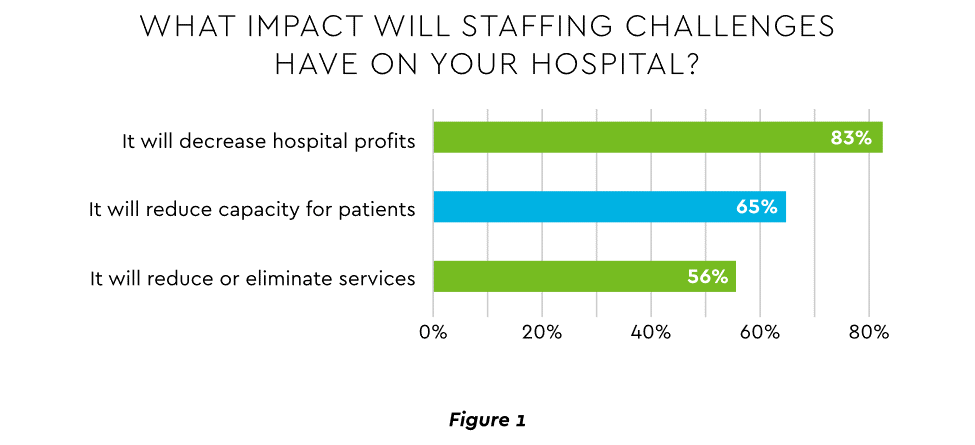
What impact will staffing challenges have on your hospital?

View PDF of Figure 1 chart[PDF]

Several studies detail negative outcomes:

  • Expenses. Hospital employee expense is expected to increase $57 billion from 2021 to 2022, with contract labor ballooning another $29 billion. Average weekly earnings are up 21.1% since early 2022. Half of medical practices budgeted higher staff cost-of-living increases in 2022. Shortages plague post-acute facilities as well. Their reduced capability to accept discharged patients is lengthening many hospitals’ patient stays.
  • Capacity constraint. Two-thirds of healthcare leaders identify “ability to meet demand” as their top workforce concern, suggesting a “looming capacity gap between future demand and labor supply.”

Range of measures being deployed

Health systems, hospitals and practices will vigorously pursue at least four direct actions to overcome the financial and staffing hurdles:

  • Cost cutting. Expense control will be paramount and “hospitals will be forced to take aggressive cost-cutting measures.” McKinsey estimates total industry administrative savings of $1 trillion through multiple aggressive changes.
  • Service line rationalization. Providers are rethinking how they deliver services to optimize efficiency. One path is utilizing “lower level” healthcare professionals in ways that free RNs and LPAs for more complex work suited to their top skills. Integrating remote care into the mix is another core element of the strategy.
  • Recruitment and retention programs. Attracting and retaining talent is crucial. Compensation is one avenue. Over two-thirds of organizations are offering signing bonuses for allied health professionals. Some are instituting value-based payments for physicians, offering salary floors to protect from drops in patient volume. CFOs and CNOs are joining forces to invest in nurse retention strategies. 
  • Staffing management. An increasingly popular tool to reduce labor cost and optimize staff resources is outsourcing. Figure 2 shows that RCM is leading the way among those using the solution.
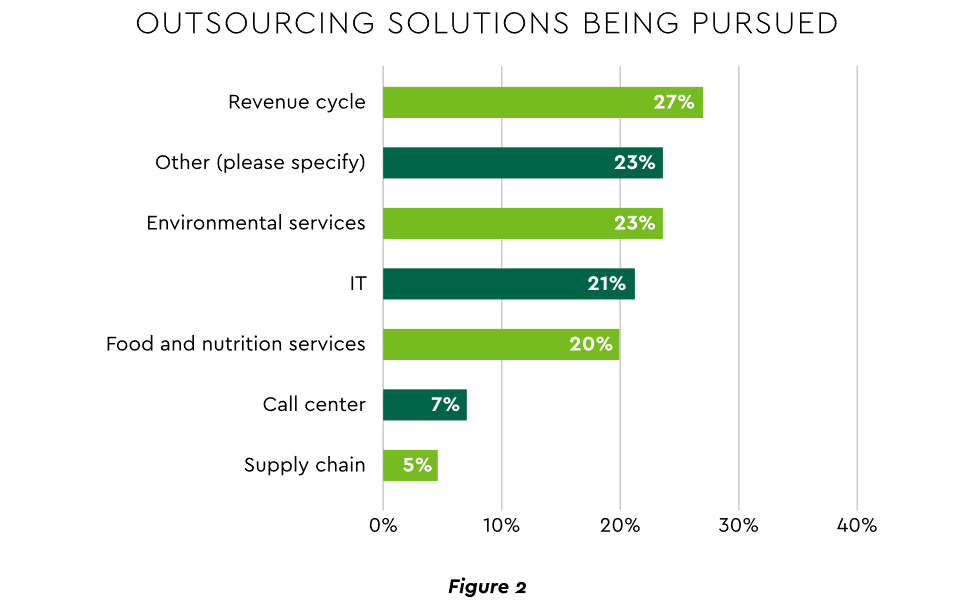
Outsourcing solutions being pursued

View PDF of Figure 2 chart[PDF]

2. Growth Strategies Favor Outpatient, Virtual, Acute Home Care

Pursuing top line growth in tandem with reining in expenses is essential. Inpatient volume growth has been tepid for several years ─ essentially flat in the 2016–20 period (Figure 3).
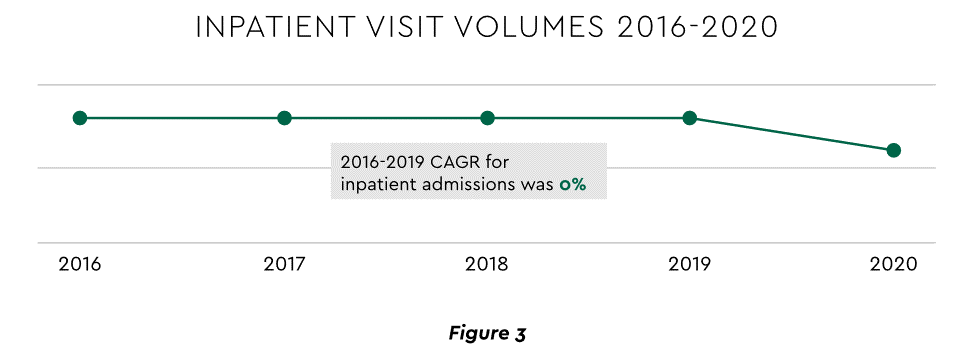
Inpatient visit volumes 2016-2020

View PDF of Figure 3 chart[PDF]

Leaders have been pivoting to outpatient and virtual care to diversify revenue streams. Two high-potential 2023 growth tracks in this sector merit deeper assessment.

Telehealth

Considerable evidence attests to strong commitment to telehealth and remote care. Sixty-three percent of physicians worldwide expect most consultations to be performed remotely within 10 years. Approximately 40% of health centers are using remote patient monitoring today. Consumers are also positive: 94% definitely or probably will use telehealth again, 57% prefer it for regular mental health visits and 61% use it for convenient care.

Telehealth is still in early stages of maturity. Only 4% of surveyed top executives consider their organization proficient at implementing remote care. Healthcare is also recognizing that a full telehealth ecosystem must be constructed. A physician leader explained that the industry’s early telehealth incarnations failed to build “virtual-only environments or really drive e-consults as a way of doing things.” A vital ecosystem demands alterations to current contracts, coding, collections, patient financing, staff training and other business practices.

Hospital-at-Home (HaH)

Health systems see particularly promising growth in the provision of acute care in patients’ home settings, including post-surgical and cancer treatment. The federal government has already allowed waivers to 114 systems and 256 hospitals to obtain inpatient-level reimbursement for acute care at home. However, these waivers were prompted by the pandemic and are slated to end in early 2023. The renewal uncertainty has stymied some activity and represents an overhang on the opportunity. However, enthusiasm appears strong, and 33% of hospitals in a recent poll said they would be prone to continue HaH even without renewal.

The forecasts are encouraging. Over half of hospitals believe it likely they will utilize HaH for at least half of their chronically ill patients over the next several years (Figure 4).
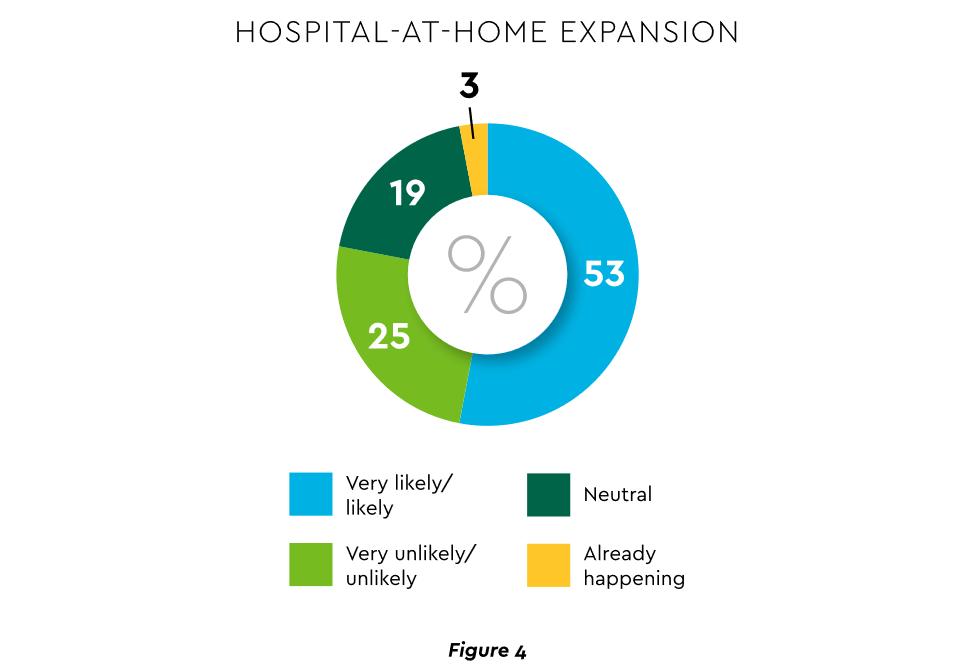
Hospital-at-home expansion

View PDF of Figure 4 chart[PDF]

HaH exists within a broader matrix of home care, and solid growth is anticipated across the range of home procedures (Figure 5).
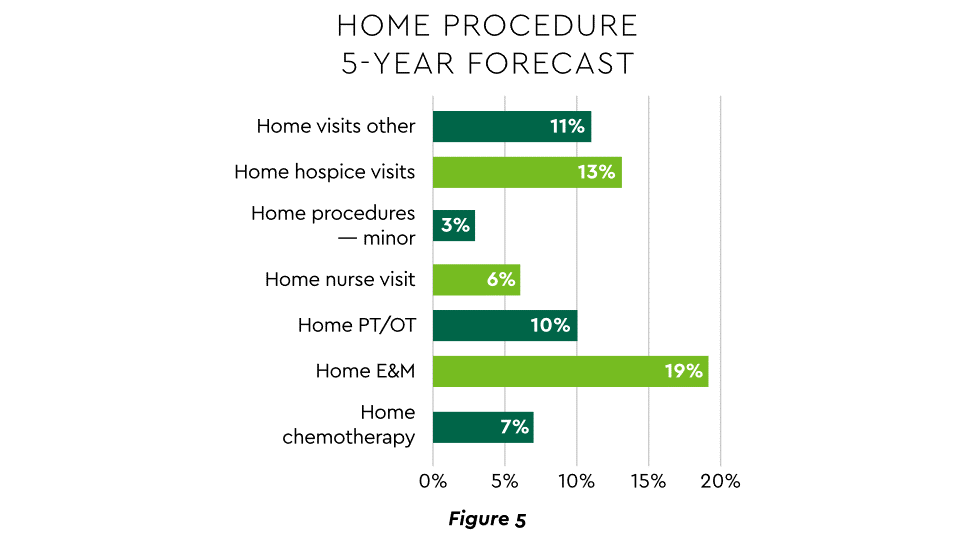
Home procedure 5-year forecast

View PDF of Figure 5 chart[PDF]

Harvesting the HaH potential will require implementation of current and emerging enabling technologies in remote monitoring, high-speed networks and artificial intelligence that generates algorithmic guidance for caregivers and patients alike.

3. Strong Drive to Improve and Personalize the Patient Financial Experience

Today’s healthcare market dynamics place a premium on positive patient experiences. The goal is to deliver “an empathetic relationship between customers and brands built on what the customer wants and how they want to be treated.” It is a complex undertaking, with numerous touchpoints as captured in HFMA’s Consumerism Maturity Model (Figure 6).
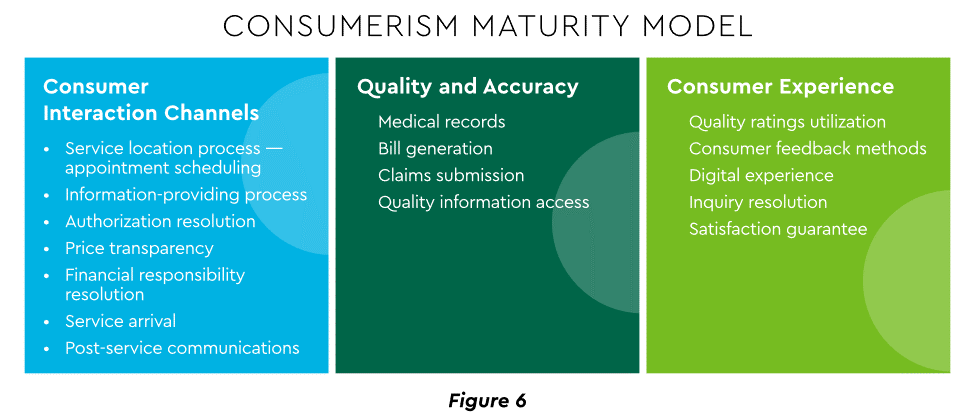
Consumerism maturity model

View PDF of Figure 6 chart[PDF]

An array of studies underscores the value proposition for intense provider focus on patient financial experience:

  • Sixty-one percent of consumers said that ease of making payments is very or somewhat important in decisions to continue seeing a doctor. Over half of patients also said text message reminders make them very or somewhat more likely to pay a bill faster than usual.
  • Thirty-five percent of respondents “have changed or would change healthcare providers to get a better digital patient administrative experience.”
  • A quality financial experience encompasses “simplified explanations, consolidated bills that match one’s health plan benefits, clear language displaying patient liability and payment options.”35

Significantly improving the financial experience requires a unified strategy, not just a collection of individual initiatives. Three threads to such a strategy will be prominent in 2023.

Using a Digital Front Door

Organizations have been moving swiftly to channel many patient financial transactions through an integrated Digital Front Door (DFD). This approach offers patients a singular online point of access and intelligent navigation to needed services.
Growth is accelerating. A DFD is their patients’ first contact point for 55% of responding organizations, according to one technology survey.  A leading forecaster sees 65% of patients engaging services via digital front doors by 2023.

Expanding price transparency

Mandates for full price transparency and “no surprises” billing are in effect, but estimates of compliance are mixed. An analysis of 2,000 hospitals determined that only 16% met the requirement to post an online “machine readable” file displaying clear charges for 300 “shoppable services.” Another assessment showed a more substantial 76% of hospitals had posted files, and 55% were deemed “complete.” One provision of interest to practices is the “good faith estimate” of expected charges required to be given to uninsured and self-pay individuals when they schedule visits.
CommerceHealthcare® has worked with clients to enhance the patient financial experience by complementing their website pricing data with clear information on patient financing options and enrollment access. Bill pay information can also be added for one-stop guidance.

Personalizing the experience

Beyond choice and convenience, the deeper objective is truly personalized experiences throughout the care journey. The words of leading analysts best define the drive to personalize:

  • “Tomorrow’s healthcare experience will be built by patients tailoring their own experience.”
  • “By 2024, 30% of chronic care patients will truly own and openly leverage their personal health information to advocate for, secure, and realize better personalized care.”

Opportunities abound to personalize the patient financial experience. Automating manual processes establishes a foundation. Patient financing with no- or low-interest credit lines and flexible terms can produce monthly payment schedules tailored to each patient’s needs. Refunds can be made through multiple payment modes to meet varying patient preferences.

4. Evidence Underscores Growing Demand for Patient Financing

Emphasizing patient financing as part of the overall experience is powerful. Patients continue to struggle paying for care. Recent granular data details three related forces at work.

Meeting care costs difficult for many patients

Commonwealth Fund found that 42% of individuals had problems paying medical bills or were paying off medical debt during the past year, while 49% were unable to pay an unexpected
$1,000 medical bill.42 Health costs trigger reduction in a range of personal expenditures, led by deferring or avoiding care and drugs (Figure 7).
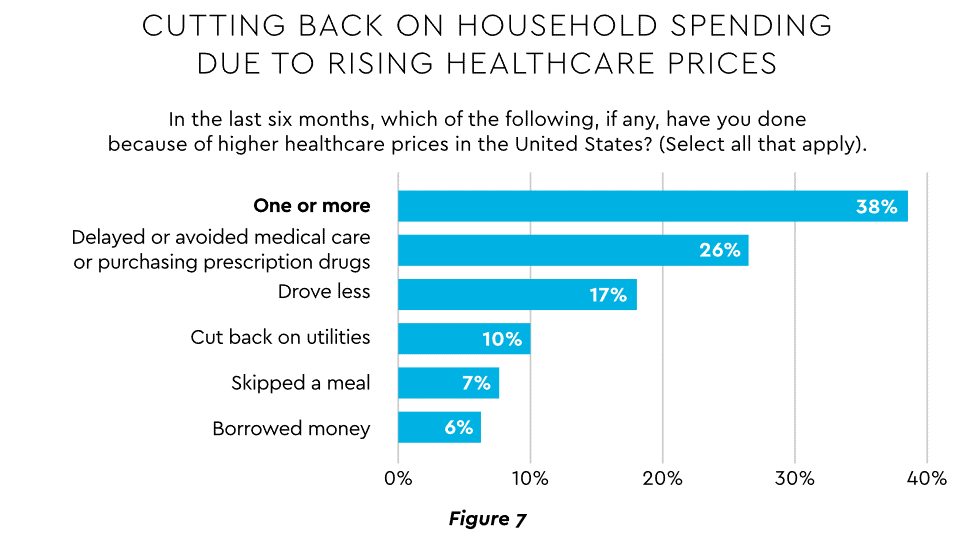
Cutting back on household spending due to rising healthcare prices

View PDF of Figure 7 chart[PDF]

Twenty-eight percent of Americans now describe themselves as less prepared than last year to pay for routine or unanticipated care.

Patient obligation for care costs still rising

Patient obligation continues its upward march. Insurance premiums have climbed steadily for both the insured and their employers, and employees now pay over $6,000 annually on average for family coverage (Figure 8).45
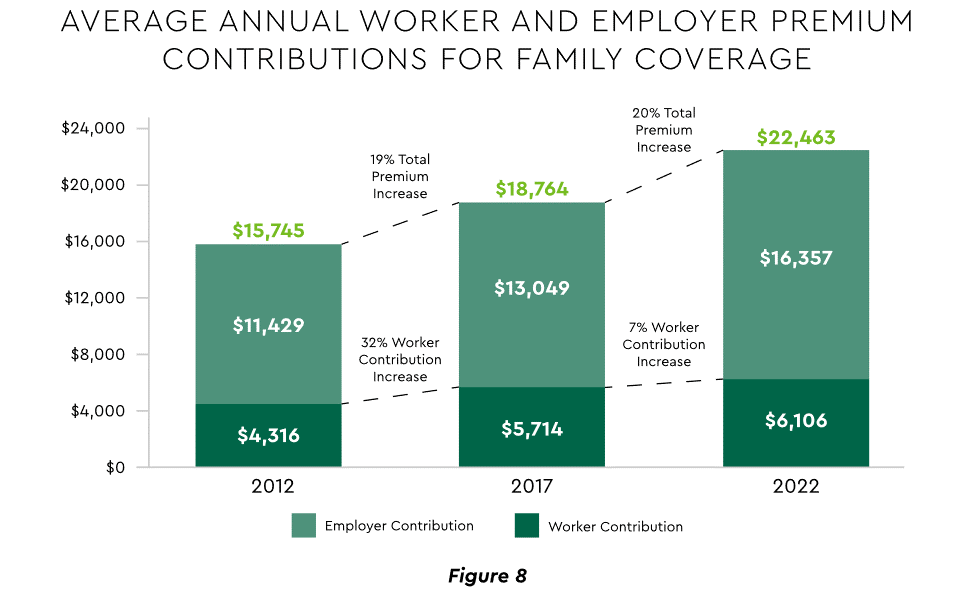
Average annual worker and employer premium contributions for family coverage

View PDF of Figure 8 chart[PDF]

High deductible health plans (HDHP) also place substantial burden on the patient. Through 2021, 28% of workers were enrolled in an HDHP with an average family deductible of $4,705. Employer satisfaction with these plans is high, auguring further expansion.

Providers feeling the financial effects

Patient payment difficulties are clearly impacting provider financials. A recent in-depth analysis uncovered substantial self-pay issues:

  • Self-pay accounts represented 60% of 2021 patient bad debt, up from 11% in 2018.
  • Nearly 18% of patient balances were over $7,500 and 17% over $14,000. Collections were noticeably lower at these balances.

Multiple chronic conditions add to the problem. A recent extensive analysis concluded: “Among individuals with medical debt in collections, the estimated amount increased with the number of chronic conditions ($784 for individuals with no conditions to $1,252 for individuals with 7–13).”

For their part, providers will be encouraged to broaden patient financing programs. Patients are certainly interested. When asked, 62% of consumers indicated they would use financing options or creative payment plans if available for large bill amounts. Many health systems, hospitals and practices will turn to outside help to satisfy the demand. A recent analysis recommended that health systems “consider keeping shorter-term payment plans in-house and extended term plans through external partnerships.”

Organizations will also need to step up their communications. A survey revealed that 64% of patients were unaware that their doctors and hospitals offered payment plans or financial help.

5. Building Trust Becoming a Critical Success Factor

Trust has emerged as a paramount issue today for most organizations as they encounter an “imperative to build trust and transparency among different stakeholder groups — employees, customers, suppliers, regulators and the communities in which they operate.” Healthcare is no exception, and the trust issue is growing in both complexity and urgency.

Healthcare’s trust gap

Trust in healthcare took a hit from the COVID-19 experience. A spring 2022 HFMA survey recorded 44% of finance leaders saying they perceived decreased patient trust. Between April 2020 and December 2021, the percentage of Americans who trusted information from doctors “a great deal” declined by 23%, from hospitals 21%, and from nurses 16%. The patient financial experience also faces “drivers of mistrust,” according to surveyed leaders who cited general payment confusion (58%), surprise billing (39%), high prices of commodity items (28%) and lack of price transparency (26%). Building trust reaps dividends. People who trust their providers are five times more likely to stay with them than those who are neutral or distrustful.

Strategies for building trust

Industry experts promote several approaches to galvanize trust among all constituencies:

  • Commitment. Embedding trust deeply in the organization requires full support from senior leadership.
  • Data transparency and governance. IDC predicts that “by end of 2023, 20% of expenses on care integration solutions will be centered around ‘trust’ to protect data, workflows and transactions.” 
  • Reliance on fewer business partners. Many health systems, hospitals and practices are reducing their number of vendors in order to focus on a set of trusted long-term partners. For example, almost two-thirds of surveyed providers said they were seeking to streamline the number of software solutions over the next year. 

The bank partner advantage

A provider’s banking relationship can yield valuable collaboration in the trust-building endeavor. Banks enjoy solid trust among consumers. As an example, 53.4% of consumers rated banks as most trusted to provide payment “super apps” and financial digital front doors ─ exceeding the next closest source by 10 points.

6. Cybersecurity in 2023: No Rest for the Weary

Cybersecurity is part of the trust calculus and has become an evergreen topic in healthcare. Compromised data and ransomware attacks are ongoing and leaders must continually refine their understanding in at least three areas: the overall security landscape, particular financially related considerations and contemporary security defenses.

The current landscape

The latest statistics quantify the cyber assault on healthcare:

  • Incidence. 89% of organizations suffered at least one attack in the past 12 months with the average number at 43.
  • Cost. A provider’s most serious attack costs an average of $4.4 million. IBM calculated healthcare’s average total cost of a breach at $10.1 million, up 42% since 2020.
  • Attack Characteristics. Healthcare data types most commonly compromised are personal (58%), medical (46%), and credentials (29%). Organizations have an exposure to an average of over 26,000 network-connected devices. A disturbing finding is that those healthcare institutions that paid ransom got back only 65% of their data in 2021.

Specific financial considerations

Finance leaders will also need awareness of the following:

  • Cyberattacks could affect credit ratings and are often a component of Environmental, Social and Governance assessments.
  • Financial outsourcing requires monitoring. A recent news story chronicled an accounts receivable firm’s breach that exposed individual information, account balances and payments.
  • Cyber insurance premiums are likely to increase substantially.

Responses/tools

Beyond a host of management and monitoring tools being deployed, a strategic philosophy is rapidly gaining ground. The “zero trust” model sounds counter to the trust-building mindset described earlier, but it has become essential. It “denies access to applications and data by default,” and 58% of hospitals and health systems have a zero trust initiative in place. Another 37% intend to implement one within 12–18 months.

Cybersecurity investment will challenge CFOs in 2023, especially in areas such as talent. Cybersecurity worker availability is estimated to satisfy only 68% of open positions. Banking partners will also be expected to play an important role. Over the years, major banks have become “leaders in enhancing cyber strategy and investing in cyber defenses, processes and talent.”

7. Digital Transformation of Finance In Focus

Digital transformation is fundamental to healthcare’s business and care delivery model changes. IBM’s website succinctly captures the goal, “Digital transformation means adopting digital-first customer, business partner, and employee experiences.” A leading forecaster believes 70% of healthcare organizations will rely on digital-first strategies by 2027.

Transformation efforts need to accelerate. One study showed that “digital, technology and analytics strategies exist for nearly all organizations, yet only 30% have begun to execute on those plans.”

One functional segment ramping up digital transformation is finance. According to a recent survey, 94% of CFOs and senior leaders stated that such efforts will be at the forefront of financial operations and strategy for 2023–2024, and 79% described it as an “absolute need” for “commercial stabilization and long-term survival of their healthcare organization.”

Advanced technology is gaining traction. Many see optimization in combining robotic process automation (RPA), artificial intelligence and machine learning to create “intelligent automation.” Together, these technologies create algorithms to automate decisions that guide “robotic” software to perform financial actions and thereby reduce manual labor.

Getting to digital-first in finance and across the enterprise has several critical success factors. These include sustained commitment, a platform-centric mindset and effective governance.

Commitment

Some assert that few healthcare executives have “created digital strategies that look far enough into the future.” Speed of change is also important. Health systems, hospitals and practices exhibit varying risk appetites and change rates. When asked to self-identify “transformation personas,” a little over half regarded themselves as being on the innovative “early mover” end of the spectrum, while the remainder will adapt as technologies prove themselves (Figure 9). Slower organizations will likely need to increase the pace.
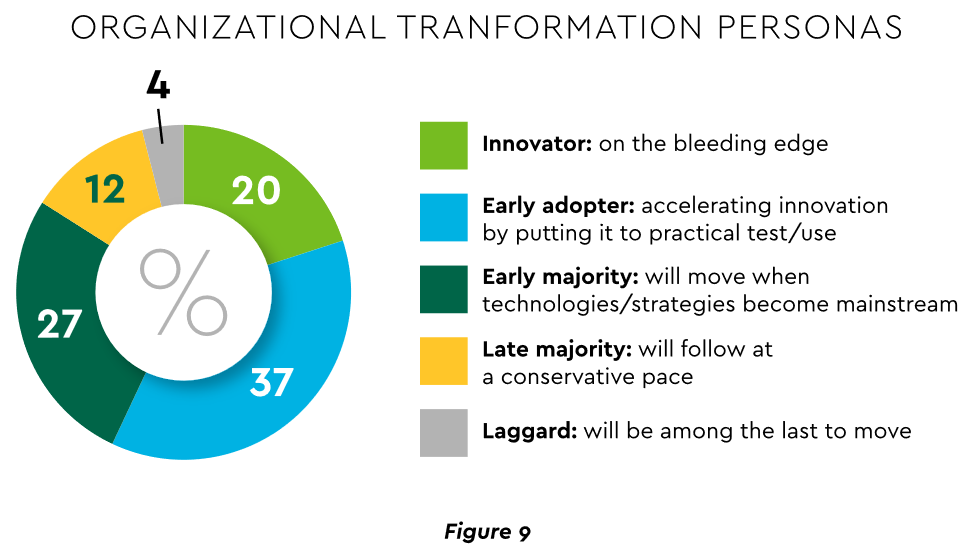
Organizational transformation personas

View PDF of Figure 9 chart[PDF]

Platforms, not point solutions

Implementing enterprise platforms rather than proliferating “point solutions” is obligatory. Organizations must be “prepared to compete in the platform economy as platform-based business models have changed the way we live, work and receive care.”

There are still too many tools and applications. A survey of top decision-makers at health systems found that 60% use over 50 software solutions just in operations (24% have over 150). System integration is one answer. Use of application programming interfaces (API) helps this effort substantially. API-first is fast becoming the norm among solution providers, with global API investment expected to nearly triple by 2030 (Figure 10)
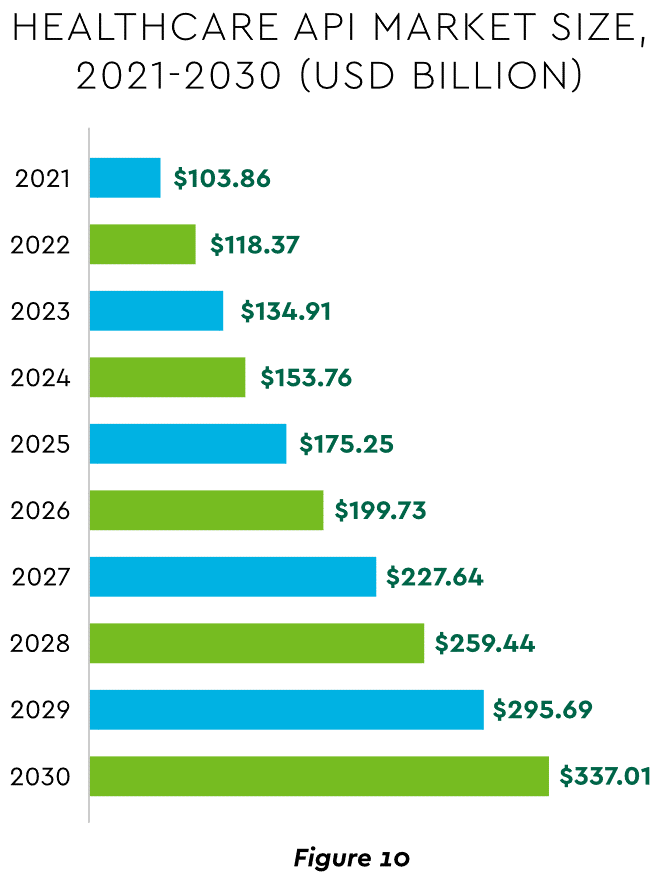
Healthcare API market size

View PDF of Figure 10 chart[PDF]

Governance

Effective governance is vital to constructing a platform-based transformative model and to ensuring wide user adoption. Healthcare has seen the rise of new senior roles such as Chief Digital Officer and Chief Transformation Officer, positions focusing on initiatives like ownership of technology success at the department level and devising user incentives.

8. Digital Payments on the Horizon for Healthcare

A variety of emerging digital payment modes will further the transformation of finance. These payments are expected to grow almost 23% annually in healthcare. ACH payments have been on a strong upward trajectory in healthcare for several years, especially for business transactions. In 2021, ACH tallied a yearly increase of 18% in volume and 5% in dollars.

Notable technologies and payment rails to watch for expected crossover from consumer markets to healthcare include:

  • Mobile payments. The market for mobile payment technologies has been growing at a 16% compound annual clip and should reach $90 billion in 2023, powered by wide smartphone use, 5G networks and convenience. This category encompasses technologies such as e-wallets, forecasted to grow 23% annually worldwide through 2030.
  • Real-time payments (RTP). These digital transactions are settled nearly instantaneously through platforms such as The Clearing House. One forecast sees 30.4% compound RTP growth in the U.S. from 2022 to 2030.
  • Buy Now Pay Later (BNPL). This growing mode offers consumers short-term financing to stretch payments over several installments. A recent survey established that 23% of American adult respondents have used a BNPL service. BNPL is just entering healthcare and is currently regarded as an option for certain elective or cosmetic procedures or for specific individual credit scenarios.  
  • Earned Wage Access (EWA). Using an RTP approach, employers are beginning to offer on-demand pay which enables “instant access to earned wages right after the work is performed, at the end of the shift, or upon completion of a project.” It is not a loan or advance pay. A 2021 poll conducted by Harris found that 83% of U.S. workers feel they should be able to access earned wages at the end of each day. Millennials were particularly interested: 80% would like daily automatic pay streaming to their bank accounts, and 78% said free EWA would boost loyalty to their employer. Given its pressing workforce concerns, healthcare is likely to find EWA a tool to promote retention.

Seeking the right use cases for these payment technologies offers many potential provider benefits.

Conclusion

The connected forces discussed and quantified here create major challenges to address in 2023. The strategic agenda calls for balancing tight cost control with investment in growth opportunities, significantly enhancing patient financial experience by meeting growing patient financial need, shoring up trusted relationships and cybersecurity, and accelerating the digital transformation of finance.

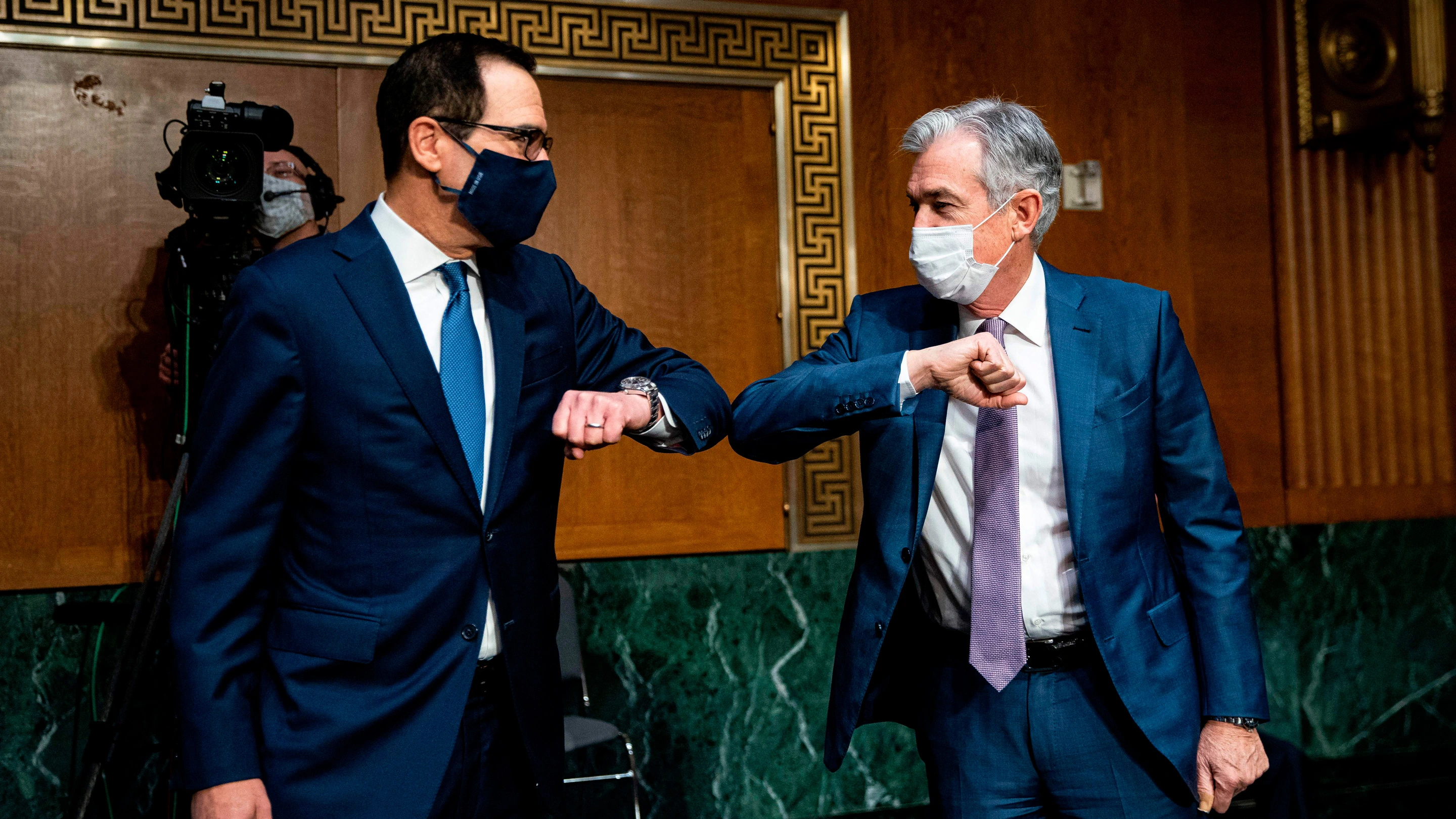
OPPS Rule to Update Outpatient Payments, Hospital Price Transparency

CMS proposes in the Outpatient Prospective Payment (OPPS) rule to increase Medicare outpatient payments by 2.8 percent next year while bolstering hospital price transparency enforcement.

The OPPS rule states that payment rates for hospitals that meet applicable quality reporting requirements will increase in 2024 based on the projected market basket percentage increase of 3.0 percent, less 0.2 percentage points for the productivity adjustment.

Meanwhile, ambulatory surgical centers (ASCs) would also see a 2.8 percent increase in payment rates next year under the proposed ASC rule that was released alongside the OPPS rule.

CMS also proposes to continue using the productivity-adjusted hospital market basket update to ASC payment system rates for another two years despite plans to shift away from the system as hospital procedures shift to ASC settings. But disruptions to care patterns during the COVID-19 pandemic have prompted CMS to extend the application of the hospital market basket update.

The OPPS and ASC proposed rules also include a new benefit category for Medicare beneficiaries who require more frequent services than individual outpatient therapy visits but less intensive services than a partial hospitalization program. The benefit would be the Intensive Outpatient Program and include its own payment and program requirements for services across various settings, including hospital outpatient departments, community mental health centers, and federally qualified health centers.

Starting next year, CMS also proposes establishing payment for intensive outpatient program services as part of Opioid Treatment Programs. These intensive behavioral health services are available for individuals with mental health conditions and substance use disorders.

Other payment policies proposed in the rule include an update to Medicare payment rates for partial hospitalization program services, remote mental health services, and OPPS and ASC dental services, as well as changes to community mental health center Conditions of Participation (CoPs). The proposed rule also contains updates to the 340B payment rate, which CMS proposed to remedy via previous rulemaking to return improper payments to eligible hospitals.

“This proposed rule reflects CMS’ commitment to ensure Medicare is comprehensive in its ability to address patient needs, filling gaps in the health care system including behavioral health,” Meena Seshamani, MD, Deputy Administrator and Director for CMS’ Center for Medicare, said in a statement. “Through these proposals, we will ensure people get timely access to quality care in their communities, leading to improved outcomes and better health.”

HOSPITAL PRICE TRANSPARENCY CHANGES ON HORIZON

In addition to payment updates, the OPPS proposed rule also includes extensive updates to hospital price transparency requirements to increase compliance and enforcement.

Previous OPPS rules have required hospitals to make standard charges, including payer-specific negotiated rates, available to the public in a machine-readable file on their websites and through a more patient-friendly list of shoppable services. Hospitals face financial penalties of up to $2 million if they do not comply with the requirements.

However, a recent website assessment conducted by CMS found that about 70 percent of hospitals were fully meeting display criteria for the machine-readable file, 27 percent were partially meeting display criteria, and just 3 percent failed to post any required pricing data online by the fall of 2022. The rates improved from a previous compliance assessment in early 2021 when 30 percent of hospitals did not publish the required pricing data.

However, the latest OPPS rule aims to increase compliance by altering enforcement actions. For example, the rule would allow CMS to require an authorized hospital official to certify the accuracy and completeness of the data in the machine-readable file. Hospitals may also have to submit additional documentation to determine hospital compliance and an acknowledgment of receipt of the warning notice if CMS deems them out of compliance.

If CMS has to take action to address noncompliance, CMS may also notify the hospital’s health system leadership of the issue and work with the health system to address compliance issues across its system.

Finally, CMS proposes to publicize a hospital’s assessment of compliance, any compliance actions taken against a hospital, and notifications sent to health system leadership.

Additionally, the OPPS rule would update hospital price transparency requirements, requiring hospitals to display the required pricing data using a CMS template versus any machine-readable file format. Pricing data would also have to be encoded in a CSV or JSON format using a CMS template layout and other specified technical instructions.

CMS aims to increase machine-readable file accessibility by proposing a requirement to place a “footer” at the bottom of a hospital’s homepage that links to the webpage with the pricing data. Hospitals would also have to ensure that a .txt file is included in the root folder of the publicly available website chosen by the hospital for posting its machine-readable format.

Healthcare stakeholders can comment on the OPPS and ASC proposed rules through September 11th. CMS expects to release the final rules in November.

The Glaring Disconnect between the Fed and CMS

Two important reports released last Wednesday point to a disconnect in how policymakers are managing the U.S. economy and how the health economy fits.

Report One: The Federal Reserve Open Market Meeting

At its meeting last week, the Governors of the Federal Open Market Committee (FOMC) voted unanimously to keep the target range for the federal funds rate at 5% to 5.25%–the first time since last March that the Fed has concluded a policy meeting without raising interest rates.

In its statement by Chairman Powell, the central bank left open the possibility of additional rate hikes this year which means interest rates could hit 5.6% before trending slightly lower in 2024.

In conjunction with the (FOMC) meeting, meeting participants submitted projections of the most likely outcomes for each year from 2023 to 2025 and over the longer run:

Median202320242025Longer RunLonger Run Range
% Change in GDP1.11.11.81.81.6-2.5
Unemployment rate &4.14.54.54.03.6-4.4
PCE Inflation rate3.22.52.12.02.0
Core PCE Inflation3.92.62.2**

*Longer-run projections for core PCE inflation are not collected.

Notes re: the Fed’s projections based on these indicators:

  • The GDP (a measure of economic growth) is expected to increase 1% more this year than anticipated in its March 2023 analysis while estimates for 2024 were lowered just slightly by 0.1%. Economic growth will continue but at a slower pace.
  • The unemployment rate is expected to increase to 4.1% by the end of 2023, a smaller rise in joblessness than the previous estimate of 4.5%. (As of May, the unemployment rate was 3.7%). Unemployment is returning to normalcy impacting the labor supply and wages.
  • inflation: as measured by the Personal Consumption Expenditures index, will be 3.2% at the end of 2023 vs. 3.3% they previously projected. By the end of 2024, it expects inflation will be 2.5% reaching 2.1% at the end of 2025. Its 2.0% target is within reach on or after 2025 barring unforeseen circumstances.
  • Core inflation projections, which excludes energy and food prices, increased: the Fed now anticipates 3.9% by the end of 2023–0.3% above the March estimate. Price concerns will continue among consumers.

Based on these projections, two conclusions about nation’s monetary policy may be deduced the Fed’s report and discussion:

  • The Fed is cautiously optimistic about the U.S. economy in for the near term (through 2025) while acknowledging uncertainty exists.
  • Interest rates will continue to increase but at a slower rate than 2022 making borrowing and operating costs higher and creditworthiness might also be under more pressure.

Report Two: CMS

On the same day as the Fed meeting, the actuaries at the Centers for Medicare and Medicaid Services (CMS) released their projections for overall U.S. national healthcare spending for the next several years:

“CMS projects that over 2022-2031, average annual growth in NHE (5.4%) will outpace average annual growth in gross domestic product (GDP) (4.6%), resulting in an increase in the health spending share of GDP from 18.3% in 2021 to 19.6% in 2031. The insured percentage of the population is projected to have reached a historic high of 92.3% in 2022 (due to high Medicaid enrollment and gains in Marketplace coverage). It is expected to remain at that rate through 2023. Given the expiration of the Medicaid continuous enrollment condition on March 31, 2023 and the resumption of Medicaid redeterminations, Medicaid enrollment is projected to fall over 2023-2025, most notably in 2024, with an expected net loss in enrollment of 8 million beneficiaries. If current law provisions in the Affordable Care Act are allowed to expire at the end of 2025, the insured share of the population is projected to be 91.2%.  In 2031, the insured share of the population is projected to be 90.5%, similar to pre-pandemic levels.”

The report includes CMS’ assumptions for 4 major payer categories:

  • Medicare Part D: Several provisions from the Inflation Reduction Act (IRA) are expected to result in out-of-pocket savings for individuals enrolled in Medicare Part D. These provisions have notable effects on the growth rates for total out-of-pocket spending for prescription drugs, which are projected to decline by 5.9% in 2024, 4.2% in 2025, and 0.2% in 2026.
  • Medicare: Average annual expenditure growth of 7.5% is projected for Medicare over 2022-2031. In 2022, the combination of fee-for-service beneficiaries utilizing emergent hospital care at lower rates and the reinstatement of payment rate cuts associated with the Medicare Sequester Relief Act of 2022 resulted in slower Medicare spending growth of 4.8% (down from 8.4% in 2021).
  • Medicaid: On average, over 2022-2031, Medicaid expenditures are projected to grow by 5.0%. With the end of the continuous enrollment condition in 2023, Medicaid enrollment is projected to decline over 2023-2025, with most of the net loss in enrollment (8 million) occurring in 2024 as states resume annual Medicaid redeterminations. Medicaid enrollment is expected to increase and average less than 1% through 2031, with average expenditure growth of 5.6% over 2025-2031.
  • Private Health Insurance: Over 2022-2031, private health insurance spending growth is projected to average 5.4%. Despite faster growth in private health insurance enrollment in 2022 (led by increases in Marketplace enrollment related to the American Rescue Plan Act’s subsidies), private health insurance expenditures are expected to have risen 3.0% (compared to 5.8% in 2021) due to lower utilization growth, especially for hospital services.

And for the 3 major recipient/payee categories:

  • Hospitals: Over 2022-2031, hospital spending growth is expected to average 5.8% annually. In 2023, faster growth in hospital utilization rates and accelerating growth in hospital prices (related to economy wide inflation and rising labor costs) are expected to lead to faster hospital spending growth of 9.3%.  For 2025-2031, hospital spending trends are expected to normalize (with projected average annual growth of 6.1%) as there is a transition away from pandemic public health emergency funding impacts on spending.
  • Physicians and Clinical Services: Growth in physician and clinical services spending is projected to average 5.3% over 2022-2031. An expected deceleration in growth in 2022, to 2.4% from 5.6% in 2021, reflects slowing growth in the use of services following the pandemic-driven rebound in use in 2021. For 2025-2031, average spending growth for physician and clinical services is projected to be 5.7%, with an expectation that average Medicare spending growth (8.1%) for these services will exceed that of average Private Health Insurance growth (4.6%) partly as a result of comparatively faster growth in Medicare enrollment.
  • Prescription Drugs: Total expenditures for retail prescription drugs are projected to grow at an average annual rate of 4.6% over 2022-2031. For 2025-2031, total spending growth on prescription drugs is projected to average 4.8%, reflecting the net effects of key IRA provisions: Part D benefit enhancements (putting upward pressure on Medicare spending growth) and price negotiations/inflation rebates (putting downward pressure on Medicare and out-of-pocket spending growth).

Thus, CMS Actuaries believe spending for healthcare will be considerably higher than the growth of the overall economy (GDP) and inflation and become 19.6% of the total US economy in 2031. And it also projects that the economy will absorb annual spending increases for hospitals (5.8%) physician and clinical services (5.3%) and prescription drugs (4.6%).

My take:

Side-by-side, these reports present a curious projection for the U.S. economy through 2031: the overall economy will return to a slightly lower-level pre-pandemic normalcy and the healthcare industry will play a bigger role despite pushback from budget hawks preferring lower government spending and employers and consumers frustrated by high health prices today.

They also point to two obvious near-term problems:

1-The Federal Reserve pays inadequate attention to the healthcare economy. In Chairman Powell’s press conference following release of the FOMC report, there was no comment relating healthcare demand or spending to the broader economy nor a question from any of the 20 press corps relating healthcare to the overall economy. In his opening statement (below), Chairman Powell reiterated the Fed’s focus on prices and called out food, housing and transportation specifically but no mention of healthcare prices and costs which are equivalent or more stressful to household financial security:

“Good afternoon. My colleagues and I remain squarely focused on our dual mandate to promote maximum employment and stable prices for the American people…My colleagues and I are acutely aware that high inflation imposes hardship as it erodes purchasing power, especially for those least able to meet the higher costs of essentials like food, housing, and transportation. We are highly attentive to the risks that high inflation poses to both sides of our mandate, and we are strongly committed to returning inflation to our 2% objective.”

2-Congress is reticent to make substantive changes in Medicare and other healthcare programs despite its significance in the U.S. economy. It’s politically risky. In the June 2 Congressional standoff to lift the $31.4 debt ceiling, cuts to Medicare and Social Security were specifically EXCLUDED. Medicare is 12% of mandated spending in the 2022 federal budget and is expected to grow from a rate of 4.8% in 2022 to 8% in 2023—good news for investors in Medicare Advantage but concerning to consumers and employers facing higher prices as a result.

Even simplifying the Medicare program to replace its complicated Parts A, B, C, and D programs or addressing over-payments to Medicare Advantage plans (in 2022, $25 billion per MedPAC and $75 billion per USC) is politically tricky. It’s safer for elected officials to support price transparency (hospitals, drugs & insurers) and espouse replacing fee for service payments with “value” than step back and address the bigger issue: how should the health system be structured and financed to achieve lower costs and better health…not just for seniors or other groups but everyone.

These two realities contribute to the disconnect between the Fed and CMS. Looking back 20 years across 4 Presidencies, two economic downturns and the pandemic, it’s also clear the health economy’s emergence did not occur overnight as the Fed navigated its monetary policy. Consider:

  • National health expenditures were $1.366 trillion (13.3% of GDP) in 2000 and $4.255 billion in 2021 (18.3% of the GDP). This represents 210% increase in nominal spending and a 37.5% increase in the relative percentage of the nation’s GDP devoted to healthcare. No other sector in the economy has increased as much.
  • In the same period, the population increased 17% from 282 million to 334 million while per capita healthcare spending increased 166% from $4,845 to $12,914. This disproportionate disconnect between population and health spending growth is attributed by economists to escalating unit costs increases for the pills, facilities, technologies and specialty-provider services we use—their underlying cost escalation notably higher than other industries.
  • There were notable changes in where dollars were spent: hospitals were unchanged (from $415 billion/30.4% of total spending to $1.323 trillion/31.4% of total spending), physician services shrank (from $288.2 billion/21.1% of total spending to 664.6 billion/15.6% pf total spending), prescription drugs were unchanged (from $122.3 billion/8.95% to $378 billion/8.88% of total spending) and public health increased slightly (from $43 billion/$3.2% of total spending to $187.6 billion/4.4% of total spending).
  • And striking differences in sources of funding: out of pocket spending shrank from $193.6/14.2% of payments to $433 billion/10.2% % of payments; private insurance shrank from $441 billion/32.3% of payments to $1.21 trillion/28.4% of total payments; Medicare grew from $224.8 billion/16.5% of payments to $900.8 billion/21.2% of payments; Medicaid + CHIP grew from $203.4 billion/14.9% to $756.2 billion/17.8% of payments; and Veterans Health grew from $19.1 billion/1.4% of payments to $106.0 billion/2.5% of payments.

Thus, if these trends continue…

  • Aggregate payments to providers from government programs will play a bigger role and payments from privately insured individuals and companies will play a lesser role.
  • Hospital price increases will exceed price increases for physician services and prescription drugs.
  • Spending for healthcare will (continue to) exceed overall economic growth requiring additional funding from taxpayers, employers and consumers AND/OR increased dependence on private investments that require shareholder return AND/OR a massive restructure of the entire system to address its structure and financing.

What’s clear from these reports is the enormity of the health economy today and tomorrow, the lack of adequate attention and Congressional Action to address its sustainability and the range of unintended, negative consequences on households and every other industry if left unattended. It’s illustrative of the disconnect between the Fed and CMS: one assumes it controls the money supply while delegating to the other spending and policies independent of broader societal issues and concerns.

The health economy needs fresh attention from inside and outside the industry. Its impact includes not only the wellbeing of its workforce and services provided its users. It includes its direct impact on household financial security, community health and the economic potential of other industries who get less because healthcare gets more.

Securing the long-term sustainability of the U.S. economy and its role in world affairs cannot be appropriately addressed unless its health economy is more directly integrated and scrutinized. That might be uncomfortable for insiders but necessary for the greater good. Recognition of the disconnect between the Fed and CMS is a start!

Headwinds facing Not for Profit Hospital Systems are Mounting: What’s Next?

Correction: An earlier version incorrectly referenced a Texas deal between Houston Methodist and Baylor Scott and White.  News about deals is sensitive and unnecessarily disruptive to reputable organizations like these. I sourced this news from a reputable deal advisor: it was inaccurate. My apology!

Congressional Republicans and the White House spared Main Street USA the pain of defaulting on the national debt last week. No surprise.

Also not surprising: another not-for-profit-mega deal was announced:

  • St. Louis, MO-based BJC HealthCare and Kansas City, MO-based Saint Luke’s Health System announced their plan to form a $9.5B revenue, 28-hospital system with facilities in Missouri, Kansas, and Illinois.

This follows recent announcements by four other NFP systems seeking the benefits of larger scale:

  • Gundersen Health System & Bellin Health (Nov 2022): 11 hospitals, combined ’22 revenue of $2.425B
  • Froedtert Health & ThedaCare (Apr 2023 LOI): 18 hospitals, combined ’22 revenues of $4.6B

And all these moves are happening in an increasingly dicey environment for large, not-for-profit hospital system operators:

  • Increased negative media attention to not-for-profit business practices that, to critics, appear inconsistent with a “NFP” organization’s mission and an inadequate trade for tax exemptions each receives.
  • Decreased demand for inpatient services—the core business for most NFP hospital operations. Though respected sources (Strata, Kaufman Hall, Deloitte, IBIS et al) disagree somewhat on the magnitude and pace of the decline, all forecast decreased demand for traditional hospital inpatient services even after accounting for an increasingly aging population, a declining birthrate, higher acuity in certain inpatient populations (i.e. behavioral health, ortho-neuro et al) and hospital-at-home services.
  • Increased hostility between national insurers and hospitals over price transparency and operating costs.
  • Increased employer, regulator and consumer concern about the inadequacy of hospital responsiveness to affordability in healthcare.
  • And heightened antitrust scrutiny by the FTC which has targeted hospital consolidation as a root cause of higher health costs and fewer choices for consumers. This view is shared by the majorities of both parties in the House of Representatives.

In response, Boards and management in these organizations assert…

  • Health Insurers—especially investor-owned national plans—enjoy unfettered access to capital to fund opportunistic encroachment into the delivery of care vis a vis employment of physicians, expansion of outpatient services and more.
  • Private equity funds enjoy unfettered opportunities to invest for short-term profits for their limited partners while planning exits from local communities in 6 years or less.
  • The payment system for hospitals is fundamentally flawed: it allows for underpayments by Medicaid and Medicare to be offset by secret deals between health insurers and hospitals. It perpetuates firewalls between social services and care delivery systems, physical and behavioral health and others despite evidence of value otherwise. It requires hospitals to be the social safety net in every community regardless of local, state or federal funding to offset these costs.

These reactions are understandable. But self-reflection is also necessary. To those outside the hospital world, lack of hospital price transparency is an excuse. Every hospital bill is a surprise medical bill. Supporting the community safety net is an insignificant but manageable obligation for those with tax exemption status.  Advocacy efforts to protect against 340B cuts and site-neutral payment policies are about grabbing/keeping extra revenue for the hospital. What is means to be a “not-for-profit” anything in healthcare is misleading since moneyball is what all seem to play. And short of government-run hospitals, many think price controls might be the answer.

My take:

The headwinds facing large not-for-profit hospitals systems are strong. They cannot be countered by contrarian messaging alone.

What’s next for most is a new wave of operating cost reductions even as pre-pandemic volumes are restored because the future is not a repeat of the past. Being bigger without operating smarter and differently is a recipe for failure.

What’s necessary is a reset for the entire US health system in which not-for-profit systems play a vital role. That discussion should be led by leaders of the largest NFP systems with the full endorsements of their boards and support of large employers, physicians and public health leaders in their communities.

Everything must be on the table: funding, community benefits, tax exemption, executive compensation, governance, administrative costs, affordability, social services, coverage et al. And mechanisms for inaction and delays disallowed.

It’s a unique opportunity for not-for-profit hospitals. It can’t wait.

Assessing Progress on the Hospital Price Transparency Rule

https://revcycleintelligence.com/features/assessing-progress-on-the-hospital-price-transparency-rule

More than a year after the regulation went into effect, compliance with the hospital price transparency rule remains low, as hospitals are hesitant to invest in necessary software and resources.

The Centers for Medicare and Medicaid Services (CMS) established the hospital price transparency rule to help individuals know the cost of a hospital item or service before receiving it.

CMS proposed the price transparency rule in the 2020 Medicare Outpatient Prospective Payment System (OPPS) and Ambulatory Surgical Center (ASC) Payment System Proposed Rule. The rule came in response to rising healthcare costs. Policymakers implemented regulations that give consumers more control over what they pay for healthcare services.

The rule went into effect on January 1, 2021, but hospitals have been slow to comply with the regulation. Without consistent compliance from hospitals and health systems, the rule does little to protect consumers from high healthcare prices.

WHAT IS THE PRICE TRANSPARENCY RULE?

The price transparency rule requires hospitals to publish the costs of their items and services on a publicly available website in two ways.

First, hospitals must have a single machine-readable digital file with standard charges for all their items and services. Standard charges include gross charges, discounted cash prices, payer-specific negotiated chargers, and de-identified minimum and maximum negotiated charges.

Hospitals must also display standard charges of at least 300 shoppable services that consumers can schedule in advance. That information must be displayed in a consumer-friendly format that includes plain language descriptions. Hospitals should also group the services with related ancillary services.

Hospitals may offer an online price estimator tool instead of publishing standard charges for the most common shoppable servicesAccording to CMS, the price estimator tool must provide estimates for as many of the 70 CMS-specified shoppable services that the hospital offers and any additional shoppable services to reach a total of 300 services.

In addition, the tool must allow consumers to receive an estimate of the amount they will have to pay for a given service. Hospitals must display the price estimator tool on their websites and make it accessible to the public for free. Consumers also need to be able to access the tool without creating a user account.

CMS established an enforcement plan to ensure hospitals comply with the price transparency rule. The agency planned to evaluate complaints made by individuals or entities, review analyses of noncompliance, and audit hospital websites. However, more than one year after the regulation went into effect, hospitals are still not complying with the price transparency rule.

PRICE TRANSPARENCY RULE COMPLIANCE

The price transparency regulation received immediate pushback from hospital and provider groups. Before the policy went into effect, the American Hospital Association (AHA) sued HHS over the rule, stating that it would confuse consumers and increase prices.

In addition, AHA and fellow hospital and provider groups submitted an emergency stay of enforcement motion in December 2020 to pause the audits and fines that would result from noncompliance. The groups said the CMS enforcement actions would force hospitals to divert resources that hospitals needed to respond to COVID-19.

Since the rule was implemented, these concerns have perhaps been reflected in the high rates of noncompliance among hospitals.

Data from as early as January 2021 revealed that pricing information was inconsistent and incomplete among the top 20 largest hospitals in the country. The hospitals published some form of pricing information but not all complied with the price transparency requirements, including posting prices for 300 shoppable services.

The Kaiser Family Foundation (KFF) analyzed data from the two largest hospitals in each state and the District of Columbia and found similar trends. For example, 80 percent of the hospitals provided gross charge information on a price estimator tool and a machine-readable file, but only 35 of the 102 hospitals displayed payer-specific negotiated rates.

Moreover, research from Manatt Health found hospitals were more likely to comply with the shoppable services requirement than the machine-readable file requirement.

According to an Insights analysis from Xtelligent Healthcare Media, hospital networks frequently had inaccessible machine-readable files and shoppable services. In addition, many hospitals required patients to provide personally identifiable information in exchange for pricing data and had machine-readable files that lacked the required charges.

PatientRightsAdvocate.org has been tracking hospital compliance with the price transparency rule since May 2021. Between May and July, the organization found that out of 500 randomly selected US hospitals, only 5.6 percent were compliant with the rule.

Between December 2021 and January 2022, the organization reviewed 1,000 more hospitals and found that only 143 complied with all aspects of the price transparency rule.

WHY ARE HOSPITALS NOT COMPLYING?

Under the 2022 Medicare OPPS rule, CMS shared the penalties for not complying with the price transparency rule. Hospitals with less than 30 beds would receive penalties of $300 per day, while hospitals with 31 or more beds would receive a $10 per bed per day penalty, with a maximum daily fine of $5,500.

However, hospitals have not received any penalties for noncompliance as of February 2022. CMS has sent around 345 warning notices to noncompliant hospitals since the rule went into effect, the agency told Becker’s Hospital Review.

The threat of financial penalties does not seem to be enough to ensure compliance, though.

Shortly after the rule took effect, noncompliant hospitals said they were not fully complying due to resource constraints and a limited understanding of the rule. Some hospitals also mentioned that they were waiting to see how their competitors responded to the rule before achieving compliance.

More than one year later, in April 2022, financial leaders expressed similar concerns regarding compliance. Revenue cycle leaders told KLAS that a top barrier to achieving compliance was the confusing and complex regulations included in the rule.

Price transparency compliance also requires significant investment in software and outside resources, the KLAS report noted. As hospitals and health systems struggle financially due to the COVID-19 pandemic, investing in price transparency software may not be a top priority.

In addition, revenue cycle leaders reported experiencing difficulties with the software used to publish machine-readable files and a master list of prices online.

Until CMS starts delivering monetary penalties for noncompliance or adjusts the regulation to reduce the financial burden for health systems, hospital compliance with the price transparency rule will likely remain slim.

Hospitals’ off-site fees draw lawmakers’ scrutiny

More than two years after Congress acted to shield patients from surprise medical bills, lawmakers are turning to another source of unexpected medical costs: the fees that hospitals tack on for services provided in clinics they own.

Why it matters: 

As health systems push more care outside hospital walls, they’re charging extra “facility fees” for common services like blood tests, X-rays and, in some cases, even telehealth visits.

  • Critics say the practice drives up health care costs while padding hospital profits and incentivizing more consolidation. But hospitals argue the fees cover the cost of nurses, lab technicians, medical records and equipment — and that limiting them could reduce patient care.

Driving the news: 

The fees have caught the attention of Congress, which could take up price transparency legislation.

But five states are currently considering laws to curb facility fees for certain services or strengthen existing laws, per the National Academy for State Health Policy, which has proposed model legislation.

  • Connecticut is updating a 2015 law that required notifications when facility fees were being charged by hospitals.
  • “Rising costs remain a barrier for far too many people and result in many people putting off care because they can’t afford it,” Deidre Gifford, executive director of the Connecticut Office of Health Strategy, said last month, when Democratic Gov. Ned Lamont proposed a package of reforms.
  • Colorado lawmakers are targeting the practice, despite mounting hospital resistance, Kaiser Health News reported.
  • And Texas legislators are weighing prohibitions on off-campus fees — a move the Texas Hospital Association brands “unprecedented and dangerous.”
  • Lawmakers in Indiana and Massachusetts are eyeing similar moves.

How it works: 

Many health services can be provided in both hospital and outpatient settings. But some patients who visit an offsite clinic are billed as if they were treated in the hospital.

  • Some might receive a facility fee if they haven’t yet met their health plan deductible. Others could see the added cost reflected later in higher premiums and copays.
  • A 2020 Rand report found facility and related professional charges factored in employers and private insurers paying 224% of what Medicare would have paid for the same services at the same facilities.

Some business groups like the Employers’ Forum of Indiana are advocating for bans or moratoriums on the fees, citing the increased cost of offering competitive benefits.

The other side: 

Hospitals maintain that facility fees are needed to cover essential infrastructure like electronic health record systems and other overhead costs. Some refer to them as “people fees,” saying they cover the expenses of nurses, lab technicians, pharmacists and other essential staff.

  • Texas hospitals are concerned about what they say is the broad definition of a facility fee in pending legislation in the state’s Senate, saying it could eliminate all hospital payments besides those that go to physicians.
  • “We need to quantify what problem we’re trying to solve,” said Cameron Duncan, vice president of advocacy at the Texas Hospital Association.
  • The group said the bill as originally filed would result in 69% of Texas hospitals closing their outpatient clinics.

The intrigue: 

Insurers that negotiated covered costs with hospitals and health systems have remained largely quiet on the fees.

  • And the vagaries of hospital pricing means transparency requirements alone may not give patients warning about added fees.
  • “It’s not clear from data either that the fees are consistent, or that you could decipher that the fee is consistent for each type of procedure,” said Vicki Veltri, senior policy fellow at National Academy for State Health Policy and former leader of the Connecticut Office of Health Strategy.

The bottom line: 

Patients increasingly get charged like they’re in a hospital even if they didn’t set foot in one as physicians’ offices are increasingly scooped up by massive health systems.

  • While those health systems tout access and efficiencies to drive down health care costs, facility fees are driving more lawmakers and regulators to do a reality check.

‘Hospital purgatory’: Confidence in healthcare plunges as criticism grows louder and larger

Payers, pharmacy benefit managers and drug manufacturers are no strangers to heavy criticism from the public and providers alike. Now another sector of the healthcare system has found itself increasingly caught in the crosshairs of constituents looking to point a finger for the rising cost of care: hospitals.

As sharp words against the industry bubble up more often and encompass a wider variety of issues, it marks an important turn in the ethos of American healthcare. Most policymakers have historically wanted hospitals on their side, and health systems are often the largest employer within their communities and in many states.

“In my career, I’ve never seen things more aligned to the detriment of hospitals than it is now,” Paul Keckley, PhD, said. Dr. Keckley is a widely known industry analyst and editor of The Keckley Report, a weekly newsletter discussing healthcare policy and current trends. 

Confidence in the medical system as a whole fell from 51 percent in 2020 to a record low of 38 percent in 2022. Though the healthcare system is among all major U.S. institutions facing record-low public confidence, are hospitals ready for an era of widespread distrust? 

We’re going into hospital purgatory. It’s a period in which old rules may not work in the future,” Dr. Keckley said. “The only thing we know for sure is that it’s not going to get easier.”

State-versus-hospital fights have popped up throughout the U.S. over the past year. Most recently, in Colorado, a back and forth unfolded between Gov. Jared Polis and the state’s hospital association over who is ultimately responsible for high care costs. In a speech Jan. 17, the Democratic governor accused Colorado’s hospitals of overcharging patients and sitting on significant cash reserves.

“It’s time that we hold them accountable,” he said.

The Colorado Hospital Association says the data supporting those claims does not reflect the several ongoing industry challenges, among them labor shortages, regulatory burdens and inflationary pressures.

“Unfortunately, we continue to hear rhetoric against the hospitals and health systems that have worked diligently on healthcare quality, access and affordability,” CHA said in a statement to Becker’s. “Colorado’s hospitals and health systems have been working with the administration on many of these programs, including reinsurance, hospital discounted care, price transparency, out-of-network patient protections, and more.”

Some 1,500 miles eastward, another incident of hospital-community conflict grew. In January, Pennsylvania lawmakers promoted a nonpartisan report that accuses UPMC of building a monopoly in the state through consolidation over the last decade — the Pittsburgh-based system refuted the claims, saying they were based on “flawed data.”

To the south, North Carolina officials accused the state’s seven largest health systems in June of using pandemic aid to enrich themselves. Hospitals said the accusations were based on “cherry-picked data” spun in a way that does not reflect their ongoing challenges.

As state- and market-level fights against hospitals intensify and grab national attention, hospitals and health systems may find themselves less familiar in steadying public perception than their payer and pharmaceutical counterparts, who are no strangers to vocal opponents.  

“With public opinion shifting a bit amid COVID, and with some anecdotal evidence that hospitals are doing some bad things, state policymakers feel that they are enjoying the political will to make these gestures,” Ge Bai, PhD, said. “It’s also a key issue for voters. Even if they don’t do anything in reality, the gesture will probably get political capital.”

Dr. Bai is a professor of accounting and health policy at Baltimore-based Johns Hopkins University. She believes a key underlying factor driving hospital critiques as of late is the reduced public confidence in medicine by way of the pandemic. 

“The hospital industry has moved away from its traditional charitable mission and toward a business orientation that is undeniable,” she said. “With the [pandemic] dust settling, I think a lot of people realize the clinicians are the heroes, but hospitals are maybe not as altruistic as they once thought.”

In 2021, over 70 percent of Americans said they trusted physicians and nurses, but only 22 percent said the same about hospital executives, according to a study from the University of Chicago and The Associated Press-NORC Center for Public Affairs Research. 

“It’s a tough job and a complicated business to run, and everybody in the community has an opinion about it based on anecdotal evidence,” Dr. Keckley said. “I think much of the blame too for hospitals taking a lot of hits has been boards that are not prepared to govern.”

For both Drs. Keckley and Bai, there are other major issues they each point to as contributing factors to the growing wariness around hospital operations: 

  • A lack of compliance with CMS price transparency rules. Some of the most recent studies estimate hospital compliance rates could range from 16 percent to 55 percent, while hospitals say the issue has been mischaracterized. CMS has penalized very few hospitals for noncompliance since the rule took effect in 2021.
  • The decades-long trend of consolidation hitting a tipping point. With consolidation, hospitals have long argued the trend would lead to more efficiency, care access, quality of care and lower costs. One of the most comprehensive consolidation studies to date was released Jan. 24 in JAMA and concluded that merged health systems have led to “marginally better care at significantly higher costs.”

    “Hospitals are doing exactly what they’re supposed to do — make money to survive and expand,” Dr. Bai said. “Instead of blaming individual players, we have to raise the bar and think about who created the system in the first place that makes competition so difficult — the government.”
  • State retirement benefits plans struggling financially. Though not a new trend, unfunded healthcare benefits promised to retired public employees and their dependents continues to grow around the country, incentivizing state lawmakers to look in new directions to save on costs. Unfunded retiree healthcare liabilities across all states surpassed $1 trillion in 2019, according to the American Legislative Exchange Council.
  • Competition from other healthcare sectors. Competition for patients has arrived from other healthcare sectors, especially from payers. In 2023, UnitedHealth Group’s Optum owns or is affiliated with the most physicians in the country at 60,000, though it’s likely higher after several large acquisitions last year.

“The center of gravity in healthcare has shifted from hospitals that muscled their way into scaling,” Dr. Keckley said. “The reality is that providing hospital services in non-hospital settings that are safe, effective and less costly is where the market, and insurers, are going.”

Despite the uptick in states and Americans that have gone into fault-finding mode against hospitals and those running them, operating a financially successful hospital or health system in 2023 is a monumental task, perhaps even close to impossible for many. Last year, approximately half of U.S. hospitals finished the year with a negative margin, making it “the worst financial year” for the industry since the start of the pandemic, according to Kaufman Hall’s latest “National Flash Hospital Report.”

“Hospitals aren’t going into this with a huge amount of goodwill at their backs, and I think that’s what they need to be prepared for,” Dr. Keckley said. “You can’t just go in and tell the story of ‘look at what we do for the community’ or ‘look at all the people we employ’ — that is not going to work anymore.”

Here’s how hospitals can chart a path to a sustainable financial future (Part 2: Hospital of the Future series)

Radio Advisory’s Rachel Woods sat down with Optum EVP Dr. Jim Bonnette to discuss the sustainability of modern-day hospitals and why scaling down might be the best strategy for a stable future.

Read a lightly edited excerpt from the interview below and download the episode for the full conversation.https://player.fireside.fm/v2/HO0EUJAe+Rv1LmkWo?theme=dark

Rachel Woods: When I talk about hospitals of the future, I think it’s very easy for folks to think about something that feels very futuristic, the Jetsons, Star Trek, pick your example here. But you have a very different take when it comes to the hospital, the future, and it’s one that’s perhaps a lot more streamlined than even the hospitals that we have today. Why is that your take?

Jim Bonnette: My concern about hospital future is that when people think about the technology side of it, they forget that there’s no technology that I can name that has lowered health care costs that’s been implemented in a hospital. Everything I can think of has increased costs and I don’t think that’s sustainable for the future.

And so looking at how hospitals have to function, I think the things that hospitals do that should no longer be in the hospital need to move out and they need to move out now. I think that there are a large number of procedures that could safely and easily be done in a lower cost setting, in an ASC for example, that is still done in hospitals because we still pay for them that way. I’m not sure that’s going to continue.

Woods: And to be honest, we’ve talked about that shift, I think about the outpatient shift. We’ve been talking about that for several years but you just said the change needs to happen now. Why is the impetus for this change very different today than maybe it was two, three, four, five years ago? Why is this change going to be frankly forced upon hospitals in the very near future, if not already?

Bonnette: Part of the explanation is regarding the issues that have been pushed regarding price transparency. So if employers can see the difference between the charges for an ASC and an HOPD department, which are often quite dramatic, they’re going to be looking to say to their brokers, “Well, what’s the network that involves ASCs and not hospitals?” And that data hasn’t been so easily available in the past, and I think economic times are different now.

We’re not in a hyper growth phase, we’re not where the economy’s performing super at the moment and if interest rates keep going up, things are going to slow down more. So I think employers are going to become more sensitized to prices that they haven’t been in the past. Regardless of the requirements under the Consolidated Appropriations Act, which require employers to know the costs, which they didn’t have to know before. They’re just going to more sensitive to price.

Woods: I completely agree with you by the way, that employers are a key catalyst here and we’ve certainly seen a few very active employers and some that are very passive and I too am interested to see what role they play or do they all take much more of an active role.

And I think some people would be surprised that it’s not necessarily consumers themselves that are the big catalyst for change on where they’re going to get care, how they want to receive care. It’s the employers that are going to be making those decisions as purchasers themselves.

Bonnette: I agree and they’re the ultimate payers. For most commercial insurance employers are the ultimate payers, not the insurance companies. And it’s a cost of care share for patients, but the majority of the money comes from the employers. So it’s basically cutting into their profits.

Woods: We are on the same page, but I’m going to be honest, I’m not sure that all of our listeners are right. We’re talking about why these changes could happen soon, but when I have conversations with folks, they still think about a future of a more consolidated hospital, a more outpatient focused practice is something that is coming but is still far enough in the future that there’s some time to prepare for.

I guess my question is what do you say to that pushback? And are there any inflection points that you’re watching for that would really need to hit for this kind of change to hit all hospitals, to be something that we see across the industry?

Bonnette: So when I look at hospitals in general, I don’t see them as much different than they were 20 years ago. We have talked about this movement for a long time, but hospitals are dragging their feet and realistically it’s because they still get paid the same way until we start thinking about how we pay differently or refuse to pay for certain kinds of things in a hospital setting, the inertia is such that they’re going to keep doing it.

Again, I think the push from employers and most likely the brokers are going to force this change sooner rather than later, but that’s still probably between three and five years because there’s so much inertia in health care.

On the other hand, we are hitting sort of an unsustainable phase of cost. The other thing that people don’t talk about very much that I think is important is there’s only so many dollars that are going to health care.

And if you look at the last 10 years, the growth in pharmaceutical spend has to eat into the dollars available for everybody else. So a pharmaceutical spend is growing much faster than anything else, the dollars are going to come out of somebody’s hide and then next logical target is the hospital.

Woods: And we talked last week about how slim hospital margins are, how many of them are actually negative. And what we didn’t mention that is top of mind for me after we just come out of this election is that there’s actually not a lot of appetite for the government to step in and shore up hospitals.

There’s a lot of feeling that they’ve done their due diligence, they stepped in when they needed to at the beginning of the Covid crisis and they shouldn’t need to again. That kind of savior is probably not their outside of very specific circumstances.

Bonnette: I agree. I think it’s highly unlikely that the government is going to step in to rescue hospitals. And part of that comes from the perception about pricing, which I’m sure Congress gets lots of complaints about the prices from hospitals.

And in addition, you’ll notice that the for-profit hospitals don’t have negative margins. They may not be quite as good as they were before, but they’re not negative, which tells me there’s an operational inefficiency in the not for-profit hospitals that doesn’t exist in the for-profits.

Woods: This is where I wanted to go next. So let’s say that a hospital, a health system decides the new path forward is to become smaller, to become cheaper, to become more streamlined, and to decide what specifically needs to happen in the hospital versus elsewhere in our organization.

Maybe I know where you’re going next, but do you have an example of an organization who has had this success already that we can learn from?

Bonnette: Not in the not-for-profit section, no. In the for-profits, yes, because they have already started moving into ambulatory surgery centers. So Tenet has a huge practice of ambulatory surgery centers. It generates high margins.

So, I used to run ambulatory surgery centers in a for-profit system. And so think about ASCs get paid half as much as a hospital for a procedure, and my margin on that business in those ASCs was 40% to 50%. Whereas in the hospital the margin was about 7% and so even though the total dollars were less, my margin was higher because it’s so much more efficient. And the for-profits already recognize this.

Woods: And I’m guessing you’re going to tell me you want to see not-for-profit hospitals make these moves too? Or is there a different move that they should be making?

Bonnette: No, I think they have to. I think there are things beyond just ASCs though, for example, medical patients who can be treated at home should not be in the hospital. Most not-for-profits lose money on every medical admission.

Now, when I worked for a for-profit, I didn’t lose money on every Medicare patient that was a medical patient. We had a 7% margin so it’s doable. Again, it’s efficiency of care delivery and it’s attention to detail, which sometimes in a not-for-profit friends, that just doesn’t happen.

Is a ‘cash pay revolution’ coming for hospitals?

https://www.advisory.com/daily-briefing/2022/10/19/cash-pay-hospitals

Amid new price transparency laws and growing consumer demand, more hospitals are adding cash pay options for certain health care services instead of just accepting insurance, Nora Tepper writes for Modern Healthcare—and some hospital officials say these offerings are “only going to go up” in the future.

How an ‘anomaly’ is becoming more common

Providers advertising cash pay rates for their services used to be considered an “anomaly,” Tepper writes. Now, the No Surprises Act, the federal price transparency law, and changing consumer expectations may make cash-only payments for health care services more common.

“The market is going there,” said Larry Van Horn, associate professor of management, law, and health policy and executive director of health affairs at Vanderbilt University. “You’ve got direct primary care, you’ve got physicians going and moving into cash pay. You’re gonna have to sit there at some point and say, ‘Wait a minute, they’re taking my business.'”

Although some hospitals and health systems that serve certain populations—such as Pomerene Hospital in Ohio with Amish and Anabaptist patients and the University of Texas MD Anderson Cancer Center with medical tourists—have long had cash-pay systems, it is still a relatively new concept for most providers in the United States.

According to data from Medscape, which surveyed more than 17,000 clinicians, just 17% of clinicians used cash-only, concierge, or direct-pay primary care models in 2020. Primary care providers (PCPs) made up the largest proportion of providers accepting cash pay, with 10% of practices charging patients a flat monthly fee for unlimited services.

“[S]ome providers embracing the cash pay revolution say their bottom line benefits from faster reimbursement, lower administration costs and higher patient retention,” Tepper writes.

In a 2020 report from the Society of Actuaries, almost all PCPs who operated under self-pay models reported “better or much better” personal and professional satisfaction compared to those under a traditional fee-for-service system. In addition, 34% of respondents reported “better or much better” earnings under a direct payment model.

How patients could benefit from cash-pay systems

According to Tepper, hospitals generally offer self-paying patients, who have typically been uninsured individuals or those with high-deductible health plans, lower rates for services compared to commercial insurers since they don’t have to handle administrative work or collections.

In a 2021 study published in JAMA Network Open, researchers analyzed rates for “shoppable” services at 922 hospitals and found that the proportion of hospitals that had lower cash prices than their median commercial negotiated rate ranged from 38.4% for liver tests to 68.5% for C-sections.

During the pandemic, more insured patients began to inquire about what services they could pay cash for, leading some health systems to create new payment models for certain procedures.

For example, Deaconess Health System launched an in-house bundled payment program, which includes cardiology, radiology, and urgent care services, in July 2020. The first year, the health system sold 130 bundled services, which increased to 351 in 2021, and 489 as of August 2022.

For any services not covered by the program, Deaconess offers a 50% discount on cash payments compared to its insurer rate. However, self-paying patients are required to pay the full cost of a procedure upfront.

“The patient has decided to take a bet on themselves,” said Steve Russell, VP and chief revenue cycle officer at Deaconess. “They have a high deductible, they don’t think they’re going to reach that threshold and their thought is, ‘If I don’t use my insurance, what kind of discount can you give me?'”

Separately, CommonSpirit Health‘s Catholic Health Initiatives (CHI) launched its own bundled cash price program in 2018 after noticing that many patients with high-deductible plans would defer care due to affordability concerns. The health system also advertises and sells its services on MDsave, an online marketplace that allows consumers to shop for health care procedures.

“With the No Surprises Act and the price transparency regulations, this has to be something that we offer,” said Jeanette Wojtalewicz, SVP and CFO at CHI Health’s Midwest division. “You’ll see more of this coming.”

The future of cash-pay systems in hospitals

According to Aaron Miri, SVP and chief digital and information officer at Baptist Health South Florida, although few patients are currently paying directly for health care services, the industry is heading towards that direction, which means health systems need to be prepared to meet the demand.

“When you look at the directionality of demand, this is only going to go up,” Miri said. “Patients are going to start seeing their total estimated bill and say, ‘I want to spend my $500 at a health system that was really transparent with me, and made me feel comfortable, versus the health system down the road that I’ve always gone to, but that simply can’t tell me what my actual amount due is.”

To make it easier for patients to directly pay for procedures, some health systems, including Baptist Health, have updated their payment options by adding Apple Pay, Google Pay, or other online payment systems instead of just accepting payment in-person or by phone.

However, even as direct payment models become more common, some insurers are “using their leverage to slow adoption of cash pay,” Tepper writes.

Kimberly Scaccia, VP of revenue management at MercyHealth, said some of the health system’s contracts with insurers prohibit it from offering cash discounts to insured patients.

“Some of the smaller payers, they’re fine with removing [cash pay restrictions],” Scaccia said. “Some of the very, very large payers, they simply will not allow it.”

In addition, Matthew Fiedler, a senior fellow of economic studies at the USC-Brookings Schaeffer Initiative for Health Policy, said clinicians may also be concerned about insurers asking to pay the lower cash rate during contract renewals or jeopardizing a provider’s network position.

“An insurer could say, ‘We’re gonna put this provider out-of-network, but we’re gonna put them in a preferred out-of-network position in our benefit design, where the cost-sharing is not that onerous, because we know they have this really good cash price,'” Fiedler said.

Setting the post-COVID agenda for health systems

https://mailchi.mp/9e0c56723d09/the-weekly-gist-july-8-2022?e=d1e747d2d8

As the economic situation has worsened over the past few months, we’ve been working with several health systems to recalibrate strategy. For many, the anticipated “post-COVID recovery” period has turned into a struggle to reverse declining (often negative) margins, while still scrambling to address mounting workforce shortages. All this amid continued pressure from disruptive competitors and ever-rising consumer expectations.

In the graphic above, we’ve pulled together some of the most important changes we believe health systems need to make. These range from improvements to the operating model (shifting to a team-based approach to staffing, greater use of automation where appropriate, and moving to asset-light capital strategies) to transformations of the clinical model (moving care into lower-cost outpatient and community settings, integrating virtual care into clinical delivery, and creating tighter alignment with key physicians).

In general, the goal is to deliver lower-cost care in less expensive settings, using less expensive staff. 

But those cost-saving strategies will need to be coupled with a new go-to-market approach, including new payment models that reward systems for shifting away from high-cost (and highly reimbursed) care models. 

Employers and consumers will expect more solution-based offerings, which integrate care across the continuum into coherent bundles of service. This will require a more deliberate focus on service line strategies, moving away from a fragmented, inpatient-centric model.

Contracting approaches must align payment with this shift, changing incentives to reward coordinated, cost-effective, outcomes-driven care. 

A key insight from our discussions with health system leaders: short-term cost-cutting initiatives to “stop the bleed” won’t suffice—instead, more permanent solutions will be required that address not only the core operating model, but also the approach to revenue generation. 

The post-COVID environment is turning out to be a lot tougher than many had expected, to say the least.