President Trump vowed to overhaul the health care system, notably saying in one of his first post-election speeches that pharmaceutical companies were “getting away with murder” over their pricing tactics.
Yes, but: Four years later, not a lot has changed. If anything, the health care industry has become more financially and politically powerful, Axios’ Bob Herman reports.
“Most of the bigger ideas have either been stopped in the courts or just never got implemented,” said Cynthia Cox, a vice president at the Kaiser Family Foundation who follows the health care industry.
The administration killed its own regulationthat would have changed behind-the-scenes negotiations between drug companies and pharmacy benefit managers.
One of the most consequential drug proposals — tying Medicare drug prices to lower prices negotiated abroad — is not remotely close to going into effect.
Forcing drug companies to disclose prices in TV ads was a small gambit, and the courts ultimately struck down the idea.
The other side: The policies the administration has seen through, so far, have been relatively modest.
New rules could force hospitals and health insurers to disclose their secret prices. Hospitals have sued, although the courts are not sympathetic to their pleas, and health insurers still have two years before their rule could go into effect.
Between the lines:Health care has consistently raked in large sums of profit every year of Trump’s presidency. That has been especially true during the pandemic.
As the “third wave” of coronavirus continued to gain steam across the US this week, the nation passed another grim milestone, with more than 9M Americans now having tested positive for the virus, and the seven-day average number of new cases hitting a pandemic record of almost 72,000 new diagnoses daily. In states that we’ll surely be discussing a lot in the next week, cases were up 33 percent in Pennsylvania, 25 percent in Michigan, 23 percent in Wisconsin, 21 percent in Florida, and 16 percent in Arizona.
In a sign that the magnitude of case growth is not just an artifact of more testing, hospitalizationsfor COVID have risen 46 percent since the beginning of October, and are up 12 percent just this week. Nevertheless, as part of its “closing argument” to voters, the Trump administration this week touted “ending the COVID-19 pandemic” as one of its signature first-term accomplishments, although new polling data from Axios/Ipsos show that 62 percent of Americans believe the federal government is making the recovery worse, and 46 percent say the response has gotten worse since the first surge of cases in March and April.
Dr. Anthony Fauci, the talismanic director of the National Institute of Allergy and Infectious Diseases, told CNBC this week that “if things do not change, if they continue on the course we’re on, there’s gonna be a whole lot of pain in this country with regard to additional cases, and hospitalizations, and deaths.”
In separate remarks, Fauci pulled back from earlier predictions for the timing of a safe and effective vaccine against the coronavirus. In comments made Thursday, he said he now expects a vaccine to be available to those in high-priority groups “by the end of December or the beginning of January.”
The CEO of drug maker Pfizer, which is among the furthest along in vaccine development, urged patience as its Phase 3 trial nears full enrollment, and researchers prepare to review and submit safety data to the Food and Drug Administration. He again assured investors that the vaccine timeline would remain apolitical, stating “This is not going to be a Republican vaccine or a Democratic vaccine. It would be a vaccine for citizens of the world.”AstraZeneca, also ahead in development of a coronavirus vaccine, reported promising results regarding immune responses among participants in its clinical trials, being conducted jointly with Oxford University.
With the Presidential election just a few days away, it remains clear that neither the virus nor the scientific community’s efforts to combat it are conforming to the best-laid plans of political leaders.
The outcome of the looming political battle, however, will surely determine the context in which the larger fight against this pandemic takes place. Again, please vote—it’s a matter of life and death.
A complete financial recovery for many organizations is still far away, findings from Kaufman Hall indicate.
For the past three years, Kaufman Hall has released annual healthcare performance reports illustrating how hospitals and health systems are managing, both financially and operationally.
This year, however, with the pandemic altering the industry so broadly, the report took a different approach: to see how COVID-19 impacted hospitals and health systems across the country. The report’s findings deal with finances, patient volumes and recovery.
The report includes survey answers from respondents almost entirely (96%) from hospitals or health systems. Most of the respondents were in executive leadership (55%) or financial roles (39%). Survey responses were collected in August 2020.
FINANCIAL IMPACT
Findings from the report indicate that a complete financial recovery for many organizations is still far away. Almost three-quarters of the respondents said they were either moderately or extremely concerned about their organization’s financial viability in 2021 without an effective vaccine or treatment.
Looking back on the operating margins for the second quarter of the year, 33% of respondents saw their operating margins decline by more than 100% compared to the same time last year.
Revenue cycles have taken a hit from COVID-19, according to the report. Survey respondents said they are seeing increases in bad debt and uncompensated care (48%), higher percentages of uninsured or self-pay patients (44%), more Medicaid patients (41%) and lower percentages of commercially insured patients (38%).
Organizations also noted that increases in expenses, especially for personal protective equipment and labor, have impacted their finances. For 22% of respondents, their expenses increased by more than 50%.
IMPACT ON PATIENT VOLUMES
Although volumes did increase over the summer, most of the improvement occurred in areas where it is difficult to delay care, such as oncology and cardiology. For example, oncology was the only field where more than half of respondents (60%) saw their volumes recover to more than 90% of pre-pandemic levels.
More than 40% of respondents said that cardiology volumes are operating at more than 90% of pre-pandemic levels. Only 37% of respondents can say the same for orthopedics, neurology and radiology, and 22% for pediatrics.
Emergency department usage is also down as a result of the pandemic, according to the report. The respondents expect that this trend will persist beyond COVID-19 and that systems may need to reshape their business model to account for a drop in emergency department utilization.
Most respondents also said they expect to see overall volumes remain low through the summer of 2021, with some planning for suppressed volumes for the next three years.
RECOVERY MEASURES
Hospitals and health systems have taken a number of approaches to reduce costs and mitigate future revenue declines. The most common practices implemented are supply reprocessing, furloughs and salary reductions, according to the report.
Executives are considering other tactics such as restructuring physician contracts, making permanent labor reductions, changing employee health plan benefits and retirement plan contributions, or merging with another health system as additional cost reduction measures.
THE LARGER TREND
Kaufman Hall has been documenting the impact of COVID-19 hospitals since the beginning of the pandemic. In its July report, hospital operating margins were down 96% since the start of the year.
As a result of these losses, hospitals, health systems and advocacy groups continue to push Congress to deliver another round of relief measures.
Earlier this month, the House passed a $2.2 trillion stimulus bill called the HEROES Act, 2.0. The bill has yet to pass the Senate, and the chances of that happening are slim, with Republicans in favor of a much smaller, $500 billion package. Nothing is expected to happen prior to the presidential election.
Less than three months from now, either Donald Trump will begin his second term as President, or Joe Biden will begin his first. What the U.S. healthcare system on that date and moving forward could be starkly different depending on who is sworn in.
The policy differences between the two men are essentially on opposite poles. If fully enacted, Trump’s policies could potentially cause tens of millions of Americans to lose their healthcare coverage.Biden’s policies would likely provide healthcare access to tens of millions more Americans compared to today.
In November, the U.S. Supreme Court will hear arguments in a case called California v. Texas. It stems from the 2017 tax bill that zeroed out the penalty individuals paid if they did not obtain health insurance. The argument put forth by the 20 Republican state attorney generals in that case is if the individual mandate no longer has taxing power, the entire law should be declared unconstitutional based upon a lack of severability of the entire law.
Many legal scholars have noted that this case is premised on a shaky argument. But with a 6-3 majority of conservative justices now on the high court, many bets are off as to the ACA’s survival. And President Trump just said in an interview with “60 Minutes” he fervently hoped the ACA is eliminated. He put forth no alternatives to the ACA in that interview.
Should the ACA be declared unconstitutional, health insurance for some 23 million people would be imperiled. That includes some 12 million Americans who are eligible for Medicaid under the ACA’s expanded income guidelines, and another 11 million who purchase insurance on the state and federal health insurance exchanges – roughly 85% of whom receive premium subsidies that make it more affordable. Moreover, another 14 million Americans who are estimated to have lost their employer-based health plans during the COVID-19 pandemic may not have another place to turn for coverage.
Before the ACA case, the Trump administration also promoted so-called “off-exchange” health plans, and health sharing ministries. The first is often a form of short-term health insurance, the second operates as a cooperative serving those of the same religious stripe. Both offer health coverage that is potentially cheaper that what is offered on the exchanges, but both also tend to cap it at low dollar levels. Many also bar applicants for a variety of claims, such as for maternity or cancer care, or if they have pre-existing medical conditions – practices prohibited for ACA plans.
Should Trump be re-elected and the ACA survives constitutional muster, expect to see many states apply for more waivers from that law. Georgia just received approval to modestly expand Medicaid eligibility, primarily for those poor already working 80 hours or more a month. The state is also on the cusp of being able to opt out of the healthcare.gov exchange entirely and have consumers work directly with insurance brokers to purchase coverage. However, there is nothing in the pending waiver to prevent those brokers from offering stripped-down coverage without the ACA protections that the Trump administration is already promoting. There could also be more block grants to states for their Medicaid budgets, which most experts have concluded would reduce the number of enrollees in that program.
If Biden is elected and both incoming houses of Congress are also Democratic, the entire Supreme Court case can be mooted simply by reattaching a financial penalty to the individual mandate. That hasn’t been mentioned at all during the campaign, presumably because Biden does not want to discuss what would essentially be a promise to raise taxes. But it is the most direct way to skirt the risk of an adverse Supreme Court decision.
Biden’s campaign has also put forth numerous proposals to enlarge the ACA and the Medicare program. They include expanded premium subsidies for individuals and families to purchase coverage, and a public health plan option – which would allow those who live in the states that have yet to expand Medicaid to obtain coverage. Biden has also proposed a buy-in to Medicare at age 60.
The estimates are that an expanded ACA and other Biden plans could net another 20 to 25 million Americans healthcare coverage. That would leave fewer than 10 million – 2% to 3% of the population – without access to coverage. It would probably be as close to universal healthcare as the United States could get given its current political realities.
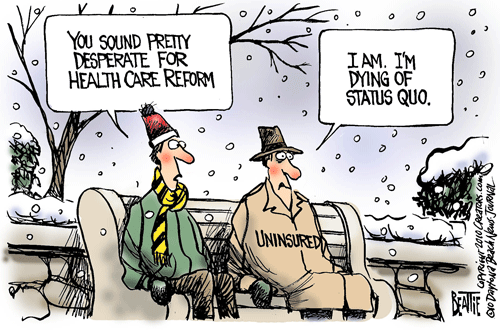
The two different approaches will either lead to a country where virtually everyone has access to healthcare coverage and services, or one where 50 million or more people could potentially be uninsured. It’s a shift that could impact a minimum of 45 million people – and that’s not even counting those who lost their coverage during the current public health crisis.
Elections have consequences. Less than three months from now, this one will determine whether the U.S. healthcare system will take one consequential path over another.








 HENRY KOTULA