Health Care in the 2020 Presidential Election — A Commonwealth Fund Blog Series

https://www.commonwealthfund.org/blog/2020/introducing-health-care-2020-presidential-election-series

Comparing the Candidates' Health Care Plans

Before each presidential election, the Commonwealth Fund analyzes the major health policy positions of the Democratic and Republican candidates to assist Americans in making informed choices. In 2020, with health care rising to the top of the electorate’s concerns for myriad reasons, this information has never been more important.

In the next week, we will be publishing a series of analyses that compare the positions of President Donald Trump and his challenger, former Vice President Joe Biden, on topics like:

prescription drug policy;

the affordability and availability of health care and insurance, including the issue of preexisting conditions;

questions concerning older adults, like Medicare; how best to control the costs of health care;

addressing mental and behavioral health concerns;

and strategies for advancing health care equity.

In most previous presidential election years, we have had the opportunity to compare fairly well-delineated party and candidate programs. In 2020, President Trump and the Republican party have chosen not to issue any party platform or formal policy positions. Therefore, we have derived our description of President Trump’s program from the policies he espoused, and decisions made during his first term. Vice President Biden’s information comes from his campaign platform.

We hope you find these summaries helpful as you weigh your choices for Election Day.

Hospitals that don’t submit daily COVID-19 data could lose participation in Medicare, Medicaid

US Department of Health and Human Services moves to Microsoft Office 365

Hospitals currently not reporting daily COVID-19 data have a few months to get in compliance or risk being thrown out of Medicare and Medicaid.

The Department of Health and Human Services (HHS) announced Tuesday it will send notices to all hospitals over their requirements for reporting COVID-19 data to the Trump administration.

Any hospital not in compliance with the daily reporting requirements will have 14 weeks to get in line or risk their participation in Medicare and Medicaid, officials said.

The agency gave an enforcement timeline that gives “hospitals ample opportunity to come into compliance,” said Centers for Medicare & Medicaid Services (CMS) Administrator Seema Verma on a call with reporters Tuesday.

The Trump administration wants hospitals to submit daily data that includes COVID-19 deaths and hospitalizations as well as patients currently in the intensive care unit with the virus. Hospitals must submit data on the ages of patients admitted with suspected COVID-19 infections. Facilities need to also report their inventory of the COVID-19 therapy Remdesivir, any staffing shortages and the number of ventilators. Every week hospitals also report data on their personal protective equipment on hand and supply of critical medications.

Facilities now must also report on new data for influenza cases. “The new requirements will allow us to gather critical information on influenza at hospitals across the U.S.,” said Centers for Disease Controls and Prevention Director Robert Redfield, M.D.

Verma said that the large majority of hospitals in CMS’ system are already reporting this data to the agency. CMS will also give hospitals that are not in compliance a wide berth to get them into compliance.

Hospitals will be sent multiple notices over the 14-week timeline to get their data reporting in line.

“This work of getting hospitals into compliance around reporting has been an ongoing effort,” Verma said.

CMS proposed the mandatory daily reporting requirements back in August, much to the chagrin of hospital advocates. 

The American Hospital Association (AHA) said that CMS tying Medicare and Medicaid participation to compliance “remains an overly heavy-handed approach that could jeopardize access to hospital care for all Americans,” according to a statement released Tuesday. 

“Today’s interpretive guidance on COVID data reporting does answer some of the questions hospitals and health systems have been asking about compliance since the interim final rule was released six weeks ago,” the group said. “In particular, the Administration will provide hospitals with information on whether their data are making it into HHS Protect and they will give hospitals the necessary time to adjust their data collection to come into compliance if need be.”

The Federation of American Hospitals called the new rules “sledgehammer enforcement.”

“It is both inappropriate and frankly overkill for CMS to tie compliance with reporting to Medicare conditions of participation,” said FAH President and CEO Chip Kahn in a statement.

States ranked by uninsured rates

https://www.beckershospitalreview.com/rankings-and-ratings/states-ranked-by-uninsured-rates-100720.html?utm_medium=email

Uninsured Rate by State: Percentage of People Without Health Insurance

Texas has the highest uninsured rate in the U.S., and Massachusetts has the lowest, according to an analysis by WalletHub, a personal finance website. 

To measure the rates of uninsured by state, analysts compared the overall insurance rates of each state in 2019 using U.S. Census Bureau data. Analysts also examined the state rates based on age, race and income. Access more information about the methodology here.

Massachusetts has the lowest uninsured rate for adults and children, at 3.39 percent and 1.52 percent, respectively. In Texas, which ranked last, the children’s uninsured rate is 12.75 percent and the adults’ uninsured rate is 20.47 percent. 

Here is each state ranked from lowest to highest uninsured rate, according to the analysis: 

1. Massachusetts

2. Rhode Island

3. Hawaii

4. Vermont

5. Minnesota

6. Iowa

7. New York

8. Wisconsin

9. Pennsylvania

10. Michigan

11. Connecticut

12. Maryland

13. New Hampshire

14. Kentucky

15. Delaware

16. Ohio

17. Washington

18. West Virginia

19. North Dakota

20. Oregon

21. Illinois

22. California

23. New Jersey

24. Virginia

25. Colorado

26. Maine

27. Montana

28. Nebraska

29. Indiana

30. Louisiana

31. Arkansas

32. Kansas

33. Utah

34. Alabama

35. New Mexico

36. Missouri

37. Tennessee

38. South Dakota

39. Idaho

40. South Carolina

41. North Carolina

42. Arizona

43. Nevada

44. Alaska

45. Wyoming

46. Mississippi

47. Florida

48. Georgia

49. Oklahoma

50. Texas

State autonomy versus a fundamental right: VP debate will spotlight divergent healthcare views

https://www.healthcarefinancenews.com/news/vice-presidential-debate-will-likely-spotlight-divergent-views-healthcare

Mike Pence and Kamala Harris take the debate stage Wednesday night. (Kamala (Harris photo by Ethan Miller; Pence photo by Joshua Roberts. Both Getty Images)

The undercurrent of the VP debate is the age and health of the two men vying for the presidency.

The two remaining presidential debates, scheduled for October 15 and 22, are in question due to President Trump’s positive COVID-19 and quarantine status, making the vice presidential debate this Wednesday at 9 p.m. even more important than VP debates of past elections.

The undercurrent in the debate consists of the ages of challenger Biden, who is 77 and turning 78 before the end of the year, and Trump, 74, who has been hospitalized for COVID-19 and was released from Walter Reed Army Medical Center on Monday afternoon. Trump has said he plans to debate Biden on October 15.

This VP debate is big, said Paul Keckley, a healthcare policy analyst and managing editor of the Keckley Report. 

“The reason is not so much the two are debating,” Keckley said. “We have a 77- year-old challenger and a 74-year-old incumbent. Voters are expecting the odds are one will become disabled and the vice president is going to step in. That’s the undercurrent of this debate.”

Healthcare is an obvious dominant theme Wednesday night beyond the health of the two men seeking the presidency. 

It is expected that Biden’s running mate, Kamala Harris will challenge Vice President Mike Pence on his role heading the coronavirus task force when close to 7.5 million people in this country have been infected with COVID-19 and more than 200,000 have died.

Pence will likely challenge Harris on her support for Medicare for All before she backtracked to support Biden’s public-private option for healthcare coverage.

Pence and Harris are expected to lay out the healthcare plans of their respective Republican and Democratic nominees less than four weeks before the election, in a way the lead candidates failed to get across during the first presidential debate that presented more chaos than clarity.

TRUMP AND BIDEN PLANS

Trump and Biden differ fundamentally on whether the federal government should be involved in the business of providing healthcare coverage.

Trump’s guiding principles rest on the pillar of state autonomy as opposed to a federalized healthcare system and Biden’s maxim that healthcare is a right, not a privilege. 

Trump believes that private solutions are better than government solutions, according to Keckley. He is much less restrained on private equity and the Federal Trade Commission’s scrutiny of vertical integration. States become the gateway to the market as private solutions are sold to states as innovation.

Trump’s other concept is that the door to engaging consumers in healthcare is price transparency. His view is that price transparency will spawn consumer engagement.

Centers for Medicare and Medicaid Services Administrator Seema Verma, who was appointed by Trump in 2016 based largely on the recommendation of Pence, is instituting a rule, starting January 1, 2021, requiring hospitals to have price transparency for 300 shoppable services. Hospitals are being required to make their contract terms with payer accessible.

This is separate from CMS’s interoperability rule aimed at payers that also goes into effect on January 1.

Trump believes healthcare is a personal responsibility, not a public obligation. To Trump, healthcare is a marketplace where there are winners and losers, according to Keckley.

Biden has a more developed policy platform on making healthcare a universal right, starting with strengthening the Affordable Care Act that was passed while Biden was vice president during President Barack Obama’s terms.

Biden wants to increase the eligibility for tax subsidies in the ACA up to 400% of the federal poverty level, which would expand access to subsidized health insurance.

He also wants to reduce the affordability threshold for employer insurance. Currently, if employees pay more than 9.7% of their adjusted income for their workplace coverage, they can seek a plan in the ACA marketplace. Biden would lower that eligibility for ACA coverage to 8.5%, opening the door for many more consumers to be insured through the ACA, at a lower cost.

Biden would also lower the age of eligibility for Medicare from 65 to 60.

For companies such as manufacturing and transportation, in which individuals can retire after 30 years of service, this lets them into the Medicare system earlier to fill that gap between retirement and Medicare eligibility.

Biden’s public option would create insurance plans that would compete with private plans. 

The other factor to watch on the Biden side, Keckley said, is his clear focus on equity and diversity in healthcare. 

AFFORDABLE CARE ACT

Biden wants to strengthen Obamacare while Trump is actively pursuing a repeal of the law through the Supreme Court. 

President Trump’s debate prep and the White House Rose Garden event announcing the nomination of Judge Amy Coney Barrett to replace the late Supreme Court Justice Ruth Bader Ginsburg, border on the definition of super spreader events.

The Justices, perhaps with the addition of Trump’s pick, Amy Coney Barrett, if there are enough Republican senators well enough and in attendance to vote for confirmation, are scheduled to hear oral arguments in the case brought by 18 GOP-led states on November 10, the week after the election.

Senators must be present to vote, and Republicans, who have a majority of 53 to 47 seats, need a four-vote majority. Two Republican senators – Susan Collins of Maine and Lisa Murkowski of Alaska – have said they wouldn’t vote on a nominee prior to the election. Vice President Mike Pence could cast the deciding vote in a tie.

Three Republican senators have tested positive for the coronavirus. Sens. Mike Lee of Utah and Thom Tillis of North Carolina, who sit on the Judiciary Committee, tested positive for COVID-19 days after attending the White House Rose Garden event on September 26. Republican Sen. Ron Johnson of Wisconsin is now the third to test positive, though he did not attend that event.

There was a lack of social distancing and mask wearing at both the Rose Garden nomination and at a meeting between Trump and staff for debate prep. Twelve people in Trump’s inner circle, including his wife Melania, former New Jersey governor Chris Christie and White House Press Secretary Kayleigh McEnany, have tested positive since attending.

Senate Majority Leader Mitch McConnell wrote in an email to GOP senators obtained by CNN that he needs all Republican senators back in Washington by October 19.

COVID-19

Trump announced in a tweet Monday that he would be leaving Walter Reed later in the afternoon, saying he felt “really good!” and adding, “Don’t be afraid of Covid. Don’t let it dominate your life. We have developed, under the Trump Administration, some really great drugs & knowledge. I feel better than I did 20 years ago!”

Trump has been criticized for leaving the hospital on Monday to take a drive-by ride to wave to supporters. Attending physician Dr. James Phillips called the action “insanity” and “political theater” that put the lives of Secret Service agents in the car with him at risk.

Trump has downplayed the virus in an effort to reopen the country and the economy, and has put the blame on China, where the coronavirus originated.

Trump told Biden during the debate, “We got the gowns; we got the masks; we made the ventilators. You wouldn’t have made ventilators – and now we’re weeks away from a vaccine.” 

Biden puts the blame squarely on Trump for delaying action to stop the spread.

Biden said during the debate: “Look, 200,000 dead. You said over seven million infected in the United States. We in fact have 5% or 4% of the world’s population – 20% of the deaths. Forty thousand people a day are contracting COVID. In addition to that, about between 750 and 1,000 people, they’re dying. When [Trump] was presented with that number he said ‘It is what it is’ – what it is what it is – because you are who you are. That’s why it is. The president has no plan. He hasn’t laid out anything.”

Biden said that back in July he laid out a plan for providing protective gear and providing money the House passed to get people the help they need to keep their businesses open and open schools. 

Under Trump’s Administration, Congress passed $175 billion in provider relief funds for hospitals, small businesses, individuals and others – $100 billion from the CARES Act and $75 billion from the Paycheck Protection Program and Healthcare Enhancement Act.

MEDICAID EXPANSION

CMS Administrator Seema Verma was healthcare advisor to Pence while he was governor of Indiana. Her consulting firm, SVC, Inc., worked closely with Pence to design Indiana’s Medicaid expansion under the Affordable Care Act. They developed a unique Medicaid expansion program called Health Indiana Plan 2.0, which mandated low income adults above the poverty level pay monthly premiums for their healthcare. 

Members who did not pay faced being disenrolled for six months. 

As administrator, Verma has initiated similar work requirements for Medicaid coverage nationwide.

While as governor Pence implemented Medicaid expansion, as vice president he has supported torpedoing the ACA, and has pushed the Graham-Cassidy plan for healthcare reform that would have replaced the ACA.

DRUG PRICES

Neither Trump nor Biden has taken on the pharmaceutical industry in a meaningful way, though both have voiced a strong belief that drug manufacturers are egregious to the system, according to Keckley.

“Both camps are saying, we’re really going to take them on,” he said. 

During the debate, Trump said he was cutting drug prices by allowing American consumers to buy drugs from Canada and other countries under a favored nation status. 

“Drug prices will be coming down, 80 or 90 percent,” Trump said during the debate, telling Biden he hadn’t done anything similar during his 47 years in government.

If Trump gets a second term, there will likely be more industry folks in his circle, following up on his first term of stacking his cabinet with business people.

Biden would be more likely to lean toward a blend of public health officials and industry executives. There would be more of a spotlight on wealth creation in healthcare and executive pay.

In the $1.1 trillion world of prescription drugs, the United States makes up 40% of the market. 

“We’re the hub of the prescription drug industry,” Keckley said. 

New Laws Strengthen California’s Response to Mental Health Crises

Governor Newsom signs legislation expanding access to quality behavioral health care.

Governor Newsom signs into law four bills expanding access to quality behavioral health care at a ceremony in Sacramento on September 25, 2020. Photo: Paula Ginsborg via YouTube

Governor Gavin Newsom has signed into law four bills intended to improve Californians’ access to mental health and substance use disorder services.

I pledged to put these critical services within reach of more Californians,” Newsom said in a September 25 statement. “The bills I am signing today will help Californians access the behavioral health services they need to recover.”

Essential Coverage

The coronavirus pandemic and the resulting economic downturn have persuaded Americans of the importance of behavioral health care services. In the last half of August, a National Council for Behavioral Health poll (PDF) found that the gap has widened considerably between demand for mental health and addiction treatment services and the financial viability of organizations that provide them. Over half of NCBH member organizations reported that in the three months before the survey, more Americans sought their services even as these providers lost, on average, 23% of their annual revenue.

A different survey, conducted in the last week of June, showed that one in four people age 18 to 24 seriously considered suicide in the past 30 days. That troubling finding was published in the Morbidity and Mortality Weekly Report of the US Centers for Disease Control and Prevention.

In California, where the wildfire season got off to an early and destructive start, the converging crises are expected to worsen residents’ mental health. “We are very concerned about the layering of multiple stresses on the people of California,” Jim Kooler, DrPH, assistant deputy director of behavioral health in the California Department of Health Care Services, told Jocelyn Wiener in CalMatters.

Newsom, who signaled his commitment to mental health during his campaign for governor, became visibly emotional at the end of the September 25 virtual bill-signing ceremony. “Thanks for leading, thanks for making a difference,” he said to the legislators and mental health advocates on the video call. “This is making a difference in real people’s lives.”

Here are the four behavioral health bills that the governor approved:

Strengthening California’s Mental Health Parity Law

Gaps in California’s mental health parity law will be bridged under SB 855 by State Senator Scott Wiener (D-San Francisco). “Current state law requires health plans to cover medically necessary treatment of just nine serious mental illnesses,” Jocelyn Wiener reported in an article about SB 855.

Mental health parity laws “have existed in both state and federal law for years, but insurers have used a complex determination of ‘medical necessity’ to deny care” for mental health issues and substance use disorders, Sigrid Bathen wrote in Capitol Weekly. (A recently published CHCF paper by researchers at Georgetown University’s Center on Health Insurance Reforms assessed California’s progress in enforcing the 2008 federal Mental Health Parity and Addiction Equity Act.)

The new state law requires commercial health plans and insurers outside of Medi-Cal (which is regulated by different standards) to provide full coverage for treatment of all mental health conditions and substance use disorders. This includes treatments for post-traumatic stress disorder, generalized anxiety disorder, and opioid use disorder, Sophia Bollag wrote in the Sacramento Bee. The new law also establishes specific standards for what constitutes medically necessary treatment and criteria for the use of clinical guidelines.

Creating a Certification Process for Peer Support Specialists

Under SB 803 by State Senator Jim Beall (D-San Jose), California will create a system to certify peer support specialists, define their roles, and help to scale up the Medi-Cal workforce.

In 2019, CHCF’s Lisa Aliferis visited Washington State to learn about its innovative statewide peer support program. A certified peer support specialist “identifies as having a significant life-altering mental health [or substance use] challenge and has been in recovery for at least a year,” Aliferis was told by Patti Marshall, the peer support program administrator for the Washington Health Care Authority’s behavioral health and recovery division.

Last year, California had not adopted a similar program — even though the US Centers for Medicare & Medicaid Services issued Medicaid reimbursement guidelines for peer providers in 2007. Now, research has shown that peer support for those with co-occurring mental health and substance use diagnoses prevents rehospitalizations and facilitates their ability to live in the community. “When we say [peer support] saves lives, it’s not hyperbole,” Michelle Cabrera, executive director of the County Behavioral Health Directors Association of California, told Jocelyn Wiener in an article about peer support specialists. “It really is a linchpin in moving people [with mental health and substance use disorder issues] into recovery and stabilizing them long-term.”

Expanding Community Paramedicine

Community paramedicine is a locally designed, community-based, collaborative model of care that leverages the skills of paramedics and emergency medical services (EMS) systems to take advantage of collaborations between EMS and other health care and social service providers. Among other expanded roles, community paramedics are trained to handle behavioral health needs and, depending on the locally designed program, can transport intoxicated patients to sobering centers or mental health treatment, and help frequent 911 callers to obtain behavioral health, medical, housing, and social services. All of these protocols take pressure off hospital emergency departments that traditionally have been the only permitted destinations for patients cared for by EMS agencies.

In 2015, California began testing the model of care through 13 community paramedicine pilot projects across the state. An external evaluation conducted by the Healthforce Center at UCSF found that “community paramedics are collaborating successfully with physicians, nurses, behavioral health professionals, social workers, and outreach workers to fill gaps in the health and social services safety net.”

AB 1544 by Assemblymember Mike Gipson (D-Carson) will expand the pilot projects by authorizing local EMS agencies to develop alternative destination programs.

Learn how community paramedics in San Francisco and San Diego have been deployed by their local jurisdictions to help people experiencing homelessness during the pandemic.

Making Substance Use Disorder Treatment More Accessible

One-third of adults who receive county services for serious mental illnesses have a co-occurring substance or alcohol use disorder, according to Assemblymember Sharon Quirk-Silva (D-Fullerton). She authored AB 2265, which will authorize counties to use Mental Health Services Act (MHSA) funds — historically limited to mental health services — to treat Californians with co-occurring mental health and substance use disorders.

By removing barriers to using MHSA-funded services for such conditions, AB 2265 will “[increase] access to substance use disorder treatment, [improve] care coordination, and [lead] to a more integrated behavioral health care system,” according to the governor’s office.

Election 2020: Trump and Biden’s starkly diverging views on healthcare

https://www.healthcaredive.com/news/presidential-election-2020-trump-biden-different-healthcare-policies-ACA-coronavirus/585184/?utm_source=Sailthru&utm_medium=email&utm_campaign=Issue:%202020-10-01%20Healthcare%20Dive%20%5Bissue:29992%5D&utm_term=Healthcare%20Dive

Spoiler: the 2 nominees differ on almost everything.

President Donald Trump and Democrat nominee Joe Biden’s starkly contrasting views on healthcare were laid bare during this week’s chaotic debate. But some major industry executives noted at a recent conference they’ve done relatively well under Trump and could likely weather a Biden presidency, given his moderate stance and rejection of liberal dreams of “Medicare for All.”

The former vice president stresses incremental measures to shore up President Barack Obama’s landmark Affordable Care Act. Trump’s campaign website has no list of healthcare priorities, making his record even more relevant to attempts to forecast his future policies.

“I think a lot of the president’s second term agenda will be extensions of things he’s done in his first term,” Lanhee Chen, domestic policy director at Stanford University’s Public Policy program, said at AHIP in September.

Either way, the impact of whoever lands in the White House next year still matters for the industry’s future.

And 33 seats in the Senate are also up for grabs in November, complicating the outlook. Two scenarios would likely lead to health policy gridlock, according to analysts and DC experts: Trump wins regardless of Senate outcome, or Biden wins and Republicans maintain control of the Senate. A third scenario, where Biden wins and Democrats retake the Senate, would be the most negative for healthcare stocks, Jefferies analysts say, while the other two outcomes would be a net positive or mostly neutral.

Here’s a look at where the candidates stand on the biggest healthcare issues: the coronavirus pandemic, the Affordable Care Act, changes to Medicare and Medicaid and lowering skyrocketing healthcare costs.

COVID-19 response

Trump

Of all wealthy nations, the U.S. has been particularly unsuccessful in mitigating the pandemic. The U.S. makes up 4% of the global population, but accounted for 23% of all COVID-19 cases and 21% of all deaths as of early September.

Public health experts assign the majority of the blame to an uncoordinated federal response, with the president electing to take a largely hands-off approach to the virus that’s killed nearly 207,000 people in the U.S. to date. That backseat stance is unlikely to change if Trump is elected to a second term.

In March, Trump said a final COVID-19 death toll in the range of 100,000 to 200,000 Americans would mean he’s “done a very good job.”

Critics blame shortages of supplies like test materials, personal protective equipment and ventilators, especially in the crucial early days of the pandemic, on Trump’s approach. States and healthcare companies have also reported challenges with shifting federal guidelines on topics from risk of infection to hospital requirements for reporting COVID-19 caseloads.

Trump has also pushed unproven treatments for COVID-19, giving rise to concerns about political influence on traditionally nonpartisan agencies like the Food and Drug Administration and the Centers for Disease Control and Prevention.

These concerns have colored Operation Warp Speed, the administration’s public-private partnership to fast-track viable vaccines. The operation received $10 billion in funds from Congress, but administration officials have also pulled $700 million from the CDC, even as top health officials face accusations of trying to manipulate CDC scientific research publications.

Fears that political motivations, not clinical rigor, are driving the historically speedy timeline could lower public trust in a vaccine once it’s eventually approved.

Trump has also repeatedly refused to endorse basic protections like widespread mask wearing, often eschewing the face covering himself in public appearances. He’s consistently downplayed the severity of the pandemic, saying it’ll go away on its own while suggesting falsely that rising COVID-19 cases were solely due to increased testing.

While Trump’s list of priorities for his second term include “eradicating COVID-19,” the plan is short on details. His most aggressive promise has been approval of a vaccine by the end of this year and creating all “critical medicines and supplies for healthcare workers” for a planned return to normal in 2021, along with refilling stockpiles to prepare for future pandemics.

Biden

Biden, for his part, would likely work to enact COVID-19 legislation and dramatically change the role of the federal government in pandemic response first thing if elected.

The Democratic candidate says he would re-assume primary responsibility for the pandemic. He plans to “dramatically scale up testing” and “giving states and local governments the resources they need to open schools and businesses safely,” per an August speech in Wilmington, Delaware.

Biden says he’d take a backseat to scientists and allow FDA to unilaterally make decisions on emergency authorizations and approvals.

The candidate supports reopening an ACA enrollment period for the uninsured, eliminating out-of-pocket costs for COVID-19 treatment, enacting additional pay and protective equipment for essential workers, increasing the federal match rate for Medicaid by at least 10%, covering COBRA with 100% premium subsidies during the emergency, expanding unemployment insurance and sick leave, reimbursing employers for sick leave and giving them tax credits for COVID-19 healthcare costs.

Trump opposes most of these measures, though he did sign COVID-19 relief legislation that upped the Medicaid match rate by 6.2% and extended the COBRA election period, though without subsidies.

Biden has said he’d be willing to use executive power for a national mask mandate, though ensuring compliance would be difficult. He’d also rejoin the World Health Organization, which Trump pulled the U.S. out of in May.

Affordable Care Act

Trump

On his first day in office, Trump issued an executive order saying: “It is the policy of my Administration to seek the prompt repeal of the Patient Protection and Affordable Care Act.” But after the Republican repeal-and-replace effort floundered in 2017, the administration began steadily chipping away at key tenets of the decade-old law through regulatory avenues.

Trump has maintained he’ll protect the 150 million people with preexisting conditions in the U.S. But despite publicly promising a comprehensive replacement plan on the 2015 campaign trail (and at least five times this year alone), Trump has yet to make one public. The president did in September sign a largely symbolic executive order that it’s the stance of his administration to protect patients with preexisting conditions.

The president doesn’t mention the ACA in his list of second term priorities. The omission could have been intentional, as Trump is backing a Republican state-led lawsuit seeking to overturn the sweeping law, now pending in front of the U.S. Supreme Court and scheduled for oral arguments one week after the election.

The death of liberal justice Ruth Bader Ginsburg puts the law in an even more precarious position.

And Trump’s health agencies have enacted myriad policies keeping the law from functioning as designed.

The president signed legislation zeroing out the individual mandate penalty requiring people to be insured in 2017. The same year, he ended cost-sharing reduction payments to insurers, suggesting that would cause the ACA to become “dead.” But the marketplace generally stabilized.

The administration has also increased access to skimpier but cheaper coverage that doesn’t have to comply with the 10 essential health benefits under the ACA. The short-term insurance plans widely discriminate against people with pre-existing health conditions, even as a growing number of Americans, facing rising healthcare costs, enrolled, according to a probe conducted by House Democrats this year.

Trump has also encouraged state waivers that promote non-ACA plans, cut funding for consumer enrollment assistance and outreach, shortened the open enrollment period and limited mid-year special enrollments.

​Despite his efforts, the ACA has grown in popularity among voters on both sides of the aisle, mostly due to provisions like shoring up pre-existing conditions and allowing young adults to stay on their parent’s insurance until age 26.

Biden

If elected, Biden would likely roll back Trump-era policies that allowed short-term insurance to proliferate, and restore funding for consumer outreach and assistance, political consultants say.

Building on the law is the linchpin of Biden’s healthcare plan. The nominee has pledged to increase marketplace subsidies to help more people afford ACA plans through a number of policy tweaks, including lowering the share of income subsidized households pay for their coverage; determining subsidies by setting the benchmark plan at the pricier “gold” level; and removing the current cap limiting subsidies to people making 400% of the federal poverty level or below.

Biden maintains as a result of these changes, no Americans would have to pay more than 8.5% of their annual income toward premiums. They could save millions of people hundreds of dollars a month, according to a Kaiser Family Foundation analysis. Commercial payers mostly support these efforts, hoping they’ll stabilize the exchanges.

But a second prong of Biden’s health strategy is deeply unpopular with private insurers: the public option. Biden’s called for a Medicare-like alternative to commercial coverage, available to anyone, including people who can’t afford private coverage or those living in a state that hasn’t expanded Medicaid.

The rationale of the public plan is that it can directly negotiate prices with hospitals and other providers, lowering costs across the board. However, market clout will depend on enrollment, which is still to-be-determined.

Critics see the plan, which by Biden’s estimate would cost $750 billion over 10 years, as a down payment on Medicare for All. And the private sector worries it could threaten the very profitable healthcare industry, which makes up about a fifth of the U.S. economy.

Medicare

Trump

Neither Trump nor Biden supports Medicare for All, dashing the hopes of supporters of the sweeping insurance scheme for at least another four years.

“It has a pulse — it’s not dead — I just don’t see it happening in any near term,” John Cipriani, vice president at public affairs firm Global Strategy Group, said at AHIP.

Trump has promised to protect Medicare if elected to a second term, and it’s unlikely he’d make any major changes to the program’s structure or eligibility requirements, experts say.

But Medicare is quickly running out of money, and neither Trump nor Biden has issued a complete plan to ensure it survives beyond 2024. Political consultants think it’ll teeter right up to the edge of insolvency before lawmakers feel compelled to act.

The president’s administration has allowed Medicare to pay for telehealth and expanding supplemental benefits in privately run Medicare Advantage programs, efforts that would likely bleed into his second term — or Biden’s first, given general bipartisan support on both, experts say.

Under Trump, HHS did pass a site-neutral payment policy, cutting Medicare payments for hospital outpatient visits in a bid to save money. But Democratic lawmakers have argued Trump’s calls to get rid of the federal payroll tax, which partially funds Medicare, could throw the future of the cash-strapped program in jeopardy.

The president has also signed legislation experts say accelerated insolvency, including the Tax Cuts and Jobs Act of 2017, the Bipartisan Budget Act of 2018 and the Further Consolidated Appropriations Act of 2020, which repealed the ACA’s Cadillac tax — a tax on job-based insurance premiums above a certain level.

Nixing that tax lowered payroll tax revenue, also dinging Medicare’s shrinking trust fund.

Trump’s proposed budget for the 2021 fiscal year floated culling about $450 billion in Medicare spending over a decade. And repealing the ACA would also nix provisions that closed the Medicare prescription drug “donut hole,” that added free coverage of preventive services and reduced spending to strengthen Medicare’s winnowing Hospital Insurance Trust Fund.

Biden

Biden has proposed lowering the Medicare age of eligibility to 60 years, with the option for people aged 60-64 to keep their coverage if they like it. The idea is popular politically, though providers oppose it, fearful of losing more lucrative commercial revenue.

It would make about 20 million more people eligible for the insurance, but could also add even more stress onto the program, experts say. Biden’s campaign says it would be financed separately from the current Medicare program, with dollars from regular tax revenues, and will reduce hospital costs.

Biden also says he’d add hearing, vision and dental benefits to Medicare.

Medicaid

Trump

Trump’s tenure has also been defined by repeated efforts to prune Medicaid. The president has consistently backed major cuts to the safety net insurance program, along with stricter rules for who can receive coverage. That’s likely to continue.

Republican lawmakers maintain the program costs too much and discourages low-income Americans from getting job-based coverage, and have enacted policies trying to privatize Medicaid. The Trump administration took a step toward a long-held conservative dream earlier this year, when CMS invited state waivers that would allow states to deviate from federal standards in program design and oversight, in exchange for capped funding.

So far, no states have enacted the block grants.

The administration also aggressively encouraged states to adopt work requirements, programs tying Medicaid coverage to work or volunteering hours. A handful of states followed suit, but all halted implementation or rolled back the idea following fierce public backlash and legal ramifications.

And repealing the ACA would ax Medicaid expansion, which saved some 20,000 lives between 2014 and 2017, according to the Center on Budget and Policy Priorities.

Biden

Biden, however, wants to preserve expansion, and would take a number of other steps to bolster the program, including increasing federal Medicaid funding for home- and community-based services. The roughly 4.8 million adults in states that elected not to expand Medicaid would be automatically enrolled into his public option, with no premium and full Medicaid benefits.

Additionally, states that have expanded Medicaid could elect to move their enrollees into the public option, with a maintenance-of-effort payment.

Lowering costs of drugs and services

Trump

Efforts to lower prescription drug costs have defined Trump’s healthcare agenda in his first term, and been a major talking point for the president. That’s more than likely to continue into a second term, experts say, despite a lack of results.

Trump did cap insulin costs for some Medicare enrollees, effective 2021. He also signed legislation in 2018 banning gag clauses preventing pharmacists from telling customers about cheaper options.

But despite fiery rhetoric and a litany of executive orders, Trump has made little if any concrete progress on actually lowering prices. One week into 2020, drugmakers had announced price hikes for almost 450 drugs, despite small price drops earlier in Trump’s tenure.

Trump has proposed several ideas either dropped later or challenged successfully by drugmakers in court, including allowing patients to import drugs from countries like Canada, banning rebates paid to pharmacy benefit manufacturers in Medicare and forcing drugmakers to disclose the list prices of drugs in TV ads.

The president has signed recent executive orders to lower costs largely viewed as pre-election gambits, including one tying drug prices in Medicare to other developed nations and another directing his agencies to end surprise billing. Implementation on both is months away. Trump has also promised to send Medicare beneficiaries $200 in drug discount cards before the election, an effort slammed as vote-buying that would cost Medicare at least $6.6 billion.

Both Trump and Biden support eliminating surprise bills but haven’t provided any details how. That “how” is important, as hospitals and payers support wildly different solutions.

Biden

Biden also has a long list​ of proposals to curb drug costs, including allowing the federal government to negotiate directly with drug manufacturers on behalf of Medicare and some other public and private purchasers, with prices capped at the level paid by other wealthy countries. Trump actually supported this proposal in his 2016 campaign, but quickly dropped it amid fierce opposition from drugmakers and free market Republican allies.

Biden would also cap out-of-pocket drug costs in Medicare Part D — but wouldn’t ban rebates, as of his current plan, allow consumers to import drugs (subject to safeguards) and eliminate tax breaks for drug advertising expenses.

He would also prohibit prices for all brand-name and some generic drugs from rising faster than inflation under Medicare and his novel public option. Biden would create a board to assess the value of new drugs and recommend a market-based price, in a model that’s shown some efficacy in other wealthy countries like Germany.

Both Biden and Trump say they support developing alternative payment models to lower costs. But they diverge on the role of competition versus transparency in making healthcare more affordable. In a rule currently being challenged in court, Trump’s HHS required hospitals to disclose private negotiated prices between hospitals and insurers, with the hope price transparency will allow consumers to shop between different care sites and shame companies into lowering their prices.

Biden, by comparison, says he would enforce antitrust laws to prevent anti-competitive healthcare consolidations, and other business practices that jack up spending. Trump has been mum on the role of M&A in driving healthcare costs, and inherited a complacent Federal Trade Commission that’s done little to reduce provider consolidation. Until a contentious hospital merger in February this year, the FTC hadn’t opposed a hospital merger since 2016.


The risky politics of reopening the ACA debate

https://www.axios.com/newsletters/axios-vitals-67f21192-7818-4d03-9c4c-5c2e3a7b4091.html?utm_source=newsletter&utm_medium=email&utm_campaign=newsletter_axiosvitals&stream=top

The sudden threat to the ACA is risky for Republicans in 2020 election -  Axios

The sudden uncertainty surrounding the future of the Affordable Care Act could be an enormous political liability for Republicans in key states come November.

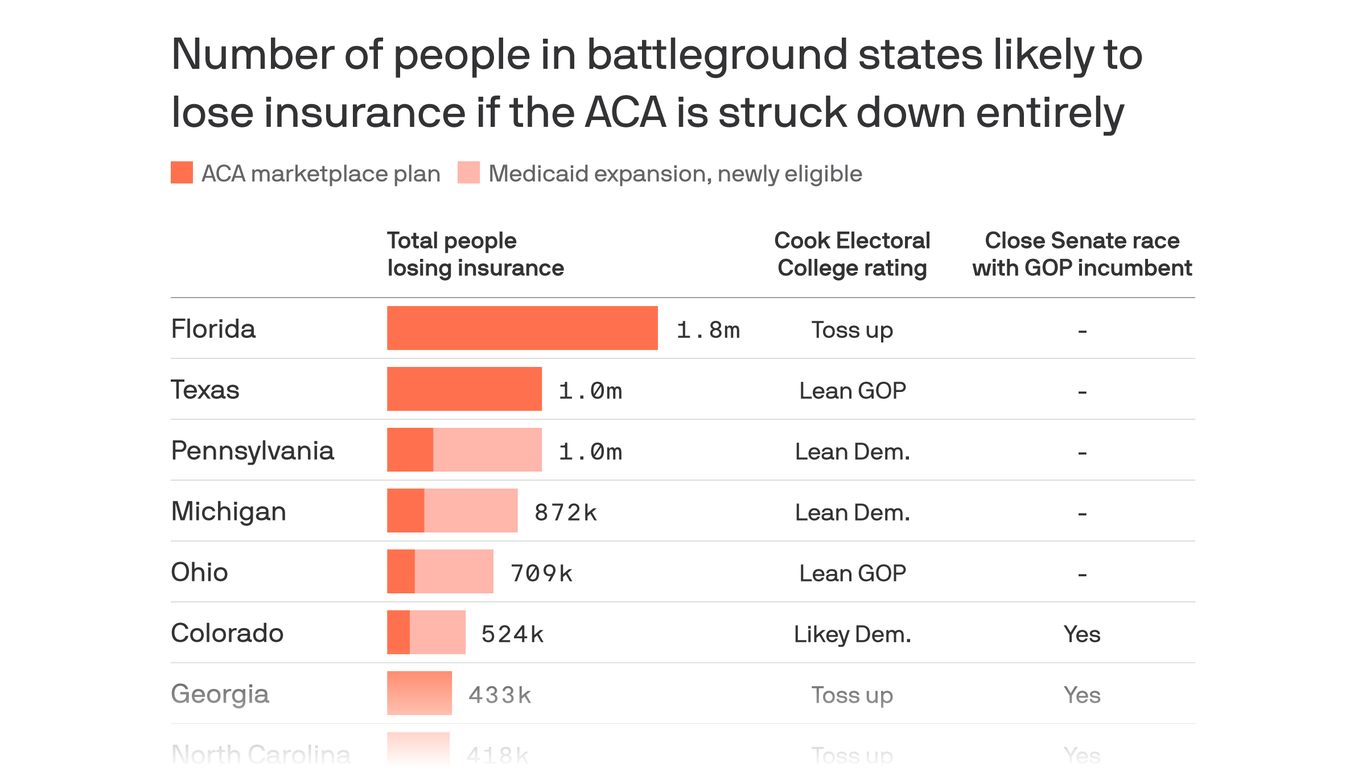
Between the lines: Millions of people in crucial presidential and Senate battlegrounds would lose their health care coverage if the Supreme Court strikes down the law, as the Trump administration is urging it to.

The chart above shows the number of people enrolled in the ACA’s insurance marketplaces or covered through its Medicaid expansion.

  • These options have become especially important over the last six months, as millions of Americans lost their jobs — and thus their employer insurance — due to the pandemic.
  • And more than a quarter of non-elderly Americans have a pre-existing condition that insurers in the individual market could refuse to cover without the ACA, per the Kaiser Family Foundation.

The big picture: Republicans paid a steep electoral price for trying to repeal parts of the ACA in 2017. Republicans’ lawsuit against the health care law, if it succeeds, would boot even more people off of their coverage and undo even more of the ACA’s regulations.

What to watch: Several vulnerable Republicans, including Sens. Susan Collins, Martha McSally, and Cory Gardner, represent purple states that expanded Medicaid and would therefore see steep coverage losses. And the broader fight over the Supreme Court has made it impossible to ignore those stakes.

  • “With the Court setting Nov. 10 as the date for hearing California v. Texas, Republicans caught a break not having it front and center right before the election.  Now it is very much front and center,” said Rodney Whitlock, a former health aide for Sen. Chuck Grassley.
  • “Debates over protection of pre-existing conditions have generally not gone positively for Republicans in purple states/district,” he added.


This Legal Attack on the ACA Could Be the Big One

This Legal Attack on the ACA Could Be the Big One

The flag-draped casket of Justice Ruth Bader Ginsburg lies in repose under the Portico at the top of the front steps of the US Supreme Court. Ginsburg died at 87 on September 18 after serving on the high court for 27 years. 

When news broke of Justice Ruth Bader Ginsburg’s death on September 18, the outpouring of grief and gratitude for the accomplishments of the feminist icon was quickly followed by speculation over how her passing will affect the legal challenge to the Affordable Care Act (ACA) now before the US Supreme Court.

The landmark health law survived high court rulings in 2012 and again in 2015. In each case, Chief Justice John Roberts voted with the court’s liberal bloc, including Ginsburg, to uphold the ACA. President Donald Trump has nominated conservative Judge Amy Coney Barrett of the Seventh Circuit of the US Court of Appeals to fill Ginsburg’s seat. Because oral arguments for California v. Texas are set for one week after Election Day, supporters of the law are uneasy.

“If the suit had a trivial chance of success yesterday, it has a new lease on life,” University of Michigan law professor Nicholas Bagley told Amy Goldstein in the Washington Post after learning of Ginsburg’s death. “The ACA has become part of the basic plumbing of the US health care system. Ripping it out at this point would create enormous problems.”

If the ACA is overturned, the consequences could be severe. At this point, the nation remains mired in the coronavirus pandemic, which has metastasized into one of the greatest public health crises in a century. Last week, the US reached the horrific milestones of more than 7 million people infected and 200,000 dead from COVID-19. ACA protections for people with preexisting conditions would disappear if the health law is struck down, and more than 12 million adults who have gained health coverage through the ACA’s Medicaid expansion could lose it. More than 9 million others would lose access to subsidized premiums for private health insurance.

Still, the worst-case scenario is just one of many. Here is a review of the lawsuit, what’s at stake, and the potential outcomes.

Implications of Eliminating the Individual Mandate

California v. Texas originated from a consortium of Republican state attorneys general led by Texas. A California-led coalition of 20 states and Washington, DC, is defending the ACA. The Texas coalition argues that the ACA is unconstitutional in its entirety because Congress in 2017 zeroed out one provision of the lengthy law, the individual mandate. If that part of the ACA is invalid, they argue, then the rest is too.

Many legal experts find this position unpersuasive. The arguments “have been roundly criticized by conservative legal scholars, the Wall Street Journal editorial board, the National Review editorial board, health care stakeholders, and some Republican members of Congress and state officials,” ACA expert Katie Keith, JD, MPH, wrote on the Health Affairs Blog. The Supreme Court is scheduled to hear oral arguments in the case on November 10, one week after the election.

Threats to the Vulnerable

Thanks to the 10-year-old ACA, millions of Americans have gained health coverage. This has proved to be essential during the global pandemic. But if the health law is struck down, about 21 million people who buy health insurance through the ACA exchanges or who gained coverage through Medicaid expansion would be at serious risk of becoming uninsured.

California enthusiastically leaned into the ACA from the start and saw the biggest decline in uninsured residents — 3.7 million — of any state. As the California uninsured rate fell, racial disparities in coverage were also reduced. By 2016, the ACA had produced historic declines in racial disparities in health coverage rates for Californians. (Learn more about the impact of the ACA in California with this collection of resources.)

Nationwide, nearly 133 million people with preexisting conditions could be denied coverage or be required to pay more for a health insurance policy if the ACA is eliminated.Contracting the [coronavirus] is the ultimate preexisting condition,” Andy Slavitt, former administrator of the Centers for Medicare & Medicaid Services under President Barack Obama, and Bagley wrote in the New York Times. “The disease can bring with it mysterious complications and affect virtually every organ system, the immune system, and even the limbs. Young, otherwise healthy people may find themselves uninsurable if the Affordable Care Act is struck down.”

A lawsuit that once seemed like a long shot now has a much more reasonable chance at success — and that means 20 million people’s health coverage really could be in the balance.

—Sam Baker, Axios

Also at risk are essential health benefits that the ACA requires all health plans to cover, including maternity care, mental health services, and substance use disorder treatment. If the law is overturned, they could disappear from insurance plans.

“Other popular provisions hang in the balance, including those that guarantee preventive care with no out-of-pocket payments; end lifetime caps; allow kids to stay on their parents’ insurance through age 26; and make vaccines free to patients. Even some key improvements to Medicare — including a reduction in prescription drug costs for beneficiaries — would be gone,” Slavitt and Bagley wrote.

The ACA’s impacts reach far beyond health care consumers. “Insurance companies, drug companies, hospitals, and doctors have all changed the way they do business because of incentives and penalties in the health law,” Julie Rovner wrote in Kaiser Health News. “If it’s struck down, many of the ‘rules of the road’ would literally be wiped away, including billing and payment mechanisms.”

Supreme Court Scenarios

If the Republican Senate votes to confirm Barrett before the oral arguments for California v. Texas, the ACA faces a tougher battle, though it could be narrowly upheld. Although Barrett has not participated in any cases regarding the ACA on the Seventh Circuit, “her academic writing and public action offer glimpses into her views” opposing the health law, Goldstein and Alice Crites reported in the Washington Post.

If Barrett misses the oral arguments, she will not participate in the case. The Supreme Court could choose to postpone the arguments or proceed with eight justices, which is “far from unprecedented,” Keith wrote. Should that result in a 4-4 ruling, the lower court’s decision would stand, and the case would be remanded to a federal district court judge to decide which other provisions of the law must fall along with the individual mandate. Other provisions on the chopping block “could include the law’s rules banning insurers from denying people coverage or charging them higher premiums because of their medical history,” Dylan Scott wrote in Vox. Litigation could continue for years, during which the ACA would remain the law of the land, according to Keith.

This is not an exhaustive list of potential outcomes. For example, an eight-judge court could narrowly rule in favor of the ACA.

As Sam Baker wrote in Axios, “A lawsuit that once seemed like a long shot now has a much more reasonable chance at success — and that means 20 million people’s health coverage really could be in the balance.”


Moody’s: Hospital financial outlook worse as COVID-19 relief funds start to dwindle

https://www.fiercehealthcare.com/hospitals/moody-s-hospital-financial-outlook-worse-as-covid-19-relief-funds-start-to-dwindle?mkt_tok=eyJpIjoiWTJZek56Z3lNV1E0TW1NMyIsInQiOiJKdUtkZE5DVGphdkNFanpjMHlSMzR4dEE4M29tZ24zek5lM3k3amtUYSt3VTBoMmtMUnpIblRuS2lYUWozZk11UE5cL25sQ1RzbFpzdExcL3JvalBod3Z6U3BZK3FBNjZ1Rk1LQ2pvT3A5Witkc0FmVkJocnVRM0dPbFJHZTlnRGJUIn0%3D&mrkid=959610

For-profit hospitals are expected to see a financial decline over the next 12 to 18 months as federal relief funds that shored up revenue losses due to COVID-19 start to wane, a recent analysis from Moody’s said.

The analysis, released Monday, finds that cost management is going to be challenging for hospital systems as more surgical procedures are expected to migrate away from the hospital and people lose higher-paying commercial plans and go to lower-paying government programs such as Medicaid.

“The number of surgical procedures done outside of the hospital setting will continue to increase, which will weaken hospital earnings, particularly for companies that lack sizeable outpatient service lines (including ambulatory surgery centers),” the analysis said.

A $175 billion provider relief fund passed by Congress as part of the CARES Act helped keep hospital systems afloat in March and April as volumes plummeted due to the cancellation of elective procedures and reticence among patients to go to the hospitals.

Some for-profit systems such as HCA and Tenet pointed to relief funding to help generate profits in the second quarter of the year. The benefits are likely to dwindle as Congress has stalled over talks on replenishing the fund.

“Hospitals will continue to recognize grant aid as earnings in Q3 2020, but this tailwind will significantly moderate after that,” Moody’s said.

Cost cutting challenges

Compounding problems for hospitals is how to handle major costs.

Some hospital systems cut some costs such as staff thanks to furloughs and other measures.

“Some hospitals have said that for every lost dollar of revenue, they were able to cut about 50 cents in costs,” the analysis said. “However, we believe that these levels of cost cuts are not sustainable.”

Hospitals can’t cut costs indefinitely, but the costs for handling the pandemic (more money for personal protective equipment and safety measures) are going to continue for some time, Moody’s added.

“As a result, hospitals will operate less efficiently in the wake of the pandemic, although their early experiences in treating COVID-19 patients will enable them to provide care more efficiently than in the early days of the pandemic,” the analysis found. “This will help hospitals free up bed capacity more rapidly and avoid the need for widespread shutdowns of elective surgeries.”

But will that capacity be put to use?

The number of surgical procedures done outside of the hospital is likely to increase and will further weaken earnings, Moody’s said.

“Outpatient procedures typically result in lower costs for both consumers and payers and will likely be preferred by more patients who are reluctant to check-in to a hospital due to COVID-19,” the analysis said.

The payer mix will also shift, and not in hospitals’ favor. Mounting job losses due to the pandemic will force more patients with commercial plans toward programs such as Medicaid.

“This will hinder hospitals’ earnings growth over the next 12-18 months,” Moody’s said. “Employer-provided health insurance pays significantly higher reimbursement rates than government-based programs.”

Bright spots

There are some bright spots for hospitals, including that not all of the $175 billion has been dispersed yet. The CARES Act continues to provide hospitals with a 20% add-on payment for treating Medicare patients that have COVID-19, and it suspends a 2% payment cut for Medicare payments that was installed as part of sequestration.

The Centers for Medicare & Medicaid Services also proposed increasing outpatient payment rates for the 2021 fiscal year by 2.6% and in-patient rates by 2.9%. The fiscal year is set to start next month.

Patient volumes could also return to normal in 2021. Moody’s expects that patient volumes will return to about 90% of pre-pandemic levels on average in the fourth quarter of the year.

“The remaining 10% is likely to come back more slowly in 2021, but faster if a vaccine becomes widely available,” the analysis found.


Three Million People Lost Health Coverage From Their Employers During The Pandemic

https://www.forbes.com/sites/brucejapsen/2020/09/20/pandemics-wrath-on-worker-health-coverage-tops-3-million-so-far/?utm_source=newsletter&utm_medium=email&utm_campaign=coronavirus&cdlcid=5d2c97df953109375e4d8b68#58cf3e92ed47

More than three million American workers lost health insurance coverage this spring and summer from their employers as the pandemic and spread of Covid-19 triggered massive job losses, a new study shows.

In all, there were 3.3 million adults under the age of 65 who lost employer-sponsored health insurance and almost two-thirds of them, or 1.9 million, “became newly uninsured from late April through mid-July,” according to a new analysis by The Urban Institute and funded by the Robert Wood Johnson Foundation. The loss of employer coverage has hit Hispanic adults particularly hard with 1.6 million losing health benefits, Urban Institute researchers said.

And it could get worse.

“With continued weakness in the labor market, researchers conclude federal and state policymakers will need to act to prevent job losses from leading to further increases in uninsurance,” the authors of the report wrote about their analysis, which was derived from  2020 U.S. Census data.

In particular, the analysis underscores the need to expand health benefits, particularly Medicaid under the Affordable Care Act, analysts say. The ACA dangled billions of dollars in front of states to expand Medicaid coverage for poor Americans but 12 states generally led by Republican Governors or legislatures have refused while President Donald Trump and his appointees at the U.S. Justice Department fight led by Republican Governors

 “The danger of an inadequate safety net can be seen in the non-expansion states, where the number of uninsured adults has already increased more than 1 million,” Robert Wood Johnson Foundation senior policy advisor Katherine Hempstead said in a statement accompanying the report.