The future of the ACA takes center stage yet again

https://mailchi.mp/0e13b5a09ec5/the-weekly-gist-august-21-2020?e=d1e747d2d8

The 2020 ACA Reporting & Regulation Landscape for US Employers ...

Across four nights of a national convention that was anything but conventional, with the nominating process, acceptance speeches, and traditional pomp and circumstance forced into a virtual format due to the coronavirus pandemic, Democrats returned to the healthcare playbook widely viewed as successful in the 2018 midterm elections.

In addition to promising a more robust and concerted response to the COVID crisis gripping the nation, party leaders vowed to protect and expand the Affordable Care Act (ACA), rather than aiming to replace it with the more aggressive “Medicare for All” (M4A) approach that dominated much of the discussion during the primary campaign.

In his acceptance speech on Thursday, Democratic nominee Joseph R. Biden, Jr. promised “a healthcare system that lowers premiums, deductibles, and drug prices by building on the Affordable Care Act he’s trying to rip away,” referring to President Trump’s continued support for the full repeal of the 2010 healthcare reform law.

Earlier, progressive runner-up and vocal M4A advocate Sen. Bernie Sanders signaled a closing of the party’s ranks around Biden’s more moderate approach: “While Joe and I disagree on the best path to get to universal coverage, he has a plan that will greatly expand healthcare and cut the cost of prescription drugs. Further, he will lower the eligibility age of Medicare from 65 to 60.”

Several other speakers highlighted the need to protect the ACA’s guarantee of affordable insurance to those with preexisting conditions, most powerfully the prominent M4A crusader Ady Barkan, who suffers from amyotrophic lateral sclerosis (ALS).

“Even during this terrible crisis,” Barkan said, “Donald Trump and Republican politicians are trying to take away millions of people’s health insurance.”


Drug payment cuts to 340B hospitals spur debate on best path forward

https://www.healthcarefinancenews.com/news/drug-payment-cuts-340b-hospitals-spur-debate-best-path-forward

340B hospitals breathing easier under Dem-controlled House

Hospitals say revenue from the 340B program is essential, while others contend the original law is being abused.

On August 3, an federal appeals court ruled that 340B hospitals will now be subject to Medicare cuts in outpatient drug payments by nearly 30%, reversing an earlier ruling calling those cuts illegal. The 2-1 decision by the U.S Court of Appeals for the District of Columbia Circuit essentially gives the Trump Administration and the Department of Health and Human Services the legal authority to reduce payment for Medicare Part B drugs to 340B hospitals.

HHS Secretary Alex Azar said the action means patients – particularly those who live in vulnerable areas – will pay less out-of-pocket for drugs in the Medicare Part B program. But providers, including the American Hospital Association, the Association of American Medical Colleges and America’s Essential Hospitals, said the 340B decision will hurt hospitals and patients in these vulnerable areas.

Hospitals that serve large numbers of Medicaid, Medicare and uninsured patients were getting the drugs for a discounted price, but, getting reimbursed at the higher price, HHS pays all hospitals for Medicare Part B drugs. The hospitals, many of which are in the red or operating on thin margins, were using the pay gap in the price difference to cover operational expenses. HHS deemed it inappropriate that these facilities would use Medicare to subsidize other activities and initiatives, and the appeals court agreed.

As per the original 340B legislation, discounts on drugs can range from 13% to 32% off the average retail price for participating providers, but Medicare Part D sets reimbursement in an entirely different way, leading to the significant reimbursement discrepancies – until the ruling, which furthered HHS’ push to narrow the spread between acquisition price and reimbursement.

THE DEBATE

“The opportunity to exploit this buy/sell differential probably has something to do with the explosive growth there’s been in the number of participating institutions in 340B,” said Michael Abrams, cofounder and managing partner of Numerof and Associates. “According to the data I came across, discounted 340B purchases grew 23% from 2018 to 2019, and currently make up about 8% of the total of the U.S. drug market. So from my perspective this looks like a loophole that’s been used by a small number of large institutions, who in many cases don’t serve that many disadvantaged patients, but nonetheless serve enough to qualify for the 340B program and to purchase the drugs they buy at the discounted rate.”

Groups representing U.S. hospitals would disagree with that assessment, and, in fact, when the appeals court handed its ruling, the AHA, AAMC and America’s Essential Hospitals said 340B hospitals and their patients would “suffer lasting consequences.”

“The decision conflicts with Congress’ clear intent and defers to the government’s inaccurate interpretation of the law, a point that was articulated by the judge who dissented from the opinion,” the groups wrote in a statement. “For more than 25 years, the 340B program has helped hospitals stretch scarce federal resources to reach more patients and provide more comprehensive services. Hospitals that rely on the savings from the 340B drug pricing program are also on the front-lines of the COVID-19 pandemic, and today’s decision will result in the continued loss of resources at the worst possible time.”

President and CEO of 340B Health Maureen Testoni also lamented the appeals court’s decision, calling the cuts “discriminatory.”

“These cuts of nearly 30% have caused real and lasting pain to safety-net hospitals and the patients they serve,” she said earlier this month. “Keeping these cuts in place will only deepen the damage of forced cutbacks in patient services and cancellations of planned care expansions. These effects will be especially detrimental during a global pandemic.

Abrams contends that much of the confusion and legal wrangling can be attributed to the vagueness of the original 340B legislation, the stated goal of which was to “enable participating institutions to stretch scarce financial dollars.” With little else to go on in terms of the language, those on each side of the issue were able to interpret it in their own way, with participating institutions saying it’s within the bounds of the law to use that revenue stream to enhance their mission – another phrase that’s open to wide interpretation.

“There’s no question this is being put to uses that were never intended,” said Abrams, adding that the profits generated by the buy/sell differential often disappear into balance sheets with little to no accountability.

Hospitals, for their part, feel they’re under siege by HHS at a critical time for the healthcare system’s financial viability. Even before the COVID-19 pandemic, hospitals saw the migration of lucrative inpatient procedures, such as hip and knee replacements, to freestanding outpatient facilities, which in some cases are not owned by the hospital. That represents a significant loss of revenue. Factor in the lost revenue from cancelled or delayed elective procedures due to the coronavirus, as well as patients who are too cautious to enter the healthcare system, and hospitals are hurting. AHA President and CEO Rick Pollack said in July that half of all U.S. hospitals will likely be in the red by the end of the year.

A COMPLICATED PICTURE

Actions by the pharmaceutical industry are also adding to the complication. A recent statement from America’s Essential Hospitals alleges that recent actions by pharmaceutical manufacturers “hinder access to affordable medications for millions of people who face financial hardships and defy clear statutory requirements that they provide drugs to 340B Drug Pricing Program covered entities.”

The manufacturers have threatened punitive actions – including withholding 340B drugs to contract pharmacies – for failing to comply with reporting requirements that Essential Hospitals call “arbitrary.”

“These data requests have no clear link to program integrity,” the group said. “Rather, they seem to be little more than a fishing expedition.”

A concrete example can be found in AstraZeneca’s decision to refuse 340B pricing to hospitals with on-site pharmacies for any drugs that will be dispensed through contract pharmacies. In a statement this week, Testoni of 340B called this action an “attack” on the 340B program that will hurt healthcare institutions as well as low-income and rural Americans.

“We believe that refusing to offer discounts that the 340B statute requires is a violation of federal law,” said Testoni. “We are calling on Health and Human Services Secretary (Alex) Azar to exercise his authority to stop these overcharges before they cause permanent damage to the healthcare safety net.”

Abrams sides more with the appeals court decision, saying that requiring the pharmaceutical industry to sell drugs at a discount comes with significant regulation to ensure they do so – a stark contrast to the lack of regulation around the resulting revenue. Though another appeal certainly isn’t out of the question, Abrams expects participation in the program to shrink back to a level reflecting the size of the target populations.

“This is about helping disadvantaged patients get their drugs, and that should be the driving activity of the program,” he said. “I’m fine with HHS taking this problem on, because it was an abuse that was never intended in the original legislation. It just seems to me that HHS really wants the healthcare sector to deliver care that is more accountable both for efficient use of resources and outcomes.”

One person who disagrees is Circuit Judge Cornelia Pillard, who wrote the dissenting opinion in the appeals court decision.

“The challenged rules took a major bite out of 340B hospitals’ funding,” she said. “Often operating at substantial losses, 340B hospitals rely on the revenue that Medicare Part B provides in the form of standard drug-reimbursement payments that exceed those hospitals’ acquisition costs. 340B hospitals have used the additional resources to provide critical healthcare services to communities with underserved populations that could not otherwise afford these services.”


Survey: Health plans to cost $15,500 per employee next year

https://www.cfodive.com/news/health-plans-employee-cost/583816/?utm_source=Sailthru&utm_medium=email&utm_campaign=Issue:%202020-08-21%20CFO%20Dive%20%5Bissue:29224%5D&utm_term=CFO%20Dive

Is Trump's debate claim about health care costs rising true? | PBS ...

More plans are expected to cover virtual office visits and expanded mental health and well-being offerings.

Dive Brief:

  • Large employers are projecting their health care benefit costs to surpass $15,500 per employee in 2021, Business Group on Health’s annual survey finds.
  • That would represent a 5.3% increase in costs, estimated at $14,769 this year.
  • The health plans are also expected to expand virtual care, mental health and emotional well-being offerings to employees.

Dive Insight:

The 5.3% increase is slightly higher than the 5% increases employers projected in each of the last five years, according to the 2021 Large Employers’ Health Care Strategy and Plan Design Survey.

In line with recent years, employers will cover nearly 70% of costs while employees will bear about 30%, or nearly $4,500, in 2021. 

“Health care costs are a moving target and one that employers continue to keep a close eye on,” said Ellen Kelsay, president and CEO of Business Group on Health. “The pandemic has triggered delays in both preventive and elective care, which could mean the projected trend for this year may turn out to be too high. If care returns to normal levels in 2021, the projected trend for next year may prove to be too low. It’s difficult to know where cost increases will land.”

The growth in virtual care is one of the trends identified in the survey. Eight in 10 health plan executives said virtual health will play a significant role in how care is delivered, up from 64% last year and 52% in 2018. More than half (52%) will offer more virtual care options next year.

Nearly all employers will offer telehealth services for minor, acute services while 91% will offer telemental health, and that could grow to 96% by 2023.

Virtual care for musculoskeletal management shows the greatest potential for growth. While 29% will offer musculoskeletal management virtually next year, another 39% are considering adding it by 2023. Employers are also expanding other virtual services including the delivery of health coaching and emotional well-being support. These offerings are expected to increase in the next few years.

“Virtual care is here to stay,” said Kelsay. “The pandemic caused the pace to accelerate at an astronomical rate. And virtual care is now garnering growing interest and receptivity from both employees and providers who increasingly see its benefit.”

Another key trend for employer plans in 2021 is the expansion of access to virtual mental health and emotional well-being services. More than two-thirds (69%) said they provide access to online mental health support resources such as apps, videos, and articles. That number is expected to jump to 88% in 2021.

Other findings:

  • More employers are linking health care with workforce strategy: The number of employers who view their health care strategy as an integral part of their workforce strategy increased from 36% in 2019 to 45% this year.
  • On-site clinics continue to grow: Nearly three in four respondents (72%) either have a clinic in place or will by 2023. Some employers are expanding services — 34% offer primary care services at the worksite, and an additional 26% plan to have this service available by 2023.
  • Growing interest in advanced primary care strategies: Over half of respondents (51%) will have at least one advanced primary care strategy next year up from 46% in 2020. These primary care arrangements, which move toward patient-centered population health management emphasizing prevention, chronic disease management, mental health and whole person care are key focus areas for employers.
  • Employers remain concerned about high-cost drug therapies. Two-thirds of respondents (67%) cited the impact of new million-dollar treatments as their top pharmacy benefits management concern.


Millions of U.S. jobs to be lost for years, IRS projections show

https://www.accountingtoday.com/articles/millions-of-u-s-jobs-to-be-lost-for-years-irs-projections-show?utm_source=Sailthru&utm_medium=email&utm_campaign=Issue:%202020-08-21%20CFO%20Dive%20%5Bissue:29224%5D&utm_term=CFO%20Dive

Millions of US Jobs to Be Lost for Years After Covid, IRS ...

The Internal Revenue Service projects that lower levels of employment in the U.S. could persist for years, showcasing the economic fallout of the coronavirus pandemic.

The IRS forecasts there will be about 229.4 million employee-classified jobs in 2021 — about 37.2 million fewer than it had estimated last year, before the virus hit, according to updated data released Thursday. The statistics are an estimate of how many of the W-2 tax forms that are used to track employee wages and withholding the agency will receive.

Lower rates of W-2 filings are seen persisting through at least 2027, with about 15.9 million fewer forms filed that year compared with prior estimates. That’s the last year for which the agency has published figures comparing assumptions prior to the pandemic and incorporating the virus’s effects.

W-2s are an imperfect measure for employment, because they don’t track the actual number of people employed. A single worker with several jobs would be required to fill out a form for each position. Still, the data suggest that it could take years for the U.S. economy to make up for the contraction suffered because of COVID-19.

The revised projections also show fewer filings of 1099-INT forms through 2027. That’s the paperwork used to report interest income — and serves as a sign that low interest rates could persist.

There’s one category that is expected to rise: The IRS sees about 1.6 million more tax forms for gig workers next year compared with pre-pandemic estimates.

That boost “likely reflects assumptions with the shift to ‘work from home,’ which may be gig workers, or may just be that businesses are more willing to outsource work — or have the status of their workers be independent contractors — now that they work from home,” Mike Englund, the chief economist for Action Economics said.


New unemployment claims top 1 million. Again.

https://www.washingtonpost.com/business/2020/08/20/august-unemployment-claims/?wpmk=1&wpisrc=al_business__alert-economy&utm_source=alert&utm_medium=email&utm_campaign=wp_news_alert_revere&location=alert&pwapi_token=eyJ0eXAiOiJKV1QiLCJhbGciOiJIUzI1NiJ9.eyJjb29raWVuYW1lIjoid3BfY3J0aWQiLCJpc3MiOiJDYXJ0YSIsImNvb2tpZXZhbHVlIjoiNWI2M2EzNDJhZGU0ZTI3Nzk1NTBjYTFiIiwidGFnIjoid3BfbmV3c19hbGVydF9yZXZlcmUiLCJ1cmwiOiJodHRwczovL3d3dy53YXNoaW5ndG9ucG9zdC5jb20vYnVzaW5lc3MvMjAyMC8wOC8yMC9hdWd1c3QtdW5lbXBsb3ltZW50LWNsYWltcy8_d3Btaz0xJndwaXNyYz1hbF9idXNpbmVzc19fYWxlcnQtZWNvbm9teSZ1dG1fc291cmNlPWFsZXJ0JnV0bV9tZWRpdW09ZW1haWwmdXRtX2NhbXBhaWduPXdwX25ld3NfYWxlcnRfcmV2ZXJlJmxvY2F0aW9uPWFsZXJ0In0.ns8VggWJk95qb-c_2926acWIaHxyFIBXSRn76O7Lrf0

The number of people applying for the first time for unemployment insurance ticked up last week to 1.1 million, from 970,000 the week before, a sign that job losses continue to plague the labor market five months into the coronavirus pandemic.

The weekly jobless claims had sunk slowly in recent months but have remained well above historical highs, averaging about 1.18 million a week for the last four weeks. Economists had predicted last week’s figure to approach the numbers from the previous week, which had fallen below 1 million for the first time in about five months.

Instead, the initial claims and new claims for Pandemic Unemployment Assistance, the program available to gig and self-employed workers, both went up. About 543,000 new claims were filed for PUA for the week that ended on Aug. 15, up from 488,000 the week before.

“The fact that the claims are so high this far into the crisis is concerning,” said AnnElizabeth Konkel, an economist at the job site Indeed. “Yet the depths of the damage remain to be seen. I would definitely call it a canary raising alarms in the economic coal mine.”

Data shows the number of job postings slowly recovering in recent weeks, compared with postings from the year prior. However, last week, postings took a turn for the worse. They had been running about 18 percent below normal and fell to 20.3 percent below normal last week.

“The longer we go into this crisis, the longer people that have been temporarily laid off may not get called back,” Konkel said. “Businesses can only ride out this crisis for so long.”

More than 28 million people were receiving some form of unemployment benefits as of Aug. 1, the most recent week for that statistic, about equal to the previous week.

Job loss from the pandemic remains a singular crisis, without comparison in modern times. The country’s unemployment rate, last calculated in July, was 10.2 percent, and economists have warned that it could go up in August as the virus continues to alter life around the country.

The extra $600 in unemployment benefits that many workers credit with keeping them afloat expired at the end of July. And funds from the $660 billion PPP program, which gave grants and loans to companies to keep workers on payroll, have been running out for many recipients.

Companies announcing layoffs in recent days include Wieland Copper Products, in North Carolina, a Mohegan Sun casino in Wilkes-Barre, Pa., Amsterdam Printing & Litho, a printing company in Upstate, N.Y., and Ohio sales and marketing company Maritz. School districts and local governments are also beginning to experience deep cuts: New York Mayor Bill de Blasio (D) warned last week that as many as 22,000 city workers faced possible layoffs in the fall.


Supreme Court to hear ACA arguments after November election

https://www.healthcaredive.com/news/supreme-court-will-hear-aca-case-after-november-election/583804/?utm_source=Sailthru&utm_medium=email&utm_campaign=Issue:%202020-08-20%20Healthcare%20Dive%20%5Bissue:29204%5D&utm_term=Healthcare%20Dive

Dive Brief:

  • The Supreme Court will hear oral arguments in the Republican-led case seeking to overturn the Affordable Care Act on November 10, exactly one week after the presidential election, according to the court’s online docket on Wednesday.
  • A hearing post-election was the likeliest choice from the outset. The justices’ October schedule did not include the highly anticipated case, leaving just one day for arguments to potentially be heard before the election.
  • Still, Wednesday’s news does not mean the Supreme Court will make a ruling on the case in 2020. Legal experts say a final ruling is still expected next year.


Dive Insight:

The ACA court case has loomed large as the nation has been ravaged by the novel coronavirus pandemic that has sickened millions, killed thousands and severed millions of people from their employer-sponsored health insurance coverage. 

Alternative coverage options introduced or strengthened by the ACA, such as expanded Medicaid coverage or marketplace plans, have served as an important safety net for those who have lost coverage as a result of the pandemic. 

Onlookers have long been waiting for the court to set a date for final arguments in the case against the ACA. Wednesday’s updated docket means the country is one step closer to knowing whether the ACA and its popular provisions, such as protections for pre-existing conditions, will remain the law of the land. 

Waiting to schedule oral arguments until after the election may have been intentional, legal experts say.

The highly unusual decision by the Trump administration’s DOJ to refuse to defend the law is likely to change with the election result, if former Vice President Joe Biden, the Democratic presidential nominee and a staunch ACA backer, wins the White House.

Republicans for years have been trying to dismantle President Barack Obama’s landmark health law, including by eliminating the financial penalty for not holding insurance.

The central argument in the case, brought primarily by a group of red states, is whether the entire law is invalid because it no longer contains the so-called individual mandate. The red states have argued that because Congress lowered the penalty to zero that the individual mandate can no longer be considered a tax and therefore renders the entire law unconstitutional.

Lower courts have ruled in favor of the red state plaintiffs, though the appeals court did not weigh in on whether the rest of the law could be severed from the mandate.


Fearing a ‘Twindemic,’ Health Experts Push Urgently for Flu Shots

Fearing a 'Twindemic,' Health Experts Push Urgently for Flu Shots ...

There’s no vaccine for Covid-19, but there’s one for influenza. With the season’s first doses now shipping, officials are struggling over how to get people to take it.

As public health officials look to fall and winter, the specter of a new surge of Covid-19 gives them chills. But there is a scenario they dread even more: a severe flu season, resulting in a “twindemic.”

Even a mild flu season could stagger hospitals already coping with Covid-19 cases. And though officials don’t know yet what degree of severity to anticipate this year, they are worried large numbers of people could forgo flu shots, increasing the risk of widespread outbreaks.

The concern about a twindemic is so great that officials around the world are pushing the flu shot even before it becomes available in clinics and doctors’ offices. Dr. Robert Redfield, director of the U.S. Centers for Disease Control and Prevention has been talking it up, urging corporate leaders to figure out ways to inoculate employees. The C.D.C. usually purchases 500,000 doses for uninsured adults but this year ordered an additional 9.3 million doses.

Dr. Anthony Fauci, director of the National Institute of Allergy and Infectious Diseases, has been imploring people to get the flu shot, “so that you could at least blunt the effect of one of those two potential respiratory infections.”

In Britain, Prime Minister Boris Johnson has been waging his own pro flu-shot campaign. Last month, he labeled people who oppose flu vaccines “nuts” and announced the country’s largest ever rollout of the shots. In April, one of the few reasons Australia allowed citizens to break the country’s strict lockdown was to venture out for their flu shots.

The flu vaccine is rarely mandated in the U.S. except by some health care facilities and nursery schools, but this month the statewide University of California system announced that because of the pandemic, it is requiring all 230,000 employees and 280,000 students to get the flu vaccine by November 1.

A life-threatening respiratory illness that crowds emergency rooms and intensive care units, flu shares symptoms with Covid-19: fever, headache, cough, sore throat, muscle aches and fatigue. Flu can leave patients vulnerable to a harsher attack of Covid-19, doctors believe, and that coming down with both viruses at once could be disastrous.

The 2019-20 flu season in the United States was mild, according to the C.D.C. But a mild flu season still takes a toll. In preliminary estimates, the C.D.C. says that cases ranged from 39 million to 56 million, resulting in up to 740,000 hospitalizations and from 24,000 to 62,000 flu-related deaths.

According to the C.D.C., flu season occurs in the fall and winter, peaking from December to February, and so was nearing its end as the pandemic began to flare in the United States in March.

But now, fighting flu proactively during the continuing pandemic presents significant challenges: not only how to administer the shot safely and readily, but also how to prompt people to get a shot that a majority of Americans have typically distrusted, dismissed and skipped.

With many places where the flu shot is administered en masse now inaccessible — including offices and plants that offered it free to employees on site and school health clinics — officials have been reaching out to local health departments, health care providers and corporations to arrange distribution. From now through Oct. 31, publicity campaigns will blast through social media, billboards, television and radio. Because the shot will be more difficult to access this year, people are being told to get it as soon as possible, although immunity does wane. There will be flu shot tents with heaters in parking lots and pop-up clinics in empty school buildings.

Because of the efforts, vaccine makers are projecting that a record 98 million flu shots will be given this year in the United States, about 15 percent more than doses ordered last year. The Kaiser Permanente health care system will be flooding more than 12 million of its members with flu shot reminders via postcard, email, text and phone calls.

Pharmacies and even supermarkets are expected to play a bigger role than they have in previous years. As of this week, Walgreens and CVS will have flu shots available. Walgreens will be hosting additional off-site flu vaccine clinics in community centers and churches. To reduce contact time, CVS is allowing patients to fill out paperwork digitally.

In New York City, which averages about 2,000 flu-related deaths a year, the health department has been reaching out to hundreds of independent pharmacies to administer the shots, because they are often located in outer-borough neighborhoods where the coronavirus has been rampaging. The health department has a detailed online flu vaccine locator.

“Access is a problem for all adult vaccines,” said L. J. Tan, chief strategy officer for the Immunization Action Coalition, a nonprofit group that works to increase vaccination rates, who was an early promoter of the term twindemic. “Adults may think, If I can get the flu shot easily, I might consider it.”

But as difficult as getting the flu shot to people safely will be, perhaps harder still will be persuading them to actually get it. In the 2018-19 flu season in the United States, only 45.3 percent of adults over 18 got the vaccine, with rates for those ages 18 to 50 considerably lower.

Skepticism to this vaccine runs high, particularly in communities of color because of longstanding distrust and discrimination in public health.2017 study in the journal Vaccine noted that, compared with white people, “African Americans were more likely to report barriers to vaccination, were more hesitant about vaccines in general and the flu vaccine specifically, more likely to believe in conspiracy theories and use naturalism as an alternative to getting vaccinated.”

Across all demographic groups, perhaps the most striking reason given for avoiding the flu vaccine is that people do not see it as efficacious as, say, the measles vaccine.

Indeed, it is a good vaccine but not a great one. It must be repeated annually. Immunity takes up to two weeks to kick in. But its efficacy also depends on how accurately infectious disease centers worldwide forecast which strains are expected to circulate in the coming year. And then those strains can mutate.

Although the flu shot confers immunity at all ages over six months, it can be less complete in people over 65. Depending on many factors, the shot’s effectiveness in a given year can range from 40 to 60 percent.

“But a vaccine not given won’t protect anyone,” said Dr. Jane R. Zucker, assistant commissioner for the Bureau of Immunization at the New York City Health Department, which has been hosting webinars for providers about how to have conversations about the flu shot with hesitant patients.

As health officials note, should a vaccinated person contract the flu, the severity will almost certainly be reduced, hospitalization rarely necessary. Especially with Covid-19 raging, public officials reason, those odds look pretty good.

Another reason people give for not getting the shot is they think it makes them sick.

“People who say ‘I’ll never get it because it gives me the flu’ have not had the flu and don’t know what it is,” said Patsy Stinchfield, senior director of infection prevention at Children’s Minnesota.

“What you’re feeling is your body’s immune response to the virus’s antigens,” said Ms. Stinchfield, a member of the C.D.C.’s influenza work group. “You may feel flu-ish. And that’s a good thing. It’s your body’s way of saying, ‘I am ready for the flu, and I won’t get as sick if I get the real one.’”

Public campaigns will describe the shot as a critical weapon during the pandemic. “Hopefully people will say, ‘There’s no Covid vaccine so I can’t control that, but I do have access to the flu vaccine and I can get that,’” Ms. Stinchfield said. “It gives you a little power to protect yourself.”

Other campaigns will emphasize familial and community responsibility.

Usually, flu vaccine compliance rates among people ages 18 to 49 are low. Vermont’s, for example, is only about 27 percent.

Christine Finley, the state’s immunization program manager, believes that rates will improve because of the pandemic’s stay-at-home households. “People are more aware that the risks they take can negatively impact others,” she said. “They’re often taking care of young children and older parents.”

If any example could prove instructive about protective behavior and flu vaccines during the coronavirus epidemic, it could well be Australia.

Australia’s flu vaccine rate tends to be modest, but this year demand was high. The government’s rollout of the shot began earlier than usual for the June-through-August winter because the coronavirus pandemic was exploding. Though the government had also issued strict no-entry limits among many states and territories and bans on international travel, the flu shot was one of the few reasons people could emerge from lockdown.

The prevalent strain circulating in the country is Type A, the most common and virulent form of flu, said Dr. Kelly L. Moore, a public health expert at the Vanderbilt University School of Medicine.

According to the C.D.C., Type A is the most likely to circulate globally. It mutates readily, particularly as it jumps between animals and humans.

“There are two strains of Type A influenza in the vaccine,” Dr. Moore said, “and so the very best way to protect yourself is to get the shot.”

Reported cases of flu in Australia have dropped 99 percent compared with 2019.

Australia’s milder-than-usual flu season is likely the result of a number of factors — strong flu vaccination uptake, social distancing, but also severely decreased movement of people,” said Dr. Jonathan Anderson, a spokesman for Seqirus, a supplier of flu vaccine.

But though American public health authorities usually look to Australia’s flu season as a predictive, Australians say this year it’s not a reliable indicator.

“This situation is of no comfort as these measures do not apply to the United States where the populace has never been effectively physical distancing,” nor have the country’s entry restrictions been as onerous, said Dr. Paul Van Buynder, a public health professor at Griffith University in Queensland, Australia.

All that Americans can do is get vaccinated against flu, he added, because circulation of the coronavirus remains high.

“It is likely they will have a significant influenza season this northern winter,” he said.


Patient-provider encounter trends have stabilized, but remain significantly lower than before COVID-19

https://www.healthcaredive.com/news/patient-provider-encounter-trends-stabilized-below-normal/583599/?utm_source=Sailthru&utm_medium=email&utm_campaign=Issue:%202020-08-17%20Healthcare%20Dive%20%5Bissue:29123%5D&utm_term=Healthcare%20Dive

Measuring a patient's vital signs without any contact - ISRAEL21c

Dive Brief:

  • In-person doctor visits plummeted during the start of the COVID-19 crisis in the United States, but have rebounded to a rate somewhat below pre-pandemic levels, according to a new analysis issued by The Commonwealth Fund and conducted by researchers from Harvard Medical School, Harvard University and the life sciences firm Phreesia.
  • According to data compiled through Aug. 1, all physician visits were down 9% from pre-pandemic levels. That’s significantly improved compared to data from late March, when visits were down 58%. Although the rebound got major traction beginning in late April, it began plateauing in early June, when all visits were 13% lower than normal. As of early August, in-person visits were down 16% compared to pre-COVID levels. States that are currently coronavirus hot spots are seeing bigger declines than states where the case levels are lower.
  • Meanwhile, telemedicine encounters have settled in at rates much higher than pre-pandemic levels. However, they still make up just a fraction of patient-provider encounters for care. As of the start of this month, they comprised 7.8% of all such encounters. That’s compared to a peak of 13.8% in the latter part of April. Prior to COVID-19, they were only 0.1% of all visits.

Dive Insight:

COVID-19 has widely disrupted healthcare delivery in the United States. However, it is becoming clear that as the pandemic has become a part of everyday life for the time being, how patients visit their medical providers has also settled into a pattern.

According to Harvard researchers using data from Phreesia’s more than 50,000 provider clients, the plunge in patients seeing their physicians has rebounded from its nearly 60% dive in early spring. However, with all patient-physician encounters still consistently down from pre-COVID levels, the study’s authors warn that “the cumulative number of lost visits since mid-March remains substantial and continues to grow.”

Meanwhile, COVID-19 hotspots in the South and Southwest are depressing patient-provider encounters for the time being. Encounters were down as of late July by 15% in Arizona, Florida and Texas, compared to 12% in the Northeast and 8% in all other states.

Among medical specialties, only dermatology has seen a rebound beyond pre-COVID levels, with encounters up about 8% overall. But primary care visits are down 2%; surgery encounters, 9%; orthopedics, 18%; and pediatrics are in a 26% decline.

That the encounters between patients, doctors and other providers remains lower than normal has sparked some concerns about practices and other medical enterprises moving forward. HHS just earmarked $1.4 billion for nearly 80 children’s hospitals across the United States to try to shore them up financially.

The private sector has also undertaken an initiative to encourage patients to return to their providers. Insurer Humana, along with the Providence and Baylor Scott & White healthcare systems, launched an advertising campaign last month to encourage patients to seek out healthcare needs, even during the historic pandemic.


Cash-Pinched Hospitals Press Congress to Break Virus Fund Logjam

https://news.bloomberglaw.com/health-law-and-business/cash-pinched-hospitals-press-congress-to-break-virus-fund-logjam

DIY Money Tree Gift Idea - So TIPical Me

Hospital groups are pressing Congress to put more money into a relief fund for hospitals and providers, even as labor data showed signs of a turnaround for the health-care industry last month.

Congressional leaders are at a standstill over the next coronavirus-relief package and it could be weeks until lawmakers vote on legislation. Hospital groups have said the $175 billion Congress already approved has been a crucial lifeline to keep hospitals from laying off more staff or potentially closing. Some are worried the money may start to run dry soon.

The coronavirus is prompting many Americans to delay health care, and further funding delays exacerbate the need for assistance, the hospitals warn. Some providers that shed jobs earlier in the pandemic have begun adding them back, but employment levels remain far below where they once were.

“The longer we are in the pandemic the more clear it becomes that this is not going to be a short-term issue,” Beth Feldpush, senior vice president of policy and advocacy at America’s Essential Hospitals, said.

Leaders of both parties back more federal funding to help hospitals and doctors’ offices stay in business. Democrats proposed $100 billion for the industry, as hospital groups such as AEH sought, in virus-relief legislation (H.R. 6800) the House passed earlier this year. Republicans included $25 billion in their counterproposal.

The Health and Human Services Department has promised about $115 billion of the $175 billion in relief Congress approved this year to help health-care providers offset their Covid-19-related losses, according to agency data. That leaves the industry with about $60 billion left.

The U.S. exceeded 5 million confirmed Covid-19 cases Aug. 9, according to data from Bloomberg News and Johns Hopkins University, more than any other country. Almost 165,000 people in the U.S. have died from the virus.

Industry Impact

The health-care industry added more than 126,000 jobs in July, according to data released last week by the Bureau of Labor Statistics. Dentist offices and hospitals, the section of the industry that was laying off tens of thousands of people in April and May, accounted for more than 70,000 of those new jobs.

Still, there were 797,000 fewer health-care jobs compared to before the pandemic, according to BLS.

The virus hit parts of the heath-care industry unevenly. Large health systems such as HCA Healthcare Inc. and Universal Health Services Inc. posted better-than-expected profits for the second quarter of 2020.

Some hospitals that didn’t have much cash-on-hand to start the year are struggling with lower profits and may need added relief if the virus continues to keep Americans from seeking care, industry watchers said.

“No hospital is going to come out of this year better than they were in prior years,” Suzie Desai, senior director for S&P Global Rating’s Not-for-Profit Health Care group, said.

The federal relief funds helped buoy hospitals this year, hospital groups argue. The American Hospital Association estimates that without relief funds, hospitals margins would have been down 15% and could be down 11% at the end of 2020 if the virus continues to spread at its current pace.

The AHA estimated losses for the nation’s hospitals and health systems will reach $323 billion this year.


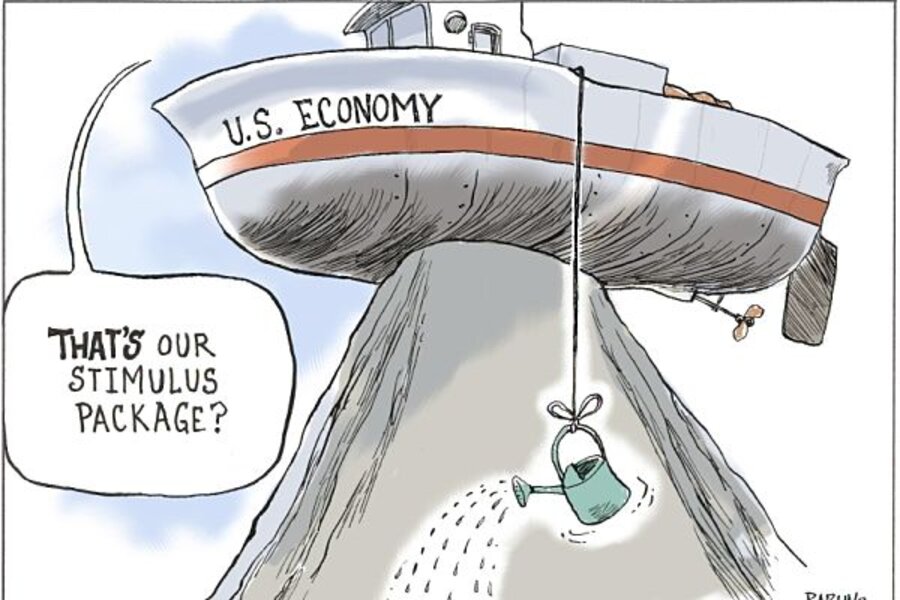
Cartoon – New Economic Stimulus Package

Obama's stimulus did NOT raise government spending - CSMonitor.com