What’s at stake in the ACA case

https://mailchi.mp/2480e0d1f164/the-weekly-gist-october-30-2020?e=d1e747d2d8

5 Key Points To Understanding New Court Skirmish Over Obamacare : Shots -  Health News : NPR

Since the Affordable Care Act (ACA) was signed into law a little more than a decade ago, it has fundamentally reshaped the American healthcare system. As the graphic below highlights, the far-reaching law expanded insurance coverage, increased consumer protections, led to new payment models, established minimum coverage standards, reformed the Indian Health Service—and even gave us calorie counts on menus, among myriad other things.

The fate of the ACA is once again in the Supreme Court’s hands—and the nine Justices, now including Amy Coney Barrett, are scheduled to hear arguments starting November 10th. Eighteen states with Republican leadership are asking the court to determine whether the individual mandate is constitutional without a financial penalty, and whether the mandate is severable from the rest of the law.
 
The process of unwinding a law that touches nearly every facet of the US healthcare system would mean a confusing and financially detrimental road ahead for many. Although we believe it’s unlikely that the entire law will be ruled unconstitutional, if it is—and no replacement legislation is passed—the effects could be devastating.

An estimated 21 million people would be at serious risk of losing their health insurance. This risk is magnified for Hispanic and Black Americans, who are also hardest hit by COVID-19. As many as 133M people with pre-existing conditions could face insurance disqualification or significantly higher premiums.

The lost coverage would result in a significant revenue hit for doctors and hospitals. While the impact would vary by state depending on Medicaid expansion terms, an Urban Institute report projects that total uncompensated care would grow an average of 78 percent for hospitals and 68 percent for physician services if the ACA is struck down. Although the Court is not expected to rule on the fate of the law until mid-2021, the direction and pace of future health reform legislation will be set by the ruling, under either a Trump or Biden administration.

This image has an empty alt attribute; its file name is b6862796-d236-4b80-8c09-5877c73ac1db.png

Chicago hospital defeats allegations of ‘ghost payroll’ scheme

https://www.beckershospitalreview.com/finance/chicago-hospital-defeats-allegations-of-ghost-payroll-scheme.html?utm_medium=email

False Claims Act & Physicians - Basic Primer

An Illinois federal court has dismissed a whistleblower lawsuit alleging University of Chicago Medical Center, Medical Business Office and Trustmark Recovery Services violated the False Claims Act, according to Bloomberg Law

MBO and Trustmark provided medical billing and debt collection services for UCMC. The whistleblowers, Kenya Sibley, Jasmeka Collins and Jessica Lopez, alleged MBO and Trustmark engaged in a “ghost payroll” scheme that involved regularly falsifying UCMC invoices, listing employes who didn’t work on the hospital’s collections and time charges from people who were not employees.

The whistleblowers, former employees of MBO and Trademark, alleged the companies and UCMC knew about the “ghost payroll” scheme, and that the allegedly falsified invoices caused the hospital to report overstated wages to the federal government, triggering a larger Medicare reimbursement than it was entitled to.

The complaint further alleged that MBO and Trustmark engaged in a “bad debt” scheme. “MBO would regularly write-off Medicare bad debts for amounts a Medicare beneficiary owed without conducting a reasonable collection effort, when Medicare beneficiaries were still paying on the debts, or when Medicare beneficiaries did not actually owe a debt,” the amended complaint states.

After writing off the bad debt, MBO would allegedly send the bad debt to Trustmark or another collection agency for further collection efforts.

On Sept. 14, Judge Harry Leinenweber of the U.S. District Court for the Northern District of Illinois dismissed the amended complaint, saying the whistleblowers failed to adequately allege the defendants engaged in a scheme to inflate bad debts and falsify invoices in University of Chicago’s cost reports. 

The allegations of a “ghost payroll” scheme fail because the whistleblowers failed to allege that defendants certified compliance with any regulation, which is required when filing a false claims case, the judge said in the decision. The amended complaint also fails to establish sufficiently UCMC’s knowledge of the alleged scheme.

The judge also ruled that the amended complaint failed to adequately allege a “bad debt” scheme. Allegations related to MBO’s and Trustmark’s bad debt reports to clients cannot satisfy the requirements to show that companies or their clients submitted improper claims for bad debt reimbursements to the government, reads the decision.


Executive Order On Housing Doesn’t Guarantee An Eviction Moratorium

https://www.forbes.com/sites/advisor/2020/08/10/trumps-executive-order-on-housing-doesnt-guarantee-an-eviction-moratorium/?tid=newsletter-dailydozen&utm_source=newsletter&utm_medium=email&utm_campaign=dailydozen&cdlcid=5d2c97df953109375e4d8b68#3a33cbc3359a

After negotiations for another stimulus package hit a dead end in Washington last week, President Donald Trump signed executive orders to extend relief in the meantime. One order, according to the president, would extend the federal eviction moratorium. 

The original moratorium, included in the CARES Act, prohibited landlords or housing authorities from filing eviction actions, charging nonpayment fees or penalties or giving notice to vacate. It expired on July 24 and only applied to federally subsidized or federally backed housing.

But housing advocates are pushing back, saying Trump’s executive order to extend an eviction moratorium actually does nothing at all—and keeps struggling Americans at risk of losing their housing. 


Details on the Order

Trump’s order doesn’t actually extend the federal eviction moratorium. Instead, it calls on the Department of Health and Human Services and the Centers for Disease Control and Prevention to “consider” whether an additional eviction ban is needed.

“The Secretary of Health and Human Services and the Director of CDC shall consider whether any measures temporarily halting residential evictions of any tenants for failure to pay rent are reasonably necessary to prevent the further spread of COVID-19 from one State or possession into any other State or possession,” reads the order.

Additionally, the executive order does not provide any new money to help struggling renters during the pandemic. Instead, it says the secretary of Treasury and the secretary of Housing and Urban Development—Steven Mnuchin and Ben Carson, respectively—can identify “any and all available federal funds” to provide temporary rental assistance to renters and homeowners who are facing financial hardships caused by COVID-19.

During a White House press briefing on Monday, Kayleigh McEnany said the president did “did what he can within his executive capacity…to prevent resident evictions.”At the time of publishing, officials mentioned in Trump’s executive order have not released guidelines on extending the federal eviction moratorium.


Housing Advocates React to Trump’s Eviction Order

Housing advocates have not reacted positively to Trump’s executive order, suggesting officials extend an eviction moratorium.

“The executive order that he signed this weekend is really nothing more than an empty shell that creates chaos and confusion, and it offers nothing more than false hope to renters who are at risk of eviction because that executive order does literally nothing to prevent or stop evictions,” Diane Yentel, president and CEO of the National Low Income Housing Coalition, said on Sunday during an MSNBC interview.

The House of Representatives included a more thorough plan to prevent evictions in its HEROES Act proposal. The proposal included $175 billion in rent and mortgage assistance and would replace the original federal eviction moratorium with a 12-month moratorium from all rental housing, not just federally subsidized ones. There also would be funds available to provide homeowners with assistance to cover mortgage and utility payments, property taxes or other resources to help keep Americans housed.

Sen. Richard Shelby (R-AL) introduced the Coronavirus Response Additional Supplemental Appropriations Act as part of the GOP’s HEALS Act proposal. Shelby’s bill included significantly less money for housing assistance than the HEROES Act—$3.2 billion—and would be used for tenant-based rental assistance. Shelby’s proposal did not include any language about extending the CARES Act eviction moratorium. 

A recent report by a group of housing advocates finds there could be as much as 40 million renters at risk of eviction in the coming months. The U.S. unemployment rate currently sits at 10.2%. 

Individuals who are struggling to pay rent might have assistance options available. Some cities and states have implemented their own eviction moratoriums—you can learn more about them by visiting the Eviction Lab at Princeton University. There are also legal aid options, like Just Shelter, that will help tenants who are facing eviction for low-cost or free.


Increasing unemployment alters national payer mix

https://mailchi.mp/9075526b5806/the-weekly-gist-july-24-2020?e=d1e747d2d8


One in every five workers is now collecting unemployment benefits as the country struggles to get the COVID-19 outbreak under control. A recent Families USA study estimates a quarter of the 21.9M workers that were furloughed or laid off between February and May lost their health insurance. And the payer mix will continue to change as the pandemic wears on.

The graphic below highlights a study from consultancy Oliver Wyman, looking at the impact of rising unemployment (at 15, 20 and 30 percent) on insurance coverage. With each five to ten percent rise in unemployment, the commercially insured population decreases by three to five percentThose who lose employer-sponsored insurance either remain uninsured, buy coverage on the Obamacare marketplaces, or qualify for Medicaid.

Surprisingly, Washington State and California are reporting little to no enrollment growth in Medicaid programs thus far. Experts point to lack of outreach and consumer awareness as key contributors to the slow growth—but Medicaid enrollment will likely begin to rise quickly in coming months as temporary furloughs convert to more permanent layoffs.

The right side of the graphic spotlights the growing number of uninsured individuals in those states with the highest uninsured rates. The previous record for the largest increase in uninsured adults was between 2008 and 2009, when nearly 4M lost coverage. The current pandemic-driven increase has crushed that record by 39 percent.

On average, states are seeing uninsured populations increase by two percent, with some as high as five percent. And the two states with the highest uninsured rates, Florida and Texas, are also dealing with the largest surge in COVID-19 cases and deaths. The ranks of the uninsured will continue to climb as states reimpose shutdowns, government assistance ends, and layoffs grow.


5.4 million Americans lost health insurance

https://www.axios.com/newsletters/axios-vitals-285240f4-9110-4c86-ad7e-e0c37085a957.html?utm_source=newsletter&utm_medium=email&utm_campaign=newsletter_axiosvitals&stream=top

Medicare for All (@AllOnMedicare) | Twitter

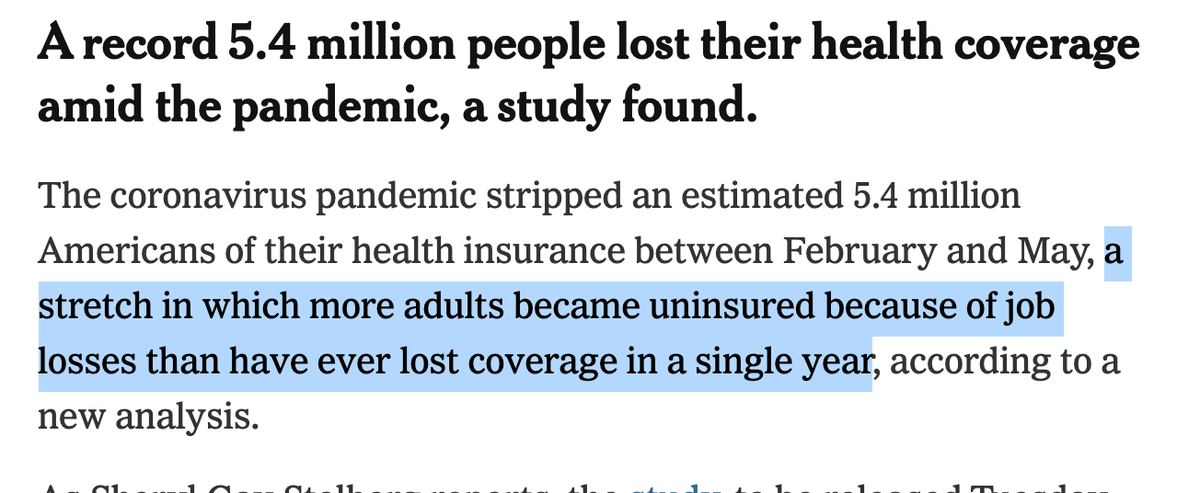
Roughly 5.4 million adults in the U.S. lost their health insurance from February to May after losing their jobs, according to a new estimate from Families USA, a group that favors the Affordable Care Act.

Why it matters: There are more adults under 65 without insurance in Southern states, which are the same states setting new records for single-day coronavirus infections along with rising hospitalizations, Axios’ Orion Rummler writes.

What they found: 3.9 million adults lost health insurance over one year during the Great Recession, per Families USA’s analysis. It only took four months in this current crisis for an estimated 5.4 million Americans to lose health insurance.

  • More than 20% of adults in Georgia, Florida, South Carolina, North Carolina, Mississippi, Oklahoma and Texas were without insurance as of May.
  • All of these states have set new records in the past two weeks for their highest number of coronavirus infections in a single day, per data from the COVID Tracking Project.
  • 46% of adults who lost coverage due to the pandemic came from five states: Florida, New York, Texas, California and North Carolina.

The backdrop: 21 million Americans were unemployed in May, according to the Bureau of Labor Statistics’ nonfarm payrolls report.


Moody’s: Patient volume recovered a bit in May, but providers face long road to recovery

https://www.fiercehealthcare.com/hospitals/moody-s-patient-volume-recovering-may-but-providers-face-long-road-to-recovery?mkt_tok=eyJpIjoiWmpjeVlXVTRZV0l5T1RndyIsInQiOiJLWWxjamNKK2lkZmNjcXV4dm0rdjZNS2lOanZtYTFoenViQjMzWnF0RGNlY1pkcjVGcFwvZFY4VjFaUUlZaFRBT1NRMGE5eWhGK1ZmR01ZSWVZWGMxOHRzTkptZVZXZmc5UnNvM3pVM2VIWDh6VllldFc3OGNZTTMxTDJrXC8wbzN1In0%3D&mrkid=959610

Moody's: Patient volume recovered a bit in May, but providers face ...

Patient volumes at hospitals, doctors’ and dentists’ offices recovered slightly in May but lagged well behind pre-pandemic levels, according to a new analysis from Moody’s Investors Service.

In all, the ratings agency estimated total surgeries at rated for-profit hospitals declined by 55% to 70% in April compared with the same period in 2019. States required hospitals to cancel or delay elective procedures, which are vital to hospitals’ bottom lines.

“Patients that had been under the care of physicians before the pandemic will return first in order to address known health needs,” officials from the ratings agency said in a statement. “Physicians and surgeons will be motivated to extend office or surgical hours in order to accommodate these patients.”

Those declines narrowed to 20% to 40% in May when compared to 2019.

Emergency room and urgent care volumes were still down 35% to 50% in May.

“This could reflect the prevalence of working-from-home arrangements and people generally staying home, which is leading to a decrease in automobile and other accidents outside the home,” the analysis said. “Weak ER volumes also suggest that many people remain apprehensive to enter a hospital, particularly for lower acuity care.”

The good news:  The analysis estimated it is unlikely there will be a return to the nationwide decline of volume experienced in late March and April because healthcare facilities are more prepared for COVID-19.

For instance, hospitals have enough personal protective equipment for staff and have expanded testing, the analysis said.

For-profit hospitals also have “unusually strong liquidity to help them weather the effects of the revenue loss associated with canceled or postponed procedures,” Moody’s added. “That is largely due to the CARES Act and other government financial relief programs that have caused hospital cash balances to swell.”

However, the bill for one of those sources of relief is coming due soon.

Hospitals and other providers will have to start repaying Medicare for advance payments starting this summer. The Centers for Medicare & Medicaid Services doled out more than $100 billion in advance payments to providers before suspending the program in late April.

Hospital group Federation of American Hospitals asked Congress to change the repayment terms for such advance payments, including giving providers at least a year to start repaying the loans.

Another risk for providers is the change in payer mix as people lose jobs and commercial coverage, shifting them onto Medicaid or the Affordable Care Act’s (ACA’s) insurance exchanges.

“This will lead to rising bad debt expense and a higher percentage of revenue generated from Medicaid or [ACA] insurance exchange products, which typically pay considerably lower rates than commercial insurance,” Moody’s said.


Jobless claims spike to another weekly record amid coronavirus crisis

https://www.axios.com/jobless-claims-unemployment-coronavirus-e54561c2-ed25-4f1e-8e32-7fbec81a9a24.html?stream=top&utm_source=alert&utm_medium=email&utm_campaign=alerts_all

Jobless claims spike to 6.6 million, another weekly record amid ...

6.6 million people filed for unemployment last week, a staggering number that eclipses the record set just days ago amid the coronavirus pandemic, according to government data released Thursday.

Why it matters: Efforts to contain the outbreak are continuing to create a jobs crisis, causing the sharpest spikes in unemployment filings in American history.

  • The colossal number of unemployment filings is worse than most Wall Street banks were expecting.

The big picture: Nearly 10 million Americans have filed for unemployment claims in recent weeks, as businesses around the country shut down in response to the pandemic.

  • But the data lags by a week, so it’s almost certain labor departments around the country are still processing claims and people are still applying.


Fifth Circuit Appeals Court Strikes Down the Affordable Care Act’s Individual Mandate

https://www.commonwealthfund.org/blog/2019/fifth-circuit-appeals-court-strikes-down-affordable-care-acts-individual-mandate

The Fallout from Texas v. U.S.:

Yesterday, a three-judge panel from the Fifth Circuit Court of Appeals struck down the Affordable Care Act (ACA)’s individual mandate. The judges agreed with a lower court decision issued in the case, Texas v. U.S., in December 2018 that the individual mandate is unconstitutional but, unlike the lower court, did not decide that the rest of the ACA is also unconstitutional. Instead, the judges remanded, or sent back, the decision to the same lower court judge to consider. California Attorney General Xavier Becerra, who is leading the 21 Democratic state attorneys general defending the law, along with the U.S. House of Representatives, immediately announced he would appeal the decision to the Supreme Court.

Whether the Supreme Court will decide to take the case now or wait for the decision of Judge O’Connor’s, of the lower court, is uncertain. If the Court decides to take the case now, they could expedite the briefing process and issue a decision in 2020. If it does not take the case now, a ruling will be delayed until after the 2020 presidential election.

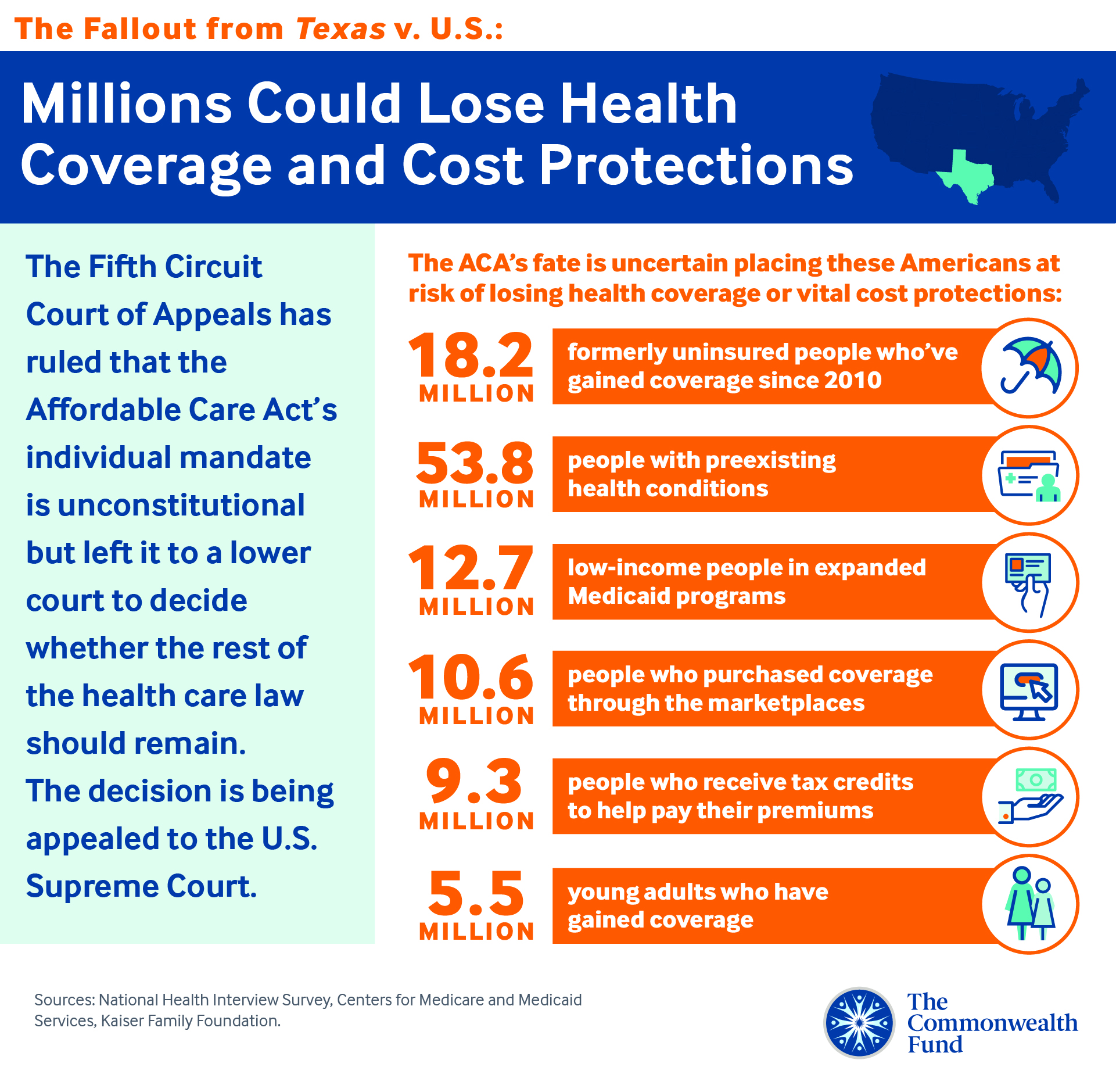
No one knows how the Supreme Court will ultimately rule. But we do know that if the Court decides to strike down the ACA, the human toll will be immense and tragic. The law has granted unprecedented health security to millions:

  • 18.2 million formerly uninsured people have gained coverage since 2010
  • 53.8 million Americans with preexisting health conditions are now protected
  • 12.7 million low-income people are insured through expanded Medicaid
  • 10.6 million people have coverage through the ACA marketplaces, 9.3 million of whom receive tax credits to help them pay their premiums
  • 5.5 million young adults have gained coverage, many by staying on their parents’ plans
  • 45 million Medicare beneficiaries have much better drug coverage.

Such a decision will also trigger massive disruption throughout the U.S. health system. The health care industry represents nearly 20 percent of the nation’s economy; the ACA has touched every corner of it. The law restructured the individual and small-group health insurance markets, expanded and streamlined the Medicaid program, improved Medicare benefits, and reformed the way Medicare pays doctors, hospitals, and other providers. It was a catalyst for the movement toward value-based care and established a regulatory pathway for biosimilars — less expensive versions of biologic drugs. States have rewritten laws to incorporate the ACA’s provisions. Insurers, hospitals, physicians, and state and local governments have invested billions of dollars in adjusting to these changes.

The law’s popular preexisting health condition protections have made it possible for people with minor-to-serious health problems to apply for coverage in the same way healthier people have always done. These protections have given the estimated 53.8 million Americans with preexisting health conditions the peace of mind that they will never be denied health insurance because of their health.

More than 150 million people who get coverage through their employers now are eligible for free preventive care, and their children can stay on their policies to age 26.

The wide racial and income inequities in health insurance coverage that have been partly remedied by the ACA would return. Hospitals and providers, especially safety-net institutions, would struggle with mounting uncompensated care burdens and sicker and more costly patients who are not receiving the preventive care they need.

The ACA tore down financial barriers to health care for millions, many of whom were uninsured for most of their lives. It has demonstrably helped people get the health care they need in states across the country. Research indicates that Medicaid expansion has led to improved health status and lower mortality risk.

To date, neither the Trump administration, which has sided with the plaintiffs in the case, nor its Republican colleagues in Congress have offered a replacement plan in the event the law is struck down. The historic progress made by Americans, particularly those with middle and lower incomes and people of color, could unravel. Voters are already telling policymakers they are worried about their ability to afford health care. Yesterday’s decision and the uncertain path forward to the Supreme Court is certain to escalate those worries. With the nation entering the 2020 presidential election year, the Supreme Court may decide to take up the case this term.


Benefit design, higher deductibles will increase bad debt for hospitals

https://www.healthcarefinancenews.com/node/139468

Legislative proposals could reduce bad debt, but would likely introduce additional complexity to billing processes.

Changes in insurance benefit design that shift greater financial responsibility to the patient, rising healthcare costs and confusing medical bills will continue to drive growth in bad debt — often faster than net patient revenue, according to a new report from Moody’s.

Legislative proposals to simplify billing have the potential to reduce bad debt, but the downside for hospitals is that they’ll likely introduce additional complexity to billing processes and complicate relationships with contracted physician groups. A recent accounting change will reduce transparency around reporting bad debt.

Higher cost sharing and rising deductibles are the main contributors to the trend of patients assuming greater financial responsibility, a trend that’s been occurring for more than a decade, and that will further increase the amount of uncollected payments. Hospitals and providers are responsible for collecting copays and deductibles from patients, which may not always be possible at the time of service; the longer the delay between providing service and collecting payment, the less likely a hospital is to collect payment.

On top of that, the higher an individual’s deductible is, the greater the share of reimbursement that a hospital has to collect. The prevalence of general deductibles increased to 85% of covered workers in 2018, up from 55% in 2006, and the amount of the annual deductible almost tripled in that time to an average of $1,573.

Multiple factors are driving the trend toward higher cost sharing, including a desire among employees and employers for stable premium growth despite steadily rising healthcare costs and the growing popularity of high deductible health plans.

WHAT’S THE IMPACT

Hospitals face an uphill battle when it comes to reducing bad debt. Strategies include point-of-service collections, enhanced technology to better estimate a patient’s responsibility for a medical bill, and offering low-cost financing or payment plans.

A common feature of these approaches is educating patients about what portion of a medical bill is their responsibility, after taking into account the specifics of their insurance plan. But hospitals often find it hard to provide reliable cost estimates for a given service, which can thwart efforts to provide patients with an accurate estimate of their financial responsibility.

One difficulty is that medical bills partly depend on the complexity of service and amount of resources consumed — which may not be known ahead of time. There’s also the need to incorporate specific benefits of the patient’s own insurance plan. A certain amount of bad debt is likely to arise from patients accessing emergency care given the insufficient time to determine insurance coverage.

Another difficulty in billing is surprise medical bills, received by insured patients who inadvertently receive care from providers outside their insurance networks, usually in emergency situations. While the term “surprise medical bills” refers to a specific, narrow slice of healthcare costs, they have become part of the broader debate about the affordability and accessibility of U.S. healthcare.

THE LARGER TREND

To minimize surprise bills, Congress is considering proposals to essentially “bundle” all of the services a patient receives in an emergency room into a single bill. Under a bundled billing approach, the hospital would negotiate a set charges for a single or “bundled” episode of care in the emergency room. The hospital would then allocate payments to the providers involved.

This approach, which major hospital and physician trade groups oppose, has the potential to significantly affect hospitals and disrupt the business models of physician staffing companies, according to Moody’s. Many hospitals outsource the operations and billing of their emergency rooms or other departments to staffing companies. Bundling services would require a change in the contractual relationship between hospitals and staffing companies.

Another recent proposal in Congress would require in-network hospitals to guarantee that all providers operating at their facilities are also in network. This approach adds significant complexity because many physicians and ancillary service providers are not employed or controlled by the hospitals where they work. Some hospitals would likely seek to employ more physicians, leading to increases in salaries, benefits and wages expense.


Paying for healthcare shouldn’t bankrupt families

https://www.modernhealthcare.com/opinion-editorial/paying-healthcare-shouldnt-bankrupt-families?utm_source=modern-healthcare-daily-finance&utm_medium=email&utm_campaign=20190923&utm_content=article4-readmore

Image result for medical bills bankruptcy

Healthcare costs in the U.S. are too high. Americans struggle to afford basic needs like prescription drugs and too often face crushing surprise bills after undergoing necessary medical procedures. Seniors in particular feel the weight of health expenses when they discover that the Medicare benefits they earned don’t always provide sufficient coverage.

While the Affordable Care Act instituted protections for Americans with pre-existing conditions, guaranteed essential health benefits and made some progress in lowering patients’ costs, those advancements are under attack in the courts and through regulatory actions. I chair the House Ways and Means Committee, which has jurisdiction over a great deal of our nation’s healthcare system, including Medicare. Under Democratic leadership, we are fighting to bring down healthcare costs and preserve critical existing health protections.

Our committee hit the ground running this year. The first hearing I convened as chairman focused on protecting Americans with pre-existing conditions. Nearly 130 million Americans have a pre-existing condition—anything from asthma to cancer to diabetes. Thanks to the ACA, insurance companies can no longer refuse to cover these individuals. The hearing shed light on the importance of this safeguard and the ways it provides Americans with greater peace of mind and financial security.

We also highlighted the immense pain families will endure if 18 Republican state attorneys general succeed in their case to repeal the law.

House Democrats, along with Democratic state attorneys general, jumped into this court battle and continue to defend the millions of Americans with health conditions from discrimination and financial ruin.

We also took concrete steps to increase transparency and lower drug prices. Ways and Means advanced legislation that sheds light across the healthcare supply chain—from pharmaceutical manufacturers to pharmacy benefit managers—to help reduce costs for families. More can be done. In the coming months, the committee will consider legislation to improve the Medicare Part D program, establishing an out-of-pocket cap on expenses for beneficiaries. This would lower costs for seniors and save taxpayers money.

Part D reform is just one way to improve Medicare for beneficiaries. Many seniors aren’t aware that Medicare does not cover routine vision, hearing or dental exams. I will work to change that. Helping seniors access the glasses, hearing aids or dental care they need will save them money on the front end. This coverage will also prevent the trauma and expense of falls or other related health problems that could arise down the road as a result of inadequate services.

Some of the most jarring and devastating medical costs Americans encounter are surprise medical bills. Ways and Means plans to tackle this problem too. We are crafting legislation now that will help patients avoid the huge expenses that follow inadvertently being treated by out-of-network providers.

Healthcare is a necessity and it’s a human right. Paying for it shouldn’t bankrupt families. We can lower patient costs without stifling medical innovation or throwing hospitals into turmoil. It’s possible to achieve commonsense solutions that strengthen our nation’s healthcare system while reducing the burden on consumers.