The norms around science and politics are cracking

https://www.axios.com/science-politics-norms-cracking-f67bcff2-b399-44f4-8827-085573f5ae52.html

Illustration of a hand holding a cracked microscope slide containing the U.S. flag.

Crafting successful public health measures depends on the ability of top scientists to gather data and report their findings unrestricted to policymakers.

State of play: But concern has spiked among health experts and physicians over what they see as an assault on key science protections, particularly during a raging pandemic. And a move last week by President Trump, via an executive order, is triggering even more worries.

What’s happening: If implemented, the order creates a “Schedule F” class of federal employees who are policymakers from certain agencies who would no longer have protection against being easily fired— and would likely include some veteran civil service scientists who offer key guidance to Congress and the White House.

  • Those agencies might handle the order differently, and it is unclear how many positions could fall under Schedule F — but some say possibly thousands.
  • “This much-needed reform will increase accountability in essential policymaking positions within the government,” OMB director Russ Vought tells Axios in a statement.

What they’re saying: Several medical associations, including the Infectious Diseases Society of America, strongly condemned the action, and Democrats on the House oversight panel demanded the administration “immediately cease” implementation.

  • “If you take how it’s written at face value, it has the potential to turn every government employee into a political appointee, who can be hired and fired at the whim of a political appointee or even the president,” says University of Colorado Boulder’s Roger Pielke Jr.
  • Protections for members of civil service allow them to argue for evidence-based decision-making and enable them to provide the best advice, says CRDF Global’s Julie Fischer, adding that “federal decision-makers really need access to that expertise — quickly and ideally in house.”

Between the lines: Politics plays some role in science, via funding, policymaking and national security issues.

  • The public health system is a mix of agency leaders who are political appointees, like HHS Secretary Alex Azar, and career civil servants not dependent on the president’s approval, like NIAID director Anthony Fauci.
  • “Public health is inherently political because it has to do with controlling the way human beings move around,” says University of Pennsylvania’s Jonathan Moreno.

Yes, but: The norm is to have a robust discussion — and what has been happening under the Trump administration is not the norm, some say.

  • “Schedule F is just remarkable,” Pielke says. “It’s not like political appointees editing a report, [who are] working within the system to kind of subvert the system. This is an effort to completely redefine the system.”
  • The Center for Strategic and International Studies’ Stephen Morrison says that the administration has been defying normative practices, including statements denigrating scientists, the CDC and FDA.

The big picture: Public trust in scientists,which tends to be high, is taking a hit, not only due to messaging from the administration but also from public confusion over changes in guidance, which vacillated over masks and other suggestions.

  • Public health institutions “need to have the trust of the American people. In order to have the trust of the American people, they can’t have their autonomy and their credibility compromised, and they have to have a voice,” Morrison says.
  • “If you deny CDC the ability to have briefings for the public, and you take away control over authoring their guidance, and you attack them and discredit them so public perceptions of them are negative, you are taking them out of the game and leaving the stage completely open for falsehoods,” he adds.
  • “All scientists don’t agree on all the evidence, every time. But what we do agree on is that there’s a process. We look at what we know, we decide what we can clearly recommend based on what we know, sometimes when we learn more, we change our recommendations, and that’s the scientific process,” Fischer says.

What’s next: The scientific community is going to need to be proactive on rebuilding public trust in how the scientific process works and being clear when guidance changes and why it has changed, Fischer says.

Healthcare executives fear for their organizations’ viability without a COVID-19 vaccine

https://www.healthcarefinancenews.com/news/healthcare-executives-fear-their-organizations-viability-without-covid-19-vaccine

A complete financial recovery for many organizations is still far away, findings from Kaufman Hall indicate.

For the past three years, Kaufman Hall has released annual healthcare performance reports illustrating how hospitals and health systems are managing, both financially and operationally.

This year, however, with the pandemic altering the industry so broadly, the report took a different approach: to see how COVID-19 impacted hospitals and health systems across the country. The report’s findings deal with finances, patient volumes and recovery.

The report includes survey answers from respondents almost entirely (96%) from hospitals or health systems. Most of the respondents were in executive leadership (55%) or financial roles (39%). Survey responses were collected in August 2020.

FINANCIAL IMPACT

Findings from the report indicate that a complete financial recovery for many organizations is still far away. Almost three-quarters of the respondents said they were either moderately or extremely concerned about their organization’s financial viability in 2021 without an effective vaccine or treatment.

Looking back on the operating margins for the second quarter of the year, 33% of respondents saw their operating margins decline by more than 100% compared to the same time last year.

Revenue cycles have taken a hit from COVID-19, according to the report. Survey respondents said they are seeing increases in bad debt and uncompensated care (48%), higher percentages of uninsured or self-pay patients (44%), more Medicaid patients (41%) and lower percentages of commercially insured patients (38%).

Organizations also noted that increases in expenses, especially for personal protective equipment and labor, have impacted their finances. For 22% of respondents, their expenses increased by more than 50%.

IMPACT ON PATIENT VOLUMES

Although volumes did increase over the summer, most of the improvement occurred in areas where it is difficult to delay care, such as oncology and cardiology. For example, oncology was the only field where more than half of respondents (60%) saw their volumes recover to more than 90% of pre-pandemic levels.

More than 40% of respondents said that cardiology volumes are operating at more than 90% of pre-pandemic levels. Only 37% of respondents can say the same for orthopedics, neurology and radiology, and 22% for pediatrics.

Emergency department usage is also down as a result of the pandemic, according to the report. The respondents expect that this trend will persist beyond COVID-19 and that systems may need to reshape their business model to account for a drop in emergency department utilization.

Most respondents also said they expect to see overall volumes remain low through the summer of 2021, with some planning for suppressed volumes for the next three years.

RECOVERY MEASURES

Hospitals and health systems have taken a number of approaches to reduce costs and mitigate future revenue declines. The most common practices implemented are supply reprocessing, furloughs and salary reductions, according to the report.

Executives are considering other tactics such as restructuring physician contracts, making permanent labor reductions, changing employee health plan benefits and retirement plan contributions, or merging with another health system as additional cost reduction measures.

THE LARGER TREND

Kaufman Hall has been documenting the impact of COVID-19 hospitals since the beginning of the pandemic. In its July report, hospital operating margins were down 96% since the start of the year.

As a result of these losses, hospitals, health systems and advocacy groups continue to push Congress to deliver another round of relief measures.

Earlier this month, the House passed a $2.2 trillion stimulus bill called the HEROES Act, 2.0. The bill has yet to pass the Senate, and the chances of that happening are slim, with Republicans in favor of a much smaller, $500 billion package. Nothing is expected to happen prior to the presidential election.

The Department of Health and Human Services also recently announced the third phase of general distribution for the Provider Relief Fund. Applications are currently open and will close on Friday, November 6.

TrumpCare Versus BidenCare: A Potential Shift For 45 Million Americans

https://mailchi.mp/burroughshealthcare/april-16-3240709?e=7d3f834d2f

Healthcare policy is a defining issue for America | Financial Times

Less than three months from now, either Donald Trump will begin his second term as President, or Joe Biden will begin his first. What the U.S. healthcare system on that date and moving forward could be starkly different depending on who is sworn in.
 
The policy differences between the two men are essentially on opposite poles. If fully enacted, Trump’s policies could potentially cause tens of millions of Americans to lose their healthcare coverage. Biden’s policies would likely provide healthcare access to tens of millions more Americans compared to today.
 
In November, the U.S. Supreme Court will hear arguments in a case called California v. Texas. It stems from the 2017 tax bill that zeroed out the penalty individuals paid if they did not obtain health insurance. The argument put forth by the 20 Republican state attorney generals in that case is if the individual mandate no longer has taxing power, the entire law should be declared unconstitutional based upon a lack of severability of the entire law.
 
Many legal scholars have noted that this case is premised on a shaky argument. But with a 6-3 majority of conservative justices now on the high court, many bets are off as to the ACA’s survival. And President Trump just said in an interview with “60 Minutes” he fervently hoped the ACA is eliminated. He put forth no alternatives to the ACA in that interview.
 
Should the ACA be declared unconstitutional, health insurance for some 23 million people would be imperiled. That includes some 12 million Americans who are eligible for Medicaid under the ACA’s expanded income guidelines, and another 11 million who purchase insurance on the state and federal health insurance exchanges – roughly 85% of whom receive premium subsidies that make it more affordable. Moreover, another 14 million Americans who are estimated to have lost their employer-based health plans during the COVID-19 pandemic may not have another place to turn for coverage.
 
Before the ACA case, the Trump administration also promoted so-called “off-exchange” health plans, and health sharing ministries. The first is often a form of short-term health insurance, the second operates as a cooperative serving those of the same religious stripe. Both offer health coverage that is potentially cheaper that what is offered on the exchanges, but both also tend to cap it at low dollar levels. Many also bar applicants for a variety of claims, such as for maternity or cancer care, or if they have pre-existing medical conditions – practices prohibited for ACA plans.
 
Should Trump be re-elected and the ACA survives constitutional muster, expect to see many states apply for more waivers from that law. Georgia just received approval to modestly expand Medicaid eligibility, primarily for those poor already working 80 hours or more a month. The state is also on the cusp of being able to opt out of the healthcare.gov exchange entirely and have consumers work directly with insurance brokers to purchase coverage. However, there is nothing in the pending waiver to prevent those brokers from offering stripped-down coverage without the ACA protections that the Trump administration is already promoting.
There could also be more block grants to states for their Medicaid budgets, which most experts have concluded would reduce the number of enrollees in that program.
 
If Biden is elected and both incoming houses of Congress are also Democratic, the entire Supreme Court case can be mooted simply by reattaching a financial penalty to the individual mandate. That hasn’t been mentioned at all during the campaign, presumably because Biden does not want to discuss what would essentially be a promise to raise taxes. But it is the most direct way to skirt the risk of an adverse Supreme Court decision.
 
Biden’s campaign has also put forth numerous proposals to enlarge the ACA and the Medicare program. They include expanded premium subsidies for individuals and families to purchase coverage, and a public health plan option – which would allow those who live in the states that have yet to expand Medicaid to obtain coverage. Biden has also proposed a buy-in to Medicare at age 60.
 
The estimates are that an expanded ACA and other Biden plans could net another 20 to 25 million Americans healthcare coverage. That would leave fewer than 10 million – 2% to 3% of the population – without access to coverage. It would probably be as close to universal healthcare as the United States could get given its current political realities.
 

The two different approaches will either lead to a country where virtually everyone has access to healthcare coverage and services, or one where 50 million or more people could potentially be uninsured. It’s a shift that could impact a minimum of 45 million people – and that’s not even counting those who lost their coverage during the current public health crisis. 
 
Elections have consequences. Less than three months from now, this one will determine whether the U.S. healthcare system will take one consequential path over another.

Almost half a million Americans contract COVID-19 in past week as infections surge

https://www.reuters.com/article/health-coronavirus-usa/almost-half-a-million-americans-contract-covid-19-in-past-week-as-infections-surge-idUSL1N2HI1Z9

Turning the Corner, LLC | HR, Management Training, and Job Seeker Services

Nearly half a million people in the United States have contracted the novel coronavirus in the last seven days, according to a Reuters tally, as cases and hospitalizations set fresh records in hot spots in the Midwest.

More than 5,600 people died from the virus nationwide in the last week, with hospitalizations shooting up 13%, a Reuters analysis showed.

Illinois, which has emerged as a hot spot in recent weeks, reported over 31,000 new cases in the last seven days, more new infections than any other state except Texas.

To try and contain the surge, Illinois Governor J.B. Pritzker imposed fresh rounds of restrictions in six of 11 regions.

Indoor dining in bars and restaurants will be suspended by Wednesday and gatherings will be limited to 25 people under a state formula that triggers ‘mitigation’ when the positivity rate tops 8% for at least two days in a row. The affected areas include some Chicago suburbs.

Other states have walked back reopening plans to curb the spread of the virus as cooler weather sets in across most of the nation.

Idaho Governor Brad Little on Monday announced indoor gatherings of more than 50 people would be prohibited, and outdoor gatherings are to be capped at 25% capacity.

Health experts believe the virus is surging because of private social gatherings, colder temperatures driving people inside, and fatigue with COVID-19 precautions.

Beyond the Midwest, the Texas city of El Paso is also facing a surge in cases that is overwhelming local hospitals, with officials setting up an alternate care facility to help relieve medical centers.

“We are seeing all sorts of patients. The narrative historically has been the above-65, those with multiple co-morbidities. But we’re seeing 20-year-olds. We’re seeing 30-year-olds, 40-year-olds,” Dr. Ogechika Alozie, an infectious disease specialist in El Paso, told Reuters. “There’s that exhaustion, but again, we buckle up and we take care of the patients.”

U.S. President Donald Trump, facing a tough re-election battle on Nov. 3, lashed out again at reports that the coronavirus is surging, and reiterated his false claim that the country is “rounding the turn” in its battle with the virus that has killed more than 225,800 people.

Pennsylvania, a hotly contested ‘battleground’ state in next week’s election, on Tuesday reported a fresh record in new coronavirus cases, according to the state’s health department.

More than half of US states broke records in daily Covid-19 cases this month. Now hospitals brace for an onslaught

https://www.cnn.com/2020/10/28/health/us-coronavirus-wednesday/index.html

https://www.cnn.com/videos/health/2020/10/27/coronavirus-cases-rising-pandemic-watt-pkg-lead-vpx.cnn/video/playlists/coronavirus/

North Dakota leading in number of new coronavirus cases - CNN Video

The fall Covid-19 surge keeps growing, with 29 states setting new records this month for the most new daily cases since the pandemic began, according to data from Johns Hopkins University.

And it’s not just due to more testing. The average number of daily new cases this past week is up 21% compared to the previous week, according to JHU. But testing has increased only 6.63% over the same time frame, according to the Covid Tracking Project. “We’re rising quickly. If we just go back about six, seven weeks ago to Labor Day, we were at about 35,000 cases a day,” said Dr. Ashish Jha, dean of Brown University School of Public Health.”

At least 73,240 new US cases and 985 deaths were reported Tuesday, according to JHU. “I would not be surprised if we end up getting to 100,000” new cases a day, Jha said. The surge is hitting all regions of the country. As of Wednesday, 40 states were trending in the wrong direction, with at least 10% more new cases this past week compared to the previous week, according to JHU. Missouri is the only state with at least 10% fewer cases, and the remaining nine states are relatively steady.

Track the virus in your state and nationwide And with more cases come more hospitalizations and deaths.

Without changes, ‘half a million people will be dead’

This month, 11 states reported their highest single day of new deaths since the pandemic began.

And because a vaccine probably won’t be available to most Americans until the middle of next year, personal responsibility will be key to saving American lives.“If we continue our current behavior, by the time we start to go down the other side of the curve, a half a million people will be dead,” said CNN medical analyst Dr. Jonathan Reiner, a professor of medicine at George Washington University.Under the current conditions, the daily US death toll is projected to reach 2,000 by January 1, according to the University of Washington’s Institute for Health Metrics and Evaluation.In the past nine months, more than 8.7million people in the US have been infected with coronavirus, and more than 226,000 have died.

Imminent threats to hospital capacity

Even after setting up a field hospital at the state fairgrounds, Wisconsin is facing a dire predicament with hospital capacity. “There is no way to sugarcoat it. We are facing an urgent crisis, and there is an imminent risk to you and your family,” Gov. Tony Evers said.

In Ohio, admissions to intensive care units have doubled since the beginning of this month, Gov. Mike DeWine said. Colorado is also worried about hospital capacity as the number of daily new cases skyrocketed this month. “If these trends continue, it would exceed May hospitalization numbers,” Gov. Jared Polis said. “And the modeling suggests that if we don’t change what we’re doing, it’ll exceed all of the existing hospital capacity by the end of the year. This thing moves quick, and we need to change the way we live.”The city and county of Denver has reduced the maximum allowed occupancy of restaurants, retailers and some other businesses from 50% to 25%, according to a statement Tuesday.”Why we’re doing this is to send a clarion call to everyone that we have a responsibility to once again put our hands on this boulder and begin to push it back up the hill,” Denver Mayor Michael Hancock said.

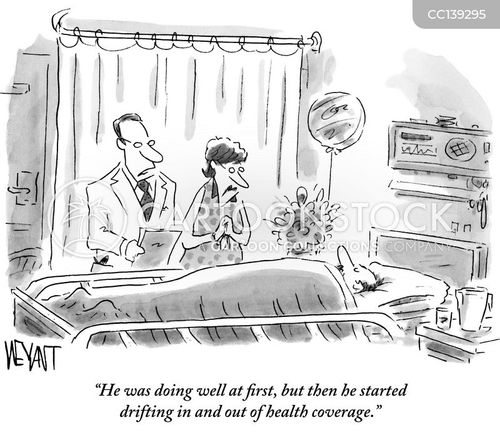
Cartoon – Drifting in and out of Health Coverage

Universal Healthcare Cartoons and Comics - funny pictures from CartoonStock

Intermountain, Sanford to merge into 70-hospital system

https://www.beckershospitalreview.com/hospital-transactions-and-valuation/intermountain-sanford-to-merge-into-70-hospital-system.html?utm_medium=email

Top 10 Largest Health Systems in the U.S.

Salt Lake City-based Intermountain Healthcare and Sioux Falls, S.D.-based Sanford Health have signed a letter of intent to merge. 

The boards of both nonprofit organizations unanimously approved on Oct. 23 a resolution to support moving forward with the due diligence process. Pending regulatory and state approvals, the merger is expected to close in 2021. 

“We’re hoping that the actions taken … just 72 hours ago will culminate in a combined organization next summer,” Kelby Krabbenhoft, president and CEO of Sanford Health, said during an Oct. 26 news conference. 

Existing boards of trustees from both systems will join to form a combined board, and Gail Miller, chair of the Intermountain board, will serve as board chair of the merged organization. 

Marc Harrison, MD, president and CEO of Intermountain, will serve as president and CEO of the combined system, which will operate 70 hospitals and employ more than 89,000 people. Mr. Krabbenhoft will serve as president emeritus. 

“These are two great organizations with strong histories that are economically and clinically very strong,” Dr. Harrison said during the news conference. “This is something that should happen for the future of American healthcare.” 

Intermountain will be the parent company of the combined organization, and the merged system will be headquartered in Salt Lake City. 

COVID response leads voters’ healthcare concerns

https://mailchi.mp/f2794551febb/the-weekly-gist-october-23-2020?e=d1e747d2d8

The upcoming election has huge implications for healthcare, far beyond how COVID is managed, ranging from how care is covered to how it’s delivered. The graphic above shows a continuum of potential policy outcomes of the November 3rd vote.

If President Trump wins a second term and Republicans control at least one house of Congress, there will likely be more attempts to dismantle the ACA, as well as continued privatization of Medicare coverage.

 If Democrats win the presidency and sweep Congress, actions to expand the Affordable Care Act (ACA), or even create a national public option, are on the table—although major healthcare reform seems unlikely to occur until the second half of a Biden term.

In the short term, we’d expect to see more policy activity in areas of bipartisan agreement, like improving price transparency, ending surprise billing and lowering the cost of prescription drugs, regardless of who lands in the White House.
 
While healthcare emerged as the most important issue for voters in the 2018 midterm elections, the COVID pandemic has overshadowed the broader healthcare reform platforms of both Presidential candidates heading into the election. As shown in the gray box, many Americans view the election as a referendum on the Trump administration’s COVID response. Managing the pandemic is one of the most important issues for voters, especially Democrats, who now rank the issue above reducing the cost of healthcare or lowering the cost of drugs. 

In many aspects, the COVID policies of Biden and Trump are almost diametrically opposed, especially concerning the role of the federal government in organizing the nation’s pandemic response.

The next administration’s actions to prevent future COVID-19 surges, ensure safe a return to work and school, accelerate therapies, and coordinate vaccine delivery will remain the most important aspect of healthcare policy well into 2021.

Nebraska gets the nod for Medicaid work requirements

https://mailchi.mp/f2794551febb/the-weekly-gist-october-23-2020?e=d1e747d2d8

Federal judge blocks Kentucky's Medicaid work requirements

This week Nebraska became the latest state to receive waiver authority from the Trump administration to implement work requirements as part of its Medicaid expansion program.

The program, called “Heritage Health Adult”, will be a two-tiered system, with expansion-eligible adults choosing between “Basic” and “Prime” coverage levels. The lower tier will provide coverage for physical and behavioral health services, with a prescription drug benefit, and is open to adults not eligible for traditional Medicaid with incomes under 138 percent of the federal poverty line.

“Prime” enrollees will get additional dental, vision, and over-the-counter drug benefits, in exchange for agreeing to 80 hours per month of work, volunteering, or active job seeking, which must be reported to the state.

Nebraska voters approved the Medicaid expansion two years ago, although enrollment only began this August, and the work-linked demonstration project is slated to start next year. An estimated 90,000 additional Nebraskans are expected to enroll in Medicaid under the expanded program.
 
The approval of Nebraska’s Medicaid work requirement comes a week after the Trump administration approved a partial expansion of Medicaid in Georgia, called “Pathways to Coverage”, which is also tied to a requirement to seek or engage in employment or education activities.

The Georgia program also requires premium payments by eligible adults who make between 50 and 100 percent of the federal poverty line. Court challenges will inevitably ensue for both the Nebraska and Georgia programs—only Utah has successfully implemented Medicaid work requirements, with 16 other state programs either pending approval, held up in court, or awaiting implementation. We continue to be deeply skeptical of Medicaid work requirements, and believe they only serve to deter those who would otherwise qualify for coverage from enrolling, and that the expense of their implementation and ongoing operation often outweighs any savings to the state.

The argument that “work encourages health”, often advanced by proponents of work requirements, gets it exactly backwards—rather, health security encourages work, a reality that has become ever more urgent as the COVID pandemic has drawn on. 

As the economy continues to falter, Medicaid’s importance as a safety net program grows ever greater, and work requirements create an unhelpful obstacle to basic healthcare access.

The Uncertain Future of the Medicare Trust Fund

https://www.commonwealthfund.org/blog/2020/uncertain-future-medicare-trust-fund

Medicare trust fund

The COVID-19 pandemic has increased pressures on an already-stressed public health care financing system. This is especially evident when it comes to the financial health of Medicare’s Hospital Insurance (HI) Trust Fund, which finances health care services related to hospital, skilled nursing facility, and hospice stays for Medicare beneficiaries.

In April, using pre-COVID-19 data, the Trustees of Social Security and Medicare projected that the HI Trust Fund would become insolvent in 2026 — meaning that Medicare Part A claims submitted by providers would not be fully reimbursed. The Congressional Budget Office (CBO) made a similar projection when it issued its March 2020 baseline projections. In a September 2020 report, the CBO projected that the date of insolvency had moved up to 2024.

The pandemic has disrupted economic activity in the United States in several ways: a large and rapid rise in unemployment substantially reduced payments to the Trust Fund from payroll taxes, and hospitals experienced unprecedented financial stress from lost revenues because of a dramatic drop in admissions and procedures, along with new costs arising from the pandemic. One way that Congress provided relief to address these economic shocks was to make advance payments. Between $65 billion and $92 billion in advance payments were made to Medicare Part A providers that draw upon the HI Trust Fund. This increased claims on the Trust Fund in 2020 and lowers them for 2021 — assuming they are paid back in 2021. Together these economic dynamics create a situation that requires quick action to prevent insolvency; the margin for error is small.

The duration of the pandemic and the timing and size of an economic recovery remain highly uncertain. While unemployment has declined notably, from 14.7 percent in April to 8.4 percent in August, new spikes in COVID-19 cases across the country continue to dampen economic activity. The recent jobs report also suggested a slowing of employment recovery. Further, there is great uncertainty about the timing, availability, and effectiveness of a potential vaccine. As a result, we are quite unsure when payroll tax revenues will recover or to what degree hospital finances will recover.

The Federal Reserve Bank of St. Louis recently underscored the uncertainty when it issued the following assessment:

“The COVID-19 pandemic — like all pandemics — will come to an end. Of course, nobody knows when that will be. No one also knows whether there will be subsequent waves of the virus that trigger a nationwide resumption of strict social distancing protocols or whether a proven vaccine allows a swift return to pre-COVID norms. Thus, the trajectory of the recovery is the key unknown at this point.”

Together these forces create policy tensions. It is important to continue to support hospitals and nursing homes whose revenues have not yet recovered, and those that continue to incur unusual costs because they are still carrying heavy financial burdens stemming from COVID-19. At the same time state and federal health care financing programs are under extreme financial stress.

Recent legislation negotiated between Congress and the Trump administration would permit hospitals to request an extension for repaying advance payment loans and also reduce the interest rate. Together, these provisions recognize the continued financial stress and provide relief but also introduce new uncertainty. That is, by lengthening the repayment period and reducing the costs of carrying the loans it becomes less certain when they will be paid back in full and returned to the Trust Fund, making the solvency date of the Trust Fund less certain (as specified further in Centers for Medicare and Medicaid Services guidance). In addition, this assumes that the full amounts of the loan will be paid back.

The timing of the COVID-19 pandemic has been especially unfortunate in terms of maintaining the Medicare HI Trust Fund’s solvency. The Trustees issued a warning that action was needed when insolvency was estimated to occur in 2026; it has now been pushed up to 2024. One way to address the uncertainty would be to make a fund transfer from general revenues to the Trust Fund in the amount of the outstanding loans, thereby removing any additional uncertainty around timing of repayment. This could help mitigate risks in a world with highly uncertain economic and epidemiological forecasts but would risk further increasing federal spending during an economic downturn.