Despite turbulence in H1, no avalanche of health systems downgrades

https://www.healthcaredive.com/news/despite-turbulence-in-h1-no-avalanche-of-health-systems-downgrades/584353/?utm_source=Sailthru&utm_medium=email&utm_campaign=Issue:%202020-09-02%20Healthcare%20Dive%20%5Bissue:29437%5D&utm_term=Healthcare%20Dive

“It’s new territory, which is why we’re taking that measured approach on rating actions,” Suzie Desai, senior director at S&P, said.

The healthcare sector has been bruised from the novel coronavirus and the effects are likely to linger for years, but the first half of 2020 has not resulted in an avalanche of hospital and health system downgrades.

At the outset of the pandemic, some hospitals warned of dire financial pressures as they burned through cash while revenue plunged. In response, the federal government unleashed $175 billion in bailout funds to help prop up the sector as providers battled the effects of the virus.

Still, across all of public finance — which includes hospitals — the second quarter saw downgrades outpacing upgrades for the first time since the second quarter of 2017.

S&P characterized the second quarter as a “historic low” for upgrades across its entire portfolio of public finance credits.

“While only partially driven by the coronavirus, the second quarter was the first since Q2 2017 with the number of downgrades surpassing upgrades and by the largest margin since Q3 2014,” according to a recent Moody’s Investors Service report.

Through the first six months of this year, Moody’s has recorded 164 downgrades throughout public finance and, more specifically, 27 downgrades among the nonprofit healthcare entities it rates.

By comparison, Fitch Ratings has recorded 14 nonprofit hospital and health system downgrades through July and just two upgrades, both of which occurred before COVID-19 hit.

“Is this a massive amount of rating changes? By no means,” Kevin Holloran, senior director of U.S. Public Finance for Fitch, said of the first half of 2020 for healthcare.

Also through July, S&P Global recorded 22 downgrades among nonprofit acute care hospitals and health systems, significantly outpacing the six healthcare upgrades recorded over the same period.

“It’s new territory, which is why we’re taking that measured approach on rating actions,” Suzie Desai, senior director at S&P, said.

Still, other parts of the economy lead healthcare in terms of downgrades. State and local governments and the housing sector are outpacing the healthcare sector in terms of downgrades, according to S&P.

Virus has not ‘wiped out the healthcare sector’

Earlier this year when the pandemic hit the U.S., some made dire predictions about the novel coronavirus and its potential effect on the healthcare sector.

Reports from the ratings agencies warned of the potential for rising covenant violations and an outlook for the second quarter that would result in the “worst on record, one Fitch analyst said during a webinar in May.

That was likely “too broad of a brushstroke,” Holloran said. “It has not come in and wiped out the healthcare sector,” he said. He attributes that in part to the billions in financial aid that the federal government earmarked for providers.

Though, what it has revealed is the gaps between the strongest and weakest systems, and that the disparities are only likely to widen, S&P analysts said during a recent webinar.

The nonprofit hospitals and health systems pegged with a downgrade have tended to be smaller in size in terms of scale, lower-rated already and light on cash, Holloran said.

Still, some of the larger health systems were downgraded in the first half of the year by either one of the three rating agencies, including Sutter Health, Bon Secours Mercy Health, Geisinger, University of Pittsburgh Medical Center and Care New England.

“This is something that individual management of a hospital couldn’t control,” said Rick Gundling, senior vice president of Healthcare Financial Management Association, which has members from small and large organizations. “It wasn’t a bad strategy — that goes into a downgrade. This happened to everybody.”

Deteriorating payer mix

Looking forward, some analysts say they’re more concerned about the long-term effects for hospitals and health systems that were brought on by the downturn in the economy and the virus.

One major concern is the potential shift in payer mix for providers.

As millions of people lose their job they risk losing their employer-sponsored health insurance. They may transition to another private insurer, Medicaid or go uninsured.

For providers, commercial coverage typically reimburses at higher rates than government-sponsored coverage such as Medicare and Medicaid. Treating a greater share of privately insured patients is highly prized.

If providers experience a decline in the share of their privately insured patients and see a growth in patients covered with government-sponsored plans, it’s likely to put a squeeze on margins.

The shift also poses a serious strain for states, and ultimately providers. States are facing a potential influx of Medicaid members at the same time state budgets are under tremendous financial pressure. It raises concerns about whether states will cut rates to their Medicaid programs, which ultimately affects providers.

Some states have already started to re-examine and slash rates, including Ohio.


2020 Hospital Operating Margins Down 96% Through July

https://www.prnewswire.com/news-releases/2020-hospital-operating-margins-down-96-through-july-301116888.html

Ship in a Storm | ICOExaminer

Hospital Operating Margins have plunged 96% since the start of 2020 in comparison with the first seven months of 2019, according to a new Kaufman Hall report, as uncertainty and volatility continue in the wake of the COVID-19 pandemic.

Those results do not include federal funding from the Coronavirus Aid, Relief, and Economic Security (CARES) Act. Even with that aid, however, Operating Margins are down 28% year-to-date compared to January-July 2019.

Operating Margins fell 2% year-over-year in July without the CARES Act relief, according to the latest edition of Kaufman Hall’s National Hospital Flash Report. Hospitals also saw flat year-over-year gross revenue performance in July, continued high per-patient expenses, and a fifth consecutive month of volumes falling below 2019 performance and below budget.

From June to July, however, hospital Operating Margins were up 24%, likely due to a backlog in demand resulting from the shutdown of many non-urgent services in the early months of the pandemic.

“COVID-19 has created a highly volatile operating environment for our nation’s hospitals and health systems,” said Jim Blake, managing director, Kaufman Hall. “Hospitals have shown some incremental signs of potential financial recovery in recent months. Unfortunately, there is no guarantee these trends will continue, and hospitals still have a long way to go to recover from devastating losses in the early months of the pandemic.”

July volumes continued to fall year-over-year, but showed some signs of potential recovery month-over-month. Adjusted Discharges were down 7% compared to July 2019, but up 6% compared to June 2020. Adjusted Patient Days were down 4% year-over-year, but up 7% month-over-month. Adjusted Discharges are down 13% and Adjusted Patient Days are down 11% since the start of 2020, compared to the first seven months of 2019.

Hospital Emergency Department (ED) volumes have been hardest hit, falling 17% year-to-date compared to the same period in 2019, down 17% year-over-year, and 13% below budget in July. Surgery volumes saw some gains with the continued resumption of non-urgent procedures pushing Operating Room Minutes up 3% month-over-month and 4% above budget in July, but they remain down 15% year-to-date.

Not including CARES Act relief, Gross Operating Revenues were essentially flat year-over-year and 2% below budget for the month, but have fallen 8% year-to-date compared to the same period in 2019. Inpatient Revenue is down 5% year-to-date and fell 3% below budget in July, but increased 1% year-over-year. Outpatient Revenue is down 11% year-to-date, 1% year-over-year, and 2% below budget.

Hospitals nationwide also continued to see higher per-patient expenses despite having fewer patients. Total Expense per Adjusted Discharge has jumped 16% year-to-date compared to the same seven-month period in 2019, and rose 9% year-over-year and 5% above budget in July. Labor Expense per Adjusted Discharge is up 18% year-to-date and rose 9% year-over-year and 5% above budget in July. Non-Labor Expense per Adjusted Discharge has increased 15% during the first seven months of 2020 and jumped 11% year-over-year and was 5% above budget for the month.

The National Hospital Flash Report draws on data from more than 800 hospitals.


Sutter posts $857M loss in H1 on investment, operational declines

https://www.healthcaredive.com/news/sutter-posts-857m-loss-in-h1-on-investment-operational-declines/583910/?utm_source=Sailthru&utm_medium=email&utm_campaign=Issue:%202020-08-21%20Healthcare%20Dive%20%5Bissue:29231%5D&utm_term=Healthcare%20Dive

California's Sutter Health reaps rewards from investments in ...

Dive Brief:

  • Sutter Health had a staggering loss of $857 million in the first half of the year as the Northern California health was bruised by the pandemic. That’s almost a $1.4 billion drop in income compared to the first half of last year, a plummet Sutter management largely blamed on investment and operational losses in its latest financial filing posted Thursday.
  • The virus shuttered operations for a period of time, driving Sutter’s revenue down 8% to $6.1 billion during the first half of the year. Expenses climbed nearly 2%, contributing to an operating loss of $557 million.
  • Still, the nonprofit noted it did experience a significant rebound in its investments in the second quarter after weathering the devastating effects of the first quarter.

Dive Insight:

Sutter joins other major nonprofit health systems in posting net losses for the first half of the year despite receiving hundreds of millions in federal grants to help offset headwinds brought on by the pandemic.

Recently, both Renton, Washington-based Providence and Arizona-based Banner Health posted losses for the first half of the year — $538 million and $267 million, respectively. Dampened revenue and downturns in investments contributed to their losses.

The federal government has funneled billions of dollars to providers across the country in an attempt to help them weather the downturn in patient volumes. Sutter noted in its filing that it’s received $400 million in federal relief funds so far, though that wasn’t enough to push the health system back into the black. Sutter operates 29 hospitals and enjoys a large presence in Northern California.

Sutter reported fewer admissions and emergency room visits in the second quarter compared to the prior-year period, down about 10% and 19%, respectively.

The pandemic was quick to wreak havoc on Sutter’s finances during the first quarter, in which the system reported an operating loss of $236 million and a net loss of almost $1.1 billion.

The coronavirus is also serving as a drag on its ratings. In April, two of the three big ratings agencies downgraded Sutter Health’s rating.

In part, Moody’s attributed the downgrade to Sutter’s weaker profitability profile. In its rationale, Moody’s said, “Following a second year of weaker results, margins in 2020 are likely to remain under pressure due to COVID-19 related disruptions, ongoing performance challenges at some of Sutter’s facilities, and continued reimbursement pressure.”

Also weighing on Moody’s rating is the $575 million settlement expected to be paid this year to resolve antitrust issues. Last year, the health system averted a trial over antitrust concerns after agreeing to a settlement with California regulators. Sutter agreed it would end any contracts that require all of its facilities to be in-network or none of them and cap out-of-network charges, among other stipulations.


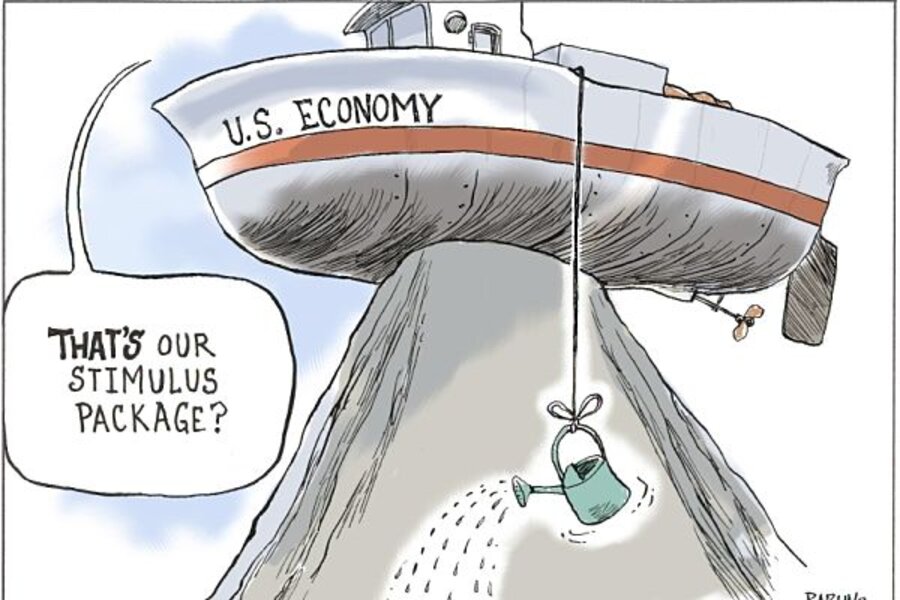
Cartoon – New Economic Stimulus Package

Obama's stimulus did NOT raise government spending - CSMonitor.com

US economy added 1.8 million jobs in July but still down nearly 13 million jobs during the pandemic

https://edition.cnn.com/2020/08/07/economy/july-2020-jobs-report/index.html?fbclid=IwAR2ZKuCxrp3mzH_GizAoLlCe3ZRAleJbzjCSYYmxiJ6Efiq_qfbU9eq2N2o

July jobs report 2020: US economy added 1.8 million jobs in July ...

The US economy added another 1.8 million jobs in July, a sharp slowdown from June and a small step for an economy that’s still down 12.9 million jobs during the pandemic.

It was the third-straight month of improvement after the spring lockdown that decimated the labor market, and the July job gain exceeded economists’ expectations. Even so, it was far fewer than the 4.8 million jobs added in June.
The unemployment rate fell to 10.2%, the Bureau of Labor Statistics reported Friday, but remains above the Great Recession high of 10% that was reached in October 2009.
Friday’s report had good and bad parts, and economists are still trying to come to grips with how the labor market is behaving in this unparalleled situation.
For example, the number of people working part-time rose by 803,000 to 24 million in total in July. The government defines part-time work as anything under 35 hours per week.
“We added more jobs than most people expected, but the gains really were disproportionately part-time workers,” said Kate Bahn, economist and director of labor market policy at the Washington Center for Equitable Growth. “To me that means even if workers are coming back it’s to jobs that pay less, and families will be worse off.”
Meanwhile, the unemployment rate fell in all demographic groups. The rate remains by far the highest for Black workers at 14.6%, which is concerning, Bahn said.
“Research from previous downturns suggests that Black workers are the most likely to be displaced,” she added.
Then there are seasonal adjustments, which are based on historical trends in the job market — but because the pandemic is unlike any other moment in history, they’re distorting the data at the moment. Without seasonal adjustments, only 591,000 jobs were added in July.
That said, one positive sign in this jobs report is the number of permanent job losses: it was more or less flat from June at 2.9 million. This might not sound exciting, but it would have been very bad news for the recovery had the number gone up.
“Granted still more than double from before the crisis, but we’ll take the one-month reprieve,” said Daniel Zhao, senior economist at Glassdoor.
Since the pandemic hit, the government has struggled to count the enormous number of people who are out of work. That’s in part because it has been increasingly difficult for workers themselves to discern whether they have been temporarily laid off or employed but not at work.
The share of misclassified responses was smaller in June and July than in the months before, the BLS said. Including the misclassified workers, the July unemployment rate would have been about one percentage point higher than reported.
The reopening of the economy and a resurgence in Covid-19 infections in some states, paired with business and individuals running out of federal aid, has created a unique set of conditions for the jobs market.
survey from Cornell University showed that 31% of workers who were recently rehired have lost their jobs for a second time during the pandemic. Another 26% have been told that they might get laid off again.
Meanwhile, the Federal Reserve Bank of St. Louis said states with more Covid cases since June also registered the weakest employment recovery. This was most notably true for Arizona, Florida and Texas.

Head-butting in Washington

Friday’s jobs report comes during tense times in Washington, as Republicans and Democrats are butting heads over the next stimulus bill. One point of contention is the government’s boost of unemployment benefits. The CARES act provided a weekly boost of $600 to regular jobless aid. But this provision ran out on July 31.
Now Congress is arguing about how to proceed: Democrats want to keep the $600 weekly supplement for the rest of the year, while Republicans want to cut it to $400 a week.
For millions of Americans, the benefit expansion contributes a large portion of their income at the moment — so cutting it could hamper the recovery. At the same time, some economists believe that too much unemployment aid actually keeps people from returning to work. The question is what is too much aid during an economic crisis of unprecedented proportions.
“The primary reasoning behind the reducing those benefits it that it would push more Americans back into the labor force. But there doesn’t seem to be a lot of evidence for the need to push people back, because the jobs aren’t’ there,” said Zhao, the Glassdoor economist.
This could mean workers who are forced back to work by the lower benefits may have to take part-time or riskier jobs than they would otherwise choose.


State of the Union: by Paul Field

Image may contain: text that says 'Whoever Paul Field is he hit the nail on the head. Field PM own opinion, but you post Everyone entitled silly "Welcome Socialism... You Socialism. the wealthiest, geographically advantaged, productive people. about This failure our, "Booming economy," modest challenges. tis the market dissonance stores, farmers/producers and crisis about corporations needing emergency bailout longest history ending interest with being unable equipped provide healthcare, time post profits. crisis response depending antiquated systems nobody remembers operate. But all, politicization the for the benefit of education, science, natural lifestyles, lifestyles, charity, compassion, virtually else for brief gain gutted our society.'

Graph of the Day: Daily Confirmed Covid-19 Cases (Rolling 3-day average)

Daily confirmed COVID-19 cases, rolling 3-day average - Our World ...

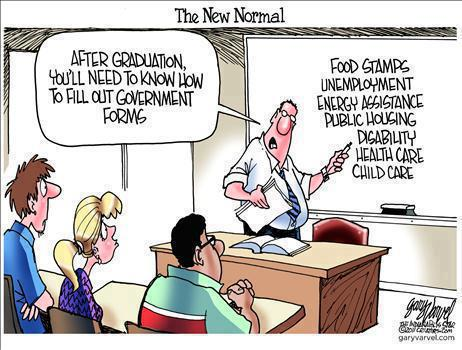
Cartoon – The New Normal

Education to employment: Getting Europe's youth into work - The ...

Cartoon – Jobless Economic Recovery

Unemployment Figure Cartoons and Comics - funny pictures from ...

Cartoon – Long-Term Unemployed (Please Give)

Sack cartoon: Unemployment benefits | Star Tribune