America Now Has 4 Million Covid-19 Cases, As Calls For Mask Mandates Grow

https://www.forbes.com/sites/carlieporterfield/2020/07/23/america-nears-4-million-covid-19-cases-as-calls-for-mask-mandates-grow/?utm_source=newsletter&utm_medium=email&utm_campaign=dailydozen&cdlcid=5d2c97df953109375e4d8b68#9e673414550f

America Now Has 4 Million Covid-19 Cases As Calls For Mask ...

TOPLINE

Seven months since the first coronavirus case in the country was reported, the United State’s total infection count passed the 4 million milestone Thursday, according to a tally from The New York Times, a brutal marker as cases continue to rise in most of the country and calls for masking increase.

KEY FACTS

The number of total fatalities attributed to the virus has exceeded 143,000, the Times reported.

On Wednesday, a record-breaking 12,807 new cases was enough to tip California’s total number past that of New York, once the world epicenter of the pandemic (though its per capita infection rate remains less than New York at its peak).

Nationwide daily virus deaths topped 1,000 fatalities Wednesday for the first time since May.

The troubling numbers come as calls for widespread use of face masks grows, with President Donald Trump, who has in the past downplayed the garment, calling their use “patriotic” in a tweet this week.

Labor Department numbers released Thursday showed unemployment claims over the past week have jumped for the first time since March, rising by upwards of 100,000 to total 1.4 million.

KEY BACKGROUND

Around 230 million Americans are under a form of public masking mandate where they live, amounting to some 70% of the country, according to a Forbes analysis. A politically-charged garment for some, Americans on both sides of the aisle seem to be accepting of face masks mandates—a Politico/Morning Consult poll released this week found that 72% of voters surveyed would support a state mask mandate where they live, though Democrats identified as “strongly support[ing]” such an order roughly twice as much as Republicans, according to the survey.

President Donald Trump and inched closer to voicing support for masking during his first coronavirus briefing in months on Wednesday, saying, “Whether you like the mask or not, they have an impact, they’ll have an effect—and we need everything we can get,” Forbes reported.


Canceled elective procedures putting pressure on nation’s hospitals

https://www.healthcarefinancenews.com/news/canceled-elective-procedures-putting-pressure-nations-hospitals

U.S. Hospitals Brace for 'Tremendous Strain' from New Virus - JEMS

Even upticks in COVID-19 patients haven’t made up for the revenue losses, since reimbursement for those services is comparatively slim.

Elective procedures are in a strange place at the moment. When the COVID-19 pandemic started to ramp up in the U.S., many of the nation’s hospitals decided to temporarily cancel elective surgeries and procedures, instead dedicating the majority of their resources to treating coronavirus patients. Some hospitals have resumed these surgeries; others resumed them and re-cancelled them; and still others are wondering when they can resume them at all.

In a recent HIMSS20 digital presentation, Reenita Das, a senior vice president and partner at Frost and Sullivan, said that during the pandemic, plastic surgery activity declined by 100%, ENT surgeries declined by 79%, cardiovascular surgeries declined by 53% and neurosurgery surgeries declined by 57%.

It’s hard to overstate the financial impact this is likely to have on hospitals’ bottom lines. Just this week, American Hospital Association President and CEO Rick Pollack, pulling from Kaufman Hall data, said the cancellation of elective surgeries is among the factors contributing to a likely industry-wide loss of $120 billion from July to December alone. When including data from earlier in the pandemic, the losses are expected to be in the vicinity of $323 billion, and half of the nation’s hospitals are expected to be in the red by the end of the year.

Doug Wolfe, cofounder and managing partner of Miami-based law firm Wolfe Pincavage, said this has amounted to a “double-whammy” for hospitals, because on top of elective procedures being cancelled, the money healthcare facilities received from the federal Coronavirus Aid, Relief, and Economic Security Act was an advance on future Medicare payments – which is coming due. While hospitals perform fewer procedures, they will now have to start paying that money back.

All hospitals are hurting, but some are in a more precarious position than others.

“Some hospital systems have had more cash on hand and more liquidity to withstand some of the financial pressure some systems are facing,” said Wolfe. “Traditionally, the smaller hospital systems in the healthcare climate we face today have faced a lot more financial pressure. They’re not able to control costs the same way as a big system. The smaller hospitals and systems were hurting to begin with.”

LOWER REVENUE, HIGHER COSTS

Some hospitals, especially ones in hot spots, are seeing a surge in COVID-19 patients. While this has kept frontline healthcare workers scrambling to care for scores of sick Americans, COVID-19 treatments are not reimbursed at the same level as surgeries. Hospital capacity is being stretched with less lucrative services.

“Some hospitals may be filling up right now, but they’re filling up with lower-reimbursing volume,” said Wolfe. “Inpatient stuff is lower reimbursement. It’s really the perfect storm for hospitals.”

John Haupert, CEO of Grady Health in Atlanta, Georgia, said this week that COVID-19 has had about a $115 million negative impact on Grady’s bottom line. Some $70 million of that is related to the reduction in the number of elective surgeries performed, as well as dips in emergency department and ambulatory visits. 

During one week in March, Grady saw a 50% reduction in surgeries and a 38% reduction in ER visits. The system is almost back to even in terms of elective and essential surgeries, but due to a COVID-19 surge currently taking place in Georgia, it has had to suspend those services once again. ER visits have only come back about halfway from that initial 38% dip, and the system is currently operating at 105% occupancy.

“Part of what we’re seeing there is reluctance from patients to come to hospitals or seek services,” said Haupert. “Many have significantly exacerbated chronic disease conditions.”

Patient hesitation has been an ongoing problem, as has the associated cost of treating coronavirus patients, said Wolfe.

“When they were ramping up to resume the elective stuff, there was a problem getting patients comfortable,” he said. “And the other thing was that the cost of treating patients in this environment has gone up. They’ve put up plexiglass everywhere, they have more wiping-down procedures, and all of these things add cost and time. They need to add more time between procedures so they can clean everything … so they’re able to do less, and it costs more to do less. Even when elective procedures do resume, it’s not going back to the way it was.”

Most hospitals have adjusted their costs to mitigate some of the financial hit. Even some larger systems, such as 92-hospital nonprofit Trinity Health in Michigan, have taken to measures such as laying off and furloughing workers and scaling back working hours for some of its staff. At the top of the month, Trinity announced another round of layoffs and furloughs – in addition to the 2,500 furloughs it announced in April – citing a projected $2 billion in revenue losses in fiscal year 2021, which began on June 1.

Hospitals are at the mercy of the market at the moment, and Wolfe anticipates there could be an uptick in mergers and consolidation as organizations look to partner with less cash-strapped entities. 

“Whether reorganization will work remains to be seen, but there will definitely be a fallout from this,” he said.


Increasing unemployment alters national payer mix

https://mailchi.mp/9075526b5806/the-weekly-gist-july-24-2020?e=d1e747d2d8


One in every five workers is now collecting unemployment benefits as the country struggles to get the COVID-19 outbreak under control. A recent Families USA study estimates a quarter of the 21.9M workers that were furloughed or laid off between February and May lost their health insurance. And the payer mix will continue to change as the pandemic wears on.

The graphic below highlights a study from consultancy Oliver Wyman, looking at the impact of rising unemployment (at 15, 20 and 30 percent) on insurance coverage. With each five to ten percent rise in unemployment, the commercially insured population decreases by three to five percentThose who lose employer-sponsored insurance either remain uninsured, buy coverage on the Obamacare marketplaces, or qualify for Medicaid.

Surprisingly, Washington State and California are reporting little to no enrollment growth in Medicaid programs thus far. Experts point to lack of outreach and consumer awareness as key contributors to the slow growth—but Medicaid enrollment will likely begin to rise quickly in coming months as temporary furloughs convert to more permanent layoffs.

The right side of the graphic spotlights the growing number of uninsured individuals in those states with the highest uninsured rates. The previous record for the largest increase in uninsured adults was between 2008 and 2009, when nearly 4M lost coverage. The current pandemic-driven increase has crushed that record by 39 percent.

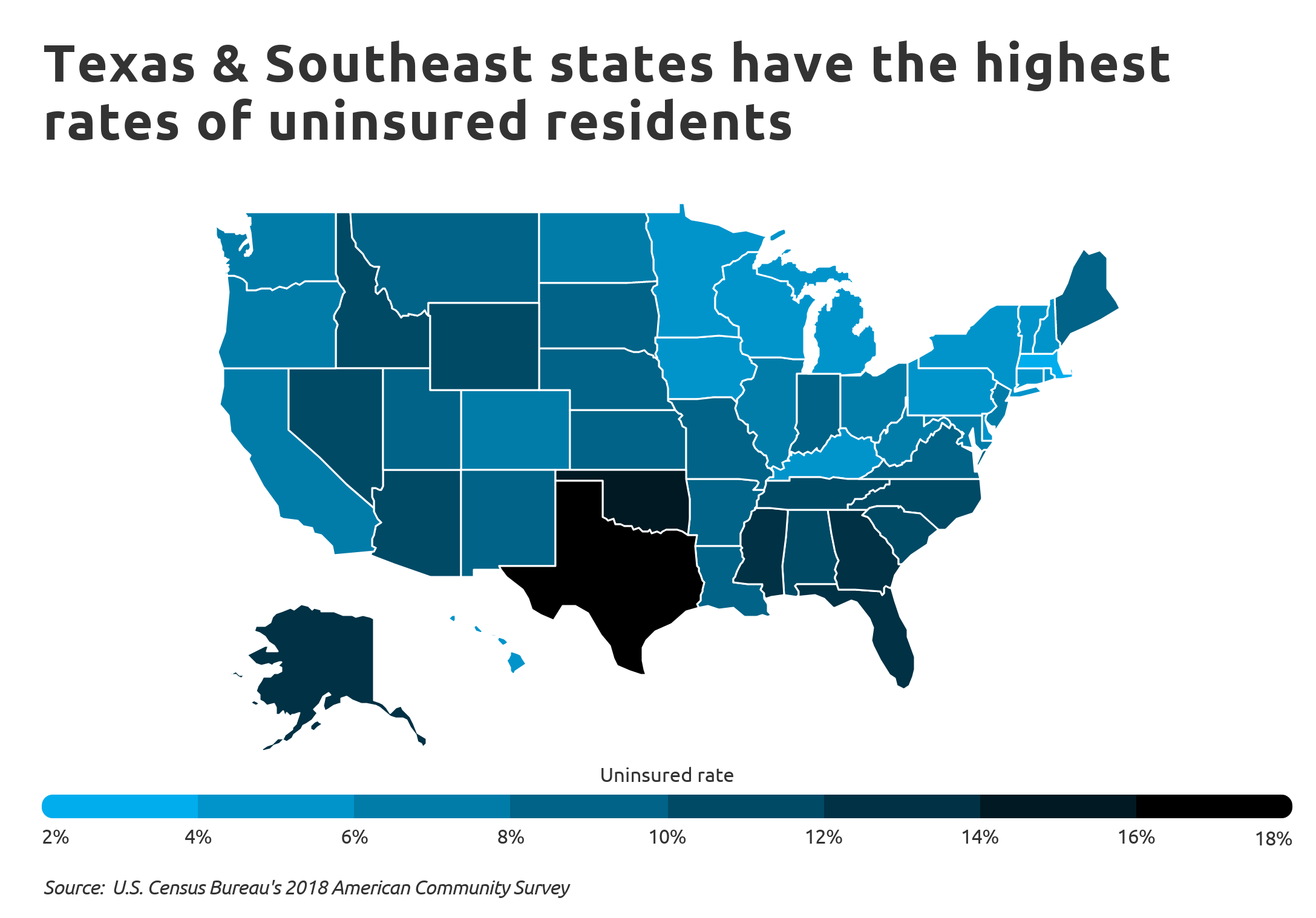
On average, states are seeing uninsured populations increase by two percent, with some as high as five percent. And the two states with the highest uninsured rates, Florida and Texas, are also dealing with the largest surge in COVID-19 cases and deaths. The ranks of the uninsured will continue to climb as states reimpose shutdowns, government assistance ends, and layoffs grow.


U.S. passes 4 million coronavirus cases as pace of new infections roughly doubles

https://www.washingtonpost.com/politics/us-passes-4-million-coronavirus-cases-as-pace-of-new-infections-roughly-doubles/2020/07/23/d0125192-cd02-11ea-b0e3-d55bda07d66a_story.html?utm_campaign=wp_main&utm_medium=social&utm_source=facebook&fbclid=IwAR3Ve5MnHiStJnPO_mzkc1c2sHE2EM6QOG-2HochFPBmJe6hnyvcmqEVQ4U

The United States on Thursday passed the grim milestone of 4 million confirmed coronavirus infections, and President Trump announced he was canceling the public celebration of his nomination for a second term, as institutions from schools to airlines to Major League Baseball wrestled with the consequences of a pandemic still far from under control.

The rapid spread of the virus this summer is striking, taking just 15 days to go from 3 million confirmed cases to 4 million. By comparison, the increase from 1 million cases to 2 million spanned 45 days from April 28 to June 11, and the leap to 3 million then took 27 days.

Trump’s cancellation of the in-person portion of the Republican National Convention planned for next month in Jacksonville, Fla., represented a remarkable reversal. He had insisted for months on a made-for-television spectacle that would have packed people close together in a state that is now an epicenter of the resurgent pandemic.

On Thursday, he conceded that was not going to work. “The timing for this event is not right,” Trump said during the latest of somber, solo White House briefings this week. “It’s just not right with what’s been happening.”

Florida reported 173 deaths on Thursday, its highest single-day count of new deaths, and also reported more than 10,200 new coronavirus cases.

In a scathing statement blaming the surge of new cases on Trump’s “failure to care,” presumptive Democratic nominee Joe Biden said the president “quit on this country and waved the white flag of surrender.”

Meanwhile, nearly every public health metric suggests America is badly losing its fight against the virus.

Positivity rates have reached alarming levels in numerous states, hospitalizations are soaring, and more than 1,100 new coronavirus deaths were reported across the United States on Wednesday, marking the first time since May 29 that the daily count exceeded that number, according to Washington Post tracking.

The rolling seven-day average of infections has doubled in less than a month, reaching more than 66,000 new cases per day Wednesday. The U.S. death toll now exceeds 141,000.

As a result, many businesses appear to be pulling back after their attempts to resume more normal operations proved premature, and an additional 1.4 million American workers filed for unemployment benefits last week. It was the first time since March that new claims rose. Another 980,000 new Pandemic Unemployment Assistance claims — the benefits offered to self-employed and gig workers — were also filed.

Congress, meanwhile, struggled to confront the crisis. Senate Republicans killed Trump’s payroll tax cut proposal on Thursday, widening an unusual rift with the White House over the cost and contents of the latest national coronavirus relief package.

Senate Majority Leader Mitch McConnell (R-Ky.) had planned to roll out a $1 trillion GOP bill Thursday morning, but that was canceled amid the intraparty conflicts.

Administration officials then floated a piecemeal approach, involving several different aid bills, but ran into opposition from lawmakers in both parties.

Trump’s briefing Thursday afternoon, his third of the week, reflected an effort to increase popular support for his management of the coronavirus outbreak, which even many of his allies have criticized. About 2 out of 3 Americans disapprove of Trump’s handling of the pandemic, a new poll found.

Trump dismissed or played down the risk of the virus for months after it had begun spreading in the United States and has been a self-described cheerleader for rapid reopening of businesses and schools shuttered to help slow its spread.

The survey of 1,057 adults in the United States, conducted by the Associated Press-NORC Center for Public Affairs Research, also showed that 3 out of 4 Americans, including a majority of Republicans, support mandatory face coverings when people are outside their own homes.

Democrats overwhelmingly favor mask mandates, at 89 percent. The majority of Republicans — 59 percent — also support them.

Ninety-five percent of Democrats and 75 percent of Republicans say they wear face coverings when leaving home. Overall, more Americans — 86 percent — are wearing masks compared with in May, when 73 percent were doing so.

Trump resisted wearing a mask in public until earlier this month, despite calls to set a good example from the top. He now calls it patriotic to wear a mask, though he still does not wear one consistently and says people should decide for themselves. Trump carries a black-cloth version in his pocket, which he says is sufficient for those instances when he is close to people who have not been screened for the virus.

Trump’s shift may reflect a growing consensus in favor of masks, although it is not clear that opposition to them has ebbed among some of the president’s strongest political supporters.

The business community is struggling, too. American Airlines and Southwest Airlines posted big quarterly losses between April and July in their earnings reports released Thursday, projecting that travel demand will not rebound anytime soon.

In American’s second quarter, revenue dropped more than 86 percent, to $1.6 billion, from nearly $12 billion a year ago, according to a Securities and Exchange Commission filing. The company posted a net loss of nearly $2.1 billion, attributing it to stay-at-home orders, border closures and travel restrictions.

“As a result, we have experienced an unprecedented decline in the demand for air travel, which has resulted in a material deterioration in our revenues,” the company said in the earnings report. “While the length and severity of the reduction in demand due to Covid-19 is uncertain, we expect our results of operations for the remainder of 2020 to be severely impacted.”

Southwest posted revenue of $1 billion in its second quarter, an almost 83 percent dip compared with a year ago. The company also posted a net loss of $915 million.

Trump also took a small step back from his insistence that schools should open on time this fall, conceding instead that some schools might need to delay in-person learning. Many school districts have already announced that decision.

Trump has been critical of guidance from the Centers for Disease Control and Prevention, saying it made it too tough for schools to reopen, and promised new guidelines would be issued. On Thursday, the CDC released several documents emphasizing the benefits of in-person school, in line with Trump’s messaging. Some of the guidance was written by White House officials rather than experts at the CDC, people familiar with the process said. They spoke on the condition of anonymity to discuss internal decision-making.

The new guidelines for school administrators mention precautions outlined in previous documents, but they appear to drop specific reference to keeping students six feet apart — something many schools find almost impossible to do if they are fully reopened. This document also suggests that schools consider closing only if there is “substantial, uncontrolled transmission” of the virus, and not necessarily even then.

Florida Gov. Ron DeSantis (R) echoed Trump in making a case for students to return to classrooms, despite the state’s teachers union suing over an order forcing schools to fully reopen. Meanwhile, a new poll showed that most parents would prefer to delay the start of in-person school.

During an appearance on “Fox & Friends,” DeSantis said that schoolchildren are “by far at the least risk for coronavirus, thankfully.”

“We also know they play the smallest role by far in transmission of the virus, and yet they’ve really been asked to shoulder the brunt of our control measures,” said DeSantis, a close Trump ally who had volunteered his state for the Republican convention next month.

DeSantis said that the “evidence-based decision” is for all parents to have the option of in-class instruction for their children if they choose. He said those who are not comfortable with sending their children back to school could continue distance learning.

The role children play in spreading the virus is still being studied, with experts saying that results are not definitive. A South Korean study found that children over the age of 10 were as likely to transmit the virus as adults, while those under 10 were less likely to spread it.

Deborah Birx, the White House coronavirus response coordinator, said Wednesday on Fox News that the United States is launching a study of its own, adding that the data “really needs to be confirmed here.”

Among the most visible American institutions searching for a path forward is the sports industry. Major League Baseball began a pandemic-shortened season on Thursday, playing in empty stadiums amid questions about whether the sport can make it through October without having to abort. It is as much a science experiment as a championship pursuit.

Players are prohibited from spitting or high-fiving. Foul balls that wind up in the stands will remain there.

Anthony S. Fauci, the nation’s leading infectious-disease expert, threw out the first pitch for the Washington Nationals home opener against the New York Yankees. Nationals star outfielder Juan Soto tested positive for the coronavirus on Thursday and missed the game.

Meanwhile, Japan marked a year’s delay of the Olympic Games on Thursday. Tokyo was to host the 2020 Summer Olympics starting Friday. A 15-minute ceremony in Tokyo’s newly built $1.4 billion Olympic Stadium started the countdown to the delayed games, now set to begin on July 23, 2021. The city also marked a new daily record in reported cases on Thursday, with 366.

poll this week by Japan’s Kyodo News Agency found that fewer than 1 in 4 people in Japan even want to host the games anymore. One-third of respondents said the games should be canceled, while 36 percent expressed interest in postponing them for more than a year.


Why COVID-19’s biggest impact on healthcare may not be until 2022

https://www.healthcaredive.com/news/why-covid-19s-biggest-impact-on-healthcare-may-not-be-until-2022/582129/

This perfect storm of a shift in payer mix, the impending insolvency of Medicare and the inability of states to absorb the growing costs of Medicaid represent a tsunami of challenges.

With COVID-19 there has been unprecedented stress placed upon the healthcare system. The human and financial toll of the current crisis has been extraordinary. Yet, little attention has been focused on the impact of this virus on the viability of our healthcare financing system.

Three significant shifts in healthcare financing are occurring as a result of the pandemic’s economic impact. First, as a result of job losses, there will be a shift in commercial insurance to government-funded insurance programs. Second, revenue for funding Medicare, based on payroll taxes, will be significantly decreased. Finally, states will have less tax revenue to pay for Medicaid, threatening the viability of this program as well.

More than 30 million Americans have filed for unemployment since the start of the COVID-19 pandemic. According to a recent report, about 27 million people may lose their employer-sponsored insurance. 

This will result in millions of people seeking coverage through Medicaid programs, the individual marketplace or simply becoming uninsured. Healthcare providers have relied upon margins from commercial insurance to offset costs from poorer reimbursing government funded programs and uncompensated care.

With more than 156 million Americans receiving employer sponsored insurance at the start of this year, and given recent projected job losses, providers may see a 17% shift in payer mix. The reliance on commercial insurance and cost shifting has become a necessary way for providers to financially sustain operations. 

With a 35% margin with commercial insurance compared to Medicare, a 17% shift in payer mix on a trillion dollar spend would result in a substantial reduction in financial resources available to hospitals.

Almost half of healthcare expenditures already come from government programs. Medicare, the largest of these programs, is principally supported by taxes on payroll and social security benefits. With COVID-related job losses there will be a corresponding reduction in payroll tax revenues to the Medicare system. Reports from the Congressional Research Service submitted to Congress in May, with data used prior to COVID-19, projected that Medicare would become insolvent in 2026.

Analyses performed show that there will be a gap in Medicare revenues during the next three years (from the pre-COVID projections) of close to $150 billion. The result is that Medicare will become insolvent as early as 2022. Even by applying more conservative projections, such as recovering all job losses by the end of 2020 and payroll tax revenue holding steady at pre-COVID levels, Medicare still becomes insolvent in 2023.

State revenues, too, will be under real pressure with reduced tax revenues resulting from the current economic downturn. Medicaid programs are supported in part by federal funds, but also from general funds from the state. 
On average, states are projecting about a 10% reduction in revenues in 2020, rising to almost a 25% reduction in 2021. Even without considering the growth in Medicaid enrollment hitting states, this reduced tax revenue will make sustaining current Medicaid program funding increasingly difficult.

This perfect storm of a shift in payer mix, the impending insolvency of Medicare by 2022 and the inability of states to absorb the growing costs of Medicaid represent a tsunami of challenges for the health system. Looking at this new reality, it is clear that our system for financing healthcare is severely broken and we must identify solutions to sustain access to medical care for our citizens.

This will be a challenge of a generation and we will need strength, courage and bold ideas to get through this. Pandemics have a way of changing a society’s political, economic and sociologic outlooks, and COVID-19 will be no different. 


New unemployment insurance claims rise for the first time since March

https://www.washingtonpost.com/business/2020/07/23/another-14-million-workers-filed-unemployment-benefits-last-week-pandemic-continues-weigh-labor-market/


Some 1.4 million workers filed for unemployment last week, the first increase in months, as the pandemic continues to weigh on the labor market

The number of new unemployment claims rose for the first time in months last week, to 1.4 million — a troubling sign for the labor market that’s weathering a new round of closures as the pandemic spreads.

For the week ending July 18, about 109,000 more jobless claims were filed compared to the week prior, according to the Department of Labor.

“What you’re seeing is that, as the economy slows, the pace of claims picks back up — which really puts at risk the monthly jobs report over the next few months,” said Joseph Brusuelas, the chief economist at RSM. “The July numbers are going to be tenuous, but it’s August that I’m worried about.”

The number of workers continually claiming unemployment insurance went down, however, a statistic that lags by a week, to 16.1 million workers for the week ending July 11, from 17.4 million for the week ending July 4.

In addition to the 1.4 million seeking unemployment nationwide last week, another 980,000 new Pandemic Unemployment Assistance claims were filed, the benefits offered to self-employed and gig workers.

The numbers come as millions of unemployed workers are about to exhaust stimulus payments from two federal benefits programs whose expiration economists have warned could have dire effects on the economy.

Brusuelas said the numbers are a sign that the burst of economic activity that marked the country’s reopening has waned, and that shrinking consumer demand remained a significant risk for businesses and the workers they employ across the country.

“We are going to see a much slower pace of growth the reset of the year,” he said. “While we still are retaining our call for a swoosh-shaped recovery, one has to acknowledge a w-shaped recovery is possible.”

The extra $600 a week in unemployment benefits that the federal government has offered to supplement more modest state unemployment benefits will end this week, as lawmakers wrangle over legislation that could extend it.

Including the new benefits available to gig workers and the self-employed, more than 53 million applications have been filed for some form of unemployment insurance during the pandemic.


U.S. Coronavirus Pandemic Status: It’s about to get a lot worse

https://www.axios.com/coronavirus-pain-getting-worse-cd329f4c-9962-4f40-b401-7a7ac1a393cf.html

The pain of the coronavirus is about to get a lot worse - Axios

For months now, American workers, families and small businesses have been saying they can’t keep up their socially distanced lives for much longer. We’ve now arrived at “much longer” — and the pandemic isn’t going away anytime soon.

The big picture: The relief policies and stopgap measures that we cobbled together to get us through the toughest weeks worked for a while, but they’re starting to crumble just as cases are spiking in the majority of states.

Next week, the extra $600 per week in expanded unemployment benefits will expire. And there’s no indication that Congress has reached a consensus on extending this assistance or providing anything in its place.

  • But nearly half of the U.S. population is still jobless, and millions will remain jobless for the foreseeable future. There are 14 million more unemployed people than there are jobs, per the Economic Policy Institute.
  • Nearly a third of Americans missed a housing payment in July — and that was with the additional $600. Plus, most Americans have already spent the stimulus checks they received at the beginning of the pandemic.
  • “We should be very concerned about what’s going to happen in August and beyond” — starting with a spike in evictions, Mathieu Despard, who leads the Social Policy Institute at the Washington University in St. Louis, tells Axios.

Expect more furloughs and layoffs as more small businesses are pushed off the pandemic cliff.

  • By economists’ estimates, more than 100,000 small businesses have permanently closed since the pandemic began.
  • For those that are hanging on, loans from the Paycheck Protection Program (PPP) have not been enough, and the back and forth between re-opening and then closing again as states deal with new case waves has been devastating. In fact, rates of closure have started increasing, the New York Times reports, citing Yelp data.
  • The big firms aren’t immune either. Just last week, behemoths like United Airlines, Wells Fargo, Walgreens and Levi’s either cut jobs or told workers their jobs were at risk, Axios’ Dion Rabouin writes.

And the question of whether schools will reopen looms.

  • Since schools sent kids home in March, and most summer camps didn’t open their doors for the summer, working parents have been dealing with a child care crisis — attempting to do their jobs, care for their kids and homeschool all at once — and hoping that the stress will be temporary.
  • The situation is more dire for low-income families with kids who rely on school lunches or for single parents who are juggling work and parenting without any help.
  • Now the public heath crisis hasn’t abated, and school districts are running out of time to figure out what the fall will look like. Some, starting with Los Angeles, have already decided to go online.

The bottom line: “It’s the uncertainty that is anxiety-inducing,” says Despard. “If you give people a time horizon and say, ‘Look you have to get through these next 8 weeks of extreme shutdown,’ they’ll do it. Now it’s like, ‘How much longer?'”


Texas has the highest uninsured rate in the U.S., with 29 percent of adults uninsured as of May

https://www.beckershospitalreview.com/rankings-and-ratings/states-ranked-by-uninsured-rates.html?utm_medium=email

COVID-19 Health: Rate of Uninsured Americans by City - Self

Texas has the highest uninsured rate in the U.S., with 29 percent of adults uninsured as of May, according to a report from Families USA. 

The report compared uninsured rates in 2018 to rates in May 2020 using data from the U.S. Bureau of Labor Statistics and the Urban Institute. Every state saw an increase in the number of uninsured, and the total number of uninsured in the U.S. climbed 21 percent.

The increase was due in part to layoffs tied to the COVID-19 pandemic in recent months. Nearly 5.4 million Americans lost health insurance coverage from February to May of this year due to job losses, according to the report.

Below is the total percentage of all uninsured adults in each state and the District of Columbia as of May. 

Texas: 29 percent

Florida: 25 percent

Oklahoma: 24 percent

Georgia: 23 percent

Mississippi: 22 percent

Nevada: 21 percent

North Carolina: 20 percent

South Carolina: 20 percent

Alabama: 19 percent

Tennessee: 19 percent

Idaho: 18 percent

Alaska: 17 percent

Arizona: 17 percent

Missouri: 17 percent

Wyoming: 17 percent

New Mexico: 16 percent

South Dakota: 16 percent

Arkansas: 15 percent

Kansas: 15 percent

Louisiana: 14 percent

Virginia: 14 percent

California: 13 percent

Colorado: 13 percent

Illinois: 13 percent

Indiana: 13 percent

Maine: 13 percent

Montana: 13 percent

New Jersey: 13 percent

Oregon: 13 percent

Utah: 13 percent

Michigan: 12 percent

Nebraska: 12 percent

Washington: 12 percent

West Virginia: 12 percent

Delaware: 11 percent

Maryland: 11 percent

New Hampshire: 11 percent

North Dakota: 11 percent

Ohio: 11 percent

Connecticut: 10 percent

Hawaii: 10 percent

Kentucky: 10 percent

New York: 10 percent

Pennsylvania: 10 percent

Wisconsin: 10 percent

Iowa: 9 percent

Rhode Island: 9 percent

Massachusetts: 8 percent

Minnesota: 8 percent

Vermont: 7 percent

District of Columbia: 6 percent


The burden on teachers

https://www.axios.com/teachers-worry-school-reopening-coronavirus-4f173e1b-f48f-49ad-a319-0b053ddd7295.html

The burden on teachers in reopening the schools - Axios

The debate over whether and how much to re-open schools in the fall has put teachers in the precarious position of choosing between their own safety and the pressures from some parents and local officials.

Why it matters: Teachers are the core of K-12 education. The people we depend on to educate our society’s children may end up bearing the brunt of both the risk and the workload.

What’s happening: With coronavirus cases spiking in many parts of the U.S., districts are weighing the feasibility of keeping classes all virtual, as Los Angeles and San Diego are doing, or conducting a rotation of in-person and remote lessons.

While all back-to-school options have pros and cons, there are specific worries for teachers.

1. Exposure: Despite a child’s overall low health risk if they contract COVID-19, scientists still do not conclusively know if schools could become hotspots for more vulnerable populations.

  • Schools are on a time and money crunch for better ventilation, more disinfectant and masks and proper social distancing techniques. If a cluster of cases do occur, teachers and parents are short on answers about how to isolate students and contact trace.
  • Districts were already facing staffing shortages before the pandemic. And nearly 1.5 million teachers have a condition that puts them at increased risk of serious illness from coronavirus, per a Kaiser Family Foundation study. A separate KFF study out today found that 3.3 million adults age 65 or older live in a household with school-age children.
  • A study in Germany found that infections in schools had not led to outbreaks in the community. But an analysis of a surge of cases in Israel found that nearly half the reported cases in June were traced back to illness in schools.

“We as teachers prepare for active shooters, tornadoes, fires and I’m fully prepared to take a bullet or shield a child from falling debris during a tornado. But if I somehow get it and I’m asymptomatic and I get a student sick and something happens to them or one of their family members, that’s a guilt I would carry with me forever.”

— Michelle Albright, a second grade teacher from northwest Indiana

2. Difficulty of a hybrid approach: Many school districts like New York City are opting to split school between in-person and online to minimize exposure. That’s an effective but more burdensome approach for teachers, top teachers union chief Randi Weingarten told Axios’ Dan Primack Monday.

  • In-person contact with a teacher can make a big difference for students struggling with a concept or who need one-on-one time.
  • But many teachers will have to prepare virtual and in-person lessons and ensure the same learning outcomes for students in both settings — a tall order.

3. Child care availability: Teachers with children of their own are concerned about how to care for them when they are teaching.

  • States could choose to provide child care services for educators as essential employees, but it’s unclear what non-school child care options will be available in areas with high infection rates or where day care centers have struggled to stay in business.

4. Concerns of other school staff: Bus drivers, custodians, classroom aides, administrative staff, cafeteria workers, school nurses and substitute teachers may come in contact with more children throughout the day because they are less likely than teachers to be confined to a single classroom.

What to watch: School districts ought to be finding other roles for teachers who are not comfortable returning to the classroom, such as reassigning them to virtual-only roles or providing one-on-one online tutoring sessions with students, said John Bailey, visiting fellow at the American Enterprise Institute and former domestic policy adviser during the George W. Bush administration.

  • But there’s not much time to sort that out on top of getting teachers the professional development they need for effective remote learning.
  • “What I worry about is that we squandered the few months we had to make sure we can think through these challenges,” Bailey said. “This was one of the most obvious challenges facing schools with reopening and we should have been thinking about that for the last several months. Instead it’s creeping up on districts.”

The bottom line: Due to the unprecedented nature of this pandemic, teachers are worried about the uncertainties and, in some cases, lack of clear planning should conditions worsen. That may drive some to quit teaching altogether.

  • “You’ve got 25% of teachers who may be in either a high-risk situation because of pre-existing conditions or because of age, and a lot of them, if they can, they may just check out and say ‘nobody’s taking care of me. I can’t go back,'” Weingarten said.


1.3 million Americans filed first-time unemployment claims last week

https://www.cnn.com/2020/07/16/economy/unemployment-benefits-coronavirus/index.html

1.3 million people filed for first-time unemployment last week

It’s still not easy to remain employed in the US, nearly four months after the coronavirus pandemic began upending the economy.

Another 1.3 million people filed first-time jobless claims on a seasonally adjusted basis for the week ending July 11, according to the Department of Labor. That’s down 10,000 from the prior week’s revised level.
On an unadjusted basis, more than 1.5 million people filed first-time claims, up almost 109,000 from the week before. The seasonal adjustments are traditionally used to smooth out the data, but that has tended to have the opposite effect during the pandemic.
Weekly first-time unemployment applications have been on the decline for more than three months since their peak in the last week of March. But last week’s drop was less than expected.
“Overall, filings remain high and are declining at a stubbornly slow pace,” said Rubeela Farooqi, chief US economist for High Frequency Economics, noting that the risk of mounting permanent job losses is high. “The pace could slow even further or reverse in coming weeks in response to a surge in virus cases and related closures of businesses.”
Continued claims, which count workers who have filed claims for at least two weeks in a row, stood at more than 17.3 million for the week ending July 4, down 422,000 from the prior week. These claims peaked in May at nearly 25 million.
In addition, about 928,500 million people in 47 states filed for first-time pandemic unemployment assistance last week, down almost 118,000 from the week before. And almost 14.3 million people claimed continued pandemic benefits across 48 states for the week ending June 27. That’s up nearly 406,000 from the prior week.
The pandemic program was created by Congress in March to respond to the coronavirus outbreak. It provides temporary benefits to workers who typically aren’t eligible for payments, including freelancers, independent contractors, the self-employed and certain people affected by the coronavirus. It expires at the end of the year.
Looking at all workers participating in an array of unemployment programs, just over 32 million Americans claimed jobless benefits the week ending June 27, down about 433,000 from the prior week.
That total includes those in the traditional and pandemic unemployment programs, as well as the pandemic emergency unemployment compensation program, which has nearly 936,500 filers. Lawmakers created it in March to provide those who have exhausted their benefits with an additional 13 weeks of payments. It also expires at the end of 2020.