GOP senators in close races mislead on preexisting conditions

https://www.washingtonpost.com/politics/2020/07/15/gop-senators-close-races-mislead-preexisting-conditions/?utm_campaign=wp_main&utm_medium=social&utm_source=facebook&fbclid=IwAR3XOi91b1jsLf-grP_iIXALJiIvlZNItPE1ZDO0_ql4Wlw8m3GicyoHIH8

2018 midterms: Republicans mislead voters about preexisting ...

“Steve Daines will protect Montanans with preexisting conditions.”

“Of course I will always protect those with preexisting conditions. Always.”

“What I look forward to working on is a plan that protects people with preexisting conditions.”

— Sen. Cory Gardner (R-Colo.), in an interview with Colorado Public Radio, July 1, 2020


Sound familiar? Just like President Trump, these Republican senators say they support coverage guarantees for patients with preexisting health conditions. And just like Trump, their records show the opposite.

The president’s doublespeak — voicing support for these protections while asking the Supreme Court to strike them down — is spreading into some battleground Senate races this year.


It’s a classic case of buyer beware: Look under the hood of what Daines, Gardner and McSally are selling, and you’ll find a car without an engine.

THE FACTS

Republicans for a decade have tried to repeal the Affordable Care Act, President Barack Obama’s signature health-care legislation. The Supreme Court has upheld the law twice in the face of challenges from conservative groups. As coronavirus cases reached a new high in the United States, the Trump administration filed a legal brief on June 25 asking the Supreme Court to strike down the entire law, joining with a group of GOP state attorneys general who argue that the ACA is unconstitutional.

Before the ACA, insurance companies could factor in a person’s health status while setting premiums, a practice that sometimes made coverage unaffordable or unavailable for those in need of expensive treatment or facing a serious illness such as cancer.


The ACA PROHIBITED THIS PRACTICE through two provisions: “guaranteed issue,” which means insurance companies must sell insurance to anyone who wants it, and “community rating,” which means people in the same age group and geographic area who buy similar insurance pay similar prices. The changes made insurance affordable for people with serious diseases or even those with minor health problems, who also could have been denied coverage before the law’s passage.

Now, about 20 million people covered through the ACA could lose their health insurance if the Supreme Court strikes down the law, among many other consequences bearing directly on the U.S. response to the coronavirus pandemic.

In addition to the coverage guarantee, the ACA established online health insurance marketplaces and subsidies for participating buyers. The law also directs billions of dollars a year in federal funding to states that have chosen to expand their Medicaid programs under the Obamacare law. Millions of Americans have gained coverage through those provisions.

We asked the Daines, Gardner and McSally campaigns whether the senators support or oppose the GOP lawsuit at the Supreme Court and how they would address affordability issues for patients with preexisting conditions if the ACA falls. None of their campaigns responded to our questions.


“Steve Daines will protect Montanans with preexisting conditions.”

Daines voted to repeal the ACA in 2013 and has supported efforts to repeal and replace the law more recently during the Trump administration.

Regarding the GOP lawsuit, a Daines spokesperson was quoted in the Billings Gazette saying the senator “supports whatever mechanism will protect Montanans from this failed law, lower health care costs, protect those with preexisting conditions and expand access to health care for Montanans.”


“What I look forward to working on is a plan that protects people with preexisting conditions.” (Gardner)

Gardner has been voting to repeal, defund or replace the ACA since 2011, the year after its passage. This year, his campaign website says nothing about the law, but his official Senate website says, “Fixing our healthcare system will require repealing the Affordable Care Act and replacing it with patient-centered solutions, which empower Americans and their doctors.”

Asked by the Hill whether he supported the GOP lawsuit, Gardner said: “That’s the court’s decision. If the Democrats want to stand for an unconstitutional law, I guess that’s their choice.” In an interview with Colorado Public Radio, Gardner evaded the question six times in a row.

“Of course I will always protect those with preexisting conditions. Always.” (McSally)

In 2015, McSally voted to repeal the ACA when she served in the House. In 2017, she voted to replace the ACA with the American Health Care Act, which would have allowed insurers to charge higher premiums to patients with complicated medical histories.

McSally, now in the Senate, has declined to comment on the GOP lawsuit pending before the Supreme Court. When asked by PolitiFact, “the campaign didn’t specifically answer, but pointed to her general disapproval of the ACA.”

WHAT HAPPENS IF  THE GOP LAWSUIT SUCCEEDS?

Trump told The Washington Post days before his inauguration in 2017 that he was nearly done with his plan to replace the ACA. Three and a half years later, no replacement plan has emerged from the administration and Republicans in Congress hardly agree on what it would look like — or how to preserve the protections for preexisting health conditions.

Sen. Thom Tillis (R-N.C.), who is also running for reelection this year, has introduced a 24-page bill called the Protect Act that includes language guaranteeing coverage for preexisting conditions. Daines signed on as a co-sponsor on June 24, the day before the Justice Department filed its brief in the Supreme Court. McSally signed on in April 2019. Gardner is not listed as a co-sponsor.

Experts say the Tillis proposal does not offer the same level of protection for preexisting conditions as the ACA, and they warn that millions of Americans could lose their health coverage if the ACA falls and the Protect Act is the only replacement.

“Insurers before the Affordable Care Act had multiple and redundant ways that they could avoid people who had preexisting conditions,” said Karen Pollitz, a senior fellow at the Kaiser Family Foundation. The Protect Act prevents some of those practices, but it “leaves enough other loopholes that it would make it very possible and likely for insurers to be able to avoid paying benefits for the conditions they most worry about,” she said.


Before the ACA, an insurance company could reject an application outright, say, after reviewing a patient’s medical history. The Protect Act has language barring that practice.

“The second thing they could do is, they could sell you coverage, but they could exclude your preexisting condition. ‘Oh, you have diabetes? I’m not going to pay for any of those benefits,’” Pollitz said. “The Tillis bill says you can’t do that, so that’s good.”

In the days before the ACA, insurers were allowed to charge higher premiums based on a patient’s health status. To prevent this, the Protect Act takes language from the Health Insurance Portability and Accountability Act (HIPAA), rather than the newer ACA.

“The Protect Act inserts old HIPAA nondiscrimination language that prevents employers from varying worker premium contributions based on health status,” Pollitz said. “But the Protect Act also includes the old rule of construction that says nothing limits what the insurance company can charge the employer or individual.”

Pollitz said the “community rating” language in the ACA provides clearer protections in this area. The Protect Act says “nothing … shall be construed to restrict the amount that an employer or individual may be charged for coverage under a group health plan.”

“The bill would reinstate three protections at risk in the Texas case — prohibiting insurers from denying applicants based on pre-existing conditions, charging higher premiums due to a person’s health status, and excluding pre-existing conditions from coverage,” Sarah Lueck, a senior policy analyst at the left-leaning Center on Budget and Policy Priorities, wrote in an analysis.

“But it would leave many others on the cutting room floor,” she wrote, because insurers would be able to exclude coverage of benefits such as maternity care, mental health and substance-use treatment; set annual and lifetime limits on insurance payouts; and charge older patients more than younger patients at greater levels than the ACA allows, among other changes.

It’s important to keep in mind that the Protect Act would not replace other parts of Obamacare, such as the online marketplaces and subsidies. Neither would it continue the ACA’s Medicaid expansion, which 37 states and D.C. have now adopted. That includes Arizona, Colorado and Montana.


The Pinocchio Test

Voters deserve straight answers when their health care is on the line, especially in the middle of a deadly pandemic.

Daines, Gardner and McSally have voted to end the Affordable Care Act. People with preexisting conditions would have been left exposed because of those votes; insurers could have denied coverage or jacked up prices for sick patients.

The three senators’ comments about the GOP lawsuit are woefully vague, but they can all be interpreted as tacit support. Asked about the case, a Daines spokesperson said “whatever mechanism” to get rid of the ACA would do. McSally’s campaign “didn’t specifically answer, but pointed to her general disapproval of the ACA.” Gardner avoided the question six times in one interview, but in another, he said: “That’s the court’s decision. If the Democrats want to stand for an unconstitutional law, I guess that’s their choice.”

Four Pinocchios all around.


UnitedHealth Group posts $6.6B in Q2 profit amid COVID-19 care deferrals

https://www.fiercehealthcare.com/payer/unitedhealth-group-posts-6-6b-q2-profit-amid-covid-19-care-deferrals?utm_medium=nl&utm_source=internal&mrkid=959610&mkt_tok=eyJpIjoiTldOaVpEUTJOMk0yTWpNNSIsInQiOiJJcFROOCtmWDU4TEhnT0FkTFFCTHZmRHpVWHBJV015M0QzQSswV3llT2liQzFsXC9wM1VYXC8yT2xsREdQVVh1WnhvNHk3TEdHNEtrTlZcL2s5WXlWZXZVMjR1TUdPZEgrNnVPOTVuYUNJSVo5VmFhT05XQlZYYmlJTHE2ekhwZENDdCJ9

The outside of UnitedHealth Group's headquarters

UnitedHealth Group reported $6.6 billion in profit for the second quarter, beating Wall Street projections.

That’s also a significant increase in profit compared to the second quarter of 2019, where the healthcare giant brought in $3.3 billion, according to its earnings report (PDF) issued Wednesday.

UnitedHealth’s mid-year profits sit at $10 billion, compared to $6.8 billion in the first half of 2019.

The insurer also reported $62.1 billion in revenue for the quarter, an increase year-over-year but a number that fell short of analysts’ expectations. UnitedHealth brought in $60.6 billion in revenue in the second quarter of 2019.

Through the first half of 2020, UnitedHealth has earned $126.6 billion in revenue, up from $120.9 billion in the first six months of 2019.

The insurer attributes the unexpectedly high profit to large amounts of care deferral due to the coronavirus pandemic and said it’s likely to see that offset in future quarters as elective procedures and other services resume.

In the earnings release, CEO David Wichmann touted the company’s efforts to combat the pandemic in the second quarter.

“Our 325,000 dedicated team members, including the 120,000 clinicians serving on the front lines of care, have tirelessly responded to COVID-19 with agility, innovation and compassion,” Wichmann said in a statement.

“We moved swiftly to assist the people we serve and their care providers, including the provision of $3.5 billion in proactive voluntary customer assistance and accelerated care provider funding. We remain committed to taking further actions to address any future imbalances as a result of the pandemic,” he said.

Though COVID-19’s full impact on finances remains unclear, UnitedHealth maintained its full-year earnings guidance of between $15.45 and $15.75 per share.


5.4 million Americans lost health insurance

https://www.axios.com/newsletters/axios-vitals-285240f4-9110-4c86-ad7e-e0c37085a957.html?utm_source=newsletter&utm_medium=email&utm_campaign=newsletter_axiosvitals&stream=top

Medicare for All (@AllOnMedicare) | Twitter

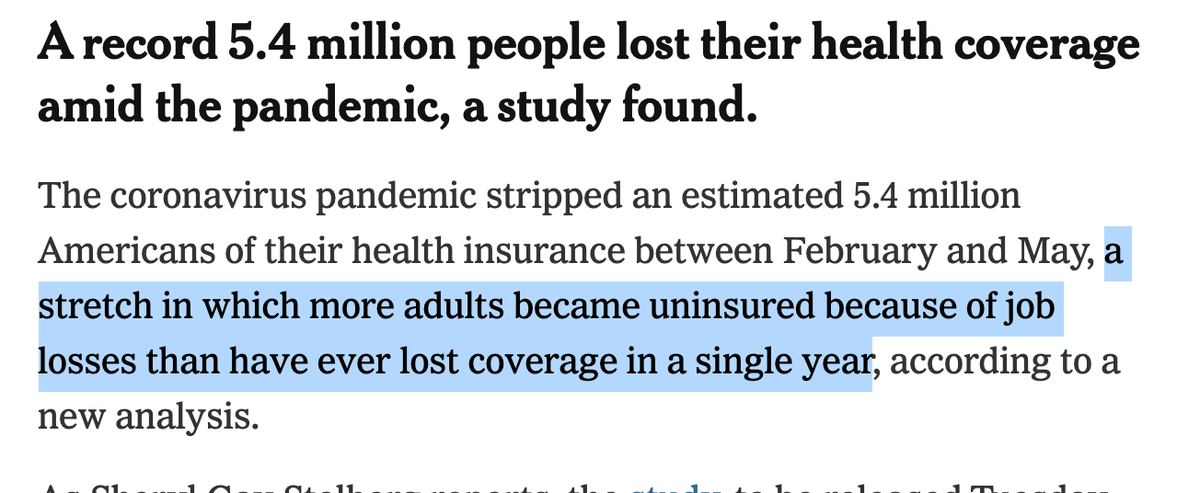
Roughly 5.4 million adults in the U.S. lost their health insurance from February to May after losing their jobs, according to a new estimate from Families USA, a group that favors the Affordable Care Act.

Why it matters: There are more adults under 65 without insurance in Southern states, which are the same states setting new records for single-day coronavirus infections along with rising hospitalizations, Axios’ Orion Rummler writes.

What they found: 3.9 million adults lost health insurance over one year during the Great Recession, per Families USA’s analysis. It only took four months in this current crisis for an estimated 5.4 million Americans to lose health insurance.

  • More than 20% of adults in Georgia, Florida, South Carolina, North Carolina, Mississippi, Oklahoma and Texas were without insurance as of May.
  • All of these states have set new records in the past two weeks for their highest number of coronavirus infections in a single day, per data from the COVID Tracking Project.
  • 46% of adults who lost coverage due to the pandemic came from five states: Florida, New York, Texas, California and North Carolina.

The backdrop: 21 million Americans were unemployed in May, according to the Bureau of Labor Statistics’ nonfarm payrolls report.


Trump admin seeks relaxed grandfathered ACA health plan rules that up out-of-pocket costs

https://www.healthcaredive.com/news/trump-admin-seeks-relaxed-grandfathered-aca-health-plan-rules-that-up-out-o/581463/

Paying for Health Insurance Out of Pocket Maximum, OOP Health ...

Dive Brief:

  • The Trump administration proposed a rule Friday to allow some group health plans grandfathered under the Affordable Care Act to raise out-of-pocket costs for enrollees but still allow them to have health savings accounts. Such plans must not discriminate against enrollees with pre-existing conditions, but are exempt from many other ACA regulations. If they violate any rules regarding costs or structure they lose their grandfathered status and are required to follow all the mandates of the landmark 2010 law.
  • The proposed rule, issued by the U.S. Department of Labor, would relax some of the complex inflation and pricing calculations grandfathered plans must follow. The department admitted that the change could lead to higher deductibles and other out-of-pocket costs for the estimated 23.1 million enrollees in such grandfathered plans.
  • The rule stems from a 2017 executive order issued by President Donald Trump that allows regulatory changes to be made in response to perceived economic burdens imposed by the ACA. However, the Labor Department conceded in its Federal Register publication of the proposed rule that the current rules for grandfathered health plans probably weren’t that burdensome.

Dive Insight:

The administration has made no secret of its ire for the ACA and is actively trying to overturn it at the U.S. Supreme Court. A release explaining the changes notes fixed cost-sharing for high-deductible health plans would be raised, and “an alternative method of measuring permitted increases in fixed-amount cost sharing” has been introduced that “would allow plans and issuers to better account for changes in the costs of health coverage over time.”

The formal 76-page proposal, published in the Federal Register on Sunday, said premiums might go down as a result of the changes, but there were no estimates provided or circumstances where that might occur.

Moreover, the proposed rule also noted that the change could lead to more people foregoing healthcare because their out-of-pocket costs might become unaffordable.

The Labor Department also noted that there have been so few fluctuations in the state of grandfathered health plans in recent years that it was likely the current regulations were not overly burdensome in the first place.

Public comments will be solicited until mid-August before a final rule is issued.

Sen. Patty Murray, D-Wash., and ranking member of the Senate Health, Education, Labor, and Pensions Committee, wasted little time late last week blasting the proposal.

“Regardless of what the president wants to believe, we’re in the middle of a pandemic that is devastating families’ health and finances,” Murray said in a statement.


American patients can’t shop their way to a low cost healthcare system

American patients can’t shop their way to a low cost healthcare system

Hospital price transparency is a distraction from policies that could reduce costs without burdening patients, say Jamie Daw and Adam Sacarny.


The prices that hospitals charge privately insured patients in the US have long been shrouded in secrecy. These prices—which are negotiated between hospitals and private insurers—vary widely: the price for the same blood test could vary 39-fold within Tampa, Florida and the cost of a cesarean delivery varies by up to $24 000 in San Francisco, California.

A recent federal court decision stands to shine a light on opaque hospital pricing in the US. In a lawsuit brought forward by the American Hospital Association, a federal judge upheld a regulation issued by the Trump administration that will soon require hospitals to post a wealth of information on payment rates online.

This policy seems intuitive: in other sectors of the economy, consumers usually know the price of a service or product before they purchase it. By comparing prices, consumers can shop around and save money. In turn, sellers anticipate that behavior and are incentivized to keep prices low. Who wouldn’t want a virtuous circle like that in healthcare? 

The Trump administration argues that hospital price transparency will encourage value in healthcare by helping patients and employers find lower prices, while pressuring hospitals to cut them further. However, the potential effects—and who stands to benefit—are not so straightforward.


Firstly, giving consumers information on prices doesn’t necessarily mean that they will respond by seeking lower cost services. Studies have consistently found that patients tend not to use price transparency tools, and their effects on healthcare spending are small or nonexistent. Why? Shopping for healthcare services is often complicated or impossible. 


Many of the most expensive services are for emergencies where there is little scope for patients to shop.

Even when a patient has time to compare prices for non-urgent procedures or tests, the complexity of healthcare payment systems and insurance products makes it next to impossible for a patient to preemptively calculate what they would personally pay for an encounter. Establishing that amount requires patients to know the cost-sharing parameters of their insurance plan, the set of services they will use during the encounter, and how aggressively the hospital will bill for those services.

Insurance also obscures patients’ incentives to shop by insulating them from healthcare prices.

While patients can be given strong incentives to shop—and an increasing number of American workers are enrolled in high deductible health plans with this aim—these incentives are created by hoisting financial risk on patients. This financially burdens American families and can result in patients forgoing appropriate care.


Beyond the challenges posed by patient shopping, the empirical evidence supporting price transparency is weak.

It could even backfire. Economists have pointed out that in sectors with low competition, price transparency can facilitate collusion and lead to higher prices. This fear was borne out in Denmark when authorities began publishing the prices of ready-mixed cement. Prices proceeded to converge and rise, and the authorities eventually abandoned the idea. The most hopeful evidence in the US healthcare system comes from New Hampshire, where prices for medical imaging fell by 3% after the state established a price transparency website. But even effects of this magnitude, while beneficial, would only make a tiny dent in lowering US healthcare costs. 


Price transparency efforts reflect a broad trend for American policy makers to turn to consumer-driven strategies to reduce healthcare costs.

These strategies are built on the assumption that patients ought to be responsible for navigating their way to high quality, low cost healthcare. However, the challenges faced by patients in assessing the complex cost-quality tradeoffs in healthcare limit the potential for price transparency to have the impact that the administration advertises.

Perhaps more troubling is that these efforts could distract policy makers from addressing the main drivers of US healthcare prices, such as rapid and ongoing consolidation. Concentrated hospital markets are becoming the norm in the US and are strongly associated with higher prices. Antitrust actions, such as preventing hospital mergers, could reduce and reverse consolidation, likely leading to lower prices.

Another option for policy makers is to assume a greater regulatory role over healthcare prices, including introducing price caps and an all-payer rate setting. A Supreme Court decision made it much more difficult for state governments to collect the data that would undergird these efforts. As a result, the information released under the transparency rule may end up being more useful for states considering new price regulations than for patients shopping for healthcare services.


If we want to reduce prices without burdening patients with financial risk, then policy makers need to address the emerging causes of rising healthcare costs directly. Efforts to control costs are most likely to succeed when policy makers tackle the structural drivers behind the most expensive health system in the world.


Pre And Post Coronavirus Unemployment Rates By State, Industry, Age Group, And Race

https://www.forbes.com/sites/mikepatton/2020/06/28/pre-and-post-coronavirus-unemployment-rates-by-state-industry-age-group-and-race/#65c42c6555eb

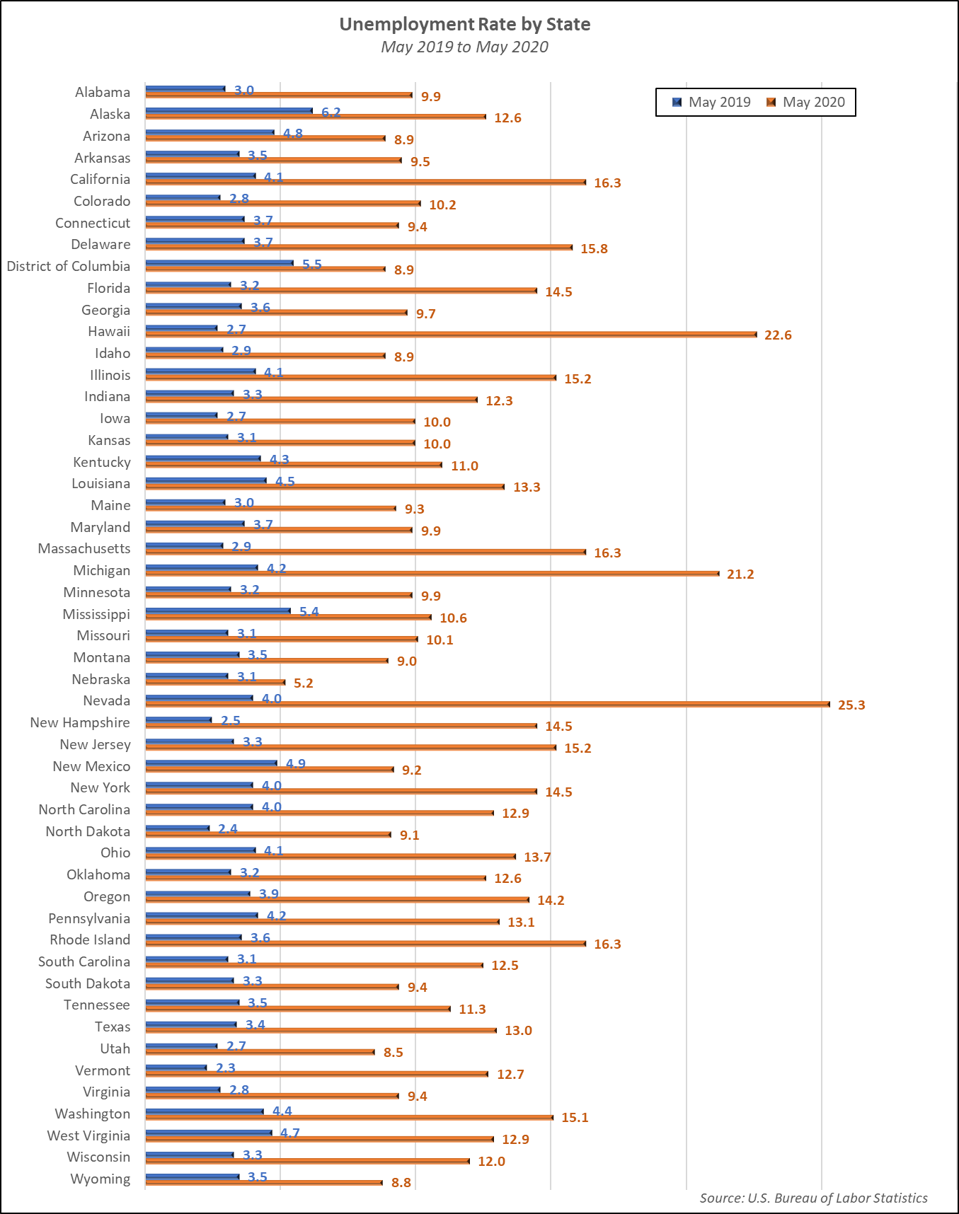
Unemployment by State-May 2019 to May 2020

The coronavirus has decimated the U.S. economy and benched nearly 40 million American workers. In the past several days, the U.S. has logged its highest number of new Covid-19 cases since the pandemic began. These combined with other factors, which we will discuss, is jeopardizing the future employment of millions of workers and the viability of thousands of businesses. Here’s how unemployment has increased for every state, industry, age group, and race, and why.

Unemployment by State

The coronavirus and subsequent stay at home orders hit the labor force especially hard. As states attempted to reopen, a resurgence in the virus is causing many businesses to close again, some by choice, others by government mandate.

Nevada has been hit the hardest as the unemployment rate in the Silver State rose from 4.0% in May 2019 to a whopping 25.3% in May 2020. Nevada’s economy is heavily reliant on leisure and hospitality, which had the brunt of the job losses. Hawaii, the second hardest hit state saw unemployment rise from 2.7% in May 2019 to 22.6% in May 2020. Which is the only other state with unemployment above 20% in May 2020? Michigan, where unemployment rose from 4.2% to 21.2% year over year. What state has fared best? Nebraska, which also has one of the most diverse economies of all states. Deriving nearly 50% of its total GDP from five different industries, unemployment in the Cornhusker State rose from 3.1% to a modest 5.2% from May 2019 to May 2020. Unemployment numbers for all states are shown in the following chart.

Unemployment by Industry

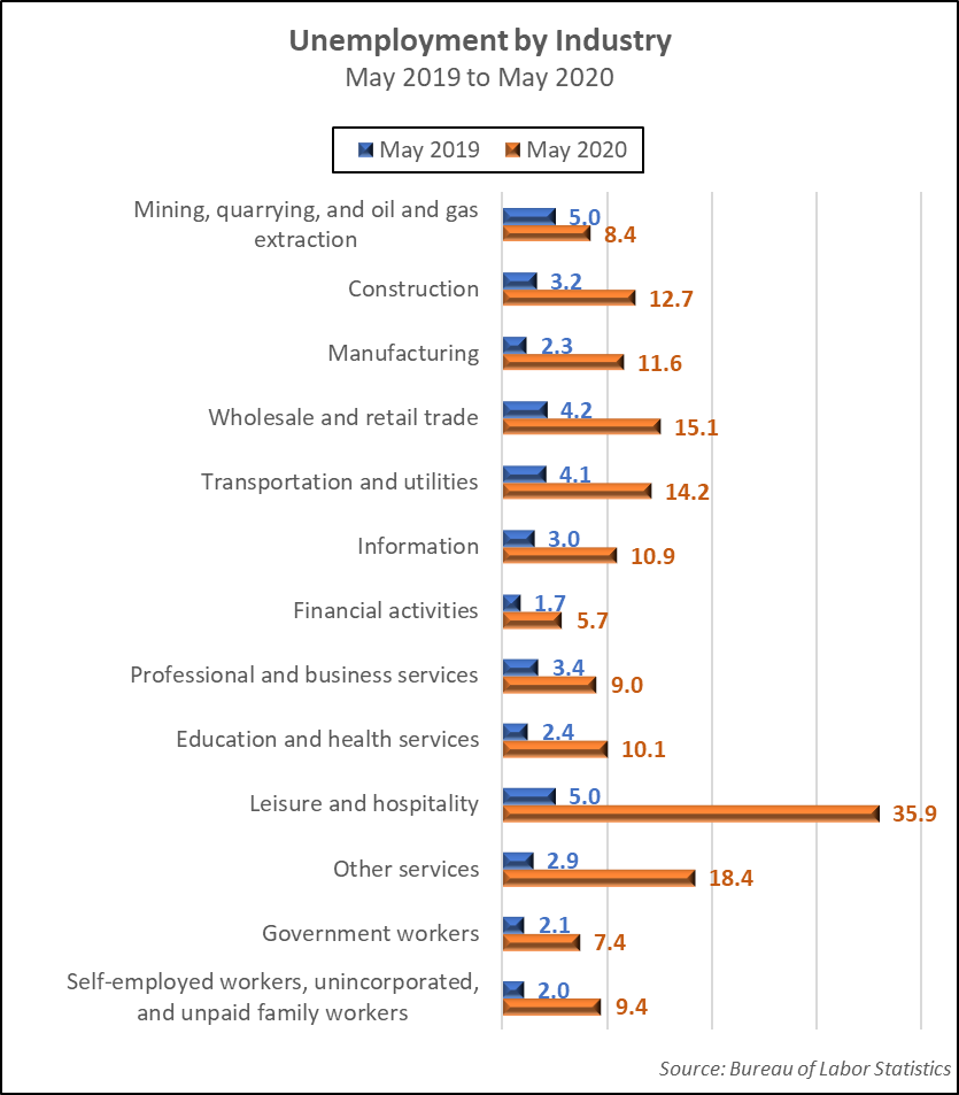
As mentioned in the previous section, the states that have fared best either have a more diverse economy or do not rely heavily on industries that have been hardest hit by the coronavirus. The most negatively affected is the leisure and hospitality industry where unemployment rose 618% from a low of 5.0% in May 2019 to a staggering 35.9% in May 2020. At a distant second, but still reeling, is the wholesale and retail trade industry, which saw unemployment rise from 4.2% to 15.1% during the same period. The rest of the industries are listed in the following chart.

Unemployment by Industry-May 2019 to May 2020

Unemployment by Age Group

Businesses need two things to exist: workers and customers. Without customers, there is no need for workers or the business for that matter. Some businesses require highly skilled workers while others operate well using unskilled labor. It is this unskilled labor group that has been hardest hit.

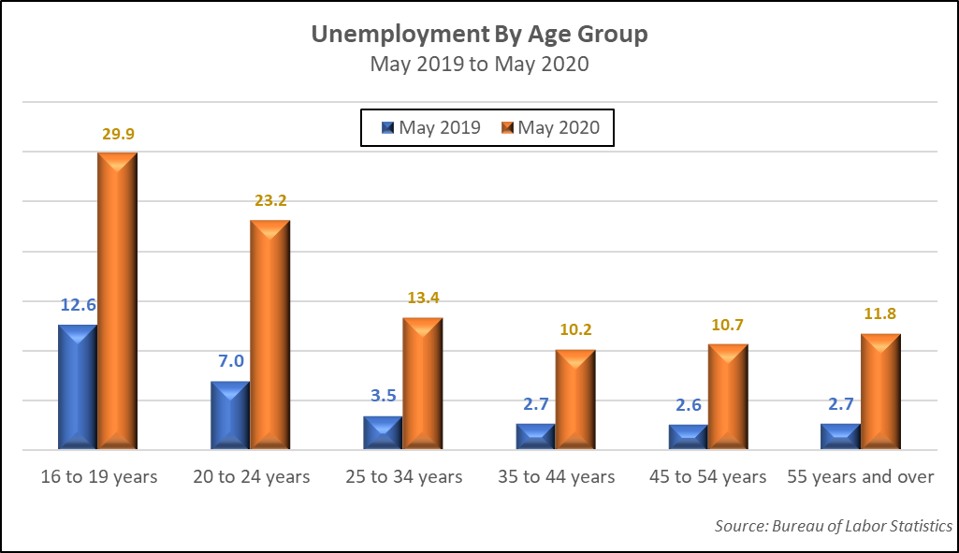
The greatest rise in unemployment is among workers under age 25. This is likely due to three factors. Younger workers typically have fewer marketable skills, less work experience, and less seniority. Many of these workers are in industries that have felt the greatest pain. Unemployment rates by age group are contained in the following chart.

Unemployment by Age Group-May 2019 to May 2020

Unemployment by Race/Ethnicity

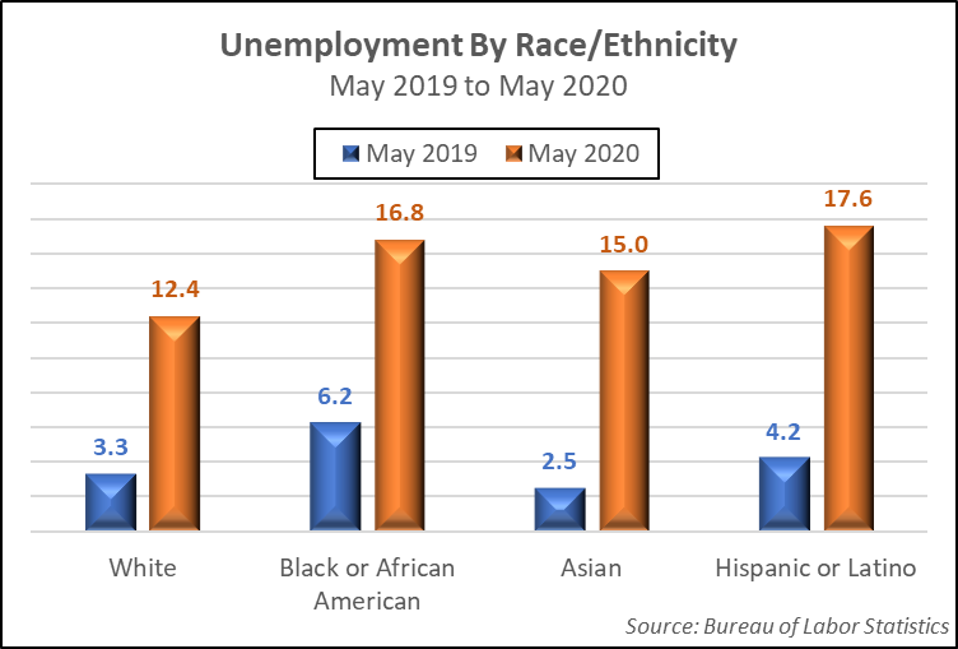
Question: Prior to Covid-19, was unemployment among blacks / African Americans at a record low as President Trump has claimed? Using the available data, which extends back to January 1972, the answer is yes. This new record low was achieved in October and November of 2019 when unemployment among black or African American workers fell to 5.1%. The previous record low was 5.2% in December 1973. The current rate is 16.8%, which is less than the highest rate of 20.7% logged in December 1982. The most recent high in unemployment for this group was 19.3% in March 2010. It has been steadily declining since then. Numbers for White, Asian, and Hispanic or Latino and black or African American workers are listed in the following chart.

Unemployment by Race or Ethnicity-May 2019 to May 2020

Businesses need workers, workers need businesses, and both depend on customers. Since the pandemic began, consumer demand has fallen sharply. With the probability that a vaccine will not be available until early 2021 at the soonest, plus a disregard for recommended safety protocols by many individuals, namely wearing masks and social distancing, it is highly unlikely that the economy will return to normal for several years.

Will the president continue to hold rallies? Will he set an example by wearing a mask? Will the protests and violence continue? Will other large gatherings continue? Unless Americans make a collective and conscious choice to mask up and social distance, we will be forced to live in a depressed economy for longer than necessary. The choice is up to us.


Trinity Health expects $2B revenue plunge as it cuts, furloughs more staff

https://www.healthcaredive.com/news/trinity-health-cutting-cost-cutting-2-billion-revenue-shortfall/580738/

The Dumbest Things You Can Do With Your Money | Work + Money

Dive Brief:

  • Trinity Health, one of the nation’s largest nonprofit health systems, said Monday it will take more measures to cut costs due to the downturn spurred by the novel coronavirus. The restructuring plan includes eliminating positions, extending furloughs, severances and reductions in schedules. The decisions are being “customized” across the system based on factors that include volume projections and the cost and revenue challenges in each market.
  • The Livonia, Michigan-based hospital operator said it continues to treat COVID-19 patients, however, it has “for now seen declining numbers of very sick patients with COVID-19.”
  • The system said it expects revenue to be depressed or “below historical levels” for the remainder of this fiscal year and much of the next. It projects revenue to drop by $2 billion to $17.3 billion for fiscal year 2021, which starts after its June 30 year end.

Dive Insight:

In May, Trinity said it planned to furlough nearly 12% of its workforce — or 15,000 employees out of the 125,000 nationally.  

Trinity, one of the nation’s largest hospital operators with 92 facilities and operations across 22 states, is now broadening that restructuring, extending and adding new furloughs.

In a Monday bond filing, Trinity said its operations were “significantly” impacted by the effects of the pandemic as many operators saw depressed volumes due to shelter-in-place orders, which started in most of Trinity’s markets during the last two weeks of March.

“The effect of COVID-19 on the operating margins and financial results of Trinity Health is adverse and significant and, at this point, the duration of the pandemic and the length of time until Trinity Health returns to normal operations is unknown,” according to Monday’s bond filing.

The system said relief funds provided by the federal government have not been enough to cover its operating losses. Trinity has received $600 million in relief funds that do not have to be repaid and more in loans through the advanced Medicare payment program, according to a previous analysis by Healthcare Dive.

Still, the system said it has drawn on credit facilities totaling $1 billion to provide adequate liquidity during the pandemic. Trinity reported having 178 days cash on hand as of March 30.

Some nonprofits are faring better than Trinity and pulling back on earlier staffing cuts.

Mayo Clinic said last week it will call back its furloughed workers by the end of August and restore pay that had been cut due to the pandemic.

Mayo has some of the most cash on hand in terms of days when comparing other major nonprofit systems. Mayo had 252 days of cash on hand as of March 30, more than the other 20 largest nonprofits except Cleveland Clinic and New York-Presbyterian.


U.S. Healthcare System vs. Socialized Medicine during the Pandemic

https://www.commondreams.org/news/2020/06/25/why-socialized-system-medicare-all-beats-profit-healthcare-one-chart-covid-19?fbclid=IwAR1qT_AI5KFreoEKOqQfvdWUHPyW80fa2Iefxb5Ul5wJQtf8rSvZXkL8RHM


“All countries successfully combatting this virus have robust public health systems, which provide for coordination of effort.”

A recent rise in cases of Covid-19 and the overt failure of the for-profit healthcare system throughout the pandemic in the U.S. are making the case for Medicare for All, advocacy groups and activists say, as countries with socialized systems see their infection rates decline.

“All countries successfully combatting this virus have robust public health systems, which provide for coordination of effort,” remarked a popular healthcare advocate who uses the @AllOnMedicare handle on Twitter.

Calls for the U.S. to adopt a single-payer heathcare system have increased as the pandemic has raged around the country. Cases and deaths in the U.S are now the highest in the world, a result critics blame on both the private healthcare system and the mismanagement of the crisis by President Donald Trump.

Public Citizen’s health care policy advocate Eagan Kemp told Common Dreams that the current for-profit healthcare system that has driven millions of Americans in to bankruptcy and leaves millions more without care will only continue to exacerbate the pain of the outbreak. 

“While no health care system can completely protect a country from Covid-19, the U.S. has failed to respond for a number of reasons, not least of which is a for-profit health care system where Americans are too afraid to go to the doctors for fear of the cost,” said Kemp. “Far too many Americans will face medical debt and even bankruptcy if they are lucky enough to survive getting Covid-19, something unheard of in all other comparably wealth countries.”

As University of Massachusetts professor Dean E. Robinson wrote in a piece that appeared at Common Dreams earlier this month, the coronavirus is impacting people of color at a disproportionate rate in cities and communities nationwide—a dynamic that bolsters the call for a universal Medicare for All program to help close those gaps.

“The obvious and immediate need of Black and other working class populations caught in the teeth of the pandemic is the right to health care treatment without the burden of cost,” wrote Robinson. “Even before the pandemic, lower-income, Latino, and younger workers were more likely to be uninsured. Undocumented workers had the highest rates of uninsurance.”

On June 18, Ralph Nader in an opinion piece for Common Dreams expressed his hope that the ongoing pandemic would make essential workers in the health field “the force that can overcome decades of commercial obstruction to full Medicare for All.”


Credit downgrades aren’t attributable to COVID-19 but cash flow will be a challenge

https://www.healthcarefinancenews.com/news/credit-downgrades-arent-attributable-covid-19-cash-flow-will-be-ongoing-challenge?mkt_tok=eyJpIjoiTUdSbVptVmhaR0ZpT0RJMyIsInQiOiJ2TVwvb3g5VWF4R05DeWFScVJ4U0lXeW9xWG1cL0pVMWo1RE1cL24rd21ySEErbk9kZWNIXC9hdmZYYmJBcGU1RDQ5MDVDNXVyZ2RZSWo2djRRSXhSOVFVQk1yNjFWOTVoVjlkTXVxXC95QXU1SU8yMEhJcEtHZXJ3ZDhDc2RMb2RcLzlMcSJ9

Just How Bad Is My Bad Credit Score? | Credit.com

The coronavirus is mainly affecting the credit outlook for the rest of the year and beyond as hospitals adapt to new financial realities.

While the COVID-19 coronavirus is likely to cause cash flow and liquidity issues for hospitals through the end of the year and into 2021, the credit outlook for the healthcare industry isn’t as dire as some had feared. While there have been some downgrades this year, most of those are attributable to healthcare financial performance at the end of 2019.

At a virtual session of the Healthcare Financial Management Association on Wednesday, Lisa Goldstein, associate managing director at Moody’s Investors Service, said the agency is taking a measured approach to issuing credit ratings and will “triage” these ratings based on factors such as liquidity and cash flow.

“Changes are happening daily, and sometimes hourly with funding coming from the federal government,” said Goldstein, “so we’re taking a very measured approach.”

Healthcare is among the most volatile industries being affected by the coronavirus due to the fact that it operates like a business, with a general lack of government support to pay off debt.

Credit downgrades are on the rise, but there’s historical precedent at play. Looking at data beginning with the 2008 financial crisis, there were consistently more downgrades than upgrades in the healthcare industry, owing to its inherent volatility. It was and has generally been subject to public policy and competitive forces. In any given year, downgrades exceed upgrades.

After passage of the Affordable Care Act, however, the number of uninsured Americans hit an all-time low. Hospitals grew in occupancy and revenues improved. The situation started to worsen once more when it became clear that there was a national nursing shortage, as well as top-line revenue pressure from government and commercial payers lowering their rates, but credit downgrades didn’t truly explode until this year. There have been 24 downgrades so far this year, already exceeding the 13 downgrades in all of 2019.

The rub is that it’s not the coronavirus’s fault.

“Most downgrades were in the first quarter of the year,” said Goldstein. “We did have a lot of downgrades in March, which is when the pandemic really started – when it became a pandemic – but even though there were 11 downgrades in March, it was based on what we’d seen through the end of 2019. There were problems that were appearing that had nothing to do with the pandemic.”

Basic fundamental operating challenges were becoming more pronounced during that time. A decline in inpatient cases, a rapid rise in observation stays, a decline in outpatient cases to competing clinics and health centers, and staffing and productivity challenges all contributed to material increases in debt.

COVID-19’s effects on hospital credit ratings are in the outlook for the rest of the year and beyond. Interestingly, in March, Moody’s changed its outlook from negative to stable.

“We haven’t seen anything like this,” said Goldstein. “The industry has been through shocks, but something this long in duration has been something we think will have an impact on financial performance going forward.”

Moody’s anticipates cash flow will remain low into 2021, mostly from the suspension of elective surgeries, rising staffing expenses and uncertainty around securing enough personal protective equipment. Liquidity is still a concern, but is more of a side issue due to Medicare funding providing a Band-Aid of sorts. The CARES act will help to fill some of that gap, but not all of it, said Goldstein.

She added that the $175 billion in stimulus funding is favorable, but modestly so, since it is estimated to cover only about two months’ worth of spending. The good news is that the opportunity to apply for grant money, which doesn’t have to be repaid, can help to fill some of the gap.

Some hospital leaders are concerned that if they violate covenants – also known as a technical default – their credit outlook will be downgraded. Goldstein sought to assuage those concerns.

“Debt service covenants are expected to rise, but an expected covenant breach or violation won’t have an impact on credit quality because it’s driven by an unusual event happening,” she said. “It doesn’t speak to your fundamental history as an operating entity.”


Re-examining the delivery of high-value care through COVID-19

https://thehill.com/opinion/healthcare/502851-examining-the-delivery-of-high-value-care-through-covid-19#bottom-story-socials

Re-examining the delivery of high-value care through COVID-19 ...

Over the past months, the country and the economy have radically shifted to unchartered territory. Now more than ever, we must reexamine how we spend health care dollars. 

While the COVID-19 pandemic has exposed challenges with health care in America, we see two overarching opportunities for change:

1) the under-delivery of evidence-based care that materially improves the lives and well-being of Americans and

2) the over-delivery of unnecessary and, sometimes, harmful care.

The implications of reallocating our health care spending to high-value services are far-ranging, from improving health to economic recovery. 

To prepare for coronavirus patients and preserve protective equipment, clinicians and hospitals across the country halted non-urgent visits and procedures. This has led to a substantial reduction in high-value care: emergency care for strokes or heart attacks, childhood vaccinations, and routine chronic disease management. However, one silver lining to this near shutdown is that a similarly dramatic reduction in the use of low-value services has also ensued.

As offices and hospitals re-open, we have a once in a century opportunity to align incentives for providers and consumers, so patients get more high-value services in high-value settings, while minimizing the resurgence of low-value care. For example, the use of pre-operative testing in low-risk patients should not accompany the return of elective procedures such as cataract removal. Conversely, benefit designs should permanently remove barriers to high-value settings and services, like patients receiving dialysis at home or phone calls with mental health providers.   

People with low incomes and multiple chronic conditions are of particular concern as unemployment rises and more Americans lose their health care coverage. Suboptimal access and affordability to high-value chronic disease care prior to the COVID-19 pandemic was well documented  As financially distressed providers re-open to a new normal, hopeful to regain their financial footing, highly profitable services are likely to be prioritized.

Unfortunately, clinical impact and profitability are frequently not linked. The post-COVID reopening should build on existing quality-driven payment models and increase reimbursement for high-value care to ensure that compensation better aligns with patient-centered outcomes.

At the same time, the dramatic fall in “non-essential care” included a significant reduction in services that we know to be harmful or useless. Billions are spent annually in the US on routinely delivered care that does not improve health; a recent study from 4 states reports that patients pay a substantial proportion (>10 percent) of this tab out-of-pocket. This type of low-value care can lead to direct harm to patients — physically or financially or both — as well as cascading iatrogenic harm, which can amplify the total cost of just one low-value service by up to 10 fold. Health care leaders, through the Smarter Health Care Coalition, have hence called on the Department of Health and Human Services Secretary Azar to halt Medicare payments for services deemed low-value or harmful by the USPSTF. 

As offices and hospitals reopen with unprecedented clinical unmet needs, we have a unique opportunity to rebuild a flawed system. Payment policies should drive incentives to improve individual and population health, not the volume of services delivered. We emphasize that no given service is inherently high- or low-value, but that it depends heavily on the individual context. Thus, the implementation of new financial incentives for providers and patients needs to be nuanced and flexible to allow for patient-level variability. The added expenditures required for higher reimbursement rates for highly valuable services can be fully paid for by reducing the use of and reimbursement for low-value services.  

The delivery of evidence-based care should be the foundation of the new normal. We all agree that there is more than enough money in U.S. health care; it’s time that we start spending it on services that will make us a healthier nation.