Americans became wealthier and more held jobs last year.
Yet at the very same time, one million people lost health insurance. And that number has steadily climbed this year under the pandemic.
A U.S. Census Bureau report released yesterday showed a continued slow erosion of the nation’s insured rate in 2019. The decline of coverage illustrates both the shortcomings of President Barack Obama’s 2010 health-care law and repeated attempts by President Trump and Republicans to undermine it.
“Though the reasons are sharply debated, the new data signifies that the first three years of President Trump’s tenure were a period of contracting health insurance coverage,” Amy Goldstein writes. “The decreases reversed gains that began near the end of the Great Recession and accelerated during early years of expanded access to health plans and Medicaid through the Affordable Care Act.”
Nearly 30 million Americans lacked health coverage in 2019.
The uninsured rate rose to 29.6 million people, totaling 9.2 percent of the population. It has slowly ticked upward since 2016, when 28.1 million people didn’t have a health plan. Between 2018 and 2019, the share of people without coverage increased in 19 states and decreased in just one.
The share of people on Medicare and with employer-sponsored coverage actually increased slightly. That was due to an aging population and last year’s booming economy, which meant more people had workplace plans — still the chief way Americans get their coverage.
The biggest erosions in coverage took place in state Medicaid programs.
Medicaid enrollment fell from 17.9 percent of Americans to 17.2 percent.
One reason for the decline is positive: As poverty rates fell for all major racial and ethnic groups, more people earned too much to qualify for the program. The poverty rate fell to 18.8 percent for Blacks, 15.7 percent for Hispanics and 9.1 percent for Whites.
But other factors were also at play. People no longer face a tax penalty for being uninsured, after Congress repealed it in 2017. Several GOP-led states expanded enrollment requirements. And wide disparities persisted in how states run their programs.
Missouri voters recently approved Medicaid expansion, making the state the seventh to do so under President Trump.
“There is huge variation state-to-state in the ease of enrollment, the administrative process, the mechanisms for verifying eligibility, how hard the state works to sign people up,” said Katherine Baicker, a health economist at the University of Chicago. “All those have big effects on net take-up rates.”
The trickle of coverage losses has become a flood under the pandemic.
Before the coronavirus pandemic upended life, the United States was enjoying a record-long economic expansion. By the end of last year, the unemployment rate was at a 50-year low of 3.5 percent.
“Women outnumbered men in the workforce for only the second time, buoyed by a tight labor market and fast job growth in health care and education,” Amy writes. “Minimum-wage increases were also fueling faster wage growth for those at the bottom.”
But now millions of people have lost their jobs — and, in the process, their health insurance.
“Since March … job losses have disproportionately hit low-income workers and women, many of whom held service-sector jobs that were gutted by shutdown measures to help protect people from infection,” Amy writes. “Nearly 40 percent of households with income below $40,000 were laid off or furloughed by early April, according to the Federal Reserve.”
The Economic Policy Institute has estimated that 12 million people have lost health insurance received through their workplace or that of a family member. Some of those have been able to enroll in Medicaid — its rolls have risen by about 4 million during the pandemic — but others find it unaffordable.
This week’s contributor is Larry Levitt, the Executive Vice President for Health Policy at the Kaiser Family Foundation.
For the first time in an economic downturn, the Affordable Care Act (ACA) exists as a health care safety net for people losing their jobs and employer-provided health insurance. A new study provides some clues as to how well the health care law works for people who lose their jobs and insurance.
The study– by Sumit Agarwal and Benjamin Sommers, published in the New England Journal of Medicine – compares people who lost their jobs before and after the ACA went into effect in 2014 to see if there is a difference in how many people retained health insurance. During the pre-ACA period (2011-2013), there was about a 5% increase in the uninsured rate for people following a job loss. After the ACA went into effect (2014-2016), no such increase occurred. Instead, Medicaid and the marketplaces saw large increases in utilization.
With millions of Americans losing their jobs during the pandemic, the number of people without health coverage has undoubtedly risen. However, by how much is unknown, since we don’t track insurance coverage in real-time like we do employment. Many who have lost jobs may not have had employer-sponsored insurance in the first place, if they worked an industry like food service or retail. And the vast majority of people who are unemployed are classified as on temporary layoff, with employers who may be continuing health benefits for their furloughed workers, at least for now. However, the share of unemployed workers who have permanently lost their jobs is growing.
If the economic crisis persists, the number of people losing job-based health insurance will climb, making the ACA’s role as a safety net more relevant than ever.
Those on the front lines of the fight against the novel coronavirus worry about keeping themselves, their families and their patients safe.
This story is part of a series examining the state of healthcare six months into the public health emergency declared for COVID-19.
There’s no end in sight for the country as it grapples with another surge of COVID-19 cases.
That’s especially true for nurses seeking the reprieve of their hospitals returning to normal operations sometime this year. Many in the South and West are now treating ICUs full of COVID-19 patients they hoped would never arrive in their states, largely spared from spring’s first wave.
And like many other essential workers, those in healthcare are falling ill and dying from COVID-19. The total number of nurses stricken by the virus is still unclear, though the Centers for Disease Control and Prevention has reported 106,180 cases and 552 deaths among healthcare workers. That’s almost certainly an undercount.
National Nurses United, the country’s largest nurses union, told Healthcare Dive it has counted 165 nurse deaths from COVID-19 and an additional 1,060 healthcare worker deaths.
Safety concerns have ignited union activity among healthcare workers during the pandemic, and also given them an opportunity to punctuate labor issues that aren’t new, like nurse-patient ratios, adequate pay and racial equality.
At the same time, the hospitals they work for are facing some of their worst years yet financially, after months of delayed elective procedures and depleted volumes that analysts predict will continue through the year. Many have instituted furloughs and layoffs or other workforce reduction measures.
Healthcare Dive had in-depth conversations with three nurses to get a clearer picture of how they’re faring amid the once-in-a-century pandemic. Here’s what they said.
Elizabeth Lalasz, registered nurse, John H. Stroger Hospital in Chicago
Elizabeth Lalasz has worked at John H. Stroger Hospital in Chicago for the past 10 years. Her hospital is a safety net facility, catering to those who are “Black, Latinx, the homeless, inmates,” Lalasz told Healthcare Dive. “People who don’t actually receive the kind of healthcare they should in this country.”
Data from the CDC show racial and ethnic minority groups are at increased risk of getting COVID-19 or experiencing severe illness, regardless of age, due to long-standing systemic health and social inequities.
CDC data reveal that Black people are five times more likely to contract the virus than white people.
This spring Lalasz treated inmates from the Cook County Jail, an epicenter in the city and also the country. “That population gradually decreased, and then we just had COVID patients, many of them Latinx families,” she said.
Permission granted by Elizabeth Lalasz
Once Chicago’s curve began to flatten and the hospital could take non-COVID patients, those coming in for treatment were desperately sick. They’d been delaying care for non-COVID conditions, worried a trip to the hospital could risk infection.
A Kaiser Family Foundation poll conducted in May found that 48% of Americans said they or a family member had skipped or delayed medical care because of the pandemic. And 11% said the person’s condition worsened as a result of the delayed care.
When patients do come into Lalasz’s hospital, many have “chest pain, then they also have diabetes, asthma, hypertension and obesity, it just adds up,” she said.
“So now we’re also treating people who’ve been delaying care. But after the recent southern state surges, the hospital census started going down again,” she said.
Amy Arlund, registered nurse, Kaiser Permanente Medical Center in Fresno, California:
Amy Arlund works the night shift at Kaiser Fresno as an ICU nurse, which she’s done for the past two decades.
She’s also on the hospital’s infection control committee, where for years she’s fought to control the spread of clostridium difficile colitis, or C. diff., in her facility. The highly infectious disease can live on surfaces outside the body for months or sometimes years.
The measures Arlund developed to control C. diff served as her litmus test, as “the top, most stringent protocols we could adhere to,” when coronavirus patients arrived at her hospital, she told Healthcare Dive.
But when COVID-19 cases surged in northern states this spring, “it’s like all those really strict isolation protocols that prior to COVID showing up would be disciplinable offenses were gone,” Arlund said.
Widespread personal protective equipment shortages at the start of the pandemic led the CDC and the Occupational Safety and Health Administration to change their longstanding guidance on when to use N95 respirator masks, which have long been the industry standard when dealing with novel infectious diseases.
The CDC also issued guidance for N95 respirator reuse, an entirely new concept to nurses like Arlund who say those changes go against everything they learned in school.
“I think the biggest change is we always relied on science, and we have always relied heavily on infection control protocols to guide our practice,” Arlund said. “Now infection control is out of control, we can no longer rely on the information and resources we always have.”
In Arlund’s ICU, she’s taken care of dozens of COVID positive patients and patients ruled out for coronavirus, she said. After a first wave in the beginning of April, cases dropped, but are now rising again.
Other changing guidance weighing heavily on nurses is how to effectively treat coronavirus patients.
“Are we doing remdesivir this week or are we going back to the hydroxychloroquine, or giving them convalescent plasma?”Arlund said. “Next week I’m going to be giving them some kind of lavender enema, who knows.”
Erik Andrews, registered nurse, Riverside Community Hospital in Riverside, California:
Erik Andrews, a rapid response nurse at Riverside Community Hospital in California, has treated coronavirus patients since the pandemic started earlier this year. He likens ventilating them to diffusing a bomb.
“These types of procedures generate a lot of aerosols, you have to do everything in perfectly stepwise fashion, otherwise you’re going to endanger yourself and endanger your colleagues,” Andrews, who’s been at Riverside for the past 13 years, told Healthcare Dive.
He and about 600 other nurses at the hospital went on strike for 10 days this summer after a staffing agreement between the hospital and its owner, HCA Healthcare, and SEIU Local 121RN, the union representing RCH nurses, ended without a renewal.
The nurses said it would lead to too few nurses treating too many patients during a pandemic. Insufficient PPE and recycling of single-use PPE were also putting nurses and patients at risk, the union said, and another reason for the strike.
But rapidly changing guidance around PPE use and generally inconsistent information from public officials are now making the nurses at his hospital feel apathetic.
“Unfortunately I feel like in the past few weeks it’s gotten to the point where you have to remind people about putting on their respirator instead of face mask, so people haven’t gotten lax, but definitely kind of become desensitized compared to when we first started,” Andrews said.
Permission granted by Erik Andrews
With two children at home, Andrews slept in a trailer in his driveway for 12 weeks when he first started treating coronavirus patients. The trailer is still there, just in case, but after testing negative twice he felt he couldn’t spend any more time away from his family.
He still worries though, especially about his coworkers’ families. Some coworkers he’s known for over a decade, including one staff member who died from COVID-19 related complications.
“It’s people you know and you know that their families worry about them every day,” he said. “So to know that they’ve had to deal with that loss is pretty horrifying, and to know that could happen to my family too.”
“It’s new territory, which is why we’re taking that measured approach on rating actions,” Suzie Desai, senior director at S&P, said.
The healthcare sector has been bruised from the novel coronavirus and the effects are likely to linger for years, but the first half of 2020 has not resulted in an avalanche of hospital and health system downgrades.
At the outset of the pandemic, some hospitals warned of dire financial pressures as they burned through cash while revenue plunged. In response, the federal government unleashed $175 billion in bailout funds to help prop up the sector as providers battled the effects of the virus.
Still, across all of public finance — which includes hospitals — the second quarter saw downgrades outpacing upgrades for the first time since the second quarter of 2017.
S&P characterized the second quarter as a “historic low” for upgrades across its entire portfolio of public finance credits.
“While only partially driven by the coronavirus, the second quarter was the firstsince Q2 2017 with the number of downgrades surpassing upgrades and by the largest margin since Q3 2014,” according to a recent Moody’s Investors Service report.
Through the first six months of this year, Moody’s has recorded 164 downgrades throughout public finance and, more specifically, 27 downgrades among the nonprofit healthcare entities it rates.
By comparison, Fitch Ratings has recorded 14 nonprofit hospital and health system downgrades through July and just two upgrades, both of which occurred before COVID-19 hit.
“Is this a massive amount of rating changes? By no means,” Kevin Holloran, senior director of U.S. Public Finance for Fitch, said of the first half of 2020 for healthcare.
Also through July, S&P Global recorded 22 downgrades among nonprofit acute care hospitals and health systems, significantly outpacing the six healthcare upgrades recorded over the same period.
“It’s new territory, which is why we’re taking that measured approach on rating actions,” Suzie Desai, senior director at S&P, said.
Still, other parts of the economy lead healthcare in terms of downgrades. State and local governments and the housing sector are outpacing the healthcare sector in terms of downgrades, according to S&P.
Virus has not ‘wiped out the healthcare sector’
Earlier this year when the pandemic hit the U.S., some made dire predictions about the novel coronavirus and its potential effect on the healthcare sector.
Reports from the ratings agencies warned of the potential for rising covenant violations and an outlook for the second quarter that would result in the “worst on record,“ one Fitch analyst said during a webinar in May.
That was likely “too broad of a brushstroke,” Holloran said. “It has not come in and wiped out the healthcare sector,” he said. He attributes that in part to the billions in financial aid that the federal government earmarked for providers.
Though, what it has revealed is the gaps between the strongest and weakest systems, and that the disparities are only likely to widen, S&P analysts said during a recent webinar.
The nonprofit hospitals and health systems pegged with a downgrade have tended to be smaller in size in terms of scale, lower-rated already and light on cash, Holloran said.
Still, some of the larger health systems were downgraded in the first half of the year by either one of the three rating agencies, including Sutter Health, Bon Secours Mercy Health, Geisinger, University of Pittsburgh Medical Center and Care New England.
“This is something that individual management of a hospital couldn’t control,” said Rick Gundling, senior vice president of Healthcare Financial Management Association, which has members from small and large organizations. “It wasn’t a bad strategy — that goes into a downgrade. This happened to everybody.”
Deteriorating payer mix
Looking forward, some analysts say they’re more concerned about the long-term effects for hospitals and health systems that were brought on by the downturn in the economy and the virus.
One major concern is the potential shift in payer mix for providers.
As millions of people lose their job they risk losing their employer-sponsored health insurance. They may transition to another private insurer, Medicaid or go uninsured.
For providers, commercial coverage typically reimburses at higher rates than government-sponsored coverage such as Medicare and Medicaid. Treating a greater share of privately insured patients is highly prized.
If providers experience a decline in the share of their privately insured patients and see a growth in patients covered with government-sponsored plans, it’s likely to put a squeeze on margins.
The shift also poses a serious strain for states, and ultimately providers. States are facing a potential influx of Medicaid members at the same time state budgets are under tremendous financial pressure. It raises concerns about whether states will cut rates to their Medicaid programs, which ultimately affects providers.
Some states have already started to re-examine and slash rates, including Ohio.
Many children heading back to school—in whichever form that that may take this fall—have skipped their annual visit to the pediatrician. The graphic above highlights the sluggish rebound in pediatric ambulatory volume. While adult primary care visits have mostly bounced back, pediatric visits are still 26 percent below pre-COVID levels.
The drop in visits early in the pandemic also impacted immunizations, with 2.5M regular childhood vaccinations missed in the US during the first quarter of 2020—and early data suggests those seem to be rebounding at a similarly anemic rate.
This lack of pediatric routine care is particularly worrisome as COVID-19 cases in children are climbing, with a 90 percent increase from July to August. Though most of the nation’s largest public school districts have opted to begin the school year with online learning, some districts have already returned to in-person classes, and, unsurprisingly, new cases are already being reported.
While COVID-19 is normally neither severe nor fatal in children, infections among school-age kids put others at risk. According to the Kaiser Family Foundation, nearly a quarter of teachers (1.5M) are considered high-risk and almost six percent of seniors (3.3M) live with school-aged children.
Without the traditional back-to-school push for well-child visits, sports physicals, and immunization updates, healthcare providers must think creatively about how to give children with the care they need, whether through personalized communication from pediatricians that assuages parental concerns about office safety, or through more innovative means such as drive-thru vaccination services.
Eight health systems in AHA case study are asking Congress for more relief funding.
The American Hospital Association has released eight case studies from hospitals and health systems across the country that highlight how systems of different shapes and sizes are reacting to the financial challenges posed by COVID-19.
The case studies include Kindred Healthcare and TIRR Memorial Hermann in Houston; AdventHealth Central Florida Division in Orlando, Florida; the Loretto Hospital in Chicago; Kittitas Valley Healthcare in Ellensburg, Washington; Washington Regional Medical Center in Fayetteville, Arkansas; Banner Health in Phoenix; UR Medicine Thompson Health in Canandaigua, New York; and the Queen’s Health Systems and the Queen’s Medical Center in Honolulu.
Across the board, every case study revealed that hospitals and health systems are asking Congress for more relief funding.
“We are begging for more assistance and more help because we can’t keep moving forward,” said Michael Stapleton, the president and CEO of UR Medicine Thompson Health in New York.
WHAT’S THE IMPACT?
In Texas, the state with the third most COVID-19 cases, Kindred Healthcare and TIRR Memorial Hermann have begun to rely on inpatient rehabilitation facilities and long-term acute care hospitals to treat COVID-19-positive and medically complex recovering COVID-19 patients.
“In particular, as communities and hospitals struggled to meet ICU capacity needs, these hospitals stepped forward to take care of COVID-19-positive patients and others to help provide beds for more COVID-19-positive patients,” the case study said.
However, even with assistance from local facilities, post-acute care providers have incurred increased costs to prepare for and treat COVID-19-positive patients and complex post-COVID-19 patients.
“When you look at lost revenue and volumes, and the additional costs of ramping up to prepare for COVID-19, whether it’s personal protective equipment, respiratory systems, medications or facility infrastructure changes, there are significant dollars associated with that,” said Jerry Ashworth, the senior vice president and CEO at TIRR Memorial Hermann.
AdventHealth in Florida has taken financial hits from declining elective procedures and purchasing personal protective equipment. The company says it has lost $263 million since the start of the pandemic and has spent $254 million sourcing PPE.
“Florida is in the middle of the crisis,” said Todd Goodman, division chief financial officer of AdventHealth. “Our current COVID numbers are four times higher than the peak that we had back in April. We are bringing in higher-priced nurses and staff from other parts of the nation, because of a rapid increase in inpatient census. We are in a different place today than we were even six weeks ago.”
COVID-19 has disproportionately affected communities of color across the country, but especially in Chicago, where 30% of the population is Black. Forty-six percent of all COVID-19 cases and 57% of all deaths are Black people.
Despite having 70% of its admissions being related to COVID-19, the Loretto Hospital in Chicago has not received any funds from the Coronavirus Aid, Relief, and Economic Security Act hot spot distribution.
“Our COVID-19 unit is full and has been for the last three months; we’re now at 296 COVID-19 patients [on July 16] and yet we’ve not received any of the COVID-19 high impact ‘hot spot’ payments,” said George Miller, the president and CEO of the Loretto Hospital. “We got the Small Business Administration loan to help keep our team members employed.”
Kittitas Valley Healthcare in Washington was among the first in the country to feel the impact of COVID-19. The rural delivery system and its critical access hospital postponed elective surgeries and many other nonessential services in response.
“Our revenues and volumes fell off a cliff,” said Julie Petersen, the CEO of Kittitas Valley Healthcare. “Our orthopedics programs, our GI [gastrointestinal] programs and cataract surgeries evaporated.”
Now, the hospital is off its original 2020 net revenue projections by $8.4 million.
After seeing a 12% rise in COVID-19 cases over a two-week period in Fayetteville, Arkansas, the Washington Regional Medical Center had 96% of its 40 intensive care unit beds occupied, a 20-bed COVID-19 ICU was completely full, and 298 of the facility’s 315 adult beds were occupied.
Taking care of these patients put the health system in a financial crisis. Its net patient revenue declined by $14 million in April. It furloughed 350 of its 3,300 employees and reduced the hours of 360 full-time workers, according to Larry Shackelford, the president and CEO of Washington Regional Medical Center.
On July 12, Banner Health in Arizona had more than 1,500 inpatients who either tested COVID-positive or are suspected of having COVID-19, representing 45% of the COVID-19 inpatient hospitalizations in the state, according to Dr. Marjorie Bessel, the chief clinical officer at Banner Health.
Banner expects operating losses of $500 million for 2020, compared to its initial expectations, with expected revenue losses approaching $1 billion for the year, according to the case study.
By mid-March, New York had 15 times more COVID-19 cases than any other state, according to the case study. Like the rest of the state, UR Medicine Thompson Health shut down many of its services, resulting in “insurmountable” financial losses and staff furloughs.
“Our first projection was a $17 million loss through the year-end,” Stapleton said. “We lost half of March, all of April and half of May. The hospital has received only $3.1 million from the CARES Act tranche payments.”
Although the Queen’s Health Systems and the Queen’s Medical Center in Hawaii are starting to reschedule appointments, surgeries and procedures that had been delayed by COVID-19, patients aren’t coming back as anticipated.
“Even with the pent-up demand for elective procedures, minimally invasive and even short-stay procedures are still down by about 18%. We are seeing our in-person clinic visits down by about 14%, and the emergency department (ED) is the one that surprised us the most – down by 38%,” said Jason Chang, president of the Queen’s Medical Center and chief operating officer of the Queen’s Health Systems and the Queen’s Medical Center.
The systems lost $127 million between March and May, according to Chang. He says the projected losses are about $60 million for 2021, but could reach $300 million if Hawaii experiences a second wave of COVID-19.
THE LARGER TREND
The AHA has cited $323 billion in losses industry-wide due to the ongoing COVID-19 pandemic, with U.S. hospitals anticipating about $120 billion in losses from July to December alone.
It was joined by the American Nurses Association and the American Medical Association to ask Congress to provide additional funding to the original $100 billion from the CARES Act. In a letter sent in July, the organizations asked for “at least an additional $100 billion to the emergency relief fund to provide direct funding to front line health care personnel and providers, including nurses, doctors, hospitals and health systems, to continue to respond to this pandemic.”
The Internal Revenue Service projects that lower levels of employment in the U.S. could persist for years, showcasing the economic fallout of the coronavirus pandemic.
The IRS forecasts there will be about 229.4 million employee-classified jobs in 2021 — about 37.2 million fewer than it had estimated last year, before the virus hit, according to updated data released Thursday. The statistics are an estimate of how many of the W-2 tax forms that are used to track employee wages and withholding the agency will receive.
Lower rates of W-2 filings are seen persisting through at least 2027, with about 15.9 million fewer forms filed that year compared with prior estimates. That’s the last year for which the agency has published figures comparing assumptions prior to the pandemic and incorporating the virus’s effects.
W-2s are an imperfect measure for employment, because they don’t track the actual number of people employed. A single worker with several jobs would be required to fill out a form for each position. Still, the data suggest that it could take years for the U.S. economy to make up for the contraction suffered because of COVID-19.
The revised projections also show fewer filings of 1099-INT forms through 2027. That’s the paperwork used to report interest income — and serves as a sign that low interest rates could persist.
There’s one category that is expected to rise: The IRS sees about 1.6 million more tax forms for gig workers next year compared with pre-pandemic estimates.
That boost “likely reflects assumptions with the shift to ‘work from home,’ which may be gig workers, or may just be that businesses are more willing to outsource work — or have the status of their workers be independent contractors — now that they work from home,” Mike Englund, the chief economist for Action Economics said.
With the coronavirus still spreading widely, it’s time to start thinking seriously about influenza, which typically spreads in fall and winter. A major flu outbreak would not only overwhelm hospitals this fall and winter, but also likely overwhelm a person who might contract both at once.
Doctors have no way of knowing yet what the effect of a dual diagnosis might be on a person’s body, but they do know the havoc that the flu alone can do to a person’s body. And, we know the U.S. death toll of COVID-19 as of Aug. 17, 2020 was 170,000, and doctors are learning more each day about the effects of the disease on the body. Public health officials in the U.S. are therefore urging people to get the flu vaccine, which is already being shipped in many areas to be ready for September vaccinations.
Flu cases are expected to start increasing early in October and could last late into May. This makes September and early October the ideal time to get your flu shot.
But there’s reason to be concerned that flu vaccination rates could be lower this year than in past years, even though the risk of getting seriously ill may be higher because of widespread circulation of the coronavirus.
In an effort to avoid getting sick, millions of Americans avoided seeing their health care provider the past few months. Social distancing and stay-at-home orders have resulted in a decreased use of routine medical preventive services such as vaccinations. Many employers that often provide the flu shot at no cost to employees are allowing employees to work from home, potentially limiting the number of people who will get the flu shot at their jobs.
As a health care professional, I urge everyone to get the flu vaccine in September. Please do not wait for flu cases to start to peak. The flu vaccine takes up to two weeks to reach peak effectiveness, so getting the vaccine in September will help provide the best protection as the flu increases in October and later in the season.
Data on flu vaccination rates from 2018-2019 show that only 49% of Americans six months of age and older received the flu vaccine. The vaccine’s effectiveness varies each season, with early data from the 2019-2020 flu season indicating a vaccine effectiveness rate of 50% overall, and 55% in youth.
It is now quite apparent that COVID-19 will still be circulating during flu season, which makes getting a flu vaccine more important than ever. As schools, our communities and our economy continue to reopen, it is vital to get the flu vaccine for personal, family and community protection.
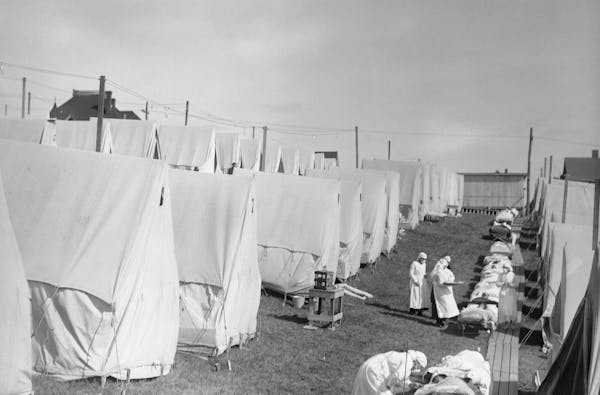
A flu camp in Lawrence, Maine during the 1918 influenza pandemic. Nurses and doctors tried desperate measures to stop the spread of the disease, which ultimately killed more than 675,000 people in the U.S. alone.Bettmann/Getty Images
Severe cases of both COVID-19 and the flu require the same lifesaving medical equipment. This highlights the importance of getting the flu vaccine for not only your own personal health but also the health of your community. Receiving the flu vaccine will help reduce the burden of respiratory illness on our already very overstretched health care system. By increasing flu vaccination rates, we can reduce the overall impact of respiratory illnesses on the population and hence lower the resulting burden on the health care system during the COVID-19 pandemic.
Because flu vaccination protects against one of these respiratory illnesses, the CDC recommends everyone (with few exceptions) six months of age and older get an annual flu vaccine. While the flu vaccine will not protect you against COVID-19, the flu vaccine will reduce your risk of developing the flu as well as reduce your risks of flu-related complications including hospitalization and even death.
While it may seem like there is so much out of our control during this pandemic, getting the flu vaccine, practicing proper hand washing, social distancing and wearing face coverings are within our control and will protect not only you but also your family and community.
If you are not getting the flu vaccine from your employer, think about alternative sources now. Vaccines should be available in most areas by Sept. 1.
Call you doctor’s office to ask how you can get a flu shot.
Call your local public health department.
Consider getting a vaccine while you are grocery shopping or picking up prescriptions.
Mainly, make sure you take advantage of this potentially lifesaving vaccine. Get it on your calendar for early September now. And remember, the flu shot cannot give you the flu.
In-person doctor visits plummeted during the start of the COVID-19 crisis in the United States, but have rebounded to a rate somewhat below pre-pandemic levels, according to a new analysis issued by The Commonwealth Fund and conducted by researchers from Harvard Medical School, Harvard University and the life sciences firm Phreesia.
According to data compiled through Aug. 1, all physician visits were down 9% from pre-pandemic levels. That’s significantly improved compared to data from late March, when visits were down 58%. Although the rebound got major traction beginning in late April, it began plateauing in early June, when all visits were 13% lower than normal. As of early August, in-person visits were down 16% compared to pre-COVID levels. States that are currently coronavirus hot spots are seeing bigger declines than states where the case levels are lower.
Meanwhile, telemedicine encounters have settled in at rates much higher than pre-pandemic levels. However, they still make up just a fraction of patient-provider encounters for care. As of the start of this month, they comprised 7.8% of all such encounters. That’s compared to a peak of 13.8% in the latter part of April. Prior to COVID-19, they were only 0.1% of all visits.
Dive Insight:
COVID-19 has widely disrupted healthcare delivery in the United States. However, it is becoming clear that as the pandemic has become a part of everyday life for the time being, how patients visit their medical providers has also settled into a pattern.
According to Harvard researchers using data from Phreesia’s more than 50,000 provider clients, the plunge in patients seeing their physicians has rebounded from its nearly 60% dive in early spring. However, with all patient-physician encounters still consistently down from pre-COVID levels, the study’s authors warn that “the cumulative number of lost visits since mid-March remains substantial and continues to grow.”
Meanwhile, COVID-19 hotspots in the South and Southwest are depressing patient-provider encounters for the time being. Encounters were down as of late July by 15% in Arizona, Florida and Texas, compared to 12% in the Northeast and 8% in all other states.
Among medical specialties, only dermatology has seen a rebound beyond pre-COVID levels, with encounters up about 8% overall. But primary care visits are down 2%; surgery encounters, 9%; orthopedics, 18%; and pediatrics are in a 26% decline.
That the encounters between patients, doctors and other providers remains lower than normal has sparked some concerns about practices and other medical enterprises moving forward. HHS just earmarked $1.4 billion for nearly 80 children’s hospitals across the United States to try to shore them up financially.
The private sector has also undertaken an initiative to encourage patients to return to their providers. Insurer Humana, along with the Providence and Baylor Scott & White healthcare systems, launched an advertising campaign last month to encourage patients to seek out healthcare needs, even during the historic pandemic.





 HENRY KOTULA