As Americans lose job-based coverage, ACA marketplace sets record with near 500K signups

https://www.healthcaredive.com/news/as-americans-lose-job-based-coverage-aca-marketplace-sets-record-with-near/580623/

Dive Brief:

  • Millions of individuals have lost their jobs as a result of the pandemic, allowing them to enroll in Affordable Care Act marketplace coverage via Healthcare.gov due to their special circumstances. CMS said this week that this special enrollment coverage due to job loss specifically has reached a record, with about 487,000 consumers gaining coverage, a 46% increase compared with the same time last year.
  • April saw the biggest jump in enrollment following job loss, an increase of 139% compared to April of last year.
  • Due to a number of factors, CMS said it “remains unclear how many people will eventually look to Exchanges using HealthCare.gov to replace job-based coverage.”

Dive Insight:

The pandemic has battered the economy, causing historic levels of unemployment. For many Americans, healthcare coverage is tethered to their jobs. As such, the pandemic is not only a threat to Americans’ health but their ability to pay for the care they need, sick with COVID-19 or not.

As many as 27 million Americans may have lost job-based coverage between March and May of this year, according to a recent analysis from the Kaiser Family Foundation. 

Of the newly uninsured, about half (12.7 million) would be eligible for Medicaid coverage, according to Kaiser’s estimates. There are a few options for workers out of a job and insurance. They can opt to extend their coverage through COBRA, enroll in coverage through the exchanges, or check to see if they qualify for Medicaid.

This week, CMS attempted to quantify just how many out-of-work Americans were turning to the exchanges.

About 500,000 out-of-work consumers enrolled in coverage so far this year. However, there are other life events that qualify a consumer to shop for coverage during a special enrollment period. Overall, special enrollment period sign-ups garnered more than 890,000 enrollees, dwarfing other periods. 

If the trend continues, it may fuel a significant shift in health insurance. For years, a majority have received commercial coverage through work. Even health insurers recognize disruption is on the horizon.

Many of the nation’s largest insurers are bracing for a shift from their commercial book of business to covering more Medicaid enrollees through their contracts with states. Earlier this year, Molina, Centene and Anthem all said they expect upticks in their Medicaid membership and exchange products.

Molina executives said in April they already saw 30,000 more Medicaid members from the prior-year period.


Trinity Health expects $2B revenue plunge as it cuts, furloughs more staff

https://www.healthcaredive.com/news/trinity-health-cutting-cost-cutting-2-billion-revenue-shortfall/580738/

The Dumbest Things You Can Do With Your Money | Work + Money

Dive Brief:

  • Trinity Health, one of the nation’s largest nonprofit health systems, said Monday it will take more measures to cut costs due to the downturn spurred by the novel coronavirus. The restructuring plan includes eliminating positions, extending furloughs, severances and reductions in schedules. The decisions are being “customized” across the system based on factors that include volume projections and the cost and revenue challenges in each market.
  • The Livonia, Michigan-based hospital operator said it continues to treat COVID-19 patients, however, it has “for now seen declining numbers of very sick patients with COVID-19.”
  • The system said it expects revenue to be depressed or “below historical levels” for the remainder of this fiscal year and much of the next. It projects revenue to drop by $2 billion to $17.3 billion for fiscal year 2021, which starts after its June 30 year end.

Dive Insight:

In May, Trinity said it planned to furlough nearly 12% of its workforce — or 15,000 employees out of the 125,000 nationally.  

Trinity, one of the nation’s largest hospital operators with 92 facilities and operations across 22 states, is now broadening that restructuring, extending and adding new furloughs.

In a Monday bond filing, Trinity said its operations were “significantly” impacted by the effects of the pandemic as many operators saw depressed volumes due to shelter-in-place orders, which started in most of Trinity’s markets during the last two weeks of March.

“The effect of COVID-19 on the operating margins and financial results of Trinity Health is adverse and significant and, at this point, the duration of the pandemic and the length of time until Trinity Health returns to normal operations is unknown,” according to Monday’s bond filing.

The system said relief funds provided by the federal government have not been enough to cover its operating losses. Trinity has received $600 million in relief funds that do not have to be repaid and more in loans through the advanced Medicare payment program, according to a previous analysis by Healthcare Dive.

Still, the system said it has drawn on credit facilities totaling $1 billion to provide adequate liquidity during the pandemic. Trinity reported having 178 days cash on hand as of March 30.

Some nonprofits are faring better than Trinity and pulling back on earlier staffing cuts.

Mayo Clinic said last week it will call back its furloughed workers by the end of August and restore pay that had been cut due to the pandemic.

Mayo has some of the most cash on hand in terms of days when comparing other major nonprofit systems. Mayo had 252 days of cash on hand as of March 30, more than the other 20 largest nonprofits except Cleveland Clinic and New York-Presbyterian.


U.S. Healthcare System vs. Socialized Medicine during the Pandemic

https://www.commondreams.org/news/2020/06/25/why-socialized-system-medicare-all-beats-profit-healthcare-one-chart-covid-19?fbclid=IwAR1qT_AI5KFreoEKOqQfvdWUHPyW80fa2Iefxb5Ul5wJQtf8rSvZXkL8RHM


“All countries successfully combatting this virus have robust public health systems, which provide for coordination of effort.”

A recent rise in cases of Covid-19 and the overt failure of the for-profit healthcare system throughout the pandemic in the U.S. are making the case for Medicare for All, advocacy groups and activists say, as countries with socialized systems see their infection rates decline.

“All countries successfully combatting this virus have robust public health systems, which provide for coordination of effort,” remarked a popular healthcare advocate who uses the @AllOnMedicare handle on Twitter.

Calls for the U.S. to adopt a single-payer heathcare system have increased as the pandemic has raged around the country. Cases and deaths in the U.S are now the highest in the world, a result critics blame on both the private healthcare system and the mismanagement of the crisis by President Donald Trump.

Public Citizen’s health care policy advocate Eagan Kemp told Common Dreams that the current for-profit healthcare system that has driven millions of Americans in to bankruptcy and leaves millions more without care will only continue to exacerbate the pain of the outbreak. 

“While no health care system can completely protect a country from Covid-19, the U.S. has failed to respond for a number of reasons, not least of which is a for-profit health care system where Americans are too afraid to go to the doctors for fear of the cost,” said Kemp. “Far too many Americans will face medical debt and even bankruptcy if they are lucky enough to survive getting Covid-19, something unheard of in all other comparably wealth countries.”

As University of Massachusetts professor Dean E. Robinson wrote in a piece that appeared at Common Dreams earlier this month, the coronavirus is impacting people of color at a disproportionate rate in cities and communities nationwide—a dynamic that bolsters the call for a universal Medicare for All program to help close those gaps.

“The obvious and immediate need of Black and other working class populations caught in the teeth of the pandemic is the right to health care treatment without the burden of cost,” wrote Robinson. “Even before the pandemic, lower-income, Latino, and younger workers were more likely to be uninsured. Undocumented workers had the highest rates of uninsurance.”

On June 18, Ralph Nader in an opinion piece for Common Dreams expressed his hope that the ongoing pandemic would make essential workers in the health field “the force that can overcome decades of commercial obstruction to full Medicare for All.”


Jobless claims: Another 1.48 million Americans file for unemployment benefits

https://finance.yahoo.com/news/coronavirus-covid-weekly-initial-jobless-claims-june-20-195644738.html

More than three months into the COVID-19 crisis in the U.S., countless Americans are still unemployed. According to the U.S. Labor Department, weekly initial jobless claims data showed yet another week of claims exceeding 1 million.

Another 1.48 million Americans filed for unemployment benefits in the week ending June 20, exceeding economists’ expectations for 1.32 million. The prior week’s figure was revised higher to 1.54 million from the previously reported 1.51 million claims. While this week’s report marked 12 consecutive weeks of deceleration, more than 47 million Americans have filed for unemployment insurance over the past 14 weeks.

“Jobless claims are not falling fast enough,” Renaissance Macro’s Neil Dutta said in an email Thursday. “Everything we have seen in the last week or two between rising case counts/hospitalizations, stalling economic progress in some important states, government job cuts, means one thing: the Phase 4 of fiscal stimulus must be bigger. Things should be better in 3-4 weeks, but the news will get worse before it gets better. Take some chips off the table and reload the chamber for August.”

Continuing claims, which lags initial jobless claims data by one week, totaled 19.52 million in the week ending June 13, down from 20.29 million in the week ending June 6. Consensus expectations were for 20 million continuing claims.

“Initial jobless claims continue to moderate only gradually,” Nomura economist Lewis Alexander wrote in a note Wednesday. “While the labor market remains exceptionally weak, signs of gradual improvement suggest another month of NFP gains during June.”

In the week ending June 20, California reported the highest number of jobless claims at an estimated 287,000 on an unadjusted basis, up from 241,000 in the previous week. Georgia had 124,000, down from 132,000, Florida reported 93,000, New York had roughly 90,000 and Texas reported 89,000 jobless claims.

Additionally, Pandemic Unemployment Assistance (PUA) program claims, which include those who were previously ineligible for unemployment insurance such as self-employed and contracted workers, was also closely monitored in Thursday’s report.

PUA claims totaled 728,120 on an unadjusted basis in the week ending June 20, down from the prior week’s 770,920.

As states reopen their economies, cases and hospitalization figures are back on the rise. As of Thursday morning, there were more than 9.4 million cases and 483,000 COVID-19 deaths around the world, according to Johns Hopkins University data. The U.S. had 2.3 million cases and 121,000 deaths.


ACA enrollment up 46%

https://www.axios.com/newsletters/axios-vitals-59e9ac1a-ab86-4f8a-917a-8c9d52f5835f.html?utm_source=newsletter&utm_medium=email&utm_campaign=newsletter_axiosvitals&stream=top

Obamacare Coverage Spikes After Covid-Related Job Losses

The number of people who lost jobs and related health coverage and then signed up for Affordable Care Act health plans on the federal website was up 46% this year compared with 2019, representing an increase of 154,000 people, the federal government said in a new report.

The bottom line: The government said the rush of people going to HealthCare.gov was tied to “job losses due to COVID-19,” Bob writes.

Yes, but: Medicaid enrollment due to coronavirus-related job losses appears to be growing even faster than enrollment in ACA plans, according to the Georgetown University Health Policy Institute.

Go deeper: Medicaid will be a coronavirus lifeline


America’s workers still aren’t protected from the coronavirus

https://www.axios.com/americas-workers-vulnerable-coronavirus-944e3451-4458-4f1d-83d2-c86a1beb1117.html

America's workers still aren't protected from the coronavirus - Axios

Essential workers have borne the brunt of the coronavirus pandemic for months, but the U.S. is still doing relatively little to protect them.

Why it matters: With no end to the pandemic in sight, America’s frontline workers still must choose between risking their health and losing their source of income.

Driving the news: The Trump administration said this week that health insurers aren’t required to cover coronavirus diagnostic tests performed as part of workplace safety or public health surveillance efforts.

  • It didn’t say who is supposed to pay for these tests. If employers are stuck footing the bill, that makes the testing less likely to happen.

The big picture: There’s been no national effort or initiative to protect essential workers, and America is still failing to implement basic public health measures as new cases skyrocket.

  • Masks have become a political flashpoint and aren’t required in many of the states that are emerging coronavirus hotspots.
  • That means essential workers go to work each day without any guarantee that the people they’re interacting with will take one of the most basic and effective steps to prevent transmission of the virus.
  • No one is even talking about mass distribution of personal protective equipment beyond health care workers. And even some health care workers — particularly those who work in nursing homes — don’t have the protective gear that they need.

More broadly, the financial incentives for frontline workers, particularly those who are low-income, to keep working make it nearly impossible for them to avoid health risks.

  • At least 69 million American workers are potentially ineligible for the emergency paid sick leave benefits that Congress passed earlier this year, per the Kaiser Family Foundation.
  • An estimated 25-30 million people — particularly lower-wage workers in service industries — are unable to work from home but also face a high risk of severe infection, KFF’s Drew Altman wrote earlier this week.

What we’re watching: The line between essential workers and those who are required to return to the office by their employer has become blurry, and millions more Americans are facing dilemmas similar to those faced by grocers and bus drivers.

  • The sickest — and thus most vulnerable — Americans may feel the most pressure to return to work, as that’s often where they get their health insurance, the NYT points out.
  • Nearly a quarter of adult workers are vulnerable to severe coronavirus infections, per KFF.

The bottom line: Essential workers and their families will continue to feel the impact of America’s coronavirus failures most acutely.

Go deeper: “Disposable workers” doing essential jobs


Credit downgrades aren’t attributable to COVID-19 but cash flow will be a challenge

https://www.healthcarefinancenews.com/news/credit-downgrades-arent-attributable-covid-19-cash-flow-will-be-ongoing-challenge?mkt_tok=eyJpIjoiTUdSbVptVmhaR0ZpT0RJMyIsInQiOiJ2TVwvb3g5VWF4R05DeWFScVJ4U0lXeW9xWG1cL0pVMWo1RE1cL24rd21ySEErbk9kZWNIXC9hdmZYYmJBcGU1RDQ5MDVDNXVyZ2RZSWo2djRRSXhSOVFVQk1yNjFWOTVoVjlkTXVxXC95QXU1SU8yMEhJcEtHZXJ3ZDhDc2RMb2RcLzlMcSJ9

Just How Bad Is My Bad Credit Score? | Credit.com

The coronavirus is mainly affecting the credit outlook for the rest of the year and beyond as hospitals adapt to new financial realities.

While the COVID-19 coronavirus is likely to cause cash flow and liquidity issues for hospitals through the end of the year and into 2021, the credit outlook for the healthcare industry isn’t as dire as some had feared. While there have been some downgrades this year, most of those are attributable to healthcare financial performance at the end of 2019.

At a virtual session of the Healthcare Financial Management Association on Wednesday, Lisa Goldstein, associate managing director at Moody’s Investors Service, said the agency is taking a measured approach to issuing credit ratings and will “triage” these ratings based on factors such as liquidity and cash flow.

“Changes are happening daily, and sometimes hourly with funding coming from the federal government,” said Goldstein, “so we’re taking a very measured approach.”

Healthcare is among the most volatile industries being affected by the coronavirus due to the fact that it operates like a business, with a general lack of government support to pay off debt.

Credit downgrades are on the rise, but there’s historical precedent at play. Looking at data beginning with the 2008 financial crisis, there were consistently more downgrades than upgrades in the healthcare industry, owing to its inherent volatility. It was and has generally been subject to public policy and competitive forces. In any given year, downgrades exceed upgrades.

After passage of the Affordable Care Act, however, the number of uninsured Americans hit an all-time low. Hospitals grew in occupancy and revenues improved. The situation started to worsen once more when it became clear that there was a national nursing shortage, as well as top-line revenue pressure from government and commercial payers lowering their rates, but credit downgrades didn’t truly explode until this year. There have been 24 downgrades so far this year, already exceeding the 13 downgrades in all of 2019.

The rub is that it’s not the coronavirus’s fault.

“Most downgrades were in the first quarter of the year,” said Goldstein. “We did have a lot of downgrades in March, which is when the pandemic really started – when it became a pandemic – but even though there were 11 downgrades in March, it was based on what we’d seen through the end of 2019. There were problems that were appearing that had nothing to do with the pandemic.”

Basic fundamental operating challenges were becoming more pronounced during that time. A decline in inpatient cases, a rapid rise in observation stays, a decline in outpatient cases to competing clinics and health centers, and staffing and productivity challenges all contributed to material increases in debt.

COVID-19’s effects on hospital credit ratings are in the outlook for the rest of the year and beyond. Interestingly, in March, Moody’s changed its outlook from negative to stable.

“We haven’t seen anything like this,” said Goldstein. “The industry has been through shocks, but something this long in duration has been something we think will have an impact on financial performance going forward.”

Moody’s anticipates cash flow will remain low into 2021, mostly from the suspension of elective surgeries, rising staffing expenses and uncertainty around securing enough personal protective equipment. Liquidity is still a concern, but is more of a side issue due to Medicare funding providing a Band-Aid of sorts. The CARES act will help to fill some of that gap, but not all of it, said Goldstein.

She added that the $175 billion in stimulus funding is favorable, but modestly so, since it is estimated to cover only about two months’ worth of spending. The good news is that the opportunity to apply for grant money, which doesn’t have to be repaid, can help to fill some of the gap.

Some hospital leaders are concerned that if they violate covenants – also known as a technical default – their credit outlook will be downgraded. Goldstein sought to assuage those concerns.

“Debt service covenants are expected to rise, but an expected covenant breach or violation won’t have an impact on credit quality because it’s driven by an unusual event happening,” she said. “It doesn’t speak to your fundamental history as an operating entity.”


White House set to ask Supreme Court this week to overturn ACA: 4 things to know

https://www.beckershospitalreview.com/hospital-management-administration/white-house-to-ask-supreme-court-this-week-to-overturn-aca-4-things-to-know.html?utm_medium=email

New rules for Supreme Court justices as they plan their first-ever ...

The White House is expected to file legal briefs with the Supreme Court this week that will ask the justices to end the ACA, according to The New York Times

Four things to know:

1. The filings are in relation to Texas v. United States, the latest legal challenge to the ACA. Arguments around the case center on whether the ACA’s individual mandate was rendered unconstitutional when the penalty associated with it was erased by the 2017 tax law. Whether that decision invalidates the entire law or only certain parts of it is at question.

2. The White House is set to ask the Supreme Court June 25 to invalidate the law. The filings come at a time when the COVID-19 pandemic has caused millions of Americans to lose their jobs and their employer-based health coverage.

3. Republicans have said they want to “repeal and replace” the ACA, but there is no agreed upon alternative, according to The New York Times. Party strategists told the publication that Republicans will be in a tricky spot if they try to overturn the ACA ahead of the November elections and amid a pandemic. 

4. In addition to the filings, Democratic House speaker Nancy Pelosi is expected to reveal a bill this week that would boost the ACA. Proposals include more subsidies for healthcare premiums, expanding Medicaid coverage for uninsured pregnant women and offering states incentives to expand Medicaid.

Read the full report here


750 Million Struggling to Meet Basic Needs With No Safety Net

https://news.gallup.com/poll/312401/750-million-struggling-meet-basic-needs-no-safety-net.aspx?utm_source=newsbrief-newsletter&utm_medium=email&utm_campaign=NewsBriefNewsletter-NewsAlerts_June_06232020&utm_content=readarticle-textlink-6&elqTrackId=4006f0c4b7d144559ddd21458f847dda&elq=855f025f02c444dcb59fe9492ea16815&elqaid=4326&elqat=1&elqCampaignId=925
750 Million Struggling to Meet Basic Needs With No Safety Net

STORY HIGHLIGHTS

  • One in seven adults worldwide struggle to afford food, shelter with no help
  • At least some percentage in every country is “highly vulnerable”
  • Highly vulnerable in developed, developing world as likely to have health problems

This article is the first in series based on results from Gallup’s new Basic Needs Vulnerability Index.

Imagine being unable to afford food or to put a roof over your head, or maybe you are struggling to do both. On top of this, you don’t have family or friends who can help you.

Now, imagine this is all happening and a pandemic hits.

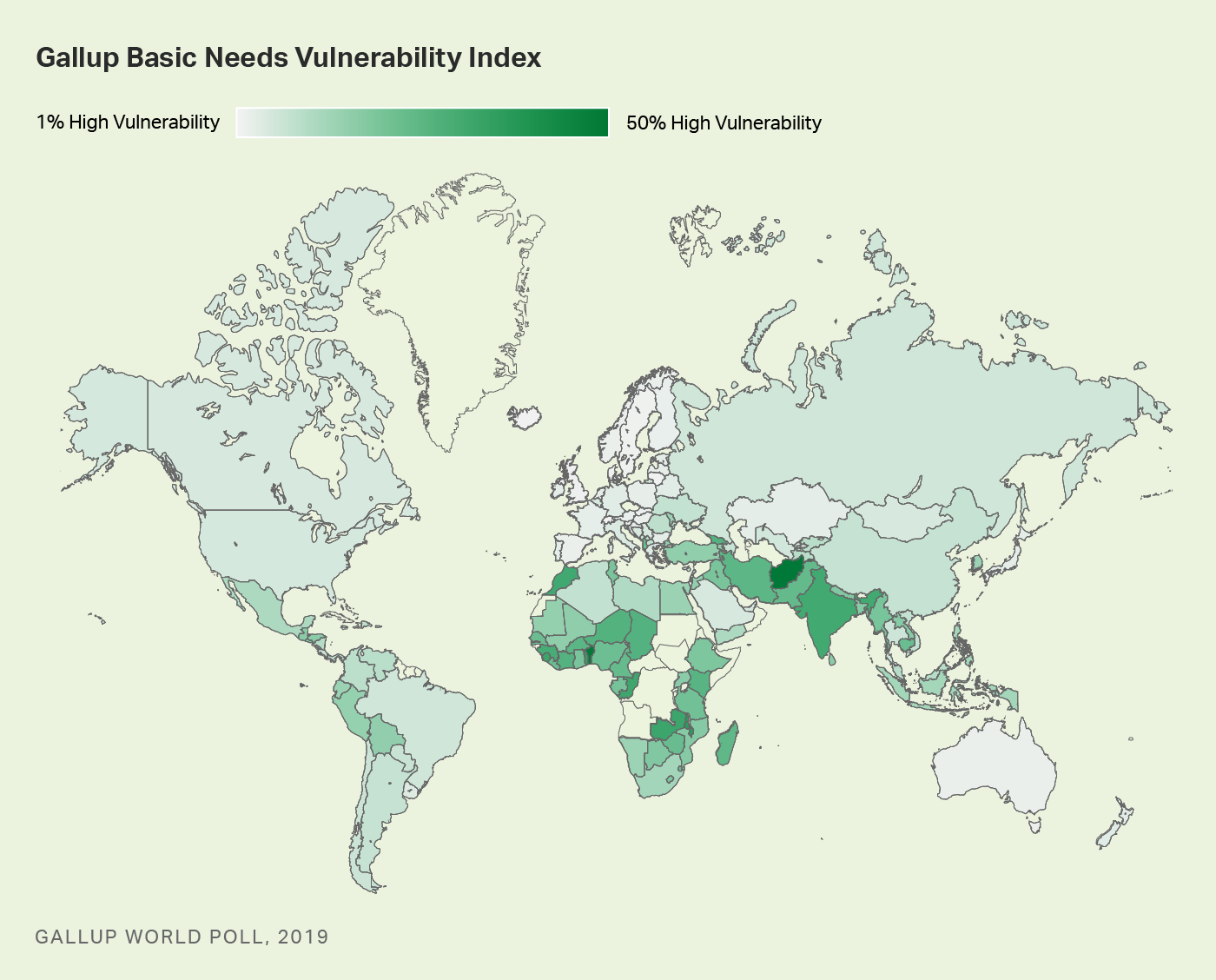
Gallup’s new Basic Needs Vulnerability Index, based on surveys in 142 countries in 2019, suggests this was the reality for hundreds of millions worldwide just as COVID-19 arrived.

About one in seven of the world’s adults — or about 750 million people — fall into this index’s “High Vulnerability” group, which means they are struggling to afford either food or shelter, or struggling to afford both, and don’t have friends or family to count on if they were in trouble.

Globally, at least some adults in every country fall into the High Vulnerability group, which is important because Gallup finds people in this group are potentially more at risk in almost every area of their lives. Worldwide, these percentages range from 1% in wealthy countries such as Denmark and Singapore to roughly 50% in places such as Benin and Afghanistan.
20200602_vulnerability@2x

Gallup’s Basic Needs Vulnerability Index gauges people’s potential exposure to risk from economic and other types of shocks like a pandemic. Beyond measuring people’s ability to afford food and shelter, this index also folds in whether people have personal safety nets — people who can help them when they are in trouble.

People worldwide fall into one of three groups:

High Vulnerability: People in this group say there were times in the past year when they were unable to afford food or shelter or say they struggled to afford both and say they do not have family or friends who could help them in times of trouble.

Moderate Vulnerability: People in this group say there were times in the past year when they were unable to afford food or shelter or say they struggled to afford both, and they do have family or friends to help them in times of trouble.

Low Vulnerability: People in this group say there were not times in the past year when they struggled to afford food or shelter and say they do have family or friends to help them if they were in trouble.

Before the pandemic, most of the world was at least moderately vulnerable, falling into either the High Vulnerability group (14%) or the Moderate Vulnerability group (39%). The rest, 47%, fell into the Low Vulnerability group.

The life experiences in these three groups illustrate the difference that not having family and friends to count on in times of trouble can make in people’s lives.

Highly Vulnerable Most Likely to Experience Health Problems, Experience Pain

While people in the High Vulnerability group are potentially more at risk in almost every area of their lives than those in the other two groups, they are particularly at risk when it comes to their health.

More than four in 10 (41%) of the highly vulnerable say they have health problems that keep them from doing activities that people their age normally do. This percentage drops to 29% among those who are moderately vulnerable and to 14% among those with low vulnerability.

The same is true for experiences of physical pain. The highly vulnerable are also far more likely to say they experienced physical pain the day before the interview (53% have) compared with 37% in the moderately vulnerable and 20% in the lowest vulnerability group.

Looking at who the highly vulnerable are within the global population reinforces why the greater risks to their health are so important. Globally, people in the high vulnerability group are just as likely to be male or female (14% of each fall into this group), and percentages are similar in the 15 to 29 age group (12%) and 60 and older group (14%).

However, the highly vulnerable are more likely to live in rural (16%) rather than urban areas (10%) and be in the poorest 20% of the population (21%) than the richest 20% of the population (7%).

Highly Vulnerable in Developed and Developing Countries Poor Health in Common

As might be expected, most of the countries with the highest percentage in the High Vulnerability group are a mix of developing economies and notably one emerging economy — India — and the countries with the lowest percentage are developed, high-income economies.

However, regardless of where they are located or their level of development, the highly vulnerable populations look a lot alike. In fact, when it comes to health problems, among the highly vulnerable populations, almost the exact same percentage in developing economies (41%) and high-income economies (42%) report having them.

The highly vulnerable in developing countries are only slightly more likely to report experiencing physical pain (53%) than this group in developed, high-income economies (47%).

Implications

As massive as the highly vulnerable group was before the pandemic, it could have been even larger, taking children and other household members into account.

As such, this new layer of vulnerability among populations will be important to monitor as the pandemic threatens to push tens of millions more people into extreme poverty and hunger this year and beyond.


Re-examining the delivery of high-value care through COVID-19

https://thehill.com/opinion/healthcare/502851-examining-the-delivery-of-high-value-care-through-covid-19#bottom-story-socials

Re-examining the delivery of high-value care through COVID-19 ...

Over the past months, the country and the economy have radically shifted to unchartered territory. Now more than ever, we must reexamine how we spend health care dollars. 

While the COVID-19 pandemic has exposed challenges with health care in America, we see two overarching opportunities for change:

1) the under-delivery of evidence-based care that materially improves the lives and well-being of Americans and

2) the over-delivery of unnecessary and, sometimes, harmful care.

The implications of reallocating our health care spending to high-value services are far-ranging, from improving health to economic recovery. 

To prepare for coronavirus patients and preserve protective equipment, clinicians and hospitals across the country halted non-urgent visits and procedures. This has led to a substantial reduction in high-value care: emergency care for strokes or heart attacks, childhood vaccinations, and routine chronic disease management. However, one silver lining to this near shutdown is that a similarly dramatic reduction in the use of low-value services has also ensued.

As offices and hospitals re-open, we have a once in a century opportunity to align incentives for providers and consumers, so patients get more high-value services in high-value settings, while minimizing the resurgence of low-value care. For example, the use of pre-operative testing in low-risk patients should not accompany the return of elective procedures such as cataract removal. Conversely, benefit designs should permanently remove barriers to high-value settings and services, like patients receiving dialysis at home or phone calls with mental health providers.   

People with low incomes and multiple chronic conditions are of particular concern as unemployment rises and more Americans lose their health care coverage. Suboptimal access and affordability to high-value chronic disease care prior to the COVID-19 pandemic was well documented  As financially distressed providers re-open to a new normal, hopeful to regain their financial footing, highly profitable services are likely to be prioritized.

Unfortunately, clinical impact and profitability are frequently not linked. The post-COVID reopening should build on existing quality-driven payment models and increase reimbursement for high-value care to ensure that compensation better aligns with patient-centered outcomes.

At the same time, the dramatic fall in “non-essential care” included a significant reduction in services that we know to be harmful or useless. Billions are spent annually in the US on routinely delivered care that does not improve health; a recent study from 4 states reports that patients pay a substantial proportion (>10 percent) of this tab out-of-pocket. This type of low-value care can lead to direct harm to patients — physically or financially or both — as well as cascading iatrogenic harm, which can amplify the total cost of just one low-value service by up to 10 fold. Health care leaders, through the Smarter Health Care Coalition, have hence called on the Department of Health and Human Services Secretary Azar to halt Medicare payments for services deemed low-value or harmful by the USPSTF. 

As offices and hospitals reopen with unprecedented clinical unmet needs, we have a unique opportunity to rebuild a flawed system. Payment policies should drive incentives to improve individual and population health, not the volume of services delivered. We emphasize that no given service is inherently high- or low-value, but that it depends heavily on the individual context. Thus, the implementation of new financial incentives for providers and patients needs to be nuanced and flexible to allow for patient-level variability. The added expenditures required for higher reimbursement rates for highly valuable services can be fully paid for by reducing the use of and reimbursement for low-value services.  

The delivery of evidence-based care should be the foundation of the new normal. We all agree that there is more than enough money in U.S. health care; it’s time that we start spending it on services that will make us a healthier nation.