Health insurance marketplace GoHealth files to go public

https://www.fiercehealthcare.com/tech/health-insurance-marketplace-gohealth-files-to-go-public?utm_medium=nl&utm_source=internal&mrkid=959610&mkt_tok=eyJpIjoiWmpjeVlXVTRZV0l5T1RndyIsInQiOiJLWWxjamNKK2lkZmNjcXV4dm0rdjZNS2lOanZtYTFoenViQjMzWnF0RGNlY1pkcjVGcFwvZFY4VjFaUUlZaFRBT1NRMGE5eWhGK1ZmR01ZSWVZWGMxOHRzTkptZVZXZmc5UnNvM3pVM2VIWDh6VllldFc3OGNZTTMxTDJrXC8wbzN1In0%3D

GoHealth files for $100M IPO

GoHealth, an online health insurance marketplace, is looking to raise up to $100 million in an initial public offering, according to a filing with the U.S. Securities and Exchange Commission (SEC) Friday.

The Chicago company, launched in 2001, said its stock will trade on the Nasdaq Global Market under the symbol “GHTH,” according to an S-1 filing.

The company didn’t list specific share price or the number of shares it’s selling in the filing.

GoHealth operates a health insurance portal offering a variety of plans that allows customers to compare numerous insurance plans such as family health plans and self-employed insurance.

The company works with more than 300 health insurance carriers and has enrolled more than 5 million people into health plans.

Goldman Sachs, BofA Securities and Morgan Stanley are acting as the managing book runners for the proposed offering. Barclays, Credit Suisse, Evercore ISI, RBC Capital Markets and William Blair are acting as book runners for the proposed offering. Cantor and SunTrust Robinson Humphrey are acting as co-managers for the proposed offering, according to a GoHealth press release.

GoHealth will join a growing list of technology-enabled healthcare companies that are testing the public markets, including One Medical, Livongo, Phreesia, Health Catalyst, Change Healthcare and Progyny.

The company has shifted its focus toward Medicare products over the past four years, positioning itself to capitalize on strong demographic trends and an aging population.

Medicare enrollment is expected to grow from approximately 61 million individuals in 2019 to approximately 77 million individuals by 2028, the company said in its SEC filing.

At the same time, an increasing proportion of the Medicare-eligible population is choosing commercial insurance solutions, with 38% of Medicare beneficiaries, or approximately 23 million people, enrolled in Medicare Advantage plans in 2019, an increase of approximately 1.5 million people from 2018 to 2019, the company said.

The market is “ripe for disruption” by digitally enabled and technology-driven marketplaces like the GoHealth platform, according to the company.

GoHealth estimates a total addressable market of $28 billion for Medicare Advantage and Medicare Supplement products.

“We believe that these trends will drive a larger market in the coming years that, when taken together with our other product and plan offerings, will result in an even larger addressable market. We also believe that we are poised to benefit from market share gains in what has traditionally been a highly fragmented market,” the company said in the S-1 filing.

The company uses machine-learning algorithms and insurance behavioral data to match customers with the health insurance plan that meets their specific needs.

In 2019, the company generated over 42.2 million consumer interactions.

In September 2019, Centerbridge acquired a majority stake of GoHealth in a deal that reportedly valued the company at $1.5 billion, the Chicago Tribune reported.

Net revenues grew to $141 million for the first quarter of this year, compared to $69.1 million last year. The company reported 2019 pro forma net revenues of $540 million, up 139% from 2018’s revenue of $226 million, the company reported in its SEC filing.

The company reported a net loss of $937,000 for the first quarter of 2020 compared to a net income of $5 million for the same period in 2019, according to its IPO.

Demographic, consumer preference and regulatory factors are driving growth in the individual health insurance market, according to the company. Medicare enrollment is expected to grow significantly over the next 10 years as 10,000-plus individuals turn 65 each day and become Medicare-eligible.

At the same time, the growth in plan choices makes education and assistance with plan selection more important for consumers, GoHealth said.

“Marketplaces such as ours help educate consumers, and assist them in making informed plan choices,” the company said.

The company also faces significant risks that may impede its growth. Currently, a large portion of GoHealth’s revenue is derived from a limited number of carriers. Carriers owned by Humana and Anthem accounted for approximately 42% and 32%, respectively, of the company’s net revenues for the first three months of 2020, the company said in its IPO paperwork.

The COVID-19 pandemic also creates uncertainty in the healthcare market, and future developments in the outbreak could impact the company’s financial performance, GoHealth said.


COVID-19 Implications for pharma: US payer insights

https://www.healtheconomics.com/resource/covid-19-implications-for-pharma-us-payer-insights

What are the implications for pharma as COVID-19 forces fundamental change in US payer practice and policy?

The COVID-19 pandemic has created a unique set of challenges for US payers. In the short-term emergency healthcare packages have included increasing patient access to medicines, waiving co-pays, relaxing prior approval requirements and increasing telemedicine services. But longer term? The commercial healthcare market is likely to contract and demand for Medicare/Medicaid will increase. Payers are looking at a very different post-COVID-19 world and the impact on drug prices, formulary coverage, generic use and plan coverage will present significant hurdles to drug manufacturers.

Pharma needs to plan for a new long-term reality. To explore current thinking we interviewed, in COVID-19 implications for pharma: US payer insights, experienced US payers to give you a clear perspective of the immediate actions being taken and the emerging issues and trends that will shape pharma/payer relations.

Payers explore key issues

  • What emergency measures are in place to ensure the health plans address customers’ medical needs and will these need to be reconsidered on an ongoing basis?
  • What precautions are currently being taken to negate the impact of costs directly related to COVID-19 such as screening, hospital admissions and long-term treatment of COVID-related health issues?
  • What impact could COVID-19 have on private healthcare plans and Medicare/Medicaid and their formulary coverage, market access to medicines and the role of telemedicine services in the future?
  • How might COVID-19 impact policy on co-payments, premiums and patient selection criteria for treatments in the future?
  • What impact could COVID-19 have on pricing and reimbursement of drugs and the role of value-based contracting?

Click here for more information about this report.


Navigating a Post-Covid Path to the New Normal with Gist Healthcare CEO, Chas Roades

https://www.lrvhealth.com/podcast/?single_podcast=2203

Covid-19, Regulatory Changes and Election Implications: An Inside ...Chas Roades (@ChasRoades) | Twitter

Healthcare is Hard: A Podcast for Insiders; June 11, 2020

Over the course of nearly 20 years as Chief Research Officer at The Advisory Board Company, Chas Roades became a trusted advisor for CEOs, leadership teams and boards of directors at health systems across the country. When The Advisory Board was acquired by Optum in 2017, Chas left the company with Chief Medical Officer, Lisa Bielamowicz. Together they founded Gist Healthcare, where they play a similar role, but take an even deeper and more focused look at the issues health systems are facing.

As Chas explains, Gist Healthcare has members from Allentown, Pennsylvania to Beverly Hills, California and everywhere in between. Most of the organizations Gist works with are regional health systems in the $2 to $5 billion range, where Chas and his colleagues become adjunct members of the executive team and board. In this role, Chas is typically hopscotching the country for in-person meetings and strategy sessions, but Covid-19 has brought many changes.

“Almost overnight, Chas went from in-depth sessions about long-term five-year strategy, to discussions about how health systems will make it through the next six weeks and after that, adapt to the new normal. He spoke to Keith Figlioli about many of the issues impacting these discussions including:

  • Corporate Governance. The decisions health systems will be forced to make over the next two to five years are staggeringly big, according to Chas. As a result, Gist is spending a lot of time thinking about governance right now and how to help health systems supercharge governance processes to lay a foundation for the making these difficult choices.
  • Health Systems Acting Like Systems. As health systems struggle to maintain revenue and margins, they’ll be forced to streamline operations in a way that finally takes advantage of system value. As providers consolidated in recent years, they successfully met the goal of gaining size and negotiating leverage, but paid much less attention to the harder part – controlling cost and creating value. That’s about to change. It will be a lasting impact of Covid-19, and an opportunity for innovators.
  • The Telehealth Land Grab. Providers have quickly ramped-up telehealth services as a necessity to survive during lockdowns. But as telehealth plays a larger role in the new standard of care, payers will not sit idly by and are preparing to double-down on their own virtual care capabilities. They’re looking to take over the virtual space and own the digital front door in an effort to gain coveted customer loyalty. Chas talks about how it would be foolish for providers to expect that payers will continue reimburse at high rates or at parity for physical visits.
  • The Battleground Over Physicians. This is the other area to watch as payers and providers clash over the hearts and minds of consumers. The years-long trend of physician practices being acquired and rolled-up into larger organizations will significantly accelerate due to Covid-19. The financial pain the pandemic has caused will force some practices out of business and many others looking for an exit. And as health systems deal with their own financial hardships, payers with deep pockets are the more likely suitor.”


Gladwell: COVID-19 should push healthcare to consider its ‘weak links’

https://www.fiercehealthcare.com/payer/malcolm-gladwell-covid-19-should-push-healthcare-to-consider-its-weak-links?mkt_tok=eyJpIjoiWlRJMk9UYzVZVFl4Tm1VMSIsInQiOiJ0aElzSllzTkpISWNIcU13ZXErNVdPSzU3K05cLzRVY2FEWFMycDNHZTZcLzlTYUo3UVNNQXd3ZjlwZXlFbVA3c3NQTHI0NFhqcjhFNk1VUXc4aVlnYW9aSnFVOVIydEFqWG5weWdEc2Viall1elwvK0RIRWtEajhPWGw3TEFTNDlkUCJ9&mrkid=959610

Gladwell: COVID-19 should push healthcare to consider its 'weak ...

The coronavirus pandemic has shown the healthcare industry that it needs to decide whether it’s playing basketball or soccer, journalist and author Malcolm Gladwell said. 

Gladwell, the opening keynote speaker at America’s Health Insurance Plans’ annual Institute & Expo, said the two sports exemplify the differences in thinking when one tackles problems using a “strong link” approach versus a “weak link” approach.

In basketball, he said, the team is as strong as its strongest, most high-profile players. In soccer, by contrast, the team is only as strong as its weakest players.

For healthcare organizations, that means making investments in the “weakest links”—such as harried clinicians who may need more training and low-income communities that cannot afford or access coverage—rather than the stronger links, like building out teaching hospitals and physician specializations.

“In healthcare, this is a chance for us to turn the ship around and say we can benefit far more from making health insurance more plentiful and more affordable,” Gladwell said. 

Gladwell emphasized that healthcare is far from the only industry to largely follow a “strong link” approach to improvement. In higher education, for example, much of the investment and funding goes to Ivy League institutions and other wealthy, top-performing universities.

Meanwhile, the education system could see significant benefits if it invested in the “weak links” like community colleges and bringing down tuition, Gladwell said. 

It’s a similar story in national security—and that “strong link” thinking led to two of the largest security breaches in American history, Gladwell said. Both Edward Snowden and Chelsea Manning were relatively low-ranking people within the security apparatus, but they were able to access critical files and release them.

“I would argue that ‘strong link’ paradigm has dominated every part of American society,” Gladwell said. “We have really put our chips down on the ‘strong link’ paradigm.” 

How could a “weak link” approach have impacted the response to the COVID-19 pandemic? Gladwell argues that, for instance, widespread testing is hampered by a lack of supplies like nasal swabs. Investment in the supply chain could have mitigated that challenge, he said.

The virus also disproportionately impacts people with certain conditions, notably diabetes. A broader focus on preventing and treating obesity could have had a large impact on how the pandemic played out, he said. 

“With this particular pandemic, I think we’re having a wake-up call,” Gladwell said.


Highmark, HealthNow New York enter affiliation agreement

https://www.fiercehealthcare.com/payer/highmark-healthnow-new-york-enter-affiliation-agreement?mkt_tok=eyJpIjoiWlRJMk9UYzVZVFl4Tm1VMSIsInQiOiJ0aElzSllzTkpISWNIcU13ZXErNVdPSzU3K05cLzRVY2FEWFMycDNHZTZcLzlTYUo3UVNNQXd3ZjlwZXlFbVA3c3NQTHI0NFhqcjhFNk1VUXc4aVlnYW9aSnFVOVIydEFqWG5weWdEc2Viall1elwvK0RIRWtEajhPWGw3TEFTNDlkUCJ9&mrkid=959610

Insurers Highmark, HealthNow New York join forces, predict better ...

Highmark is expanding its reach into New York through an affiliation with HealthNow New York.

The acquisition is pending regulatory approval, the two Blues insurers announced Tuesday. Should it be finalized, HealthNow’s plans will continue to operate locally as Highmark BlueCross BlueShield of Western New York and Highmark BlueShield of Northeastern New York.

HealthNow will bring nearly 1 million additional members into the Highmark fold and boasted $2.8 billion in revenue for 2019. It will join the fourth largest Blues organization in the country, building on Highmark’s 5.6 million members and $18 billion in operating revenue for 2019.

David Holmberg, Highmark’s CEO, said on a call with reporters that Highmark has been pursuing a “focused growth strategy of working with like-minded partners” to improve care quality and affordability.

“We believe together Highmark and HealthNow can be transformational as we prepare healthcare for the next generation of people in all of our regions,” Holmberg said.

Highmark entered intro similar affiliations to expand into Delaware and West Virginia.

HealthNow will maintain its Buffalo headquarters as well as offices in the Albany area and will maintain a significant amount of local autonomy, executives said on the call. The boards of both insurers have unanimously signed off on the deal.

Dave Anderson, CEO of HealthNow, will remain at the helm once the two insurers have integrated. Anderson told reporters that uniting with Highmark allows it to maintain its community-based presence and approach while tapping into the scale of the larger health plan.

He said the affiliation has been in the works for more than two and a half years, but the COVID-19 pandemic highlighted just how critical the additional scale would be to filling some of the gaps exposed as the virus spread.

So while COVID-19 wasn’t on either company’s radar as talks began, the pandemic did play a key role in underscoring the value of uniting, Anderson said.

“COVID has essentially emphasized the strategy that we put in place,” he said.

The insurers did not offer an estimated timeline for the affiliation to be completed.


Anthem: No change in 2020 profit forecast

https://www.beckershospitalreview.com/payer-issues/anthem-no-change-in-2020-profit-forecast.html?utm_medium=email

End Citizens United announces 2018 targets, will spend $35M in 2018

Anthem reaffirmed its profit guidance for 2020 as the insurer expects continued financial growth despite the COVID-19 pandemic, according to a June 9 filing with the Securities and Exchange Commission. 

Anthem officials said their full-year guidance will be greater than $21 per share. The company expects to generate about 70 percent of its adjusted earnings in the first half of the year.

Anthem reported first-quarter revenues of $29.6 billion, up from $24.7 billion in the same period a year before. Anthem ended the quarter with $1.5 billion in profits, down slightly from $1.6 billion a year prior. 


Cigna sues dozens of drugmakers in alleged price-fixing scheme

https://www.beckershospitalreview.com/pharmacy/cigna-sues-dozens-of-drugmakers-in-alleged-price-fixing-scheme.html?utm_medium=email

26 Generic Drugmakers Accused of Price-Fixing, 'Multibillion ...

Cigna, one of the country’s largest health insurers, filed a lawsuit this week accusing dozens of generic drugmakers of breaking national and state antitrust laws by fixing prices. 

The lawsuit, filed June 9 in a Pennsylvania district court, alleges the drugmakers conspired to fix, increase, stabilize or maintain prices of generic drugs, allocate customers and markets and rig bids for generic drugs in violation of federal and state antitrust and competition laws.

A similar lawsuit was filed by all 50 states June 10 accusing 26 drugmakers of a price-fixing scheme. 

Cigna wrote that the drugmakers orchestrated the conspiracy through secret communications and meetings. The scheme increased the drugmakers’ profits at the expense of many customers, including Cigna, the lawsuit alleges.

“This scheme to fix, increase, stabilize or maintain prices, allocate customers and markets, and rig bids for generic pharmaceutical drugs, and otherwise stifle competition caused, and continues to cause, significant harm to the United States healthcare system,” the lawsuit states.

Cigna is seeking damages incurred from overcharges it paid for generic drugs. 

Find the full lawsuit here.


The pandemic isn’t hurting health care companies

https://www.axios.com/newsletters/axios-vitals-d0f987be-1f6b-4b4b-bcb6-0132dc0e7e3f.html?utm_source=newsletter&utm_medium=email&utm_campaign=newsletter_axiosvitals&stream=top

The pandemic isn't dampening Wall Street's view of health care - Axios

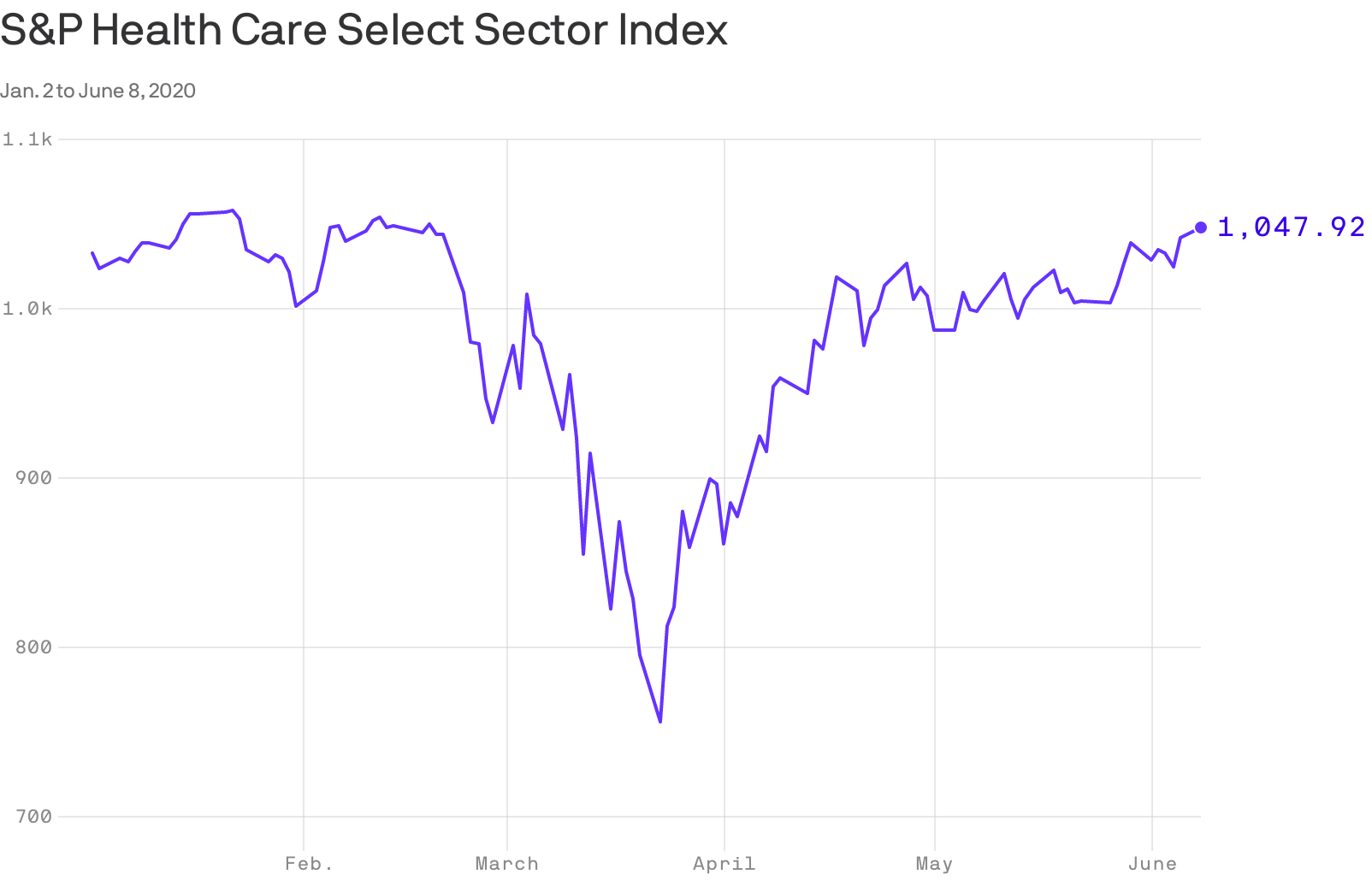
The S&P index of top health care companies finished Monday higher than where it opened the year, Axios’ Bob Herman reports.

The big picture: A global coronavirus pandemic, social unrest, mass unemployment, and the halting of medical procedures haven’t been enough to derail Wall Street’s rosy view of the health care industry.

Where things stand: The coronavirus started to affect the economy toward the tail end of the first quarter, but the health care industry was relatively unscathed.

  • Among the 109 publicly traded health care companies tracked by Axios, first-quarter profits exceeded $50 billion, good for a 7.4% net profit margin.
  • Pharmaceutical companies and health insurers generated the highest returns. Wall Street believes drug companies stand to benefit from potential coronavirus treatments or vaccines.
  • The stock price of Gilead Sciences, for example, is up 18% so far this year, partially on the assumption its coronavirus drug, remdesivir, will produce billions of dollars of revenue — even though the drug has showed only modest benefit for patients.

Between the lines: The second quarter likely will be worse, as the brunt of the coronavirus lockdown was felt in April and May. But normal operations have already started resuming for some health care sectors, regardless of the virus’ spread.


COVID-19 could cost insurers up to $547B through 2021: report

https://www.fiercehealthcare.com/payer/report-covid-19-could-cost-insurers-up-to-546b-over-next-two-years?mkt_tok=eyJpIjoiWlRnNU16RmxOemM1WXpWaSIsInQiOiJ0TFFnRkR2OUVoQjY5SXArbjU0ZXVmcjJaMFdNWXZ6cXBHOGQxVzZ1dkxhMHJVK0t3dmRtcUVicFIrVDdlMUJPY3doWlQzeVN0VVZxakdnUFBHY2w2a0VVQ0s2WFI1anhqR2xvSFBtMDZZcVlaYVwvK2xlRWdcL01uQmFRVTA0VGtMIn0%3D&mrkid=959610

COVID-19 could cost insurers up to $547B through 2021: report ...

The estimated costs for treating COVID-19 could add up as much as $547 billion for private insurers from 2020 to 2021 depending on the rate of infection, an updated report found.

The report, released Monday from consulting firm Wakely and commissioned by insurance lobbying group America’s Health Insurance Plans (AHIP), looks at the utilization of medical services associated with a COVID-19 infection and the costs for such services. The analysis is restricted to insurers operating in commercial, Medicare Advantage and Medicaid managed care markets.

Wakely estimates that the pandemic could cost insurers between $30 billion and $547 billion.

The report explores the costs of COVID-19 based on a series of potential infection rates, which represent the total population infected. The study modeled infection rates based on 10%, 20% and 60%, while acknowledging that the true infection rate could be far lower.

Wakely then looked at the total costs the plan is liable to cover based on each infection rate.

A 10% rate would lead to a total cost of $30 billion to $92 billion from 2020 to 2021, and a rate of 20% would be $60 billion to $182 billion.

But an infection rate of 60% would cost insurers the greatest, with a range of $180 billion to $547 billion.

“We assume that a higher volume of COVID related services will be incurred in 2020 and lower volume in 2021, distributing approximately 75% of the total services to 2020 and 25% to 2021,” the study said.

Wakely notes it did not model any long-term costs for treating people recovering from COVID-19 infections.

The firm also didn’t factor in vaccine mitigation in 2021 nor a scenario in which large-scale infections occur throughout 2021.

While private insurers have waived cost-sharing for COVID-19 treatments, it remains unclear how long the waivers will last. Anthem and Molina announced Monday they will extend their cost-sharing waivers through the rest of 2020.

The report is an update to an earlier one distributed by Wakely back in March at the onset of the pandemic. That report pegged the total COVID-19 costs between $56 billion and $556 billion.

The main reason for the decline is Wakely factored in deferred care due to the pandemic.

Wakely also reduced the overall assumed rate of hospitalizations for COVID-19-infected individuals to align with more recent studies. But the estimated unit cost for a hospital admission also increased, based on survey data from AHIP members.

People have been putting off necessary care for fear of going to a doctor’s office, and hospital systems have canceled or postponed elective surgical procedures for months.

Hospitals have slowly started to resume elective procedures, but only after installing stringent requirements on cleaning and testing.

Insurers are bracing for a wave of healthcare utilization some time later this year or in 2021 to deal with this pent-up demand.

The deferred care costs would differ based on the infection rate of the virus.

“We assumed, particularly for higher infection rate scenarios, that there may be limited capacity to make up care in 2021,” the report said.