42 hospitals closed, filed for bankruptcy this year

https://www.beckershospitalreview.com/finance/42-hospitals-closed-filed-for-bankruptcy-this-year.html?utm_medium=email

The Local Hospital Closed. These Doctors Didn't Give Up.

From reimbursement landscape challenges to dwindling patient volumes, many factors lead hospitals to shut down or file for bankruptcy. At least 42 hospitals across the U.S. have closed or entered bankruptcy this year, and the financial challenges caused by the COVID-19 pandemic may force more hospitals to do the same in coming months. 

COVID-19 has created a cash crunch for many hospitals across the nation. They’re estimated to lose $200 billion between March 1 and June 30, according to a report from the American Hospital Association. More than $161 billion of the expected revenue losses will come from canceled services, including nonelective surgeries and outpatient treatment. Moody’s Investors Service said the sharp declines in revenue and cash flow caused by the suspension of elective procedures could cause more hospitals to default on their credit agreements this year than in 2019. 

Below are the provider organizations that have filed for bankruptcy or closed since Jan. 1, beginning with the most recent. They own and operate a combined 42 hospitals.

Our Lady of Bellefonte Hospital (Ashland, Ky.)
Bon Secours Mercy Health closed Our Lady of Bellefonte Hospital in Ashland, Ky., on April 30. The 214-bed hospital was originally slated to shut down in September of this year, but the timeline was moved up after employees began accepting new jobs or tendering resignations. Bon Secours cited local competition as one reason for the hospital closure. Despite efforts to help sustain hospital operations, Bon Secours was unable to “effectively operate in an environment that has multiple acute care facilities competing for the same patients, providers and services,” the health system said.

Williamson (W.Va.) Hospital
Williamson Hospital filed for Chapter 11 bankruptcy in October and was operating on thin margins for months before shutting down on April 21. The 76-bed hospital said a drop in patient volume due to the COVID-19 pandemic forced it to close. CEO Gene Preston said the decline in patient volume was “too sudden and severe” for the hospital to sustain operations.

Decatur County General Hospital (Parsons, Tenn.)
Decatur County General Hospital closed April 15, a few weeks after the local hospital board voted to shut it down. Decatur County Mayor Mike Creasy said the closure was attributable to a few factors, including rising costs, Tennessee’s lack of Medicaid expansion and broader financial challenges facing the rural healthcare system in the U.S.

Quorum Health (Brentwood, Tenn.)
Quorum Health and its 23 hospitals filed for Chapter 11 bankruptcy April 7. The company, a spinoff of Franklin, Tenn.-based Community Health Systems, said the bankruptcy filing is part of a plan to recapitalize the business and reduce its debt load.

UPMC Susquehanna Sunbury (Pa.)
UPMC Susquehanna Sunbury closed March 31. Pittsburgh-based UPMC announced plans in December to close the rural hospital, citing dwindling patient volumes. Sunbury’s population was 9,905 at the 2010 census, down more than 6 percent from 10 years earlier. Though the hospital officially closed its doors in March, it shut down its emergency department and ended inpatient services Jan. 31.

Fairmont (W.Va.) Regional Medical Center
Irvine, Calif.-based Alecto Healthcare Services closed Fairmont Regional Medical Center on March 19. Alecto announced plans in February to close the 207-bed hospital, citing financial challenges. “Our plans to reorganize some administrative functions and develop other revenue sources were insufficient to stop the financial losses at FRMC,” Fairmont Regional CEO Bob Adcock said. “Our efforts to find a buyer or new source of financing were unsuccessful.” Morgantown-based West Virginia University Medicine will open a 10-bed hospital with an emergency department at the former Fairmont Regional Medical Center by the end of June.

Sumner Community Hospital (Wellington, Kan.)
Sumner Community Hospital closed March 12 without providing notice to employees or the local community. Kansas City, Mo.-based Rural Hospital Group, which acquired the hospital in 2018, cited financial difficulties and lack of support from local physicians as reasons for the closure. “Lack of support from the local medical community was the primary reason we are having to close the hospital,” RHG said. “We regret having to make this decision; however, despite operating the hospital in the most fiscally responsible manner possible, we simply could not overcome the divide that has existed from the time we purchased the hospital until today.”

Randolph Health
Randolph Health, a single-hospital system based in Asheboro, N.C., filed for Chapter 11 bankruptcy March 6. Randolph Health leaders have taken several steps in recent years to improve the health system’s financial picture, and they’ve made progress toward that goal. Entering Chapter 11 bankruptcy will allow Randolph Health to restructure its debt, which officials said is necessary to ensure the health system continues to provide care for many more years.

Pickens County Medical Center (Carrollton, Ala.)
Pickens County Medical Center closed March 6. Hospital leaders said the closure was attributable to the hospital’s unsustainable financial position. A news release announcing the closure specifically cited reduced federal funding, lower reimbursement from commercial payers and declining patient visits.

The Medical Center at Elizabeth Place (Dayton, Ohio)
The Medical Center at Elizabeth Place, a 12-bed hospital owned by physicians in Dayton, Ohio, closed March 5. The closure came after years of financial problems. In January 2019, the Medical Center at Elizabeth Place lost its certification as a hospital, meaning it couldn’t bill Medicare or Medicaid for services. Sixty to 65 percent of the hospital’s patients were covered through the federal programs.

Mayo Clinic Health System-Springfield (Minn.)
Mayo Clinic Health System closed its hospital in Springfield, Minn., on March 1. Mayo announced plans in December to close the hospital and its clinics in Springfield and Lamberton, Minn. At that time, James Hebl, MD, regional vice president of Mayo Clinic Health System, said the facilities faced staffing challenges, dwindling patient volumes and other issues. The hospital in Springfield is one of eight hospitals within a less than 40-mile radius, which has led to declining admissions and low use of the emergency department, Dr. Hebl said.

Faith Community Health System
Faith Community Health System, a single-hospital system based in Jacksboro, Texas and part of the Jack County (Texas) Hospital District, first entered Chapter 9 bankruptcy — a bankruptcy proceeding that offers distressed municipalities protection from creditors while a repayment plan is negotiated — in February. The bankruptcy court dismissed the case May 26 at the request of the health system. The health system asked the court to dismiss the bankruptcy case to allow it to apply for a Paycheck Protection Program loan through a Small Business Association lender. On June 11, Faith Community Health System reentered Chapter 9 bankruptcy.

Pinnacle Healthcare System
Overland Park, Kan.-based Pinnacle Healthcare System and its hospitals in Missouri and Kansas filed for Chapter 11 bankruptcy on Feb. 12. Pinnacle Regional Hospital in Boonville, Mo., formerly known as Cooper County Memorial Hospital, entered bankruptcy about a month after it abruptly shut down. Pinnacle Regional Hospital in Overland Park, formerly called Blue Valley Hospital, closed about two months after entering bankruptcy.

Central Hospital of Bowie (Texas)
Central Hospital of Bowie abruptly closed Feb. 4. Hospital officials said the facility was shut down to enable them to restructure the business. Hospital leaders voluntarily surrendered the license for Central Hospital of Bowie.

Ellwood City (Pa.) Medical Center
Ellwood City Medical Center officially closed Jan. 31. The hospital was operating under a provisional license in November when the Pennsylvania Department of Health ordered it to suspend inpatient and emergency services due to serious violations, including failure to pay employees and the inability to offer surgical services. The hospital’s owner, Americore Health, suspended all clinical services at Ellwood City Medical Center Dec. 10. At that time, hospital officials said they hoped to reopen the facility in January. Plans to reopen were halted Jan. 3 after the health department conducted an onsite inspection and determined the hospital “had not shown its suitability to resume providing any health care services.”

Thomas Health (South Charleston, W.Va.)
Thomas Health and its two hospitals filed for Chapter 11 bankruptcy on Jan. 10. In an affidavit filed in the bankruptcy case, Thomas Health President and CEO Daniel J. Lauffer cited several reasons the health system is facing financial challenges, including reduced reimbursement rates and patient outmigration. The health system announced June 18 that it reached an agreement in principle with a new capital partner that would allow it to emerge from bankruptcy.

St. Vincent Medical Center (Los Angeles)
St. Vincent Medical Center closed in January, roughly three weeks after El Segundo, Calif.-based Verity Health announced plans to shut down the 366-bed hospital. Verity, a nonprofit health system that entered Chapter 11 bankruptcy in 2018, shut down St. Vincent after a deal to sell four of its hospitals fell through. In April, Patrick Soon-Shiong, MD, the billionaire owner of the Los Angeles Times, purchased St. Vincent out of bankruptcy for $135 million.

Astria Regional Medical Center (Yakima, Wash.)
Astria Regional Medical Center filed for Chapter 11 bankruptcy in May 2019 and closed in January. When the hospital closed, 463 employees lost their jobs. Attorneys representing Astria Health said the closure of Astria Regional Medical Center, which has lost $40 million since 2017, puts Astria Health in a better financial position. “As a result of the closure … the rest of the system’s cash flows will be sufficient to safely operate patient care operations and facilities and maintain administrative solvency of the estate,” states a status report filed Jan. 20 with the bankruptcy court.


Moody’s: Patient volume recovered a bit in May, but providers face long road to recovery

https://www.fiercehealthcare.com/hospitals/moody-s-patient-volume-recovering-may-but-providers-face-long-road-to-recovery?mkt_tok=eyJpIjoiWmpjeVlXVTRZV0l5T1RndyIsInQiOiJLWWxjamNKK2lkZmNjcXV4dm0rdjZNS2lOanZtYTFoenViQjMzWnF0RGNlY1pkcjVGcFwvZFY4VjFaUUlZaFRBT1NRMGE5eWhGK1ZmR01ZSWVZWGMxOHRzTkptZVZXZmc5UnNvM3pVM2VIWDh6VllldFc3OGNZTTMxTDJrXC8wbzN1In0%3D&mrkid=959610

Moody's: Patient volume recovered a bit in May, but providers face ...

Patient volumes at hospitals, doctors’ and dentists’ offices recovered slightly in May but lagged well behind pre-pandemic levels, according to a new analysis from Moody’s Investors Service.

In all, the ratings agency estimated total surgeries at rated for-profit hospitals declined by 55% to 70% in April compared with the same period in 2019. States required hospitals to cancel or delay elective procedures, which are vital to hospitals’ bottom lines.

“Patients that had been under the care of physicians before the pandemic will return first in order to address known health needs,” officials from the ratings agency said in a statement. “Physicians and surgeons will be motivated to extend office or surgical hours in order to accommodate these patients.”

Those declines narrowed to 20% to 40% in May when compared to 2019.

Emergency room and urgent care volumes were still down 35% to 50% in May.

“This could reflect the prevalence of working-from-home arrangements and people generally staying home, which is leading to a decrease in automobile and other accidents outside the home,” the analysis said. “Weak ER volumes also suggest that many people remain apprehensive to enter a hospital, particularly for lower acuity care.”

The good news:  The analysis estimated it is unlikely there will be a return to the nationwide decline of volume experienced in late March and April because healthcare facilities are more prepared for COVID-19.

For instance, hospitals have enough personal protective equipment for staff and have expanded testing, the analysis said.

For-profit hospitals also have “unusually strong liquidity to help them weather the effects of the revenue loss associated with canceled or postponed procedures,” Moody’s added. “That is largely due to the CARES Act and other government financial relief programs that have caused hospital cash balances to swell.”

However, the bill for one of those sources of relief is coming due soon.

Hospitals and other providers will have to start repaying Medicare for advance payments starting this summer. The Centers for Medicare & Medicaid Services doled out more than $100 billion in advance payments to providers before suspending the program in late April.

Hospital group Federation of American Hospitals asked Congress to change the repayment terms for such advance payments, including giving providers at least a year to start repaying the loans.

Another risk for providers is the change in payer mix as people lose jobs and commercial coverage, shifting them onto Medicaid or the Affordable Care Act’s (ACA’s) insurance exchanges.

“This will lead to rising bad debt expense and a higher percentage of revenue generated from Medicaid or [ACA] insurance exchange products, which typically pay considerably lower rates than commercial insurance,” Moody’s said.


Navigating a Post-Covid Path to the New Normal with Gist Healthcare CEO, Chas Roades

https://www.lrvhealth.com/podcast/?single_podcast=2203

Covid-19, Regulatory Changes and Election Implications: An Inside ...Chas Roades (@ChasRoades) | Twitter

Healthcare is Hard: A Podcast for Insiders; June 11, 2020

Over the course of nearly 20 years as Chief Research Officer at The Advisory Board Company, Chas Roades became a trusted advisor for CEOs, leadership teams and boards of directors at health systems across the country. When The Advisory Board was acquired by Optum in 2017, Chas left the company with Chief Medical Officer, Lisa Bielamowicz. Together they founded Gist Healthcare, where they play a similar role, but take an even deeper and more focused look at the issues health systems are facing.

As Chas explains, Gist Healthcare has members from Allentown, Pennsylvania to Beverly Hills, California and everywhere in between. Most of the organizations Gist works with are regional health systems in the $2 to $5 billion range, where Chas and his colleagues become adjunct members of the executive team and board. In this role, Chas is typically hopscotching the country for in-person meetings and strategy sessions, but Covid-19 has brought many changes.

“Almost overnight, Chas went from in-depth sessions about long-term five-year strategy, to discussions about how health systems will make it through the next six weeks and after that, adapt to the new normal. He spoke to Keith Figlioli about many of the issues impacting these discussions including:

  • Corporate Governance. The decisions health systems will be forced to make over the next two to five years are staggeringly big, according to Chas. As a result, Gist is spending a lot of time thinking about governance right now and how to help health systems supercharge governance processes to lay a foundation for the making these difficult choices.
  • Health Systems Acting Like Systems. As health systems struggle to maintain revenue and margins, they’ll be forced to streamline operations in a way that finally takes advantage of system value. As providers consolidated in recent years, they successfully met the goal of gaining size and negotiating leverage, but paid much less attention to the harder part – controlling cost and creating value. That’s about to change. It will be a lasting impact of Covid-19, and an opportunity for innovators.
  • The Telehealth Land Grab. Providers have quickly ramped-up telehealth services as a necessity to survive during lockdowns. But as telehealth plays a larger role in the new standard of care, payers will not sit idly by and are preparing to double-down on their own virtual care capabilities. They’re looking to take over the virtual space and own the digital front door in an effort to gain coveted customer loyalty. Chas talks about how it would be foolish for providers to expect that payers will continue reimburse at high rates or at parity for physical visits.
  • The Battleground Over Physicians. This is the other area to watch as payers and providers clash over the hearts and minds of consumers. The years-long trend of physician practices being acquired and rolled-up into larger organizations will significantly accelerate due to Covid-19. The financial pain the pandemic has caused will force some practices out of business and many others looking for an exit. And as health systems deal with their own financial hardships, payers with deep pockets are the more likely suitor.”


Atrium Health bids $3.1B for North Carolina hospital

https://www.beckershospitalreview.com/hospital-transactions-and-valuation/atrium-health-bids-3-1b-for-north-carolina-hospital.html?utm_medium=email

Atrium Health preps for more coronavirus patients - Charlotte ...

Charlotte, N.C.-based Atrium Health committed to spending $3.1 billion to enter into a long-term lease and make improvements to New Hanover Regional Medical Center in Wilmington, N.C.

Atrium Health is one of three health systems working to secure a deal to partner or own New Hanover Regional. The health system presented its proposal June 11.

During the presentation, Atrium Health proposed entering into a 40-year, long-term operating lease before becoming the owner. The system said it would pay $941.8 million, including $50 million in upfront cash to the county, lease payments and community foundation funds. It also said it would invest up to $2.17 billion for capital improvements. 

Under the deal, if selected, New Hanover Regional would maintain a local governance structure, and also have two seats on Atrium Health’s board.

The other two health systems interested in acquiring the hospital are Durham, N.C.-based Duke Health and Winston-Salem, N.C.-based Novant Health. Duke Health proposed purchasing the hospital for $1.4 billion and investing $1.9 billion in capital improvements over the next five years. Novant Health proposed spending $5 billion.


Dow plunges more than 1,800 points as rising COVID-19 cases roil Wall Street

Dow plunges more than 1,800 points as rising COVID-19 cases roil Wall Street

Dow plunges 1,800 as investors turn jittery over new wave of ...

Stocks plummeted Thursday as the emergence of new coronavirus hotspots and a caution from the Federal Reserve chairman shook Wall Street after months of steady gains.

The Dow Jones Industrial Average closed with a loss of 1,861 points, plunging 6.9 percent for its worst day of losses since March. The S&P 500 index closed with a loss of 5.9 percent, and the Nasdaq composite sunk 5.3 percent on the day.

All three major U.S. stock indexes closed with their steepest single-day losses since crashing in March amid the beginning of lockdowns imposed to slow the spread of COVID-19. Thursday’s losses come after more than two months of steady recovery toward the record highs seen before the pandemic derailed the economy.

Despite the loss of more than 21 million jobs and the deaths of more than 110,000 Americans due to the coronavirus, investors had gradually upped their bets on a quick economic recovery through April and May as states began loosening business closures and travel restrictions.

The surprise addition of 2.5 million jobs in May, according to the Labor Department, also fueled hopes for a quicker than expected rebound from a recession of unprecedented scale and speed.

But Thursday’s abrupt reversal comes as states across the U.S. see spiking COVID-19 cases and diminishing hospital capacity to handle a new wave of infections.

Week-over-week case counts are rising in half of all U.S. states, and only 16 states plus the District of Columbia have seen their total case counts decline for two consecutive weeks.

North Carolina, California, Mississippi and Arkansas are all facing record levels of hospitalizations, and the virus appears to be quickly spreading in Houston, Phoenix, South Carolina and Missouri.

Some market experts also attribute Thursday’s losses to Fed Chairman Jerome Powell’s Wednesday prediction of a “long road” to recovery.

During a Wednesday press conference, Powell said that while the U.S. may see significant job growth in coming months as people return to their jobs,” the country is “still going to face, probably, an extended period where it will be difficult for many people to find work.”

“What we’re trying to do is create an environment in which they have the best chance either to go back to their old job or to get a new job,” he continued.

President Trump, who frequently lashes out at the Fed when markets turn south, blasted the Fed for underestimating how quickly the U.S. economy could recover and how soon a COVID-19 vaccine would be available.

“The Federal Reserve is wrong so often. I see the numbers also, and do MUCH better than they do. We will have a very good Third Quarter, a great Fourth Quarter, and one of our best ever years in 2021. We will also soon have a Vaccine & Therapeutics/Cure. That’s my opinion. WATCH!” Trump tweeted.

Trump’s top economic advisor Larry Kudlow also criticized Powell, urging the Fed chief to ease up on the dour forecasts

“I do think Mr. Powell could lighten up a little when he has these press offerings. You know, a smile now and then, a little bit of optimism,” Kudlow said on Fox Business Network.

“I’ll talk with him and we’ll have some media training at some point.


Health system financial results for Q1

https://www.beckershospitalreview.com/finance/health-system-financial-results-for-q1-2020.html?utm_medium=email

The health systems listed below recently released financial results for the quarter ended March 31. 

Health system Revenue Operating income Net income
Indiana University Health $1.6 billion $77.6 million -$631.3 million
Allina Health $1 billion -$67.5 million -$342.5 million
Kaiser Permanente $22.6 billion $1.3 billion -$1.1 billion
Beaumont Health $1.1 billion -$54.1 million -$278.4 million
BayCare  $1.1 billion $50 million -$656.4 million
CommonSpirit Health $7.8 billion -$145 million -$1.4 billion
Mayo Clinic $3.2 billion $29 million -$623 million
Henry Ford Health System $1.5 billion -$36.2 million -$234.5 million
Intermountain Healthcare  $2.3 billion $115 million -$1 billion
Advocate Aurora Health $3.1 billion -$85.6 million -$1.3 billion
Texas Health Resources $1.1 billion -$13.8 million -$802.9 million
Banner Health $2.4 billion $30.6 million -$683.5 million
Ascension $6.1 billion -$429.4 million -$2.7 billion
AdventHealth $2.9 billion $35.7 million -$578.5 million
Ochsner Health $965 million -$32.8 million -$143.6 million
Providence  $6.3 billion -$276 million -$1.1 billion
Cleveland Clinic $2.6 billion -$39.9 million -$830.6 million
Sutter Health  $3.2 billion -$236 million -$1.1 billion
Dartmouth-Hitchcock Health $563 million -$59.3 million -$150.3 million
UPMC $5.5 billion -$41 million -$653 million
Montefiore Health System $1.5 billion -$116.1 million -$96.7 million
Allegheny Health Network $891 million -$59.5 million -$98.5 million
SSM Health $1.9 billion -$78 million -$471.1 million
Northwell Health $3.1 billion -$141 million -$710 million
MedStar Health $1.5 billion $32.2 million -$246.8 million
Scripps Health $899.6 million $47.1 million -$296 million
NewYork-Presbyterian $2.2 billion -$128.5 million -$569.4 million


Sports bettors may be a driving force behind the stock market surge

https://www.axios.com/sports-betting-stock-market-surge-0e945773-d676-4f0a-a6a0-a0f92611b10b.html

Sports bettors may be a driving force behind the stock market ...

Professional investors have largely abandoned the stock market amid the coronavirus pandemic, but sports bettors and bored millennials have jumped into the retail stock trading market with both feet.

Why it matters: They may be a driving force pushing U.S. stocks to their recent highs — and potentially driving them further.

What’s happening: Online brokerages have seen a record number of new accounts opened this year, and the big four — E-Trade, TD Ameritrade, Charles Schwab and Interactive Brokers — executed as many trades in March and April as in the whole first half of last year, per public disclosures.

  • Equity strategists at Deutsche Bank note there is “plenty of evidence” that new retail investors have been buying since the stock market began to crash and that professional money managers are “now chasing” them.

Between the lines: Robinhood, whose easy-to-use app makes the transition between sports betting and trading seamless, boasts a similar customer base to most sportsbooks, notes Marc Rubinstein in his newsletter, Net Interest.

  • “43% of North American men aged 25-34 who watch sports also bet on sports at least once per week, and that’s the same group that has flocked to Robinhood,” Rubinstein writes.
  • “On the basis that their customers love sports betting, there’s something meta about DraftKings itself having worked its way into more Robinhood portfolios than practically any other stock over the past month.”

The big picture: Sports betting and stock trading aren’t all that different. In fact, most online betting platforms are modeled on stock exchanges, and Nasdaq itself provides sportsbooks with technology that was born in the financial markets.

  • The comparisons between the two have only increased with the rise of legal sports betting and the surge in mobile stock trading, two activities that cater to the thrill of short-term gains and losses.
  • “For a gambler, investing has a ton of similarities,” said Barstool Sports founder Dave Portnoy, who has begun streaming his day-trading sessions for an audience that normally consumes sports betting content.
  • Barstool also changed its daily gambling radio show from “Picks Central” to “Stocks Central” — further evidence of the crossover between the two.

Meanwhile, most professional investors were sitting on the sidelines.

  • Nearly $5 trillion now sits in money market funds, which are effectively savings accounts, the largest total on record and about $1 trillion more than the record high during the global financial crisis.
  • In its note to clients, Deutsche strategists add that for “large swathes of the equity market in the U.S. as well as globally … positioning is still extremely low.”

Professionals have also been buying bonds rather than stocks as U.S. equity indexes raced back from their lows over the last two months.

  • Data from the Investment Company Institute shows equity funds saw six straight weeks of outflows from the week ending April 22 to the week ending May 27, totaling $78.2 billion. Bond funds, on the other hand, have had seven straight weeks of inflows through May 27, totaling $91.7 billion.
  • Professional traders have finally started dipping their toes back into the stock market in June, according to Bank of America’s data, which showed $6.2 billion into stocks last week, compared with $32.5 billion into bonds.
  • BofA’s Bull & Bear indicator rose from its lowest possible level — 0.0 — where it had been since March 25 to move to 0.4 last week, still indicating a paucity of institutional investors buying stocks.

The bottom line: Day trading has replaced sports betting as a form of entertainment for many Americans during the shutdown, and this phenomenon could partly explain the current disconnect between the economy (down) and the stock market (up).


The pandemic isn’t hurting health care companies

https://www.axios.com/newsletters/axios-vitals-d0f987be-1f6b-4b4b-bcb6-0132dc0e7e3f.html?utm_source=newsletter&utm_medium=email&utm_campaign=newsletter_axiosvitals&stream=top

The pandemic isn't dampening Wall Street's view of health care - Axios

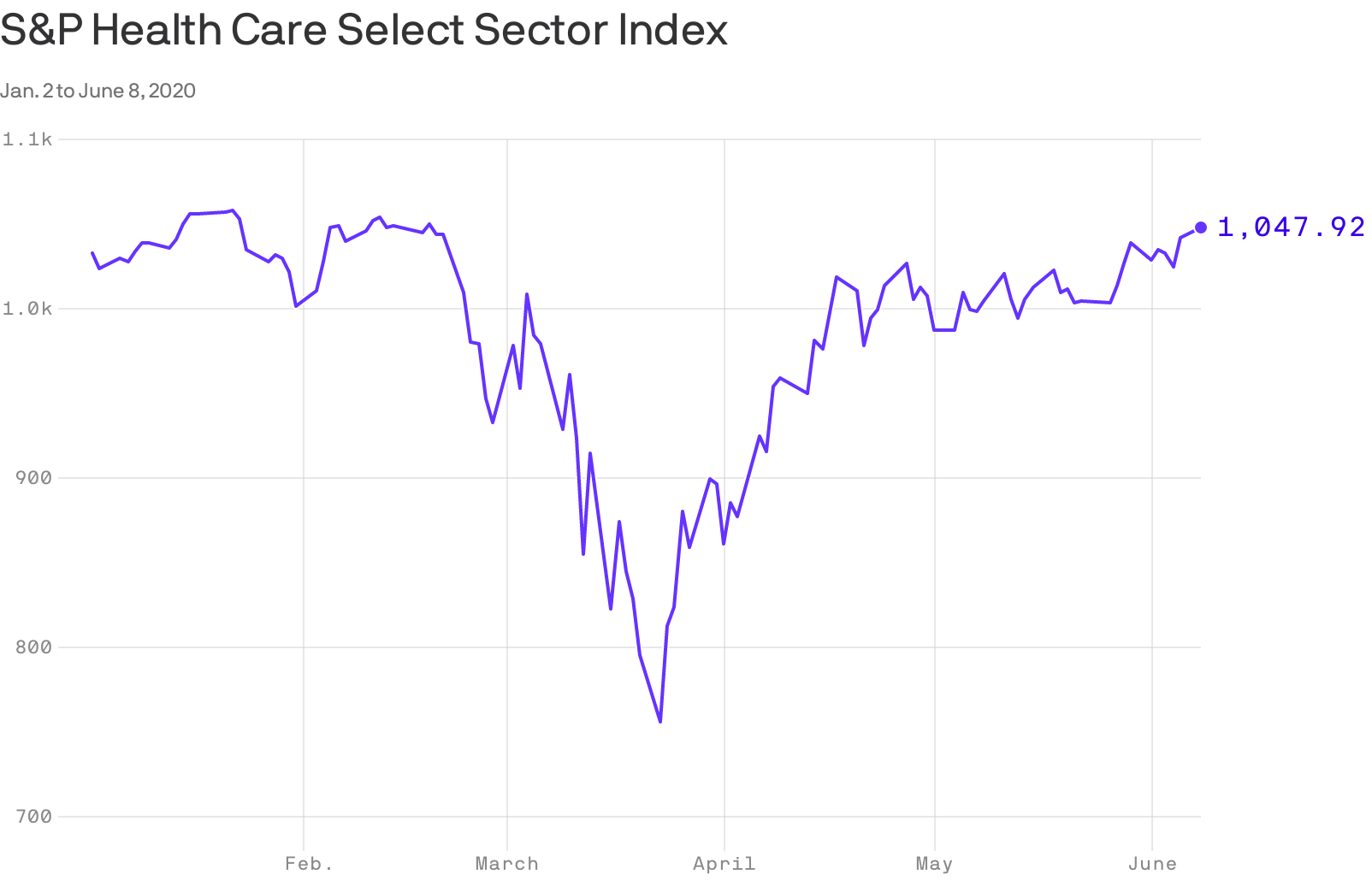
The S&P index of top health care companies finished Monday higher than where it opened the year, Axios’ Bob Herman reports.

The big picture: A global coronavirus pandemic, social unrest, mass unemployment, and the halting of medical procedures haven’t been enough to derail Wall Street’s rosy view of the health care industry.

Where things stand: The coronavirus started to affect the economy toward the tail end of the first quarter, but the health care industry was relatively unscathed.

  • Among the 109 publicly traded health care companies tracked by Axios, first-quarter profits exceeded $50 billion, good for a 7.4% net profit margin.
  • Pharmaceutical companies and health insurers generated the highest returns. Wall Street believes drug companies stand to benefit from potential coronavirus treatments or vaccines.
  • The stock price of Gilead Sciences, for example, is up 18% so far this year, partially on the assumption its coronavirus drug, remdesivir, will produce billions of dollars of revenue — even though the drug has showed only modest benefit for patients.

Between the lines: The second quarter likely will be worse, as the brunt of the coronavirus lockdown was felt in April and May. But normal operations have already started resuming for some health care sectors, regardless of the virus’ spread.


How the CFO enables the board’s success—during COVID-19 and beyond

https://www.mckinsey.com/business-functions/strategy-and-corporate-finance/our-insights/how-the-cfo-enables-the-boards-success-during-covid-19-and-beyond?cid=other-eml-alt-mip-mck&hlkid=85d408119efe4175b478a0599b8302da&hctky=9502524&hdpid=ed9aa1f2-3c88-4b89-9cd2-61a12e2d602c

How the CFO can guide the board through crises and transformations ...

Two board experts explain how in times of crisis or transformation, the CFO can serve as a rock in the boardroom, a critical arbiter of difficult decisions, and a scout for the future.

Critical business decisions cannot be made unless management teams and boards of directors are on the same page. Transparency, fair and balanced dialogue, and well-structured processes for gaining agreement on strategic plans—these dynamics must be present in every boardroom, in good times and, especially, in bad.

The CFO plays an important role in ensuring that they are.

In crises, such as the global spread of the novel coronavirus, the CFO is best-positioned to provide the most relevant and up-to-date facts and figures, which can help boards find clarity amid chaos. In corporate transformations, the pragmatic, data-focused finance leader is the only one who can prompt the board to actively consider all the short- and long-term consequences of proposed strategy decisions.

Barbara Kux and Rick Haythornthwaite, longtime board directors for multiple global organizations, shared these and other board-related insights with McKinsey senior partner Vivian Hunt in a conversation that spanned two occasions: a gathering of CFOs in London some months ago and, more recently, follow-up phone conversations about the COVID-19 pandemic.

These interviews, which have been condensed and edited here, explained the importance of finance leaders in serving both as scouts for the future and as trusted translators of critical market information.

Shaping the COVID-19 crisis response and recovery

Rick Haythornthwaite: The board’s most important functions in the wake of COVID-19 are threefold: one is making sure that employees are being treated decently and that the company is taking all the precautions it can. Second is obtaining an objective, insightful understanding of the business and trends. And third is anticipating and preparing for recovery. The key in all three areas is having high-quality data to inform the board’s decisions and to share with employees. Of course, getting data from a market in freefall is never easy. This is where you need CFOs to be absolutely on top of their game.

The board needs to know what is really happening to the top line, what short-term measures can be taken to preserve and boost cash, and all the actions you have to take during the early stage of such events to buy time. But the board must also have a handle on long-term issues.1 And now that we’re months into this crisis, people are starting to draw lessons from previous ones and bringing some historical data into board discussions. The CFO can use these data to construct hard-edge scenarios that prompt good conversations in the boardroom.

Barbara Kux: An important difference in the role of CFOs today, as compared with their role during the financial crisis in 2008, is that they need to simultaneously manage both short-term responsiveness and future recovery. The CFO must keep the ship floating through rough waters—safeguarding employees’ health, securing liquidity, monitoring cash flow and payment terms, ensuring the functioning of the supply chain, assessing effects on P&L and the balance sheet, reviewing customers’ and suppliers’ situations, and initiating cost-reduction programs. That is all very challenging indeed. But then the CFO must also serve as the ship’s scout—watching for key trends that are emerging or that have accelerated as a result of COVID-19, such as digitization and changes in consumer behavior.

The balance between opportunity and risk is being altered substantially for most companies. The CEO could be tempted to profit from immediate demands—“let’s make ventilators, let’s make disinfectants.” The CFO’s job, by contrast, is to point out the differences between quick-to-market options and long-term post-COVID-19 options. These post-COVID-19 options can be an important factor in motivating and engaging employees during these challenging times.

It is also important for the CFO to present the board with reports and pre-reads that paint the entire picture in an objective way, including potential scenarios for the future. That is the only way boards and senior management can take thoughtful and well-founded decisions—first for the recovery and then for a sustainable future for all stakeholders. The word “crisis” has two meanings, one being “danger” and the other being “chance.” Today’s CFO must consider both.

The word ‘crisis’ has two meanings, one being ‘danger’ and the other being ‘chance.’ Today’s CFO must consider both.

Shaping the general transformation agenda

Barbara Kux: Outside of crisis periods, studies by INSEAD and McKinsey show, boards spend more than two-thirds of their time on “housekeeping”—financial reporting, compliance, environment, health and safety issues, regulatory issues, and the like. Only about 20 percent is spent on strategy. It is very important for boards to get out of this “compliance cage,” as I call it, and really focus on sustainable value creation. I’m thinking of the board of a leading oil and gas company that did just that. It recognized the importance of sustainable business development early on. The company gained first-mover advantages by diversifying toward a green business, including investing in solar and battery technologies.

At the end of the day, the board is ultimately responsible for the strategy, and the CFO is best-positioned to support strategy discussions. The finance leader can serve as a neutral party among the members of the C-suite, synthesizing their transformation ideas, supplementing them with comprehensive quantitative and qualitative data, and then working with the CEO to bring it all back to the board. This is even more important today to respond to COVID-19–related challenges early on.

Rick Haythornthwaite: The biggest challenge for any CEO, CFO, or other senior leader is to institutionalize new ideas without sucking the life out of them. Each C-suite leader plays a different but important role in this regard. The CFO needs to give transformation initiatives structure and rigor, while the CEO is probably better suited to take on the motivational aspects—for instance, the context for change and definitions of success. The whole team creates the strategy map—the markets and products affected, changes in pricing, the execution plan. But the CFO needs to ensure that the financial and operational underpinnings are there. Even if they are not visible to every single part of the organization, the board can see them through the CFO.

‘Scouting for the future’

Barbara Kux: To serve as an effective scout, the CFO should establish nonfinancial KPIs, like net promoter and employee-engagement scores, that are critical for the future health and performance of the organization. CFOs should review the strategy process to see that risks and opportunities are being well-assessed. And they can raise the political antennae of the board—accessing global think tanks, for instance, to understand what’s going on in Washington, China, and other important regions or in the medical community. The CEO often is not the most long-term–focused person in the organization; we know this because our financial markets are still very much short-term oriented. The board has to be long-term oriented. The CFO, therefore, must maintain a good balance of both. That might mean introducing a lean-transformation program with a focus on short-term results while, at the same time, contributing to the definition and implementation of a sustainable strategy for the company to emerge strong from the COVID-19 pandemic.

Rick Haythornthwaite: Boards need CEOs who can handle multiple truths, who can be expansive in thinking, and who can live comfortably in the future and bring the company along for the ride. The CFO also needs to be a protagonist in the boardroom, but from a different base: you can’t move to the future until you are anchored in the present. The CFO provides that anchor. Having a balance between future and present, between CEO and CFO, is important. The board wants to feel that there is strategic momentum—but also that the company is not just heading off on a journey of delusion.

Daring to dissent

Barbara Kux: It is important for the CEO and CFO to get on well, but their relationship should not be too close. It is better for the CFO to be objective, even if that sometimes leads to constructive conflicts. At times the CEO defaults to presenting only the positive in the boardroom, which makes it harder for the CFO to play back a more objective story. But that is very much the role of CFOs. They need to raise those early warnings. As a board director, I feel better if the CFO sometimes states, “by the way, we are losing market share here.” It takes a great deal of self-assurance for the CFO to come into the boardroom and say something like that. An independent-minded CFO will always be transparent with the board. A good CEO will always strive to establish an open relationship with the CFO. It is important for the board to motivate this constructive behavior from both executives so it can truly understand what is going well or not so well.

An independent-minded CFO will always be transparent with the board. A good CEO will always strive to establish an open relationship with the CFO.

Leading constructive dialogues

Rick Haythornthwaite: The senior-management team should not be delivering full solutions to the board at the outset; there should be a period of questions and discussion. The boardroom should be the place for CFOs and boards to engage in the cut and thrust of examination and exploration, with thoughtful planning and framing of dialogues to ensure that decision making is of the highest possible quality.

I’ll give you an example. CFOs used to be able to put traditional capital cases in front of the board about things like investments in plant and equipment, and there was typically a well-grooved dialogue. The kinds of actions they are talking about have changed, though. Think about companies’ investments in platform technologies, which can involve large sums being paid for targets with very low EBITDA—the idea being that value will ultimately come from the combination of entities rather than from a singular target.

Boards may be unfamiliar with such investment cases, so rather than jumping into quick, instinctive type-one decisions forced by the imposition of inappropriate and probably unnecessary time constraints, they will need an education. The board must take time to understand what, in practice, the acquisition of a platform would look like—how it might be scaled under new ownership, how that scaling would affect the bottom line, any risks involved, and so on. This is fundamentally a type-two decision, requiring time and deliberation. The CFO has an important role to play in making sure that this process happens, that it plays out over several board sessions rather than being squeezed into one meeting, and that conversations are grounded in hard numbers.

In the wake of COVID-19, of course, these dialogues may need to happen virtually; the quality of the conversation will still be good, as people are becoming accustomed to virtual meetings.2 They are fine for certain pro-forma tasks, where the issues are well-understood and processes are well-established. But when you’re trying to bring in new voices and new ideas, that’s when you need to be together in the same room.

Growing into the role of change agent

Barbara Kux: The role of the CFO is so much more expansive than it was even five years ago, including additional responsibility for cyber and digital transformations and for IT initiatives. To get your arms around the role and grow in it, take a step back and look at the company objectively. “What other roles could I play in the company, and how does that overlap with what I am doing now?” “Which initiatives would make the most impact in the company, and how could I realize quick wins in those areas?” Maybe it’s a focus on digital or compliance or export control or political intelligence. The CFO’s professional response to COVID-19 crisis management could be a springboard for future development. Whatever it is, I would identify it and just start. Take any kind of training you can get; read as many business publications as you can. Train yourself in how to deal with activist investors. Step by step, your hat will become bigger.

Rick Haythornthwaite: Whether you are talking about COVID-19 or digital disruption or any other impact on the business, please remember that the board still wants to sleep at night, and when the details are lost, the board will be much less forgiving of CFOs than of CEOs. Don’t forget that part of it. Particularly in this challenging economic environment, it is very important. Chairs and boards? We like to sleep soundly at night.