Pre And Post Coronavirus Unemployment Rates By State, Industry, Age Group, And Race

https://www.forbes.com/sites/mikepatton/2020/06/28/pre-and-post-coronavirus-unemployment-rates-by-state-industry-age-group-and-race/#65c42c6555eb

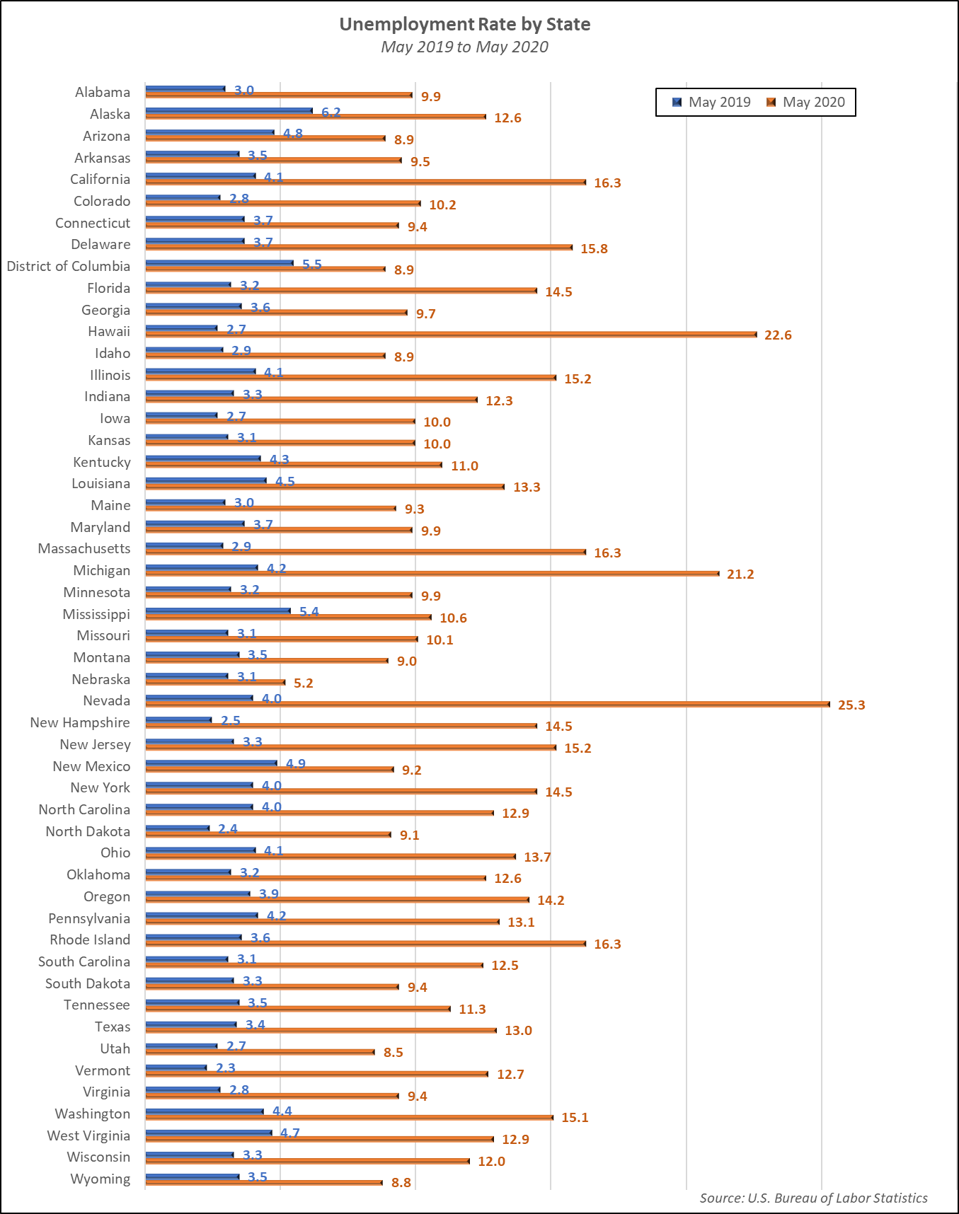
Unemployment by State-May 2019 to May 2020

The coronavirus has decimated the U.S. economy and benched nearly 40 million American workers. In the past several days, the U.S. has logged its highest number of new Covid-19 cases since the pandemic began. These combined with other factors, which we will discuss, is jeopardizing the future employment of millions of workers and the viability of thousands of businesses. Here’s how unemployment has increased for every state, industry, age group, and race, and why.

Unemployment by State

The coronavirus and subsequent stay at home orders hit the labor force especially hard. As states attempted to reopen, a resurgence in the virus is causing many businesses to close again, some by choice, others by government mandate.

Nevada has been hit the hardest as the unemployment rate in the Silver State rose from 4.0% in May 2019 to a whopping 25.3% in May 2020. Nevada’s economy is heavily reliant on leisure and hospitality, which had the brunt of the job losses. Hawaii, the second hardest hit state saw unemployment rise from 2.7% in May 2019 to 22.6% in May 2020. Which is the only other state with unemployment above 20% in May 2020? Michigan, where unemployment rose from 4.2% to 21.2% year over year. What state has fared best? Nebraska, which also has one of the most diverse economies of all states. Deriving nearly 50% of its total GDP from five different industries, unemployment in the Cornhusker State rose from 3.1% to a modest 5.2% from May 2019 to May 2020. Unemployment numbers for all states are shown in the following chart.

Unemployment by Industry

As mentioned in the previous section, the states that have fared best either have a more diverse economy or do not rely heavily on industries that have been hardest hit by the coronavirus. The most negatively affected is the leisure and hospitality industry where unemployment rose 618% from a low of 5.0% in May 2019 to a staggering 35.9% in May 2020. At a distant second, but still reeling, is the wholesale and retail trade industry, which saw unemployment rise from 4.2% to 15.1% during the same period. The rest of the industries are listed in the following chart.
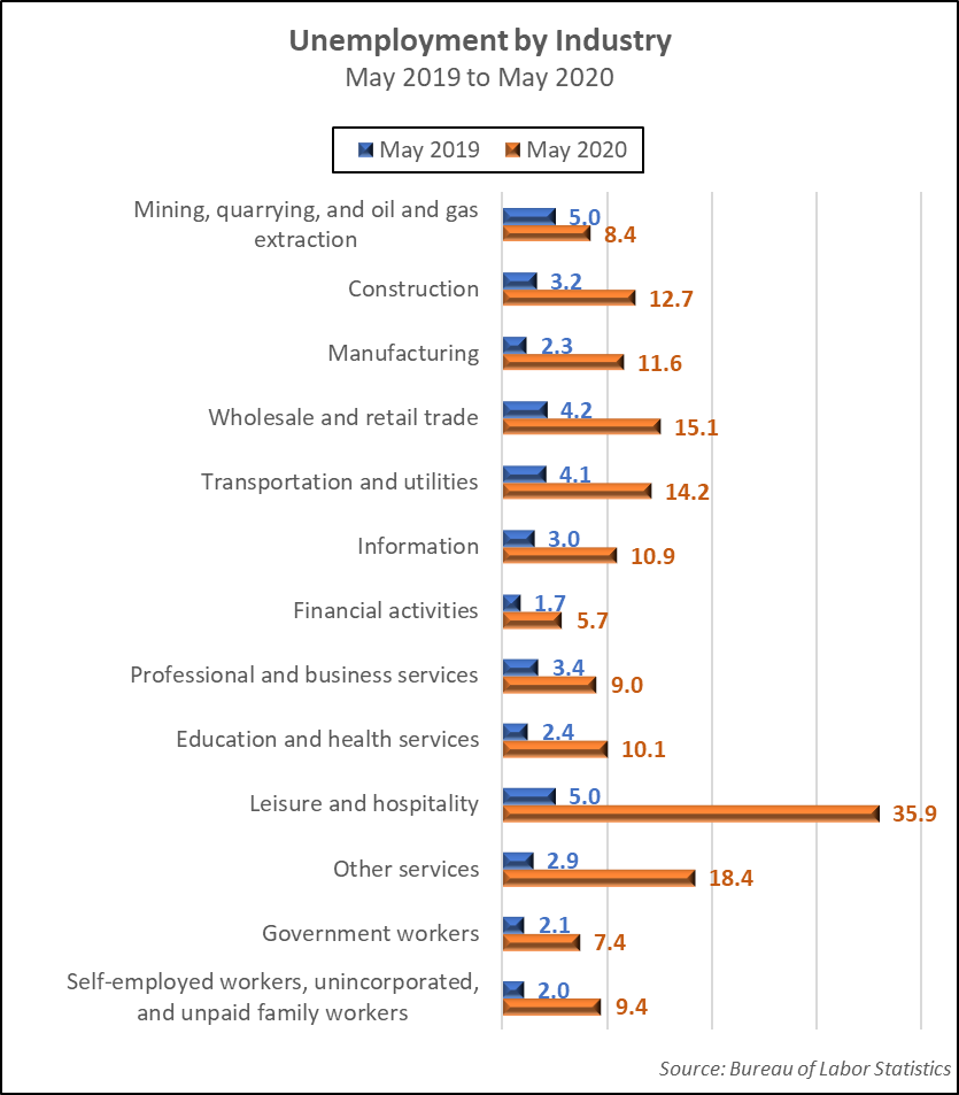
Unemployment by Industry-May 2019 to May 2020

Unemployment by Age Group

Businesses need two things to exist: workers and customers. Without customers, there is no need for workers or the business for that matter. Some businesses require highly skilled workers while others operate well using unskilled labor. It is this unskilled labor group that has been hardest hit.

The greatest rise in unemployment is among workers under age 25. This is likely due to three factors. Younger workers typically have fewer marketable skills, less work experience, and less seniority. Many of these workers are in industries that have felt the greatest pain. Unemployment rates by age group are contained in the following chart.
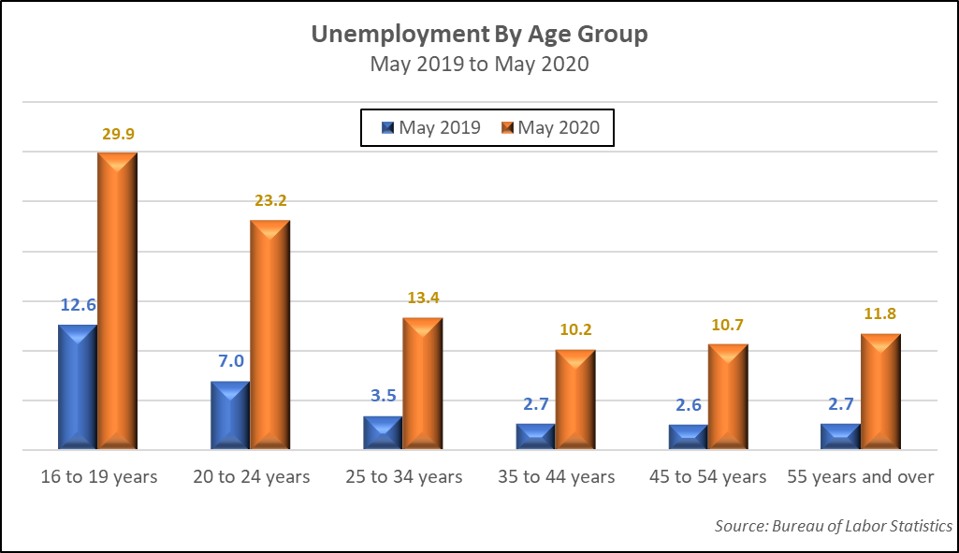
Unemployment by Age Group-May 2019 to May 2020

Unemployment by Race/Ethnicity

Question: Prior to Covid-19, was unemployment among blacks / African Americans at a record low as President Trump has claimed? Using the available data, which extends back to January 1972, the answer is yes. This new record low was achieved in October and November of 2019 when unemployment among black or African American workers fell to 5.1%. The previous record low was 5.2% in December 1973. The current rate is 16.8%, which is less than the highest rate of 20.7% logged in December 1982. The most recent high in unemployment for this group was 19.3% in March 2010. It has been steadily declining since then. Numbers for White, Asian, and Hispanic or Latino and black or African American workers are listed in the following chart.
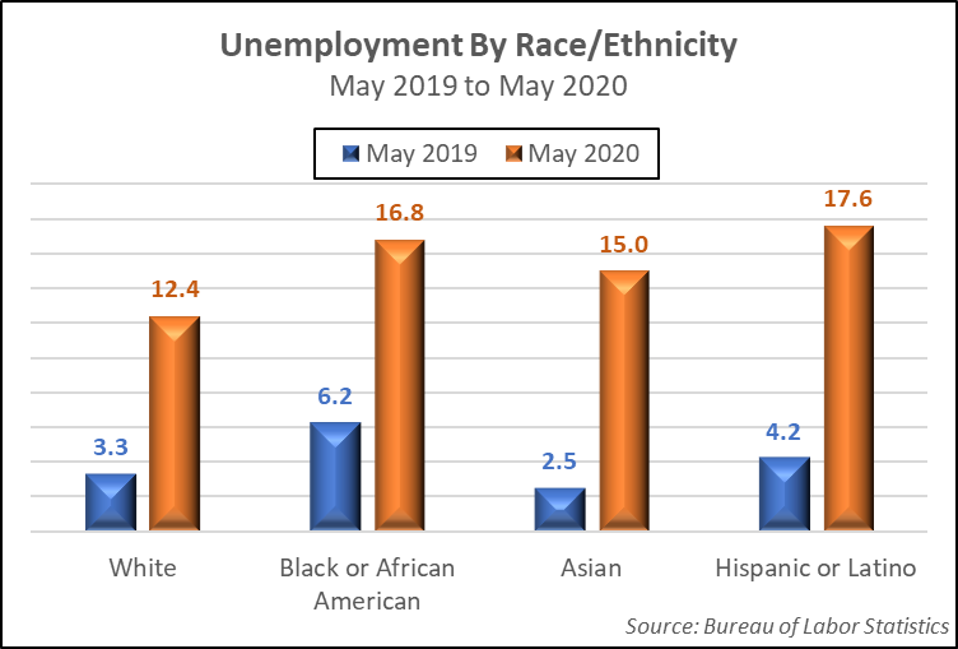
Unemployment by Race or Ethnicity-May 2019 to May 2020

Businesses need workers, workers need businesses, and both depend on customers. Since the pandemic began, consumer demand has fallen sharply. With the probability that a vaccine will not be available until early 2021 at the soonest, plus a disregard for recommended safety protocols by many individuals, namely wearing masks and social distancing, it is highly unlikely that the economy will return to normal for several years.

Will the president continue to hold rallies? Will he set an example by wearing a mask? Will the protests and violence continue? Will other large gatherings continue? Unless Americans make a collective and conscious choice to mask up and social distance, we will be forced to live in a depressed economy for longer than necessary. The choice is up to us.


U.S. Healthcare System vs. Socialized Medicine during the Pandemic

https://www.commondreams.org/news/2020/06/25/why-socialized-system-medicare-all-beats-profit-healthcare-one-chart-covid-19?fbclid=IwAR1qT_AI5KFreoEKOqQfvdWUHPyW80fa2Iefxb5Ul5wJQtf8rSvZXkL8RHM


“All countries successfully combatting this virus have robust public health systems, which provide for coordination of effort.”

A recent rise in cases of Covid-19 and the overt failure of the for-profit healthcare system throughout the pandemic in the U.S. are making the case for Medicare for All, advocacy groups and activists say, as countries with socialized systems see their infection rates decline.

“All countries successfully combatting this virus have robust public health systems, which provide for coordination of effort,” remarked a popular healthcare advocate who uses the @AllOnMedicare handle on Twitter.

Calls for the U.S. to adopt a single-payer heathcare system have increased as the pandemic has raged around the country. Cases and deaths in the U.S are now the highest in the world, a result critics blame on both the private healthcare system and the mismanagement of the crisis by President Donald Trump.

Public Citizen’s health care policy advocate Eagan Kemp told Common Dreams that the current for-profit healthcare system that has driven millions of Americans in to bankruptcy and leaves millions more without care will only continue to exacerbate the pain of the outbreak. 

“While no health care system can completely protect a country from Covid-19, the U.S. has failed to respond for a number of reasons, not least of which is a for-profit health care system where Americans are too afraid to go to the doctors for fear of the cost,” said Kemp. “Far too many Americans will face medical debt and even bankruptcy if they are lucky enough to survive getting Covid-19, something unheard of in all other comparably wealth countries.”

As University of Massachusetts professor Dean E. Robinson wrote in a piece that appeared at Common Dreams earlier this month, the coronavirus is impacting people of color at a disproportionate rate in cities and communities nationwide—a dynamic that bolsters the call for a universal Medicare for All program to help close those gaps.

“The obvious and immediate need of Black and other working class populations caught in the teeth of the pandemic is the right to health care treatment without the burden of cost,” wrote Robinson. “Even before the pandemic, lower-income, Latino, and younger workers were more likely to be uninsured. Undocumented workers had the highest rates of uninsurance.”

On June 18, Ralph Nader in an opinion piece for Common Dreams expressed his hope that the ongoing pandemic would make essential workers in the health field “the force that can overcome decades of commercial obstruction to full Medicare for All.”


Re-examining the delivery of high-value care through COVID-19

https://thehill.com/opinion/healthcare/502851-examining-the-delivery-of-high-value-care-through-covid-19#bottom-story-socials

Re-examining the delivery of high-value care through COVID-19 ...

Over the past months, the country and the economy have radically shifted to unchartered territory. Now more than ever, we must reexamine how we spend health care dollars. 

While the COVID-19 pandemic has exposed challenges with health care in America, we see two overarching opportunities for change:

1) the under-delivery of evidence-based care that materially improves the lives and well-being of Americans and

2) the over-delivery of unnecessary and, sometimes, harmful care.

The implications of reallocating our health care spending to high-value services are far-ranging, from improving health to economic recovery. 

To prepare for coronavirus patients and preserve protective equipment, clinicians and hospitals across the country halted non-urgent visits and procedures. This has led to a substantial reduction in high-value care: emergency care for strokes or heart attacks, childhood vaccinations, and routine chronic disease management. However, one silver lining to this near shutdown is that a similarly dramatic reduction in the use of low-value services has also ensued.

As offices and hospitals re-open, we have a once in a century opportunity to align incentives for providers and consumers, so patients get more high-value services in high-value settings, while minimizing the resurgence of low-value care. For example, the use of pre-operative testing in low-risk patients should not accompany the return of elective procedures such as cataract removal. Conversely, benefit designs should permanently remove barriers to high-value settings and services, like patients receiving dialysis at home or phone calls with mental health providers.   

People with low incomes and multiple chronic conditions are of particular concern as unemployment rises and more Americans lose their health care coverage. Suboptimal access and affordability to high-value chronic disease care prior to the COVID-19 pandemic was well documented  As financially distressed providers re-open to a new normal, hopeful to regain their financial footing, highly profitable services are likely to be prioritized.

Unfortunately, clinical impact and profitability are frequently not linked. The post-COVID reopening should build on existing quality-driven payment models and increase reimbursement for high-value care to ensure that compensation better aligns with patient-centered outcomes.

At the same time, the dramatic fall in “non-essential care” included a significant reduction in services that we know to be harmful or useless. Billions are spent annually in the US on routinely delivered care that does not improve health; a recent study from 4 states reports that patients pay a substantial proportion (>10 percent) of this tab out-of-pocket. This type of low-value care can lead to direct harm to patients — physically or financially or both — as well as cascading iatrogenic harm, which can amplify the total cost of just one low-value service by up to 10 fold. Health care leaders, through the Smarter Health Care Coalition, have hence called on the Department of Health and Human Services Secretary Azar to halt Medicare payments for services deemed low-value or harmful by the USPSTF. 

As offices and hospitals reopen with unprecedented clinical unmet needs, we have a unique opportunity to rebuild a flawed system. Payment policies should drive incentives to improve individual and population health, not the volume of services delivered. We emphasize that no given service is inherently high- or low-value, but that it depends heavily on the individual context. Thus, the implementation of new financial incentives for providers and patients needs to be nuanced and flexible to allow for patient-level variability. The added expenditures required for higher reimbursement rates for highly valuable services can be fully paid for by reducing the use of and reimbursement for low-value services.  

The delivery of evidence-based care should be the foundation of the new normal. We all agree that there is more than enough money in U.S. health care; it’s time that we start spending it on services that will make us a healthier nation.


Navigating a Post-Covid Path to the New Normal with Gist Healthcare CEO, Chas Roades

https://www.lrvhealth.com/podcast/?single_podcast=2203

Covid-19, Regulatory Changes and Election Implications: An Inside ...Chas Roades (@ChasRoades) | Twitter

Healthcare is Hard: A Podcast for Insiders; June 11, 2020

Over the course of nearly 20 years as Chief Research Officer at The Advisory Board Company, Chas Roades became a trusted advisor for CEOs, leadership teams and boards of directors at health systems across the country. When The Advisory Board was acquired by Optum in 2017, Chas left the company with Chief Medical Officer, Lisa Bielamowicz. Together they founded Gist Healthcare, where they play a similar role, but take an even deeper and more focused look at the issues health systems are facing.

As Chas explains, Gist Healthcare has members from Allentown, Pennsylvania to Beverly Hills, California and everywhere in between. Most of the organizations Gist works with are regional health systems in the $2 to $5 billion range, where Chas and his colleagues become adjunct members of the executive team and board. In this role, Chas is typically hopscotching the country for in-person meetings and strategy sessions, but Covid-19 has brought many changes.

“Almost overnight, Chas went from in-depth sessions about long-term five-year strategy, to discussions about how health systems will make it through the next six weeks and after that, adapt to the new normal. He spoke to Keith Figlioli about many of the issues impacting these discussions including:

  • Corporate Governance. The decisions health systems will be forced to make over the next two to five years are staggeringly big, according to Chas. As a result, Gist is spending a lot of time thinking about governance right now and how to help health systems supercharge governance processes to lay a foundation for the making these difficult choices.
  • Health Systems Acting Like Systems. As health systems struggle to maintain revenue and margins, they’ll be forced to streamline operations in a way that finally takes advantage of system value. As providers consolidated in recent years, they successfully met the goal of gaining size and negotiating leverage, but paid much less attention to the harder part – controlling cost and creating value. That’s about to change. It will be a lasting impact of Covid-19, and an opportunity for innovators.
  • The Telehealth Land Grab. Providers have quickly ramped-up telehealth services as a necessity to survive during lockdowns. But as telehealth plays a larger role in the new standard of care, payers will not sit idly by and are preparing to double-down on their own virtual care capabilities. They’re looking to take over the virtual space and own the digital front door in an effort to gain coveted customer loyalty. Chas talks about how it would be foolish for providers to expect that payers will continue reimburse at high rates or at parity for physical visits.
  • The Battleground Over Physicians. This is the other area to watch as payers and providers clash over the hearts and minds of consumers. The years-long trend of physician practices being acquired and rolled-up into larger organizations will significantly accelerate due to Covid-19. The financial pain the pandemic has caused will force some practices out of business and many others looking for an exit. And as health systems deal with their own financial hardships, payers with deep pockets are the more likely suitor.”


Why People Are Still Avoiding the Doctor (It’s Not the Virus)

Why People Are Still Avoiding the Doctor (It's Not the Virus ...

At first, people delayed medical care for fear of catching Covid. But as the pandemic caused staggering unemployment, medical care has become unaffordable for many.

At first, Kristina Hartman put off getting medical care out of concern about the coronavirus. But then she lost her job as an administrator at a truck manufacturer in McKinney, Texas.

While she still has health insurance, she worries about whether she will have coverage beyond July, when her unemployment is expected to run out.

“It started out as a total fear of going to the doctor,” she said.

“I definitely am avoiding appointments.”

Ms. Hartman, who is 58, skipped a regular visit with her kidney doctor, and has delayed going to the endocrinologist to follow up on some abnormal lab results.

While hospitals and doctors across the country say many patients are still shunning their services out of fear of contagion — especially with new cases spiking — Americans who lost their jobs or have a significant drop in income during the pandemic are now citing costs as the overriding reason they do not seek the health care they need.

“We are seeing the financial pressure hit,” said Dr. Bijoy Telivala, a cancer specialist in Jacksonville, Fla. “This is a real worry,” he added, explaining that people are weighing putting food on the table against their need for care. “You don’t want a 5-year-old going hungry.”

Among those delaying care, he said, was a patient with metastatic cancer who was laid off while undergoing chemotherapy. He plans to stop treatments while he sorts out what to do when his health insurance coverage ends in a month.

The twin risks in this crisis — potential infection and the cost of medical care — have become daunting realities for the millions of workers who were furloughed, laid off or caught in the economic downturn. It echoes the scenarios that played out after the 2008 recession, when millions of Americans were unemployed and unable to afford even routine visits to the doctor for themselves or their children.

Almon Castor’s hours were cut at the steel distribution warehouse in Houston where he works about a month ago. Worried that a dentist might not take all the precautions necessary, he had been avoiding a root canal.

But the expense has become more pressing. He also works as a musician. “It’s not feasible to be able to pay for procedures with the lack of hours,” he said.

Nearly half of all Americans say they or someone they live with has delayed care since the onslaught of coronavirus, according to a survey last month from the Kaiser Family Foundation. While most of those individuals expected to receive care within the next three months, about a third said they planned to wait longer or not seek it at all.

While the survey didn’t ask people why they were putting off care, there is ample evidence that medical bills can be a powerful deterrent. “We know historically we have always seen large shares of people who have put off care for cost reasons,” said Liz Hamel, the director of public opinion and survey research at Kaiser.

And, just as the Great Recession led people to seek less hospital care, the current downturn is likely to have a significant impact, said Sara Collins, an executive at the Commonwealth Fund, who studies access to care. “This is a major economic recession,” she said. “It’s going to have an effect on people’s demand for health care.”

The inability to afford care is “going to be a bigger and bigger issue moving forward,” said Chas Roades, the co-founder of Gist Healthcare, which advises hospitals and doctors. Hospital executives say their patient volumes will remain at about 20 percent lower than before the pandemic.

“It’s going to be a jerky start back,” said Dr. Gary LeRoy, a physician in Dayton, Ohio, who is the president of the American Academy of Family Physicians. While some of his patients have returned, others are staying away.

But the consequences of these delays can be troubling. In a recent analysis of the sharp decline in emergency room visits during the pandemic, officials from the Centers for Disease Control and Prevention said there were worrisome signs that people who had heart attacks waited until their conditions worsened before going to the hospital.

Without income, many people feel they have no choice. Thomas Chapman stopped getting paid in March and ultimately lost his job as a director of sales. Even though he has high blood pressure and diabetes, Mr. Chapman, 64, didn’t refill any prescriptions for two months. “I stopped taking everything when I just couldn’t pay anymore,” he said.

After his legs began to swell, and he felt “very, very lethargic,” he contacted his doctor at Catalyst Health Network, a Texas group of primary care doctors, to ask about less expensive alternatives. A pharmacist helped, but Mr. Chapman no longer has insurance, and is not sure what he will do until he is eligible for Medicare later this year.

“We’re all having those conversations on a daily basis,” said Dr. Christopher Crow, the president of Catalyst, who said it was particularly tough in states, like Texas, that did not expand Medicaid. While some of those who are unemployed qualify for coverage under the Affordable Care Act, they may fall in the coverage gap where they do not receive subsidies to help them afford coverage.

Even those who are not concerned about losing their insurance are fearful of large medical bills, given how aggressively hospitals and doctors pursue people through debt collections, said Elisabeth Benjamin, a vice president at Community Service Society of New York, which works with people to get care.

“Americans are really very aware that their health care coverage is not as comprehensive as it should be, and it’s gotten worse over the past decade,” Ms. Benjamin said. After the last recession, they learned to forgo care rather than incur bills they can’t pay.

Geralyn Cerveny, who runs a day care in Kansas City, Mo., said she had Covid-19 in early April and is recovering. But her income has dropped as some families withdrew their children. Although her daughter is urging her to get some follow-up testing because she has some lingering symptoms from the virus, she is holding off because she does not want to end up with more medical bills if her health plan will not cover all of the care she needs. She said she would dread “a fight with the insurance company if you don’t meet their guidelines.”

Others are weighing what illness or condition merits the expense of a doctor or tests and other services. Eli Fels, a swim instructor and personal trainer who is pregnant, has been careful to stay up-to-date with her prenatal appointments in Cambridge, Mass. She and her doctor have relied on telemedicine appointments to reduce the risk of infection.

But Ms. Fels, who also lost her jobs but remains insured, has chosen not to receive care for her injured wrist in spite of concern over lasting damage. “I’ve put off medical care that doesn’t involve the baby,” she said, noting that her out-of-pocket cost for an M.R.I. to find out what was wrong “is not insubstantial.”

At Maimonides Medical Center in Brooklyn, doctors have already seen the impact of delaying care. During the height of the pandemic, people who had heart attacks and serious fractures avoided the emergency room. “It was as if they disappeared, but they didn’t disappear,” said Dr. Jack Choueka, the chair of orthopedics. “People were dying in home; they just weren’t coming into the hospital.”

In recent weeks, people have begun to return, but with conditions worsened because of the time they had avoided care. A baby with a club foot will now need a more complicated treatment because it was not addressed immediately after birth.

Another child who did not have imaging promptly was found to have a tumor. “That tumor may have been growing for months unchecked,” Dr. Choueka said.


Moody’s: US healthcare system rebounds from COVID-19 in May, but a bumpy road lies ahead

https://www.healthcaredive.com/news/moodys-us-healthcare-system-rebounds-from-covid-19-in-may-but-a-bumpy-ro/580152/

Banks rating downgrade: Moody's changes outlook on Indian banks to ...

Dive Brief:

  • A Moody’s Investors Service report on Thursday suggests that the U.S. healthcare industry is on the rebound from COVID-19, but recovery will likely to slow and uneven. Moreover, the report expressed concerns that regional flareups of coronavirus could majorly set back the return to normal volumes.
  • Investment firm Jefferies affirmed those worries in hospital traffic data shared Friday, noting “a sharp reversal” in hotspot state Arizona. Analysts tracked “record lows” in Arizona’s hospital traffic last week, down from what was thought to be the trough in April and sagging below May recovery amid a significant uptick in COVID-19 cases and protests.
  • “Whether states can continue their recovery even as cases increase, as we’ve seen in [Texas] and others, or if the recent reversals in [Arizona, Illinois,] etc. become more widespread is a trend to watch in coming weeks,” Jefferies analysts wrote.

Dive Insight:

Large sections of the healthcare sector all but shut down during the spring as the coronavirus led to nationwide shelter-in-place orders. However, as states and municipalities slowly reopen, so are the doors for hospitals, ambulatory surgical centers, clinics and other integral components of healthcare delivery.

As a result, Moody’s reported “considerable sequential improvement” during May. For example, while for-profit hospitals saw surgery volumes drop as much as 70% in April compared to the same period in 2019, May volumes were down about 20% to 40% compared to last year’s. Hospital-operated ambulatory surgical centers saw an 80% to 90% drop in April volumes, but only a 30% to 40% drop in May.

However, Moody’s noted that the “path to normalized volumes are not linear.” It also pointed out that emergency room care volumes, which dropped as much as 60% in April, have yet to really rebound, as they still appeared depressed as much as 50% in May.

“This could reflect the prevalence of working-from-home arrangements and people generally staying home, which is leading to a decrease in automobile and other accidents outside the home. Weak ER volumes also suggest that many people remain apprehensive to enter a hospital, particularly for lower acuity care,” the Moody’s report said.

The firm also noted that “the shape of recovery will vary by state, region and service line, reinforcing the importance of diversification for credit quality among healthcare service providers.”

However, Moody’s believes that the darkest days of March and April are behind much of the healthcare sector. It noted that most providers have stockpiled appropriate personal protective equipment and have reconfigured their offices, waiting rooms and other infrastructure to protect the health of both patients and employees.

Traffic data from 3,300 U.S. hospitals, tracked by Jefferies via mobile device pings, indicates that compared to January 2019 levels, national traffic lows of 43.7% in mid-April improved to 63.3% by early June.

But state-by-state analysis reveals some parts of the country are trending backwards. Arizona fell to a new low of 28.5% last week after hitting 51.5% on May 20. The analysts also reported Illinois hit its own new low on June 7.

While Moody’s did express some concern about regional outbreaks, it concluded that the precautions already taken “make it less likely that the U.S. would once again shut down all non-elective care across the nation if there is a second wave of coronavirus infections.”

Moody’s did express some concerns about hospital finances, but noted that for-profit hospitals “have unusually strong liquidity” due to payouts from the CARES Act and other government-sponsored financial relief programs.

Medical device firms should be prepared for a long and uneven recovery, according to Moody’s. The dental and orthopaedic sectors “will see a greater than average impact from consumers’ inability to pay for procedures or their unwillingness to engage with the healthcare system.” Moody’s forecast “a gradual, uneven pace of recovery,” with pre-tax earnings to decline as much as 30% in 2020 compared to 2019, while revenues will shrink around 10%. It expects that earnings will rebound in 2021 to 2019 levels.

Companies that operate in discretionary sectors will be hit harder as they rely on patients able to meet large deductibles or co-payments or to pay for related procedures entirely on their own. Moody’s noted that a large number of these procedures are performed in acute care hospitals with the assistance of robotics, but hospitals may be more conservative in their robotics investments given new budget constraints.


Surprise medical bills in the coronavirus era

https://www.axios.com/surprise-medical-bills-coronavirus-c61a5529-3272-4edd-b660-35dc61f751b4.html

Surprise medical bills in the coronavirus era - Axios

Rep. Katie Porter recently received an explanation of benefits from her insurer saying that, in addition to the $20 co-pay she paid when she got her coronavirus test, she may be on the hook for an additional $56.60.

The catch: The law requires insurers to cover coronavirus testing without cost-sharing. Porter knows that because she voted for it.

Why it matters: Containing the coronavirus depends on knowing who has it, and it’s going to be much harder to get people to get tested if they think they’ll have to pay for it. But it’s becoming increasingly clear that patients may be vulnerable to surprise coronavirus bills.

Between the lines: Porter, who received a coronavirus test on March 23, has insurance through UnitedHealthcare and shared her explanation of benefits with Axios. Congress has required both the test itself and the associated care to be covered without cost-sharing.

  • In a statement, UnitedHealth Group said it has waived member cost-sharing for coronavirus testing and treatment.
  • “Some members received bills early on when there were not yet specific COVID-19 billing codes and during a period in which code adoption was first taking place,” the company said, adding that it’s waiving those charges and evaluating claims from earlier this year to make sure they were handled correctly.
  • “We are not authorized to talk about [Porter’s] specific situation without permission, however, what likely occurred is that her provider used the wrong billing code for the visit. To confirm if that’s the case and have it corrected, we encourage Rep. Porter to contact us so we can clarify with her directly.”

Yes, but: There’s a huge question of who should have to pay for coronavirus testing as it becomes more prolific, and many insurers — United included — have said that they’ll only cover tests that are “medically necessary,” at least without cost-sharing. It’s unclear who will pay for tests that aren’t deemed medically necessary.

  • The federal government hasn’t said who should pay for testing when, whether it be insurers, employers or the government itself. Insurers are questioning whether they should be on the hook for the hundreds of thousands of tests of asymptomatic people that public health experts say will need to be conducted every day.
  • Even though Congress has tried to resolve payment disputes between insurers and out-of-network labs, there’s a loophole that would allow patients to receive balance bills from out-of-network labs in some circumstances.
  • If a patient sees an out-of-network doctor for a coronavirus test, they’re vulnerable to receiving a surprise medical bill from this provider — just as they are under normal, non-coronavirus conditions, said Loren Adler, associate director of the USC-Brookings Schaeffer Initiative for Health Policy.

What they’re saying: “We will not be able to truly reopen and rebuild if Americans rightly fear costly medical bills for visiting their health care providers for coronavirus tests,” Porter writes in a letter to top Health and Human Services officials being sent today, asking the administration to implement the law more forcefully.

  • She also asked for “formal, explicit guidance for insurers, providers, employers like nursing homes and assisted living facilities, and testing companies, as well as all 50 states…to ensure patients and workers are not asked to pay any costs.”


A 70-year-old man was hospitalized with COVID-19 for 62 days. Then he received a $1.1 million hospital bill, including over $80,000 for using a ventilator.

https://www.yahoo.com/news/70-old-man-hospitalized-covid-170112895.html

Man, 70, hospitalized with COVID-19 for 62 days gets $1.1 million ...

  • A man in Washington state who spent more than two months in the hospital and more than a month in the Intensive Care Unit with COVID-19 received a 181-page itemized bill that totals more than $1.1 million, The Seattle Times reported.
  • Michael Flor, 70, will likely foot little of the bill due to his being insured through Medicare, according to the report.
  • “I feel guilty about surviving,” Flor told The Seattle Times. “There’s a sense of ‘why me?’ Why did I deserve all this? Looking at the incredible cost of it all definitely adds to that survivor’s guilt.”

A 70-year-old man in Seattle, Washington, was hit with a $1.1 million 181-page long hospital bill following his more than two-month stay in a local hospital while he was treated for — and nearly died from — COVID-19. 

“I opened it and said ‘holy (expletive)!’ ” the patient, Michael Flor, who received the $1,122,501.04 bill told The Seattle Times.

He added: “I feel guilty about surviving. There’s a sense of ‘why me?’ Why did I deserve all this? Looking at the incredible cost of it all definitely adds to that survivor’s guilt.”

According to the report, Flor will not have to pay for the majority of the charges because he has Medicare, which will foot the cost of most if not all of his COVID-19 treatment. The 70-year-old spent 62 days in the Swedish Medical Center in Issaquah, Washington, 42 days of which he spent isolated in the Intensive Care Unit (ICU). 

Of the more than one month he spent in a sealed-off room in the ICU, Flor spent 29 days on a ventilator. According to the Seattle Times, a nurse on one occasion even helped him call his loved ones to say his final goodbyes, as he believed he was close to death from the virus.

While in the ICU, Flor was billed $9,736 each day; more than $80,000 of the bill is made up of charges incurred from his use of a ventilator, which cost $2,835 per day, according to the report. A two-day span of his stay in the hospital when his organs, including his kidneys, lungs, and heart began to fail, cost $100,000, according to the report.  

In total, there are approximately 3,000 itemized charges on Flor’s bill — about 50 charges for each day of his hospital stay, according to The Seattle Times. Flor will have to pay for little of the charges — including his Medicare Advantage policy’s $6,000 out-of-pocket charges — due to $100 billion set aside by Congress to help hospitals and insurance companies offset the costs of COVID-19.

Flor is recovering in his home in West Seattle, according to the report.


COVID-19 could cost insurers up to $547B through 2021: report

https://www.fiercehealthcare.com/payer/report-covid-19-could-cost-insurers-up-to-546b-over-next-two-years?mkt_tok=eyJpIjoiWlRnNU16RmxOemM1WXpWaSIsInQiOiJ0TFFnRkR2OUVoQjY5SXArbjU0ZXVmcjJaMFdNWXZ6cXBHOGQxVzZ1dkxhMHJVK0t3dmRtcUVicFIrVDdlMUJPY3doWlQzeVN0VVZxakdnUFBHY2w2a0VVQ0s2WFI1anhqR2xvSFBtMDZZcVlaYVwvK2xlRWdcL01uQmFRVTA0VGtMIn0%3D&mrkid=959610

COVID-19 could cost insurers up to $547B through 2021: report ...

The estimated costs for treating COVID-19 could add up as much as $547 billion for private insurers from 2020 to 2021 depending on the rate of infection, an updated report found.

The report, released Monday from consulting firm Wakely and commissioned by insurance lobbying group America’s Health Insurance Plans (AHIP), looks at the utilization of medical services associated with a COVID-19 infection and the costs for such services. The analysis is restricted to insurers operating in commercial, Medicare Advantage and Medicaid managed care markets.

Wakely estimates that the pandemic could cost insurers between $30 billion and $547 billion.

The report explores the costs of COVID-19 based on a series of potential infection rates, which represent the total population infected. The study modeled infection rates based on 10%, 20% and 60%, while acknowledging that the true infection rate could be far lower.

Wakely then looked at the total costs the plan is liable to cover based on each infection rate.

A 10% rate would lead to a total cost of $30 billion to $92 billion from 2020 to 2021, and a rate of 20% would be $60 billion to $182 billion.

But an infection rate of 60% would cost insurers the greatest, with a range of $180 billion to $547 billion.

“We assume that a higher volume of COVID related services will be incurred in 2020 and lower volume in 2021, distributing approximately 75% of the total services to 2020 and 25% to 2021,” the study said.

Wakely notes it did not model any long-term costs for treating people recovering from COVID-19 infections.

The firm also didn’t factor in vaccine mitigation in 2021 nor a scenario in which large-scale infections occur throughout 2021.

While private insurers have waived cost-sharing for COVID-19 treatments, it remains unclear how long the waivers will last. Anthem and Molina announced Monday they will extend their cost-sharing waivers through the rest of 2020.

The report is an update to an earlier one distributed by Wakely back in March at the onset of the pandemic. That report pegged the total COVID-19 costs between $56 billion and $556 billion.

The main reason for the decline is Wakely factored in deferred care due to the pandemic.

Wakely also reduced the overall assumed rate of hospitalizations for COVID-19-infected individuals to align with more recent studies. But the estimated unit cost for a hospital admission also increased, based on survey data from AHIP members.

People have been putting off necessary care for fear of going to a doctor’s office, and hospital systems have canceled or postponed elective surgical procedures for months.

Hospitals have slowly started to resume elective procedures, but only after installing stringent requirements on cleaning and testing.

Insurers are bracing for a wave of healthcare utilization some time later this year or in 2021 to deal with this pent-up demand.

The deferred care costs would differ based on the infection rate of the virus.

“We assumed, particularly for higher infection rate scenarios, that there may be limited capacity to make up care in 2021,” the report said.